|
Swipe Fee Law Shifts Costs To Consumers
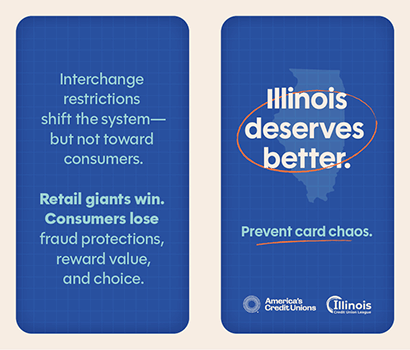
Thursday, May 21, 2026 - Posted by Advertising Department [The following is a paid advertisement.] Illinois’ proposed swipe-fee law promises relief at the register - but delivers something else entirely. By cutting interchange fees, it redirects billions from consumers to large retailers, without any requirement that savings be passed on as lower prices. Interchange fees fund essential parts of today’s payments system, including fraud protection, rewards programs, and access to low-cost banking. Eliminating those resources doesn’t remove costs, it shifts them. Consumers are likely to see fewer benefits, weaker safeguards, and higher fees in other areas, while major retailers pocket the difference. Evidence from similar policies shows that price reductions rarely materialize. Instead, the biggest financial gains accrue to large national chains, not Illinois families. The law also risks creating a fragmented, state-by-state payments landscape that increases complexity, undermines security, and adds friction at checkout. Those challenges ultimately fall on consumers through higher costs, reduced choice, and a less reliable system. This proposal isn’t about lowering prices - it’s about redistributing value. And if enacted, consumers will bear the cost in lost protection and diminished benefits, while large retailers come out ahead. For more information, visit https://www.icul.com/advocacy/ifpa/. Paid for by Illinois Credit Union League.
|
|
UChicago Medicine: ‘Weakening 340B Would Hurt The Communities That Need Care Most’
Thursday, May 21, 2026 - Posted by Advertising Department [The following is a paid advertisement.] The federal 340B program “is not a financial windfall for hospitals,” wrote UChicago Medicine leaders in a recent Crain’s op-ed, noting that discounted drug prices allow hospitals serving many low-income patients to “redirect resources that otherwise would be spent on expensive medications toward services and programs communities depend on every day.” The University of Chicago Medical Center is one of Illinois’ largest providers of care to Medicaid patients. 340B savings help UChicago Medicine sustain critical services, including Level 1 trauma care, neonatal intensive care, the South Side’s only burn center, and Chicago’s only hospital-based emergency helicopter transport program. “Many of these services are financially challenging to sustain, yet they are indispensable to the health and safety of our communities,” said UChicago Medicine President Thomas Jackiewicz and Executive Vice President for Medical Affairs Mark E. Anderson. Hospitals are facing rising costs, persistent workforce shortages and increasing challenges in in maintaining essential healthcare services. House Bill 2371 SA 2 restores the 340B program in Illinois after more than five years of drugmakers unlawfully limiting 340B discounts. As the op-ed pointed out, Health Resources and Services Administration data prove that 340B discounts are a small share of drugmaker revenue. Ensuring the 340B program operates the way Congress intended has a small impact on the bottom lines of drugmakers, but it makes a profound difference in preserving patient access to care. Pass HB 2371 SA 2 to support Illinois’ most vulnerable patients and the providers serving them. Learn more.
|
| PREVIOUS POSTS » |