Isabel’s afternoon roundup
Wednesday, May 29, 2024 - Posted by Isabel Miller
* Quite the show last night, too…
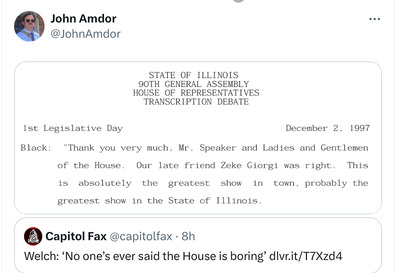
Speaking of…
*** Statehouse News ***
* Crain’s | Tucked in Illinois budget, a break for retailers infuriating airlines and credit card companies: The Interchange Fee Prohibition Act slipped into the revenue bill at the behest of the Illinois Retail Merchants Association, which reached a compromise to allow Gov. J.B. Pritzker’s cap on the retailers’ discount into the final legislation. That measure caps the tax discount claimed by retailers at $1,000 per month, which would generate more than $100 million in revenue for the state. “We were trying to think of ways to help offset some of that loss for the retailer,” said Rob Karr, president and CEO of the merchants association. “We could have said ‘take it off everything,’ but that would not have been fair.”
* Tribune | Illinois lawmakers pass bill to expand reporting of sexual abuse in health care settings following Tribune investigation: Under the bill, doctors’ offices and clinics affiliated with hospitals would have to report allegations of patient abuse to the Illinois Department of Public Health, triggering an investigation by the state. Now, hospitals must only report allegations that happen at hospitals. The House unanimously passed the bill Tuesday night. The Senate also previously passed the bill unanimously. The bill now goes to the governor for his signature.
* Chalkbeat | A child tax credit, an Early Childhood Department, and more money for K-12 schools: Illinois lawmakers pass 2025 budget: The state’s General Assembly also passed a state child tax credit, which would make Illinois one of more than a dozen states to approve such legislation in the wake of the COVID pandemic, when the federal government temporarily expanded the benefit. Low-income Illinois families with children under the age of 12 and those who qualify for the state’s Earned Income Tax Credit would be eligible to receive the credit in 2025.
* SJ-R | Session overtime: Hundreds of bills heading to Pritzker’s desk. Here are 5 key takeaways: Workers ordered to attend meetings regarding political and religious matters by their employers might soon no longer be required in Illinois. The House passed Senate Bill 3649 in a 79-30 tally last week. Seen as a way to avoid holding workers in “captive audience,” bill sponsor Rep. Marcus Evans, D-Chicago, clarified that his bill does not prohibit businesses from holding these meetings but rather prevents workers from receiving retribution if they choose not to attend.
*** Chicago ***
* Crain’s | U of C pays nearly $5 million in COVID-tuition settlement: The University of Chicago has agreed to a $4.95 million settlement in a class-action lawsuit with students and former students who allege the university breached its contract by moving classes online as the COVID-19 pandemic hit. All who were enrolled in any of the University of Chicago’s undergraduate or graduate programs from January 2020 through the end of the spring quarter will receive at least $25 from the settlement.
* Block Club | Red-Winged Blackbirds Are Back Divebombing Chicagoans: Red-winged blackbirds — known for divebombing people who come too close to stepping on their nests — are back in the city early for the second straight year due to “unseasonably warm weather,” said Edward Warden, president of the Chicago Ornithological Society. The emergence of cicadas this summer also puts into play a rare “massive food source” for the blackbirds — which will only grow their numbers, Warden said.
*** Cook County and Suburbs ***
* Daily Herald | Highland Park shooting suspect makes brief court appearance: Lake County Judge Victoria Rossetti set Robert Crimo III’s next hearing for Aug. 28, by which time prosecutors and defense attorneys said they will file pretrial motions. The suspect is scheduled to face trial in February 2025. The 23-year-old is charged with opening fire from a downtown Highland Park rooftop about 10:15 a.m. July 4, 2022, killing Highland Park residents Katherine Goldstein, 64; Stephen Straus, 88; Jacquelyn “Jacki” Sundheim, 63; and Kevin McCarthy, 37, and his wife Irina McCarthy, 35. Nicolas Toledo-Zaragoza, 78, of Morelos, Mexico, and Eduardo Uvaldo, 69, of Waukegan also were killed in the attack.
* Tribune | Winnetka private equity firm wins bankruptcy auction for Oberweis Dairy: Geoff Hoffmann, co-CEO of his family’s eponymous Winnetka-based private equity firm, emerged as the top bidder Wednesday for the bankrupt assets of the century-old Oberweis Dairy, putting everything from its North Aurora plant to 40 branded ice cream stores under new ownership. The undisclosed offer from the Hoffmann Family of Companies through its investment arm, Osprey Capital, bested Brian Boomsma, owner of Chicago-based Dutch Farms, who made a $20 million stalking horse bid in April for Oberweis.
* Daily Herald | DuPage County clerk controversy prompts change in state law: DuPage County Board Chair Deborah Conroy enlisted the help of state lawmakers to make it clear that countywide elected officials, such as the county clerk, need to follow state bidding laws and seek county board approval for certain budget transfers. During an evening meeting of the county board Tuesday, Conroy announced that lawmakers late that afternoon had approved changes providing the “highest level of clarity” regarding competitive bidding and budget transfer regulations as they relate to countywide elected officials.
* Crain’s | Lawsuit claims Evanston’s reparations program is unconstitutional: The suit was filed by Judicial Watch, a conservative Washington, D.C., organization whose website says its mission is to “promote transparency, accountability and integrity in government, politics and the law.” It represents six plaintiffs, all of whom claim hereditary ties to Evanston during the specified period and none of whom, according to the lawsuit, identifies as Black.
*** Downstate ***
* SJ-R | Massage parlor ordinance going to full vote in Springfield amid human trafficking concerns: Concerned about the suspicion of human trafficking and prostitution, the working committee of the Springfield City Council sent an ordinance Tuesday to the consent agenda requiring massage parlors to register annually with the city. City attorney Gregory Moredock, who crafted a similar ordinance for the Village of Chatham when he was an attorney with Sorling Northrup in 2019, said the city hadn’t had anything on the books regards to the regulations of such establishments since the 1980s.
*** Sports ***
* Sun-Times | White Sox manager Pedro Grifol says he hears enough from Jerry Reinsdorf to know he wants to win: White Sox manager Pedro Grifol has gotten to know his boss — the big boss, chairman Jerry Reinsdorf — quite well in the last year and a half. He gets a lot of text messages from him, has conversations about baseball and the current state of the team, and has a more than a good feel for Reinsdorf’s baseball acumen. In a conversation with the Sun-Times last week, Grifol said he believes he has the support of the man who has signed his checks for the last season and a half and will sign them for another season and a half if he’s allowed to work through his three-year contract.
*** National ***
* Crain’s | Alito rejects Durbin’s call for recusal from election interference cases: “The two incidents you cite do not meet the conditions for recusal,” Alito wrote in a letter addressed to Durbin in his capacity as Senate Judiciary Committee chairman as well as to Sen. Sheldon Whitehouse, the Ohio Democrat who has joined Durbin in his demand that Alito step aside on election interference cases.
14 Comments  
|
Uber Partners With Cities To Expand Urban Transportation
Wednesday, May 29, 2024 - Posted by Advertising Department
[The following is a paid advertisement.]
Uber is leading the charge to close critical transportation gaps, ensuring reliable access to its services in places that need it most, such as underserved areas like Englewood. This is a part of Uber’s broader commitment to augment and expand the reach of Chicago’s transportation ecosystem, focusing on overcoming the first-mile/ last-mile hurdles that have long plagued residents in farther afield neighborhoods. Uber aims to extend the public transit network’s reach, making urban transportation more accessible and efficient for everyone. Discover the full story on how Uber is transforming city transportation for the better.
Comments Off
|
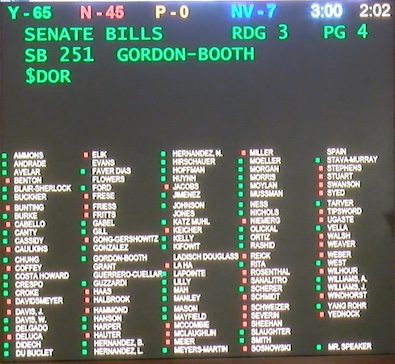
* Operations and capital appropriations vote…
* Final (third) concurrence motion on the revenue omnibus…
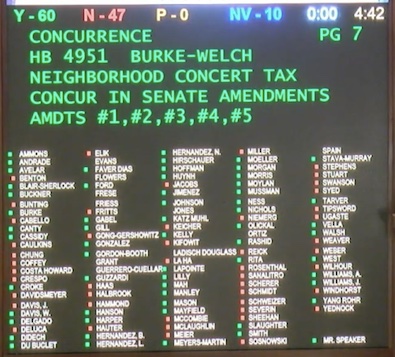
Democratic Reps. Sharon Chung, Terra Costa Howard, Fred Crespo, Stephanie Kifowit and Sue Scherer voted to spend all the money, but not to raise it.
Rep. Crespo, you’ll recall, has been chiding his colleagues all year for introducing bills that will cost the state money but aren’t paid for in the budget.
So far, we’ve received no explanation from any of them. Rep. Chung is a target, so she was likely given a pass, along with other targets like Reps. Katie Stuart and Nabeela Syed, who voted against both bills.
Rep. Larry Walsh was the opposite, voting against the budget, and (on the third try) voting for the revenue.
Thoughts?
[Hat tip to a commenter for giving me the idea.]
9 Comments
|
Giannoulias on House floor while bill goes down
Wednesday, May 29, 2024 - Posted by Rich Miller
* I was distracted and forgot to post my weekly syndicated newspaper column yesterday…
I’m not sure I’ve seen a stranger roll call than last week’s House vote on Senate Bill 2978. The data privacy bill is an initiative of Illinois Secretary of State Alexi Giannoulias, and he was on the House floor during the debate.
The far-right ginned up social media opposition to the bill by claiming that it would allow non-citizens to vote. More than 1,400 electronic witness slips have so far been filed in opposition.
Groups like the Illinois Freedom Alliance and the Illinois Conservative Union claimed on Facebook the bill would “interfere with verification of citizenship of voters.” The Illinois Family Institute went even further in a recent email blast, claiming, “As it is written, this bill will likely be used to allow non-citizens to vote in our elections.”
Accusations from the far-right that Democrats will use the votes of undocumented residents to “steal” the 2024 election have gained significant national traction over the past months. Usually, no evidence is presented, and you can chalk up this latest freak out to yet another misunderstanding of the basic lawmaking process.
The offending language is actually already in state statute, an official with the secretary of state’s office explained during a House Executive Committee hearing last week. The bill drafters simply “recodified” it. A search of state statutes shows those claims to be accurate.
The official also said the secretary of state voter registration system “does prevent anybody that is not provided citizenship information from being transmitted to register to vote.”
But the loud, conspiracy-minded opposition stampeded Republican committee members away from the bill, and so it passed the committee on a partisan roll call.
The American Civil Liberties Union of Illinois is also strongly opposed to the bill but for an entirely different reason.
The civil liberties group claims the measure “could be read as permitting data-sharing with federal or out-of-state law enforcement who are investigating or enforcing laws that criminalize abortion or gender-affirming care in other jurisdictions.”
“We believe that the bill should be amended to be clear that our data should not be used to identify people seeking, providing, or assisting with reproductive or gender-affirming care — health care Illinois has made a policy decision to protect,” the ACLU of Illinois continued. “This could be accomplished by enacting protections similar to last year’s automated license plate reader bill.”
Giannoulias never convinced the group to drop its opposition.
Rep. Kelly Cassidy (D-Chicago), a legislative leader on abortion and trans rights, rose in debate to point out, “Indiana law enforcement could ask the secretary to provide information related to an Illinois license plate on a car used in connection with an Indiana resident accessing abortion care in Illinois.”
Cassidy also objected to the bill by noting it does not have the same standard language inserted “several times” in other bills to make it “explicitly clear that the data would not be used to identify people seeking, providing or assisting with lawful health care.” She also said she was “deeply concerned” the data could be sold, “given that that’s allowed as well.”
In a shocking defeat, the entire Republican caucus and three House Democrats voted “no,” while numerous other Democrats skipped the vote. The bill wound up with 57 votes, three shy of passage, as Giannoulias looked on. I don’t think I’ve ever seen a legislative chamber reject a bill supported by a statewide officeholder while that official was standing among the members.
The sponsor, Rep. Margaret Croke (D-Chicago), put it on what’s called postponed consideration, meaning she could bring the bill up for a vote again. Some House Democrats were legitimately absent, but this bill needs to be retooled.
17 Comments
|
Some budget react
Wednesday, May 29, 2024 - Posted by Isabel Miller
* Governor JB Pritzker…
Today the Illinois General Assembly passed the $53.1 billion state FY25 budget package, concluding a legislative session that reaffirmed Governor Pritzker’s commitment to common-sense investments in Illinois families and fiscal responsibility. This is the sixth balanced budget the Governor has proposed in as many years and continues a track record of fiscal responsibility and good stewardship that has raised Illinois’s credit rating nine times and paid off billions in debt.
“Since day one, I’ve said I would only support a balanced budget that makes good use of Illinois taxpayer dollars to make our state and its working families stronger—and the budget agreement passed today fulfills both of those goals,” said Governor JB Pritzker. “I’m grateful for the partnership of Speaker Welch, President Harmon, and the budget negotiating team in getting this package across the finish line, and I look forward to seeing how the initiatives approved within will benefit Illinoisans across the state.”
“This budget reflects our steadfast belief that every Illinoisan deserves an opportunity to thrive, free from the burdens of poverty, lack of access to healthcare, and systemic barriers,” said Lt. Governor Juliana Stratton. “With the historic investments included in this budget, we are paving the way for generations to come, ensuring that Illinois remains a beacon of hope and progress. I thank Governor Pritzker, Speaker Welch, President Harmon, and our partners in the General Assembly for their hard work.”
Governor Pritzker and the General Assembly have collaborated to pass six balanced budgets in the five and a half years since he took office. In that time, the state has seen its Budget Stabilization Fund balance grow to over $2 billion, received nine credit rating upgrades, paid down an $8 billion bill backlog, and surpassed a trillion dollar economy.
Some highlights of the FY25 budget include:
-$500 million to build a world-leading quantum computing campus, attracting billions in potential private sector and federal government investment.
- More than $500 million in increases for education funding across early childhood, K-12, and higher education.
- $50 million for the state’s first ever child tax credit to help working families with children under 12 who receive earned income tax credits.
- Pay increases for Direct Support Professionals (DSP) who work in group homes and Community Care Program (CCP) in-home providers who serve seniors.
- Nearly $3 billion to serve people with intellectual and developmental disabilities, the highest-ever investment of its kind in Illinois.
- Funding to increase birth equity and eliminate black maternal mortality disparities.
- Increases in funding to safety net hospitals and nursing homes across the state.
- $198 million into the Budget Stabilization “Rainy Day” Fund.
- Elimination of the statewide grocery tax.
$290 million to Home Illinois to work towards ending homelessness in Illinois.
- $14 million to fund creation of the new Department of Early Childhood.
In addition to the budget package, the General Assembly passed several landmark pieces of legislation in the final weeks of session that were initially proposed by Governor Pritzker in his February “State of the State” address, including:
- The Healthcare Protection Act, a series of reforms meant to address network inadequacy and eliminate step therapy and prior authorization issues to make health insurance companies more navigable and affordable for patients and providers.
- Nearly $1 billion in medical debt relief supported by a $10 million new state funding commitment.
- Strengthened protections to Illinois SHIELD laws to protect patients travelling from out of state to obtain reproductive care.
- Establishment of nation-leading standards around carbon capture and sequestration.
Click here for a budget summary from the governor’s office.
* House Speaker Chris Welch…
“This balanced budget is the culmination of months of good-faith negotiations and challenging conversations to ensure the values of Illinoisans are reflected in this moral document. It continues to rebuild our fiscal house, while meeting the needs of families, communities, and businesses across this state.
“I want to thank my Chief Budgeteer Jehan Gordon-Booth, the House appropriations chairs, the budget negotiation team, and our entire budget staff for their dedication to getting this right. And thank you to Governor JB Pritzker and Senate President Don Harmon for their partnership in our goal to lift up all of Illinois.”
* House Minority Leader Tony McCombie…
After the Illinois House passed the new state budget on partisan lines in the wee- hours of Wednesday morning, House Minority Leader Tony McCombie issued the following statement:
“This budget is a negligent political document that comes at a massive price to Illinois families. The partisan approach by Democratic leaders has pushed the state onto a failed path of taxes and overspending while ignoring necessary structural and ethical reforms.”
“Over the past few weeks, the House has passed bills that address vital needs in the state. The Illinois House Republican caucus, representing parts of all 102 counties, is responsible for holding the majority party accountable on spending. This is especially important with the passage of a budget with bloated political projects, taxpayer-funded benefits for noncitizens, and politician pay raises, which come at the expense of the state’s most vulnerable residents.”
* Comptroller Susana Mendoza…
The state budget for the new fiscal year beginning July 1st makes key investments in our future and addresses the needs of our state’s most vulnerable residents.
I applaud lawmakers for their hard work this session, increasing investments in K-12 and early childhood education, career and technical programs, college MAP grants, after school programs and services for people with developmental disabilities. The budget also supports Illinois’ healthcare network, especially Illinois’ nursing homes and pharmacies and funds two new Illinois State Police cadet classes.
I am grateful to the General Assembly for adopting my proposal giving my office the flexibility to make pension payments earlier, as noted in the Budget Implementation Bill. The five pension systems will welcome this option when the state’s finances allow. The fact that we can even take advantage of this cash management tool is a testament to the hard work put into improving the state’s finances. This will give the pension systems stability and flexibility for their investment portfolios.
This budget anticipates payments of $198 million by June 2025 into the Rainy Day Fund, which would bring the total to an estimated $2.3 billion. That’s good, but the bond rating agencies – and I – think Illinois can do better. I look forward to resuming conversations with legislators and the administration on my bill to require more regular contributions to the Rainy Day and Pension Stabilization funds. It’s imperative that the state have a healthy Rainy Day Fund to see us through times of economic crisis such as a major recession or another global pandemic, and that we do more to pay down our pension debt as quickly as possible. I will continue to pursue this proposal.
* Illinois Freedom Caucus…
The Illinois Freedom Caucus is calling out the Democratic supermajority for approving massive tax increases while continuing to funnel hundreds of millions of dollars to programs and services for illegal immigrants.
The recently approved $53.1 billion budget proposal includes approximately $750 million in tax increases. The budget also authorizes $622 million in spending for illegal immigrants.
“The budget process in Illinois is a joke. The negotiations on how to spend $53 billion of taxpayer money was done in secret behind closed doors. We all know we are required by law to pass a budget and we have had five months to work on a budget and yet we had only essentially a weekend to view the budget before being asked to vote on it.
The heavy-handed approach the majority party employs in the budget process is an affront to the hard-working people of this state. When the supermajority could not get 60 votes to pass their tax increases, they voted to suspend the rules to keep running the vote until it passed. We are living in a state of tyranny. While families across the state are having to make tough economic choices because of inflation and our state’s high taxes, the Democrats are helping themselves to yet another pay raise with this budget, and ramming through tax increase after tax increase.
The spending priorities in this budget do not reflect the priorities of the vast majority of Illinois citizens. The vast majority of voters in this state do not want to have their taxes go up just to pay for services for illegal immigrants. The more money we spend on illegal immigrants, the more illegal immigrants we will attract and the more money we will have to spend just to keep up. Where does it end? How much of our money will we spend for people who are not even legally allowed to be here in the first place? What we are doing is not sustainable and it is wrong. It is time to put the people of Illinois first.”
* Rep. Jehan Gordon-Booth…
“This is a responsible, human-centered budget that delivers needed investment to our classrooms, enhances public safety and works to uplift families in every community. From helping our youngest learners access early childhood education opportunities, to enabling more older adults to receive the care they deserve, this is a comprehensive document that helps people now and moving forward.
“Our balanced approach builds on the significant financial progress our state has made in recent years, making us more responsive to the real challenges facing families. This plan invests millions more in our schools, reinforces after-school and summer youth programs and creates a new child tax credit that will provide assistance to families with young kids. It also continues to comprehensively address public safety, reinvesting in communities while giving first responders the tools they need to do their job safely and effectively.
“After months of rigorous negotiation, this is a strong budget that is going to help a lot of people. Let’s continue to work together to build a stronger Illinois for everyone.”
* Illinois Retail Merchants Association…
“Retailers play a crucial role for the state by collecting sales taxes on behalf of state and local governments. While they will now be reimbursed at a lower rate for their costs in administering the sales tax code, we are pleased the Governor’s office and legislators agreed to limit the fees financial institutions can charge on the sales tax portion of transactions. This important change will give retailers across Illinois some much-needed breathing room and we thank the Governor and legislators for their constructive engagement on this issue,” said Rob Karr, president and CEO, Illinois Retail Merchants Association. “We also applaud the decision to expand access to convenient, affordable, and safe healthcare by allowing pharmacists to provide a wider range of vaccinations and treatments for common ailments. This will ensure people can receive healthcare from highly trained professionals when they need it most.”
* The Illinois Manufacturers’ Association…
“We appreciate the ongoing collaboration with Governor JB Pritzker’s office and legislators on both sides of the aisle to advance policies that will maintain our state’s manufacturing strength, including the IMA’s initiative to extend the Research & Development tax credit,” said Mark Denzler, President & CEO of the Illinois Manufacturers’ Association. “We applaud passage of legislation establishing a framework for carbon capture and storage, which will foster economic investment and job creation while reducing greenhouse gas emissions, as well as important investments in career and technical education, workforce training, and transformative quantum computing technology. However, we are disappointed that businesses will not be able to fully write off losses for three more years. We look forward to continuing conversations in the coming months.”
* Illinois Federation of Teachers President Dan Montgomery…
“Passing this budget is crucial for our state’s success. The IFT supports and applauds the legislature’s additional investments in early childhood education of $75 million, an additional $350 million toward the school funding formula, and continued investment in teacher recruitment and retention programs. However, the meager increase in higher education funding falls woefully short. Our state needs sustainable revenue solutions to ensure full funding for PreK-12, higher education, and early childhood programs now. Supporting these foundational areas is essential for strengthening our state and making Illinois the best place to work, live, and thrive. It’s clear that we still do not have a sufficient, sustainable, rational and fair revenue system.
“Since Illinois shifted to the Evidence-Based Funding (EBF) model for K-12 schools, the legislature has allocated, on average, $350 million, or the bare minimum statutory funding level required each fiscal year. The EBF funding gap for public schools stands at $2.3 billion. The original promise of the Evidence-Based Funding for Student Success Act, passed in 2017, was that EBF would be fully funded by 2027. At our current rate of investment, EBF will not be fully funded until 2040. To fulfill the legislature’s promise to public schools and students, we must increase our investment. Illinois urgently needs robust revenue streams and serious discussions about securing sustainable funding. We must not fail yet another generation of Illinois children.
“The additional $10 million for the Monetary Assistance Program (MAP), bringing full investment in the program to $711 million, is a commendable step. This increased funding will enhance the financial stability of our public colleges and universities, making higher education more affordable for students, particularly Black, Brown, and low-income students who benefit the most. A 2 percent increase to our state universities is not good enough, however. Funding for our state universities has been decimated over the past two decades and it shows. They require meaningful re-investment now.
“In light of the ongoing teacher shortage and the critical need to hire and retain a more diverse teaching force, securing the Grow Your Own program funding was essential, as was continued funding for teacher vacancy grants. These are two very positive, continued investments in the next generation of teachers. Eliminating the Virtual Instructional Coach (VIC) program is a deeply misguided decision, however. At a time when teacher retention is crucial, dismantling a proven support system designed to nurture and retain talent is a step backward for our schools.
“By ensuring pension payments are made as mandated by law, the legislature has taken a crucial step to secure the financial stability of our retirees and honor the commitments already made to hardworking public servants. We look forward to continued discussion around repairs to the inadequate “Tier II” pension, which is widely agreed to violate federal law, and to creating a fairer structure that is properly resourced for the long term while addressing the dire shortages in teaching and public service workforces.
“The IFT expresses our gratitude to legislators for their hard work and collaboration throughout this session. As we move forward, we are committed to intensifying our efforts and working collectively to identify sustainable revenue streams. These crucial revenue discussions are essential to ensuring Illinois remains a strong economic state and continues to thrive for all its residents while supporting and funding our education and public service priorities.”
* Planned Parenthood Illinois Action President Jennifer Welch …
“Planned Parenthood Illinois Action (PPIA) applauds the Illinois General Assembly on passing a budget that supports reproductive and sexual health for Illinoisans particularly around family planning and birth equity. We are grateful for the Governor’s leadership on prioritizing the fight for birth equity and his commitment to addressing the Black maternal health crisis.”
* President of SEIU Healthcare Illinois Greg Kelley…
As a union of frontline workers providing home care, child care and healthcare services, we applaud the leadership of Governor Pritzker, President Harmon and Speaker Welch for wrestling with hard choices and choosing to go in the direction of raising revenue in order to make some of the desperately needed investments in Illinois communities.
We want to express appreciation for the lawmakers, and in particular those in the Black, Latino, Asian and Progressive caucuses, who prioritized the Community Care Program, lifting the hourly wage up to a minimum of $18, an increase of $1 an hour for home care workers. Thanks to their advocacy, over 100,000 seniors across the state will now have a more stabilized work force and more security in the care they rely upon in order to continue living independently in their homes. While this is a crucial step in the right direction, it will take additional investment to lift wages to a level that will truly stabilize this program. We look forward to working with our legislative advocates in the future to secure the funding and wage levels needed to get this program where it needs to be to best serve seniors in the state.
Our members are also appreciative of lawmakers’ protection of a key nursing home staffing level incentive in Medicaid rate reform, and of the new sources of hospital safety funding to offset funding being lost. These are modest but important measures to prioritize safe staffing and to assure healthcare accessibility for communities experiencing the highest unmet needs.
There is work still to do in offsetting the lost ARPA funding, especially in the area of child care—both to make child care more affordable and accessible to families, and to raise wages and improve working conditions to reverse the child care workforce crisis—but we commend Governor’s Pritzker’s commitment to securing new funding.
Overall, we appreciate the work and compromise that went into creating a strong and balanced budget, but there is still more we need to do as a state in terms of securing the revenue necessary to invest in care work—which is crucial to ensuring that care is available to all in Illinois who need it.
* Illinois Association of Rehabilitation Facilities President Josh Evans…
The Illinois Association of Rehabilitation Facilities (IARF), representing community providers of services for persons with intellectual and developmental disabilities and serious mental illnesses, today issued the following statement after the final state budget proposal was acted on by the Illinois Legislature:
“We offer a sincere and important thank you to state legislators and Gov. Pritzker’s Administration for supporting another state budget that provides wage increases to workers who support those with intellectual and developmental disabilities and invests in psychiatric services for persons with serious mental illnesses in the Medicaid program.
Illinois has taken important steps forward in recent years to increase wages for Direct Support Professionals (DSPs). The new state budget will mark another step forward with a $1-an-hour increase in DSP wage rates.
Due to the support of the Legislature, we’re seeing staffing levels improve throughout the state. This budget will keep us on the path outlined in the Guidehouse report for parity with the state’s minimum wage that will increase to $15 next January, and that will allow us to compete against the wage packages offered by restaurants, retailers and others in the marketplace.
We understand state resources are scarce, and that is why we thank the legislators who stepped up during final budget negotiations to ensure this investment is a priority. We will continue this momentum to provide the critical support for our shared goal: helping all with disabilities and mental illnesses receive the quality care and services they need for meaningful lives.”
* Healthy Illinois Campaign Director Tovia Siegel…
We applaud the Illinois General Assembly, in conjunction with Gov. JB Pritzker, for passing much needed funding for the Health Benefits for Immigrant Adults and Health Benefits for Immigrant Seniors programs that support healthier families and boost our economy as a whole. This funding level should ensure that the nearly 70,000 people enrolled in either program will not be forced off of their much-needed coverage, a significant victory for undocumented Illinoisans who rely on this life-saving healthcare as well as for the healthcare and immigrant advocates who have fought for these critical programs for years.
Additionally, we’re hopeful that this increase in funding, coupled with a significant decrease in program costs in recent months, offers the opportunity for these programs to be reopened to new applicants and could also eliminate the need to impose unnecessary cost sharing on participants. Our coalition stands ready to work with the Pritzker Administration to examine reopening enrollment for these programs in a fiscally responsible manner, and we urge the Department of Healthcare and Family Services to reconsider imposing copays or other cost-cutting measures that will undo positive healthcare and financial progress made in recent years.
While we are encouraged to see these programs avoid harmful cuts, it is still the goal of the Healthy Illinois Campaign to secure health coverage for all, regardless of immigration status. We will continue to fight for proper funding of HBIA and HBIS that forever eliminates all caps and copays, and we will continue to work toward expanding coverage for those ages 19-41 in the years to come.
Today, thanks to the work of Gov. Pritzker, President Harmon, Speaker Welch and the General Assembly, these programs are backed by more than $600 million in funding, which provides life-saving care like cancer screenings, chronic disease management, and vitally needed prescription medications for older adults and seniors across Illinois. We would also like to extend a special thank you to the Latino Caucus, the Asian American Caucus and the Progressive Caucus for their relentless legislative advocacy to ensure these programs are properly funded. We look forward to continuing to engage the legislature and the governor as we work toward the goal of coverage for all.
* The Illinois Hotel & Lodging Association…
The Illinois Hotel & Lodging Association (IHLA) commends the General Assembly for passing its FY25 State Budget that includes a measure championed by the IHLA to raise much-needed revenue for the state by closing a loophole used by third-party booking websites that allows their customers to pay lower taxes when they book rooms online. By closing this loophole, it is estimated that the state will generate an additional $30 million in tax dollars that would have previously gone uncollected.
“Closing this loophole is a win for Illinois’ hotel industry, and a win for the state. On top of leveling the playing field between hotels and third-party websites, it is expected to generate an additional $30 million in revenue that can be used to fund important state programs and promote tourism. Travel promotion is more important than ever as we work to increase Illinois’ competitiveness and return to pre-pandemic tourism levels to further bolster our state’s economy. We appreciate our partners in the House and Senate for including this this important measure in this year’s budget and supporting Illinois’ tourism and hospitality industry,” said Michael Jacobson, President and CEO of the Illinois Hotel & Lodging Association.
9 Comments
|
* Democrat Rep. Fred Crespo has been warning his colleagues all spring about sponsoring bills that cost money without providing the funding. Last night, before voting no on the revenue omnibus, he warned fellow legislators last night of future budget issues…
“We have all these other pressures. So where do we go? There’s really only one place we can look at getting these revenues, and that’s taxpayers. And at this rate, ladies and gentlemen, we’re going to run out of taxpayer dollars to spend. Now, I’ve heard some say that a budget is a moral document. Sure is. But I also would argue that we have a moral obligation to look after taxpayers.”
* Ben Szalinski…
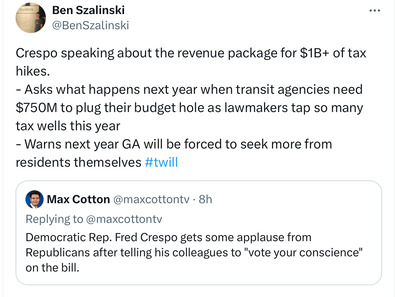
* Hannah Meisel asked the governor today about Rep. Crespo’s remarks…
Hannah Meisel: Before Fred Crespo voted no on the revenue package he stood up and said I’m a Democrat but you know, this makes me worry, I think that next year we are going to be facing this cliff and we’re going to be asking even more of taxpayers. Can you respond to that criticism?
Governor Pritzker: Well, every year we start the year with challenges looking ahead. What are we going to do in the next year? How do we pay for the necessary things for working families across Illinois? And we spend the year working through that until we get to the budget address in February. And then there are months for the legislature, who already are aware of many of the things that are in the budget before I actually introduce it, for them to debate it for months until May.
And so it’s hard to say why somebody would all of a sudden wake up and decide that the budget isn’t quite right for them, but you’d have to ask him.
Hannah Meisel: [Some legislators] mentioned that we would have to ask for a service tax or an increase in income tax.
Governor Pritzker: Every year, particularly Republicans say things like that. They say, ‘oh, we’re careening toward a brick wall.’ It hasn’t happened. Six years in a row, we have balanced this budget, and we have made sure that we’re thinking about and lowering costs for working families every time we put a budget together. So I’m pleased with how the budget ultimately came out. Six years of balanced budgets for Illinois that’s a record.
Thoughts?
24 Comments
|
* Sun-Times…
Instead of delivering a decisive budget victory to Gov. J.B. Pritzker, Democrats stood on the Illinois House floor scratching their heads early Wednesday as they searched for a key vote needed to pass the state’s budget.
When all was said and done, the Democratic-led House eked out a vote of 60-47, the bare minimum needed to clear a revenue package — one of three budget bills that had been approved by the Senate on Sunday. By 4:43 a.m., more than four hours after legislators began taking up the budget, the House approved the $53.1 billion budget that relies on $1.2 billion in revenue from several changes to the state’s tax code. […]
Pritzker’s office had optimistically put out a statement after the budget’s spending plan cleared the House 65-45, following more than an hour of debate. But what came afterward were theatrics, foot stomping and both sides trying to utilize floor rules to their advantage. Shortly before the third revenue vote, Republicans sifted through the Democrat-drafted House rule book to see how they could stall another vote.
An initial vote to clear the revenue bill included a request for verification — meaning all members had to be present to approve it. State Rep. Aaron Ortiz, D-Chicago, was marked as a yes vote, but was nowhere to be found. From there, it took several motions to reconsider and another two votes to get the bill passed.
* Capitol News Illinois…
More than $1.1 billion in added revenue was needed to balance the books, so lawmakers extended an expiring cap on corporate net operating losses to ensure that $526 million in tax dollars wouldn’t disappear in FY25. Another $25 million will be raised by subjecting “re-renters” of hotel rooms to an existing state hotel tax.
Sportsbooks will see their current 15 percent tax rate on profits increase via a new graduated structure that will tax between 20 and 40 percent, based on profits. The change is projected to bring in about $200 million to the state’s General Revenue Fund. A 1 percentage point increase to the tax on the state’s video gambling industry would generate an additional $35 million for infrastructure projects next year.
The revenue plan also caps a tax discount claimed by retailers at $1,000 monthly, generating $101 million for state coffers and about $85 million for municipalities.
To appease retailers, lawmakers included a prohibition on financial institutions and credit card companies charging fees on the sales tax and gratuity portion of electronic transactions beginning July 1, 2025.
* Tribune…
Highlights of the measures headed to the governor’s desk include a slight hourly boost for service providers who help the developmentally disabled and a more generous child tax credit. Lawmakers removed from the spending plan Pritzker’s proposal to lower a built-in annual increase to the standard state income tax exemption, which experts said would have harmed lower-income families.
The spending plan includes the minimum $350 million annual increase in funding for elementary and secondary education laid out in the state’s school funding formula. The increase helps bring total K-12 spending from the state’s general fund to about $10.8 billion. The budget also calls for making the legally required pension payment of about $10 billion.
The budget also includes $14 million for the Department of Early Childhood, the new agency that both the House and Senate voted to create, and sets the salary for the new agency’s secretary at $215,000 per year. […]
Lawmakers and many top state officials will see 5% raises, boosting annual pay for all 177 members of the Illinois General Assembly to $93,712. Many lawmakers also receive stipends for holding leadership positions or chairing committees. The raises also affect all constitutional offices — the governor, lieutenant governor, secretary of state, attorney general, comptroller and treasurer — and heads of executive agencies.
Rep. Kelly Cassidy’s Prisoner Review Board reform bill, an omnibus cannabis measure sponsored by Rep. La Shawn K Ford legislation banning unregulated hemp products and the Potawatomi land deal did not make it across the finish line.
* Brenden Moore…
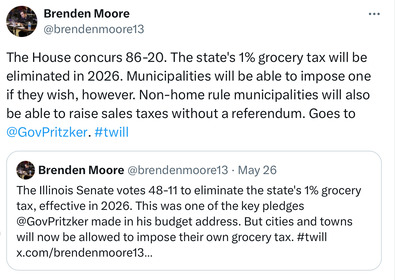
Three Democrats, Reps. Diane Blair-Sherlock, Terra Costa Howard and Lance Yednock, voted no on removing the grocery tax.
* More…
* WCIA | Illinois House passes budget, sends it to Governor Pritzker’s desk: To help pay for all of the spending, the state is counting on a revenue package of tax hikes — mostly on businesses, including sports books –to balance it out. In order to create those new revenue streams though, the House needed to pass a bill, and that proved harder than one would think for a supermajority caucus.
* Center Square | In dead of night, Illinois House approves largest spending plan in state history: Approved by the Senate late in the evening Sunday and by the House in the early morning hours Wednesday, the plan also pays $971 million for non-citizen migrant health care, direct services and welcoming centers. State Rep. Jehan Gordon-Booth carried the plan for the House. “This budget is balanced, responsible and fair,” Gordon-Booth said late Tuesday during a committee hearing.
* Capitol City Now | IL $53.1B budget heads to guv: Seven House Democrats – Reps. Harry Benton (D-Plainfield), Anthony DeLuca (D-Chicago Heights), Jennifer Gong-Gershowitz (D-Glenview), Katie Stuart (D-Edwardsville), Nabeela Syed (D-Chicago), Larry Walsh, Jr. (D-Elwood), and Lance Yednock (D-Ottawa) – joined all House Republicans in voting against the bill.
* WGEM | After chaotic ending, IL House sends FY25 budget to Gov. Pritzker’s desk: “No one, and I mean no one, is getting everything that they want. Some very difficult decisions were made and I hope that people respect that. But I truly believe that this budget puts Illinois forward,” said state Rep. Jehan Gordon-Booth, D-Peoria, House Democrats’ lead budget negotiator. It includes more than $20 billion for education, a nearly $350 million increase from the FY24 budget. It also has $500 million for quantum technologies.
* WICS | Illinois House approves new state budget in late night vote: Governor Pritzker released a statement shortly after the vote applauding the general assembly for their work on the new budget: For the sixth consecutive year, the General Assembly and I have a balanced budget that uplifts the working families of Illinois, saves more money in our Rainy Day fund, creates jobs, lowers taxes on small businesses, grows our economy, and continues our track record of fiscal responsibility. From expectant mothers and their newborn babies to people with disabilities to veterans to seniors who need our care, we’re keeping our promises to all Illinoisans and the most vulnerable among us. My deepest thanks to Speaker Welch, President Harmon, the budget teams, and every legislator and stakeholder who came together to craft and pass this legislation. I look forward to signing it and continuing the work of building an even stronger Illinois.
28 Comments
|
Open thread
Wednesday, May 29, 2024 - Posted by Isabel Miller
* How are things in your part of Illinois?…
11 Comments
|
Isabel’s morning briefing
Wednesday, May 29, 2024 - Posted by Isabel Miller
* ICYMI: Once again working through the night, lawmakers finalize $53.1 billion budget. Capitol News Illinois…
Despite holding 78 seats in the chamber, it took Democrats three tries to reach the 60 votes needed to approve more than $1.1 billion in revenue increases, including a tax hike on sportsbooks and businesses, to balance the $53.1 billion spending plan for fiscal year 2025.
The spending plan passed 65-45, with seven Democrats joining Republicans in opposition.
The revenue plan that capped the voting on the budget-related bills was more of a challenge. House Bill 4951 fell one vote short of passage twice after 4 a.m. due to attendance issues. On the third try – after about an hour of procedural maneuvering by Republicans that left Democrats reeling – the bill passed at 4:43 a.m. with the minimum 60 votes necessary.
* Related stories…
I’ll have more on the blog in a bit.
* Governor Pritzker will hold an end of session press availability at 10 am today. Click here to watch.
*** Isabel’s Top Picks ***
* WBEZ | With shortage of mental health workers, Chicago trains the public to try to prevent suicide: The Chicago Department of Public Health is training city workers and residents who live in neighborhoods with the highest suicide rates on how to spot the signs of suicide risk. They include Mount Greenwood and Calumet Heights on the South Side to Norwood Park on the Northwest Side. Some of these areas are home to high numbers of city workers, including police officers and other frontline workers who are exposed to repeated trauma, said Chicago Public Health Commissioner Dr. Simbo Ige.
* CBS | Thompson Center’s “Standing Beast” carried off: Workers used a crane to remove pieces of the black-and-white sculpture that stood outside the Thompson Center for decades. The fiberglass sculpture “Monument with Standing Beast” was first unveiled in 1984.
*** Statehouse News ***
* WCIA | Capitol Connection: AFL-CIO discusses session, captive audience and future policy pushes: Tim Drea, Illinois AFL-CIO’s president, sat down on Capitol Connection on Friday morning to talk about the bill, the proposed new stadium for the Chicago Bears and other policies the organization will be advocating for in the future.
* Play Illinois | Legislative Session Ends Without Movement on iGaming: Two bills that would have legalized online casinos in Illinois stalled in committee as the state legislative session concluded last week. In the end, consensus could not be formed to push either bill to a vote. House Bill 2239, introduced by State Rep. Edgar Gonzalez Jr., and Senate Bill 1565, sponsored by State Sen. Cristina Castro, failed to escape the committee process and come to a debate and vote on Friday in Springfield.
* Tribune | Lawyers for ex-AT&T boss object to Madigan evidence at upcoming trial: In their 13-page response filed Friday, lawyers for La Schiazza argued that the government’s proffer “is devoid of any evidence” showing La Schiazza or any other AT&T employee knew “that seeking to influence Mr. Madigan was forbidden,” as required by current Chicago-area case law. “Doing something to develop or maintain a positive relationship with a politician or politically influential person is not a crime,” attorneys Tinos Diamantatos, Megan Braden, Alborz Hassani and John Dodds wrote. “Hiring a consultant recommended by a politician or politically influential person in order to build relationships or curry favor is not a crime.”
*** Chicago ***
* Chalkbeat | At least 150 Chicago schools set to lose staff next school year: The shifts in school staff are coming despite a new funding formula meant to more equitably fund schools and provide set staffing levels, as district leaders work to close a major budget deficit and grapple with the end of federal COVID relief money. Still, district leaders said Tuesday that they’re optimistic about the new budget formula, and that CPS will guarantee a job elsewhere in the district for teachers who are losing their current positions due to budget cuts.
* Crain’s | CPS releases schools budget under new funding formula as $391M deficit looms: “I am cautiously optimistic that we’ll be able to work collaboratively with the CTU and our principals union to do the same,” CPS CEO Pedro Martinez said during a briefing with reporters today. CPS’ current deficit does not reflect any impacts from collective bargaining agreements, he added.
* Sun-Times | With time running out, Save A Lot operator makes little progress toward opening stores: After months of blown deadlines and broken promises to renovate and reopen six low-cost grocery stores in underserved communities, the operator of Save A Lot stores in Chicago promised a top city official in January that his company will do better. “We took your comments about a ‘hard reset’ to heart,” Yellow Banana Chief Executive Joe Canfield wrote to Ciere Boatright, Chicago’s top planning and development official, in a January 31 email. Five months later, Yellow Banana continues to fall short of its own goals.
* Crain’s | Chicago’s Hispanic community welcomes Biden and the DNC — and demands work permits: “The immigrant issue is dividing our community. I think one message that President Biden should say and should do is, ‘work permits for all.’ I think that would take care of a lot of issues,” said Jaime di Paulo, president and CEO of the Illinois Hispanic Chamber of Commerce. “But they don’t want to do it. And in fact, (Biden) called us ‘illegals’ at the State of the Union. So you need to understand that he’s playing to his base and he’s playing to the other base.”
* Tribune | Democrats plan to nominate President Joe Biden by virtual roll call before DNC in Chicago: The Democratic National Convention, where the president would otherwise be formally nominated, comes after Ohio’s ballot deadline of Aug. 7. The party’s convention is scheduled for Aug. 19-22. Ohio lawmakers have moved the deadline in the past for candidates of both parties, although they had not done so yet for Biden this year and were called to a rare special session by Gov. Mike DeWine to address the issue.
* Tribune | Artists, entrepreneurs transform cicadas from ick to in demand while building community: “It’s more than just an item,” said Nina Salem, founder of The Insect Asylum, an Avondale-based museum of zoology leading a citywide effort for amateur and expert artists to buy or sponsor over 1,000 giant plaster cicada sculptures to be decorated and placed around Chicago. “It’s an experience, and it’s an opportunity to join a community.”
* Sun-Times | Off-duty police officer shoots and kills pit bull held by neighbor, prompting lawsuit, COPA probe: COPA is asking the police department to strip Mostek of her policing powers, noting in its report that Maynard’s head was “inches away” from the gunshot. “This action raises concerns about Officer Mostek’s ability to make sound, risk-averse decisions concerning the use of deadly force as a last resort,” COPA Chief Administrator Andrea Kersten wrote. “Her decision-making in situations involving force could potentially endanger herself, members of the public, and other CPD officers by exposing them to unnecessary risks and harm.”
*** Cook County and Suburbs ***
* Daily Herald | ‘One giant step closer’: Deal would create governing body for emergency dispatch consolidation in Lake County: The Regional Operations and Communications Center will house partnering agencies, including Mundelein, Fox Lake, Gurnee, CenCom dispatch, Vernon Hills, Lake Zurich and Countryside Fire Protection District. Seventeen entities have said they wish to become founding members and have until June 30 to do so, according to Sutton.
*** National ***
* AP | Washington Post said it had the Alito flag story 3 years ago and chose not to publish: “It was a surprising admission from such a major news organization,” said Jesse Holland, associate dean of the School of Media and Public Affairs at George Washington University, and a former journalist who covered the Supreme Court for five years. “Very, very rarely do you have a major news organization say they likely would have made a different decision.”
* The Athletic | Bill Walton leaves legacy far larger than basketball: Walton’s passing may have hit the basketball world hard, but its impact was profound in San Diego County, where he grew up and lived when his 14-season career ended. San Diego has always been fertile ground for elite athletes, producing the likes of Billy Casper, Phil Mickelson, Gail Devers, Jimmie Johnson, Marcus Allen, Terrell Davis, John Lynch, Reggie Bush, Rashaan Salaam and so many others. But the reverence for Walton was different, dare I say deeper.
Comments Off
|
|
Comments Off
|
Live coverage
Wednesday, May 29, 2024 - Posted by Rich Miller
* You can click here or here to follow breaking news. It’s the best we can do unless or until Twitter gets its act together.
Comments Off
|
Welch: ‘No one’s ever said the House is boring’
Wednesday, May 29, 2024 - Posted by Rich Miller
* House Speaker Chris Welch speaking before adjournment…
Thank you, Madam Speaker, members of the House. No matter what the other chamber says, no one’s ever said the House is boring. The House is definitely not boring.
I wanted to come out to the floor tonight to first thank everyone for sticking through these final days of the legislative session, and particularly sticking through this very long day. I cannot let us adjourn without thanking our staff who made this whole operation run. Can we please give our staff a round of applause, please?
And that was meant for the staff on both sides, you know, Democratic side, the Republican side. We may disagree at times. We’re going to represent our districts to the fullest, but all of us here are nothing without the fabulous staff that we have. I think both Chiefs of Staff deserve a round of applause. Tiffany and Andrew, thank you.
I also want to thank two people that are new to their positions, and that’s on the Democratic side. Our new chief legal counsel, Kendra Piercy, who knows her stuff, and she had that on display tonight in our new research and appropriations director. Without the two of them, we don’t make it through tonight. So please, let’s give them a round of applause.
I had different remarks prepared for tonight, but the hour is late. Everyone’s tired. You want to go home. And because you stayed and put in the work, we’re done. We can go home. We can enjoy the summer and the fall. We can spend time on our families. We can get some rest before we come back here, to continue the peoples’ business. Thank you all. Go home, get some rest, travel safely.
1 Comment
|
* Keep an eye on the live session coverage post for instant updates. The House just passed the Fiscal Year 2025 budget. The seven Democratic “No” votes were Reps. Harry Benton, Anthony DeLuca, Jennifer Gong-Gershowitz, Katie Stuart, Nabeela Syed, Larry Walsh and Lance Yednock (none of whom spoke in debate)…
All of the absent Democrats had been earlier excused.
The bill will soon be sent to the governor.
…Adding… The BIMP bill just passed with 62 votes. Democratic Reps. who voted “No” were Benton, Matt Hanson, Gregg Johnson, Stephanie Kifowit, Sue Scherer, Stuart, Walsh and Yednock (none of whom spoke in debate)…
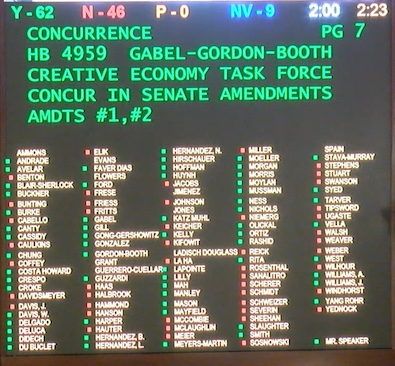
Reps. Carol Ammons and Lilian Jiménez were noticeably absent.
…Adding… Democratic Reps. Diane Blair-Sherlock, Terra Costa Howard and Lance Yednock were the “No” votes on eliminating the grocery tax (none of whom spoke in debate)…
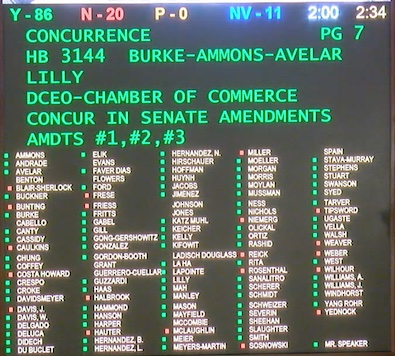
Reps. Ammons and Jiménez returned to the roll call.
…Adding… The revenue omnibus has bee put on postponed consideration after Assistant Majority Leader Aaron Ortiz was verified off the roll call. Here’s the original vote…
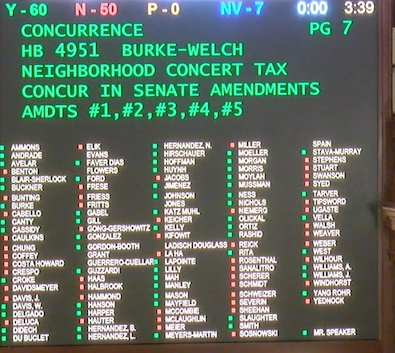
Stay tuned.
Democratic Reps. Benton, Sharon Chung, Costa Howard, Fred Crespo, DeLuca, Gong-Gershowitz, Kifowit, Scherer, Stuart, Syed, Walsh, Yednock were all “No” votes. Crespo spoke negatively about the bill in debate.
…Adding… Rep. Jennifer Gong-Gershowitz has moved to reconsider the vote. JGG had voted “No.” But the Republicans are claiming there was no recorded vote, so there’s no motion to reconsider. The Democrats said the record was taken, but the Republicans say that didn’t happen.
…Adding… Motion to reconsider…
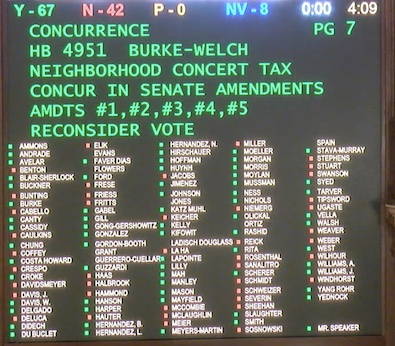
…Adding… Second concurrence motion, but there’s a verification request…
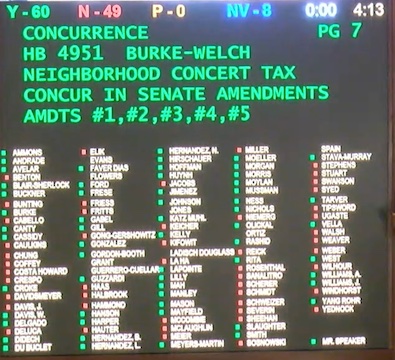
…Adding… A Republican, Rep. Randy Frese, flipped.
…Adding… I’m told Democratic Rep. Larry Walsh was supposed to flip to Yes, then saw the roll call hit sixty and went back to No. If Frese is verified off, they’re back at 59.
…Adding… If Frese is off, the bill will die by rule. But the Democrats can vote to suspend the rule, if they can find enough votes.
…Adding… Frese is verified off and the Democrats move to suspend the rule.
…Adding… Motion to suspend the rule passes, then Gong Gershowitz moves to reconsider the vote. That vote passes.
…Adding… Concurrence motion passes again, but waiting on verification.
…Adding… Republicans gave up on the verification. Here’s the roll call…
13 Comments
|
|
 Support CapitolFax.com
Visit our advertisers...

 ...............
 ...............
 ...............


|
   
|
Hosted by MCS |
SUBSCRIBE to Capitol Fax |
Advertise Here |
Mobile Version |
Contact Rich Miller
|



