Woke up this morning with a wine glass in my hand
Whose wine? What wine?
Where the hell did I dine?
Must have been a dream
I don’t believe where I’ve been
Come on! Let’s do it again!
* The governor’s office is saying they weren’t briefed on today’s $1.8 billion Senate Democratic proposal to cut taxes. Here’s Jordan Abudayyeh from Pritzker’s office…
We look forward to reviewing this proposal. Our conversations with members of the General Assembly in both chambers have been productive, and we will continue to focus on delivering fiscally responsible relief for working families.
House Speaker Chris Welch received a brief phone call about half an hour before the press conference. From Welch’s spokesperson Jaclyn Driscoll…
The Senate President did reach out to the Speaker shortly before the plan went public, but he still has not been thoroughly briefed on the details. He plans to review the proposal and discuss it in detail at the next caucus.
I’ve been hearing that Welch isn’t enamored at all with the idea of handing out tax breaks to upper-income earners. But he hasn’t had much time yet to digest this new proposal.
* The Senate Democratic plan would do things like pare back Pritzker’s one-year gas and grocery tax freeze/cut proposals to just six months in order to fund other items. But, at least it’s in there.
Look, the Senate’s gonna Senate, but let’s see how hard they decide to fight for all of these things. This looks like it could be, at least in part, member management. But, hey, at least they didn’t demand this stuff next Wednesday or Thursday. There’s still time to figure things out.
* By the way, these sorts of ideas have never really worked well in the past, politically speaking, including here in Illinois.
Senate GOP Leader Dan McConchie…
The Senate Democrats’ proposal appears to be just another election year stunt. Under their plan, checks and relief will arrive right before the election and then will expire right after the election. This is not the real reform the people of this state want and need, and Illinoisans will see right through this disingenuous gimmick.
* It is quite comprehensive, though. Here’s the press release…
Illinois Senate Democrats proposed Friday a more than $1.8 billion inflation-busting relief plan that would wipe out state taxes on back-to-school shopping and groceries, stop higher gas taxes and deliver income and property tax refund checks statewide.
“This plan gets money back in the hands of consumers. They’ve endured through this pandemic. It’s time for the state to pay it forward,” Senator Scott Bennett (D-Champaign) said at a Capitol press conference.
Under their plan, the state would directly deliver relief checks valued at $100 per person and $50 per child to state taxpayers making up to $250,000 individually or up to $500,000 jointly. A household of four could see a $300 check.
The relief checks would likely come in late summer or early fall. Lawmakers estimated more than 97 percent of state taxpayers would get a check of some amount.
The plan also wipes out for six months the state sales tax on groceries and stops a gasoline tax increase from happening. The proposal is modeled after one Gov. JB Pritzker proposed in his budget speech earlier this year.
“We’re going to drive down skyrocketing gas and grocery costs and give people some needed relief,” said Senator Elgie Sims (D-Chicago).
The plan also includes property tax relief checks of up to $300 that would be mailed to taxpayers. This idea is also one that originated with Gov. Pritzker’s budget proposal.
“Homeowners need help and this plan delivers direct relief to them,” said Senator Ann Gillespie (D-Arlington Heights).
The plan also wipes out the state sales tax on clothing, shoes and school supplies for 10 days in August to give consumers an economic boost as they go back-to-school shopping. As proposed, the sales tax would be lifted from Aug. 5 to Aug. 14.
“This recognizes the reality that families across the state face and should help lower the bill on their back-to-school shopping,” said Senator Michael Hastings (D-Frankfort).
The comprehensive proposal also includes expanded economic aid for lower-income workers and increased tax credits for teachers and volunteer first responders.
The plan, included in legislation filed Friday in the Senate, totals more than $1.8 billion in economic relief. It could be voted on in the coming days as the legislative session heads toward a planned adjournment on April 8.
“Through responsible budgeting the state has wiped out deficits and paid our bills. Now is the time to pay it forward and get money back to taxpayers,” said Senator Bennett.
* Dot points…
Putting money back in Illinoisans pockets
Senate Bill 1150
Paying it forward
Floor Amendment 1 (Bennett)
• The majority of Illinoisans – more than 97% of taxpayers – will receive a one-time tax refund by the fall of 2022. Individual filers will receive $100 and joint filers will receive $200, with an additional $50 for up to three dependents.
• Individuals making up to $250,000 and joint filers making up to $500,000 will receive checks in the mail.
How do people know how much they could receive from the refund?
o People should review their 2021 income tax return. If they made $250,000 or less individually, they will receive $100. If they made $500,000 or less jointly, they would receive $200.
o Individuals and households can add $50 per dependent, up to three dependents.
Who would be eligible for the refund?
o Any Illinois taxpayer who filed a 2021 tax return and makes $250,000 or less individually or $500,000 jointly. This includes taxpayers who utilized an ITIN number on their 2021 return.
What would people need to do to qualify?
o People would need to have filed their 2021 return by the filing deadline and make $250,000 or less individually or $500,000 or less jointly. Any person who fits this criteria would automatically be sent a check.
When would people receive this refund?
o The refund is expected to hit people’s mailboxes by September.
Many people have already filed their 2021 return and received their 2021 refund. What would they need to do to claim this particular refund?
o Nothing additional. Anyone who fits the income criteria and filed a 2021 return will automatically receive a check in the mail.
Suspending everyday taxes
Floor Amendment 2 (Sims)
• Addressing inflation by suspending the 1% state grocery tax for six months.
Floor Amendment 3 (Sims)
• Suspends the state’s portion of the gas tax increase for six months to help with rising prices at the pump.
Providing property tax relief
Floor Amendment 4 (Gillespie)
• Provides property tax relief for homeowners. Property owners making up to $250,000 individually and $500,000 jointly are eligible for the tax credit of 5% of property taxes paid, with a maximum check of $300.
Helping Illinois families
Floor Amendment 5 (Hastings)
• Helps families with back-to-school shopping by creating a state sales tax holiday on school supplies and clothing from Aug. 5 to Aug. 14 of 2022. Qualifying clothing and footwear with a retail price of $125 or less will have no sales tax during that time. School supplies are not subject to the $125 threshold.
Increasing the Earned Income Credit
Floor Amendment 6 (Aquino)
• Helping lower-income Illinoisans by increasing the Earned Income Credit to 19%. The current EIC in Illinois is at 18% of the federal EIC.
• Taxpayers 18-24 years of age, 65 and older, and taxpayers who use an individual taxpayer identification number would be able to claim the EIC if they would otherwise qualify for the federal EIC, which excludes these groups.
Tax Breaks for Teachers
Floor Amendment 7 (Holmes)
• Gives teachers a tax credit of up to $250 for supplies bought for their classrooms.
Relief for Volunteer First Responders
Floor Amendment 8 (Belt)
• Shows appreciation for volunteer firefighters and EMS professionals by giving them a tax credit of up to $500 for a year in which they served at least 9 months in a volunteer capacity.
State legislators have given strong endorsement to State Rep. Anna Moeller’s proposal to expand bereavement leave in Illinois.
Rep. Moeller, D-Elgin, pushed Senate Bill 3120 through the Illinois House on March 30.
The proposed law expands current Illinois law, which allows parents to take up to 10 unpaid days of leave for bereavement of the death of a child. Moeller’s changes would allow those 10 unpaid days off work for bereavement of the death of other close family members, including parents, grandparents and in-laws, grandchildren, spouses or partners, and siblings.
The legislation also allows the same unpaid leave for families who go through loss related to stillbirth, miscarriage, failed adoptions or surrogacy, and failed IVF procedures.
“This expands the family members who would be covered in these other tragic situations that an employee might experience, and need time to grieve and make arrangements and heal from such an experience,” Moeller said in presenting the bill on the House floor.
The bill has the support of a number of organizations representing women and workers, including Illinois NOW, Women Employed and the Illinois AFL-CIO. It has already passed the Illinois Senate, so now it goes to the Governor to be signed into law.
The state Senate on Thursday advanced a measure to create a task force to study electric grid reliability in light of the 2021 passage of the energy regulatory overhaul bill known as the Climate and Equitable Jobs Act.
A House committee, meanwhile, began preliminary conversations about lifting the ban on new nuclear developments in Illinois.
The unpaid, 33-member task force outlined in Senate Bill 1104 would be known as the Illinois Regional Generation Reliability Task Force. It passed 32-15 in a bipartisan vote, although several Democrats voted against the measure. It still needs approval in the House.
The task force would study the effect of state laws, including CEJA, on energy prices as well as grid reliability. It would also study ways to deploy new technologies and ways to “improve” the power supply mix, among other tasks.
It wouldn’t have authority to create any new laws or regulations, but it would report to the General Assembly by Feb. 1, 2023, and each year thereafter.
Labor unions were among some of the prominent backers of the bill, according to witness slips filed on the General Assembly website, while the environmental group Illinois Sierra Club opposed the measure.
One enviro lobster I know described the legislation as a “gas/coal dominated task force designed to recommend changes that are good for fossil fuels.”
Illinois lawmakers passed legislation last October to address concerns with corruption and conflicts of interest. They intended to bring more light to government; instead, some argue the law has made things cloudier.
The House Ethics and Elections Committee heard complaints from various groups about the confusion caused by the reforms. Namely, the changes it made to the economic disclosure forms that all public officials have to fill out their economic interests and investments.
The language of the law lays out what should and shouldn’t be reported on the form. It reads that those filling it out should list out all single assets worth over $10,000. That includes items that are owned jointly with a spouse or child. the minimum amount increased on the reform from an asset worth $5,000 to double that. […]
“In many ways, this is perceived by a lot of people as swatting flies with a hammer,” [Illinois Municipal League Executive Director Brad Cole] said. “It’s intended to solve problems that we see on the news of people that have been convicted or accused of wrongdoing, and the thousands if not tens of thousands of additional people that are now kind of the unintended consequences are having to comply with this.” […]
However, Ethics and Elections chair Rep. Kelly Burke (D - Evergreen Park) contended the reform did not change what needed to be reported or who needed to report. Any financial interests that weren’t disclosed on the old version of the form should have been.
“Much of this should have been being reported under the old form,” Burke said. “The fact that people didn’t understand that or weren’t doing it is troubling.”
Local governments could see an additional $500 million dollars for their share of state income taxes, something that could help fund local services and control local taxes.
The Local Government Distributive Fund, or LGDF, was instituted when the state implemented an income tax decades ago. The LGDF sends a percentage of state income taxes back to local governments as a way to keep local governments from implementing their own income taxes.
“If the state is experiencing the positive revenues that it says that it is and there are additional resources available, then the money that is rightfully due to local governments should be distributed back to them,” Illinois Municipal League Executive Director Brad Cole told The Center Square.
* Press release…
Legislation sponsored by Senator Sara Feigenholtz (D-Chicago) would protect restaurants, bars and retailers from deceptive delivery services advanced out of the Senate Friday.
House Bill 3205 would prohibit third party delivery companies from posting a menu, registered trademark or any intellectual property without the express written consent of restaurant, bars and retail establishments.
“Restaurants, bars and retailers have a right to protect their brand,” Feigenholtz said. “Some establishments simply do not want to offer delivery because their food does not travel well or they are focused on the dine-in experience.”
The Fair Food and Retail Delivery Act would prohibit third-party delivery services from listing non-partnered restaurants or retailers on their platform. Several reports indicate that these delivery services have listed menus and items without the knowledge or consent of the restaurant or retailer. In addition, this law would prohibit a third-party delivery service from posting a menu, registered trademark or any intellectual property of a restaurant, bar or retail establishment without the express written consent of that business.
“Small businesses are the backbone of our communities,” Feigenholtz said. “We have to ensure that restaurants and retailers are in control of their brand and that outside delivery services can only do business with whom they have consent.”
House Bill 3205 passed the Senate with bipartisan support.
* Press release…
House Bill 4994 (HB 4994) passed both chambers of the Illinois General Assembly and is now awaiting Gov. JB Pritzker’s signature. The legislation, initiated by the Illinois Education Association, would track which school districts are not in compliance with the Illinois’ School Threat Assessment Law. Rep. Fred Crespo (Hoffman Estates-D) and Rep. Tony McCombie (Savanna-R) worked with the IEA and are sponsoring the bill.
“Unfortunately, during the pandemic, we’ve seen a dramatic increase in the amount of violence in our schools,” said Griffin. “We need our school district administrators to be following the law and keeping our schools safe. Our teachers and school support staff should not have to worry about their own safety and the safety of their students. When this bill becomes law, it will hold our school districts accountable and make sure we’re doing everything we can to keep our schools and communities safe.”
In 2019, the Illinois Education Association initiated, and the state legislature passed what’s known as the School Threat Assessment Law.
The law does several things:
• Instructs schools to develop a threat assessment team and a threat assessment protocol.
• Expands the use of the 1-cent county sales tax to include school safety improvements, school resource officers or mental health professionals, or allow a district to issue bonds, borrow money or find other ways to pay for the similar needs.
• Requires school districts to implement a threat assessment procedure that may be part of a school board policy on targeted school violence and prevention, which must include the creation of a threat assessment team made up of specific people.
• Calls for each district to review each school building’s emergency and crisis response plans, protocols and procedures and the make-up of its team.
• Requires each district’s assessment team to include mental health professionals as well as representatives from state, county and local law enforcement agencies.
The IEA partnered with Crespo and McCombie to sponsor HB 4994 to ensure school districts are complying with the requirements in the School Threat Assessment law.
“I’m so glad to see this legislation on its way to becoming law. Strong schools mean we have strong communities. This legislation will protect our students and school employees across the state. This will lead to a better Illinois,” Crespo said.
“In a situation like what happened in Michigan, the threat assessment team would have been called upon and intervened to get the student the help they needed before tragedy occurs. That is the intent of this law,” McCombie said. “The children of our state are our most important asset. We must ensure threat assessment plans are not only created but reviewed and followed to keep our students safe.”
School districts can use Elementary and Secondary School Emergency Relief (ESSER) funds to hire more staff to address mental health issues students may be facing.
“Laws can certainly help keep us safe, but we need to make sure we are working with our children to get them the supports they need,” Griffin said. “The pandemic is causing additional trauma for so many Illinois families. We need to recognize that and do what we can to help.”
* Press release…
– On Thursday, State Representative Mark Batinick’s (R-Plainfield) last sponsored piece of legislation passed the House with unanimous support. Senate Bill 3785 will allow a pension transfer credit for county correctional officers.
“I was happy to see my last bill to pass through the House will help our local police officers,” said Rep. Batinick. “It has been an honor to see my legislation pass through these halls and head to the Governor’s desk for the past seven years. I’m grateful to my constituents and fortunate to have seen ideas turn into change in the Statehouse to make Illinois a better place to live.”
SB 3785 will allow members of pension funds established in Article 3 of the Illinois Pension Code to transfer accumulated creditable service from the Illinois Municipal Retirement Fund for service as a county correctional officer or as a person employed by a participating municipality who performs law enforcement-related administrative duties.
Rep. Batinick spoke on his legislation on the floor of the House and his remarks ended with a standing ovation from the entire House chamber for his years of service to the state. Rep. Batinick’s first piece of legislation signed into law was Senate Bill 810 in the 99th General Assembly, which decreased the time between a first and second attempt at an examination to apply for a public adjuster license from 90 days to 7 days. It was signed into law by Governor Bruce Rauner in August 2015.
Rep. Batinick has served as House Republican Spokesperson for the Personnel & Pensions Committee since 2019. He has been a member of the House of Representatives since January 2015.
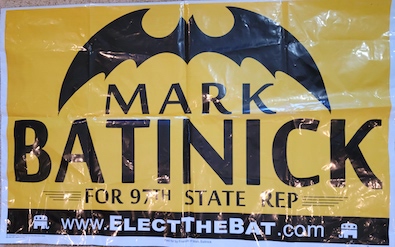
I’m gonna miss that guy. My only complaint is that he never should’ve retired his campaign logo…
To work to reduce crime in neighborhoods and invest in education opportunities, Democratic legislators unveiled a package of legislation to help better address the equity needs of local communities at a press conference Friday.
“Public Safety is an issue that has touched me and my neighbors directly and that is why I am in favor of greater community involvement,” said Senator Robert Peters (D-Chicago). “We can achieve real public safety for all by listening to communities and expert input, not by continuing the misguided policies of the past.”
House Bill 4736, sponsored Peters, would create the Crime Reduction Task Force – made up of a bipartisan group including legislators, law enforcement and legal and criminal justice professionals, as well as crime victims and witnesses. The task force would develop a plan of action to reduce crime across the state and report its findings to the General Assembly and the governor.
Additionally, the measure would create a statewide anonymous tip hotline and a Violent Crime Witness Protection fund to encourage individuals who witness crimes to file reports without putting their safety in jeopardy. Peters’ Senate Bill 4203 would provide $20 million for the Witness Protection fund and $1 million for the anonymous tip program.
Representative Jehan Gordon-Booth (D-Peoria) is filing an amendment to House Bill 1360 to create the Co-Responder Unit Pilot Program at police departments in East St. Louis, Peoria, Springfield and Waukegan. These co-responder units would employ social workers and focus on serving communities by focusing on mental and behavioral health, substance use disorder services and homelessness issues. In particular, the proposed units would work to connect violence survivors with needed services, including trauma-informed crisis intervention and counseling.
“We need a comprehensive, well-funded plan that targets the root causes of violence and gives communities the tools they require to reach out and assist those impacted by crime,” Gordon-Booth said. “Communities should utilize trained behavioral health professionals in conjunction with law enforcement. While this is one part of a larger effort to combat violence, an increased focus on behavioral health can help reduce use of force, crime rates and recidivism. Combined with stronger anonymous reporting and witness protection programs, it will help to create trust in communities we need to help.”
Senator Celina Villanueva (D-Chicago) introduced Senate Bill 4202, which would invest in funding for various programs supporting Illinois children and families.
“It’s especially important to me that marginalized populations have the same rights and opportunities as everyone else,” Villanueva said. “I take great care to make sure our underserved communities have equitable access to the resources they so critically need to target disparity at its source.”
The pandemic has highlighted cracks in early childhood care systems across the country – making the nearly $600 million investment in early childhood education more critical than ever. Additionally, the package includes investments for the Parents Too Soon program, Healthy Families Illinois program, Teen REACH After-School Program and the Child Care Assistance Program.
Senate Bill 4202 also appropriates $529 million – an increase of $50 million – for need-based MAP grants to help students afford college.
“I’ve said it before, but our children and how they’re taken care of says so much about our society. Investing in our children means building a solid future for them as individuals in our communities,” said Cristina Pacione-Zayas (D-Chicago). “The saying goes, ‘it takes a village,’ and making sure community programs can support our state’s youngest truly exemplifies that idea.”
As budget discussions continue in the last week of the spring legislative session, Democratic legislators continue to work to empower Illinois families.
* Dot points…
House Bill 4736 (Peters)
Crime Reduction Task Force
• House Bill 4736 would create a Crime Reduction Task Force to develop and propose ways to reduce crime across the state.
• The Crime Reduction Task Force would be made up of a bipartisan group of senators and representatives, alongside law enforcement, legal and criminal justice professionals, crime victims and witnesses.
• The group would review research and best practices while taking expert and witness testimony. It would then submit a report detailing its findings, recommendations and needed resources to the General Assembly and governor by March 1, 2024.
Anonymous reporting hotline
• House Bill 4736 would work to set up statewide tip hotlines to allow people to anonymously report crime in their communities.
• Under the measure, the Illinois Criminal Justice Information authority would establish a grant program open to organizations and units of local government to assist in the creation of creating anonymous tip hotlines or other systems to crime victims and witnesses.
• The grant program would help provide cash rewards for tips which lead to arrest.
Violent Crime Witness Protection Program
• House Bill 4736 would reconstitute and fund the Gang Crime Witness Protection Act as the Violent Crime Witness Protection program.
• The program would provide funding assistance for emergency or temporary living costs, moving costs, security deposits, mental health treatment and lost wage assistance.
Senate Bill 4202 (Villanueva)
• Senate Bill 4202 would provide investments into a number of community-based programs. The programs include:
o Early Childhood Education: $598 million, an increase of $54.4 million
o Parents Too Soon program: $7.7 million, an increase of $850,000
o Healthy Families Illinois program: $10.8 million, an increase of $850,000
o Teen REACH After-School Program: $19.6 million, an increase of $5.1 million o Child Care Assistance Program: $3 billion, an increase of $41.1 million
o Redeploy Illinois Program: $14.3 million, an increase of $8 million
o Monetary Award Program: $529 million, an increase of $50 million
o After school programming: $45 million, an increase of $25 million
*increase compared to FY 22
Senate Bill 4203 (Peters)
• Senate Bill 4203 would allocate $20 million for the Witness Protection Program and $1 million for the anonymous tip program.
House Bill 1360 (Gordon-Booth)
• House Bill 1360 would create the Co-Responder Unit Pilot Program at police departments in East St. Louis, Peoria, Springfield and Waukegan.
• The co-responder units would employ social workers and focus on serving communities by focusing on mental and behavioral health, substance use disorder services and homelessness issues. In particular, the proposed units would work to connect violence survivors with needed services, including trauma-informed crisis intervention and counseling.
Despite his promises to “bring honest and good government back to Illinois,” Richard Irvin has been exposed as a hypocrite yet again by a new WTTW report that shows Irvin used his mayoral office to line his campaign coffers.
After reporting on Monday that an Aurora company that donated to Irvin’s mayoral campaign received millions in city contracts, a new follow-up story from WTTW shows developers that donated to Irvin’s campaign received tens of millions in city incentives.
“Aurora taxpayers are on the hook for tens of millions in tax incentives to two other development companies that have donated thousands to Irvin and political funds connected to him,” a WTTW News review of public records found.
As they have on almost every key issue throughout the race, Irvin’s team dodged questions about the projects and campaign donations. But his GOP opponents got some jabs in over the pay-to-play scandal.
“Career Democrat Richard Irvin’s pay to play approach as Mayor of Aurora is one of the many red flags surrounding his campaign,” said Darren Bailey.
Jesse Sullivan said Illinoisans are “sick and tired of career politicians on both sides of the aisle who use public office to benefit themselves and their friends.” And Gary Rabine said that Irvin “turns out to be more like Mike Madigan than the reformer this state badly needs.”
Aurora should add more than $350 million in assessed value from projects currently outstanding – more than 10 times what the city has spent in incentives for them.
That was the word from outgoing Finance Director Martin Lyons during the July 20 City Council Committee of the Whole meeting.
Lyons, who has retired but has been working part-time as the city’s chief management officer, said the city has spent about a total of $34 million in incentives for a number of development or redevelopment projects.
That’s a pretty darned good return on the city’s investment. Plus, these are all union projects.
Also, all of those incentives that “Aurora taxpayers are on the hook for” were approved by the city council. The Hobbs Building project mentioned in the story, for instance, passed the council on a unanimous vote as did the Windfall development.
This February, Aurora’s City Council struck an agreement with Windfall to redevelop a three-acre, city-owned parking lot into 160 apartment and townhouse units on the west bank of the Fox River just north of downtown. […]
“I think they’re doing the right thing,” [Naperville-based developer Eddie Ni] told WTTW News. “If you don’t have the right incentives, nobody would do business here.”
The Chicago Sun-Times previously reported Ni is the developer referenced in a sweeping indictment of former Illinois House Speaker Mike Madigan. Ni and Windfall reportedly agreed to hire Mike Madigan’s property tax law firm in exchange for Madigan pushing legislation to transfer a parcel of state-owned land in Chinatown that Ni wanted to develop. The Sun-Times reported that Irvin’s current running mate for lieutenant governor, state Rep. Avery Bourne, amended legislation to include the transfer of land, but the deal never happened.
Public campaign records show that since 2018, Irvin’s mayoral political fund has received $25,000 in donations connected to Windfall, $3,500 of which came from Pacifica Square, $12,000 from a company listed with the same owners and same address called Pacific Square (without the “a”), and $9,500 from company owner Eddie Ni and real estate director Judy Ni.
Eddie Ni said there was no connection between the donations and awarded incentives.
“We donated small amounts over many years,” Ni said. “Everybody does that, both in and outside of Aurora.”
Irvin is the handpicked gubernatorial candidate of the state’s wealthiest resident, Citadel founder Ken Griffin. Griffin has deposited $20 million in Irvin’s campaign and has vowed that Irvin would clean up the corruption pervasive in state government.
As we’ve discussed more than once, Bourne’s bill never went anywhere, but the Irvin campaign has made a big deal out of calling Pritzker corrupt, so whatever I suppose.
Public records reveal that Mary Miller’s business has received fines, liens, and revocation of her business license for failure to pay taxes and unemployment insurance. Miller has also been repeatedly fined for chronically late payment of property taxes on properties owned by her personally and by her business.
“First we learned Mary Miller’s business took over $1 million in government subsidies from Farm Bill programs even as she touts support from the biggest Farm Bill opponent. Then we find out Miller’s business is incorporated in Delaware, which helps her avoid Illinois taxes. Now, we learn that Miller has been repeatedly fined for failing to pay her own taxes. This is yet another example of Miller saying one thing and doing another. It’s clear that Mary Miller is a professional politician looking out for herself.” - Davis campaign spokesperson Aaron DeGroot
While both are politicians, Mary Miller and her husband Chris are also corporate officers and co-owners of Miller Bros Farms, which is incorporated in the state of Delaware, a domestic tax shelter. Both the State of Illinois and Coles County have levied fines, penalties, and liens against Mary Miller for failing to pay business taxes and property taxes and make unemployment insurance contributions. Miller even had her business license revoked by the Illinois Secretary of State for failure to pay taxes.
* I posted an excerpt from an article in the Athletic the other day and pointed to Ken Griffin’s investment in Chinese surveillance companies. Here’s Griffin’s response via Greg Hynes…
“I was proud to serve as a member of the Chicago organizing committee when the city bid for the 2016 Summer Olympics. We all appreciated the critical importance of ensuring the safety and security of athletes and visitors attending the Games.
“In 2006, China Security & Surveillance Technology—a company listed on the New York Stock Exchange—was raising further capital to pursue growth opportunities. CS&ST was hoping to be selected as a key partner in providing security capabilities for the 2008 Beijing Summer Olympics and the 2010 Shanghai World’s Fair to ensure those events would be safe for everyone.
“Rather than waste taxpayers time peddling fanciful stories about me, we would all be so much better off if the governor finally took action to address violent crime, improve the state’s finances, and fight corruption and waste. This is a new low, even for him.”
Dude loaned money to a company which used the cash to buy other companies that supply the Chinese Communist Party with intelligence on their own people, including dissidents. His answer ain’t gonna cut it.
Cheryl L. Johnson
Clerk of the U.S. House of Representatives
H-154 The Capitol
Washington, D.C. 20515
Dear Ms. Johnson:
Pursuant to House Resolution 8, I write to notify you of the designation of a proxy to cast my vote.
I am unable to physically attend proceedings in the House Chamber due to the ongoing public health emergency, and I hereby grant the authority to cast my vote by proxy to the Honorable Don Beyer (VA-08), who has agreed to serve as my proxy.
The House of Representatives voted Thursday to approve legislation that would limit cost-sharing for insulin under private health insurance and Medicare. The vote was 232-193, with 12 Republican members joining their Democratic colleagues to pass the measure.
Last night, every Illinois Republican in the U.S. House of Representatives voted against a bill to cap the cost of insulin for many Americans at $35 per month. Nearly one million people in Illinois rely on insulin – but right now, many families can be forced to choose between paying their bills or being able to afford a drug they cannot live without. That’s why every Illinois House Democrat voted yesterday to drastically cut the monthly cost of insulin for many Illinoisans – and why President Biden has been pushing to lower drug prices for Americans, including insulin.
Last night’s vote builds on state legislation enacted by the Illinois General Assembly and Gov. JB Pritzker in 2019 to cap insulin costs at $100 per month for all patients using a state-regulated insurance plan. That legislation passed on an overwhelming bipartisan vote, though current Republican statewide candidates Avery Bourne and Tom Demmer voted no to cutting health care costs.
“The vote by every Illinois Republican in Congress against capping insulin costs is a slap in the face to the many Illinoisans on private health insurance and Medicare who depend on this life saving drug,” said Abby Witt, Executive Director of the Democratic Party of Illinois. “While Illinois Democrats at every level are focused on lowering the cost of insulin and other medications Americans depend on, Republicans are siding with big pharmaceutical companies over working families.”
— Rep. Sean Casten has been endorsed by the Associated Fire Fighters of Illinois and the Chicago Fire Department Fire Fighters in the suburban 6th Congressional District primary.
— David Moore, a Democrat running for secretary of state, has been endorsed by the Collective PAC, a political action committee “dedicated to increasing Black political engagement, representation, and power across all levels of government.”
Despite allegations of using dirty tricks, 13th Ward Ald. Marty Quinn beat the college kid again — this time in federal court.
U.S. District Judge Steven Seeger this week dismissed a lawsuit brought by David Krupa, who as a 19-year-old DePaul University student ran an upstart campaign for alderman in 2019 but lost. Krupa in the lawsuit accused Quinn and then-Speaker Michael Madigan of violating his civil rights following the alderman’s overly aggressive efforts to keep Krupa off the ballot and defeat him. […]
Krupa’s attorney, Tony Peraica, acknowledged in an interview that the lawsuit was an “uphill battle” and said he did not plan to appeal. A spokeswoman for Quinn declined to comment.
* Cases are up by 4.8 percent and hospitalizations are up 6 percent from last Friday. Everyone should probably stop partying like it’s 1999. Still, these are small base numbers, so there could be some statistical noise out there. ICU usage is up 14 percent, from 64 to 73. Ventilator usage, another lagging indicator, was down 21 percent. Deaths, the ultimate lagging indicator, were down 20 percent, from 109 to 87. Positivity rates are up slightly. Average daily vaccine doses are finally rising again (11.6 percent). From IDPH…
The Illinois Department of Public Health (IDPH) today reported 8,426 new confirmed and probable cases of coronavirus disease (COVID-19) in Illinois, including an increase of 87 deaths since March 25, 2022.
Currently, IDPH is reporting a total of 3,069,650 cases, including 33,394 deaths, in 102 counties in Illinois since the beginning of the pandemic. The age of cases ranges from younger than one to older than 100 years. Since March 25, 2022, laboratories have reported 501,236 specimens for a total of 57,392,864 since the start of the pandemic. As of last night, 500 individuals in Illinois were reported to be in the hospital with COVID-19. Of those, 73 patients were in the ICU and 26 patients with COVID-19 were on ventilators.
The preliminary seven-day statewide case rate is 65.3 COVID-19 cases per 100,000 Illinoisans. The preliminary seven-day statewide positivity for cases as a percent of total tests from March 25-31, 2022 is 1.7%. The preliminary seven-day statewide test positivity from March 25-31, 2022 is 1.7%.
This week, IDPH informed Illinois vaccine providers that it has adopted the recommendation of the Centers for Disease Control and Prevention (CDC) for a second booster dose for certain individuals at least four months after the first booster dose. This applies to adults over 50 years of age, and to immunocompromised individuals over 12 years old. The CDC also recommended a second booster dose with an mRNA vaccine for all those who received the Johnson & Johnson vaccine for both their primary dose and their first booster, four months after their first booster dose. Those who already received an mRNA booster dose after their initial Johnson and Johnson primary vaccine do not need an additional booster unless they are either over the age of 50 years or immunocompromised.
The state also announced that providers who administer COVID-19 vaccines to uninsured individuals can bill the Illinois Department of Healthcare and Family Services’ (HFS) COVID-19 Uninsured Program for vaccine administration. More information on the HFS program, which also covers COVID-19 testing, is available here.
As of today, April 1, IDPH and the Illinois Emergency Management Agency are discontinuing their joint effort of the Statewide Community Partner Vaccination and Staffing Assistance Program. Vaccines will continue to be readily available at locations across the state, including pharmacies, local health departments, doctor’s offices, and other health centers.
Since the COVID-19 vaccine became available to the public, millions of eligible adults and children across the state of Illinois have received their COVID-19 vaccine or booster dose.
Illinois remains among the highest in the Midwest for its vaccination rates, with more than two thirds of the population fully vaccinated.
A total of 21,374,596 vaccines have been administered in Illinois as of last midnight. The seven-day rolling average of vaccines administered daily is 8,386 doses. Since March 25, 2022, 58,703 doses were reported administered in Illinois. Of Illinois’ total population, more than 76% has received at least one COVID-19 vaccine dose, more than 68% of Illinois’ total population is fully vaccinated, and more than 50% are boosted according to data from the Centers for Disease Control and Prevention.
All data are provisional and are subject to change. Additional information and COVID-19 data can be found at https://dph.illinois.gov/covid19.html.
Vaccination is the key to ending this pandemic. To find a COVID-19 vaccination location near you, go to www.vaccines.gov.
This week, the federal government established a new website that provides an all-purpose toolkit that provides information on how to obtain masks, treatment, vaccines and testing resources for all areas of the country at: https://www.covid.gov/.
I am currently debating about whether to get my second booster shot today or wait until the end of session next week.
The Irvin for Illinois campaign is setting the record straight on Pritzker’s cowardice in having his Democratic allies launch illegitimate attack ads to hijack the Republican gubernatorial primary.
The new 30-second tv spot “Best Chance” clears the air that the Democratic Governors Association is doing Pritzker’s dirty work to smear Richard’s strong record as a decorated combat veteran, tough on crime prosecutor and successful mayor of Illinois’ second largest city.
“Instead of manning up, J.B. Pritzker is letting the Democratic Governors Association do his dirty work in maligning the strongest candidate to take him out this November,” Irvin for Illinois campaign spokesperson Eleni Demertzis said. “J.B. Pritzker needs to take the silver spoon out of his mouth and fight his own battles.”
“Instead of being a man and putting his name on these false attacks, Governor Pritzker chooses to hide behind political insider groups by forcing them to meddle into the GOP primary on his behalf,” Durkin said.
…Adding… Christina Amestoy at the DGA…
“Republicans can whine all they want but they can’t point to anything false in this ad. This ad reveals Richard Irvin’s real record on crime and even he knows it - that’s why he still won’t talk about the 15 years of his career profiting off of defending these types of criminals. Turns out the only thing Richard Irvin won’t defend is his own record.”
* Another Irvin press release from this morning…
Today the Irvin for Illinois campaign is announcing a new list of legislative co-chairs who support Richard Irvin and Avery Bourne to take back Illinois from skyrocketing crime, high taxes, and never-ending corruption.
Topping the list of endorsers is State Senator and Deputy Minority Leader Sue Rezin (R-Morris), who believes we need new leadership in Springfield for a better Illinois.
“Our state has been critically mismanaged under JB Pritzker’s leadership,” said Rezin. “Illinois faces out-of-control crime, ongoing corruption within the statehouse, and diminished care for veterans at state-run facilities without real solutions to address these challenges. We have an opportunity for real leadership in Illinois with Richard Irvin and Avery Bourne, and I’m proud to support them.”
State Representative Ryan Spain (R-Peoria) has worked alongside Avery Bourne in the statehouse, and has seen her success in the General Assembly firsthand.
“Illinois under JB Pritzker has been one disaster after another—from his failure to take accountability for the state’s significant challenges or his inability to manage problems at state agencies,” said Spain. “Now we have an opportunity to elect proven leaders who have prioritized Illinois families and have pledged to root out crime and corruption, and provide the relief residents so badly need, which is why I am putting my full support behind Richard Irvin and Avery Bourne.”
Aurora Mayor and gubernatorial candidate Richard Irvin and his running mate, State Representative Avery Bourne (R-Morrisonvile) released the following statement regarding the endorsements:
“We are pleased to have this resounding support from legislative leaders who understand that JB Pritzker has not met the needs of families and businesses across Illinois. There are countless challenges our state faces–from crime and corruption to our state’s fiscal stability. Together, we are committed to taking our state back and working to reduce crime, cut taxes, and fight corruption.”
The legislative endorsements include the following lawmakers:
Tim Ozinga, Illinois State Representative (HD 37)
Seth Lewis, Illinois State Representative (HD 45)
Dan Ugaste, Illinois State Representative (HD 65)
Jeff Keicher, Illinois State Representative (HD 70)
Ryan Spain, Illinois State Representative (HD 73)
David Welter, Illinois State Representative (HD 75)
Jackie Haas, Illinois State Representative (HD 79)
Jim Durkin, Illinois State Representative (HD 82)
Tim Butler, Illinois State Representative (HD 87)
Mark Batinick, Illinois State Representative (HD 97)
Amy Elik, Illinois State Representative (HD 111)
Donald DeWitte, Illinois State Senator (SD 33)
Sue Rezin, Illinois State Senator (SD 38)
John Curran, Illinois State Senator (SD 41)
Jesse Sullivan tried hard to convince Sen. Rezin to be his running mate. Didn’t work. Rep. Spain is one of the most likeable members of the HGOP caucus.
Announcing: The Bitcoin & Freedom panel at #TGFB2022:@jimmysong will be joined by AZ Senate candidate @bgmasters, IL governor candidate @JesseSullivanIL, & former NFL player/philanthropist @TimTebow to talk about Bitcoin as a tool for freedom.
Sullivan said “hand on the Bible” he will not do the bidding of his big crypto currency donors or any others.
“I want to go to Heaven more than being Governor,” said Sullivan. “I owe no man anything when I step into office. So all my top donors, that I have gotten to know, have done this work with me around the world…trying to back companies and create jobs…didn’t even really know my politics. For me, the one area that I believe in that they also believe in is in the future of the internet.”
As governor, Jesse Sullivan will transform Chicago into a hub for cryptocurrency and blockchain technologies.
Sullivan’s top campaign contributor said the candidate will “put Chicago in the rightful position as a top-five global financial center by embracing fintech and crypto. He’s a bridgebuilder to a more unified future.”
*** UPDATE *** Also from the Thank God for Bitcoin conference organizer J.M. Bush’s Twitter feed…
The March University of Illinois Flash Index moved ahead strongly in March, rising to 106.1 compared to 105.7 in February.
“This is a post-crisis high,” said University of Illinois economist J. Fred Giertz, who compiles the monthly index for the Institute of Government and Public Affairs. “The Illinois economy gained strength as measured by state tax receipts for the month, overcoming the economic headwinds of the invasion of Ukraine and the most recent variant of the COVID-19 virus.”
As noted in recent reports, state tax revenues have been extremely strong as has been the case for other states and the federal government. “This raises concerns about the stability of the ratio of tax receipts and economic activity that is the fundamental building block of the index,” said Giertz. “These issues should be resolved once the disruptions of the COVID-19 crisis recede.”
Illinois unemployment data provide support for the strength of the index. The unemployment rate in Illinois fell to 4.8%, which is also a post-recession low, from 5.0% the previous month and 6.9% a year ago.
Many observers have expected the economy to slow somewhat in 2022, but this has yet to materialize. Even after adjusting for the recent high rate of inflation, all three components of the index were up from the same month last year, with corporate and individual tax receipts especially strong. See The Full Flash Index Archive. The recently released national GDP growth rate for the last quarter of 2021 was also strong at an inflation-adjusted 7.0%.
The Flash Index is the weighted average of Illinois growth rates in corporate earnings, consumer spending and personal income as estimated from receipts for corporate income, individual income, and retail sales taxes. These are adjusted for inflation before growth rates are calculated. The growth rate for each component is then calculated for the 12-month period using data through March 31, 2022. After two years since the beginning of the COVID-19 crisis, ad hoc adjustments are still needed because of the timing of the tax receipts resulting from state and Federal changes in payment dates.
A bill that allows teachers and other school and university employees or contractors who are fully vaccinated to take paid administrative leave if they have to miss work due to coronavirus-related issues cleared the Illinois Senate Thursday and will soon be sent to Gov. JB Pritzker.
House Bill 1167, by Rep. Janet Yang Rohr, D-Naperville, and Senate President Don Harmon, D-Oak Park, would guarantee full pay for any day that a fully-vaccinated school employee misses if they are required to stay home because they have a confirmed or probable case of COVID-19. […]
Senate Minority Leader Dan McConchie, R-Hawthorn Woods, pointed to a hypothetical example of two teachers, one vaccinated and one not, who have to stay home to take care of a sick child. He said one of those would receive paid leave to do so but the other would not. […]
Harmon, however, said the bill does not mandate that any school employee be vaccinated, and he compared the extra benefit vaccinated employees would receive to the extra pay some teachers receive if they pursue an advanced degree.
“This is not a vaccine mandate,” Harmon said. “There is no requirement that one needs to be vaccinated to work in public schools. It is, however, an incentive.”
There are also provisions in the measure giving retroactive time to vaccinated staff who previously took time off because of COVID-19 issues and guarantees pay for workers like bus drivers if schools have to shut down because of a COVID-19 outbreak.
The measure found bipartisan opposition, but secured enough votes to pass both chambers and could now be sent to the governor.
Senate Democrats not voting were Belt, Collins, Crowe, Loughran Cappel, Muñoz and D. Turner.
No Republicans voted for the bill.
…Adding… IEA President Kathi Griffin…
“Our state is in the middle of a growing teacher and education employee shortage. We have thousands of open public education positions right now. We need to be doing everything we can to attract young people to the profession and to also show those who’ve chosen education as their life’s work that they are respected. Providing COVID administrative days and paycheck protection for hourly employees is one way we can do that. We know some of our support staff and teachers have exhausted their sick and personal time because of the COVID-19 pandemic. We have educators who saved their sick time to take after the birth of a child, who have since run out of days and are now forced with a very difficult decision - to take unpaid time off or to cut precious bonding time with their newborn short and return to work early. We have support staff who’ve used all their sick and personal days, and are being forced to take unpaid time off to quarantine or for another COVID related reason. House Bill 1167 would provide much needed relief to our teachers and support staff who’ve worked diligently to not only provide a quality education for students but also work to keep their students, schools and their communities safe over the past two years.”
With states across the country passing draconian bans on reproductive health care, House Democrats made it clear on Thursday that Illinois will always protect a person’s right to choose.
“Reproductive health care is under assault throughout this country,” said House Speaker Emanuel “Chris” Welch. “Today, House Democrats sent a clear message that people seeking health care won’t be criminalized, providers won’t be forced to abandon patients, and Illinois will remain a safe haven for anyone who needs reproductive health care.”
House Democrats passed House Bill 1464 which will ensure Illinois health care providers are not punished by other states’ cruel and oppressive laws because performing an abortion in Illinois is not a crime. The measure clarifies that a licensed doctor in Illinois cannot be disciplined in Illinois if another state suspends or revokes their license for participating in or performing an abortion. This bill protects doctors from these restrictive and unnecessary sanctions so they can continue to provide the vital health care Illinoisans need.
“Planned Parenthood Illinois Action is tremendously grateful for the leadership being shown today by Speaker Welch and other pro-choice leaders who are working to ensure that all Illinois residents have equitable access to the high-quality health care that Planned Parenthood of Illinois provides,” said Brigid Leahy, Vice President of Public Policy at Planned Parenthood Illinois Action. “It is crucial that Illinois remain a haven state in the Midwest because if Roe falls, every state that borders Illinois would quickly move to either ban or severely restrict abortion, forcing people to travel to a state like Illinois for the health care they need and deserve.”
“As abortion rights are attacked each week across the country, Illinois worked diligently to establish a fundamental right for all people to make every decision regarding their reproductive health care without government interference,” said Colleen Connell, Executive Director, ACLU. “The Illinois House of Representatives today reaffirmed that our state will not let others undermine this commitment. That message is welcome – for people in Illinois and those in other states who need to access health care, including abortion care.”
The House of Representatives also voted for a variety of resolutions that will reaffirm Illinois’ commitment to protecting reproductive health care for all. House Resolution 789 will bring further awareness to the importance of reproductive rights and promotes Illinois as a role model for other states as they strive toward full reproductive justice. House Resolution 790 is a strong reminder of Illinois’ support for the landmark legislation Roe v. Wade and House Resolution 94 urges the state to fully fund Planned Parenthood so that they can continue to perform essential reproductive and general health care services.
One woman was particularly notable among those voting against all four bills: Republican Rep. Avery Bourne, the running mate of gubernatorial candidate Richard Irvin, who associates say in the past has expressed support for abortion rights — and has stumbled more recently in explaining his views.
Not voting at all: Republican Rep. Tom Demmer, who’s running for state treasurer on the Irvin-Bourne slate backed by billionaire Ken Griffin; and House Minority Leader Jim Durkin, an outspoken supporter of Griffin’s slate.
Rep. Dan Brady, who’s running for secretary of state in the Republican primary — without any help from Griffin — was a no on all four bills.
The most substantive bill was House Bill 1464, which says physicians and nurses who find their licenses challenged in other states because they performed or assisted in an abortion can’t be punished in Illinois for doing so if they’re otherwise qualified to practice here. Three resolutions called for expressing “unwavering support” and commitment for abortion rights, and support for the work of Planned Parenthood.
The bills prompted impassioned speeches from Democratic lawmakers, including Camille Lilly, who heads the Democrats’ women’s caucus, Margaret Croke, Dagmara Avelar, and Maura Hirschauer.
Republicans lost the battles on all four bills but they didn’t go down without a fight. Rep. Jackie Haas from Kankakee called one of the bills “out of touch.” And Rep. Tony McCombie from Sterling said another of the abortion rights-supporting measures does nothing to help communities “feel safer.”
“It’s incredibly frustrating,” said State Rep. Randy Frese (R-Paloma), “that instead of working on a plan that could provide relief, we waste our time debating resolutions such as this.”
“I don’t want to negate anything in regards to inflation,” said State Rep. Margaret Croke (pictured) (D-Chicago), 21 weeks pregnant. “But I don’t want to have to worry about dying in a back alley trying to get an abortion, and I think that’s pretty frickin’ important, and we need to make sure that we are funding places like Planned Parenthood, where women in this state can get those services.” Applause rose as she spoke.
Several Democrats spoke to propel resolutions in favor of preserving abortion rights. House Speaker Chris Welch (D-Hillside) bragged that the Democrats are the ones putting Illinois on the right track, as opposed to former Gov. Bruce Rauner, a Republican, who, Welch said, “was destroyin’ this state.”
Ironically, it was Rauner who signed into law the Reproductive Health Act after telling supporters, including Chicago Cardinal Blase Cupich, that he wouldn’t.
A bill that would make it a felony to donate fetal tissue from abortions for research or therapies won first-round approval in the Missouri House Tuesday, but lawmakers blocked an effort to make it illegal to help a women obtain an abortion outside the state. […]
The only anti-abortion provision offered Tuesday that didn’t make it onto the final bill was a much-discussed proposal that aimed to limit women from seeking abortions outside Missouri. It would have made it illegal to perform or “aid or abet” an abortion for a Missouri resident — regardless of where the procedure occurs. It would provide exceptions in instances where the abortion is needed due to a life-threatening condition.