CEO Chris Crane has said [the governor’s proposed $70 million a year subsidy for two of Exelon’s nuclear power plants is] not nearly enough. So how much is enough? The company continues to dodge that question. The only hint Crane has given came in a May 5 earnings call with analysts when he pointed to a recent decision in New Jersey to subsidize nukes there.
“If you take a look at what happened in New Jersey last week, the (state) concluded that the financial challenges faced by nuclear plants there justified a maximum (subsidy) of $10 per megawatt-hour,” Crane said.
Applying that level of support to Dresden and Byron would entail increases in electricity rates sufficient to generate $353 million in annual revenue based on the two plants’ 2019 production. That’s nearly five times what Pritzker is offering—an amount based on an independent audit the governor commissioned of Exelon’s nuclear plants—and well above the $235 million Rauner signed into law in 2016.
The 2016 subsidy adds about $2 a month on average to electric bills throughout the state. A $353 million subsidy would tack on nearly $3 more.
The demanded subsidy is about $120 million more than the 2016 bill signed into law by Gov. Bruce Rauner. But that $353 million figure may actually be low. Subscribers know more.
* I’m told that several performers are demanding that anyone who works backstage at the Illinois State Fair Grandstand must be vaccinated or they won’t play. The state uses an outside company to provide backstage workers and they must be unionized. From Stagehands Local 138…
For those that plan to work the 2021 Illinois State Fair I have some information and requirements to pass along.
The Department of Agriculture has notified us that we will need to ensure all our employees performing services on the Fairgrounds are fully vaccinated with an FDA-approved COVID-19 vaccination. This is an amendment to our current State Fair contract. Here is the definition of fully vaccinated per the Dept of Ag.
“Fully vaccinated with an FDA-approved COVID-19 vaccination” is defined as the person having all doses of a vaccine approved by for public use by the Federal Drug Administration, and being at least two weeks past the final shot. This means either: two (2) doses of the Moderna vaccine within the allowable time apart, two (2) doses of the Pfizer vaccine within the allowable time apart, or one (1) dose of Johnson & Johnson. If additional vaccinations become FDA-approved treatment, these can be included without violating this agreement. Exemptions to this exist for any individual with a religious or medical exemption as defined by the EEOC.
We are also required to notify the Dept of Ag at least one week prior to arrival on the Fairgrounds with a list of all employees and their vaccination status. It can take awhile to get fully vaccinated so we (local 138) are putting a deadline to reporting your verification status.
The deadline will be Saturday July 17th, 2021 by 8pm. Anyone that does not report their vaccination status by this date and time will not be able to work the State Fair.
Note: If we fail to comply with any of these requests it could be considered a breach of our contract, cause for termination or removal from the Fairgrounds. So please help this process go as smoothly as possible. If you have any questions please contact one of your officers of the local.
* On to the fun stuff, if you like Sammy Hagar…
The Illinois State Fair will welcome Sammy Hagar & The Circle, one of rock music’s most dynamic supergroups, featuring Rock & Roll Hall of Fame inductees Sammy Hagar and bassist Michael Anthony, drummer Jason Bonham and guitarist Vic Johnson to the Illinois Lottery Grandstand Stage Thursday, August 12.
Tickets for Sammy Hagar & The Circle will go on sale Saturday, May 22 at 10am on www.ticketmaster.com.
For the last four decades, Sammy Hagar has been one of rock music’s most dynamic and prolific artists. From breaking into the industry with the seminal hard rock band Montrose, to his multiplatinum solo career, to his ride as the front man of Van Halen, Chickenfoot and his latest supergroup The Circle, Hagar has set the tone for some of the greatest rock anthems ever written with songs like “I Can’t Drive 55,” “Right Now,” and “Why Can’t This Be Love.”
Sammy Hagar & The Circle have quickly established themselves as one of the most emphatic and exciting live acts on tour today. The band seamlessly rips through career-spanning hits from Sammy Hagar’s solo career, Van Halen, Montrose and new music from The Circle’s debut album, Space Between, which debuted at #4 on the Billboard 200 chart and #1 four Billboard charts including Top Rock Albums and Hard Rock Albums charts. The Circle kicked off 2021 with the release of Lockdown 2020, an album collection of their massively popular Lockdown Sessions featuring raw and raucous compact covers recorded remotely by each bandmember during the Covid-19 pandemic, the digital music videos which include hits like The Who’s “Won‘t Get Fooled Again,” Bob Marley’s “Three Little Birds, “AC/DC, “Whole Lotta Rosie” and David Bowie’s “Heroes” had already reached an online audience of more than 30 million before the album’s release.
In addition to Sammy Hagar & The Circle joining the Illinois Lottery Grandstand lineup, Dorothy and Dead Poet Society have been announced as opening acts for Badflower on August 19. Dorothy’s first album ROCKISDEAD hit number one on Billboard’s Heatseekers Chart, with two songs from the album in the Top 40 on Billboard’s Mainstream Rock Chart. Dead Poet Society’s musical landscape runs the gamut from heavy riff driven songs to stunningly beautiful ballads. Their signature sound is created by fretless guitars and the extraordinary vocals of lead singer Jack Underkofle.
The Illinois State Fair also announced Kelsea Ballerini has canceled her stop at the Illinois State Fair. Ballerini was scheduled to perform with Kylie Morgan and Chapel Heart on Friday August 20. Customers who purchased Kelsea Ballerini tickets directly through www.Ticketmaster.com or through the Ticketmaster mobile app, will receive an automatic refund back to the card used to purchase the tickets.
Tickets for Sammy Hagar & The Circle will go on sale Saturday, May 22 at 10am on www.ticketmaster.com. Please note, fairgoers who purchase grandstand tickets will receive a full refund if COVID-19 prevents the Illinois State Fair from being held.
The Illinois House on Wednesday passed a bill that would expand the scope of the Firearms Restraining Order Act and spread awareness of the law in law enforcement and the general public.
Skokie Democratic Rep. Denyse Stoneback, a freshman legislator, introduced House Bill 1092 last month in response to high profile mass shootings that took place in the U.S. earlier this year, including a shooting at an Indiana FedEx facility. […]
Under the Illinois’ Firearm Restraining Order Act, family members of an individual and law enforcement can petition the courts to remove that individual’s guns and prevent them from purchasing or borrowing guns if it is determined that the individual would pose a threat to themself or others if they were in possession of a firearm.
Stoneback’s legislation would expand the list of family members who can file such a petition to include former spouses and people who have or allegedly have a child with the subject of the restraining order.
HB 1092 would also apply the firearm restraining order to more than just guns. If courts grant the order, under Stoneback’s bill, the individual would also be banned from purchasing or owning ammunition and weapon parts that could be assembled into a usable gun.
Congress banned states from installing new lead water lines in 1986. Yet, most of the older pipes still haven’t been removed. Illinois state lawmakers hope to finally address that issue this year to make sure everyone has clean water.
Experts say Illinois has one-eighth of all lead service lines in the United States. Lawmakers argue it’s past time to replace those pipes.
Their plan could also create a state grant program to fund the project and technical assistance for utility workers. Research from the Metropolitan Planning Council shows Black and Latinx people in Illinois are twice as likely to live in areas with lead pipes than their white counterparts.
Sen. Melinda Bush (D-Grayslake) says her proposal is a reasonable and equitable path forward to ensure every community eliminates this issue. She also feels this plan is a significant long-term economic engine for Illinois.
* I’ve received several not quite literate emails from this group, so I’m glad somebody stepped in to make some sense out of it…
A group of Illinois county clerks opposing a hike in a document fee has coincided with an audit of the Housing Development Authority that found repeated instances of inaccurate financial reporting involving millions of dollars.
Lawmakers are considering legislation that would double the fee for documents obtained through Recorder of Deeds offices from $9 to $18, and the money is supposed to be distributed to the Rental Housing Support Program throughout the state.
Tazewell County Clerk John Ackerman said his county hasn’t received any grants from the program in the last decade despite contributing nearly $1 million in fees. Two of the 10 clerks opposed to the fee hike say their county has received grants from the program.
“Our research found this grant revenue rarely leaves the Chicago Metro Area and not all the expenses could be accounted for, leaving many of us wondering just where is all this already existing revenue going?” according to a statement from the clerks.
The Illinois House has passed House Bill 3498, a bill aimed at removing barriers to telehealth services.
COVID-19 sped up the adoption telehealth, in which patients attend doctors’ visits remotely via video call, but not all have access under existing law.
Charles James, the Illinois Rural Health Association’s president-elect, said the bill addresses at the state level a problem “cooked in” to how providers get paid for telehealth services.
The reimbursement structures for rural health clinics and community health centers meant they weren’t getting paid for remote patient visits.
“There were restrictions on providers being able to be paid in certain circumstances, and there was a hard restriction on patients being able to be at their home,” James said.
And in Kansas City, Mo., Mayor Quinton Lucas in a matter of about seven hours said he would not change his mask order, then that he would think about it, then that he was getting rid of it altogether because there was no good way to know who was fully vaccinated and who was not.
“While I understand the C.D.C.’s theory that they could just create a rule that says vaccinated folks go anywhere without a mask, and everybody else who’s unvaccinated will follow it, I don’t know if that’s the type of rule that was written in coordination with anyone who has been a governor or a mayor over the last 14 months,” said Mr. Lucas, a Democrat.
The abrupt decision by the Centers for Disease Control and Prevention to free fully vaccinated people from its mask guidance in most indoor and outdoor settings set off a scramble on Friday across the country to update local rules and redefine social norms.
Major corporations and local shopkeepers weighed whether to take down “masks-required” signs on their doors. People heading to the office or coffee shop or grocery store had to navigate rapidly shifting scientific advice and government restrictions. And surprised state and local officials, including some who withstood months of protests and lawsuits to keep mask orders in place, said they needed time to evaluate the new federal guidance.
“We’ve just learned of that prospective determination while we’re on the stage,” Stefan Pryor, the Rhode Island secretary of commerce, said during a news conference on Thursday shortly after the C.D.C. released its new guidance. “But as of now, yes, mask-wearing will be required.”
* The Question: Do you think there will be much confusion or controversy over this new mask policy? Explain, please.
Friday, May 14, 2021 - Posted by Advertising Department
[The following is a paid advertisement.]
We can’t have fair maps if those maps aren’t drawn using the full set of detailed Census data. But, due to census delays, Illinois politicians are planning to use outdated, estimated numbers to draw election maps that will last for a decade.
We know those estimates missed tens of thousands of us. We need the next set of election district maps to fully reflect our communities, and the only way that can happen is if those maps are drawn with current, complete Census data to give all our communities accurate and fair representation.
Call Governor Pritzker’s office today to ask that he push lawmakers to seek court permission to delay the process so that the next set of election maps are drawn with COMPLETE Census data, NOT old estimates.
The Illinois Department of Public Health (IDPH) today reported 1,841 new confirmed and probable cases of coronavirus disease (COVID-19) in Illinois, including 49 additional deaths.
Boone County: 1 male 80s
Cook County: 2 females 50s, 3 males 50s, 1 male 60s, 1 female 70s, 2 males 70s, 2 females 80s, 2 females 90s, 1 male 90s
DuPage County: 1 female 60s, 1 male 60s
Edgar County: 1 female 50s
Ford County: 1 female 40s
Franklin County: 1 male 60s
Fulton County: 1 female 50s
Hancock County: 1 female 70s
Henry County: 1 female 80s
Jersey County: 1 male 70s
Kane County: 1 female 40s, 1 female 70s, 1 male 70s
Kendall County: 1 female 60s
Madison County: 1 female 70s
McHenry County: 1 male 70s, 1 male 80s, 1 female 90s
Morgan County: 1 female 60s
Peoria County: 1 female 40s, 1 male 50s, 2 males 60s, 1 female 80s
Rock Island County: 1 male 70s, 1 female 90s, 1 male 90s
Schuyler County: 1 male 90s
St. Clair County: 1 male 60s
Stephenson County: 1 female 80s, 1 female 90s
Tazewell County: 1 male 50s
Whiteside County: 1 male 40s
Williamson County: 1 male 80s
Winnebago County: 1 male 90s
Currently, IDPH is reporting a total of 1,363,507 cases, including 22,369 deaths, in 102 counties in Illinois. The age of cases ranges from younger than one to older than 100 years. Within the past 24 hours, laboratories have reported 83,624 specimens for a total of 23,677,720. As of last night, 1,708 individuals in Illinois were reported to be in the hospital with COVID-19. Of those, 425 patients were in the ICU and 237 patients with COVID-19 were on ventilators.
The preliminary seven-day statewide positivity for cases as a percent of total test from May 7-13, 2021 is 2.5%. The preliminary seven-day statewide test positivity from May 7-13, 2021 is 3.1%.
A total of 10,229,330 vaccines have been administered in Illinois as of last midnight. The seven-day rolling average of vaccines administered daily is 72,767 doses. Yesterday, 50,326 doses were reported administered in Illinois.
*All data are provisional and will change. In order to rapidly report COVID-19 information to the public, data are being reported in real-time. Information is constantly being entered into an electronic system and the number of cases and deaths can change as additional information is gathered. For health questions about COVID-19, call the hotline at 1-800-889-3931 or email dph.sick@illinois.gov.
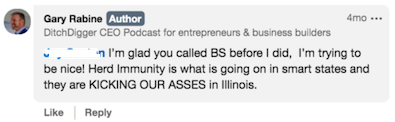
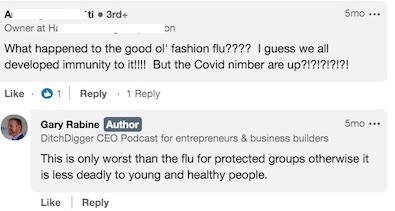
Gary Rabine, a candidate for Governor, is calling for Illinois to join the list of a growing number of states opting out of the federal unemployment benefits.
“Small businesses have suffered long enough and now with their inability to find workers to fill their openings, they will suffer longer,” Rabine said. “It is very important that we stop the unemployment stimulus now and get our kids back to school in Illinois.”
The National Federation of Independent Business reported that 44% of small businesses said they can’t find workers to fill job openings. The unemployment bonus is scheduled to expire in September, but by that time the most productive months of Illinois small business will be gone.
“The Biden administration, who our Governor Pritzker is aligned with on almost everything, said there is little evidence that the unemployment stimulus is dissuading people from taking jobs,” Rabine said. “They blamed closed schools and daycare centers, saying many parents have to stay home to take care of children. The Biden administration is wrong, the unemployment bonus is dissuading people from working. Any worker who can make more on unemployment owes it to themselves and their families to consider staying home.”
At least nine states, including Missouri and Iowa, are opting out of the benefit later this summer. Iowa Governor Kim Reynolds said in a statement: “Federal pandemic-related unemployment benefit programs initially provided displaced Iowans with crucial assistance when the pandemic began. But now that our businesses and schools have reopened, these payments are discouraging people from returning to work.”
Businesses have 8.1 million jobs to fill and yet in April, the economy only added a paltry 266,000 jobs suggesting the federal unemployment benefits are keeping workers out of the workplace. Rabine said he is hearing from Illinois employers with concerns about their ability to fill open positions.
“As I travel this state, I see ‘Help Wanted’ signs everywhere and when I talk to the business owners, I hear the same thing – they can’t fill the jobs,” Rabine said. “I don’t blame workers for choosing unemployment benefits over going to a job. It makes total sense to get the same pay or in some cases higher pay staying home than dealing with going to work every day. I don’t blame anyone for making a logical decision, but at the same time we need healthy, able-bodied workers to return to the workforce. We need to follow the lead of Missouri and Iowa and opt out of the federal unemployment benefits. Job growth is the only path forward for a full economic recovery and we can’t have that if our workers aren’t working.”
Rabine said Biden is right that many parents feel they must stay home with their children who are not in school and we can’t blame good parents for this. The Rabine plan is to:
1. Stop the unemployment stimulus bonuses
2. Get Illinois’ public schools open 100%
3. Lower, not raise, taxes
“If we do these things, Illinoisans will want to get back to work and small businesses will have the opportunity to serve their customers again at maximum productivity with millions of career opportunities,” Rabine said. “We need to stop the printing presses, get back to school and back to work!”
* I was on break when Rabine announced his candidacy in late March. Sun-Times story…
“Fifteen years ago in Illinois, we really were the best place in the middle of the country to create jobs and start a business, to grow a business. But over the last 15 years, that’s deteriorated to being the worst,” he told the Sun-Times in an interview between events Tuesday.
He dismisses Democratic Gov. J.B. Pritzker as a “trust fund billionaire” who doesn’t have the right business experience to lead the state.
“I don’t have any knowledge of him ever building a business from the ground up. I mean, he calls himself an entrepreneur, but I’ve not witnessed real entrepreneurship there,” he said of Pritzker. “Buying and selling companies for profit is a little different from … building a paving business here in Illinois and creating a national platform for paving parking lots.”
Rabine criticized Pritzker’s handling of the COVID-19 crisis, saying that “a total shutdown may not have been necessary” last March.
Fifteen years ago, Rod Blagojevich was running for his second term in office. Just sayin…
Rabine, a Bull Valley resident, said he will avoid the partisan paralysis the state saw with Rauner by bringing an open mind and steady communication to working with the legislature, rather than relying on executive orders as Rabine said Pritzker has done in his response to the COVID-19 pandemic.
“I believe that I get stronger when I surround myself with people who think differently,” Rabine said. “Because my passion is to understand all sides of the coin, I’m confident that I’ll be able to reach across better than most anybody I’ve seen.”
Rabine said he thinks the legislature will continue to evolve from the one involved in the budget impasse under the Rauner administration after being freed from the grip of former Illinois House Speaker Michael Madigan.
By 2022, the “financial crisis” in Illinois will have reached a breaking point where bipartisan cooperation will be necessary, and unavoidable, he said.
Asked by a reporter if he believed, as Trump has falsely stated, that the election was stolen due to fraud, Rabine said, “I’m not smart enough to understand what was the end result, whether it was stolen or not, and I would never say that.” […]
Rabine is an advisory board member of Turning Point USA, the controversial conservative youth group founded by Illinoisan Charlie Kirk. Rabine has called Kirk one of his heroes. Kirk, who has come under fire for spreading disinformation about the pandemic, was one of the first users of the term “China virus.” The Washington Post reported that during last year’s election season his organization funded a deceptive social media campaign aimed at influencing young people. […]
[Rabine] pledged he would “never shut down our economy and ruin thousands of businesses as J.B. Pritzker has.” […]
Rabine pledged a 50% cut in property taxes by 2024. Asked earlier how he would substantially cut property taxes, which primarily fund schools, without hurting education, Rabine offered no details but said he had an “economic team” working on a plan.
* It’s almost the two-year mark for Chicago Mayor Lori Lightfoot, so analyses abound. I’ll just focus on my lane. Here’s Greg Hinz…
One place adjustment clearly is needed is Springfield. Despite a big win in finally getting permission to build a casino—something her predecessors could only dream about—the mayor’s team constantly jostles with Pritzker’s. With her friend John Cullerton no longer the Senate president, Lightfoot suffered a series of humiliating defeats, including being routed on a bill that will raise pensions for some firefighters at a difficult time, dropping plans for a tax hike she wanted for affordable housing and struggling to save her power on the school board.
The advice from such varied figures as House GOP Leader Jim Durkin and Sen. Sara Feigenholtz, D-Chicago: Reach out, personally. “It’s about compromising and collaborating,” Feigenholtz puts it.
That graduated real estate transfer tax issue could’ve been easily resolved had she simply recognized that the other side had enough votes to kill her plan and all she had to do was find a win. She went my way or the highway and it died. Her refusal to deal on the elected school board likely led to the firefighters pension bill, and her elected board counter-proposal was ridiculous. Subscribers know more about another challenge she faces these days.
* But despite all this, she apparently remains above water with the public. This poll was conducted by the same pollster I used last year and found to be pretty darned reliable…
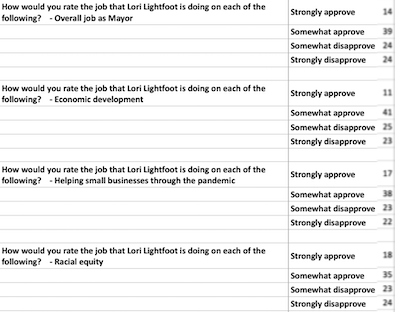
The poll, which had a margin of error of 4.8%, also asked respondents how they rate Lightfoot’s overall performance, with 53% saying they either strongly approved or somewhat approved of the job she’s doing.
Lightfoot did best among respondents age 65 or older; 64% of them approved of the job she’s done. And 70% of Black respondents approved of her performance.
According to the poll, 41% of Latinos surveyed and 50% of whites said they approved of her performance.
Remember, however, that she won her election with 73 percent of the vote. Also, you may notice there are no disapproval numbers in that story.
* I reached out and was able to get the crosstabs. Here are her topline results…
As you can see, she’s at 14 percent strongly approve with all respondents versus 24 strongly disapprove.
The crosstabs show her underwater with Latinos 41-58. She’s at 50-49 with whites, 70-30 with Black people, 44-56 with 18-34 year olds, 59-42 with 35-49 year olds, 54-47 with 50-64 year olds and 64-35 with 65+. Obviously, there’s some rounding to those numbers over four different variables. Methodology is here.
There’s another angle to this poll, so I’ll try to get to that in a bit.
The Lincoln Club of McLean County on Thursday evening hosted its inaugural event at the Bloomington Country Club. Billed as an educational forum, the event was entitled “Can Illinois Be Fixed?”
As debated by a panel of GOP leaders, that question centered largely around another question: Can Republicans unseat Gov. JB Pritzker in the 2022 gubernatorial race?
The answer, according to former Illinois Gov. Jim Edgar is … maybe.
He was joined on the panel by state Rep. Dan Brady of Bloomington and former Illinois Republican Party Chairman Pat Brady. The event was moderated by state Sen. Jason Barickman, also of Bloomington.
Edgar said the problem facing Republicans in a gubernatorial race is the growing chasm between a state that’s moving left and a party that’s moving right.
“One of the things I found as a downstater running is you can’t scare the folks up north,” Edgar said. “Now, I could get votes up there and there’s some I didn’t get. But, for the most part, they weren’t scared of me. They didn’t think I was going to be evil, so they didn’t go out and try to beat me. So, if we have candidates who sound pretty harsh and talk about ‘well, let’s [kick] Chicago out of the state.’ that’s not going to play well.”
That was an implicit dig at state Sen. Darren Bailey, R-Xenia, who co-sponsored a resolution last session calling for Chicago to be made its own state. Bailey announced his gubernatorial campaign in 2022. […]
Edgar, when asked about prospective candidates who might have a shot against Pritzker, named U.S. Rep. Rodney Davis, R-Taylorville, and Barickman.
Barickman, first elected to the House in 2011 before moving over to the Senate in 2013, said he’s not ruling out a gubernatorial campaign and will make a decision “later this summer.”
House Majority Leader Greg Harris, D-Chicago, told reporters at a Statehouse news conference that the latest information from federal officials indicates Illinois state government will receive $8.1 billion in stimulus funds, not $7.5 billion as initially reported. […]
However, Harris and Zalewski said the additional federal stimulus funds and indications that the state’s economy is recovering quicker as the COVID-19 pandemic wanes don’t mean Pritzker’s proposed repeal of certain tax breaks for companies can be abandoned.
Harris noted that Pritzker now agrees with Democratic leaders that $350 million in spending needs to be added to the fiscal 2022 budget to boost the school-aid formula.
And $296 million more needs to be appropriated for the Medicaid program to deal with pandemic-related medical expenses for low-income residents, Harris said.
Harris says lawmakers are looking at a $1.3 billion hole in the budget right now. That’s down significantly since last week. He explained appropriations groups already started to go through each of the over 12,000 spending lines in the budget.
“The choices are really clear,” Harris said. “We’re either going to find ways to cut to fill that hole or we’re going to have to review the proposals the governor made to close corporate tax loopholes on wealthy individuals and corporations.”
On Thursday, Durbin led a letter from most of the Democrats in the Illinois congressional delegation to Yellen, making the point the Federal Reserve created that fund to “help state and local governments manage cash flow pressures caused by the pandemic.”
Gov. J.B. Pritzker “and his administration have been in frequent contact with the Treasury Department” to overturn the ban, deputy chief of staff Emily Bittner told the Chicago Sun-Times on Thursday.
The White House should not be surprised at the Illinois pushback. Mendoza and Pritzker have been saying for months Illinois would use a chunk of the $8 billion to repay the debt from the Federal Reserve loan.
They are all asking the Biden White House and Treasury Department to recognize the special Illinois circumstances concerning this one specific debt offering and not apply fiscal handcuffs.
While we appreciate the work that the Treasury Department is doing to implement the state and local aid provisions of the American Rescue Plan (“ARP”) Act, we write to raise concerns about limitations on the use of funds included in Treasury’s recently released Interim Final Rule on State and Local Fiscal Recovery Funds that will have negative economic impacts on Illinois. We ask Treasury to clarify this Rule to allow State and Local Fiscal Recovery Funds to be used to directly repay short-term borrowing necessitated by the pandemic.
Over the course of the pandemic, Illinois and state and local governments around the country have experienced significant budget shortfalls that impacted their ability to fund essential government services. During the most fiscally challenging times for the state’s cash flow during the pandemic, Illinois utilized short-term borrowing to prevent drastic cuts to healthcare, education, public safety, and key social services. As outlined in the attached letter to Treasury from Illinois Comptroller Susana Mendoza, the State of Illinois used $3.8 billion in short-term borrowing to continue necessary medical payments to the Illinois healthcare industry and purchase urgently needed PPE supplies and equipment at critical points in 2020. Without this short-term borrowing, the state’s recovery would have been jeopardized. These debts would not have been incurred except as a response to the pandemic, which is why Illinois utilized the Federal Reserve’s Municipal Liquidity Facility that was specifically created to help state and local governments manage cash flow pressures caused by the pandemic.
Despite the ARP’s clear intent to allow state and local funding to be used to pay for government services to the extent needed to replace the revenue lost during the last year, Treasury’s Interim Final Rule prohibits the use of funding to repay short-term borrowing even if that borrowing occurred as a result of the pandemic and was used to fund essential government services during the crisis. This limitation that uniquely impacts Illinois runs contrary to the intent of the ARP. We ask that you clarify this Rule to accommodate Illinois’ unique circumstances and allow the ARP’s State and Local Fiscal Recovery funding to be used to directly repay short-term borrowing by state and localities which was necessitated by pandemic and used to help mitigate their response to it.
I firmly believe in following the science and will revise my executive orders in line with @CDCgov guidelines lifting additional mitigations for vaccinated people.
— Governor JB Pritzker (@GovPritzker) May 13, 2021
* Heh…
BREAKING: CDC Officially Announces that We Can Dance If We Want to, We Can Leave Your Friends Behind, Cause Your Friends Don’t Dance and If They Don’t Dance, Well They’re No Friends of Mine
In the months before the state-run veterans’ home in LaSalle saw a massive COVID-19 outbreak that eventually killed more than a quarter of the facility’s residents, leaders at the state agency that oversees the home obscured its inner workings from Gov. JB Pritzker’s office, a top Pritzker staffer told lawmakers on Thursday.
Thirty-six residents at the LaSalle Veterans’ Home eventually died after testing positive for COVID in an outbreak that began in early November and spread to more than 100 residents and more than 100 staff members. A damning inspector general’s report on the outbreak released late last month faulted absentee leadership, lack of preparedness, lax COVID protocols and poor communication as contributing factors for the crisis at the home.
In an appearance in front of the Illinois House Veterans’ Affairs Committee Thursday, Deputy Gov. Sol Flores painted the state’s Department of Veterans’ Affairs as a sort of black box, repeatedly telling lawmakers she believed what top officials at the Illinois Department of Veterans’ Affairs was telling her in the months leading up to the LaSalle outbreak. […]
“It’s not just grief; I also share your rage at the loss of life that occurred at LaSalle,” Flores said. “What I was told was happening there is a far cry from the circumstances set forth in the [inspector general]’s report.”
Mazzochi also noted that on Nov. 11, Pritzker appeared at a ribbon-cutting for a new veterans home in Chicago where he touted the success of the agency in combating COVID-19 in veterans homes despite what was happening at LaSalle.
“We’ve worked very hard. Our veterans homes really have done an outstanding job of keeping our veterans safe. But you can’t 100% keep everybody safe in this environment” when local officials aren’t enforcing mitigations, Pritzker said at the ribbon-cutting.
That was a day before the state public health department and the federal Veterans Affairs sent an on-site team to LaSalle, where they found lapses in protocols and the use of non-alcohol based hand sanitizer as well as staff congregating without masks.
By Nov. 9, two days before Pritzker’s statement, the home had more than 60 positive cases, and by Nov. 13, two days after his statement, 10 veterans had died.
“How could you let him make that statement with a straight face … given the nature of the briefing that you gave him internally on Nov. 9?” Mazzochi asked after Flores said she briefed Pritzker of the intensifying outbreak.
“We didn’t understand the full scope of what was happening until after Nov. 10,” Flores replied.
But she also said Pritzker had ordered the public health agency be “immediately” deployed to LaSalle on Nov. 9. They arrived three days later.
Oof.
The TV ads write themselves.
Ironically enough, Gov. Rauner did a public event with his own IDVA director at the beginning of the Quincy Legionnaires’ outbreak. That came back to haunt him, too.
Over the past three decades, a family-owned construction company got 32 contracts from the city of Chicago to repair sewers and install water mains — work that cost taxpayers more than $295 million.
Now, in a federal lawsuit against the company that was initiated by a whistleblower, City Hall accuses Joel Kennedy Constructing Corp. of lying and cheating to get six contracts since 2013, including falsely claiming to be a Chicago company when it’s actually headquartered in Waukegan.
According to the lawsuit, the company also submitted phony paperwork showing 50% of the work was done by Chicago residents, as required by a city ordinance.
But an investigation by City Hall’s inspector general’s office found that Kennedy’s company submitted its weekly payroll records only after first deleting the names of its suburban employees, making it wrongly appear Chicago residents had done more than half of the work.
A Waukegan contractor who has gotten nearly $300 million in water and sewer construction work from the city of Chicago has been banned from getting any more city contracts.
That’s after City Hall Inspector General Joseph Ferguson found that Joel Kennedy Constructing Corp. cheated to meet the city’s residency requirement for workers employed by a contractor.
Now, Joel Kennedy, who says the ban would put his company out of business, is asking city officials to rescind the order. The company says it has “taken multiple steps to make sure we are fully compliant with residency requirements in the future.”
If he can’t persuade City Hall to drop the ban, “we intend to challenge the city’s debarment decision in court,” according to a written statement from Kennedy.