Following is a statement from State Rep. Kelly Cassidy in response to today’s vote for Speaker of the House of Representatives:
“While Speaker Madigan has dedicated his life to this chamber, it was clear that the time for change has come. And that change comes in the election of the first Black Speaker of the House. That is something our state should celebrate, especially on the heels of the historic criminal justice reform package we passed today–which was a direct result of the work of our Black Caucus. Having a more diverse slate of leaders in Illinois right now is critical, which is why I decided not to put my own name in for Speaker, after some serious consideration.
“While I have always had a strong relationship with and a great deal of respect for Speaker Welch and believe him to be a good man, I reserved my vote and recorded myself as ‘present’ in the Speaker’s election today. I did so because, at the same time that we’re ending years of scandal over allegations of sexual harassment and corruption, we have also just been made aware of troubling allegations from Speaker Welch’s past. He has denied each allegation, and we certainly have seen plenty of examples of Black men being wrongfully accused. I feel strongly that I have been too outspoken on issues of sexual harassment and domestic violence to simply ignore these questions.
“I have worked with victims for decades. I am a survivor of domestic violence. I trust women. I know the complexities of choosing to pursue charges or other legal action. This isn’t a simple situation–and it should not be dismissed as such by any of us.
“It is my fervent wish that these allegations will be vigorously reviewed so that we can move forward as a unified caucus embracing this historic moment.”
69 Comments  
|
* Amanda Vinicky did an expert job of live-tweeting Speaker Chris Welch’s first press conference…
First question is about what Welch will do to grow the economy. His answer: First, we need to get COVID under control b/c the feds’ approach thus far isn’t working.
“I haven’t had time to digest anything .. it’s been like a whirlwind 48 hours,” Welch says, noting that he’s on two hours of sleep … and he hasn’t had any before then. I’ll take it all in at some point, it’s going to hit me”
He’s so conditioned to fight, punch, Welch says of Durkin’s jabs at Madigan during his speech. But Welch says Durkin once supported him in a run for local school board. It’s an opportunity to develop a new relationship in this space.
Welch asked about the incidents with women in 2002, 2010; no need to go beyond that statement, he says. I respect the privacy of those involved. But you have to recognize that one incident was over 20 years ago — people mature, they handle situations differently
My life’s work shows that I respect women. The reason I’m here today is because my colleagues (men and women) asked me to do this, Welch says.
Last night, women met with Welch; he says it was “cordial, professional and I thought powerful.”
What’s an appropriate term limit: I think ten years. Asked will it be a rule? Welch says it should be a law, let’s pass one.
What are Welch’s priorities on ethics and how does he rebuild trust after the ComEd scandal/fed investigation? He talks about the final-hour ethics bill as a start. re: ComEd DPA, it’s being handled by the US Attorney, people should feel confident that’ll continue
Welch says Madigan should be applauded: We have 73 Democrats and are in the super-majority because of his leadership. There are some things we have to do differently, though.
Welch says he supports “fair maps” for redistricting. We’ll try to do the best we can, be as transparent as possible.
When @DonHarmonIL was elected Senate President, he stepped away from his job at a law firm. Welch says he’s had preliminary talks with partners at his law firm; he expect he will do the same and will make an announcement if/when it comes to that
“When you’ve been oppressed for 400 years there’s going to be some tension,” Welch said when asked about what he can do to help heal racial tensions.
What will he change? Welch says he’s going to be having a lot of conversations about that, and soon. For one, a leadership team that reflects the diversity of Illinois and the caucus (including 52% women)
* For more on the redistricting stuff, this is from CHANGE Illinois…
Speaker Chris Welch has a long track record of supporting independent redistricting. He has co-sponsored the Fair Maps Amendment and wrote about it here:
https://www.vfpress.news/articles/government/op-ed-why-redistricting-ensures-minority-representation/
The people of Illinois long have made known their strong support for moving to an independent redistricting process. In a CHANGE Illinois survey last year, 75 percent of voters supported it.
https://www.changeil.org/2020/03/poll-shows-voters-overwhelming-want-governor-pritzker-to-push-for-fair-maps/
I hope you will ask our new Speaker about his plans for redistricting soon and that editorial boards will encourage him to live up to his longstanding support.
17 Comments
|
Question of the day
Wednesday, Jan 13, 2021 - Posted by Rich Miller
* Biggest losers and biggest winners of the lame duck session? Make sure to explain your answer.
35 Comments
|
React to new House Speaker
Wednesday, Jan 13, 2021 - Posted by Rich Miller
* Illinois AFL-CIO…
The Illinois AFL-CIO today issued the following statement in response to the Illinois House selecting Emanuel “Chris” Welch as the new Speaker:
“The Illinois AFL-CIO, representing nearly 1 million working families across the state, today offers a hearty congratulations to new Illinois House Speaker Emanuel “Chris” Welch. Speaker Welch has a proven track record of fighting for working families, and we are eager to work with him, Senate President Harmon and Gov. Pritzker to address the significant challenges facing the state of Illinois as we begin 2021.”
Tim Drea, President, Illinois AFL-CIO
Pat Devaney, Secretary-Treasurer, Illinois AFL-CIO
* IFT…
Illinois Federation of Teachers (IFT) President Dan Montgomery released the following statement on today’s historic vote to elect Representative Emanuel “Chris” Welch as the first Black House Speaker in Illinois.
“Today, the Illinois House of Representatives made history by electing its first Black Speaker, Representative Emanuel “Chris” Welch. On behalf of the Illinois Federation of Teachers, I congratulate Speaker Welch on his momentous victory. As a state representative, Speaker Welch has been a friend and ally in protecting middle-class families from devastating cuts to public services and healthcare and an ardent supporter of public education. I have stood with him as he organized grassroots support for the safety of school children. Chris is a true public servant and will make an excellent Speaker.
“We look forward to working with Speaker Welch to protect collective bargaining for all workers and to strengthen public education for all children and educators of Illinois.”
* PPIA…
Statement attributed to Jennifer Welch, President and CEO of Planned Parenthood Illinois Action:
Planned Parenthood Illinois Action (PPIA) congratulates Rep. Emanuel “Chris” Welch on his historic election as the first African American Speaker of the Illinois House of Representatives. As a co-sponsor of both the Reproductive Health Act and HB40, which guarantee that abortion is safe and legal in Illinois, Speaker Welch has proven he is a champion for reproductive rights. We applaud his work requiring Illinois health insurance plans to cover contraception without a co-pay and his co-sponsorship of the Equal Rights Amendment. We look forward to continuing to work with Speaker Welch to ensure that Illinois is a safe haven for reproductive rights and access to health care.
We also urge Speaker Welch to continue his leadership on reproductive rights and push for the repeal the Parental Notice of Abortion Act, as well as promote the enactment of PPIA’s other 2021 legislative agenda items including family planning funding for lower-income and uninsured people, passing the Responsible Education for Adolescent and Children’s Health (REACH) Act, and supporting policies to address Black maternal health disparities.
* Equality Illinois…
Statement from Equality Illinois CEO Brian C. Johnson on the election of State Rep. Emanuel Chris Welch as Speaker of the Illinois House of Representatives for the 102nd General Assembly:
“Equality Illinois congratulates Rep. Welch on his historic election today as Speaker of the Illinois House of Representatives. From Marriage Equality in 2013 to the Inclusive Curriculum Law in 2019, Speaker Welch has always been a strong ally of LGBTQ Illinoisans and valued partner of Equality Illinois. We look forward to working with him to keep the Land of Lincoln moving forward and ensure Illinois lives up to our shared values of justice, fairness, and equality.”
* IEC…
The Illinois Environmental Council congratulates Emanuel “Chris” Welch on his election as house speaker and looks forward to our continued partnership in advancing protections for people and the environment in his new role,” said Jen Walling, IEC executive director. “It is monumental to have Speaker Welch, a champion for environmental justice and Clean Energy Jobs Act co-sponsor, who has earned a lifetime score of 98% on our Environmental Scorecard, holding the gavel. His speakership is historic as the first Black speaker of the Illinois House of Representatives, and we are eager to work with him in further tackling pollution, climate change and the other environmental challenges before us.
* ICJC…
The Illinois Clean Jobs Coalition congratulates State Representative Emanuel “Chris” Welch on his election as the next Speaker of the Illinois House of Representatives.
As a longtime champion for the Clean Energy Jobs Act (CEJA), Speaker Welch understands the urgency of addressing climate change with solutions built around equitable jobs, lower energy bills, and no bailouts.
The new Speaker takes the helm at a historic time, and our coalition looks forward to confronting the challenges and seizing the opportunities that lie ahead together.”
…Adding… Rep. Kifowit…
Today, Rep. Stephanie Kifowit issued the following statement congratulating Rep. Emanuel “Chris” Welch on his historic election as the first Black Speaker of the Illinois House of Representatives.
“When I announced my intention to run for Speaker of the House back in October, I did so because I believed our caucus deserved a choice in leadership. Today, I am proud to have voted for Rep. Emanuel “Chris” Welch, who has shown time and time again that he is in it for the people of Illinois.
“Our state is facing tremendous challenges and it is imperative that we solve them together. Speaker Welch has shown that he will unite the state for the betterment of all Illinoisans, and I look forward to working with him in the 102nd General Assembly.
“I am energized by Speaker Welch’s vision and dedication, and I am proud to be a small part of the historic election of Illinois’ first Black Speaker of the House.”
* Frerichs…
Illinois State Treasurer Michael Frerichs today issued the following statement regarding the election of Rep. Emanuel “Chris” Welch as the newly elected Speaker of the 102nd General Assembly:
“We witnessed history today when members of the Illinois House of Representatives elected the first African American to lead their chamber,” Illinois State Treasurer Michael Frerichs said.
“I have worked successfully with the new Speaker to pass legislation to make it easier to save for college and fought alongside him to ensure the life insurance industry pays death benefits after a customer passes away,” Frerichs said. “Because of those past victories, I am excited to work with him to bring financial order to our state and to expand economic opportunity for every person in Illinois.”
* Personal PAC…
In every single fight for reproductive rights in the Illinois General Assembly over the past decade, Chris Welch has been a passionate, strategic, thoughtful and leading voice in the Illinois House.
Welch is fearless in his support for reproductive justice.
When many thought the historic 2017 fight for HB 40 would not be successful, Chris Welch worked to help us end the disgraceful denial of abortion care to low-income women and state employees.
In 2019, when the ground-breaking Reproductive Health Act (RHA) was facing an uphill battle in the Illinois House, Chris Welch spoke eloquently for the need to protect all Illinois women, regardless of Donald Trump’s Supreme Court.
In continuing to demonstrate his leadership and commitment to the reproductive rights of all, Chris Welch did not hesitate for a second to take on the great responsibility of being the Chief Sponsor of the House bill to repeal the dangerous Illinois Parental Notice of Abortion (PNA) law. We look forward to working with Speaker Welch to rid Illinois of this harmful law that puts the health and lives of young women at risk every single day.
Today, Speaker Welch becomes the first African American in Illinois history to lead the Illinois House.
It is a great day for Illinois and reproductive justice!
* IHA…
The Illinois Health and Hospital Association (IHA) congratulates State Representative Emanuel “Chris” Welch on his historic election as Speaker of the Illinois House of Representatives for the 102nd General Assembly. IHA and the hospital community look forward to working with Speaker Welch on critical healthcare issues, including addressing disparities in health and healthcare, to improve the health and well-being of all Illinoisans.
* JGG…
State Rep. Jennifer Gong-Gershowitz, D-Glenview, who was sworn in for her second term as an Illinois state representative for the 17th district on Wednesday, released the following statement:
“House Democrats have made a transformational change in our caucus by electing a new Speaker of the House. I congratulate my colleague, Representative Emmanuel “Chris” Welch, on his victory and I look forward to working with him as we lead Illinois through these uncertain times. I am proud that our caucus has finally elected a person of color to lead us. Speaker Welch represents real progress.
“As the first African-American Speaker of the House in Illinois’ 202-year history, his perspective and leadership is invaluable as we seek to combat racial inequity and anti-blackness in our communities. Speaker Welch has fought to expand access to healthcare for Illinois families, been a staunch ally of environmental organizations and has been a leader in protecting a woman’s right to choose.
“I am encouraged by the role that women played in this process. The first voices to call on former Speaker Madigan to retire were women. Women led the process to change our leadership from the beginning. I trust Speaker Welch to lead the House with an agenda that protects women’s rights, increases environmental sustainability and creates a more equitable Illinois.
“I am proud of the careful consideration and process that our caucus underwent. We came out of that process more united than we have ever been. That commitment to cooperation will be a vital asset and fills me with hope and resolve for the upcoming legislative session.
“The election of a new Speaker is not the end of this historic transformation, it is just the beginning. Addressing the immense challenges that our state faces while identifying new opportunities will be a herculean effort. It will require bold leadership, innovative solutions and difficult decisions. I am more confident than ever that our caucus, united around Speaker Welch, will rise to meet these challenges and work together to lead Illinois into a bright future.”
* Chamber…
The Illinois Chamber would like to congratulate Representative Emanuel “Chris” Welch on his election today as Speaker of the Illinois House of Representatives. Speaker Welch will be the first new speaker in the lifetime of many Illinoisans. It is no secret that Illinois faces a number of challenges including its budget and business climate, which have been exacerbated by the COVID-19 pandemic. The Illinois Chamber hopes to work collaboratively with Speaker Welch to better the state’s economy and jobs climate.
* Teamsters…
On behalf, Teamsters throughout the State of Illinois, Teamsters Joint Council No. 25 President Terrence J. Hancock offered his congratulations to State Representative Emanuel “Chris” Welch on being elected Speaker of the Illinois House of Representatives for the 102nd General Assembly on Wednesday.
“On behalf of Teamsters Joint Council 25 and the 100,000 hard working men and women we represent, I would like to offer our sincere congratulations to Speaker Welch. This is an historic moment, not just because the House is seeing its first change in speaker in three decades, but also because Speaker Welch is the first African American to lead the House in our State’s history,” Hancock said.
“This is an important time for our nation. We are more divided than we have ever been in my lifetime. That is why it is critical that we have strong leadership in our State. In his time in the House, Speaker Welch has been a staunch supporter of working families, and I am confident he will bring that same sensibility to his new role,” Hancock said.
“I would also like to thank outgoing Speaker of the House Michael J. Madigan for his decades of public service and his dedication to working families and the labor movement. I know that our Members and countless others throughout the State, are the better for it,” Hancock said. “And to Speaker Welch, I look forward to working with you on behalf of Teamsters throughout Illinois, and I wish you nothing but success as our next Speaker of the Illinois House of Representatives.”
* Clerk Yarbrough…
Cook County Clerk Karen A. Yarbrough issued the following statement on the election of State Representative Emanuel ‘Chris’ Welch as the new Speaker of the Illinois House of Representatives.
“I want to congratulate Representative Welch on his historic election as Speaker, and as a former Assistant Majority Leader in the House, I am particularly proud that Chris will serve as the first African American Speaker of the House. It is a fitting and just tribute to his leadership, and I have great confidence that he will serve with distinction in working to move our state forward.
I look forward to working with him on legislation concerning the operations and efficiencies of the Cook County Clerk’s Office, particularly with respect to our continued efforts to safeguard and protect the integrity of our electoral process as well as expanding access to the ballot as broadly as possible,” said Yarbrough.
* Comptroller Mendoza…
Congratulations, Speaker Emanuel Chris Welch, on your historic election as the first African-American Speaker of the Illinois House of Representatives! I have appreciated your help on legislation over the years and I look forward to working with you to move Illinois ahead.
* Rep. Margaret Croke…
“I congratulate Emanuel “Chris” Welch on his historic election as the first African-American Speaker of the Illinois House. It marks the start of a new era during a moment in time when much is at stake for our democracy as well as our state and its communities. I’m proud to have an opportunity to serve in this chamber and get to work with new leadership on protecting our small businesses, women’s healthcare and environment.”
* Faith in Place…
The Faith in Place Action Fund issued the following statement regarding the election of Rep. Emanuel “Chris” Welch as the new Speaker of the 102nd General Assembly.
Yesterday, the Faith in Place Action Fund stood in solidarity with the Illinois Legislative Black Caucus in their unanimous support of Rep. Emanuel “Chris” Welch (D-Hillside) for Speaker of the Illinois House of Representatives by issuing our strong endorsement.
We did so because Rep. Welch is a longtime ally as a champion of environmental and climate justice. Today we extend our congratulations to Speaker Welch. We stand in prayer, solidarity, and action to continue to promote political action for environmental justice in Illinois.
* IAMHP…
“The Illinois Association of Medicaid Health Plans would like to congratulate State Rep. Emanuel Chris Welch on his election as Speaker of the Illinois House of Representatives for the 102nd General Assembly. This is truly a momentous victory, becoming the first African American Speaker of the Illinois House of Representatives. IAMHP has had the pleasure of working with Speaker Welch on a number of priority initiatives including, implicit bias training to address Racial Disparities in Healthcare and protections for nursing home residents. We look forward to continuing to work together to improve the Medicaid program for over 3 million Illinoisans.”
* SEIU Local 73…
“SEIU Local 73 congratulates Rep. Emanuel “Chris” Welch on his historic election as the first Black Speaker of the Illinois House of Representatives,” said Dian Palmer, President of SEIU Local 73. “Speaker Welch’s support for the labor movement and working families is the leadership we need. We look forward to working with him in the continuing fight for workers’, voters’, and immigrants’ rights.”
* AG Raoul…
Attorney General Kwame Raoul today issued the following statement to congratulate Rep. Emanuel “Chris” Welch on his election as the 70th speaker of the Illinois House of Representatives.
“Today is a historic day, as Rep. Chris Welch was elected to serve as the 70th speaker of the Illinois House of Representatives. Speaker Welch has been a dedicated advocate for his constituents, and I know Speaker Welch will continue to serve the people of Illinois with diligence.
“Members of the Illinois House of Representatives have passed the baton to a new generation of leadership, and I look forward to our work together to enact policies and reforms that protect and benefit all Illinois residents.”
* Secretary White…
Statement from Illinois Secretary of State Jesse White on the Election of Emanuel “Chris” Welch as Speaker of the Illinois House of Representatives
It was an honor today to preside over the inauguration of the 102nd Illinois House of Representatives and the historic election of Emanuel “Chris” Welch as the new House Speaker. Speaker Welch will serve as the first African American in that important post. I congratulate Chris on this historic achievement.
* Chicago’s mayor…
* Governor…
Governor JB Pritzker issued the following statement on the election of Representative Emanuel “Chris” Welch as Speaker of the House.
“I would like to extend my heartfelt congratulations to Representative Welch on his historic win as he becomes our state’s first Black Speaker of the House,” said Governor JB Pritzker. “Speaker Welch has a record of championing legislation that has improved the lives of hard working Illinoisans, and I have enjoyed working with him to move our state forward. As Governor, I believe strongly that it is incumbent upon me to work with the General Assembly’s leaders who are chosen by their caucuses, and I look forward to continuing to work with Speaker Welch on our shared agenda.”
“I also want to recognize Speaker Madigan for his decades of service to the state of Illinois. Years from now, when historians focus on the legacy of the General Assemblies he has led, they will see beyond this chapter to the many achievements in the fight to lift up working families and those most in need, and they will especially acknowledge the necessary firewall that was built in the fight against Governor Rauner’s destructive agenda.
* IBIC…
The Illinois Business Immigration Coalition congratulates State Representative Emanuel “Chris” Welch on his historic election as Speaker of the Illinois House of Representatives for the 102nd General Assembly. Speaker Welch is a fighter for immigrants and small businesses. We look forward to continuing to work with him to ensure Illinois’ most vulnerable populations and businesses have a fighting chance to recover, rebuild, and serve their local economy.
We thank Speaker Michael J. Madigan for his decades of service. Under Speaker Madigan’s leadership, Illinois became the most immigrant friendly state in the nation. From passing in-state tuition, to driver’s licenses and healthcare for undocumented children and seniors, immigrants are able to go to school, work, church in relative peace. We wish Speaker Madigan the best.
* LG…
Lt. Gov. Stratton’s Statement on New Speaker of the Illinois House
CHICAGO —This is historic. Congratulations to Speaker Emanuel “Chris” Welch for becoming the first African-American to hold this position.
In this country, the momentum is towards broadening leadership that looks like, and represents, all people. When we do that we can create policies and initiatives that will positively impact all Illinoisans.
Thank you to immediate past Speaker Michael Madigan for your service. We look forward to working with Speaker Welch and the newly inaugurated members of the 102nd General Assembly on issues that impact every resident of Illinois, including economic development, physical and mental health, education, and social justice reform.
* LIUNA…
“We wish to congratulate Representative Emanuel ‘Chris’ Welch on his election as Speaker of the Illinois House of Representatives. Laborers across the state of Illinois will surely benefit from Speaker Welch’s leadership and his dedication to working families,” said John F. Penn, Vice President and Regional Manager of LiUNA’s 50,000 member Midwest Region.
Raised in a union household, Mr. Welch was awarded the prestigious Zeke Giorgi award by the Illinois AFL-CIO in 2016 as an outspoken advocate for working families. He has a strong voting record on issues important to not only Laborers, but the entire union movement.
“We look forward to working closely with Speaker Welch,” Penn said, “and again, congratulate him on his historic win as Illinois’ first African American Speaker of the House.”
“We also want to thank outgoing House Speaker, Michael Madigan. As the longest serving House speaker in American history, Mr. Madigan’s reputation as a champion for issues facing working families is well deserved,” Penn said.
“Historic laws expanding and strengthening prevailing wage and work zone safety laws and passage of collective bargaining rights for public employees were successfully guided through the Illinois House of Representatives under his leadership. And, we will never forget that Speaker Madigan also stood up to Bruce Rauner and his anti-worker agenda for four, long years; and won.
“The hard-working Laborers in downstate Illinois owe you a debt of gratitude and thank you Speaker Madigan.”
* Carpenters…
Chicago Regional Council of Carpenters Executive-Secretary Treasurer Gary Perinar issued the following statement today:
“The 30,000 hardworking men and women of the Chicago Regional Council of Carpenters congratulate State Rep. Emanuel “Chris” Welch on his historic election to become the first Black Speaker of the Illinois House of Representatives. Speaker Welch is a strong advocate for working families across Illinois, and we look forward to working with him and his leadership team to enact policies that focus on improving the lives of the working class and make sure our rights are protected.”
* *EA President Kathi Griffin…
“The Illinois Education Association would like to congratulate one of the top public education advocates in the Illinois General Assembly, and the 2018 recipient of the IEA Friend of Education Award, on his election as Speaker of the Illinois House of Representatives. State Rep. Emanuel “Chris” Welch (D-Hillside), has consistently distinguished himself, specifically when he served as past chair of the House Higher Education Committee and as a member of the Elementary and Secondary Education Appropriations Committee. Representative Welch believes in local control of schools. He was the chief sponsor of legislation that would empower local school boards to create charter schools, rather than having the state charter school commission dictate that decision. He opposes measures that would divert public money to private schools and supports providing schools and education employees with what they need in order to deliver a high-quality education to all students. I was able to work with him, personally, when he co-chaired Gov. JB Pritzker’s Educational Success Transition Committee with me, Sen. Andy Manar (D-Bunker Hill) and Chicago Public Schools Supt. Janice Jackson. We look forward to working with him in his new role and know he’ll do a great job! Speaker Welch’s commitment to education predates his time in the legislature. He served for years on the Proviso Township High School District 209 Board of Education and led efforts to create Illinois’ first suburban-based magnet high school, the Proviso Math and Science Academy.”
* IARF…
IARF congratulates the new Speaker of the Illinois House of Representatives, Emmanuel “Chris” Welch on his historic election. As a State Representative from the 7th District, Representative Welch consistently voted for funding and policies to support community providers serving and supporting children and adults with intellectual/developmental disabilities and serious mental illnesses. We look forward to working with Speaker Welch, President Harmon, and Republican Leaders Durkin and McConchie in the 102nd General Assembly to advance and improve community-based services in Illinois.
* G-PAC…
Newly elected Speaker Welch has been a staunch ally of gun violence survivors, underserved communities and a champion of laws designed to protect children, families, and communities from the devastation caused by illegal guns. As G-PAC approaches the gun violence problem as a public health crisis, we look forward to working with Speaker Welch to pass policies that will promote equity by providing employment, education and healthcare to all Illinois communities.
* Rep. Harper…
State Rep. Sonya Harper, D-Chicago, Joint Caucus Chair for the Illinois Legislative Black Caucus (ILBC), issued the following statement regarding the election of state Rep. Emanuel “Chris” Welch, D-Hillside, as the first African American Speaker of the Illinois House of Representatives:
“Today’s election of Speaker Welch to lead the Illinois House is historic. As the first African American to lead the Illinois House, Speaker Welch has reached a pinnacle not just of his own making, but of generations of African Americans before him who fought for equality and justice.
“Here in Illinois the Legislative Black Caucus is extremely proud to have had several members who represent historic firsts, a list that now includes Speaker Welch. Former ILBC member Carol Moseley Braun served Illinois as the first Black, female U.S. Senator in the history of our nation and former ILBC member Barack Obama served our country as the first Africian American president. As a member of the Black Caucus and as a member of the House who has worked alongside Speaker Welch, I am confident that he will have the same tradition of forward-thinking service as President Obama and Sen. Moseley Braun.
“I look forward to working with Speaker Welch to help achieve justice and equality for all and on behalf of the members of the Black Caucus, I salute him on this historic achievement.”
* Raja…
Today, Congressman Raja Krishnamoorthi issued the following statement in response to State Representative Chris Welch’s election as Speaker of the Illinois House of Representatives:
“I congratulate State Rep. Chris Welch on being elected as the 70th Speaker of the Illinois House of Representatives. I look forward to working with Speaker Welch, Gov. Pritzker, Senate President Harmon, and the members of the Illinois General Assembly to pass much needed state and local government stimulus support in Congress as we continue to fight and beat COVID-19.”
* SEIU Healthcare…
The following is a statement from SEIU Healthcare Illinois President Greg Kelley regarding the news that Representative Emanuel “Chris” Welch has been elected as the 70th Speaker of the Illinois House and the first African American to hold that position.
We congratulate Representative Welch on his historic election as the first Black Speaker of the Illinois House of Representatives.
Speaker Welch has been a steadfast champion for working families and the 85,000 members of SEIU HCII, and we look forward to working with him on the critical issues of the day: dismantling structural racism, eliminating income inequality, defeating COVID-19, and making sure everyone has a voice on the job and in their community. We will engage with Welch as we continue to fight for a society and economy that works for everyone.
* Harmon…
Illinois Senate President Don Harmon issued the following statement congratulating the new Speaker of the Illinois House Chris Welch.
“Congratulations to Representative Welch on being elected Speaker of the House. It is a historic occasion.
“We have worked together for years serving the near western suburbs, so I know firsthand the commitment he has to the people he represents.
“We have monumental challenges ahead of us this legislative session. I look forward to working with Speaker Welch to meet them.”
7 Comments
|
* That means three House Democrats didn’t vote. They’re missing Rep. Jaime Andrade, who is ill with COVID-19. Checking on roll call.
…Adding… Rep. Lance Yednock voted “Present.” Rep. Kelly Cassidy did not vote.
13 Comments
|
House Republicans complain about process
Wednesday, Jan 13, 2021 - Posted by Rich Miller
* Press release…
Ugaste Condemns Unconscionable Process Behind Black Caucus Bill
SPRINGFIELD–On the heels of the Illinois Black Caucus’ police reform legislation passing at the eleventh hour of the 101st General Assembly, State Representative Dan Ugaste (R-Geneva) released the following statement:
“This police reform bill is the most hurtful to those who serve and protect us, and while I know that is not the intention behind it, words matter. The reality is that this 764 page bill—that the Republican caucus received in final form at 4:30am—will only pose a greater threat to public safety.
Despite my issues with the content included in this bill, I found the process behind it the most disturbing. With minimal collaboration and zero efforts put forth for bipartisanship, a rushed bill was pushed through in the literal last minutes of our General Assembly. The process matters. In the case of the Black Caucus, while their policy deserves consideration, they completed disrespected the legislative process. For my constituents back home who were maybe watching this debate live, it was hard to see what was actually happening on the house floor. The reality was this: our caucus was unable to pose questions to the bill’s sponsor, debate was cut off, and a vote was taken when it was convenient for the majority party to receive the needed votes for the bill to pass.
Up until 4am last night, I heard from record numbers of constituents, interest groups, and law enforcement members who emphasized their opposition to this measure. Their concerns varied but they were all were unified in their request that I oppose this bill. This was the easiest ‘no’ vote for me; I refuse to have the questions and concerns of my constituents be ignored.”
* Press release…
State Representative Deanne Mazzochi (R- Elmhurst) released the following statement upon the conclusion of the 101st General Assembly’s lame duck session:
“The events of the last few days highlight the brokenness of the legislative process in Springfield.
Comprehensive, lengthy, and sweeping bills were rammed through under both condensed process and truncated debate at the last minute of an outgoing General Assembly.
Rushing through the process doesn’t give the public and the various stakeholders enough time to vet legislation, voice their opinions, and engage in negotiations before it is voted on. The result of the last few days, and what many are going to pat themselves on the back for, is well-intentioned, but seriously problematic legislation.
All told, the consequences of these bills will ripple through every corner of the state for years to come; they contained thousands of pages that either amended or created hundreds of laws, yet the substance and specific text of these bills were given less than 48 hours for public input and legislative debate.
Meanwhile, we failed to address, to our great shame, some of the most needed relief for the people of Illinois. We didn’t address a plan to re-open schools, to wrest some semblance of power back from the Governor, to address the issues at IDES, etc and instead tried to shove through a billion dollar tax increase on already suffering small businesses, which thankfully not even some Democrats could stomach.
The 101st General Assembly ended in a manner which no one, regardless of party, should be proud of.”
* Press release…
State Representative Mike Murphy (R-Springfield) issued the following statement in response to the passage of a massive criminal justice overhaul bill in the waning moments of the 101st General Assembly. Amendment 2 to House Bill 3653 passed by a slim margin of 60-50 votes after only being compiled in the middle of the night.
“How can we have an open and honest debate about hundreds of pages of legislation if we barely have time to read it and the people of Illinois aren’t even allowed to engage in the discussion about legislation that will fundamentally change policing and public safety in the state?” questioned Murphy. “The short answer – we can’t! Preventing law enforcement, state’s attorney’s, victims’ rights advocates and others from being part of this discussion is an absolute travesty.
“Just as egregious as the language in the bill that will allow many violent felons to walk free before trial, was the handling of debate by the Democrat majority. It was an embarrassment and shows the true colors of their one-party rule. Law enforcement and public safety across our state were irreparably damaged today.”
* Meanwhile, from the other side…
The Illinois General Assembly today passed long-awaited public safety reforms — made possible by the leadership of the Illinois Legislative Black Caucus — securing a victory that makes communities left behind by the criminal justice system safer. Among the sweeping changes in House Bill 163, the law includes reforms championed by the Alliance for Safety and Justice that prioritize proven approaches to rehabilitation, enacting more effective sentence credit policies that reduce recidivism and racial disparities. In addition, the approved legislation reduces barriers that crime victims face in accessing recovery services by removing eligibility restrictions for families and communities most impacted by crime and violence.
“With the passage of HB 163, the Illinois state legislature has shown national leadership by advancing the state’s commitment to improving public safety and justice,” said Aswad Thomas, managing director of the Alliance for Safety and Justice’s flagship program, Crime Survivors for Safety and Justice. “By continuing to shift away from failed over-incarceration policies, prioritizing rehabilitation that stops cycles of crime, and lifting unnecessary barriers to victim services, Illinois has taken a crucial step towards connecting communities in greatest need to safety. The Illinois Legislative Black Caucus has advanced a commitment to achieving safer communities, and we especially want to thank Senator Elgie Sims and Deputy Majority Leader Jehan Gordon-Booth, as well as Attorney General Kwame Raoul.”
“Too many Illinois families have experienced the pain of losing a loved one or watched their communities suffer - I’ve felt that pain and loss myself. But today, Illinois is helping lead the way in addressing the root causes of violence and trauma,” said Bertha Purnell, coordinator of the Chicago chapter for Crime Survivors for Safety and Justice. “For far too long, public safety policies have focused on over-incarceration, rather than prevention, rehabilitation, and victim services for communities most impacted by violence. Today, our elected officials affirmed that we must address trauma and rehabilitation to ensure healthier and safer lives for our children and families.”
HB 163 improves the Illinois Department of Corrections’ (IDOC) sentence credit program that provides opportunities for people who are incarcerated to earn time off their sentences through good conduct and participation in rehabilitative programs — proven to reduce recidivism and break cycles of crime. For years, this system has been undermined by inconsistency in its administration. In partnership with the Illinois Department of Corrections, the Alliance for Safety and Justice designed changes to this system that will reduce rates of recidivism, racial disparities, and rising costs. HB 163 included these changes that will:
• Reduce racial disparities and increase the ability for Black applicants to earn credit by refining how IDOC uses risk assessments in determining program eligibility;
• Increase the amount of time people can earn through rehabilitative programs;
• Modernize Earned Program Credits, providing uniform access to the program across the IDOC system and expanding eligibility to earn credits;
• Create a standard and fair process for IDOC to remove and restore sentence credits, including the implementation of behavioral incentives for people who have lost credits due to violations.
The approved legislation also takes several steps to expand access to victim services for survivors of crime in Illinois. Through the leadership of Illinois’ Attorney General, the Alliance for Safety and Justice helped design important changes to the state’s Crime Victim Compensation program. These reforms include:
• Extending overall time limits to file victims compensation applications from 2 years to 5 years.
• Expanded victim compensation program coverage to family members of crime survivors by recognizing non-traditional households and classifying children, spouses, and parents of victims to be victims in their own right.
• Increased victim compensation caps for funeral expenses, loss of support, and loss of earnings.
• Crime survivors currently on probation or parole will no longer be barred from eligibility for the victim compensation program.
• Removes barriers for survivors in the victim compensation application and cooperation process before receiving services.
The full text of the bill can be viewed here.
15 Comments
|
* Back to reality, campers. Press release…
The Illinois Department of Public Health (IDPH) today reported 5,862 new confirmed and probable cases of coronavirus disease (COVID-19) in Illinois, including 97 additional deaths.
- Bond County: 1 female 90s
- Boone County: 1 male 50s
- Christian County: 1 female 80s
- Clinton County: 1 female 80s
- Cook County: 1 male 40s, 1 male 50s, 3 females 60s, 5 males 60s, 4 females 70s, 4 males 70s, 3 females 80s, 4 males 80, 1 female 90s, 1 male 90s
- DuPage County: 1 female 50s, 1 male 60s, 1 female 70s, 3 males 80s, 1 female 90s
- Hamilton County: 1 male 70s
- Iroquois County: 1 male 80s
- Jefferson County: 1 female 70s, 1 female 80s
- Jersey County: 1 male 70s
- Knox County: 1 female 70s
- Lake County: 2 females 80s, 1 male 80s, 2 females 90s, 1 male 90s
- LaSalle County: 1 male 70s
- Logan County: 1 female 60s
- Macon County: 1 male 80s
- Madison County: 1 male 70s
- McHenry County: 1 male 50s
- McLean County: 1 male 40s, 2 males 80s
- Monroe County: 3 females 90s
- Montgomery County: 1 male 60s, 1 female 80s
- Morgan County: 1 female 60s
- Ogle County: 1 female 70s, 1 male 70s
- Peoria County: 1 male 60s, 1 female 80s, 1 male 80s
- Pike County: 1 female 90s
- Randolph County: 1 male 60s, 1 female 80s
- Richland County: 1 male 90s
- Rock Island County: 1 female 70s, 1 female 90s, 1 male 90s
- Sangamon County: 1 female 80s, 1 male 80s, 1 female 90s
- St. Clair County: 1 female 60s, 2 females 80s, 1 female 90s, 1 male 90s
- Stephenson County: 1 male 70s
- Tazewell County: 1 male 70s
- Vermilion County: 2 females 80s, 2 males 80s, 1 female 90s
- Will County: 1 female 70s, 1 male 70s, 2 females 80s
- Williamson County: 1 female 80s
- Winnebago County: 1 male 80s
Currently, IDPH is reporting a total of 1,046,030 cases, including 17,840 deaths, in 102 counties in Illinois. The age of cases ranges from younger than one to older than 100 years. Within the past 24 hours, laboratories have reported 76,107 specimens for a total 14,339,584. As of last night, 3,642 in Illinois were reported to be in the hospital with COVID-19. Of those, 749 patients were in the ICU and 386 patients with COVID-19 were on ventilators.
The preliminary seven-day statewide positivity for cases as a percent of total test from January 6–12, 2021 is 7.3%. The preliminary seven-day statewide test positivity from January 6–12, 2021 is 8.3%.
As of last night, 703,525 doses of vaccine were delivered to providers in Illinois, including Chicago. In addition, approximately 268,525 doses have been allocated to the federal government’s Pharmacy Partnership Program for long-term care facilities. This brings the total Illinois doses to 972,050. IDPH is currently reporting a total of 384,658 vaccines administered, including 48,811 for long-term care facilities. The 7-day rolling average of vaccines administered daily is approximately 25,400 doses.
*All data are provisional and will change. In order to rapidly report COVID-19 information to the public, data are being reported in real-time. Information is constantly being entered into an electronic system and the number of cases and deaths can change as additional information is gathered. For health questions about COVID-19, call the hotline at 1-800-889-3931 or email dph.sick@illinois.gov.
4 Comments
|
Madigan issues final statement as House Speaker
Wednesday, Jan 13, 2021 - Posted by Rich Miller
* Press release…
House Speaker Michael J. Madigan released the following statement Wednesday:
“As I prepare to pass the Speaker’s gavel to a new generation of Democratic leadership, I want to thank the people of my district and the members of the House Democratic Caucus for the faith and trust they have placed in me over the years. I want to thank my staff for their hard work on behalf of every member of this caucus. It has been the honor of a lifetime to help bring people of different experiences and backgrounds together to serve our state.
“It is time for new leadership in the House. I wish all the best for Speaker-elect Welch as he begins a historic speakership. It is my sincere hope today that the caucus I leave to him and to all who will serve alongside him is stronger than when I began. And as I look at the large and diverse Democratic majority we have built—full of young leaders ready to continue moving our state forward, strong women and people of color, and members representing all parts of our state—I am confident Illinois remains in good hands.”
As I mentioned below, Madigan will be sworn in to the new General Assembly. There was no comment about his future plans.
39 Comments
|
Are You Ready For The Chicago Reassessment?
Wednesday, Jan 13, 2021 - Posted by Advertising Department
[The following is a paid advertisement.]
This year every property in the City of Chicago will be reassessed by the Cook County Assessor.
In addition to a pandemic and a perpetual property tax increase recently passed by the City Council, commercial property owners must be ready to protect their bottom line when it comes the reassessment of their property.
Fanning Law concentrates its practice on commercial, industrial, and multifamily property tax appeals. They have the experience and track record that you need to ensure that you’re not paying more than your fair share.
If you own or represent a commercial, industrial, or multifamily property click here and fill out the contact submission form at the bottom of the page to obtain a no cost review of your current property tax assessment.

Comments Off
|
* Press release…
After a series of caucus votes, Illinois House Democrats have finally chosen Representative Chris Welch to be the next Speaker of the House. Illinois Republican Party Chairman Tim Schneider released the following statement in response:
“House Democrats have chosen to go from Mike Madigan, the most corrupt politician in America, to Rep. Chris Welch, a top Madigan lieutenant who has been credibly accused by multiple women in court documents of harassment, assault, and retaliation.
It’s now clear that House Democrats are doubling down on allowing Madigan’s corrupt machine to continue running state government. In Madigan’s stead, they have promoted a serial harasser and assaulter of women. But in spite of that, Welch passed the most important test this fall - he’s been a loyal Madigan ally for years but performed most recently as Madigan’s human shield in legislative hearings investigating the sweeping corruption scandal that ultimately brought Madigan down.
This decision is a travesty for the people of Illinois, and we will make sure every voter understands that House Democrats just can’t quit Madigan.”
Thoughts on the tone?
…Adding… Look who’s back…
…Adding… Illinois Policy Institute…
Matt Paprocki, president of the Illinois Policy Institute, offered the following statement:
“This is a historic day for the General Assembly. For the first time in nearly four decades, Speaker Madigan was not voted into power by members of his own party.
“No state gives their House speaker as much power as Illinois. Under Madigan’s 36 years as speaker, Illinois’ finances deteriorated from a perfect credit rating and just under $6 billion in unfunded pension debt to the lowest credit rating in the nation and over $144 billion in pension debt. And the state’s notoriety for public corruption has been backed up by 1,978 public corruption convictions since Madigan first became speaker, more than any other state and over one a week.
“This vote must become a catalyst for lasting, meaningful change. Illinois can only reverse its culture of corruption and recurring financial crises by dismantling the system that has allowed for one person to control so much power, starting with the House Rules. For the first time in nearly four decades, state lawmakers have an opportunity to change this power structure and finally put an end to the endless cycle of debt and corruption. This moment in Illinois state politics should not be just about a new face, but about a new way of doing the people’s business.”
55 Comments
|
Speaker Welch!
Wednesday, Jan 13, 2021 - Posted by Rich Miller
* I’ll get you the final total in a bit.
Welch received 69 votes. 3 voted Present.
He will be the 70th Illinois House Speaker.
…Adding… Madigan spokesman Steve Brown said Madigan will be sworn in with the new General Assembly. Asked if Rep. Madigan would stick around, Brown repeated that he’d be sworn in and said that’s all the information he had.
…Adding… The three “Present” votes were Reps. Kelly Cassidy, Stephanie Kifowit and Lance Yednock. Rep. Katie Stuart did not vote. It’s expected that at least some will vote for Welch on the floor.
[Old-timers might get that headline. When the House Republicans won a majority in 1994, the headline was “Speaker Daniels!” When Madigan did the same two years later, it was “Speaker Madigan!”]
61 Comments
|
2021 lame duck session cheat sheet
Wednesday, Jan 13, 2021 - Posted by Rich Miller
* A friend shared her scorecard, so here’s where things stand as of 11 this morning…
Requires Final Action in the House:
Black Caucus health care omnibus (HB 3840)
Cannabis clean up (HB 122)
Election bill (HB 3994)
Remote legislating (HB3469)
Requires Final Action in the Senate:
COVID housing bill (SB3066)
Black Caucus healthcare bill (SB 558)
Chicago elected school board (HB2267)
Requires Action in Both Chambers:
Decoupling and revenue package (SB1199) – postponed consideration in House
Ethics bill (SB 3071)
Passed Both Chambers:
Black Caucus education reform (HB2170)
Black Caucus economic package (SBs 1480, 1608, 1792, 1980)
ITLA prejudgment interest (HB3360)
Home liquor delivery (SB54)
Black Caucus criminal justice/policing pillar (HB3653)
And if you click here, you can see all bill action during the day.
Let me know in comments if I miss something that passes or fails. Thanks.
22 Comments
|
Things that make you go hmmmm…
Wednesday, Jan 13, 2021 - Posted by Rich Miller
* Background is here if you need it. Tribune…
A major initiative by Gov. J.B. Pritzker aimed at preventing the loss of up to $1 billion in revenue was put in jeopardy early Wednesday after falling 10 votes short in the Democratic-controlled state House.
Pritzker wanted to block a change to the federal tax code passed by Congress as part of the coronavirus relief plan from applying to state tax bills. He unveiled the proposal late last week, as the legislative lame duck session was getting underway. […]
Republicans also criticized the state Department of Revenue, which knew of the cost to the state of the federal change in October but didn’t immediately let legislators know about it.
* From comments…
Very charitable of you to think this was ‘missed’. Seems likely they didn’t want to talk about another billion dollar tax increase when they were going for the $3+ billion tax increase in the graduated tax amendment. Too cynical? Maybe but our choices seem to be incompetence or intentional.
My brain was too tired to think of this possibility last night and I didn’t hear anybody mention it during the debate.
Thoughts?
24 Comments
|
* Rep. Jay Hoffman, I’m told, is still holding out…
…Adding… From comments…
Be patient. It takes time,
Oldsters will recall the number of ballots necessary in the contest for State Senate President between Thomas Hynes and Cecil Partee. That was a marathon.
That is true, but they have a ton of bills to pass before the current GA expires at noon.
What a mess.
*** UPDATE 1 *** They’re going back to the floor to vote on bills while Reps. Welch, Hoffman and Williams work things out.
*** UPDATE 2 *** After passing the criminal justice reform bill with just 60 votes on a roll call that seemed to take forever, the House Democrats are now heading back to caucus. Seemed like non-Welch Democrats were staying off the roll call for a while.
*** UPDATE 2 *** Press release…
Statement from Illinois Democratic Women, Illinois NOW, Chicago NOW, She Votes Illinois, We Will and Resistor Sisterhood and Vote Mama on the Speaker of the House race in Illinois
Women have made significant progress in advancing a legislative agenda in Illinois that addresses the most pressing needs of Illinois women, girls and working families in our state. We must recognize the value that women in leadership bring to that process. While we had hoped that the House Democrats would support a woman for Speaker of the House of Representatives, we recognize it is their choice to select someone who has the respect and trust of their caucus. We look forward to working with a leader who is a champion for the issues that are most important to us. We expect that as a new leadership structure is established a woman will be in one of the top roles and is diverse, inclusive, and honors the equality of all of the residents of Illinois. Finally, we are deeply grateful to the women who were not afraid to put themselves forward as candidates for Speaker and opened the conversation. Thank you to Representative Ann Williams, Representative Kathy Willis, and Representative Stephanie Kifowit.
* Press release…
The Illinois House Republican Women’s Caucus released the following statement on the upcoming election for Speaker of the House:
“We applaud the House Democratic women who are courageously trying to end the status quo and toxic culture in Springfield. We strongly urge them to stand strong for all the women in our state in electing a leader that will stand for the principles we have all been fighting for, not only for us, but for our daughters and future generations.”
39 Comments
|
Open thread
Wednesday, Jan 13, 2021 - Posted by Rich Miller
* I’m writing this at 5:49 in the morning and the Illinois Senate is still in session. I’m going to do something I’ve never done before and go to bed while a chamber finishes up its last night of work. The House convenes at 8. I cannot promise you that I will fire up the blog by then, but keep an eye on the live coverage post and the news feeds for updates. Thanks.
Keep it Illinois-centric and polite, please. Thanks.
…Adding… OK, I choked down about a half a cup of coffee. Did I miss anything?
59 Comments
|
|
Comments Off
|
* The Democrats won’t caucus tonight and vote on who they want to be the next House Speaker, according to reporters who’ve spoken with Speaker Madigan’s spokesman Steve Brown….
Hooray, I’m gonna be a wreck.
Both chambers are still slogging away as I write this at 2:50 am.
9 Comments
|
* A bill that would separate the state from a federal tax break and which Democrats said would prevent as much as a $1 billion state revenue hit received just 50 votes tonight - 10 shy of the minimum passage number. Here’s the screen shot…
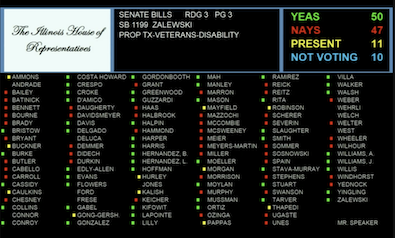
There was some debate over whether the bill had been properly put on the order of Postponed Consideration, which would allow another floor vote. But the Democrats brushed back the challenge (of course) and now the governor can try to run it again.
By my late-night eyes, 11 House Democrats voted “Present” or “No,” and another 8, including Speaker Madigan, didn’t vote. Several members of the Black Caucus did not vote for the bill.
This is a huge setback for the governor. He absolutely has to pass this bill to save his budget.
* But there were some very significant complaints about the Illinois Department of Revenue only figuring out about this budget hole in December and not informing legislators until this month. Other states, like New York, were all over this in the spring…
17 Comments
|
|
 Support CapitolFax.com
Visit our advertisers...

 ...............
 ...............
 ...............


|
   
|
Hosted by MCS |
SUBSCRIBE to Capitol Fax |
Advertise Here |
Mobile Version |
Contact Rich Miller
|