* Open letter…
TO: THE HONORABLE JB PRITZKER, GOVERNOR, STATE OF ILLINOIS
FROM: LEADING VETERAN ADVOCATES OF ILLINOIS
SUBJECT: LEADERSHIP CHANGES
DATE: JANUARY 1, 2021
CC: LINDA CHAPA LAVIA, DIRECTOR, ILLINOIS DEPT. OF VETERANS AFFAIRS
It is with deep regret, that we, the undersigned, must demand the immediate dismissal or resignation of Director Linda Chapa LaVia and Chief of Staff Anthony Kolbeck for their misfeasance and nonfeasance concerning the Coronavirus Disease 2019 Outbreak at the various Illinois Department of Veterans Affairs Veterans Homes. As the leading advocates for veterans, in the 10th most veteran populous state, we have simply lost confidence in their ability lead. We are concerned about actions that took place under their leadership as well as actions that did not take place under their leadership. These include, but are not limited to:
- In a consultative visit by the VA’s VISN-12 Infection Control Lead on 11/12/2020 it was found that a non-alcohol-based hand sanitizer, ineffective against COVID-19, was found to be used in all mounted dispensers throughout the La Salle Veterans Home. This occurred several months after the U.S. Centers for Disease Control recommended that only specific alcohol-based hand sanitizers be used. According to Illinois House Testimony by Department staff, this occurred inat least one other State Veterans Home.
- Additionally, unapproved Personal Protective Equipment was being used and there was found to be no temperature monitoring staff found to be at the employee entrance at the time of the consultative visit.
- A key position in preventing such issues, the Senior Homes Administrator, was left vacant for over a year despite a majority of that time being during a Pandemic that has been known to have a detrimental impact on long-term care facilities. There is no excuse as to why that position, one which oversees all State Veterans Homes, would remain vacant for that long.
- Until mid-December, there was no standardized notification letter that reported standard information for the outbreaks across the State Veterans Homes. In fact, it appeared that the Quincy Veterans Home altered their notification letter to remove information in early December after a new outbreak started there. That is despite promises from Department leadership to be “transparent” and leads us to the conclusion that Department leadership was aware of and directing these actions or that they were simply asleep at the wheel. Our veterans deserve better.
As far as what was not done, we are deeply concerned about the Department’s communication plan and incident response plan which have been seemingly non-existent. To our knowledge, no Department Press Conferences have been held on the specific topic of the COVID-19 outbreaks at any of the State Veterans Homes. Additionally, an Incident Command System appears to have never been activated, which would have allowed for a Unified Command to coordinate the response. Further, not until late into the La Salle Veterans Home outbreak did leadership even visit the Veterans Home. This is indicative of leadership that is not actively participating in managing the crisis and is again, unacceptable. Our veterans deserve better.
It is for the reasons set forth above, that we must take the unprecedented step in demanding the immediate dismissal or resignation of Director Linda Chapa LaVia, Chief of Staff Anthony Kolbeck, and any other official deemed culpable in these outbreaks. Our veterans deserve better.
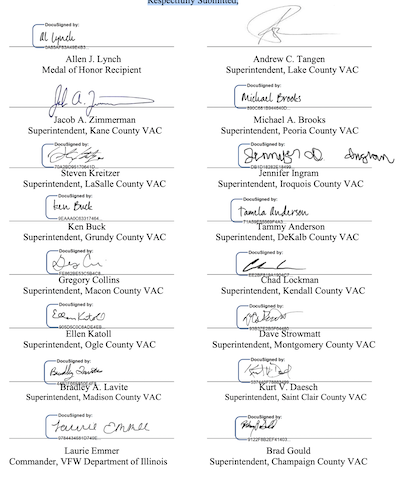
Respectfully Submitted
* Signatories…
I’ve asked the governor’s office for a response.
26 Comments  
|
It’s just a bill
Monday, Jan 4, 2021 - Posted by Rich Miller
* November…
Illinois Gov. J.B. Pritzker gave a grim reminder about the magnitude of the coronavirus pandemic on Monday when a reporter asked him why flags remain at half-staff throughout the state several months after the pandemic began.
“We’ve lost more than three 9/11s in nine months,” the governor said at his daily coronavirus news briefing. “We are losing dozens of people every single day.” […]
In April, Pritzker directed all flags be lowered at half-staff to honor those who lost their lives to COVID-19. During his daily briefing Monday, the governor said flags will remain at half-staff until the pandemic is over.
“I think it’s the right thing to do to recognize the terrible loss that so many people who cant even go to a funeral sometimes for a relative or friend, this is one way we can honor all of them,” he said.
* This has been a real thing with some folks…
* Daily Herald…
State Rep. Dan Didech says he’ll introduce legislation to create guidelines regarding the display of the American flag.
The proposal follows a letter sent to Gov. J.B. Pritzker from Vernon Hills Mayor Roger Byrne saying a state directive to fly the American flag at half-staff to honor those who’ve died in Illinois from COVID-19 has run its course.
Didech, a Buffalo Grove resident who represents the 59th District, says the legislation would be modeled after federal code that sets time limits on how long the flag can be displayed at half-staff. Putting time limits in place as amendments to the Illinois Flag Display Act would ensure “everybody who should be respected feels respected,” he said.
Didech said he would introduce legislation soon after the 102nd General Assembly convenes Jan. 13.
* I asked Rep. Didech (D-Buffalo Grove) if he thought lowering the flag for the covid dead, including nurses, was not appropriate…
I do think it’s appropriate. But I empathize with the sentiment that lowering them for a full year leaves people numb to the sentiment.
Pressed further…
My job is to be responsive to my constituents. I think it’s a worthwhile conversation to have so I’m happy to facilitate it. I’m not critical of the governor’s decision, but I understand why some people have a good faith concern about it.
* From Jordan Abudayyeh…
The flag is flying at half staff to honor the more than 16,000 Illinoisans who have lost their lives during this pandemic. Right now, there are hundreds of Illinoisans losing their battle to covid per week. Flying the flag at half staff is a stark reminder that this pandemic has tragic consequences and that the state of Illinois will not forget those who battled this disease.
Thoughts?
29 Comments
|
* Center Square on a House GOP press conference this morning…
House Minority Leader Jim Durkin, R-Western Springs, said Republicans are worried that under House Speaker Michael Madigan, past is precedent. Durkin raised concerns about lawmakers trying to sneak a tax increase through the legislature during the lame-duck session.
“Call your state Representative now, let them know that you are not for more taxes and they must reject Madigan as Speaker for the next General Assembly,” Durkin said. […]
House Revenue Committee Chairman state Rep. Mike Zalewski, D-Riverside, said he doesn’t expect a last-minute tax increase to surface this year despite a 2011 tax hike passed during the lame-duck session.
“It really is not going to be easy for us in a convention center during COVID with a leadership fight going forth to then turnaround and also pass a tax increase,” Zalewski said. […]
State Rep. La Shawn Ford, D-Chicago, said lawmakers could discuss increasing the state’s existing 4.95 percent flat income tax. But, he said they have to have the conversation about increased revenue.
“Hopefully we look at revenue streams that will deal with those that have the ability to pay more,” Ford said.
Ford said it’s important any proposal be vetted with public input before being voted on.
Zalewski said there are ideas some House Democrats have proposed to close what they say are corporate tax loopholes, but he said with the federal stimulus giving money for education and other things the state typically funds, there a bit of a cushion to get to the new general assembly that begins work after Jan. 13.
Republicans have said the state needs to cut spending, not increase revenue.
* Sun-Times…
Demmer said the appropriations committees of the House and the Senate should meet and bring in agency directors and leaders in the state’s executive branch to see what ideas they’ve shared with the governor about potential cuts to their budget as a starting point for talking about the state’s finances.
“We need to understand what the options are, and hear directly from individuals who are responsible for carrying out the budgets, what options exist,” Demmer said. “The Legislature needs to be involved in this. This is no longer a situation where one person can govern. We need to work on this together, and the way to do that is by convening appropriations committees to hear directly from the people responsible for this.”
State House Majority Leader Greg Harris, D-Chicago, said the GOP news conference was just “politics as usual.”
“I have not heard of any tax increase proposals,” Harris said, adding that Republicans are following “their traditional path” of saying there should be budget cuts though they’re not proposing any cuts of their own.
21 Comments
|
* December 31…
Today, Governor JB Pritzker announced 492,129 thousand non-felony cannabis related arrest records have been expunged at the state level by the Illinois State Police (ISP). The milestone announcement comes four years in advance of the deadline set in the Cannabis Regulation and Tax Act (CRTA), the most equity-centric cannabis legislation in the country signed into law by Governor Pritzker in 2019. Additionally, the Governor today issued pardons for 9,219 low-level cannabis conviction records, for a total of over 20,000 cannabis convictions now pardoned since the signing of the legislation.
“Statewide, Illinoisans hold hundreds of thousands low-level cannabis-related records, a burden disproportionately shouldered by communities of color,” said Governor JB Pritzker. “We will never be able to fully remedy the depth of that damage. But we can govern with the courage to admit the mistakes of our past—and the decency to set a better path forward. I applaud the Prisoner Review Board, the Illinois State Police, and our partners across the state for their extraordinary efforts that allowed these pardons and expungements to become a reality.”
The CRTA requires cannabis-related arrest records created between 2013 and 2019 be expunged by January 1, 2021, a total of 47,000 records. With the expungement of all 492,129 cannabis arrest records, ISP is four years ahead of the January 1, 2025 statutory deadline for completing automatic expungements. While the expungement process has been completed at the state level, county clerks are still processing expungements at the local level. Arrest records from DuPage, Kane, Knox, Lake, McHenry, McLean, Peoria, Rock Island, Will, and Winnebago Counties have been expunged at the local level. The remaining counties have until January 1, 2025 to expunge their arrest records.
“As we near the end of the first year of Illinois’ new legal cannabis industry, I am heartened by the progress we have made towards undoing the harms dealt by the failed war on drugs. Eleven states in the nation have legalized cannabis for recreational use, but no other state has done the important work we’re doing here in Illinois, where equity intentionality takes center stage,” said Toi Hutchinson, Senior Advisor to the Governor on Cannabis Control. “We are one year into what will be an ongoing effort to correct historic wrongdoings. The administration remains committed to working with legislators to address any challenges to equity and on building an industry that re-invests in our state’s communities.”
The administration remains committed to upholding the intention of the law and ensuring the cannabis industry is equitable for all Illinois residents, regardless of background. Under the law, 25% of revenues collected from recreational cannabis sales will be directed to communities that have been disproportionately impacted by the justice system through the Restore, Reinvest and Renew (R3) Program. In the coming weeks, the innovative R3 program will grant over $25 million in funding to organizations working in historically underserved communities across Illinois.
“The public servants of the Illinois State Police Division of Justice Services have worked diligently on the expungement process for thousands of eligible records across the state,” said ISP Director Brendan F. Kelly. “We will continue to work closely with the Governor in the years ahead to implement this new law.”
“The Prisoner Review Board is proud to stand with the Governor in this historic effort to restore the rights of thousands of Illinoisans. During the upcoming year, the Board expects to review thousands of additional felony and misdemeanor Minor Cannabis Offense convictions. We appreciate the partnership shown by the Attorney General’s Office, the Clerks of the Circuit Courts, and State’s Attorneys throughout Illinois,” said Craig Findley, Chair of Illinois Prisoner Review Board.
“Dismantling decades’ worth of criminal justice atrocities will take years. That’s evidenced by how this country handles cannabis,” said Senate Majority Leader Kimberly Lightford (D- 4th District. “We must never stop chipping away at that painful history. I’m proud of these critical first steps.”
“Having spent the last five years working with people in my community who know firsthand the collateral consequences that an arrest or conviction will bring, I am incredibly proud to have been a part of the negotiating team that fought hard for the criminal justice reforms in the CRTA,” said Deputy Majority Leader Jehan Gordon-Booth (D –92ndDistrict). “We in the legislature should be pleased with these critical first steps in writing the wrongs of the past so that our people are no longer calcified in poverty based on cannabis convictions.”
“We must ensure that the benefits of the new cannabis industry are experienced equally in every community across Illinois,” said Senator Heather Steans (D- 7th District). “I applaud Governor Pritzker and his administration for their continued commitment to equity and their diligence in expunging thousands of arrest records at the state level.”
“While we have a long road to an equitable recovery from decades of an unjust criminal system, these efforts will take us a step towards healing our communities,” said State Representative Sonya Harper (D-6th District). “I stay committed to continue the work with my colleagues to ensure that Illinois leads a cannabis industry that offers equity and justice to communities of color.”
In addition to conducting a disparity study and providing financial support to organizations offering services in disproportionately impacted communities, the administration offered lower application fees, low-interest loans, and informational workshops on cannabis-related licenses to social equity applicants. Governor Pritzker continues to work with State’s Attorney Kim Foxx, the Prisoner Review Board, and state’s attorneys across Illinois to expunge additional records of non-violent offenders with a cannabis related conviction.
Credit where credit is due.
16 Comments
|
* Wow…
After eight successful years in the Illinois Senate representing the 48th District and more than 22 years in public office, State Senator Andy Manar (D-Bunker Hill) announced today that he will be resigning from the Illinois Senate on January 17, 2021.
Manar was first elected to the Bunker Hill City Council at the age of 21 in 1997. He was elected Mayor of Bunker Hill in 2001 and Chaired the Macoupin County Board until his election to the Illinois Senate in 2012.
During his tenure in the Senate, Manar passed numerous consequential laws that will have an impact on hardworking Illinois families for generations. Some highlights include Automatic Voter Registration, a statewide minimum wage for teachers, elimination of police ticket quotas, capping the out-of-pocket cost of insulin at $100 per month, and the first ever regulation of pharmacy benefit managers. Manar was a vocal supporter of labor unions, voting rights, access to affordable health care, teachers, and the LGBTQ community.
But, the most defining piece of legislation championed by Manar was school funding reform. For decades, Illinois was the worst-ranked state for its contribution to school funding—driving local property taxes higher every year and leaving students in low-income districts at a serious disadvantage. Over the course of four years, Manar held hundreds of town halls and public meetings across the state and overcame a veto by former Gov. Bruce Rauner to establish the Evidence-Based Funding for Student Success Act. For the first time in a generation, Illinois now puts the most underfunded schools and children living in poverty at the front of the funding line, making equity the foundation of public school funding, which now serves as a model for the country.
Amy Ballinger-Cole of Advance Illinois said of the 2017 overhaul, “He basically picked a fight that no one else wanted to touch. The fact that he got it done in this political environment is nothing short of a miracle.”
As Chair of Senate Appropriations II Committee, Manar delivered millions of dollars in infrastructure investment for parks, libraries, schools, and roads for the communities of the 48th District. Manar also directed state resources to new programs to help develop the area’s workforce, including millions of dollars in funding for the Work Skills Program at Richland Community College in Decatur, for the South Macoupin Consortium for Innovation and Career Pathways serving students in six high schools, to construct the new South Central Illinois Regional Workforce Training & Innovation Center in Litchfield, and for the Golden Apple Teacher Accelerators program at Blackburn College in Carlinville. Manar also created the first ever statewide Critical Access Pharmacy program to help keep small, independent pharmacists operating in underserved and rural communities.
Manar was the recipient of dozens of awards and recognitions during his tenure in the Illinois Senate, including the Dawn Clark Netsch ”Straight Talk” Award from the Illinois Campaign for Political Reform, Common Cause Champion of Democracy, Rural Legislator of the Year from the Illinois Hospital Association, The President’s Award from the Faith Coalition for the Common Good, Vince Demuzio Legislator of the Year from the Illinois Association of Community Action Agencies, 2019 Illinois Education Association Friend of Education, and 2016 Wall of Honor inductee at Bunker Hill High School.
Senator Manar has issued the following statement in relation to the announcement:
“Today, my heart is full with gratitude to the people of my hometown of Bunker Hill, Macoupin County, and the 48th Legislative District for giving me — the son of small town, blue-collar parents – the opportunity to serve half my life in public office and to leave my mark on the state that I love.
“On January 17, I will resign from the Illinois Senate. I will cherish the friendships I forged as we accomplished meaningful change together over the past eight years. I will always appreciate the truly unique diversity of the small towns and urban neighborhoods of the 48th District. While serving communities with people from all walks of life was often challenging, it brought me great joy to see firsthand what unites us and to then bring that perspective to Springfield to take on big issues. I’m proud to say we did that together and along the way improved life for everyone in this state.
“Trista and our children — now teens — have only known me as a husband and father who also carries the responsibility of serving as an elected official. They have never known a day otherwise. The time has come for someone new to take up the call in the Illinois Senate. Central Illinois is full of outstanding individuals ready to step forward to meet the challenge — be an agent of change in Downstate Illinois.
“After more than 22 years of public service, I realize this: I got more out of it than I gave it, and I gave it all I had each and every day. I remain forever grateful to my hometown of Bunker Hill, Macoupin County, and the people of the 48th District for giving me the opportunity time and again to serve.”
A replacement to fill the vacancy in the 48th Legislative District will be chosen by the Democratic Party Chairs in Christian, Macon, Macoupin, Madison, Montgomery, and Sangamon Counties.
Manar and his family will remain in Bunker Hill, three blocks from his childhood home.
…Adding… I’m hearing he’s going to the administration.
*** UPDATE 1 *** And here it is…
Governor JB Pritzker announced that Senator Andy Manar (D-Bunker Hill) will join his administration to serve as senior advisor, bringing a wealth of experience and accomplishments on vital issues in Illinois.
“Andy has been one of the most thoughtful and successful lawmakers of his generation, and he will be a trusted advisor,” said Governor JB Pritzker. “In his career, Andy has done so much to improve the lives of working families. He led the effort to reform the state’s antiquated education funding formula, made insulin cheaper for the millions who depend upon it, led efforts to reform election laws, and oversaw the appropriations committee during truly challenging times. Any one of those accomplishments would be hailed as a career capstone, and Andy has too many to name. I value his insights and look forward to him joining my administration as we overcome this pandemic and rebuild Illinois together.”
“Andy is a fiercely devoted public servant with an enviable track record in the legislature. His counsel and friendship have been invaluable over the last two years,” said Chief of Staff Anne Caprara. “We are elated that he will be serving alongside this team as we face the challenges of the coming years. He is someone who has always put the needs of the state and its people front and center, and I am thrilled to have him serve in the Governor’s office.”
Manar will begin the role on January 19, 2021, shortly after he steps down from the Illinois Senate. He will work closely with the governor on his agenda and key priorities. Because of the breadth of Manar’s policy background, he will advise the governor on a range of issues, including downstate economic revitalization, appropriations, and COVID-19 recovery efforts.
“Illinois faces so many challenges, and I look forward to taking on these challenges from the executive branch,” Senator Manar said. “Governor Pritzker has shown tremendous leadership in the most grave crisis this state has experienced in our lifetime, and I’m honored to share what I’ve learned to advance his agenda to rebuild our state and stand up for working families.”
*** UPDATE 2 *** Senate President Don Harmon…
It’s hard to imagine the Illinois Senate without Andy Manar. He’s been a guiding force for so many lawmakers on so many issues, first as a chief of staff and then as a Senate colleague. He’s compiled a lifetime of achievements in what is still a very young career. Atop that list would be the education funding overhaul he led that sets our state on a course for fundamental education fairness, equity and excellence. Andy’s been my friend and an invaluable sounding board since my first days in the Senate, and I’m grateful that our friendship is even stronger today. The governor is very lucky to have him. I wish Andy all the very best in his new role.
…Adding… The lay of the land…
81 Comments
|
* The average positivity rates have risen about a point since I went on break…
The Illinois Department of Public Health (IDPH) today reported 5,059 new confirmed and probable cases of coronavirus disease (COVID-19) in Illinois, including 79 additional deaths.
- Cook County: 1 teen, 1 female 30s, 2 females 40s, 1 male 40s, 1 female 50s, 3 males 50s, 3 females 60s, 5 males 60s, 2 females 70s, 8 males 70s, 3 females 80s, 5 males 80s, 4 females 90s, 2 males 90s
- DeKalb County: 1 male 80s
- DuPage County: 1 male 30s, 1 female 60s, 1 male 60s, 2 females 80s, 1 male 80s, 1 male 90s
- Fulton County: 2 males 80s
- Kane County: 1 female 40s, 1 male 50s
- Kankakee County: 1 male 50s
- Lake County: 2 females 70s
- Macoupin County: 1 female 90s
- Madison County: 1 male 30s, 1 male 80s, 1 male 90s
- McDonough County: 1 male 80s
- Piatt County: 1 female 60s
- Putnam County: 1 male 60s
- Rock Island County: 1 male 80s
- Sangamon County: 1 female 70s, 1 male 80s
- St. Clair County: 1 male 40s, 1 female 80s
- Stephenson County: 1 male 80s
- Tazewell County: 1 male 60s, 2 males 70s, 2 males 80s
- Warren County: 1 female 90s
- Wayne County: 1 male 80s
- Will County: 1 female 50s, 2 females 70s
Currently, IDPH is reporting a total of 984,880 cases, including 16,834 deaths, in 102 counties in Illinois. The age of cases ranges from younger than one to older than 100 years. Within the past 24 hours, laboratories have reported 48,254 specimens for a total 13,530,371. As of last night, 3,948 in Illinois were reported to be in the hospital with COVID-19. Of those, 816 patients were in the ICU and 471 patients with COVID-19 were on ventilators.
The preliminary seven-day statewide positivity for cases as a percent of total test from December 28, 2020 – January 3, 2021 is 8.6%. The preliminary seven-day statewide test positivity from December 28, 2020 – January 3, 2021 is 9.8%
*All data are provisional and will change. In order to rapidly report COVID-19 information to the public, data are being reported in real-time. Information is constantly being entered into an electronic system and the number of cases and deaths can change as additional information is gathered. Information for deaths previously reported has changed, therefore, today’s numbers have been adjusted. For health questions about COVID-19, call the hotline at 1-800-889-3931 or email dph.sick@illinois.gov.
8 Comments
|
|
Comments Off
|
* U of I…
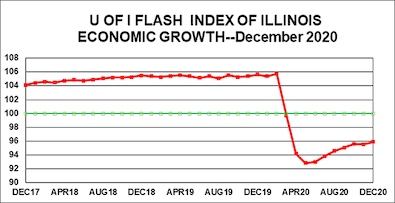
After a pause in November, the University of Illinois Flash Index continued its slow climb to finish the year, rising to 95.9 in December from its 95.6 level the previous two months.
This the highest reading since the precipitous decline that resulted from the COVID-19 pandemic in March. However, the index is still almost 10 points below the pre-crisis level, and it remains below the 100-dividing line between growth and decline. See the full Flash Index archive.
“In one sense, 2020 was a devastating year for the Illinois and national economies. Unemployment rose from a historic low of less than 4% to nearly 15% in just a few weeks,” said University of Illinois economist J. Fred Giertz, who compiles the monthly index for the University of Illinois System’s Institute of Government and Public Affairs. “However, from another perspective, the economy’s resilience has been remarkable. Few observers would have predicted in April that the unemployment rate would fall below 7% before the end of the year.”
The Illinois unemployment rate exceeded the national rate by 2.5 percentage points after the onset of the crisis, but it is now near that of the rest of the nation. The recovery of the financial markets has been even more impressive.
Recovery is far from complete, and Giertz said that the process is not fully understood. It is likely the result of an unusually strong pre-crisis economy along with prompt and aggressive intervention on both the fiscal and monetary fronts. The surprisingly fast development of a vaccine has bolstered expectations even as the disease has persisted.
For the month, all three components of the index (corporate, individual income and sales tax receipts) exceeded the levels of the previous December after adjusting for inflation. For the year, receipts for Illinois’ three major taxes were below pre-crisis forecasts, but well above post-crisis predictions of a revenue disaster.
The Flash Index is normally a weighted average of Illinois growth rates in corporate earnings, consumer spending and personal income as estimated from receipts for corporate income, individual income, and retail sales taxes. These are adjusted for inflation before growth rates are calculated. The growth rate for each component is then calculated for the 12-month period using data through December 31, 2020. Ad hoc adjustments have been made to deal with the timing of the tax receipts resulting from state and federal changes in payment dates beginning in March.
Graph…
* Ugh…
If you have not received an unexpected unemployment benefits debit card in the mail, there is a chance you know someone who has already received one.
NBC 5 continues to hear from viewers who say their names are being used by strangers to file fraudulent unemployment claims with the Illinois Department of Employment Security.
As of early November, the IDES said more than 212,000 fraudulent claims have been made since March.
The cards may not have money pre-loaded, but an IDES spokesperson said fraudsters may try to access a victim’s account information in order to divert payments to another card.
* More…
The Illinois Department of Employment Security has confirmed fraudsters are using a new scheme to file for unemployment compensation using personally identifying information which was seemingly obtained from a separate source (e.g. a previous cyber-attack or other identity theft) outside of the department’s systems.
An analysis found fraudsters were applying for unemployment benefits using the PII of certain identity theft victims and including fake employer addresses in their applications. Fraud notices from IDES, containing the PII, were then sent to the addresses fraudsters claimed were employers. This is now another aggressive maneuver used by bad actors looking to defraud and disrupt states’ unemployment systems.
Across the country, bad actors are filing unemployment insurance claims in the names of identity theft victims. Fraudsters take this information and submit claims using a fake employer address, which can coincide with a residential address, or with an employer that has no connection to the victim. IDES’s anti-fraud systems are structured to detect, stop, and flag these claims as fraudulent. However, this process does generate an employer notice, informing the employer of the fraudulent claim(s) filed on an employee.
* And…
Illinois is working on restoring unemployment benefits to nearly 450,000 people whose benefits expired temporarily after President Donald Trump delayed signing a $900 billion coronavirus relief package.
Roughly 447,500 Illinoisans were at risk of losing jobless benefits entirely when multiple federal programs tied to the $2.2 trillion stimulus package from last spring expired Dec. 26, according to the Illinois Department of Employment Security. […]
The state is waiting on guidance from the U.S. Department of Labor on how to reinstate and implement the federal programs, but plans to pay any missed benefits retroactively, spokeswoman Rebecca Cisco said.
The U.S. Department of Labor said in a statement Tuesday most programs will remain unchanged, but it will deliver guidance to help states implement new programs “in the near future.”
* And here’s Yvette Shields at the Bond Buyer…
While Chicago and the Illinois state government were left out, the region’s transit system and Chicago Public Schools emerged as winners in the new federal relief package, securing aid both had banked on when assembling their new budgets.
The Illinois Regional Transportation Authority’s service boards that provide light rail, commuter rail, and bus service in Chicago and the suburbs will receive $450 million from the $14 billion earmarked for public transit in the $910 billion package President Trump signed Sunday.
The infusion of funding will help prevent what officials had warned was an Armageddon scenario of deep service cuts and layoffs, but it’s still $50 million short of the $500 million a $3 billion 2021 budget assumed. […]
CPS expects to receive a $720 million windfall from the $82 billion allocation for public education in the Coronavirus Response and Relief Supplemental Appropriations Act after sending $80 million to non-public schools as required under the package. The $82 billion provides $54.3 billion for K-12 education, $22.7 billion for higher education and additional funding at governors’ discretion to offset higher costs or state aid cuts.
The $720 million is double the $343 million CPS counted on its fiscal 2021 budget approved over the summer but officials also warn of ongoing fiscal pressure from the pandemic that will hurt future revenues and endanger state aid.
13 Comments
|
* December 30th…
COVID-19 vaccinations for residents at LaSalle Veterans’ Home began Tuesday, while vaccinations for staff members started Wednesday.
It’s the first step in the process at the LaSalle Veterans’ Home. The interim administrator says residents and employees will continue to take all the necessary precautions to stay healthy. […]
Since the beginning of the pandemic, 35 residents have died from COVID-19 and there have been more than 200 cases among residents and employees.
“The staff was heartbroken that the virus got in here and the toll that it takes,” [Anthony Vaughn, LaSalle Veterans’ Home Interim Administrator] said. “Everything death is personal. These are our residents and veterans that they have been looking at after day in and day out.”
Vaughn said it’s not mandatory for residents or staff members to get the vaccine, but most have chosen to do so. The second dose will be given out next month.
* The staff may have been heartbroken, but look at what they actually did, or, rather, what they refused to do…
Ugh.
Every time I see one of these stories about the state bungling its care of our veterans, I ask myself why Illinois doesn’t just shut down the facilities and pay to put all the residents in nursing homes. We do not seem to be up to the task.
* Imagine what it’s gonna be like when those AFSCME-represented state corrections officers are offered the vaccines…
More than 7,800 people imprisoned in Illinois Department of Corrections facilities have had coronavirus, according to state data. Another 3,435 staff members have tested positive for COVID-19.
Recent data on the number of people who have died from COVID-19 while incarcerated was not immediately available, but a story from Injustice Watch reported 52 people had died from coronavirus while incarcerated in Illinois as of Dec. 8. Fifteen inmates and one corrections officer died in November alone, according to those figures.
I sure hope the state and the union are more prepared for the next round.
73 Comments
|
* Bill Ruthhart and Rick Pearson at the Tribune take a look at the end of an era…
For decades, a member of the Lipinski family representing the Southwest Side middle class bungalow belt has been as much of a way of life as the airplanes roaring overhead from nearby Midway Airport.
Read to the bottom…
William Lipinski hinted several times that his son might run again and also noted he had a pair of grandsons “who have very serious political opinions” and “the blood flowing in them also.”
In any case, the Illinois congressional map will look much different in 2022, with the new census likely to result in the state losing one, if not two, congressional seats.
“It may or may not be the end of an era,” William Lipinski said. “It may be just a temporary interruption.”
* Related…
* Lipinski’s exit interview: What’s next for the departing Democratic House member: The politics aside, Lipinski said he remained a Democrat because, in contrast to small-government Republicans, “As a Democrat I think that government has an important role to play in helping people who need help, or unable to help themselves…. I’m a Democrat because I think there are things that government needs to do that individuals cannot do”
40 Comments
|
|
Comments Off
|
WBEZ looks at the GOP field
Monday, Jan 4, 2021 - Posted by Rich Miller
* Tony Arnold at WBEZ took a look at possible Republican gubernatorial candidates. There are more names in the story, so click here…
“I’ve been encouraged by numerous people across the state to run for governor,” [state Sen. Sen. Jason Barickman, R-Bloomington] told WBEZ. “It’s not something I sought out to do. I have a young family which is my first consideration but I’m doing my due diligence in response to the encouragement that’s been made of me.” […]
Many of the Republicans on this list took some shots at Pritzker for this story. [US Rep. Rodney Davis], however, was the by far the most aggressive, calling Pritkzer’s tenure as governor an “unmitigated disaster.” […]
Though his role within the party has traditionally been to advocate for the Illinois GOP, [Illinois National GOP Committeeman Richard Porter] joked that he may have to be an adversary against his fellow candidates if he chooses to run. […]
A spokesman for Todd Ricketts did not comment, though multiple sources confirmed Ricketts is at least considering a run for governor. […]
[State Sen. Paul Schimpf, R-Waterloo] would not comment on a possible gubernatorial run. Multiple Republicans told WBEZ Schimpf is taking a look at running.
* US Rep. Adam Kinzinger was also on the list. This is what he recently told the Tribune…
Traditionally, Illinois Republicans who have had success statewide have been more centrist. Kinzinger’s willingness to take on his own party has prompted speculation that he is positioning himself for higher office — perhaps a run against Democratic Gov. J.B. Pritzker or Democratic U.S. Sen. Tammy Duckworth in 2022.
But Kinzinger, a former Air Force pilot and Iraq War veteran who still serves in the Air National Guard, said he’s “not doing this to set myself up to run statewide.”
“I’m not going to rule anything out. But it’s really not anything I’m planning,” he said. […]
To be sure, Kinzinger has voted in support of Trump-backed legislation more than 92% of the time, according to a vote tracker run by FiveThirtyEight.com.
* Zorn’s predictions…
Former state Rep. Jeanne Ives of Wheaton will once again run for governor. Illinois U.S. Rep. Adam Kinzinger and State Rep. Darren Bailey of Xenia also will announce bids. If I were hedging my bets I’d include the possibility that Kinzinger will mount a 2022 run for the seat now held by Illinois U.S. Sen Tammy Duckworth.
* And, of course, newly retired Senate Republican Leader Bill Brady left the door open to a possible bid a while back. But considering that his December 31st retirement date allowed him to collect the 3 percent annual pension boost the very next day on January 1, maybe not. I have heard mentions of a possible US Senate run.
40 Comments
|
* This is my weekly syndicated column from break. It came out a week ago, but I don’t think anything has changed…
I reached out to several Illinois House Democrats who could be considered politically vulnerable in 2022 to ask them how they plan to vote on Speaker Michael J. Madigan’s reelection in January.
With one exception, I didn’t make much headway.
Much has been made about the number of Democratic women who have said they will not vote to reelect the longtime House speaker. That’s true, but it isn’t yet a universal opinion.
Democratic Representative-Elect Suzanne Ness, D-Crystal Lake, may have breezed past GOP Rep. Allen Skillicorn by almost 2,300 votes last month, but her district leans Republican. A remap may not help her all that much (particularly if it’s a “Fair Map” and therefore not drawn with partisan intent) and 2022 will be the midterm election of a Democratic president. Ness ran as a reformer and raised over a million dollars from Madigan’s network. Skillicorn, for whatever weird reasons, barely campaigned and spent almost nothing.
Ness likely won’t get a pass in two years. That January vote on Madigan, therefore, looms large.
“I do not have a statement at this time regarding the election for House speaker,” Ness told me the other day.
A recent House Republican poll showed that 76% of Ness’ district has an unfavorable view of Madigan, with 65% having a “very unfavorable” opinion. Only 12% had a favorable view. The poll, of 716 respondents, was conducted on Dec. 16 by Ogden & Fry.
Janet Yang-Rohr, D-Naperville, defeated GOP Rep. Grant Wehrli by a couple of thousand votes. Her district leans slightly Democratic at the top, but the uncertainties of the coming remap mean that nothing is guaranteed. Yang-Rohr didn’t respond to multiple attempts to reach her about the speaker’s election.
Rep. Katie Stuart, D-Edwardsville, has been the Democrats’ only real and consistent bright spot in the area of the Metro East that has been trending Republican. Stuart defeated a Republican incumbent in 2016, and she has fended off two attempts to unseat her since then. Still, 2022 could be problematic, particularly if mapmakers can’t deliberately pack her district with Democrats who are stuck in soon-to-be-former Rep. Monica Bristow’s district. Stuart also did not respond to an inquiry about her January intentions.
Others who did not respond included Representative-Elect Dave Vella, D-Rockford, who just barely squeaked by Rep. John Cabello, and Representative-Elect Dee Avelar, D-Bolingbrook. Rep. Joyce Mason’s state senator is the crusading reformer Melinda Bush, and Mason, D-Gurnee, shares that senate district with Rep. Sam Yingling, who has said he will not vote to reelect Madigan. Mason has not responded to numerous attempts to ask for whom she’s voting.
Representative-Elect Denise Wang Stoneback, D-Skokie, lives in a liberal Democratic stronghold, so she could face a primary opponent if she votes to reelect Madigan. “Right now I have no comment on this,” Stoneback wrote to me the other day.
Representative-Elect Maura Hirschauer, D-Batavia, also has a strong, albeit less liberal Democratic district. “I do not have a comment at the moment,” she told me.
I got the distinct feeling that at least some of these folks (and plenty of others in that caucus) are hoping everything will work itself out by the second Wednesday in January, which would spare them from have to make such a momentous decision.
As mentioned above, I found one exception.
Rep. Mark Walker, D-Arlington Heights, was asked recently by the Daily Herald how he was voting for House speaker. “We’ll see,” was his initial response.
Walker then praised Madigan for his organizational skills, but the Daily Herald also reported that he claimed public servants must be held to a higher standard.
“I don’t believe he’ll be a viable candidate by January,” Walker then said of Madigan.
The Daily Herald story included no explanation for why Walker said that about Madigan’s viability. So, I called him. Walker said his comment was deliberately designed to send a message to the House Democratic caucus and the sub-caucuses within it, including the Black Caucus.
“Your guy’s not gonna win, come up with an alternative,” is what Walker said he meant.
Whew.
To Walker’s mind, anyway, the 19 public Madigan opponents in the House Democratic caucus are not going to budge. “I think the caucus ought to decide,” Walker said, adding he doesn’t want to see this matter go to the House floor for endless votes.
“I want us to succeed as a caucus because the state absolutely needs it,” he said.
Walker said he also believes that the days of voters not caring about Madigan are over. “I’m afraid that ship has sailed,” he said.
At least somebody said something.
25 Comments
|
|
Comments Off
|
|
Comments Off
|
|
 Support CapitolFax.com
Visit our advertisers...

 ...............
 ...............
 ...............


|
   
|
Hosted by MCS |
SUBSCRIBE to Capitol Fax |
Advertise Here |
Mobile Version |
Contact Rich Miller
|



