These folks just never give up
Wednesday, Nov 3, 2021 - Posted by Rich Miller
* Earlier this year Hannah Meisel noted this in a story about a lawsuit filed against the legislative redistricting plan passed in May…
Of the four districts identified in the lawsuit, three of them saw minor adjustments to their proposed borders under the new district maps Democrats published Monday, compared with the maps passed in May. That includes the 1st House District, which State Rep. Aarón Ortiz (D-Chicago) has represented since 2019 and will continue to represent under the new map, despite the changed territory.
The slight change to the first district does not affect its neighbor to the south, the 22nd House District, represented by freshman State Rep. Angelica Guerrero-Cuellar (D-Chicago). Guerrero-Cuellar, who was appointed to the House seat vacated by longtime former House Speaker Mike Madigan in February, recently filed an unusual motion in the MALDEF suit asking to be added to the list of defendants, along with Democratic leaders.
In the filing, Guerrero-Cuellar said she was asking the court on behalf of her constituents as she wanted to prevent any sort of settlement of surrounding districts that may affect her own. According to internal data, the new 22nd District’s population is nearly 63% voting age residents of Hispanic origin — the third-most largest share in the new proposed map.
“The Representative of the 22nd District has a significant interest in maintaining the current configuration of the map to protect her constituents’ rights to a fair and reasonable opportunity to elect candidates of their choice and avoid dilution of Latino/a/x votes,” Guerrero-Cuellar’s attorneys wrote.
Guerrero-Cuellar is represented in the matter by the Del Galdo Law Group, whose namesake Michael Del Galdo has long been close with Madigan.
* As we’ve discussed, Rep. Guerrero-Cuellar along with help from 13th Ward Ald. Marty Quinn attempted to round up enough votes to stop the congressional remap bill from passing. It didn’t work, but she complained during debate about how her own House district was drawn…
The lone Democratic “no” vote came from Rep. Angelica Guerrero-Cuellar, who was appointed to the 22nd state legislative district in Chicago to replace former House Speaker Michael Madigan, who resigned earlier this year.
Guerrero-Cuellar said on the floor that she remained upset about how the 22nd District was reshaped during the legislative redistricting process in August.
“And there was something done to that district intentionally to exclude Latinos and that representation,” she said. “So when someone tells me, ‘Hey, we’re here to represent the Latinos on the southwest side,’ I’m gonna say, hold on. That was not the case.”
…Adding… I mean, AGC voted twice for this district, so I’m not quite sure what her beef is…
* The map passed in May was tossed out, but a new one was drawn and then signed into law in September. Rep. Guerrero-Cuellar has now filed another motion to intervene…
A Democratic member of the Illinois House has filed a motion in federal court to intervene as a separate defendant in a pair of lawsuits challenging the legislative redistricting plan that was signed into law in September.
Rep. Angelica Guerrero-Cuellar, who represents the largely Latino 22nd District on Chicago’s southwest side, is arguing that the composition of her district, and therefore her chances of reelection, could hang in the balance if the court decides to alter the map. […]
“The [Republican lawsuit] explicitly proposes a revised September map that cuts through the 22nd District,” the motion states, referring to one alternative map portrayed in the GOP complaint.
The motion also states that Guerrero-Cuellar has a right to intervene, “to protect her right to reelection.”
She also claims in the filing that her interests “are not adequately represented” by the other defendants.
Man. The lengths these folks will go to protect the sacred boundaries of the 22nd House District is quite something to behold.
I mean, I get it that over the decades they have put a whole lot of time and effort into constituent services and developing relationships with the residents (which produce major benefits come election time). It’s the same argument used by Ald. Quinn with legislators last week against the bill which divided his ward into two congressional districts. It’s just that… wow.
…Adding… Remember this from September?…
A Hispanic candidate who lost a 2016 House Democratic primary to then-Speaker Michael Madigan is asking the U.S. Supreme Court to weigh in on a case that alleges Madigan planted two sham candidates with Hispanic-sounding names on the ballot to confuse voters and ensure his victory.
In an appeal to the high court filed Thursday, Jason Gonzales argues that lower court judges incorrectly tossed the matter on grounds that voters knew about the alleged sham candidates from pre-primary publicity and Madigan still won with 65% of the vote.
I’ve been meaning to tell you that the United States Supreme Court refused to take Gonzales’ appeal this week. He doesn’t give up easily, either.
15 Comments  
|
* ABC 7…
Former Illinois state Rep. Luis Arroyo returned to court Wednesday to plead guilty in a federal bribery case.
Prosecutors said the Democratic lawmaker paid a bribe to a state senator in exchange for support of a gambling bill that would have benefited one of Arroyo’s clients.
* Tribune…
Arroyo, 67, who resigned soon after he was charged with bribery in October 2019, changed his plea during a telephone hearing before U.S. District Judge Steven Seeger. Sentencing was set for Feb. 18. […]
A superseding indictment filed last year added new wire and mail fraud charges against Arroyo and also charged James T. Weiss with bribery, wire fraud, mail fraud and lying to the FBI. Weiss, who is married to Berrios’ daughter, former state Rep. Toni Berrios, has pleaded not guilty.
The case centers on the largely uncharted world of sweepstakes machines, sometimes called “gray machines,” which allow customers to put in money, receive a coupon to redeem for merchandise online and then play electronic games like slot machines.
Since the machines can be played for free, they are not considered gambling devices. Critics, however, contend the unregulated devices, which operate in cities like Chicago that have banned video gambling, are designed to skirt the law.
* Sun-Times…
Weiss managed Collage LLC, which operated unlicensed video gambling machines known as sweepstakes machines. The indictment alleged that Weiss paid bribes to Arroyo from November 2018 until October 2019, cutting checks from Collage to Arroyo’s Spartacus 3 LLC.
It also said Weiss was there on Aug. 2, 2019, when Arroyo asked Link to support sweepstakes legislation. The men met at a Highland Park restaurant, according to a criminal complaint. Afterward, when Arroyo and Link were alone outside the restaurant, Arroyo suggested to Link he could be paid for his support, according to the complaint.
“We could put you on a contract. … Tell me what you need,” Arroyo said, according to the document.
Weeks later, it said Arroyo gave the senator the first of what he promised would become monthly payments of $2,500.
“This is the jackpot,” Arroyo boasted, according to the complaint.
I still can’t get over Luis calling $2,500 a “jackpot.” The penny ante nature of so much corruption has always boggled my mind.
36 Comments
|
COVID-19 roundup
Wednesday, Nov 3, 2021 - Posted by Rich Miller
* For the umpteenth time, I would like to hear someone explain why taking a weekly test is a violation of their conscience…
Two Springfield District 186 teachers who have refused to provide proof of COVID-19 vaccinations or submit to weekly testing now have until Nov. 10 to follow the directives of a state mandate issued by Gov. JB Pritzker in August.
* Center Square…
The vaccine rollout for 5 to 11 year olds is nearing and some are wondering if a school vaccination mandate in Illinois will follow. […]
In other states, Republican lawmakers have banned COVID-19 vaccine mandates for college students and school children.
“Here in Illinois that requirement is something that would go through the legislature as others have,” said Gov. J.B. Pritzker after receiving a COVID-19 booster shot Tuesday. “We require lots of vaccinations when kids go to school already.”
Vaccine mandates by states have been around for more than a century. In the 1850s, Massachusetts became the first state to mandate a smallpox vaccination for school children. By the early 1980s, all 50 states had vaccination laws covering students first entering school.
* Press release…
The Illinois Department of Public Health (IDPH) is adopting the Centers for Disease Control and Prevention’s (CDC) recommendation for children ages 5 through 11 years to receive the Pfizer-BioNTech COVID-19 vaccine. The announcement comes following the U.S. Food and Drug Administration’s (FDA) expansion of the emergency use authorization for the Pfizer-BioNTech vaccine for children on October 29, 2021.
Previously, the Pfizer-BioNTech vaccine was authorized for use in individuals ages 12 years and older. The vaccine for children ages 5 through 11 years is a smaller dose (10 µg), a third of the dose for individuals 12 years and older (30 µg). The Pfizer-BioNTech COVID-19 vaccine is administered as a series of two doses, 3 weeks apart, for all eligible individuals.
“I encourage parents who may have questions about COVID-19 vaccines for their children to talk with a pediatrician or family doctor,” said IDPH Director Dr. Ngozi Ezike. “Medical experts and scientists have reviewed the data, which included clinical trials with more than 3,000 children receiving the vaccine, and have recommended the Pfizer-BioNTech vaccine for children. While most children do not suffer severe COVID-19 illness, some do. We also know children are great transmitters and can unknowingly infect people who could suffer severe illness. We need as many people as possible, including children, to be vaccinated to stop the spread of the virus and end this pandemic.”
COVID-19 vaccinations for those 5 years and older will be available at local health departments, many pharmacies, pediatrician offices, Federally Qualified Health Centers, and from other providers who offer the Pfizer-BioNTech vaccine. IDPH has requested all COVID-19 vaccine providers watch the Pfizer-BioNTech training video for administering the pediatric doses of vaccine. Approximately 2,200 pediatric providers in Illinois have enrolled in the State immunization registry and can administer COVID-19 vaccine to their patients. Additionally, IDPH continues to work with schools to set up vaccination clinics and more than 1,200 youth vaccination events have been held or are scheduled.
In clinical trials, the Pfizer-BioNTech vaccine was found to be more than 90% effective in preventing COVID-19 in children ages 5 through 11 years. Side effects commonly reported in children, although less frequent compared to adolescents and adults, were generally mild to moderate and included injection site pain (sore arm), redness and swelling, fatigue, headache, muscle and/or joint pain, chills, and fever. Side effects occurred within two days after vaccination and went away within a day or two.
Pfizer Inc. will continue to monitor the safety of the vaccine and will be required to report to the Vaccine Adverse Event Reporting System, along with providers, all serious adverse events, cases of Multisystem Inflammatory Syndrome, cases that result in hospitalization or death, and vaccine administration errors.
Both the Moderna and Johnson & Johnson (Janssen) COVID-19 vaccines are authorized for use in individuals 18 years and older and will continue to be available to adults.
* More…
* Here’s what to know about kids’ COVID-19 vaccines in Illinois, and where appointments can be scheduled
* Walgreens, CVS® to Begin Offering COVID Vaccines for Kids Under 12 This Weekend
* CPS ‘test-to-stay’ pilot would reduce number of students in quarantine, CEO says
* CDC finds immunity from vaccines is more consistent than from infection, but both last at least six months
* Everyone’s Making Up Their Own Post-booster Rules
43 Comments
|
* Press release…
Governor JB Pritzker today announced that First Assistant Deputy Governor for Education Martin V. Torres will serve the administration as the Deputy Governor for Education. Torres brings significant experience in the work to improve Illinois’ education system, with a strong focus on uplifting the state’s Latinx community.
“Martin is a dedicated public servant and trusted advisor whose passion for achieving a quality education for all of our children will continue to be an asset to this administration,” said Governor JB Pritzker. “From fighting for education equity at the Latino Policy Forum, to executing our P-20 education agenda and helping bring students safely back to our classrooms during the COVID-19 pandemic, Martin has done so much to improve the lives of Illinois’ families. I value his insights and look forward to our continued work to ensure a full pandemic recovery and quality education for all of our students.”
“The Governor and I are focused on making Illinois the best state in the nation to raise children. Illinois students, now more than ever, need additional support to achieve their potential and pursue their dreams,” said Deputy Governor Martin V. Torres. “This administration is committed to changing the trajectory of students’ lives by expanding access to early care and education, bolstering the state’s investment in the k-12 funding, making college more affordable, and expanding pathways to emerging industries.”
Torres served as Deputy Policy Director of Pritzker’s first campaign for Governor, and later in the administration as a Senior Policy Advisor and then the First Assistant Deputy Governor for Education. He has played a critical role in coordinating the administration’s COVID-19 response in classrooms and communities across Illinois. In particular, he oversaw the execution of the Governor’s p-20 agenda, working to revitalize learning and teaching for students and educators through a holistic and practical approach. Previously, Torres spent eight years at the Latino Policy Forum, where he served as Associate Director and managed the organization’s state policy agenda. During his leadership at the Forum, he negotiated a significant increase in funding for bilingual education during the transition to an evidence-based funding model for K-12 schools, he served as an appointed member of the Illinois Early Learning Council, and he partnered with lawmakers to pass legislation that increased transparency surrounding the demographic composition of state boards and commissions.
Torres succeeds Deputy Governor Jesse Ruiz, who announced his departure from the public sector on August 25, 2021.
* Meanwhile…
Today, the Illinois Department of Human Services (IDHS) announced the appointment of Christine Haley as State Homelessness Chief. In this role, which was created by EO 2021-21 (Executive Order To Fight Homelessness in Illinois) issued on Sept. 3 by Governor Pritzker, Haley will lead the State’s comprehensive effort to decrease homelessness in Illinois, improve outcomes for people who experience homelessness and strengthen the safety nets that contribute to housing stability. Christine will chair the Illinois Interagency Task Force on Homelessness and co-chair the Community Advisory Council on Homelessness, as part of her work.
“Housing is about justice. It’s about every Illinois resident having the right to feel safe and settled in a space they can call home,” said Lt. Governor Juliana Stratton. “Our administration is putting policies and resources to work in a comprehensive effort to decrease homelessness in Illinois. Congratulations to Christine Haley. We are excited to have her join us in this new role as we all continue this important work.”
“I am elated to have Christine join IDHS as State Homelessness Chief– her experience and knowledge will make a difference in the lives of thousands of Illinois residents who are experiencing homelessness,” said Grace B. Hou, Secretary of the Illinois Department of Human Services. “Her commitment to equity, and her substantial work on major housing projects, procurements, grant management, and program evaluation make her the perfect leader for this role.”
Haley will also serve as a policymaker and spokesperson on homelessness prevention, coordinating a multi-agency effort and communicating with community-based stakeholders and elected officials on critical housing issues.
“We have an incredible opportunity to fight homelessness through the collective efforts of persons experiencing homelessness, community providers, and coordinated government departments,” said Christine Haley, State Homelessness Chief. “I am thankful for Governor Pritzker and his administration for taking the bold steps to create the Interagency Task Force and Community Advisory Council. I look forward to creating a visionary plan with the community to prevent and end homelessness for Illinois residents.”
Haley brings more than 18-years of experience in the housing field, including extensive work in programs designed to prevent homelessness and create housing stability. Prior to joining IDHS, she was the Director of Housing at Cook County Health (CCH), leading programmatic and financial investments in housing for patients experiencing homelessness and housing instability.
She worked across the CCH public health and hospital system, coordinating and supporting housing and health integration activities with Departments including Policy & Government Affairs, Emergency Medicine, Trauma & Burn, Family Medicine, Maternal & Child Health, Behavioral Health, the Cook County Jail, and the Cook County Department of Public Health. Haley served on the Chicago Homeless Continuum of Care Board of Directors and the suburban Alliance to End Homelessness Board of Directors.
Haley previously served as Senior Director of Programs at Housing Opportunities for Women from 2018-2019. She was responsible for client-centered programs, including planning, organizing, staffing, evaluating, and monitoring at the community-based homeless services agency.
From 2016-2018, she was the Founding Executive Director for the Chicago Torture Justice Center and provided strategic guidance and advanced the organization’s vision to provide mental health and community services to survivors of police violence. Other past positions include serving as Associate Director for the Corporation for Supportive Housing and serving as Associate Director for Heartland Human Care Services, where she had oversight of the Supportive Housing Department.
4 Comments
|
The Batman will retire at end of this term
Wednesday, Nov 3, 2021 - Posted by Rich Miller
* I talked to Batinick earlier today, but I was going to let him make his own announcement…
* Rep. Batinick succeeded former House Republican Leader Tom Cross despite Cross’ support of a different candidate in a 2014 Republican primary. His opponent was also backed by the IEA and tried to paint Batinick as a radical right-winger (times have sure changed in GOP primaries). Batinick is now considered a moderate conservative. But, the truth is his ideology didn’t really change all that much. His caucus changed, though. A lot.
Rep. Batinick publicly pushed for a statewide mask mandate, giving the Democratic governor some much-needed political cover. He’s taken some hits for that back in the district, but he’s always been a pretty deft guy. Speaker Madigan went all-out against him in 2020, but he won by four points.
His new district is more Democratic than his current district, so this retirement is good news for the Democrats. However, the Democrats better hope the president gets his act together because there were some big surprises around the country yesterday, including this one…
The New Jersey Legislature could see a major shakeup — including the disappearance of its most prominent lawmaker, state Senate President Stephen Sweeney — following a closer-than-expected governor’s race between Gov. Phil Murphy and Republican challenger Jack Ciattarelli.
It’s likely that Democrats will retain their nearly two-decade hold on the Legislature, the body in Trenton that crafts the state’s laws and passes the state budget. But their influence is poised to shrink.
Sweeney’s GOP opponent barely spent any money.
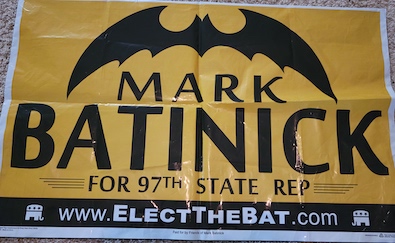
* Anyway, Oswego Willy snagged this yard sign for me during Batinick’s first race. He’s since dropped the Batman references…
12 Comments
|
* Just the other day, Bailey was complaining about Marxism in Illinois…
From the story…
Bailey on Tuesday met with several striking John Deere union workers in Moline.
The UAW members he spoke with are supportive of the agreement that was struck with Deere to extend their contract through 2027 (including a 10% wage increase the first year, and $82,000 total average increase over the term of the contract), he said. “One thing on the line I found that I was happy about – people love their job; they love John Deere; they love Illinois.”
Those folks were in the minority. UAW members voted to reject the contract offer yesterday.
* Gary Rabine on the Virginia race…
Gary Rabine, Republican candidate for Illinois Governor, says Glenn Youngkin’s victory in the Virginia governor’s race sends a clear message that voters want candidates who will stand up for families and oppose the far-left agenda of woke politicians.
“I have met Glenn Youngkin and I can tell you he is a common-sense leader who can’t be bought,” Rabine said. “Throughout his campaign, Glenn sounded the alarm about the war on families. Instead of ignoring the concerns of parents, he embraced them. Not only was his message the right message, but it proved to be a winning message.”
Rabine said woke politicians in Illinois should be worried. In 2022 people in Illinois will stand up for Life, Liberty and Freedom as Virginia has.
“Governor Pritzker wants to be the wokest of the woke and he continues to ignore common sense and continues to wage his war on families,” Rabine said. “He has doubled down on vaccine mandates and mask mandates. He has signed legislation to put sexually explicit and borderline pornographic material into classrooms and he has pushed legislation to take away the Right of Conscience for working people. While Pritzker was not on the ballot in Virginia, his far-left views were. Voters in Virginia rejected woke politics and I am confident voters in Illinois will do the same.”
* And here’s Paul Schimpf’s take…
Republican candidate Paul Schimpf celebrated new Virginia Governor-Elect Glenn Youngkin’s decisive, seismic victory yesterday, saying that Youngkin’s win sends a message that Republicans can prevail in so-called “blue” states by focusing on issues that are relevant to everyday Americans.
“I’m thrilled to see Governor-Elect Youngkin win in Virginia,” Schimpf said. “But it isn’t just that he won, it’s how he won. He ran a thoughtful, inspired campaign that spoke to voters on what matters most—their wallets, their freedom, and, most importantly, their children.”
“This is also my vision for our state, and I fully believe that this is the blueprint for how to connect with voters and win in Illinois as well,” Schimpf added. “Illinoisans are fed up with corrupt, partisan politics and the blue-red divide and just want to know that their communities are safe, the economy is strong, and they can give their kids the best possible future.”
“To make that vision a reality for Illinois, we need to clean up corruption, support our law enforcement community, and reduce our state’s massive tax burden to grow our economy for working families,” he said.
“Governor-Elect Youngkin was able to persuade voters across the ideological spectrum and regardless of party by appealing to their core values and priorities,” Schimpf continued. “And, just as Youngkin stressed in his campaign, nothing is more important to me than for parents—not the government—to have the power to decide what’s best for kids when it comes to education, health, and more.”
Pushing back against the Pritzker Administration and Springfield Democrats’ desire to have more and more control over our lives, Schimpf has proposed an “Illinois Parents’ Bill of Rights,” which ensures that parents of minor children have a variety of educational, financial, and health-related rights when it comes to raising their kids as they see fit.
Explaining the importance of parental rights further, Schimpf elaborated that “a pro-family reset is long overdue. Let’s restore the relationship between the parents of Illinois and their government to one that gives back to parents the autonomy and respect that they never should have lost in the first place.”
As the next Governor of Illinois, Paul Schimpf will be a common-sense conservative leader who will stand up for parents, stand up for small businesses, and stand up for everyday Illinoisans. That’s what it will take to fix Illinois, and that’s what Paul Schimpf can deliver.
Bailey didn’t say much on Facebook and the same thing went for Jesse Sullivan on Twitter.
…Adding… IDCCA…
Yesterday, Senator Darren Bailey — Republican candidate for Governor with a zero percent Illinois AFL-CIO rating — stopped by a UAW union picket line. IDCCA President Kristina Zahorik issued the following statement:
“Watching Republicans like Darren Bailey constantly gaslight Illinoisians is like living in the Twilight Zone — what’s up is down, and what’s fact is fiction. Let’s be clear to Illinois workers: Darren Bailey has a zero percent lifetime rating from the Illinois AFL-CIO, and he opposed letting voters have their say at the ballot box over whether we should constitutionally protect workers’ rights — like those UAW members — to collectively bargain.”
“Illinois Democrats and the IDCCA stand with our union brothers and sisters at John Deere, and we support their right to collectively bargain. We can’t let Darren Bailey lie to us, and voters need to remember he’s full of BS.”
As reported by Mark Maxwell of WCIA, Darren Bailey voted against putting the workers’ rights amendment on the ballot in 2022.
*** UPDATE *** Center Square…
Venture capitalist Jesse Sullivan’s campaign said Youngkin’s win shows Illinoisans they can move beyond an era of high taxes, high crime and self-interested career politicians.
“[M]others and fathers and people from all walks of life stood up and spoke loudly against a government that has reached into their homes, their schools, and their lives,” a Sullivan spokesperson said in an email. “Leadership is about prioritization, and time and time again, J.B. Pritzker and the radical legislature has prioritized virtue signaling and personal aspirations over the lives and livelihoods of working people.”
And while Illinois’ gubernatorial election isn’t for another 12 months, Bailey said the momentum from Youngkin’s win in Virginia will persist, especially after the recent veto session where Illinois Democrats passed controversial legislation.
“I don’t think anyone is going to forget this anytime soon,” Bailey said. “I think momentum, yes, will build and it’s going to build even much more than it did in Virginia.”
43 Comments
|
* This is not a bad piece from Politico about last week’s congressional redistricting vote. I say that tongue in cheek because subscribers will recognize that much (not all) of this is just unattributed rehash of what they’ve already been reading for the past several days…
As many as 10 representatives had opposed the third draft of the map, so the Democratic leaders hoped this map and soothing discussions would change their minds. It did.
Supporters of Rep. Sean Casten felt better that he got some breathing room. And state Rep. Kathleen Willis dropped her opposition to the map after Garcia assured he wasn’t orchestrating a primary challenge against her.
Garcia also made sure that the 22nd Legislative District was split between his newly drawn 4th District and Casten’s 6th. That didn’t sit well with Chicago Ald. Marty Quinn — known to some insiders as “the general” for carrying out orders of his friend and ally, former House Speaker Michael Madigan, the man synonymous with the state’s Irish political machine. Quinn didn’t want to see the district broken up.
Given the area has a high concentration of police officers and a reputation for getting out the vote, the left-leaning Garcia wanted to avoid a potential challenge in any upcoming election.
His team worked with Harmon’s team and mapmakers — some of whom are Madigan allies — to tweak boundaries before handing a new version to the Illinois House. Representatives then had two choices: vote for it and move on, or vote against it and see the process finished in January. (Smart move. Who wants Nancy Pelosi upset at your vote?)
Welch backed the new boundaries — another sign of his growing influence in the General Assembly. As one legislative observer put it, Welch took the view that “I don’t care what Marty Quinn thinks. I don’t care what Michael Madigan wants. I want this on the board.”
Most lawmakers fell in line. Rep. Angie Guerrero-Cuellar, who succeeded Madigan in the 22nd Legislative District and has a ward office across the hall from Madigan and Quinn, was the only Democrat to vote against it. And Rep. Kelly Cassidy didn’t vote at all, a protest vote about not all women’s voices being heard.
Another Democratic lawmaker put it this way: “You think people will side with the old speaker over the new speaker? Madigan is gone and no one was going to take the chance to side with Quinn. The new speaker is the boss. He’s in charge.”
As subscribers knew days ago, Rep. Willis wanted to avoid a primary challenge and she was satisfied with the talks. But others are now saying that she may get one anyway. We’ll see. Also, Garcia wanted the first responders out of his new district, but I seriously doubt he has any real fears of being primaried from the right. I could go on, but whatever.
18 Comments
|
* Background is here if you need it. Hannah Meisel…
Top staff at the Illinois Tollway were left without clear direction on Tuesday after the agency’s board of directors made no decisions on an internal power struggle that has split the Tollway and left two high-ranking agency officials out of a job.
Members of the Tollway’s Board requested a special meeting after agency Executive Director José Alvarez asked them to referee a split between him and Board Chair and CEO Will Evans, who recently moved to consolidate more power in an agency reorganization.
The Tollway’s in-house drama threatens to slow or derail massive ongoing and future plans for road projects in its massive $14 billion multi-year Move Illinois infrastructure plan and drag Gov. JB Pritzker into the mire in an agency whose reputation he’d hoped to give a fresh start when he cleaned house at the beginning of his term. […]
But tensions between Evans and Alvarez have grown since they began working together, finally spilling over into the boardroom recent weeks, first with a vote on reorganizing the agency and then Tuesday’s special meeting called by board members frustrated by having been asked to mediate the power struggle between the two men.
Evans stepped aside from the chair’s traditional role running the board meeting while the body was in its marathon five-hour executive session the board held behind closed doors at the Tollway’s headquarters on Tuesday — the first in-person meeting the board has staged since the pandemic began. Instead, another board member acted as chair during the meeting. But Alvarez, who is normally present during executive session, was not in the board room.
Neither [board member Karen McConnaughay] nor Evans could say whether that internal investigatory mission would include bringing in third parties like outside counsel to help, but McConnaughay did say the board wants to settle the matter “sooner rather than later,” so long as the board members feel they’ve done “a thorough job of looking at everything that’s been raised.”
Adults need to act like adults and not like children fighting over toys. If you cannot adequately do your job without drama, then leave. And rather than taking one side or the other, construction trade unions and management groups need to help calm things down.
16 Comments
|
Open thread
Wednesday, Nov 3, 2021 - Posted by Rich Miller
* Two good points…
What’s up by you today?
81 Comments
|
|
Comments Off
|
|
Comments Off
|
|
 Support CapitolFax.com
Visit our advertisers...

 ...............
 ...............
 ...............


|
   
|
Hosted by MCS |
SUBSCRIBE to Capitol Fax |
Advertise Here |
Mobile Version |
Contact Rich Miller
|



