Question of the day
Monday, May 10, 2021 - Posted by Rich Miller
* Via the Progressive Grocer, here’s a recent Numerator online survey…
Consumers who don’t plan to get the vaccine were twice as likely to say that they’re ready to celebrate holidays on a larger scale, and 57% said that they’re ready to celebrate holidays normally. In contrast, fully vaccinated consumers are the most cautious group, with 36% saying that they’ll ease back into normal celebrations, and 16% planning to stick to small-scale celebrations for the foreseeable future, even after restrictions are lifted.
* Chart…
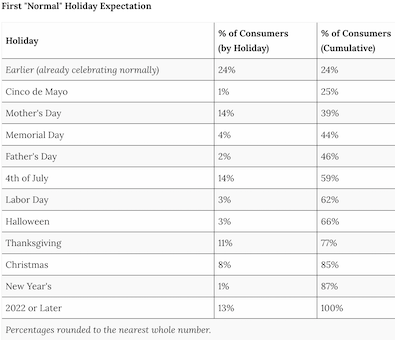
* The Question: Using the list above, what is the first holiday that you expect will be (or already was) “normal” for you and yours? Explain. Also, let us know your vaccination status.
48 Comments  
|
Coalition To Protect Telehealth Supports House Bill 3498
Monday, May 10, 2021 - Posted by Advertising Department
[The following is a paid advertisement.]
A coalition of 35 diverse organizations has come together with a common goal: to modernize healthcare and empower patients. To achieve this goal, The Coalition to Protect Telehealth—which includes Illinois healthcare providers, professionals and patient advocates—is united behind patient-centered virtual care that’s high-quality, accessible and safe.
The pandemic brought the coalition together, as it brought the need for telehealth to the forefront. Coalition members include:
• AARP Illinois;
• American Academy of Pediatrics, Illinois Chapter;
• American Nurses Association, Illinois;
• Community Behavioral Healthcare Association;
• Heartland Alliance;
• Illinois Association for Behavioral Health;
• Illinois Critical Access Hospital Network;
• Illinois Primary Health Care Association;
• National Multiple Sclerosis Society; and
• The Kennedy Forum.
The Coalition to Protect Telehealth strongly supports House Bill 3498 and urges Senators to vote “YES” on bill. This legislation advances health equity by allowing patients to be treated via telehealth in their home, prohibiting geographic or facility restrictions on telehealth services, and reimbursing telehealth services at the same rate as in-person care.
Learn how permanent telehealth coverage will continue to provide Illinoisans’ access to quality, appropriate care. Visit https://protectillinoistelehealth.org/ for a complete listing of coalition members.
Comments Off
|
COVID-19 roundup
Monday, May 10, 2021 - Posted by Rich Miller
* WREX…
Illinois will begin receiving less COVID-19 vaccines in from the federal government in the near future.
Illinois Governor JB Pritzker made the announcement Monday morning in Chicago.
“Illinois, like the nation as a whole, has reached a point where, by and large, all the people who were immediately eager to get vaccinated, have already been vaccinated,” Gov. Pritzker said. […]
Pritzker said health officials in the state have been expecting this to happen for “some time now.”
* Press release…
Today, State Senator Sue Rezin (R-Morris) joined area veterans’ groups to demand more accountability and actions regarding the COVID-19 outbreak at the LaSalle Veterans’ Home, the deadliest outbreak at a state-run facility in Illinois history.
“The tragedy that occurred at the LaSalle Veterans’ Home shouldn’t have ever happened,” said Sen. Rezin. “The residents of the LaSalle Veterans’ Home served and protected our nation when we needed it, but when they need us to serve and protect them, our state failed them miserably.”
In response to this failure, Sen. Rezin has filed several pieces of legislation that would help prevent future devastating outbreaks from occurring and would open a truly independent investigation into the LaSalle Home’s outbreak. However, the bills have not received a committee hearing.
The legislation includes:
* Senate Bill 1471: requires facilities licensed and operated by the State to conduct outbreak preparedness drills.
* Senate Bill 2251: requires IDPH to have an onsite visit within one business day of an infectious outbreak at a veterans’ home. An outbreak is defined as two or more individuals who have contracted an infectious disease within 48 hours of the first diagnosis.
* Senate Bill 2252: requires the Auditor General to conduct a performance audit of the Department of Veterans’ Affairs (IDVA) and the Department of Public Health’s (IDPH) management of the 2020 COVID-19 outbreak at the LaSalle Veterans’ Home.
“I have not been given an explanation on why these bills are being held,” said Sen. Rezin. “The fact that these important and potentially life-saving bills have been essentially blocked is embarrassing and disrespectful to the lives of the veterans we lost at the LaSalle Veterans’ Home.”
Additionally, after learning that Former IDVA Director Linda Chapa La Via and LaSalle Veterans’ Home Administrator Angela Mehlbrech refused to cooperate with the Inspector General’s investigation, Sen. Rezin has filed new legislation.
“When I learned that former Director Chapa La Via and the Home’s Administrator refused to cooperate with the OIG’s investigation, I was outraged,” Sen. Rezin. “How could we allow the former director of IDVA and the head of the veterans’ home refuse to answer questions about an outbreak that cost the lives of 36 veterans? It is unacceptable, and the state legislature needs to provide the Inspector General with the power to get the answers they need.”
Senate Bill 1445 would give the Inspector General the authority to subpoena former agency directors, senior administrator, or any other individual who, while employed at the Department, had the authority to implement policy action for the Department, an agency under contract with the Department, or any facility or program operated for or licensed or funded by the Department.
Sen. Rezin is urging the General Assembly to swiftly take up all of these critically important legislation before the end of spring legislative calendar.
“There may only be a few more weeks left in May, but there is still plenty of time for us to do the right thing, said Sen. Rezin. “There is still time to pass these bills. There is still time for us to help ensure that nothing like this happens again.”
* Good to see that not all restaurant owners are blind to the preferences of actual paying customers and aren’t heeding the ranters on social media…
Consumers once again have the choice to dine-in at their favorite restaurants but many are taking a pass, opting to eat al fresco.
That could explain why outdoor dining tents continue to pop up like spring flowers at local eateries even with 50% capacity now allowed for dine-in service.
“Even when COVID is over and we’re back to 100% (occupancy) the mood of the consumer is they still want curbside (take out) or outdoor dining,” said Joe Rupnik, owner of The Pasta House Co. […]
Lunch rush was just beginning on a recent day that clocked winds strong enough to garner a weather warning. Still, Rupnik noted over half of his customers opted to eat in the new tent.
* Center Square…
“Everyplace is different,” said Larry Troche, owner of Déjà Vu. He’s not ready to require dancers, staff, or patrons to show proof of vaccination.
“But I do require masks,” he said, “and I ask them to wear a mask, and if they don’t want to wear a mask, that’s their prerogative, but it’s my prerogative not to have them come in.” […]
Still, particularly in the sectors of food and hospitality, some employers are having a difficult time getting workers to return to the job, due in part to extended unemployment benefits.
For his part, Troche, who said he pays well, isn’t seeing it.
“Every situation is unique, but I am not having a lot of problems,” he said.
* Related…
* COVID-19 positivity rate in Illinois lowest in more than a month, and hospitalizations also down
* 15-Year-Old Illinois Girl Dies 2 Days After Testing Positive for COVID, Family Says - Dykota Morgan’s mother said the high school freshman was an athlete who played multiple sports and did not have any pre-existing conditions
* 5 things to know about the need for ongoing COVID-19 testing in Illinois
* Illinois’ Top Doctor Touts Safety of COVID Vaccine
* Illinois flu activity plunges amid pandemic
* Illinois Set to Move into Bridge Phase Friday. Here’s What That Means For You
* How the COVID-19 Crisis is Affecting Indian Americans
10 Comments
|
* This was supposed to be done by the end of April, but at least it got here before May 31. From the US Department of the Treasury…
The American Rescue Plan will deliver $350 billion for eligible state, local, territorial, and Tribal governments to respond to the COVID-19 emergency and bring back jobs.
The Coronavirus State and Local Fiscal Recovery Funds provide a substantial infusion of resources to help turn the tide on the pandemic, address its economic fallout, and lay the foundation for a strong and equitable recovery.
Funding Objectives
Treasury is launching this much-needed relief to:
• Support urgent COVID-19 response efforts to continue to decrease spread of the virus and bring the pandemic under control
• Replace lost revenue for eligible state, local, territorial, and Tribal governments to strengthen support for vital public services and help retain jobs
• Support immediate economic stabilization for households and businesses
• Address systemic public health and economic challenges that have contributed to the inequal impact of the pandemic
[…] Use of Funds
The Coronavirus State and Local Fiscal Recovery Funds provide eligible state, local, territorial, and Tribal governments with a substantial infusion of resources to meet pandemic response needs and rebuild a stronger, and more equitable economy as the country recovers. Recipients may use these funds to:
• Support public health expenditures, by, for example, funding COVID-19 mitigation efforts, medical expenses, behavioral healthcare, and certain public health and safety staff
• Address negative economic impacts caused by the public health emergency, including economic harms to workers, households, small businesses, impacted industries, and the public sector
• Replace lost public sector revenue, using this funding to provide government services to the extent of the reduction in revenue experienced due to the pandemic
• Provide premium pay for essential workers, offering additional support to those who have and will bear the greatest health risks because of their service in critical infrastructure sectors
• Invest in water, sewer, and broadband infrastructure, making necessary investments to improve access to clean drinking water, support vital wastewater and stormwater infrastructure, and to expand access to broadband internet
Within these overall categories, recipients have broad flexibility to decide how best to use this funding to meet the needs of their communities.
The “interim final rule” is here.
* Pew Charitable Trusts…
“The American Rescue Plan Act represents historic investment in state and local governments—approximately $1,000 per American,” said Adam Levin, who researches state fiscal policy for The Pew Charitable Trusts. “The key to ensuring these resources yield returns is not just about the amount of funding – but how that money is spent. State and local leaders should take a long-term perspective on these new funds and analyze what their budgets will look like after this federal relief expires in 2024. Tools like multi-year revenue and expenditure forecasts and budget stress tests can help officials decide how to use this money today without inadvertently creating budget holes tomorrow.”
…Adding… US Sen. Durbin…
“Democrats and President Biden provided these federal relief dollars to prevent layoffs and save essential services. State and local governments will finally be able to fill revenue gaps to keep our teachers, first responders, and state employees serving our communities as we recover from the pandemic.
“A word of caution: governors and mayors asked for maximum flexibility in using these funds. As someone who supported their request, I am asking for maximum responsibility in spending these funds for essential needs.”
6 Comments
|
So, what are we, chopped liver?
Monday, May 10, 2021 - Posted by Rich Miller
* The Columbus Dispatch…
Ohio’s public corruption case involving $61 million in bribes in exchange for a $1.3 billion bailout is the biggest open investigation in any Statehouse in America — surpassing a similar scandal in Illinois and two closed-out cases in New York.
The Ohio case involves big money, a Fortune 500 company, top political leaders, 4.5 million electricity customers across the state and the suicide death of a defendant. […]
So far, five Ohioans have been charged in U.S. District Court with racketeering. Akron-based FirstEnergy Corp. fired its chief executive and other top managers and lobbyists, disclosed it paid $4.3 million to someone who became an Ohio utility regulator, and is in early talks with federal prosecutors to avoid prosecution. And FBI agents searched the home of then Public Utilities Commission of Ohio chairman Sam Randazzo, who then resigned.
Public corruption watchdogs told the USA Today Network Ohio that the House Bill 6 case, an open investigation against another previous House speaker and several city-level cases, catapults Ohio ahead of the pack.
So disappointing /s
16 Comments
|
Today’s quotable
Monday, May 10, 2021 - Posted by Rich Miller
* WTTW…
U.S. Rep. Jesus “Chuy” Garcia, a Democrat from Chicago’s Little Village neighborhood, says he has faith in Illinois Senate President Don Harmon and Illinois Speaker of the House Chris “Emanuel” Welch – both of whom assumed their leadership positions within the past year or two.
“We’re going to have one of the most open and inclusive redistricting processes ever in Illinois,” Garcia said. “I am heartened by the leadership that we have in Illinois with a president of the Senate and a new speaker of the House who have committed to having real community engagement hearings … and recognizing the diversity of the populations in Illinois, specially across northern Illinois.”
“Open and inclusive.” Right.
9 Comments
|
It’s just a bill
Monday, May 10, 2021 - Posted by Rich Miller
* Illinois Press Association/Foundation convention coverage last week…
Just as he did with Welch, Jeff Rogers, director of the Illinois Press Foundation, asked Harmon for his thoughts on the bill sponsored by Sen. Steve Stadelman, D-Rockford, which would create a local media task force. It passed through the Senate, but must now make its way through the House Labor Committee. Before letting Harmon answer, Rogers first offered his take, which stems from a career of tracking such legislation.
“I know one of the things people think about when they hear ‘task force’ is something that goes somewhere to die, in terms of recommendations,” Rogers said. “But how do you think this particular task force could help newspapers, and what do you think the prospects are for it to pass this legislative session?”
“I think it’s a great bill, and I was happy to see it passed through the Senate without opposition,” Harmon said. “I certainly want to see local news thrive. Obviously this is a starting point, and I hope it would give important stakeholders the opportunity to share their ideas for keeping local news vibrant, and I hope it would give you all the opportunity to weigh in, as well. I would imagine the House would be happy to take it up.”
And yet some people still wonder why the foundation’s media outlet isn’t allowed into the press boxes.
To the bill…
Establishment. The Local Journalism Task Force is established to: (1) conduct a comprehensive, nonbinding study relative to communities underserved by local journalism in Illinois; and (2) review all aspects of local journalism including, but not limited to, the adequacy of press coverage of communities, the ratio of residents to media outlets, the history of local news in Illinois, print and digital business models for media outlets, the impact of social media on local news, strategies to improve local news access, and public policy solutions to improve the sustainability of local press business models and private and nonprofit solutions. […]
The Task Force shall meet a minimum of 5 times to review, study, and analyze existing literature as well as quantitative and qualitative data on the status of journalism in the State of Illinois.
The Department of Commerce and Economic Opportunity shall provide administrative and other support to the Task Force.
So, basically the state is paying for a market research report for the news industry.
* In case you were still wondering why a bill to ban mass balloon releases was a government overreach…
The power is back on for around 14-hundred City Water Light and Power customers whose lights went out Friday morning… because of mylar balloons.
Crews responded to the outage around 14th and Clay around 9am and found power lines burned and down on the ground. They had apparently been struck by mylar balloons, which have a metallic coating which conducts electricity, and which can cause substantial damage when they come in contact with power lines.
* More stuff…
* Man says he lost his job in southwest IL because he was ‘supported by Republicans’: According to the complaint, which was filed Madison County Circuit Court, Irby said he was provided no notice that he would be replaced or a chance to defend his job during the same meeting at which current Executive Director Rick Fancher was appointed. The board had just come under Democratic control due to new state law.
* Tax credit considered by state lawmakers to spur more construction of affordable housing
* Senate passes Medicare, tax zone legislation
* Lawmakers propose election reform bill to increase voters’ trust in process
* Where suburban lawmakers hold sway under the state Capitol dome
* Illinois House Republicans argue lawmakers are “wasting time” in Springfield as session winds down
5 Comments
|
* Just keep in mind that Sunday death reports are usually undercounts…
The Illinois Department of Public Health (IDPH) today reported 1,424 new confirmed and probable cases of coronavirus disease (COVID-19) in Illinois, including 12 additional deaths.
- Cook County: 1 female 40s, 1 male 50s, 1 male 60s, 1 female 70s, 1 female 80s, 1 male 80s, 1 female 90s
- Peoria County: 1 female 30s, 1 male 40s, 1 male 50s, 1 male 60s, 1 male 70s
Currently, IDPH is reporting a total of 1,356,391 cases, including 22,235 deaths, in 102 counties in Illinois. The age of cases ranges from younger than one to older than 100 years. Within the past 24 hours, laboratories have reported 41,133 specimens for a total of 23,388,864. As of last night, 1,906 individuals in Illinois were reported to be in the hospital with COVID-19. Of those, 473 patients were in the ICU and 242 patients with COVID-19 were on ventilators.
The preliminary seven-day statewide positivity for cases as a percent of total test from May 3-9, 2021 is 2.8%. The preliminary seven-day statewide test positivity from May 3-9, 2021 is 3.4%.
A total of 9,978,915 vaccines have been administered in Illinois as of last midnight. The seven-day rolling average of vaccines administered daily is 81,265 doses. Yesterday, 70,426 doses were reported administered in Illinois.
*All data are provisional and will change. In order to rapidly report COVID-19 information to the public, data are being reported in real-time. Information is constantly being entered into an electronic system and the number of cases and deaths can change as additional information is gathered. For health questions about COVID-19, call the hotline at 1-800-889-3931 or email dph.sick@illinois.gov.
Comments Off
|
Mod Squad gets whip
Monday, May 10, 2021 - Posted by Rich Miller
* Press release…
Speaker Emanuel “Chris” Welch today announced Representative Frances Ann Hurley as the new whip of the Democratic Moderate Caucus (Mod Caucus), a relatively new caucus of like-minded members who advocate for a balanced, steady approach to lawmaking.
“The Mod Caucus has made an excellent choice in selecting Representative Hurley as their whip, and I welcome her to the leadership team as we continue to do the people’s work,” said Speaker Welch. “As Democrats, we are proud of our diversity and want to bring together ideas from all corners of our party as one common agenda for everyday families.”
“I am proud to represent the Mod Caucus as we tackle a number of issues that will impact the state for years to come: from revitalizing our economy to our fiscal house, public safety and law enforcement, human services, and education,” said Representative Hurley. “Honoring the Mod Caucus’s request for a whip is a great example of Speaker Welch’s promise to lead in a more decentralized and inclusive manner.”
As whip, Representative Hurley will join a cohort of members empowered to rally Democratic sub-caucuses around key issues and pieces of legislation. The full list of whips include:
State Rep. Kam Buckner Black Caucus Whip
State Rep. Deb Conroy Women’s Caucus Whip
State Rep. Will Guzzardi Progressive Caucus Whip
State Rep. Frances Hurley Moderate Caucus Whip
State Rep. Theresa Mah Asian Caucus Whip
State Rep. Aaron Ortiz Latinx Caucus Whip
State Rep. Larry Walsh, Jr. Downstate Caucus Whip
Representative Hurley’s appointment is effective immediately.
9 Comments
|
* Frank Main, Fran Spielman, Tom Schuba at the Sun-Times…
The way the city of Chicago investigates fatal shootings by police officers violates state law and Mayor Lori Lightfoot has been sitting on recommendations to fix that for nearly a year, records reviewed by the Chicago Sun-Times show.
According to the documents, the city isn’t complying with the Illinois Police and Community Relations Act, which governs investigations regarding whether a police officer who has shot someone to death should be charged with a crime.
Under the law, which took effect in 2016, a criminal investigation into a fatal shooting by police has to be done by two investigators from outside the agency that employs the officer involved.
It says one of the investigators doing a criminal investigation of an “officer-involved death” must be a specially trained “lead homicide investigator.” Lead homicide investigators must be sworn officers, according to the state’s law enforcement training board. […]
Under a federal consent decree — a court order that took effect in 2019 requiring sweeping reforms in Chicago Police Department practices — the city must “use best efforts” to ensure that a law enforcement agency conducts investigations into “officer-involved deaths.”
* Meanwhile, Fran Spielman tallied up resignations, etc. under Mayor Lori Lightfoot so far. I turned her well-written story into a list…
Chief Operating Officer Anne Sheahan
Streets and Sanitation Commissioner John Tully
Chief Procurement Officer Shannon Andrews
Mayoral press secretary Jordan Troy
Water Management Commissioner Randy Conner
Family and Support Services Commissioner Lisa Morrison Butler
Sydney Roberts, head of the Civilian Office of Police Accountability
Chicago Public Schools CEO Janice Jackson
Deputy Mayor for Public Safety Susan Lee
Chief Risk Officer Tamika Puckett
Chief of security Jim Smith
Corporation Counsel Mark Flessner
Lightfoot’s chief of staff, Maurice Classen (possible)
* Politico…
A huge cache of internal emails from City Hall was hacked by a third party and made public Friday, revealing the inner workings of Mayor Lori Lightfoot’s administration in Chicago.
The select group of emails had been given to the Jones Day law firm as part of an inquiry into how the police raid on Anjanette Young’s home had been handled. The law firm transferred them to a third party as part of that investigation using a data software service when the emails were swiped. “The breach … at no time involved or impacted the city’s computers or computer system,” according to a statement from the city.
The emails were posted online by Distributed Denial of Secrets, a WikiLeaks-esque group. The file is 4.6 GB — too large for your Playbook author to download, so I’m relying on a few sources who have shared some of the more interesting missives.
The emails primarily involved former deputy mayor Susan Lee, former deputy press secretary Patrick Mullane, former Chief Risk Officer Tamika Puckett, and former mayoral Freedom of Information Act Officer Anjali Julka. They also include emails by Lightfoot and her outside communications consultant, Joanna Klonsky.
They show a mayor who, much like former Mayor Richard M. Daley before her, puts a great deal of energy into every detail of management.
She’s like Daley alright…
By far the best story on the hack is in the Sun-Times. Click here and read it all.
16 Comments
|
Dem county chairs jump into national GOP fray
Monday, May 10, 2021 - Posted by Rich Miller
* IDCCA…
This week Republican members of Congress return to Washington DC to meet and potentially vote to remove Congresswoman Liz Cheney from her leadership position within their caucus. This vote will follow former President Donald Trump’s repeated false claim that the election was fraudulent and stolen, and Liz Cheney’s repudiation of the Big Lie. Today, Illinois Democratic County Chairs Association (IDCCA) President Kristina Zahorik issued the following statement:
“Which path will Rodney Davis, Mary Miller, Darrin LaHood, and Mike Bost take? The path of falsehoods and subversion, and vote to oust Liz Cheney from Republican leadership because she stands up to Trump and his big lie? Or the path of truth and Democracy, and defy their leaders who claim to have ‘lost confidence’ in conservative Liz Cheney.”
“Many of these Illinois Republicans have previously joined Donald Trump and conspiracists in casting doubt on our election, and as early as this Wednesday they will vote in secret to dump ultra-conservative Liz Cheney because she won’t parrot the lie that the election was stolen. If Davis, Miller, LaHood, and Bost truly believe in fair and transparent elections, they can do the bare minimum of telling the public how they intend to vote.”
In December 2020 Congressmen Darrin LaHood and Mike Bost joined 104 of their House Republicans in filing an amicus brief to overturn election results in four other states. In January 2021, Congress members Mary Miller and Mike Bost voted to object to counting Electoral College votes for the States of Arizona & Pennsylvania.
Lynn Sweet in the Chicago Sun-Times reported that Mary Miller has pledged to vote against Cheney. Kinzinger said he would retain. LaHood and Davis have avoided answering the question publicly.
Liz Cheney continues to refute Donald Trump’s claim that the election was stolen, and credits him with inciting the insurrection at the nation’s Capitol on January 6, 2021. Now, Washington Republicans are planning to remove her from her leadership post.
Does anyone else find it odd that the county chairs association is stepping up on an issue that would, in a normal state, be more of a state party function?
25 Comments
|
Because… Madigan!
Monday, May 10, 2021 - Posted by Rich Miller
* They just can’t quit him…
In a wide-ranging 15 minute interview with News 3 WSIL, Congressman Mike Bost shared a wide range of concerns about what’s happening in our nation’s capitol and in the state of Illinois.
He says democrats in Illinois, including Governor JB Pritzker, need to be more transparent as they work to re-shape legislative districts over the next decade.
Bost believes a surprising source may reemerge during the process.
“I believe Mike Madigan will have a lot input into that. Even since he’s not there anymore. Because of his experience and because even though he may not be in those places of position–the people will still ask him because of the amount of time he spent building maps that hold the democratic majority,” Bost said.
The Republicans should be more worried about John Cullerton getting involved. He was much more enthusiastically aggressive about drawing Democratic districts.
14 Comments
|
* Press release excerpt…
To further expand convenient opportunities for Illinoisans to get vaccinated, Governor JB Pritzker launched a new program today that offers building workers and returning office staff a chance to get their shot at work.
“Having vaccine available where you work makes getting vaccinated very convenient,” said Governor JB Pritzker. “SEIU and other area unions, local businesses, and the building managers have worked hand in hand with IDPH to make this as easy as possible. It’s exciting to see traffic in commercial districts across Illinois begin to pick up after a long year apart – an achievement only possible because of the life-saving protection of vaccines and the consequent reduction of cases and hospital admissions. More vaccinations will mean more of a return to normal for everyone.”
“Getting vaccinated is a personal decision and my goal is to arm people with the facts, including the safety and efficacy of the vaccine, as they are making that decision,” said IDPH Director Dr. Ngozi Ezike. “As a physician, I know and have seen the benefits of vaccination. In fact, nearly all doctors have already been vaccinated. I encourage people who may have questions or concerns about the vaccine to talk with their doctor.”
“Chicago was one of the first and only municipalities to prioritize employer-based vaccinations, which has significantly enhanced our vaccine accessibility and equity efforts,” said Chicago Mayor Lori E. Lightfoot. “Thanks to this new initiative, people will be able to conveniently get this life-saving vaccine right in their workplace, furthering our efforts to create a safe return to work process for our residents in the economic heart of our city—regardless of their occupation. I commend Governor Pritzker, our partners in labor and at the State for launching this initiative to help us get one step closer to fully vaccinating our city.”
The effort launches with 10 sites in Chicago, Schaumburg and Rockford — including iconic buildings like the Merchandise Mart and Wrigley Building. The state is partnering with the Building Owners and Managers Association and local unions to encourage front desk staff, custodial workers, security, building engineers and other employees to sign up for an appointment in advance, and outreach will be conducted to neighboring buildings as well. The clinics offer two-dose vaccinations and will also take walk-ins.
Beginning in mid-May, the following buildings will be included in the first wave of the program:
• Merchandise Mart, 222 West Merchandise Mart Plaza, Chicago
• Harris Bank Building, 115 S. LaSalle Street, Chicago
• 540 W. Madison Street, Chicago
• Equitable Building, 401 N. Michigan Avenue, Chicago
• 150 N. Riverside Plaza, Chicago
• 311 South Wacker (Walgreens at 250 S Wacker Dr), Chicago
• Wrigley Building, 400-410 North Michigan Avenue (Walgreens at 410 N Michigan Ave), Chicago
• 308 W. State Street, Rockford
• 1111 S. Alpine Road, Rockford
• 1061 American Lane, Schaumburg
Dates and times will be promoted in advance, which have been strategically chosen around shift changes to allow as many workers to take advantage of this opportunity as possible.
Illinois building operators interested in hosting additional clinics are encouraged to contact IDPH directly or contact the Building Owners and Managers Association.
Illinois is also supporting vaccination clinics for community organizations across the state such as churches and other religious organizations, neighborhood associations, mutual aid groups, nonprofits, immigrant service providers, and the like. Interested community organizations can sign up to host a clinic at no cost to them and IDPH will provide the staff and supplies. The interest form for this program can be found athttps://www.dph.illinois.gov/covid19/vaccinationclinics. To date, IDPH has completed 130 community vaccination clinics with more than 120 scheduled for the weeks ahead.
* Meanwhile…
A micro-brewery in Buffalo, New York, has been offering free beer to encourage vaccine-hesitant customers to visit pop-up vaccination clinics next to its taprooms – and the program has been a roaring success.
The scheme, a hook-up between Erie county health department and two local breweries, comes as many regions across the US are seeing sharp declines in vaccine demand.
Under the plan, brewery patrons are offered a Moderna vaccine shot with a free pint glass and coupon for the vaccinated person’s drink of choice. A second drink comes with the second shot four weeks later. […]
Hours after Erie county’s Shot and a Chaser program got under way at Resurgence Brewing Company on Saturday, about 100 people had been vaccinated.
5 Comments
|
Helmut Jahn
Monday, May 10, 2021 - Posted by Rich Miller
* Whatever you might say about the Thompson Center, we were all very fortunate to have this man in our state. WBEZ…
World famous Chicago-based architect Helmut Jahn died in Campton Hills in a biking accident, authorities confirmed.
In a news release, Campton Hills police say Jahn failed to stop at a stop sign at Burlington and Old LaFox Road in the far west suburbs, and was struck by two vehicles Saturday afternoon. One driver was transported to a local hospital with non-life threatening injuries. The driver of the second vehicle was not injured.
Jahn, who lived in St. Charles, was 81.
The German-born architect is most well-known in Chicago for designing at age 39 the James R. Thompson Center, a postmodern building that wowed the architectural scene upon its opening in 1985 but has become a drain on the state for its much-needed costly repairs. Illinois is in the process of selling the building.
* Daily Herald…
Campton Hills police said Jahn, who kept a farm in St. Charles, was riding near Burlington and Old La Fox roads Saturday afternoon when he was struck by two vehicles. He was pronounced dead at the scene, authorities said.
A native of Germany, Jahn won international recognition and awards for projects around the globe, including United Airlines Terminal 1 at O’Hare International Airport, the former Citigroup Center (the main entrance to the Richard B. Ogilvie Transportation Center) in Chicago, and the Sony Center in Berlin.
Besides MetroWest in Naperville, his suburban work includes the Oakbrook Terrace Tower in Oakbrook Terrace.
“Helmut was bold, audacious, daring, dashing, a kind of star architect before the term was even coined,” said Blair Kamin, former architecture critic for the Chicago Tribune.
* Tribune…
The Thompson Center, built in 1985 and originally called the State of Illinois Center, later was renamed for former Republican Gov. James Thompson Jr., also known as “Big Jim” Thompson.
Jahn once said the building made his reputation around the world and killed it in Chicago. […]
He went on to design such other high-profile projects as the sleek Xerox Center, now known as 55 West Monroe; the art deco revival addition to the Chicago Board of Trade, 141 W. Jackson Blvd.; and the romantically modern United Airlines Terminal 1 at O’Hare International Airport.
Jahn was also behind the Sony Center in Berlin, One Liberty Place in Philadelphia and the Suvarnabhumi Airport in Bangkok. In 2016, he designed a 74-floor residential tower, 1000M, 1000 S. Michigan Ave., that had been expected to be complete in 2022 before construction stopped as a result of the coronavirus pandemic.
Jahn died on what would have been Thompson’s birthday.
* Crain’s…
At 26 years old, Jahn arrived in Chicago to attend the Illinois Institute of Technology, a famed school for aspiring architects that was developed under his fellow German immigrant Ludwig Mies van der Rohe. Jahn left IIT before graduating, but was invited back almost four decades later to design the State Street Village student housing, a row of round-topped, metal-clad buildings that holler back at the black-edged rectilinear buildings by Mies that dominated the campus.
When he left school, Jahn joined the Chicago architecture firm C.F. Murphy Associates, in 1967. He later became executive vice president of the firm, which was renamed Murphy/Jahn. In 2012, the firm took the all-caps, singular name “Jahn.”
Some of Jahn’s earliest buildings are in northwest Indiana: the Michigan City public library, built in 1977 with translucent walls and an interior courtyard, and a round-topped gymnasium for the La Lumiere private school in La Porte. Others are in Kansas City and cities across the globe. Jahn made his first contribution to the Loop skyline in 1980 with the Xerox Center, now called 55 W. Monroe, which an Architect magazine review almost 25 years later described as one of the best expressions of “a sleek, machine-like minimalism” that architects everywhere were seeking at the time.
* ABC 7…
“In losing Helmut Jahn we not only lose one of the best architects on the planet. We lose someone who cared about Chicago,” [Lee Bey, an adjunct professor of architecture at ITT] said. “And a voice that really spoke and cared about the city.”
Jahn taught at the University of Illinois Chicago, Harvard University, Yale University and the Illinois Institute of Technology.
* Neil Steinberg…
My favorite Jahn building is the Mansueto Library at the University of Chicago, its glass-domed reading room outfitted with a working air conditioning system and the actual books tucked away in sub-basements reached by a wondrous automated retrieval system.
Jahn came to Chicago in 1966, to study under Ludwig Mies van der Rohe, adding a whimsy to the former Bauhaus chief’s minimalism or, if you prefer, brutalism. Since Mies came here under the wing of Frank Lloyd Wright in the late 1930s, you can draw a direct line from Louis Sullivan through Wright, to Mies, to Jahn and … well, the line sort of ends there.
The most exciting architect today in Chicago, if not the world, is Jeanne Gang, and Jahn embarrassed himself in 2019 by his sour grapes decrying of Studio Gang’s selection for the $1 billion-plus O’Hare expansion. But this is a time for appreciation, not criticism. The man left his mark.
28 Comments
|
Here come the LaSalle lawsuits
Monday, May 10, 2021 - Posted by Rich Miller
* Sun-Times…
David Liesse is one of about two dozen relatives who lost family members at the LaSalle Veterans’ Home who are now preparing to file suit against the state and the home for what Liesse calls “all-around mismanagement.”
He holds the state liable for the death of his father, a native of Spring Valley in Bureau County.
“They did not take proper precautions with him when they needed to,” he said.
“When I left on that Wednesday, he had absolutely no signs of any illness of any kind, and he was confined to his room, he never left his room, but people came into his room,” David Liesse said. “The virus doesn’t run down the hall on its own. […]
Bonamarte, the lawyer who represents Stachowicz, pointed to reports released late last year that he said show “horrible mismanagement of the facility.”
“You have a lack of planning, you have a lack of infection prevention plans or policies, major issues with communication, staff training, education, the wrong type of hand sanitizer,” Bonamarte said.
Go read the whole thing.
16 Comments
|
* Friday afternoon at 5:09 pm…
Chicago South Side Alderman David Moore is announcing his run for Illinois Secretary of State to replace long time incumbent Jesse White, who is retiring at the end of his term in January 2023. Moore is the fifth candidate to enter the race for one of the most coveted offices in Illinois.
Moore says he intends to serve in the footsteps of White who he considers a great public servant, Illinois ambassador and role model to the state’s youth.
“He has run the office with great integrity and character while professionally conducting the business of the Secretary of State. I have decided to accept the call to build on such a rich legacy,” says Moore.
The alderman, who was elected in 2015, is a native Chicagoan who spent his childhood in the Robert Taylor Homes before moving to the Englewood and Auburn-Gresham communities. Upon completing Simeon Vocational High School, he graduated Western Illinois University with a dual major in accounting and operations management. He earned an MA with emphasis in government studies at Loyola University-Chicago.
Moore established a successful accounting career in the private sector at several Fortune 500 companies, as well as with Chicago’s Department of Aviation, Chicago Housing Authority and he also served as an assistant to the commissioner of the Cook County Board of Review, coordinating the Faith-based and Community Initiatives.
His work in the public sector exposed him to nearly every aspect of government management, including hands-on experience with cost-benefit analysis, budgeting, strategic planning, directing inter-agency teams, and projecting the impact of initiatives related to such issues as urban renewal, affordable housing, land use, public works, and transportation. He oversaw projects for redeveloping the South Loop, creating job-training sites and identifying employment opportunities for low-income residents. Moore also worked on the redevelopment of Hilliard Homes and construction of the National Teachers Academy.
Moore is making his announcement for Secretary of State in Macomb Illinois where he attended Western Illinois University.
“The campus is where I learned to love Illinois. I met so many people from different parts of the state, different ethnicities, different religions and different political parties. I still have many of the friendships and relationships that I developed while at Western Illinois University,” explains Moore.
As a public servant, Moore considers himself on the “front line” and his duty is to provide access, customer service, transparency, accountability, integrity and advocacy. He believes his grassroots and corporate backgrounds give him the skills to be effective.
The announcement will take place in front of Sherman Hall, 600 Sherman Drive, Macomb, Illinois at noon, Saturday, May 8, 2021.
* My own take…
* CBS 2…
He joins fellow Ald. Pat Dowell (3rd), former Illinois State Treasurer Alexi Giannoulias, Chicago City Clerk Anna Valencia and state Sen. Michael Hastings (D-Frankfort) in the Democratic primary.
15 Comments
|
* My weekly syndicated newspaper column…
The state legislators negotiating a massive new energy reform bill for Illinois are said to have made real progress at their Tuesday working group meeting this past week.
Shortly before the meeting began, a legislator who is a longtime union ally and involved in the talks told me the consensus was that “a pound of flesh” would have to be extracted from Exelon, which wants more subsidies for two nuclear power plants and has been under a dark ethics cloud as the U.S. attorney’s office probes it and its subsidiary ComEd’s Statehouse activities.
Well, lawmakers may want to increase the weight of that flesh to be extracted after a routine federal court hearing was rocked by a bombshell that could complicate the negotiations.
Near the end of a status hearing last week to discuss setting a trial date for the case of four people charged with conspiring to bribe former House Speaker Michael Madigan on behalf of ComEd, the defense attorney for former ComEd lobbyist Mike McClain told U.S. District Court Judge Harry Leinenweber that setting a date would be difficult because, “there has been some at least intimations that the government might be seeking a superseding indictment in this matter,” the Chicago Tribune reported.
The defense lawyer for former ComEd vice president and lobbyist John Hooker then chimed in: “We know they are apparently on the brink of a superseding indictment. When are they going to tell us?” the Chicago Sun-Times reported.
The state is rife with speculation that the superseding indictment could be of Madigan, who has denied all wrongdoing and has not been charged.
And that speculation intensified further when the Tribune reported that federal prosecutors had asked a couple of former House Democrats to explain to a grand jury how Madigan controlled the legislative process. Those former members are not subjects of the investigation, the paper reported. Another former legislator told the Tribune he was recently interviewed by federal agents about “Madigan’s role in the process.”
Madigan, of course, was forced out of office in January as a direct result of the federal probe and the resulting deferred prosecution agreement entered into by ComEd’s parent company Exelon and the indictments of his former close associates who worked or lobbied for the companies.
And even though much of the federal investigation revolves around the companies’ successful passage of a bill to heavily subsidize two nuclear power plants, Exelon is now asking the legislature to bail out two more downstate nuke facilities. The company is ostensibly taking a hands-off approach to the bill for obvious reasons, but a union-backed group is advocating on behalf of union members who work at the plants, which means its proposals will directly benefit the company.
While that arrangement allows lawmakers and the governor to avoid talking directly with Exelon and ComEd, it doesn’t change the fact that the end result will have a direct impact on the companies’ bottom lines.
The governor’s financial proposal, based on an independent audit of Exelon’s actual needs, all but guarantees that any bailout number agreed to above that amount would be immediately suspect.
The union group has deemed the governor’s plan inadequate and claims that a similar Synapse audit in New Jersey produced an allegedly inaccurate subsidy projection that was subsequently rejected by the state’s public utilities commission. Coincidentally (or not) Exelon’s CEO Chris Crane pointed to the same Synapse audit in New Jersey during a recent earnings call with investors.
There has been some talk of basing the first year’s Exelon subsidy on the governor’s proposed level and then allowing the Illinois Commerce Commission, or some other body, to determine the subsidy moving forward. But in New Jersey, the public utilities commission eventually awarded the maximum allowed amount of zero emissions credits to the local nuclear fleet. Even so, a punt to a non-legislative body would have its advantages for legislators up for reelection next year.
The bottom line here is that lawmakers got a fresh reminder last week of the tricky minefield they’re in. And you can’t help but wonder how closely the feds are monitoring the activities surrounding this particular bill.
* Related…
* Pritzker Is Seeing Through the Haze on Energy Reform
4 Comments
|
|
Comments Off
|
|
Comments Off
|
|
 Support CapitolFax.com
Visit our advertisers...

 ...............
 ...............
 ...............


|
   
|
Hosted by MCS |
SUBSCRIBE to Capitol Fax |
Advertise Here |
Mobile Version |
Contact Rich Miller
|



