US 7th Circuit gets salty
Monday, Mar 8, 2021 - Posted by Rich Miller
* 7th Circuit US Court of Appeals in re Gonzales v. Madigan…
Four candidates were on the ballot for the Democratic primary in spring 2016: Michael Madigan, Jason Gonzales, Grasiela Rodriguez, and Joe G. Barboza. Madigan won with 65% of the votes cast; Gonzales received 27%, Rodriguez 6%, and Barboza 2%. Gonzales contends in this suit under 42 U.S.C. §1983 that Rodriguez and Barboza were stooges put on the ballot by Madigan’s allies to divide the Hispanic vote and ensure Madigan’s victory. The effort was hardly necessary, since if every non-Madigan vote had gone to Gonzales he still would have lost in a landslide. Nonetheless, Gonzales contends, the appearance of two candidates who served only as distractors violated the Equal Protection Clause in the Fourteenth Amendment and entitles him to damages (perhaps represented by the expenses of his failed run). Gonzales relies on Smith v. Cherry, 489 F.2d 1098 (7th Cir. 1973), which held that a stalking-horse candidacy, in which the nominal contestant secretly planned to withdraw after winning the primary and permit a party committee to name the candidate for the general election, could in principle violate the Equal Protection Clause. […]
Because the voters were not deceived, the judge held, the conditions leading to liability in Smith have not been satisfied. The court granted summary judgment against Gonzales. […]
Gonzales’s response has been to file an appellate brief that treats the district judge as an extra defendant. According to Gonzales, the judge personally violated the First Amendment by penalizing Gonzales’s campaign speech. That utterly misunderstands the burdens of production and persuasion in litigation. To prevail, any litigant must establish the elements of a valid claim. One aspect of that claim, under the analysis of Smith, is that the voters have been hoodwinked. Gonzales’s own speeches and ads during his campaign show that the voters were not hoodwinked. End of case. Recognizing this does not penalize anyone’s speech. It shows, rather, that Gonzalez did not satisfy the governing legal standard. […]
Gonzales also accuses the district judge of violating the Due Process Clause and the Equal Protection Clause. Those assertions—advanced without elaboration in one-half page of the appellate brief—do not require independent analysis.
Great lawyering there /s
* In other news…
The full opinion is here.
13 Comments  
|
It’s just a bill
Monday, Mar 8, 2021 - Posted by Rich Miller
* Sun-Times editorial…
Six years ago, a woman in Downstate Springfield, Billie Aschmeller, took out a $596 short-term loan that carried a crazy high 304% annual interest rate. Even if she paid back the loan in the two years required by her lender, her total bill would exceed $3,000.
Before long, though, Aschmeller fell behind on other basic expenses, desperately trying to keep up with the loan so as not to lose the title to her car. Eventually, she ended up living in that car.
Aschmeller regrets she ever went the payday and car title loan route, with its usury-high levels of interest, though her intentions — to buy a winter coat, crib and car seat for her pregnant daughter — were understandable. She is now an outspoken advocate in Illinois for cracking down on a short-term small loan industry that, by any measure, has left millions of Americans like her only poorer and more desperate.
For years, as she has told the Legislature, she felt “like a hamster on one of those wheels.”
A bill awaiting Gov. J.B. Pritzker’s signature, the Illinois Predatory Loan Prevention Act, would go a long way toward ending this sort of exploitation by the financial services industry, and there’s little doubt the governor will, in fact, sign it. The bill, which would cap interest rates at 36%, has strong bipartisan support. It was approved unanimously in the House and 35 to 9 in the Senate.
But two hostile trailer bills — HB 3192 and SB 2306 — have been introduced in the Legislature that would greatly water down the Predatory Loan Prevention Act, defeating much of its purpose. Our hope is that those two bills go nowhere. They would create a loophole in how the annual percentage rate is calculated, allowing lenders to charge hidden add-on fees.
The House bill is sponsored by Democratic Rep. Jonathan Carroll. The Senate bill is sponsored by Republican Sen. Sue Rezin.
* Mike Miletich…
A Democratic state lawmaker hopes to make payments for childcare services easier on families struggling to get by. Rep. La Shawn Ford (D-Chicago) says Illinois families living in poverty should only have to pay $1 per month for child care.
The Pritzker administration lowered childcare payments for eligible families to $1.25 for the first two months of this year due to the COVID-19 pandemic. Ford wants to make this emergency idea a law. His proposal for a $1 monthly co-pay would only be in place for families with income at or below 185% of current federal poverty guidelines.
Ford says families should be able to send their children to child care and keep more money to pay bills and put food on the table.
“We hope that we respect the frontline workers that have carried this state during the pandemic and realize how important it is to make sure that every child has access to high-quality child care,” Ford explained.
98,000 children enrolled in the Child Care Assistance Program (CCAP) in December. Still, advocates say participation in CCAP is down significantly. In fact, data from the Department of Human Services showed a 45% decrease for infants and toddlers and a 35% drop for preschoolers in the program. Advocates feel permanently reducing the co-pays to a dollar will help more families return to childcare providers. Some say it could also allow parents to work throughout the day.
* Press release…
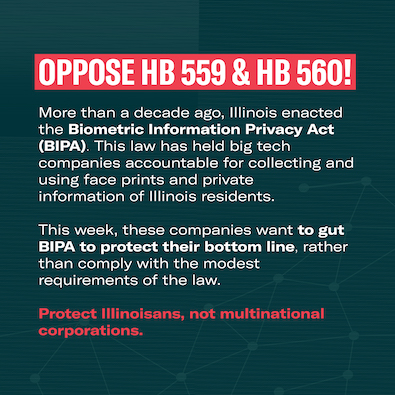
Two bills threatening to weaken the nation’s strongest biometric information privacy law will get a hearing on Tuesday in the Illinois House Judiciary – Civil Committee. The proposals, House Bill 559 and House Bill 560, effectively gut the meaning and enforcement of the Biometric Information Privacy Act (BIPA), adopted unanimously by both legislative chambers a little more than a decade ago. The effort to reverse the law comes after court decisions in recent years that have held large companies like Six Flags and Facebook accountable for collecting and using the biometric information of Illinois residents.
“BIPA has worked to protect the biometric information – like face prints and fingerprints – of Illinois residents,” said Sapna Khatri, advocacy and policy counsel for the ACLU of Illinois. “This information is incredibly sensitive because it can never be changed. At a time when other cities and states are moving to ban dangerous biometric technology like facial recognition, this is not the time to reverse course on these important privacy guidelines we have in place in Illinois. Indeed, these guidelines are seen as a model for other states. The Committee should stop these measures in their tracks.”
BIPA is straightforward. It simply requires a company to inform someone in writing when biometric data is being collected or stored. And BIPA requires written consent in order for the company to collect, store of use the data. Because the law allows an individual to bring a legal claim against any company that violates the provisions of BIPA, it has been used in recent years to win judgments for violations against Six Flags, Facebook and other companies.
Together, the two House measures would undo all of these protections. The bills redefine what is biometric information so that some of our most intimate, private data is no longer covered. The measures also eliminate any protections for employees, allowing companies to collect and store their information without meaningful information or consent. And the bills end the ability to bring cases in court against violators, leaving the enforcement to government agencies that are not positioned to punish violations – including the massive ones we have seen in recent years.
“This is dream legislation for companies that exist to collect and monetize our information,” added the ACLU’s Khatri. “It removes any meaningful requirement to comply with BIPA. The message is clear – if you cannot comply with the law, just use the legislature to remove the requirement.”
“Our privacy in Illinois should not be treated in such a cavalier fashion.”
The two bills are expected to come up for consideration at a Committee Hearing that begins at 3:00 p.m. on Tuesday, March 9. The hearing will be held virtually in Virtual Room 3 of the Illinois House.
Both bills are sponsored by House GOP Leader Jim Durkin.
* Mark Maxwell…
Republican state senator Darren Bailey (R-Louisville) won praise from several of his social media followers for proposing the state transition to “paper ballots only,” with many of them voicing distrust in the security of elections. […]
The first-term state senator who challenged Governor Pritzker’s Coronavirus executive orders in court launched a primary bid for governor last month.
One commenter suggested if the state doesn’t follow Bailey’s proposal, “this coming election will be stolen from you!!”
A month after November’s election, in a video posted to his Facebook page, Bailey called the idea that former President Trump should concede defeat to then President-elect Joe Biden “appalling.” […]
Illinois already requires election officials to keep a permanent paper record of every ballot. While most voters use paper ballots, there are some exceptions where voters use technological assistance to pick their preferred candidates.
“There are some where they do use touchscreens, but that produces a paper receipt,” Illinois State Board of Elections spokesman Matt Dietrich explained. “There is a paper record for every single vote that’s cast in Illinois. Not all of them are with pen on paper, and I don’t know how that would work, because disabled people need to use screens.
“There are people who cannot write on a paper ballot,” he said. “Visually impaired people can use audio cues to guide them through a ballot on a touch screen. That wouldn’t be possible under this bill.”
Sheesh.
13 Comments
|
* Press release…
Building on efforts to improve education and career outcomes, Governor JB Pritzker signed legislation that expands access, equity and opportunity in Illinois’ education system. This legislation strengthens the state’s priorities in delivering high-quality learning from cradle to career by supporting public schools, making college education more affordable, investing in vocational training, and expanding the teacher workforce –all with a heightened equity focus on communities that have been disproportionally impacted by longstanding disinvestment.
“This legislation accomplishes so much to expand access – from early childhood services to AP courses; To achieve equity – by addressing learning loss due to the COVID-19 pandemic; And to broaden opportunity – by evaluating and streamlining our workforce programs so more students might choose a career in education,” said Governor JB Pritzker. “Improving education, and especially early childhood education, was an important focus of mine for more than 20 years prior to holding this office, and it’s my great honor to carry forward that mission as governor. I was proud to collaborate with the Black Caucus to help build a bill that truly does more for the students of Illinois, with a mission to make progress toward eliminating racial inequities and structural barriers that hold our learners back. Much has been accomplished here, but there’s more work to be done.”
“House Bill 2170 is a step toward ridding Illinois of the damaging policies and procedures built into our state’s systems of law and government that have created deep inequities and opportunity gaps in education for Black students,” said Senate Majority Leader Kimberly A. Lightford. “It’s time for our children to accelerate their education throughout the duration of their careers, from early learning to prestigious universities, followed by successful careers. I’m humbled to have led this effort and look forward to continuing to fight to ensure fairness and equality in Illinois for all our state’s residents.”
“When the ILBC sat down to construct HB2170 we knew that we needed to pull together experts who agree that education must be redesigned to address the root problem of equitable access,” said House Majority Conference Chairperson Carol Ammons. “This bill reimagines education and seeks to uproot the systemic racism that has persisted in it for centuries. Passing this bill was a labor of love. I am grateful to my mentor and partner Leader Kimberly Lightford, my education partner in the House, Representative La Shawn Ford, the entire ILBC, and Governor Pritzker for his unwavering support.”
House Bill 2170 uses equity and fairness as guiding principles to improve outcomes across early childhood education, primary and secondary education, higher education and workforce development.
Early Childhood Education
• Expands access to the Early Intervention program by allowing children who turn 3 years old between May and August to continue receiving services until the beginning of the next school year.
• Requires the Illinois State Board of Education (ISBE) to annually assess all public-school students entering kindergarten to measure their readiness.
• Requires that behavioral health providers use diagnostic codes and descriptions that are developmentally and age appropriate for children under the age of 5.
Primary and Secondary Education
• Adds new graduation requirements that will better prepare students in computer literacy, laboratory science and foreign languages.
• Increases access to accelerated placement programs for students meeting or exceeding state standards in English language arts, math, or science.
• Expands the required Black history coursework to include pre-enslavement of Black people, why Black people came to be enslaved, and the American Civil Rights renaissance.
• Requires the Illinois P-20 Council to make recommendations for the short-term and long-term learning recovery actions for public school students in the wake of the COVID-19 pandemic.
• Establishes a 22-person Inclusive American History Commission.
• Requires the Professional Review Panel to study various issues to strengthen the equity components in the state’s evidence-based school funding formula.
• Creates the Whole Child Task Force to focus on expanding trauma-responsive school services.
• Establishes a freedom school network to supplement learning in public schools.
Higher Education
• Establishes the Developmental Education Reform Act, which requires community colleges to use certain measures to determine the placement of students in introductory college-level courses.
• Increases the percentage of grant funds prioritized for Black males and incorporates consideration of financial need in awarding grants.
• Establishes priority in grant funding for students wanting to become bilingual teachers.
• Expands the Illinois Teaching Excellence Program to cover programs working with diverse candidates.
• Reduces the AIM High Program matching funds requirement for public universities based on the percentage of low-income students enrolled at the public institution.
• Requires that ISBE compile a review that identifies the courses that each public university requires or recommends that high school students take in order to be admitted as an undergraduate.
Workforce Development
• Requires the Illinois Workforce Investment Board conduct a feasibility study of all workforce development programs funded by the federal Workforce Innovation and Opportunity Act.
HB 2170 is effective immediately.
3 Comments
|
Question of the day
Monday, Mar 8, 2021 - Posted by Rich Miller
* I have to run into town to get tested before the Senate returns to Springfield. And the Sangamo Club has opened its outdoor patio, so we’re gonna have some lunch afterward - a treat I rarely indulge during the work week. So, blogging will be light for a bit.
* The Question: How often have you been tested for COVID-19 since the pandemic began, and how has it changed over the months?
61 Comments
|
* Press release…
The Illinois Department of Public Health (IDPH) today reported 1,182 new confirmed and probable cases of coronavirus disease (COVID-19) in Illinois, including 5 additional deaths.
- Christian County: 1 female 70s
- Cook County: 1 male 60s, 1 male 70s, 1 female 90s
- Monroe County: 1 male 90
Currently, IDPH is reporting a total of 1,199,517 cases, including 20,767 deaths, in 102 counties in Illinois. The age of cases ranges from younger than one to older than 100 years. Within the past 24 hours, laboratories have reported 39,636 specimens for a total of 18,679,826. As of last night, 1,178 individuals in Illinois were reported to be in the hospital with COVID-19. Of those, 266 patients were in the ICU and 118 patients with COVID-19 were on ventilators.
The preliminary seven-day statewide positivity for cases as a percent of total test from March 1-7, 2021 is 2.3%. The preliminary seven-day statewide test positivity from March 1-7, 2021 is 2.8%.
A total of doses of 3,824,675 vaccine have been delivered to providers in Illinois, including Chicago. In addition, approximately 443,700 doses total have been allocated to the federal government’s Pharmacy Partnership Program for long-term care facilities. This brings the total Illinois doses to 4,268,375. A total of 3,387,778 vaccines have been administered in Illinois as of last midnight, including 347,915 for long-term care facilities. The 7-day rolling average of vaccines administered daily is 90,135 doses. Yesterday, 29,564 doses were administered in Illinois.
*All data are provisional and will change. In order to rapidly report COVID-19 information to the public, data are being reported in real-time. Information is constantly being entered into an electronic system and the number of cases and deaths can change as additional information is gathered. Information for a death previously reported has changed, therefore, today’s numbers have been adjusted. For health questions about COVID-19, call the hotline at 1-800-889-3931 or email dph.sick@illinois.gov.
14 Comments
|
* January 6…
Supporters of President Donald Trump’s efforts to overturn Joe Biden’s victory in the 2020 presidential election gathered for hours on Freedom Plaza in downtown Washington, D.C. Tuesday, where speakers delivered Christian nationalist messages and veiled threats of violence if Congress failed to reject Biden electors on Wednesday.
“We should not accept this,” said former national security adviser Michael Flynn, who has called on Trump to declare martial law rather than concede. “Everybody in this country knows” that Trump won the election, Flynn claimed.
Standing in front of a sign declaring “MARTIAL LAW NOW,” so-called Stop the Steal organizer Ali Alexander led the crowd in chants of “Victory or death!” Alexander told activists, “Our government is only our government if it is legitimate” and declared, “1776 is always an option.” He said Stop the Steal activists are starting “a rebellion against the Deep State.”
“What’s going to start a civil war is if we legitimize a rigged and stolen election,” said political consultant Alex Bruesewitz, a friend of Alexander’s and a Stop the Steal colleague. “We will never acknowledge Joe Biden as the president of the United States.”.
* Alex Bruesewitz is now on board with the Lauf campaign…
Republican Catalina Lauf has hired GOP political consultant Alex Bruesewitz to help run her congressional campaign challenging Rep. Adam Kinzinger in IL-16.
Bruesewitz, who heads the conservative X Strategies consulting group in Washington, D.C. (and Palm Beach, Fla.), spoke at a Stop the Steal rally the day before the attack on the Capitol. He has criticized the violence, saying it allows Donald Trump’s critics to paint him as a threat.
Bruesewitz is now supporting Trump’s efforts to target Republicans who have opposed him, and it’s no surprise that one of the first to be identified in that vein is Kinzinger.
The congressman was one of 10 House Republicans who voted with Democrats to impeach Trump after the Jan. 6 attack on the U.S. Capitol. Kinzinger has formed a “Country First” political action committee and movement focused on steering the Republican Party away from Trumpism.
Lauf is all in for Trump. She ran unsuccessfully for Congress in the 14th District in 2020 and spoke at the GOP national convention last summer.
40 Comments
|
* The state rules allow 20 percent seating occupancy for outdoor sports, so this is right in line with that…
The Chicago Cubs and White Sox will be allowed to have more than 8,000 fans in the stands on Opening Day, Mayor Lori Lightfoot announced on Monday.
Lightfoot said the city will allow 8,122 fans at Guaranteed Rate Field beginning on Opening Day, while 8,274 fans will be allowed per game at Wrigley Field. […]
There must be six feet between parties in the stands, the city said.
…Adding… If they hold it outside, likely yes…
*** UPDATE *** WTVO…
The Illinois High School Association announced Monday that schools can allow 20% capacity at outdoor sporting venues.
The IHSA cited guidance from the Illinois Department of Public Health on the announcement.
The rules apply to any region in Phase 4 of Gov. JB Pritzker’s Restore Illinois plan.
18 Comments
|
Protect BIPA Now!
Monday, Mar 8, 2021 - Posted by Advertising Department
[The following is a paid advertisement.]
Comments Off
|
Another day, another failed lawsuit
Monday, Mar 8, 2021 - Posted by Rich Miller
* Last year…
The Thomas More Society is claiming victory as the Illinois Department of Health released a statement issuing, “COVID-19 Guidance for Places of Worship and Providers of Religious Services Overview.” Governor “JB” Pritzker, the target of three separate Illinois lawsuits by the Thomas More Society, charging religious discrimination and violations of the United States and Illinois constitutions and Illinois’ Religious Freedom Restoration Act, announced in his daily press briefing on May 28, 2020 that he is withdrawing mandates on Illinois churches and replacing them with health department “guidelines” for places of worship.
* The lawsuit demanding a preliminary injunction was filed in April, but the Thomas More Society kept up its legal efforts despite the revised executive orders. It lost at the appellate level today. From the opinion…
Much has changed since the church filed this case on April 30, 2020. By the time the district court heard this case, Executive Order 10 had been replaced by Executive Order 2020-32, which still contained the ten-person limit on religious gatherings. But on May 29, months before plaintiffs filed their appellate brief, the governor issued Executive Order 2020-38, which encouraged a ten-person limit on religious gatherings but removed the mandate to that effect. Since then, the governor has continued to adjust regulations to manage risk with a series of executive orders that have all expressly exempted religious gatherings from mandatory restrictions. The plaintiffs’ complaint challenges the ten-person limit as it stood in April, when it applied to religious gatherings. That’s what the district court assessed when it denied a preliminary injunction on May 3, 2020.
We affirm that denial. Intervening authority from the Supreme Court offers plaintiffs a greater prospect for success on the merits of their First Amendment claim than either the district court or we had expected. Yet recent Supreme Court authority has also indicated that equitable considerations weigh against granting a preliminary injunction at this time, when the prospect of irreparable injury to the plaintiffs is very low. In addition, the interests of people who are not parties to this case (“the public interest” in the preliminary injunction balancing) weigh substantially against injunctive relief.
Plaintiffs’ remaining claims are unlikely to succeed on the merits, at least in federal court. Their federal procedural due process claim was not presented to the district court and appears to have little merit. Plaintiffs’ state-law claims present jurisdictional concerns that cast serious doubt on their ultimate success in federal court. The Eleventh Amendment bars relief against the governor; it may also bar relief against the local defendants. The state-law claims may also be moot as against the local defendants, and most fundamental, all of the state-law claims appear to be poor candidates for a federal court’s exercise of its supplemental jurisdiction. […]
All told, these concerns about immunity, mootness, and supplemental jurisdiction cast substantial doubt on whether the district court can and should decide the plaintiffs’ state- law claims. These concerns undermine the plaintiffs’ ability to prove likely success on the merits of these claims.
6 Comments
|
* My weekly syndicated newspaper column…
When legal questions were raised about U.S. Rep. Robin Kelly’s campaign for state Democratic Party chair last week and Kelly only got stronger, that should tell you a couple of things.
One — Kelly is a genuinely well-liked, well-known and trusted person within the Democratic Party and her alliance with U.S. Sen. Dick Durbin was crucial. They were quickly able to believably reassure her supporters and those leaning in her direction that she’d find a way around the admission by her own attorney that the state party couldn’t raise or spend “soft,” non-federal campaign money as long as she had even “indirect” control of the party apparatus.
Two — and perhaps more importantly — the hit solidified the contest as a referendum on Gov. J.B. Pritzker, and not in a good way.
When the potential loss of millions of dollars in campaign contributions, plus the possible loss of as much as $300,000 in postage discounts per cycle for the Illinois House Democrats alone, plus publicly expressed fears about Kelly’s election from the party’s most dependable ally organized labor, plus the very real possibility of alienating a sitting liberal billionaire governor weren’t enough to stop Kelly, you’re dealing with a heck of a candidate, a clever sponsor and no fear of reprisal from the other side.
Granted, the state central committee is a strangely unique voting universe populated with some odd sorts. But everybody knew that going in. Also, people lied. But that’s not new. In the end, however, the governor got rolled. Again.
Pritzker’s foray into the 2020 Illinois Senate president election caused a backlash that ended in defeat and lingering resentment on both sides. His “Fair Tax” was so thoroughly beaten last year that Democratic legislators all over the state who voted to put it on the ballot were running away from it throughout the fall. January’s lame duck session was a gubernatorial disaster. And now this.
Last week’s narrow but convincing thumping of Pritzker’s candidate, Michelle Harris, won’t matter at all to actual 2022 voters, who are far more concerned right now with staying alive, healthy and employed. But these losses have a cumulative effect under the Statehouse dome.
Losing is like a disease in politics. People usually don’t want to have anything to do with you when you lose. So, the governor needs to start putting some points on the board or this could morph into something that voters care about. Someday, this pandemic’s gonna end.
Pritzker is starting to take some positive steps. The governor just finished two weeks of events with Legislative Black Caucus members, enthusiastically supporting the new criminal justice reform law and aggressively rebutting its many critics. The Black Caucus passed three of its four “pillars” in January (education and economic reform were the other two), so expect another four weeks of similar whistle-stops.
Pritzker also has done a few recent events to announce projects from 2019’s massive capital construction program.
With the way things stand now, though, the legislature will roll over him like he’s not even there on the new district maps, the budget or whatever.
For instance, Pritzker’s failed efforts for more than a year to pass a cleanup bill for the cannabis legalization law are encountering even more resistance. Rep. Sonya Harper, chair of the Illinois Legislative Black Caucus, insisted to the Cook County Cannabis Commission last week that the Pritzker administration’s implementation of the 2019 law is the main problem, not the law itself.
And then, of course, there are the ongoing problems at the Illinois Department of Employment Security a full year since the economic crisis began. Legislators receive more gut-wrenching calls about this topic than pretty much everything else combined.
The best path forward for the governor boils down to good governance, good politics and much better “member management.”
One thing that encompasses all three of those is the state’s capital program, which needs to be rolled out more. Nothing generates more legislative goodwill than projects. Make lots of people happy and create some jobs, already.
Above all, though, Pritzker’s gotta figure out why these losses keep happening. Stop talking and start listening.
He wouldn’t confirm it, but I’m told one of the last people to declare his state party chair allegiance was millennial committeeperson Tom Maillard moments before the voting began. Maillard had just enough weighed votes to put Kelly over the top.
A phone call to that young man to hear him out is probably the last thing anyone on Team Pritzker wants to do right now. But it wouldn’t be a horrible first step.
34 Comments
|
Open thread
Monday, Mar 8, 2021 - Posted by Rich Miller
* Really hoping to make it back to 17th Street BBQ later this year…
Keep it Illinois-centric and be polite to each other. Thanks.
24 Comments
|
|
Comments Off
|
|
Comments Off
|
|
 Support CapitolFax.com
Visit our advertisers...

 ...............
 ...............
 ...............

|
   
|
Hosted by MCS |
SUBSCRIBE to Capitol Fax |
Advertise Here |
Mobile Version |
Contact Rich Miller
|



