The large criminal justice plan could also eliminate cash bail. This is a major piece of the legislation, including language from the “Pretrial Fairness Act” previously filed by Sims’ colleagues in the Black Caucus.
[Ed Wojcicki, Executive Director of the Illinois Association of Chiefs of Police] is concerned lawmakers aren’t paying attention to whether individuals are too dangerous to leave jail before trial.
“They’re gonna wreak havoc,” Wojcicki said. “We’re always encouraging women to call the police if they’re victims of domestic or sexual abuse. If these people are arrested and just let go like a traffic ticket, that’s very dangerous for women. So, we’re not just saying these things are dangerous for law enforcement.”
* Um, the Illinois Coalition Against Domestic Violence is for the bill…
The Illinois Coalition Against Domestic Violence (ICADV) is invested in working to improve the justice system, however, ensuring the safety of survivors has to be included in any reform effort. Our mission has always been to advance statewide policies and practices that transform societal attitudes and institutions to eliminate and prevent domestic abuse. As such, ICADV is supportive of the concept of eliminating money bond as the current system is harmful, especially to people of color.
Working with the Coalition to End Money Bond, ICADV supports ending money bond through the Pretrial Fairness Act as a key criminal justice reform effort. ICADV along with many other survivor-based organizations worked tirelessly with the Coalition to End Money Bond to include provisions that support survivor safety and creates a process that ICADV can support. ICADV is grateful to the Coalition to End Money Bond and Senator Robert Peters for hearing the concerns of the service provider and survivor community and working to address those concerns. This is an example of how criminal justice reform can happen while supporting survivor safety. ICADV is hopeful that future criminal justice reform efforts have the same interest in addressing survivor safety.
Detention only shall be imposed when it is determined that the defendant poses a danger to a specific, identifiable person or persons, or has a high likelihood of willful flight.
In other words, while the chiefs may have a decent argument about other topics, they are wrong about this one and ought to drop that line of attack.
* The General Assembly will be in session all weekend and I just realized that I didn’t need to find a play-out tune. But if I had closed comments today, this would’ve been the one. Turn it up…
* I told subscribers about some of this earlier today…
Due to the budget crisis caused by the ongoing COVID-19 pandemic, Governor JB Pritzker is freezing the implementation of a new set of state business tax credits and calling for a decoupling of Illinois tax law from recently enacted federal business tax changes that would cost Illinois in excess of $500 million.
The expanded state tax credits were authorized in 2019 as part of a series of tax changes contained in PA 101-9 and were scheduled to take effect January 1, 2021. The new, expanded credits are estimated to cost the state an additional $20 million annually.
The proposed decoupling would keep the Illinois income tax framework the same as it was before Congress amended the federal income tax law in March 2020 as part of the Coronavirus Aid, Relief and Economic Security (CARES) Act. The amendments substantially changed federal tax treatment of net operating losses and excess business losses, automatically causing the same change in Illinois tax treatment. Without decoupling, these federal tax changes could reduce Illinois income tax revenue by more than $500 million.
“My administration recognizes the many challenges facing businesses during this unique time, which is why we are going above and beyond the federal support program by providing hundreds of millions of dollars in support to our small businesses, our best job creators who have been impacted severely by COVID-19,” said Governor JB Pritzker. “Unfortunately, COVID also hit our state budget, requiring tough choices about what we can and cannot afford. Right now, we cannot afford to expand tax breaks to businesses that already receive tax breaks. As we recover from the pandemic, we must focus on job creation and balancing our state budget. I am confident in our ability to grow our economy and put our state on firmer fiscal footing.”
The state business incentives in PA 101-9 allow companies that already receive tax credits for relocating or expanding in Illinois through the State’s Enterprise Zone, River’s Edge Redevelopment Zone, Economic Development for a Growing Economy (EDGE), or High Impact Business tax credit programs, to qualify for even more credits based on wages paid to workers for construction associated with that relocation or expansion. Companies would be eligible for up to $20 million in credits across these four programs. These new credits will not be implemented while the state is working to overcome its current fiscal challenges.
The CARES Act repealed the federal tax law provision that limited net operating losses to 80% of taxable income and added another provision allowing a 5-year carryback of losses incurred after December 31, 2017 and before January 1, 2021. As a result, instead of the previous practice of limiting immediate deductibility and permitting deduction of such business losses gradually over a period of years using loss carryforwards, taxpayers are permitted to deduct such business losses immediately in tax year 2020. The decoupling will affect the tax treatment of such losses for owners of pass-through entities such as partnerships and limited liability companies.
The CARES Act also deferred until 2021 the federal tax law provision limiting the immediate deductibility of excess business losses for noncorporate taxpayers. Decoupling will reinstitute the previous limits.
The Governor said the two actions were necessary given Illinois’ current fiscal challenges and are part of the Pritzker Administration’s ongoing budget review. In December, the Governor announced $700 million in spending reductions for fiscal year 2021 that included a hiring freeze, grant reductions and operational savings. Today’s announcement will get the state another step closer to balancing the budget.
“The recently announced budget cuts along with these new roll backs of corporate tax breaks are just the first steps in this budget process. More will be necessary. We will need to scrutinize and potentially roll back other corporate tax breaks – including those that have been on the books for many years. We hope to hear from members of the General Assembly on both sides of the aisle about their best ideas for progress in this regard.”
National Federation of Independent Business Illinois State Director Mark Grant said from what he’s hearing the change the governor characterized as “technical” would have consequences for some small businesses in Illinois hit the hardest by the pandemic and the government’s restrictions to slow the spread of the disease.
“It just takes away an avenue for our small businesses, sole proprietors, to be able to recover from this incredible economic damage that’s been done to them over the last year,” Grant said. “It takes away avenue the federal government thought was a good idea, and would help our small businesses recover, and this would take away that ability to help with that.”
* I’ve been telling subscribers about this bill for days…
A new, controversial bill is set to come before Illinois lawmakers, which they could then vote on in the next five days. The bill includes major police reforms, and it’s sparking controversy amongst our local officials. […]
“It’s necessary to empower our community,” Democratic State Representative Maurice West says. “How else will we bring back trust [between] law enforcement and everyone.” […]
“There’s so many bad parts about this legislation that it will pretty much put law enforcement out of business in Illinois,” [Republican Senator Dave Syverson] explains. […]
Here are just some of the bill’s reforms:
• New procedures for reporting in-custody deaths
• Mandated statewide use of force policy
• Eliminate qualified immunity for police officers
• Reduce officer’s collective bargaining rights
• End cash bail
• Ensure disciplinary records of police officers are never erased
• Mandate crisis intervention training
• Scale back no-knock orders
The bill has seen intense pushback from Republican lawmakers and groups representing law enforcement. The Illinois Fraternal Order of Police called it “the worst thing to happen to our profession” and “the end of the law enforcement profession as we know it” in a statement released Tuesday.
In a Wednesday notice, the Chicago Fraternal Order of Police wrote “it might as well be a crime to be a law enforcement officer in Illinois.” […]
In response, the Senate Black Caucus distributed their own release Wednesday, saying “From our perspective, our communities know what they need in order to be kept safe. We come from the communities we represent. Our experiences, combined with our understanding of policy, have shaped our legislative approach, and they cannot be dismissed when it comes to determining what our communities need.”
A key piece of the caucus’s criminal justice reform plan is eliminating cash bail, which proponents argue disproportionately affects low-income people of color who are awaiting trial.
Sen. Elgie Sims, a Chicago Democrat, is sponsoring a measure that would eliminate the term “bail” from state statute. Judges would still have discretion to keep people awaiting trial in custody if it’s determined they pose a risk to the public or have violated the conditions of their pretrial release. But people could no longer be kept in jail solely based on their inability to make bail.
Gov. J.B. Pritzker backs eliminating cash bail and made it a legislative priority before the General Assembly’s spring session was truncated by the coronavirus pandemic.
The proposal from Sims also would place strict limitations on the collective bargaining rights of police unions. Future contract negotiations would be limited to subjects directly related to wages and benefits, and discipline policies would no longer be subject to bargaining.
New polling on pretrial release: “The old-school default of keeping people who are presumed innocent in jail unless they can afford bail has always been unfair, destructive, and dangerous, and that is especially true amid a pandemic that poses a unique threat to incarcerated people. When informed that other jurisdictions have safely reduced jail populations through bail reform, 57 percent of Illinois voters support reforming the cash bail system and creating a presumption of pretrial release for most people, while only 29 percent oppose,” according to new polling from Data for Progress and The Lab, a policy vertical of The Appeal.
If you click here, you’ll see the full poll. The pre-informed response, which isn’t in the press release, is what you should pay more attention to.
The Illinois Department of Public Health (IDPH) today reported 9,277 new confirmed and probable cases of coronavirus disease (COVID-19) in Illinois, including 126 additional deaths. Illinois has now reported more than one million cases since the beginning of the COVID-19 pandemic.
Adams County: 1 male 70s
Boone County: 1 female 80s
Cook County: 1 female 40s, 1 male 40s, 3 females 50s, 2 females 60s, 4 males 60s, 3 females 70s, 7 males 70s, 7 females 80s, 7 males 80s, 3 females 90s, 7 males 90s
DeKalb County: 1 female 60s
DuPage County: 1 female 40s, 1 female 90s, 1 male 90s
Edwards County: 1 male 80s
Effingham County: 1 male 80s
Fayette County: 1 female 80s
Fulton County: 1 female 50s, 1 female 80s, 1 female 90s
Henry County: 1 male 90s
Iroquois County: 1 male 60s
Jackson County: 1 male 60s
Jefferson County: 1 female 90s
Kane County: 1 male 50s, 1 male 70s, 1 male 80s
Kankakee County: 1 female 80s
Knox County: 1 male 50s
Lake County: 1 female 50s, 1 male 60s, 3 females 90s
LaSalle County: 1 male 80s
Livingston County: 1 female 70s, 1 female 90s
Madison County: 1 male 80s, 1 female 90s
Marion County: 1 female 70s, 1 male 80s
Marshall County: 1 female 50s
McLean County: 1 male 70s, 1 female 90s
Montgomery County: 1 male 70s, 1 male 80s
Morgan County: 1 male 70s
Peoria County: 1 female 60s, 1 female 70s, 1 male 80s
Perry County: 1 female 60s
Randolph County: 1 female 90s
Richland County: 1 female 70s
Rock Island County: 2 males 60s, 1 female 70s, 2 females 80s, 1 male 80s, 2 females 90
Saline County: 1 male 70s, 1 female 90s
Sangamon County: 1 male 90s
St. Clair County: 1 female 70s, 1 male 90s
Stark County: 1 male 80s
Stephenson County: 1 female 60s, 1 male 70s
Tazewell County: 1 male 40s, 4 males 70s
Vermilion County: 1 female 80s, 1 male 80s
Whiteside County: 1 male 60s
Will County: 1 female 50s, 1 female 60s, 3 females 70s, 2 males 70s, 1 female 80s
Williamson County: 1 male 70s
Winnebago County: 2 females 90s
Woodford County: 1 female 90s
Currently, IDPH is reporting a total of 1,017,322 cases, including 17,395 deaths, in 102 counties in Illinois. The age of cases ranges from younger than one to older than 100 years. Within the past 24 hours, laboratories have reported 118,665 specimens for a total 13,922,611. As of last night, 3,777 in Illinois were reported to be in the hospital with COVID-19. Of those, 780 patients were in the ICU and 422 patients with COVID-19 were on ventilators.
The preliminary seven-day statewide positivity for cases as a percent of total test from January 1–7, 2021 is 8.5%. The preliminary seven-day statewide test positivity from January 1–7, 2021 is 9.5%.
*All data are provisional and will change. In order to rapidly report COVID-19 information to the public, data are being reported in real-time. Information is constantly being entered into an electronic system and the number of cases and deaths can change as additional information is gathered. Information for deaths previously reported has changed, therefore, today’s numbers have been adjusted. For health questions about COVID-19, call the hotline at 1-800-889-3931 or email dph.sick@illinois.gov.
Illinois’ top education official is recommending school districts consider extending classes into the summer, a proposition that Chicago Teachers Union leaders for the first time have suggested could be amenable if it would put off mandatory in-person teaching until educators are vaccinated for the coronavirus.
Though an extended school year would come with potentially massive costs, including additional compensation for teachers and staff, State Superintendent of Education Carmen Ayala wrote in a letter to administrators this week that $2.25 billion in coronavirus relief that Illinois is getting from the feds should help make it possible. Chicago Public Schools is set to receive $720 million.
Ayala said the funds should primarily be used to “close the digital divide for good” and mitigate learning loss by offering more educational opportunities.
* Press release…
Governor JB Pritzker, Michigan Governor Gretchen Whitmer, Minnesota Governor Tim Walz and Wisconsin Governor Tony Evers sent a letter to the U.S. Department of Health and Human Services, demanding that the federal government begin distributing reserved COVID-19 vaccines to states immediately.
“In each of our states, vaccine delivery has been much slower than we anticipated, so it is imperative that the federal government distribute the vaccines it is holding on reserve. These vaccines will save millions of Americans from the unnecessary danger and hardship of contracting COVID-19,” said Governor JB Pritzker. “Up to now, this vaccine has only been offered to a very specific group of people at very specific location. Our states are ready to work alongside the federal government to expand vaccine distribution so that we can protect the wellbeing of all our residents, families, small businesses and our economy.”
According to publicly reported information, the federal government currently has more than 50 percent of currently produced vaccines held back by the presidential administration for unknown reasons. At the same time, the country is losing over 2,600 Americans each day, according to the latest seven-day average.
Earlier this week, Governor JB Pritzker announced guidelines for the next stage of COVID-19 vaccine distribution across Illinois, Phase 1B. Phase 1B prioritizes equity and lowers the vaccine age to 65 from 75 because black and brown Illinoisans with COVID-19 die at a much younger age than their white counterparts. Distribution of the reserved vaccines by the federal government would accelerate the completion of Phase 1A.
Today, the Illinois Department of Professional and Financial Regulation (IDFPR) announced they have worked with the banks to provide services for unbanked Illinoisans seeking to cash their stimulus checks without incurring check cashing fees. The banks provided this service during the first round of stimulus checks and IDFPR secured the same agreement for the second round of stimulus checks.
The FDIC estimates that over 22% of Illinois households are under or unbanked. Many of these Illinois households will once again be receiving paper stimulus checks and will have few check cashing options that won’t incur fees. IDFPR is proud to announce a number of banking institutions that are able to work with non-customers on cashing their stimulus checks for free. Thanks to Bank of America, First Midwest, Fifth Third, Huntington, Wells Fargo, JP Morgan Chase and U.S. Bank, Illinoisans will be able to cash their stimulus checks without incurring fees in order to ensure these funds go toward the food, housing, and necessities that people need during this difficult time.
* Press release…
Governor JB Pritzker and the Illinois Department of Commerce and Economic Opportunity (DCEO) today announced more than $275 million in nearly 9,000 emergency assistance grants have been made to small businesses in over 600 cities and towns statewide through the Business Interruption Grants (BIG) program. Through this historic program – the largest of its kind in the nation - grants have been made available to a wide range of small businesses– with a focus on the industries and communities hardest hit by the COVID-19 crisis, and with the majority of funding going to smaller and minority-owned businesses.
Today’s announcement marks the conclusion of the BIG program, which was created by Governor Pritzker and the General Assembly to assist Illinois’ hardest hit businesses with making ends meet during the pandemic. A full list of awards made can be found on DCEO’s website.
* My COVID-19 test results came back today. I tested negative. Many thanks to Springfield Clinic for running such a tight ship.
Four Springfield residents traveled more than 787 miles from one capital city to another for a protest that turned into a breach of the U.S. Capitol.
Sarah Smith says she wanted to take it all in firsthand.
The group arrived in Washington, D.C. at 8 a.m. on Wednesday, Jan. 6.
“We met many people from different backgrounds to different states — I’m talking from Alaska to California,” Smith said.
Jake Carroll’s view showed him a glimpse of what he thinks people want in the future.
“Multiple races, ethnicities, people of color there, standing shoulder to shoulder to be heard, wanting the government to hear them that we can no longer stand divided, that we have to come together as a country,” Carroll said.
They make it sound like wholesome, all-American fun for the entire family.
The Illinois General Assembly’s lame duck session begins on Friday in Springfield.
However, riots at state capitols around the country on Wednesday have some lawmakers feeling uneasy.
After pro-Trump insurrectionists breached the U.S. Capitol, statehouses across the country are stepping up security.
In Illinois, lawmakers are set to return for a lame duck session on Friday, Jan. 8, after over 200 days away.
“We’re not going to be intimidated,” Rep. Tim Butler, R-Springfield, said. “We’re not going to allow these thugs to overturn our government and create some sort of coup across the United States.”
* Riots in Congress bring state Capitol security concerns into focus: The Illinois State Police has increased security around the state Capitol and the Bank of Springfield Center, at Gov. JB Pritzker’s request, and will be coordinating efforts with the Secretary of State police and the Springfield Police Department, an ISP spokesperson wrote in an emailed statement Thursday.
Congresswoman Mary Miller (R-IL) issues a statement on her remarks at the recent Moms for America event in Washington, D.C.
“Earlier this week, I spoke to a group of mothers about the importance of faith and guarding our youth from destructive influences. I sincerely apologize for any harm my words caused and regret using a reference to one of the most evil dictators in history to illustrate the dangers that outside influences can have on our youth. This dark history should never be repeated and parents should be proactive to instill what is good, true, right, and noble into their children’s hearts and minds. While some are trying to intentionally twist my words to mean something antithetical to my beliefs, let me be clear: I’m passionately pro-Israel and I will always be a strong advocate and ally of the Jewish community. I’ve been in discussion with Jewish leaders across the country and am grateful to them for their kindness and forthrightness.”
As your President, I showed a lapse in judgement yesterday during an interview. For that I am sorry. I brought negative attention to our Lodge, the FOP family and law enforcement in general.
I was in no way condoning the violence in DC yesterday. My statements were poorly worded. I certainly would never justify any attacks on law enforcement. After seeing more video and the full aftermath, my comments would have been different.
I ask that you consider the totality of my comments yesterday. What is almost totally overlooked was the fact I said the President needs to accept responsibility for yesterday’s events and that he should formally concede the race to put everything to bed once and for all.
Lastly, I commit to doing better each day. I will never be too big to admit when I am wrong. Stay safe and healthy.
John J. Catanzara Jr.
President
FOP Lodge 7 Chicago
*** UPDATE *** Ouch…
Chicago Fraternal Order of Police President John Catanzara is getting ripped by the national FOP for his comments about the Capitol insurrection, even after he tried to apologize and take his comments back. https://t.co/GoKjYCfpS3
Attorney General Kwame Raoul today announced his office is partnering with the FBI to establish the Attorney General’s Task Force on Unemployment Insurance Benefits Fraud. The task force will for the first time allow state and federal resources to be deployed on a large scale to combat unemployment insurance benefits fraud.
Throughout the COVID-19 pandemic, Raoul’s office has received and investigated complaints related to unemployment insurance benefits fraud. The aim of the task force is to enhance collaboration among state and federal agencies investigating and prosecuting forms of unemployment benefits fraud. In addition to the Illinois Attorney General’s office and the FBI, the task force will be made up of the Illinois Department of Employment Security, the Illinois State Police, the U.S. Department of Labor Office of Inspector General, the Illinois Department of Revenue, the Internal Revenue Service, as well as the Illinois Association of Chiefs of Police and the Illinois State’s Attorneys Association.
“The Task Force on Unemployment Insurance Benefits Fraud will for the first time allow a broad coalition of federal, state and local law enforcement to collaborate and share resources and address widespread unemployment insurance benefits fraud,” Raoul said. “I appreciate the FBI dedicating the needed resources and look forward to working with our partner agencies to investigate and hold accountable those who steal federal funding that is intended to help residents during the COVID-19 pandemic.”
“While the citizens of Illinois have worked to regain financial stability after last year’s tumultuous job market, criminals have sought to do them harm,” FBI Special Agent in Charge Emmerson Buie Jr said. “With today’s announcement of a joint unemployment task force, we commit to working with our local, state, and federal partners to ensure that those who would steal resources from our most vulnerable are brought to swift justice.”
“Bad actors have taken advantage of a global pandemic that has pushed desperate people to unemployment insurance agencies for economic relief,” IDES Acting Director Kristin Richards said. “While this massive fraud scheme has redirected the valuable man-hours and resources the Department would be better served to use assisting claimants, IDES remains committed to detecting and shutting these claims down and will continue to support law enforcement’s efforts to find the fraudsters behind these crimes.”
“The Illinois State Police are here to coordinate, facilitate and share intelligence on fraudulent activity,” Illinois State Police Director Brendan F. Kelly said. “It is through multi-jurisdictional partnerships such as these that will allow us to better combat and contain this criminal conduct.”
“An important mission of the Office of Inspector General is to investigate allegations relating to unemployment insurance fraud. We will continue to work with our law enforcement partners to investigate these types of allegations,” Irene Lindow, Special Agent-in-Charge, Chicago Region, U.S. Department of Labor Office of Inspector General said.
“As the 2021 tax filing season nears, the Illinois Department of Revenue remains focused on preventing fraudulent income tax refunds, including those perpetrated through unemployment insurance claims.” Illinois Department of Revenue Director David Harris said. “We look forward to working with our state and federal partners on Attorney General Raoul’s Task Force to end this criminal activity and assist victims of fraudulent claims.”
According to the Illinois Department of Employment Security (IDES), the increase in identity theft unemployment fraud can likely be attributed to large corporate data breaches and is not the result of any state system breaches. These breaches compromised personal information including Social Security numbers, driver’s license numbers, names, dates of birth, credit card numbers and addresses – information individuals must provide when applying for loans or lines of credit, or during other interactions.
Currently, state unemployment agencies throughout the nation are battling widespread fraud by individuals seeking to steal federal money. Using personal information obtained as a result of data breaches, thieves are applying for unemployment insurance benefits for which they are not eligible. The IDES strongly encourages anyone who has received notice that an unemployment insurance claim has been fraudulently filed in their name to immediately report the claim to the department via its website or by calling 800-814-0513. To date, the IDES has stopped more than 350,000 fraudulent claims.
Attorney General Raoul encourages individuals who think their personal or financial information has been compromised to take steps to protect themselves. People should closely monitor credit reports, consider requesting a fraud alert by contacting one of the three nationwide credit bureaus, consider placing a freeze on credit reports, and closely review and monitor all financial accounts for any unauthorized charges.
Additional information on how to protect yourself from potential identity theft is available free of charge on the Illinois Attorney General’s website. Residents can also call the Attorney General’s Identity Theft Hotline at 1-866-999-5630 for assistance.
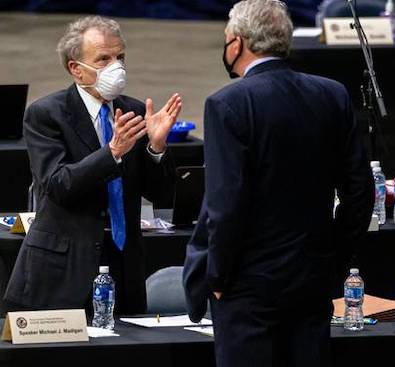
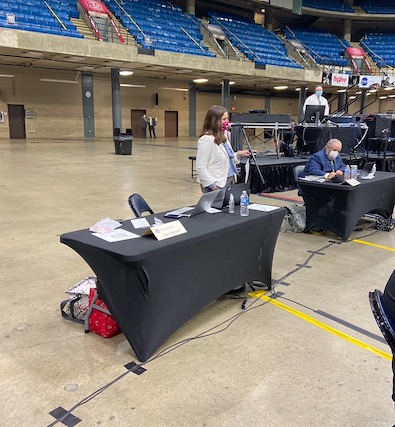
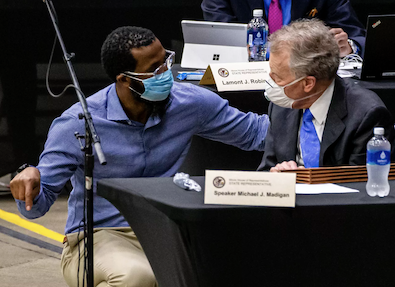
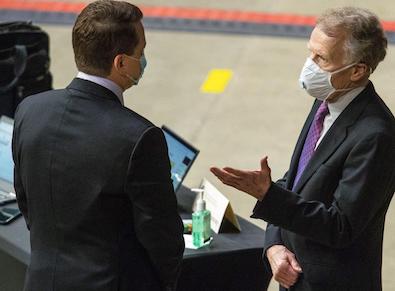
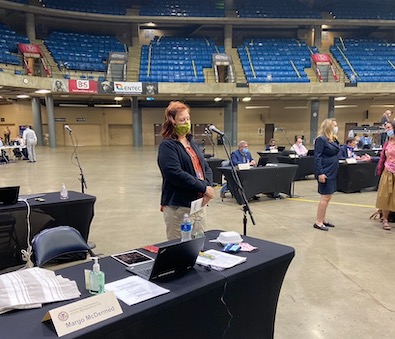
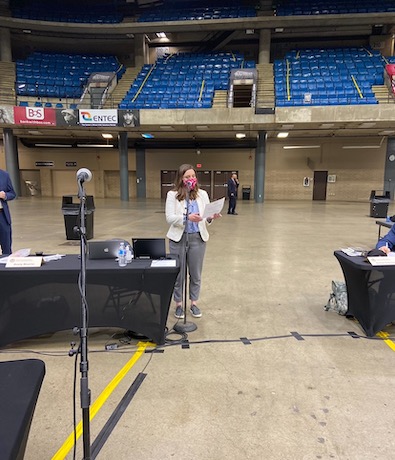
* The House has decreed that it will not allow reporters on the floor of the 40,000 square foot BOS Center because of public health and security concerns. When I’ve objected, I’ve been asked why I wanted to be on the floor if I was going to have to remain at least six feet away from everyone else anyway.
But adding a relative handful of reporters to a huge hall like that shouldn’t significantly increase viral load. House press credentials are not easily available, so the security concerns are unfounded and even insulting. And folks who are wearing masks are allowed to be closer together than six feet, as should be abundantly clear from these photos taken during the May special session…
* And, again, look at all the empty space behind the members in that 40,000 square foot hall…
* I’ve been tested for COVID-19 and won’t be venturing forth until the results come back and would be happy to provide testing documentation. I never go anywhere in public without wearing a mask, I don’t go to indoor restaurants and bars and nobody comes into my house without wearing a mask.
I’m more than willing to take what will hopefully be a relatively moderate risk to do my job, and most other reporters I know agree. We’re essential workers who do necessary work. And the next several days could be the most momentous in Illinois government since I do not know when.
Let us in.
*** UPDATE *** Earlier today…
Illinois House Republican Leader Jim Durkin officially requests Speaker Madigan lift the unnecessary restrictions that block the press corps from their regular access to members along the perimeter of the House chamber floor. pic.twitter.com/G1IEgFPbE7