State Senator Mike Simmons (D-Chicago) and State Representative Kelly M. Cassidy (D-Chicago) issued the following joint statement after Target announced it would be removing certain Pride merchandise after employees claimed the items threatened their sense of safety following customer interactions:
“Target has sold and marketed Pride products for years, no doubt profiting well from their efforts. To pull these very products from their shelves in response to acts of bigotry, violence, and threats against the LGBTQ+ community is an act of cowardice. As the General Assembly’s only two openly LGBTQ+ legislators, we refuse to sit idly by as one of the country’s largest retailers fails to stand in solidarity for our rights.
“One of our country’s largest big-box retailers, Target, has removed certain Pride Month products from its shelves and moved others to the back of its stores citing threats, vandalism and unsafe workplace conditions due to confrontation and backlash from patrons.
“Target had an opportunity to stand in support with the LGBTQ+ community and denounce bigotry within its stores. By moving merchandise marketed to LGBTQ+ communities to the margins of their stores, it sends the wrong message to our communities and to those who are pushing hate and violence in oppressing the rights and visibility of the LGBTQ+ community.
“We will not be moved to the back of the store. We will not be hidden in the shadows. We will not be intimidated by those who threaten violence or by those who cannot accept this simple truth — all humans are equal. To our LGBTQ+ communities - as we enter into the month of June, hold your head high, be proud of who you are, and know that we have your back.”
* Orr refused to divulge the identity of this person when I followed up…
Good Government Illinois posts statement from David Orr on process for replacing Brandon Johnson on the County Board:
“Several West Side community leaders with long records of engagement and accomplishment are applying to replace Mayor Brandon Johnson on the Cook County Board. But we’re hearing rumors that a typical insider deal is being cut.
“It goes something like this: a clouted state rep who’s tired of traveling to Springfield gets the County Board seat, and politicians get to play another round of musical chairs, appointing his replacement — avoiding having voters choose their own representative.
“If enough people speak up, this deal could be quashed. Politics in this era of progressive change should be different. We’re all tired of backroom deals.”
* I think I understand his general gist, but it’s not like he hasn’t been able to introduce a drone bill of his own in the past, and the city has its own drone rules…
[Rep. Curtis Tarver, D-Chicago] also noted that it took a mass shooting in a predominantly white suburb to get lawmakers moving on drones.
“We have mass shootings unfortunately in the city of Chicago very, very often. And nobody here had the political fortitude or concern for people of color to bring a bill that related to drones in some other way to monitor these events,” Tarver said. “So, it’s frustrating.”
Tarver was on the short end of an 84-7 vote in the House.
Also, legislators did propose drone bills in the past. Former Rep. John D’Amico (D-Chicago) was one of them.
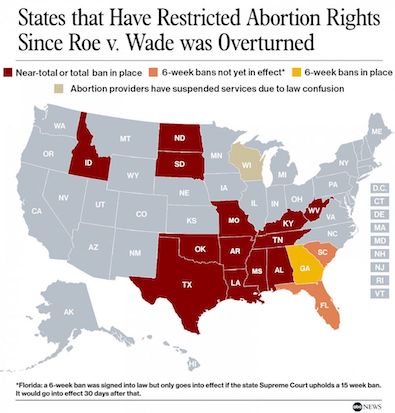
The landscape of abortion rights has shifted dramatically in the 11 months since the U.S. Supreme Court overturned Roe v. Wade, ending federal protections for abortion rights.
The decision left it up to states to decide how to regulate abortion services.
States in the West and Northeast have since taken steps to expand and protect abortion rights, while states across the South, Great Plains and Midwest have moved to ban or restrict abortion care.
Fifteen states have ceased nearly all abortion services.
The Illinois Department of Transportation announced today that a public hearing will be held Tuesday, June 13, on a proposed project to add lanes on Interstate 55 and Interstate 72 around Springfield. The estimated $802 million cost of the project includes reconstructing several interchanges.
The purpose of the hearing is to present the preferred design for the improvements and obtain feedback. The public is invited to review project plans, view exhibits, watch a video, and discuss with IDOT staff and consultants. All interested parties are encouraged to attend:
Tuesday, June 13
4-7 p.m.
Northfield Inn Suites and Conference Center
3280 Northfield Drive, Springfield, Ill.
Funding was approved through Gov. JB Pritzker’s historic, bipartisan Rebuild Illinois capital program for $150 million for the project’s first phase, which consists of adding capacity and making other improvements to I-55 from just north of Sangamon Avenue to the Williamsville weigh station. The improvements will connect to the wider I-55 north of Springfield, resulting in three lanes in each direction to Lincoln. Construction is anticipated to begin in 2024, starting with the bridges over the Sangamon River. A timeline for the project will be finalized in the coming months.
The remaining phases, estimated to cost more than $650 million, involve continuing with the third lane in each direction of I-55 and I-72 from just north of Sangamon Avenue to Veterans Parkway (Illinois 4), as well as reconstructing interchanges with Sixth Street/I-72, Stevenson Drive, South Grand Avenue, Clear Lake Avenue/I-72 and Sangamon Avenue. Additional work will occur on I-55 to Toronto Road to accommodate reconstruction of the Sixth Street/I-72 interchange. Funding for construction has not been identified.
“Improving I-55 and I-72 around Springfield will enhance safety, increase reliability and ease congestion,” said IDOT Region 4 Engineer Jeff Myers. “A lot of consideration and public input has gone into the design of this project. I encourage anyone interested in learning more about the future of Springfield to attend.”
* Isabel’s roundup…
* WTTW | Bill Designed to Revamp Property Tax Sale System That Fueled ‘Urban Decay’ Headed to Governor’s Desk: Pritzker is expected to sign the bill, which was prompted by “Maps of Inequality: From Redlining to Urban Decay and the Black Exodus,” a study Cook County Treasurer Maria Pappas’ office released in July. The study was part of a concerted effort by her office to revamp the system designed to return distressed properties saddled with mountains of tax debt to productive use.
* Illinois Answers Project | CPS Faces Dwindling Enrollment, Empty Buildings, Soaring Deficits Decade After Mass Closure Of Schools: In the decade since the closures, which left dozens of empty schools throughout the city, CPS has about 81,000 fewer students and has dropped from the third largest district in the nation to the fourth, as the city continues to lose Black residents. CPS data from the 2022-2023 school year shows 61 school buildings have an occupancy rate of 30 percent or less, compared to the 17 buildings that fell into the same category when Mayor Rahm Emanuel approved the largest mass school closure in modern American history.
* WCMY | Republican state representatives vote no on 2024 Illinois State Budget: St. Rep. Jed Davis of Yorkville says he’s not surprised with the unbalanced budget that appropriates money to Democrat pet projects instead of making sound investments in Illinois. St. Rep. Jason Bunting of Emington says he’s disappointed with the process because Republican voices aren’t being heard during budget talks.
* The Crusader | Speed camera near DuSable Museum nets highest revenue for city at $6.4M: A breakdown of tickets from the Washington Park speed camera also revealed the device generated the highest number of tickets and revenue from drivers going between 6 to 10 miles per hour, a $35 fine. According to the ABC7 Chicago investigation, the Washington Park speed camera has given 135,131 tickets for a total of $4,720,031. About 16,590 tickets totaling $1,654,850 were given to drivers going over 11 mph, a $100 fine. That places the Washington Park speed camera as the fifth highest device that gave out tickets to drivers going 11 mph over the speed limit.
* Rockford Register Star | Rockford mayor: Illinois ’stole’ $123M from the city, and he wants it back: Mayor Tom McNamara renewed his call for Illinois to return what he called “stolen” income tax dollars to the people of Rockford. Under a 1969 agreement, 10 percent of residents’ income taxes was to return to the municipalities in which they lived, McNamara said. That changed in 2011 when the state began cutting back on how much income tax dollars paid by residents was returned to their home cities as part of what is called the Local Government Distributive Fund.
* Treasurer Mike Frerichs | ‘Though my new home will be in Chicago, my heart always will be downstate’: When we learned about the twins, it became clear that we could not continue to shuttle back and forth with two babies in tow. We wanted to consolidate in Champaign, but doing that and maintaining her career as a successful corporate executive was not an option. It is unfortunate that Jim Dey mocks me for making this decision to support my wife and our family (“New digs for a growing family,” May 20). I do not believe he has made any effort to understand our personal situation, and it feels as though he wants to Make America Great Again by reverting to a time when women were expected to sacrifice their careers for their husbands. I’m sorry, Jim, I don’t share your worldview.
* Crain’s | Durbin turns up heat in ethics probe over gifts to Justice Thomas: And, in a letter sent over the Memorial Day weekend, Durbin, pressed on a second front, writing not only to Thomas benefactor Harlan Crow but asking for data from corporate entities controlled by Crow that own his private jet, yacht and resort.
* NPR | Miller says she will vote against debt limit deal: “I will vote NO on increasing the debt on our children and grandchildren by $4 trillion because this deal does not contain anywhere near the CUTS and policy changes we need in order to stop Joe Biden’s war on the American people. This deal does not repeal Biden’s “Green Bad Deal” attack on American energy or reinstate the Trump Administration energy independence policies we passed in the Limit, Save, Grow Act,” Miller said in a statement released to media.
* Sun-Times | Mom creates garden where son was shot, hoping people will remember him, maybe help solve his killing: D’Vignon said hardly anyone noticed when her 24-year-old son, Nicolaus Cooper, a father of three, was killed in March. Now, she and her family hope that, in death, people will know him — and perhaps help solve his killing. “A lot of people are afraid to speak,” D’Vignon said. “We just want justice for him. And we just want his name to be remembered.”
* AP | LGBTQ+ activists call for new strategies to promote equality after Target backlash: “We need a strategy on how to deal with corporations that are experiencing enormous pressure to throw LGBTQ people under the bus,” said California state Sen. Scott Wiener, D-San Francisco, a member of the LGBTQ legislative caucus. “We need to send a clear message to corporate America that if you’re our ally — if you are truly our ally — you need to be our ally, not just when it’s easy but also when it’s hard,” he said.
* Sun-Times | Merchandise Mart adjusts with the times but stays regal on the river: About a decade ago, Chicago’s Merchandise Mart became hip. It was great for the Art Deco-style property that’s one of the most familiar buildings among the city’s architectural royalty, but it wasn’t enough. There was still a matter of space that wasn’t used well and a design that could seem off-putting to casual visitors and some tenants. The building’s owner, Vornado Realty Trust, first worked to fix that in 2016 by investing $40 million toward changes that included a broad staircase that connects to the lobby.
Chicago Public Schools has repeatedly violated state law over the use of physical restraints of students, “overwhelmingly failed” to train its staff properly and continued the practice despite multiple directives this school year from the Illinois State Board of Education to stop, the state agency alleged in a letter to CPS obtained by the Tribune.
“CPS’ complete disregard for the health and safety of its students and blatant violation of state law is unconscionable,” an ISBE official wrote to CPS CEO Pedro Martinez. […]
Such findings from ISBE’s monitoring of CPS prompted the state agency to open a “systemic complaint investigation” in October alleging “several violations” of state law related to staff training. At that point, ISBE “mandated that CPS stop the use of physical restraint until it could demonstrate that staff who may need to use physical restraint are trained in its safe application,” the letter to Martinez states.
ISBE contends CPS continued to report the use of physical restraints in the following weeks, despite at least two more warnings from the state education agency.
“CPS provided a wholly inappropriate response on November 9, 2022, to our third directive to halt its unlawful practice physical restraint because it had overwhelmingly failed to train its staff appropriately. CPS continues to defy its legal obligations,” ISBE wrote.
* It’s kinda ridiculous that the General Assembly doesn’t offer archived audio and video of floor and committee action. I found this while looking for something else on the Civic Federation’s website…
According to the National Conference of State Legislatures (NCSL), all 50 state legislatures now livestream floor proceedings, and most legislatures, including Illinois, also livestream all or selected committee hearings. Most hearings of the Illinois legislature are streamed via video, audio or both on the Illinois General Assembly website. However, Illinois is unlike other states in that the General Assembly does not make video recordings of meetings and proceedings easily available to the public online.
NCSL reports that a growing number of state legislatures are archiving and making available on-demand recordings of floor and committee proceedings online and at no charge. Unfortunately, Illinois is one of only four states that does not archive its General Assembly videos online. The process for obtaining copies of recordings is to submit a request from the Clerk of the House of Representatives or Secretary of the Senate, each of which has different procedures. For example, the House provides video recordings of floor hearings only, and audio recordings of committee hearings. The Senate does not provide any video recordings, and only provides audio recordings of floor hearings (not committee hearings). Per the State’s Legislative Materials Act, the House Clerk and Senate Secretary may establish fees for providing recordings and transcripts. Third-party platform Blueroomstream live-streams selected hearings of the Illinois General Assembly, Illinois Supreme Court and State press conferences, and some of the videos remain online after the hearings. However, a paid subscription is required. […]
While it is positive that the Illinois General Assembly livestreams proceedings, archiving video recordings online would be an even greater step towards transparency and public access to government. Illinois’ legislative hearings are usually scheduled during the workday when many residents are not able to view them live, and frequent scheduling changes can make it difficult for the general public to keep track of those proceedings.
Requiring the General Assembly to archive videos of its proceedings would entail some investment in online storage and organization. However, since many proceedings are already livestreamed and recorded, there would likely not be significant up-front costs for equipment. An analysis by the California Legislative Analyst’s Office of a 2016 ballot initiative that required, in part, the California legislature to video record and make available online within 24 hours all open legislative proceedings, estimated the initiative would require a $1-2 million upfront investment and ongoing costs of approximately $1 million to implement.
I love BlueRoomStream.com. But not everyone can afford its high-quality streams. And not everyone needs them.
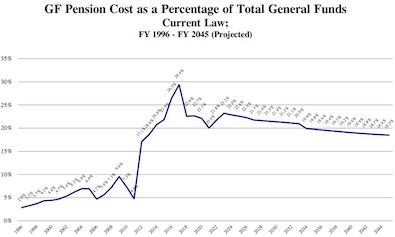
Consider state employee pension funding, the biggest source of fiscal instability in Illinois. Pensions are underfunded by $140 billion, a staggering debt that’s consuming an ever-larger share of state revenues. Annual contributions required by state law have climbed to $10 billion, or 20% of the budget. That figure is expected to reach $18 billion over the next couple of decades.
If you look closely at the original chart (page 155), you’ll see that the state is currently a few percentage points below where it had been projected to be, avoiding that little spike. We’ve been at around 20 percent for a few years.
Overall, high cost, but manageable, and, if projections stand, stable.
Ald. Walter Burnett Jr. (27th) still can’t explain to the satisfaction of state elections authorities what happened with $165,000 he got in campaign contributions.
And state officials say they don’t have the authority to make him show what happened with the unaccounted-for money — or to require him or anyone else who runs for office in Illinois to verify what they say in their required campaign-finance reports.
The Chicago Sun-Times reported in November that Burnett had told state elections officials he’d put $375,000 from campaign contributions over the past two decades in investment accounts with various banks. But, over time and despite candidates being required to file updates with state elections officials on what they do with campaign contributions, he stopped including any mention of $300,000 of that money in his required campaign-finance reports.
Now, Burnett has told the Illinois State Board of Elections that the amount he put into investment accounts with banks actually was $400,000 — including a previously unreported $25,000 certificate of deposit.
But, even after filing amended campaign-finance reports covering six years, his filings still haven’t accounted for $165,000. […]
“It’s all self-reporting,” [Matt Dietrich, a spokesman for the state elections board] says. “We can’t go back and look at their bank records. We can’t subpoena the bank records.”
* The Question: Should the Illinois State Board of Elections be given the authority to subpoena bank records in certain cases? Explain your answer, please.
Here’s a look at some of the highlights from the session that will affect Illinois residents if they’re signed into law by Pritzker.
All-gender bathrooms: Sets standards for all-gender, multi-occupancy restrooms should a business choose to build them. Right now, state law requires single-use restrooms to be all-gender, but parameters don’t exist for multi-occupancy. The bill does not require a business to create all-gender restrooms, nor does it require them to alter existing bathrooms. HB1286
Full-day kindergarten: School districts in Illinois would have to establish a full-day kindergarten program by the 2027-2028 school year, but they’re eligible for an extension if they fall within certain evidence-based funding parameters. Districts could also offer half-day programs as long as they offer a full-day option. HB2396
Ban on book bans: A measure spearheaded by Illinois Secretary of State Alexi Giannoulias withholds state grants from school or public libraries that run afoul of the American Library Association’s Bill of Rights, which says “materials should not be proscribed or removed because of partisan or doctrinal disapproval.” HB2789 […]
Cracking down on “crisis pregnancy centers”: People could sue these facilities run by anti-abortion rights nonprofits if they feel they were given deceptive information about abortion care. The bill would also allow the Illinois attorney general’s office to investigate. SB1909
There is good news for Illinois residents who get generic and off-brand prescription medication as a bill looks to crack down on price gouging.
House Bill 3957 or the Pharmaceutical and Health Affordability: Restrictions on Manufacturers’ Amoral Behavior through Reasonable Oversight Act lays out the procedures and penalties for drug manufacturer’s who violate the state’s definition of price gouging.
The bill defines price gouging as “an increase in the price as 30% or more within the preceding year, 50% or more within the preceding 3 years, or 75% or more within the preceding 5 years.” […]
The bill has passed both chambers and awaits Governor J.B. Pritzker’s signature. If it gets signed into law, the measure would go into affect January 1, 2024.
A pandemic-era law to allow Illinois bars and restaurants to sell cocktails to-go may be extended.
When Gov. J.B. Pritzker ordered all bars and restaurants closed after the pandemic began, owners said they needed a way to survive, and selling and delivering cocktails was one way to do so.
Andy Deloney, senior vice president and head of state public policy with the Distilled Spirits Council of the United States, said the cocktails to-go movement was a savior for some bars and restaurants during tough times. […]
If signed by the governor, Senate Bill 89 would extend the cocktails to-go and delivery until Aug. 1, 2028. Illinois’ current law expires June 1, 2024.
Senate Bill 90, colloquially known as the Racism-Free Schools Act, was sponsored in the Illinois House by Rep. Maurice West, D-Rockford, and in the Senate by Sen. Laura Murphy, D-Des Plaines. The measure passed in a Senate concurrence vote unanimously on Thursday and is currently awaiting Gov. JB Pritzker’s signature to go into effect.
“Here in Illinois, we will not tolerate racism or discrimination within schools – period,” West said in a press release. “But as we continue to see a rise in incidents of hateful conduct across our country, it is clear that our actions need to match our words. That’s why the Racism-Free Schools Act is so important.”
The legislation requires school districts to create a policy on discrimination and harassment based on race, color, or national origin. It also requires the Illinois State Board of Education to create a data collection system to report on allegations of discrimination, harassment, and retaliation against students. […]
The new law also states that the failure of an institution to take remedial or disciplinary action against a student or an education representative employed by the institution, if the institution knows that the student or representative committed or engaged in harassment, is a civil rights violation.
If signed by Pritzker the new law will go into effect Aug. 1, 2024.
House Bill 3903 would ban automatic traffic enforcement companies or their officers from donating to candidates for public office at the state and local level. It would also prevent state and local government officials from accepting jobs or contracts with those companies while in office or for two years after leaving office, a kind of “revolving door” ban.
Sponsors praised the bill as much-needed ethics reform after several public officials in the past decade have been caught by federal investigators engaging in bribery deals and kickback schemes involving red-light camera companies. […]
“What this does is it tightens up the ethics surrounding the red-light camera corruption and scandals,” Rep. Bob Rita, D-Blue Island, said during the House debate on Thursday.
Rep. Patrick Windhorst, R-Metropolis, called the two-year revolving door ban “a good step.”
I was elated to hear about the Illinois Freelance Worker Protection Act (HB1122). The legislation provides basic protections to freelancers, including requiring clients to pay within 30 days of the work’s completion unless otherwise stated in the contract, and it provides for damages if freelancers aren’t paid on time. Clients can’t retaliate against freelancers who pursue payment. and the Illinois Department of Labor can investigate entities that repeatedly violate the law.
When the bill passed the Illinois House and Senate, I breathed a sigh of gratitude. State Rep. Will Guzzardi, D-Chicago, and state Sen. Cristina Pacione-Zayas, D-Chicago, championed the bill because they recognized the value of freelancers and the shortcomings in state law that often leave freelancers struggling to collect payment.
The model works: New York City’s Freelance Isn’t Free Act contains similar provisions and helped freelancers collect more than $2 million in late and delinquent payments over the past few years. Cities like Los Angeles and Columbus, Ohio, have recently passed their own laws. Illinois now has the chance to be the first state to enact these protections on a broader scale.
I urge Gov. J.B. Pritzker to sign this bill into law, which will mean more stability for freelancers and require their clients to honor the terms of contracts. Most important, it recognizes that even though we’re not full-time employees, we’re still workers who deserve to be paid.
House Bill 2389 passed the state Senate on May 4, clearing both legislative branches. The bill, filed in February by Rep. La Shawn Ford, D-Chicago, would take away the police’s ability to stop or search a car because the driver hung something off the mirror. Sen. Christopher Belt, D-East St. Louis, was the bill’s chief sponsor in the Senate. […]
Under current law, it is illegal for any driver in the state to hang an item from their rearview mirror. That includes items like air fresheners, rosaries, face masks and even placards for handicap parking spots. Texas, California, Arizona and Pennsylvania all have similar laws.
The bill has picked up three other co-sponsors in the House and six in the Senate, as well as another supporter in Illinois Secretary of State Alexi Giannoulias. Proponents of HB2389 said it would make driving conditions safer for both motorists and police officers, while also allowing law enforcement to focus on violent crimes. […]
“Obstructions that affect drivers’ views of their environment and other motorists or pedestrians are a form of distracted driving and put the public in danger,” Tracy said. “Officers must have the ability to better protect the public by using their professional judgment at any moment of the potential for harm resulting from blocked sightlines.”
Almost a year after the mass shooting in Highland Park that left seven people dead and over 30 injured, Illinois lawmakers passed a bill that would allow law enforcement to operate a surveillance drone for security purposes during special events like the Fourth of July parade where the shooting took place.
“It has been so clear to me that we need to give the police just this one additional tool to keep people safe,” said Democratic state Sen. Julie Morrison of Deerfield, whose district includes Highland Park and who was at the parade with her family when the gunman took aim from a nearby rooftop.
The legislation, passed in the final hours of the General Assembly’s spring session last week, amends the Freedom From Drone Surveillance Act by allowing law enforcement to use drones at “routed” or “special” events, which means planned gatherings like parades, walks, races, concerts and food festivals.
Under the measure, drones could be operated only by a law enforcement agency and could not be weaponized. The public would have to be notified when they were in use, and facial identity systems could be used only if necessary to prevent “imminent harm to life.”
Rep. Miller: One of the reasons why we have the lifestyle we have is because of cheap, affordable, reliable energy. We’ve created this monster called CEJA. One of the observations that President Reagan made was the most terrifying words in the English language was ‘I’m from the government and I’m here to help you.’
We’ve created this mess and now we’re on the fourth amendment to try to clean it up. You know, I work outside every day I work in the environment. You know, when it’s 100 degrees in the shade and 90% humidity, I don’t sit around and whine about it being hot. When it’s the wintertime and I’m out feeding the cows and it’s 20 below zero, I’m not whining about it being cold. And we’ve created a complete myth that is destroying the economy in Illinois, and eventually we destroy the economy in the United States of America if we continue down this rabbit trail. You know, before CEJA happened, myself, Representative Halbrook, Representative Caulkins, we actually went on the energy tour, and we visited the Prairie State Campus. We visited Hamilton Coal. We visited the nuclear power plant in Clinton and we visited the wind farms, we visited the solar fields and we made a decision based on information, not our emotions or how we feel.
I know one of the things that we found out in these energy producing plants that everyone was running about almost 100% capacity. And at that time, we knew that there was no way in the world we could shut down our existing power and still power our grid. And the net result of it was a war on the middle class, and people can no longer afford to pay their doggone electric bills because of bad public policy. I know one thing about it for the last 69 years we’ve had a climate crisis, and we’ve gone from one thing to the other.
When I was a kid, we had global cooling. We’re gonna have the great freeze out and and 4 billion people were gonna die. And then we went to global warming where the Earth was gonna return to turn into a frying pan. We were all gonna burn up. And now we’re on this myth we call climate change. And now we’re all going to change to death. One of the common threads that links all of these ideas together is none of it ever happened. And guess what? None of it is ever going to happen. We aren’t going to be destroyed by CO2. And I would suggest that probably most of the people in this body don’t even know what carbon dioxide is. There’s a good dose of it. [*Blows into the mic*] There’s a little carbon dioxide for ya’ and guess what? Nobody’s gonna die! One of the things that-
Rep. Jay Hoffman in Speaker’s chair: Representative [laughter] Wilhour gives you three minutes.
Rep. Miller: But anyway, does anybody know how much carbon dioxide is in the entire globe? I guess and probably nobody can answer that question. There’s four hundredths of 1% of the entire world atmosphere is made up of carbon dioxide. During the Obama administration, the EPA said if we do everything that we want to do by the year 2100 that we will increase the global temperature by two one hundredths of 1% of a degree. It doesn’t amount to jack squat.
There’s one thing that I know is in sound science, your observation dictates your conclusion. Your observation dictates your conclusion, and I know I am 69 years of observation, and I have come to the conclusion that this is a bunch of blunk and we need to throw this all in the garbage. One of the things that we, that I understand is Earth science as a farmer and there’s a great mechanism that we call photosynthesis. And it’s an incredible, it’s an incredible way that we clean up the atmosphere. Guess what we have millions of acres of green leafy plants that absorb carbon dioxide and produce oxygen. It’s amazing. It’s incredible.
Another thing that takes us out of the atmosphere is sulfur. And guess what we’ve taken so much sulphur out of the atmosphere, now as a farmer, I have to buy sulfur to put in my fertilizer mixes so I can grow the maximum production of corn.
There’s one thing that I know is our biggest threat to civilization is not climate change. But I know a lot of times that I think that our biggest threat to civilization is the hot air that gets produced in this General Assembly by passing bad public policy. No one continues to whether or not Joe Biden not Barack Obama, not JB Pritzker, not John Kerry. They cannot change the climate. People do what they really believe. And when you see these guys flying around the world in their private jets, they live in mansions on the beach. If they actually thought the world was doomed because of climate change, they would have a different lifestyle. Part of the lie is convincing you that electricity comes from magic!!! We wave our magic word all of a sudden we produce electricity, and it’s just not true. We’re not having a climate crisis. But what we are having is we’re having a crisis of common sense. And the only way we’re on the fourth amendment to this bill and the only way to fix it is to have amendment number five in throw CEJA in the garbage and start over! Thank you Mr. Speaker.
Ironically, the bill in question will likely increase consumer prices, according to the United States Justice Department and the Federal Trade Commission.
House and Senate Republicans claimed during budget-related floor debate last week that the super-majority Democrats had masked the true size of their plan by delaying the start of some spending until the second half of the upcoming fiscal year.
Yes and no.
Republicans pointed to the $317 million to increase Medicaid provider reimbursement rates, including for hospitals. But that new spending doesn’t begin until Jan. 1, the halfway point in the 2024 fiscal year, which begins July 1.
And so, basic arithmetic means the rate increase in Fiscal Year 2025 will be double FY24’s cost, because that 2025 spending will cover all 12 months, instead of just six. That means the state will start the following fiscal year with at least a $317 million hole.
Sometimes, it takes time to stand up new programs, so state spending can’t justifiably begin for a while. That’s the case here as well, according to the governor’s office, which says the higher reimbursement rates can’t start until the state applies for and receives permission from the federal government. And that can take a while.
Also, $317 million is only 0.6% of the $56.6 billion state spending plan. Not much in the grand scheme of things.
While that $317 million is small in context, just think about how much scrambling the Democrats had to do during the past couple of weeks of spring session to collect enough crumbs under the couch cushions to pull its appropriations bill together.
First, they blew well past their self-imposed May 19th adjournment deadline because they couldn’t agree on a spending package. And even then, it took 24 hours after the state’s top Democrats announced a budget agreement until an actual budget bill surfaced, because of even more scrambling. And the budget agreement announcement itself was delayed by about an hour because of even more scrambling over relatively small amounts of money.
The Democrats also only built a $100 million cash cushion into this plan, or about 0.2% of total spending. That doesn’t leave them any room if their revenue projections are too low by a tiny fraction, or if spending is higher than anticipated.
Some Republicans pointed to the $550 million in increased spending to cover the exploding health care costs for undocumented residents as the reason why Democrats had to get so creative elsewhere. Medicaid providers, they said, could’ve received more money if not for that.
That’s true, but only in the abstract. Yes, proponents (including legislators) and the Pritzker administration vastly underestimated what the health care program would cost and how many folks would enroll. And, yes, the governor waited until this spring to turn to the legislature for either statutory relief or the full, guaranteed legal authority via authorized emergency rules to rein in costs in a way that can survive a barrage of lawsuits. Mistakes, as they say, were made.
In the real world, you can’t just wish away problems. “If only” is a fine game for pundits and politicians. But it doesn’t do you much good when building an actual state budget, which, unlike federal spending plans, can’t rely on simply printing more dollars.
No matter how much some Democrats may have privately grumbled about those massively increased costs, they would not publicly trumpet any sort of solution that kicked thousands of people off health care coverage (“Health care is a right” is a longtime Democratic Party talking point, after all) and forced hospitals and other medical providers to go back to treating them without any reimbursements.
And even though there was definitely some resistance and bitterness about those unexpected costs, Black legislators have wisely not had an appetite to publicly inflame the current tensions in Chicago, where some local Black leaders and conservative whites are grabbing headlines by echoing angry Fox News talking points about the costs of caring for the influx of mostly Latino asylum seekers.
While some Democrats clung to the notion that Gov. J.B. Pritzker had the authority to rein in costs without their assistance, they also saw the almost daily and widespread court battles throughout the pandemic over the governor’s use of emergency rules and executive authority.
Determined lawyers on the other side tied the attorney general’s office up in knots throughout the pandemic and have so far succeeded at stymying the implementation of both the SAFE-T Act and the assault weapons ban.
Lawsuits over limiting enrollment and putting undocumented immigrants into managed care programs might still be filed, but the state will be on much firmer legal ground by specifically allowing the governor to file emergency rules.
* Meanwhile, from the Latino Caucus…
Illinois Legislative Latino Caucus members released the following statement following the passage of the Fiscal Year 2024 state budget:
“We are pleased to report our progress in passing a state budget that focuses on the people. There are historic investments in early childhood education and more resources than ever to support students from working and middle class families on their path to receive a more affordable college education with the help of MAP grants, among other accomplishments that invest in our people and the future of our state.
“Illinois will continue to be a beacon of hope for those seeking a better life. In the coming year, we will devote $25 million to Welcoming Centers, which assist in integrating immigrant and refugee communities into our state, another $38 million will be devoted to Immigrant Integration programs that help immigrants on their pathways to citizenship and over $40 million to respond to the arrival of asylum seekers. We are committed to making Illinois one of the most welcoming states to immigrants.
“We are proud of the work to make Illinois the first state in the nation to offer Medicaid-like benefits to non-citizens. Thanks to this initiative, 50,000 more people, 42+ years old, receive preventive care, contributing to healthier communities, reducing the pressure over hospital emergency rooms, and saving taxpayers money. Lives have been saved because of this program.
“The need for the healthcare coverage we fight for is because of the real people and their real needs in the communities we represent. These are communities that contribute to our state often with nothing in return. While we were not able to expand coverage this year, the Illinois Legislative Latino Caucus has not given up, and we will not give up pursuing closing the age gap of coverage.
“Latino lawmakers are here in Springfield to represent the interest of the communities we represent, both in our districts and all Latino/x community members throughout the state; communities that have been historically disenfranchised and underserved, all while being taxpayers and contributing to our state in numerous ways. Our job as legislators is to fight for the resources our communities need and deserve, and to change the vicious trend of using Latino/x and immigrant communities as political pawns. We will continue to be their voice in Illinois and fight on their behalf, because that is what our communities need and deserve.”
* WTTW | Legislative Session Roundup: Updates on Chicago’s Elected School Board, Red Light Cameras: That includes bills that prevent license plate reader technology from being used by other states seeking to extradite residents who travel to Illinois to have an abortion (HB3326), that require Illinois universities’ major course credits to be transferable to other 4-year state public higher education institutions (HB2288) and a requirement that if a new drinking fountain is installed in place where the state requires them, a water bottle filling station must also be put in (SB1715).
* WBEZ | Illinois lawmakers passed bills on book bans, abortion rights and other issues: Lawmakers approved a $50.4 billion spending plan for the fiscal year that starts July 1. It took some time to craft because revenue estimates started trending down soon after the governor gave his budget address, and a program offering Medicaid-style healthcare to undocumented immigrants 42 and older blew past cost expectations.
* Tribune | Migrant crisis puts more pressure on Chicago finances as state budget offers less than sought: The $50.6 billion state budget approved by the Illinois Senate late Thursday and the House early Saturday includes $42.5 million to provide services for migrants arriving from the country’s southern border. That provision emerged earlier Thursday following an ask from Mayor Brandon Johnson; however, his administration had pressed for more, and the $42.5 million total will be available to counties and towns statewide, rather than just Chicago.
* Crain’s | Johnson buys time to work out firefighter pension bills: The bills, sponsored by State Sen. Rob Martwick, D-Chicago, had been sailing along despite warnings from the outgoing Lightfoot administration that the measures would boost unfunded liability in the fund by $3 billion and cost taxpayers $55 million a year in extra payments.
* Daily Herald | Landmark Muslim bills on their way to becoming laws: Two landmark pieces of state legislation, one requiring halal/kosher foods be made available at public facilities and another providing Muslim imams access into prisons for chaplaincy, are on their way to becoming laws. The bills — Faith by Plate Act and Faith Behind Bars Act — recently passed both chambers of the Illinois General Assembly.
* Tribune | Some rural communities in Illinois are pushing back against the narrative that they’re dying: Rural towns like Cullom stand in contrast to some larger downstate communities that have struggled amid population loss and a changing national landscape over the past half-century as companies that once employed hundreds have left and stores on rural Main Streets have closed. These smaller towns also are being used as examples by advocates for rural development who are trying to change the narrative about how small towns — and rural America as a whole — are perceived.
* Craig’s | Greg Hinz: Illinois Republicans start choosing which candidate to back in the 2024 race: Just a few hours after Florida Gov. Ron DeSantis got off to a dead-air-filled start to his race for president, Donald Trump picked up an endorsement from Darren Bailey, who may have been blown out in his race for governor last year but now appears to be preparing to run for Congress in Southern Illinois and wants the former president on his side. That, in a nutshell, is the state of the GOP race for president, both here in Illinois and nationally.
* KSDK | Darren Bailey mulls primary challenge against GOP Congressman Mike Bost: Another clue about Bailey’s designs came in the form of a recent poll that asked Republican primary voters to compare Bailey’s favorability to Bost, measured support for Ron DeSantis and Donald Trump, and floated a question asking whether voters might support his wife Cindy Bailey in a run against incumbent Jason Plummer for the state senate.
* NPR | A ‘natural death’ may be preferable for many to enduring CPR: Many people learn what they know about CPR from television. In 2015, researchers found that survival after CPR on TV was 70%. In real life, people similarly believe that survival after CPR is over 75%. Those sound like good odds, and this may explain the attitude that everyone should know CPR, and that everyone who experiences cardiac arrest should receive it. Two bioethicists observed in 2017 that “CPR has acquired a reputation and aura of almost mythic proportions,” such that withholding it might appear “equivalent to refusing to extend a rope to someone drowning.”
* NPR | Illinois State Superintendent Tony Sanders talks about the need to eliminate preschool ‘deserts’: The Illinois State Board of Education is offering grant money to preschool providers to try to eliminate “preschool deserts” where there are little to no pre-k services for kids. WNIJ’s Peter Medlin spoke with state superintendent Tony Sanders about the grants. The deadline to apply for the preschool grants is June 14th.
* Tribune | DuPage County explores cutting water contract with Chicago, building pipeline to Lake Michigan: The massive undertaking, which would cost billions of dollars and was once considered almost unthinkable, comes at an inflection point in the region’s water system, as the DuPage Water Commission’s 40-year agreement with Chicago is ending in March 2024. It also comes just weeks after Chicago inked a historic deal to sell water to the city of Joliet at an attractive rate.
In the wee hours of Saturday morning, the Illinois House approved a $50.4 billion state budget that Democrats called a financially responsible and “compassionate” spending plan — and Republicans blasted as “another partisan one-sided budget.”
Just after 2:30 a.m., the Illinois House voted 73-38 to pass the budget, which Gov. J.B. Pritzker touted as his “fifth balanced budget,” vowing to sign it.
“This budget reaffirms our shared commitment to fiscal responsibility while making transformative investments in the children and families of Illinois that will be felt for years to come,” Pritzker said in a statement. “I look forward to signing this budget making childcare and education more accessible, healthcare more affordable, and our state’s business and economic position even stronger.”
In all, there is a roughly $100 million surplus built into the budget. Even a small overrun could place it out of balance, especially with volatile revenue projections in recent months and variables like a still-unresolved contract negotiation with AFSCME, the union that represents state workers. […]
House Republican Leader Tony McCombie, R-Savana, said House Speaker Chris Welch, D-Hillside, offered “false hope for a new day.”
Welch, responding a few minutes later, said, “Work with us and put some votes on the board. … Don’t just talk, walk with us.”
“We should not have to choose between being responsible for being a responsible state and being a compassionate one,” Speaker Pro Tem Jehan Gordon-Booth, D-Peoria, the top Democratic budget negotiator, said on the House floor. “We can do both. I dare say we have to do both.” […]
“In our eyes, this isn’t a budget that provides for the future of Illinois,” Rep. Norine Hammond, R-Macomb, the House Republicans’ chief budget negotiator, said Friday afternoon ahead of the final vote.
But Democrats countered that the budgets they have pushed through since Pritzker became governor in 2019 have not only been balanced but have resulted in multiple credit upgrades from the three major rating agencies.
“If you want to vote for credit upgrades for the state of Illinois, vote aye,” Gordon-Booth said in her closing speech just before the final vote. “If you want to vote to fund the public school children in your district, vote aye. If you want to vote to fund the cities, towns and villages in your district, vote aye. If you want to vote to give low income and middle-income college students and your district the opportunity to go to college without being overburdened with college debt, vote aye.”
* Let’s switch gears and send it over to Steve Daniels…
Legislation giving downstate utility Ameren Illinois a monopoly on future high-voltage line construction in its service territory cleared the General Assembly early this morning, with passage in the House.
Before the House vote, Gov. J.B. Pritzker pledged to veto the measure, which he said favors the utility at the expense of consumers. He now will get that opportunity.
The 63-32 vote in the House was eight votes short of the number needed to override a veto. The 41-9 vote in the Senate was well above the required override tally.
All GOP House members voting on the bill were in support. All 32 “no” votes were from Democrats, meaning more Democrats opposed a bill passing the House than supported it — a highly unusual result. Many of the opponents are backers of green energy policies. […]
With 22 House members not voting or absent during the vote, the result of a future override is difficult to figure at this point.
There are options here. He could simply veto out the offending part and push for an acceptance, for example. The fact that the bill was loudly and uniformly supported during House debate by the farthest of the far-right works against the bill as well.
* More…
* Tribune | State lawmakers extend deadline for Chicago’s elected school board map: In 2021, Gov. J.B. Pritzker signed into law a bill that will shift the board from a seven-person panel appointed by the mayor, as it has been for decades, to a 21-member elected board by 2026. Legislators gave themselves until July 1 to draw a map of 20 districts from which the Board of Education members will be elected — the 21st seat will be the president chosen by citywide vote — but planning issues, disagreement between the two chambers and fears of a lack of representation forced an 11th-hour delay.
* Tribune | Migrant crisis puts more pressure on Chicago finances as state budget offers less than sought: The $50.6 billion state budget approved by the Illinois Senate late Thursday and the House early Saturday includes $42.5 million to provide services for migrants arriving from the country’s southern border. That provision emerged earlier Thursday following an ask from Mayor Brandon Johnson; however, his administration had pressed for more, and the $42.5 million total will be available to counties and towns statewide, rather than just Chicago.
* Tribune | Mayor Johnson aims to address a problem that vexed his predecessors: Woefully underfunded pensions: “As Mayor of Chicago, I am committed to protecting both the retirement security of working people, as well as the financial stability of our government so we can achieve our goal of investing in people and strengthening communities in every corner of the city,” Johnson said in a statement. “Together, with our state legislative partners in Springfield, I am establishing a working group to collaborate on finding a sustainable path forward to addressing existing gaps in the city’s four municipal pension systems (Firefighters, Police, Municipal, and Laborers).” Local Fraternal Order of Police President John Catanzara, meanwhile, released a video in which he said he’s working with City Hall on broader solutions. The clip was seen as a positive sign due to the otherwise contentious relationship Catanzara has with City Hall and his claim that swaths of the police force would quit if Johnson were elected.
* Both chambers have now adjourned for the spring. Click here to see what passed and what didn’t and what might get vetoed. Tribune…
In the end, it may have been appropriate that one of the major budget implementation bills was shoehorned into legislation that began as an effort to make the soybean the “official state bean.” Illinois legislators wound up writing their own version of the old saw that people should never see how sausage and the law is made, replacing it with tofu.
For the last three years, we have been working very hard and intentionally to right a wrong from 2020 and get the 3% COLA passed and have parity with the fire department for the bare minimum compared to other pensions in this state. That was Senate Bill 1956. It passed the Senate. It was waiting to be called in the House.
Reality is, here’s where we’re at right now. Last week, the city reached out to us and made a request for the bill to be carried over into the veto session in the fall. The request was based on the fact that there was not a chief financial officer in place and they needed to wrap their head around the numbers, the commitments and everything else to present it properly in the fall budget.
We wanted to press forward. We worked very hard to get to where we’re at. The city realized that we had overwhelming support in both chambers, from both parties, actually, which was pretty unique, and that the bill was pretty much going to pass if it was called.
So that triggered some talks, and those talks developed into something even I think a little better in the long term here.
Not only do we have a pledge that Senate Bill 1956 is alive and well being will be called in the veto session. in week one for the 3 percent COLA.
There’ll be a second bill out of the House, 4098. That will include language for fixes for tier two, a DROP program and some other things encompassing a much broader repair to the pension issues that we’re facing here.
So we’re not going to keep piece-mealing these bills together, Assembly after Assembly. We’re going to try and get it all done in the veto session and have some at least pension clarity for the future, not only for our sake, but for the new administration.
So that’s where we’re at. The Speaker has pledged to call the bill. The supporters on both sides of the aisle have assurances that the bill will be called the first week in the veto session. And that that House bill, there will be a committee put together with police and fire to address the issues, and kind of work them all out together in one big piece of legislation and have that one also pass in the veto session.
Am I happy? I’m not gonna lie. No. We worked really hard to get where we’re at. But bigger picture is we have the ability to affect much broader potential legislation with much longer reaching consequences in the fall veto session.
If something happens between now and then, and those promises aren’t kept, well, we’re going to be having a very different conversation come November, I can assure you of that. Because we certainly expect people to hold their obligations.
The DROP (Deferred Retirement Option Plan) program is explained here.
Nobody’s ever completely happy with compromises. But, if you’d told most people right before the election that FOP Lodge 7, the Johnson administration and both legislative chambers could all calmly pledge to work together to come up with some pension ideas, they might’ve thought you were nuts.
…Adding… Mayor Brandon Johnson…
Mayor Brandon Johnson today announced the formation of a working group to address Chicago’s municipal pension systems.
“As Mayor of Chicago, I am committed to protecting both the retirement security of working people, as well as the financial stability of our government so we can achieve our goal of investing in people and strengthening communities in every corner of the city,” said Mayor Johnson. “Together, with our state legislative partners in Springfield, I am establishing a working group to collaborate on finding a sustainable path forward to addressing existing gaps in the city’s four municipal pension systems (Firefighters, Police, Municipal, and Laborers). The working group’s mission is to find workable solutions with sustainable funding sources to ensure retirement security and taxpayer relief in the long term in time for the fall veto session.”
The working group will include state legislators, the city’s Budget Director, the city’s Chief Financial Officer, and representatives from the city’s various labor unions, including both the police and fire unions.
Planned Parenthood Illinois Action (PPIA) applauds the Illinois General Assembly for passing several key pieces of legislation related to abortion, gender-affirming care, and preventive health care. Thus far in 2023, the General Assembly passed seven significant measures aimed at protecting reproductive and sexual healthcare in Illinois.
“Because Illinois is a haven state in the Midwest for abortion and gender-affirming care, it’s critical the General Assembly continue its commitment to protecting and expanding access to reproductive and sexual health care.” said Jennifer Welch, President and CEO of PPIA. “Thanks to the pro-choice champions in Springfield, the passage of these crucial bills solidifies our state’s ability to welcome and protect health care refugees forced to flee their home state for services as well as expand access for all Illinois residents. We look forward to Governor Pritzker signing these bills this summer.”
Spring session legislative milestones include:
• SB 1909 – (Senator Celina Villanueva, Rep. Terra Costa Howard D-Glen Ellyn) amends the Consumer Protection and Deceptive Practices Act to prohibit limited services pregnancy centers (more commonly known as crisis pregnancy centers) from engaging in deceptive or fraudulent practices.
• HB 3326 – (Rep. Ann Williams, D-Chicago, Senator Sara Feigenholtz, D-Chicago) provides that law enforcement shall not sell or share automatic license plate reader data to any state for the purpose of investigating or enforcing a law that denies or interferes with a person’s right to choose or obtain reproductive health care services or any lawful health care services, or for an investigation of a person based on the person’s immigration status.
• SB 1907 – (Senator Celina Villanueva, Rep. Barbara Hernandez, D-Aurora) requires public colleges and universities, including community colleges, to make emergency contraception available on campus via a wellness kiosk or vending machine.
• HB 2450 - (Senator Ram Villivalam D-Chicago, Rep. Dagmara Avelar D-Romeoville) requires cultural competency continuing education for health care providers in order to provide them with the tools and information they need to effectively and affirmingly serve communities of color, people with disabilities, people of diverse faiths, undocumented individuals, LGBTQ+ people, people living with HIV, intersex people, and other communities that have been marginalized in the health care system.
• HB 4664 – (Senator Celina Villanueva, D-Chicago, Rep. Kelly Cassidy, D-Chicago) provides legal protections for providers of and patients seeking reproductive and sexual health care, including abortion and gender-affirming care. It requires state-regulated health plans to cover abortion medications, PEP, and PrEP with no copay or deductible spend down, and creates a program for training health professionals in providing abortion care.
• SB 1344 – (Senator Celina Villanueva, Rep. Kelly Cassidy) is a trailer to HB 4664 that makes corrections and clarifies that state-regulated health insurance must cover medications used off-label for abortion.
• SB 1561 – (Rep. Kelly Cassidy, Senator Celina Villanueva) requires state-regulated health insurance to cover certain preventive health care services without a copay or deductible spend down including immunizations, mammograms, and other services listed in the current recommendations of the United States Preventive Services Task Force. In addition, it clarifies that any preventive service designated for “men” or “women” company shall not deny or limit the coverage required or a claim based solely on the individual’s recorded sex or actual or perceived gender identity, or for the reason that the individual is gender nonconforming, intersex, transgender, or a has undergone or is in the process of undergoing gender transition.
* Rolling Stone | Illinois Is the Midwest’s Abortion Refuge. Clinics Are Being Terrorized: When officers arrived at the scene they found the car lodged halfway into the building’s entrance, its driver still inside. The arson attempt, according to the FBI affidavit, quickly devolved into a comedy of errors: “After the Passat got stuck, Buyno was trapped inside and could not get out. Buyno stated that he threw the red gas can out of the window so the gas would spill and he could light the gas on fire, but the can landed in an upright position. Buyno told us that he intended to burn his own car, along with the building, but he never got the chance because he got stuck inside the Passat and then the police arrived.” In an interview the following day, Buyno was unrepentant. “If I could sneak in with a gas can and a match, I’d go in there again,” he said.
* WBEZ | Waukegan cops who extracted a teen’s false confession to a shooting will face no discipline: The city of Waukegan has agreed to pay $200,000 to the family of a 15-year-old boy who falsely confessed to shooting a dollar store clerk last year. Officials of that north suburb are also confirming for the first time that no cops were disciplined for extracting the confession — not even the lead detective, accused of deceptive tactics banned by an Illinois law that protects children under interrogation.
* Bloomberg | Walgreens is laying off 10% of its corporate workers: The cuts account for 10% of the corporate workforce, and none of them will be based at stores, microfulfillment centers or call centers, according to Fraser Engerman, a spokesman for the Deerfield, Illinois-based company.
* Tribune | Mapping a threat: Climate change’s deadly summer heat may deepen disparities in Chicago: To intervene where aid is most needed, local officials and organizations in dozens of cities have participated in a National Oceanic and Atmospheric Administration program launched in 2017 to map heat disparities and raise public awareness. But Chicago didn’t apply to take part until late last year, and a map is still months away.
* Tribune | Chicago Bears get OK to begin teardowns inside Arlington racetrack structures in preparation for new stadium: Arlington Heights spokesperson Avis Meade confirmed that the village had approved plans for the first phase of demolition at the old racetrack, marking another move toward a $5 billion NFL stadium and accompanying mixed-use residential, commercial and entertainment district the team has proposed to build on the 326-acre racetrack in Arlington Heights.
* Tribune | From Kristine Anigwe to Courtney Williams: Meet the new-look Chicago Sky before the home opener: After an unsuccessful title defense and the departures of most of the 2021 championship core, the offseason held a bit of uncertainty, but the retooled Sky are off to a 2-0 start with road wins against the Minnesota Lynx and Phoenix Mercury on the WNBA’s opening weekend. At the team’s media day, coach James Wade said “we’re going to cause some chaos” with the season’s expectations.
* The governor has rarely used his veto pen, but we might possibly see that happen if this bill reaches his desk. This language proposal was included as a late Senate amendment on HB3445, the energy omnibus yesterday. It’s now awaiting House concurrence…
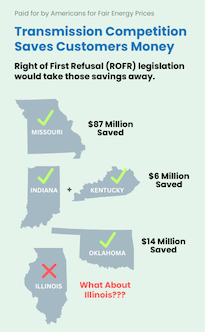
Illinois is only the latest in a string of states to consider “right of first refusal” bills pushed by incumbent utilities. The effort comes as investment in new transmission wires grows. Federal cash from the Inflation Reduction Act and actions by regional power-grid managers are leading to more spending on infrastructure to connect renewable power sources like wind farms in remote areas to population centers like Chicago.
Utilities, monopoly owners of local power grids, want to exert monopoly control, too, over the portions of interstate power lines within their service territories.
Advocates for competition say these laws will inflate costs of the projects, which could benefit from competitive bidding. Ultimately, ratepayers will cover those costs in their electric bills. Likewise, clean-energy advocates are concerned, worried that inflated costs of needed high-voltage connections will hold back renewable power development as rate shock leads to consumer pushback. […]
The sudden momentum didn’t emerge because of some newfound Ameren clout. Instead, the International Brotherhood of Electrical Workers moved yesterday to make passage of the Ameren bill a high priority in Illinois, sources say, with the international president based in Washington, D.C., making calls to Illinois lawmakers.
But, last August, the United States Justice Department and the Federal Trade Commission called on the Federal Energy Regulatory Commission not to allow this to happen…
The FERC is considering reinstating the right of first refusal, or ROFR – which was eliminated in certain instances in 2011 – as long as incumbent transmission owners agree to a joint ownership structure with one or more unaffiliated, non-incumbent partners. FERC issued a Notice of Proposed Rulemaking on April 21, 2022. This could mean that the design and construction of certain transmission facilities is less competitive, resulting in higher prices or lower quality.
“We commend FERC for undertaking this rulemaking, which is aimed at encouraging needed regional transmission planning and construction,” said Assistant Attorney General Jonathan Kanter of the Justice Department’s Antitrust Division. “The rulemaking comes at a critical time, when the nation is undertaking major grid modernization efforts, and competition can make transmission design and construction less costly, more resilient, and more innovative for the American consumer. Thus, we urge FERC not to abandon competition, through the reinstatement of a federal right of first refusal, but to first evaluate the effects of its other proposals, which are consistent with competition, on achieving its goals.”
The U.S. is on the cusp of a transmission boom, a high-voltage rewiring to enable the switch away from electricity generated with fossil fuel to a grid dominated by renewable energy and batteries. And the Midwest and Great Plains regions are poised for huge investments, said Sharon Segner, senior vice president of LS Power, a competitive energy developer.
Just in the Midwest, MISO approved $10.3 billion of new regional transmission last year to enable renewables and batteries to plug into the grid and boost reliability (Energywire, July 26, 2022). Another set of Midwest projects worth an estimated $24 billion could be approved next year. Ultimately, $100 billion of new high-voltage power lines could be approved across the grid operator’s 14-state territory this decade.
Since organized labor is backing the bill and organized labor gets just about whatever it wants at the Illinois Statehouse, and since it zoomed out of the Senate 41-9, you wouldn’t be wrong to expect that it will also fly out of the House. But 8 of the 9 “No” votes in the Senate were Democrats and several other SDems took a walk. Rank and file House Democrats are working to find the votes to stop it.
And the bill’s opponents have a major ally.
* From Gov. Pritzker’s office…
We oppose a measure that puts corporate profits over consumers.
They added that the bill would all but lock in rate increases for Ameren.
…Adding… From the AG’s office…
While we have not yet reviewed the language in detail, we echo comments issued by the Department of Justice and FTC, which state that the 2011 federal elimination of “Right of First Refusal” resulted in new benefits for consumers: lower rates, improved service and increased innovation. We are concerned about the impact that of a right of first refusal will have on consumers, as a right of first refusal generally increases transmission costs. Research has demonstrated that competitively-bid projects are typically more affordable, costing 40% less than projects that are not competitively bid. We are concerned that right of first refusal stifles competition and discourages new entry to the market.
Chicago Cardinal Blase Cupich urged the Illinois attorney general on Thursday to provide information about newly uncovered cases of clergy sexual abuse that were included in a statewide investigative report, saying he would gladly add the names on his list of credibly accused priests if the claims were substantiated.
In his first interview since the report was released Tuesday, Cupich expressed surprise that the 125 new cases involved some priests he had never heard of. He voiced dismay that the attorney general’s office hadn’t forwarded the new claims to the Archdiocese of Chicago to look into, as it had done during the five-year investigation.
“We thought we had that kind of relationship with the attorney general and so are disappointed that we’re hearing these for the first time,” Cupich said. […]
Cupich said he would gladly add the names onto his list but needed information on how Raoul’s investigators substantiated the claims. Asked why it wasn’t sufficient for the church to accept cases that the attorney general’s office had substantiated, Cupich said the archdiocese just needed to understand the process.
* AG Raoul…
Attorney General Kwame Raoul today released the following statement expressing surprise and dismay at comments made by Cardinal Blase Cupich. In comments to the media, Cardinal Cupich claims to be have been unaware of names included in the Attorney General’s Report on Catholic Clergy Child Sex Abuse in Illinois, which was released May 23.
“I am surprised and dismayed by the cardinal’s claim in the media that he and the Archdiocese of Chicago ‘had never heard of’ the priests and religious brothers listed in the group of 125 substantiated child sex abusers named in the report my office issued this week. The cardinal’s statements, including that he needs information on how our investigators substantiated the claims, are particularly perplexing because many of those 125 names – 62 in fact – came directly from an archdiocese spreadsheet entitled, ‘Religious Order Clerics With a Substantiated Allegation of Sexual Abuse of Minors Who Served within the Archdiocese of Chicago.’
“As my office explained previously, all 451 listed clerics and brothers included in our report have been substantiated by a Catholic source, either by an Illinois diocese, a non-Illinois diocese or a religious order. And as our report explains, many of those allegations were substantiated after my office’s investigators presented evidence to church representatives one file at a time. In his comments to the media, Cardinal Cupich said that if the cases are substantiated, the names will be added to the archdiocese’s website. The archdiocese itself confirmed to my investigators that 62 of the 125 priests and religious brothers in question were substantiated child sex abusers who ministered in the Archdiocese of Chicago. I am calling on the archdiocese to immediately add at least those 62 names to its online list of substantiated child sex abusers.
“At best, the cardinal’s claims of being blindsided are misleading. At worst, they are more of the same, a continuation of the church’s decades-long pattern of turning a blind eye and covering up allegations of child sex abuse to the detriment of survivors. We released this report to give a voice to survivors and to shine light on the church officials who covered up child sex abuse in the church, allowing child sex predators to continue to abuse children who trusted them.
“Once he returns from his trip abroad, we look forward to continuing our dialogue with the cardinal regarding the remaining names on the list of 125 substantiated child sex abusers, which we previously addressed with archdiocese representatives.”
The Healthy Illinois Campaign believes that healthcare is a human right and will continue to work with our elected leaders until everyone is covered, regardless of age and regardless of immigration status.
We thank the Illinois General Assembly for defending and continuing coverage for all low-income state residents ages 42+. More than 50,000 Illinois immigrants will continue to receive life-changing and life-saving care. Safety-net healthcare providers will continue to be compensated for the care they provide. Our families and communities will be safer and healthier and our healthcare system will be stronger and more stable because Illinois continues to cover low-income residents.
Healthy Illinois will continue to advocate for the over 100,000 Illinoisans ages 19-41 who are still left without a pathway to health coverage. They are our neighbors and family members. They are essential workers, young parents, and people in need of reproductive healthcare.
Illinois made history in 2020 and set national precedent when we became the first state to expand coverage to low-income seniors regardless of immigration status. Next year, in 2024, we must pass coverage for all. Healthcare is a right, not a privilege. Healthy Illinois invites the General Assembly and Governor Pritzker to work with immigrant communities, advocates, and healthcare providers to continue to protect and expand coverage for all.
* Illinois Policy Institute…
The Illinois Senate passed a $50 billion budget that includes nearly $5,000 a year in raises for lawmakers, $50 million for new offices for themselves but nothing for the low-income students depending on Illinois’ only school choice program.
State senators approved the fiscal year 2024 budget package (Senate Bill 250 and House Bill 3817) late Thursday night, with the Illinois House of Representatives poised to approve it by early Saturday morning. It heads to Gov. J.B. Pritzker for his signature afterwards.
Among the line items leaders are set to approve is a lawmaker pay hike to $89,675 a year salary from $85,000, and $50 million toward demolition and redesign of the Stratton Office Building. Notably absent in the package is any sort of extension of the Invest in Kids Tax Credit Scholarship Act, which is set expire Dec. 31, 2023.
Matt Paprocki, president and CEO at the Illinois Policy Institute, offered the following statement:
“This budget is a travesty for thousands of working families who wanted better opportunities for their children. More than 9,000 kids rely on the Invest in Kids program to attend a school that best fits their needs and thousands more are still on a waiting list.
“With this budget, state leaders missed a huge opportunity to give relief and certainty to a vitally important, yet modest scholarship program supported by most Illinois voters.
“Harmon, Pritzker and Welch all sent their kids to private schools. But they left low-income Illinoisans on the chopping block because they care more about the political support of radical teachers union leadership than Illinois’ working families.
“We should be talking about extending this program and making it permanent in the fall.”
* Leader Curran…
Illinois Senate Republican Leader John Curran (R-Downers Grove) responds to passage of FY 24 Budget
“This budget isn’t just a spending plan, it’s a list of choices. The Democratic Majority chose to spend $600 million on free healthcare for non-citizen adults and asylum seekers in Chicago over fully-funding services for developmentally disabled Illinoisans and saving K-12 scholarships for low-income families.”
* Sen. DeWitte…
On Thursday night, the Senate approved a Fiscal Year 2024 budget that spends over $50 billion. After receiving bipartisan opposition, State Senator Don DeWitte, who voted against the budget, issued the following statement:
“Republicans brought some very important priorities to the negotiation table this year. We wanted to support our manufacturers, our corporations, and the small businesses that provide jobs to millions of Illinoisans. Through our priorities we wanted to grow jobs in this state so people could earn a good wage, have benefits, and put good food on their tables. Unfortunately, our policy initiatives, like the elimination of the estate tax, which would help generational farming families, didn’t make the budget. Our Research & Development tax credits, which would provide opportunities for existing businesses to invest in new product development, so they could create more jobs with good wages and benefits, also wasn’t included. A thriving economy depends on a robust business community, and this budget misses the mark.
“There is not one legislator in the General Assembly who didn’t hear from mayors and other community leaders in their home districts asking for restoration of the Local Government Distributed Fund funds owed to them. This is tax revenue generated locally and sent to the state, and per a long-standing agreement, 10% of those funds are supposed to be returned to local units of government to help fund their budgets. While we made some progress, we didn’t go nearly far enough. The majority party continues to sweep nearly half of these funds for other state-level uses. Our municipalities deserved much better from this body.”
* Sen. Lewis…
On Thursday night, the Senate approved a Fiscal Year 2024 budget that spends over $50 billion. After the 34 to 22 vote, State Senator Seth Lewis, who voted against the budget, issued the following statement:
“We live in a wonderful state with great potential, and we had an opportunity this year to collaborate on a Fiscal Year 2024 budget that reflects the priorities of the people and families that call Illinois home. Unfortunately, I could not support the budget because I felt it came up short in addressing issues my constituents have said are important to them. They just want safe streets, good schools, opportunities to be successful, and to know that our state’s most vulnerable citizens have the services they need.
“I saw glimpses of bipartisanship in this year’s budget process and that gives me hope for future budget discussions. The reinstatement of the Blue Collar Jobs Act was an important priority for Republicans, and I was pleased to see bipartisan support for bringing that important job-creating program back. But there is much more we could have done to unleash the entrepreneurial spirit and help our job creators build, grow and thrive in this state. Those conversations will continue.”
* Sen. Villa…
The Illinois Senate approved a Fiscal Year 2024 budget, which included key wins for education, health care and a home modification program. In response, State Senator Karina Villa (D-West Chicago) released the following statement:
“It is vital that we support the youth in our state in both their educational and mental development. Educational advancements would mean nothing if we weren’t also supporting our students as they grow, struggle and learn who they are. That is why I am pleased to see this budget not only increases funding to education but to mental and behavioral health services as well.
“There are many educational wins in this budget. Of this, I am glad to see $45 million going towards the first year of a three-year pilot program to fill teacher vacancies. There has been a massive strain on the educational workforce in our state, and this funding will help both teachers and students.
“As a former social worker, I know how important it is to pair education with mental health services. I am proud this budget will give over $22 million to begin implementing the new Children’s Behavioral Health Transformation Initiative. In addition to mental health care funding, I am excited to see this budget is also increasing funding to the Illinois Association of Free and Charitable Clinics, who provide medical services to those who are uninsured or underinsured.
“Finally, I am eager to announce that $7.5 million dollars has been awarded to the Home Modification Program that I introduced to the Senate with Senate Bill 120. The program will offer financial assistance so people with disabilities may pay for home modifications to improve their living situations to assist them in day to day life, such as a stair lifts. This program will benefit seniors, veterans and people with disabilities. I would like to thank my friend and colleague, Representative Maurice West, for introducing this program.
“My colleagues and I have worked diligently to provide our state with a budget that will provide something for everyone, and I was proud to see it pass today.”
* Sen. Chesney…
On Thursday night the Senate approved a Fiscal Year 2024 budget that spends over $50 billion. After the 34 to 22 vote, State Senator Andrew Chesney, who voted against the budget, issued the following statement:
“This is yet another out-of-touch budget filled with misplaced priorities that cater to the extremes of the Democratic base at the expense of vulnerable Illinois citizens. This irresponsible spending plan does plenty for illegal immigrants, not enough for Illinois citizens, and sets the taxpayers of Illinois up for a tax hike in the not-too-distant future. Democrats did make sure, however; that legislators will receive another pay increase next year.
“Illinois is fast becoming known as the state that can’t take care of its own citizens, but bends over backward to take care of people who are in this country illegally. From millions toward welcoming centers for illegal immigrants to likely over a billion in free healthcare for non-citizens, the majority party is certainly letting Illinois citizens know where their priorities lie.
“I am extremely disappointed that there was no line item in the budget or its supporting implementation document that removes the 2023 sunset of the Invest in Kids Tax Credit Scholarship Program. To date, over 30,000 scholarships have been handed out to children in failing schools, allowing them to improve their chances of academic success by going to a private or charter school. It’s an incredibly successful program that should continue. I am also disappointed to see the state is continuing with spending initiatives that cement Illinois’ position as the ‘abortion capitol of the United States.’”
* Sen. Simmons…
State Senator Mike Simmons (D-Chicago) issued the following statement after the Illinois Senate approved a Fiscal Year 2024 budget on Thursday:
“This budget provides first in a generation rate increases for hospitals, federally qualified health centers, community clinics, as well as provides rate increases for crisis response and critical support services. These across the board increases will be felt in our communities as our constituents broadly access health care. Our 7th District safety net hospitals will also receive significant funding boosts to support the delivery of quality health care while supporting our health care workers. I am also thrilled to have secured two new line items in the budget for a total of $2.5 million for HIV/AIDS reduction efforts targeted to helping communities access life-saving PREP medications as well as STI screening.
“And by passing $85 million in increased funding to support homelessness prevention, permanent supportive housing, and outreach to those in need, we also are making progress in getting our unhoused neighbors housed. This is huge — having worked to pass legislation to shore up protections for affordable housing residents in our state, I am happy to see this timely new funding. Additional funding to help with teacher vacancies, higher education access, and additional EBF funding for our public schools is also a win for our communities.
“More locally, our 7th District neighborhoods will see increased funding on a hyper-local level supporting street-level violence prevention and community safety, investments in early childcare facilities, culturally competent mental health care for LGBTQ+ communities, services for refugee communities, and new funding for enrichment and mentorship programs for 7th District youth. And we also secured additional capital dollars that we are investing directly in aging school buildings, cultural institutions, food pantries, and more right here in the 7th District.
“I am thrilled with the passage of today’s budget. It supports our communities while putting our state on a path to long-term fiscal health and stability. ”
* Majority Leader Lightford…
Senate Majority Leader Kimberly A. Lightford (D-Maywood) declared the state’s Fiscal Year 2024 budget a positive investment for our state’s children – prioritizing education, youth employment and mental health.
“A person’s educational success begins the day they are born. The quickest way to fail a generation is by failing to prioritize their education,” said Lightford (D-Maywood). “In Illinois, I am proud to say we took a positive step toward ensuring our students aren’t failed by an unjust system.”
The budget – backed by Lightford – includes a $250 million investment into early childhood education. The funding will be used to expand preschool, stabilize the child care workforce, and provide more early intervention and home visiting programs.
Further, the budget includes additional MAP grant funding, ensuring everyone at or below the median income can go to community college free. This builds upon Lightford’s commitment to prioritize education from birth to college.
“As a General Assembly, we did what was right by the people of Illinois and fought for equitable funding and access to education,” said Lightford. “I was proud to vote for a budget that provides our youth with greater opportunities for success – from investing in early childhood education to ensuring higher education is more affordable and accessible.”
The budget also included investments into workforce development – particularly for teens and young adults. It passed the Senate Thursday.
* Senate President Harmon…
Senate President Don Harmon (D-Oak Park) issued the following statement after the Senate voted to pass a balanced budget:
“This budget continues the work Democrats have done to restore economic prosperity to our state. It encompasses our shared goals of responsible budgeting and paying down debt while investing in key priorities like education, violence prevention and affordable housing.
“This was a collaborative effort. I am proud of the work we did, and I look forward to the House sending this balanced budget to the governor so he can sign it into law.”
* Leader Sims…
Majority Caucus Appropriations Leader Senator Elgie R. Sims, Jr. (D-Chicago) released the following statement after the Senate passage of the Fiscal Year 2024 budget:
“In keeping with our commitment to the people of Illinois, we have approved a budget that is balanced, responsible and invests in people in all corners of our state.
“As Chair of the Senate Appropriations Committee, I set a goal that our budget would work to solve the pressing economic issues facing low- and middle-income families. Because of our responsible fiscal approach, particularly the last few years, our state continues to have fiscal stability while caring for the people of our state.
“I am particularly proud of our investments in education, business attraction and development, public safety and in efforts to address the social determinants of health. This budget provides our frontline workers and institutions with the resources they need to best serve our communities, while at the same time supporting public safety measures to keep our communities safe. This budget invests in mental health and trauma informed services while also strengthening investments in violence prevention programs.
“It also further continues to set our state on a path of fiscal responsibility and invests in education from preschool to college.
“This budget sets us up for short- and long-term success and I remain committed to economically advancing the state of Illinois.”
* Illinois Municipal League…
“The Local Government Distributive Fund is an important tool to help Illinois cities, villages and towns pay for services like mandated pension benefits, critical infrastructure repairs, public safety and other important programs. We are pleased that the General Assembly recognizes the importance of LGDF to Illinois communities, and has chosen to increase the LGDF rate from 6.16% to 6.47%. We appreciate the increase and we are hopeful that LGDF will be put on a more rapid path to full restoration of 10% of the state’s total income tax revenue. The Illinois Municipal League will continue to advocate on this issue until LGDF is fully restored,” said IML Executive Director Brad Cole.
* IMA…
“A skilled, educated workforce is critical to the future of the manufacturing industry in Illinois, which is the largest contributor of any sector to the state’s Gross Domestic Product. We are encouraged by the additional investments in education, which will help to better prepare students for the high-tech, advanced manufacturing jobs that will grow our economy and move our state and nation forward,” said Mark Denzler, President & CEO of the Illinois Manufacturers’ Association. “We proudly partnered with the Governor’s office and legislative leaders in securing $400 million to close major economic development deals and attract businesses to the Land of Lincoln, as well as expand programs to strengthen our state’s electric vehicle and clean energy ecosystem. These initiatives, along with the reinstatement of the Blue Collar Jobs Act and continued elimination of the franchise tax, will further aid economic development across the state, and we look forward to building on these efforts in the coming years.”
* Gov. Pritzker…
Following the Senate passage of the FY24 budget agreement, Governor JB Pritzker released the following statement:
“My thanks to President Harmon, Leader Elgie Sims, and all the members of the Senate who voted today to advance our fifth balanced budget. This budget makes transformative investments in the children and families of Illinois while building on our record of fiscal responsibility. I look forward to the House taking up this budget that will make childcare and education more accessible, healthcare more affordable, and our state’s business and economic position even stronger.”
* Sen. Holmes…
Illinois has seen four straight years of balanced budgets, paid down debt and received eight upgrades from credit rating agencies. Today, the Senate passed the Fiscal Year 2024 budget that prioritizes education, public safety, job creation and business development, and health and human services. Assistant Majority Leader Linda Holmes (D-Aurora) released the following statement in response to today’s action:
“This budget is balanced and responsible. We’re making the annual full pension payment, with an additional $200 million — the first time since the plan was enacted in 1994 that the state will provide contributions above what is required.
“The focus on fiscal strength continues: this budget would pay off COVID-related debt, pay off over $4 million of the Unemployment Insurance Trust Fund advance and put over $1.9 billion into the Rainy Day Fund.
“The Local Government Distributive Fund will see an increase, and Monetary Award Program (MAP) Grant funding is increased by $100 million for prospective college students. $20 million will go to the Fast-Track Workforce program to provide employee screening, recruitment and job training development to employers.
“I’m particularly pleased to see us make significant funding increases for public safety and law enforcement activities, as well as domestic violence programs. Making Illinois a safer place to live and work is fundamental so that our improved economy is a comfortable place to enjoy life with fewer security concerns.”
* And from Wednesday…
Few details are available about the budget agreement Governor JB Pritzker and the Democratic leaders have proposed without any Republican input but there is no question Illinois is again setting another spending record, according to the Illinois Freedom Caucus.
“Repeating the words ‘balanced budget’ over and over again does little to assure us the budget is indeed balanced. Furthermore, ‘balanced’ is not a synonym for responsible. The final budget that is likely going to pass will set yet another spending record in Illinois. Creating new programs and new line items in the budget does nothing to address the long-term budgetary issues facing our state. We are not addressing pension reform. There won’t be any meaningful property tax reforms and there won’t be any accountability measures in this budget to ensure taxpayers’ dollars are being spent wisely.
The budget process took place in a shroud of secrecy with no Republican involvement whatsoever. The process and the end product will be nothing more than the usual bloated budget that puts the needs of political insiders ahead of the best interests of the people. It is taxpayer money we are spending. The budget process should be a transparent and open process. Even rank and file Democrats had little say in this process. The people of Illinois deserve better than the corruption and lack of transparency in the budget process.”
* The House adjourned at about 1 o’clock this morning. The Senate finished its business and went home at about 1:30. That’s two late session nights in a row and the House won’t be back in session until 5 o’clock this afternoon, so prepare for another late one.
I’ve given Isabel the morning off. I’ll probably take some time off today, too, but I need to get another subscriber post up first and I may do some other stuff for everyone.
* Capitol News Illinois | Senate Democrats send budget to House, teeing it up for early Saturday morning vote: The discussion in a Senate committee earlier Thursday was at times laudatory as Republicans thanked Democrats for their inclusion in the budget process. Praise was especially strong for Sen. Elgie Sims, D-Chicago, who sponsored the budget and had nearly lost his voice by the time it came for a vote due to the long hours of negotiating.
* Tribune | Illinois legislature sends bill reforming property tax sale system to Gov. J.B. Pritzker: “Over the past two generations, the tax sale system has evolved — whether intentionally or not — into a vehicle to strip wealth and drive inequality in some of our most vulnerable communities,” state Rep. Kam Buckner, a Chicago Democrat and one of the bill’s sponsors, said in a statement. “This bill seeks to rebalance the tax sale system in the interest of local governments, residents and community developers who actually want to reinvest in their neighborhoods from the ground up.”
* WCIA | Education experts ‘thrilled’ over Illinois 2024 fiscal year budget: “You can put a lot of work into K-12, and higher ed, but if you’re not building the foundations in early childhood, you’re missing the boat,” Mark Klaisner, the president of the Illinois Association of Regional Superintendent of Schools, said. “You already start with some problems that have developed prior to coming in.”
* WTAX | Unexpected $ cut for ICASA: Illinois Coalition against Sexual Assault CEO Carrie Ward (pictured) made her case to the Illinois Senate Appropriations Committee, asking for another $12 million in state dollars to bring the state participation to $20 million. She says the shortfall would mean layoffs, closure of satellite and outreach offices, and longer waits for services for victims of sexual assault.
* WBEZ | Cook County employees might get 12 weeks of paid parental leave: Existing parental leave policy offers county workers a wide range of time off, depending on whether the birth is surgical, whether they are the birthing parent, or whether they are adopting. Employees can then use paid sick and vacation time to extend their leaves.
* Politico | House Dems in No Labels-allied caucus are livid with No Labels: On Tuesday, No Labels texted people who live in the district of Rep. Brad Schneider (D-Ill.), criticizing the congressman for scoffing at their idea for a unity presidential ticket and claiming it could result in Donald Trump’s return to the presidency. In its message, No Labels said it was “alarmed to learn that your U.S. Rep. Brad Schneider recently attacked the notion that you should have more choices in the 2024 presidential election.” They called Schneider “out of step” with his voters.
* Sun-Times | 2 million Illinoisans expected to travel Memorial Day weekend: Over 2 million Illinois residents are expected to travel at least 50 miles by car, plane or other means of transportation this weekend, a number just shy of 2019’s all-time record for Memorial Day Weekend travel, the release stated.