With this latest independent expenditure disclosure Illinois United for Change has now spent more than $100,000 in the 22nd House race supporting Jason Gonzales/opposing Mike Madigan thereby exceeding the threshold needed to lift the campaign contribution limits for all candidates in this race for the remainder of the primary election cycle. This means that the Speaker’s candidate committee, Friends of Michael J. Madigan, can now raise unlimited funds, an advantage not shared by the candidate committees of any of the other three legislative leaders.
The affected timeframe may be brief, the primary election cycle ends in two weeks, but the impact of this may be significant. Candidate committees can make unlimited transfers to party committees and during the general election party committees can make unlimited transfers to candidate committees. For the next two weeks the Speaker can raise unlimited funds into his candidate committee, he can then transfer as much of that as he’d like to the State Party (which he also controls) and come fall he can then use those State Party funds to either make expenditures on behalf of his candidates in targeted races or make unlimited transfers to those candidate committees.
* A Cook County judge tossed a lawsuit that claimed Ted Cruz isn’t eligible to run for President and so he shouldn’t be on the ballot…
Lawrence J. Joyce, of far northwest suburban Poplar Grove, petitioned the Illinois State Board of Elections in January to have Cruz’s name removed from the March 15 primary ballot, arguing Cruz is not eligible to run for president because he is not a “natural-born citizen,” as required by the U.S. Constitution. Cruz was born in Canada to an American mother and a Cuban father.
Cruz’s lawyer, Sharee Langenstein, countered that the senator indeed is a “natural-born citizen” because American citizenship was conferred upon him at birth by his mother. Langenstein said it is customary for children born to Americans outside the country to receive American citizenship, citing the examples of Arizona Sen. John McCain and late Michigan Gov. George Romney. McCain was born to American parents in Panama and Romney was born to American parents in Mexico.
* But this being Illinois, with our complicated election law procedures, the judge’s ruling had nothing to do with the merits…
Specifically, [Circuit Court Judge Maureen Ward Kirby] said Joyce did not properly serve Cruz or the members of the election board with copies of his petition before the court. Ward Kirby said failing to satisfy any of the Illinois Election Code requirements meant she had no legal standing to review his complaint.
Legislative analysts predict that Illinois revenue will grow only by $200 million this year — less than 1 percent.
The bipartisan Commission on Government Forecasting and Accountability’s figure released Tuesday is significantly lower than Gov. Bruce Rauner’s prediction. A commission report says the Republican governor counts $925 million in revenue which “can be described in varying degrees from being unlikely to uncertain.” […]
The report says the administration counts on $500 million in federal Medicaid reimbursement under an obsolete formula, $200 million from a possibly complex sale of the Thompson Center state office building in Chicago; and sweeping the state’s “rainy day” fund of $275 million.
GOMB assumes $500 million from the old “spend and reimburse” methodology of Medicare premiums rather than the “off-set” method which has been in effect for a number of fiscal years. At this time, it seems unlikely the old method will be applied again. It should be noted that on a budgetary basis the two methods impact the same—while we get less back under the “off-set” method, we also spend less in a similar amount.
GOMB assumes the receipt of $200 million from the sale of the Thompson Center. History may be a guide in terms of counting on the sale of this property. It may take some time for such a transaction to occur, if at all.
GOMB assumes a one-time non-repayable sweep of the balance in the Budget Stabilization Fund, valued at $275 million. Statutory changes would be required to eliminate repayment provisions.
GOMB assumes in their estimate of “other sources” a change in the distribution of the hotel tax whereby approximately $50 million that normally gets deposited into GRF, instead is directed to the Tourism Promotion Fund. Statutory changes are necessary to enact that proposed change.
* The Question: How should Illinois spend this projected $200 million in shiny, new revenues?
Centerstone officials today announced that the state budget crisis in Illinois has forced the non-profit organization to take measures to consolidate its operations to preserve core behavioral health and substance abuse treatment services essential to its 16,000 clients in Southern Illinois and the Metro-East region.
These measures follow an eight-month budget impasse, during which the State of Illinois has amassed approximately $4.5 million owed to Centerstone for services provided under contracts and other funding agreements.
“Centerstone’s board of directors and executive leadership have been forced to make program, staffing and facility decisions that are painful to our organization and the communities we serve,” said John G. Markley, chief executive officer of Centerstone’s Illinois operations. “We have warned our lawmakers for months that we could not sustain our operations and ensure our most vulnerable citizens have access to the services and support they need while providing millions of dollars in state services without payment. Unfortunately, our concerns have not been heeded, and we have no options left but consolidation that will help us ensure the continued viability of our organization.”
Centerstone is consolidating its operations to focus most of its resources on critical, life-saving services. Measures taken include:
· A strategic consolidation of offices. An office in Jerseyville, Illinois, will be closed, effective April 1, 2016, and its services relocated to Alton. A transition plan to support impacted clients is in place. Centerstone will continue to provide residential, crisis, community and school-based services in Jersey, Calhoun and Greene Counties.
· The closure of Centerstone’s Big Brothers Big Sisters of Southern Illinois, impacting youth, volunteers and supporters in Jackson, Franklin, Union, Perry and Williamson Counties.
· The elimination of several open administrative positions; and
· Reviewing the sale of under-utilized facilities.
Staff in impacted programs will be offered other open positions in the organization.
“These were difficult decisions for our board to make,” said Sally Sheahan, president of Centerstone’s Illinois board of directors. “For the long-term sustainability of Centerstone’s operations, we cannot continue to mount losses related to state contracts any longer. This consolidation will protect jobs and the most essential, life-saving services we offer, but even these measures will not sustain us if this budget impasse is not resolved. We urge our lawmakers to take action now to halt the damage occurring to the fragile behavioral health system in Illinois.”
Centerstone provides comprehensive behavioral healthcare, serving communities in the Metro East region and in Southern Illinois. Centerstone’s compassionate professionals work with children, adults and families to inspire hope and personal growth. Last year, over 16,000 people sought to change their lives for the better through Centerstone’s mental health counseling, substance abuse services, life enrichment programs and services for adults with developmental disabilities. Visit www.centerstone.org for more information.
About Centerstone
Centerstone, a nonprofit organization, is one of the nation’s largest behavioral healthcare providers. It offers a range of treatment, support and educational programs and services to individuals who have mental health and addiction disorders and adults with intellectual and developmental disabilities. Each year, the organization serves more than 142,000 people of all ages across Florida, Illinois, Indiana and Tennessee. It also operates the Centerstone Foundation, Centerstone Research Institute, Advantage Behavioral Health, Centerstone Military Services and Centerstone Health Partners. For more information about Centerstone, please visit www.centerstone.org.
With the budget impasse approaching nine months, Western Illinois University President Jack Thomas announced today (March 1) that mandatory furloughs and voluntary pay reduction programs will be implemented for all non-negotiated personnel (administrative/non-academic and civil service personnel not covered by unions). While the mandatory program will take place June 1-30, employees may voluntarily elect to spread out their furlough days or participate in the voluntary pay reduction program beginning April 2.
The furlough schedule, which is based on base salary, follows:
Over $150,000: 15 days
$125,000-$149,999: 14 days
$100,000-$124,999: 13 days
$75,000-$99,999: 12 days
$50,000-$74,999: 10 days
$40,000-$49,999: 6 days
Less than $39,999: No furloughs
* Meanwhile, from a senior Republican official close to the process…
Speaker Madigan has agreed to consider not calling the override on the governor’s veto of SB 2043 and will consider negotiating a new bipartisan plan that both Democrats and Republicans can support.
That is why the GOP press conference scheduled for 3 has been postponed.
SB 2043 is the MAP grant bill. The GOP press conference was about alternative funding proposals for higher education.
*** UPDATE *** Steve Brown…
The plan is to override the bumbled veto of the community college/MAP grants appropriation. Talks have been going on for a long time. If you want to portray that as recent progress you’re getting ahead of yourself.
If you’re a candidate angling for a win in the upcoming Democratic primary, you have to put Rauner’s head on your opponent’s torso, whether it’s a fair fit or not.
After all, Rauner is the most unpopular politician in Chicago not named Rahm.
But apparently, not all candidates appreciate this rather obvious campaign strategy—especially Juliana Stratton, who’s running against Ken Dunkin in the fiercely contested, highly expensive, mother-of-all primary battles for the Fifth District seat, on the south side.
Joravsky is upset that Stratton apparently hasn’t yet paired Rauner with Dunkin in her advertising.
* But the 42nd Ward has…
* Meanwhile, from a reader…
You should know the Stratton campaign’s got some nice video footage of a very honest Dunkin campaigner explaining how Dunkin’s Campaign is giving out a “free pack of cigarettes for every 5 people” they get on the early voting bus…
“They” would be the organizers, not the actual voters…
* Meanwhile, Maze Jackson interviewed ABC 7’s Charles Thomas yesterday about Rep. Ken Dunkin’s higher education appropriations bill and the Black Caucus…
FACEBOOK LIVE BROADCAST: The Maze Said Radio Show and Podcast featuring Charles Thomas fromABC 7…Tune in we are going to break it down!#mazesaid
Posted by Maze Jackson on Monday, February 29, 2016
Thomas makes some valid points. But a much longer, and, to me, more interesting part of the interview is here. He has, for instance, a very interesting take on Madigan’s opponent Jason Gonzales after hanging out with him much of Friday. Thomas claims Gonzales has real trouble “connecting” with Latino voters in the district, partly because he grew up in the suburbs and partly because he doesn’t speak very fluent Spanish.
Rauner said Senate President John Cullerton, House Speaker Mike Madigan and the “Chicago Machine” plan to block additional school funding unless Chicago Public Schools receive a significant increase, a plan that Rauner said is unfair to the rest of the state’s districts.
“We can’t let school funding be held hostage for the political games that are going on in our state legislature,” Rauner said. “We can’t allow Rockford schools, which are much better run, to be held hostage to the problems in Chicago.”
Steve Brown, a spokesman for Madigan, called Rauner’s claims “irrational” and that there is no basis for what the governor is saying. Brown attributed the hard stance to Cullerton, but said the Senate president made the statement in broad terms — that the entire state school funding system needs to be overhauled.
“We are concerned about how critical the Governor is of the Chicago Public Schools,” said Brown in a phone interview. “But we are going to work with him to help all students and better fund all schools.”
Found a message from Liberty Principles PAC on my answering machine last night. The gist of it: Sam McCann is bad for State employees because he wants to trash our pensions. They played a garbled, mostly inaudible (at least on my phone) recording of him in a noisy room to support this, repeating one of the few audible parts several times, which I think was “Why wouldn’t we?”
I asked him if he could work up a transcript
…Adding… Mr. Proft has kindly sent along an official transcript…
Here’s Senator Sam McCann on state union workers:
“Is there any reasons we shouldn’t cut their pensions?”
“I don’t see any reason why, no. I know that’s very direct and blunt and to the point answer. But yea, why wouldn’t we?”
Sam McCann. Telling state employees he has their back…then stabbing them there when they aren’t looking.
Do we cut state pensions in Sam McCann’s eyes?
“But yea, why wouldn’t we?”
Paid for by Liberty Principles PAC (708) 568-1493
…Adding… Listen to it Proft’s official audio for yourself…
* From the Chicago Tribune’s endorsement in the 66th House District Republican primary…
But in this race, our nod goes to Skillicorn, a marketing professional who is the most outspoken about the need to blow up the status quo in Springfield.
I happen to like Skillicorn and think he’s running a solid campaign. This isn’t about him. It’s about this bizarre belief that if we only had more chaos in Springfield things would be perfect and everything would turn out well. Politicians say what politicians say, but editorial boards ought to be more thoughtful.
Along those lines, it seems to me that the rhetorical flourishes are getting way out of control these days. I don’t think I’ve ever seen anything like this and I’m really starting to worry that somebody’s gonna get physically hurt - or worse - because our “betters” keep ginning up their bases well beyond the usual political crankiness.
…Adding… MrJM in comments…
This is the shared faith of all aggrieved fundamentalists of any political stripe. They know that their political beliefs — and their political beliefs alone — are Right and Universal. Whether it’s based in Marxist dialectical materialism or Randian free-market fundamentalism is irrelevant; theirs is the political viewpoint of Nature itself.
And yet, somehow, their perfect world view has not been universally accepted as The Truth, i.e. the one solution to every political and economic ill. But they have a ready explanation for that: They believe that the only reason their political philosophy hasn’t been recognized as the Truth is the corruption in the current political system.
If only the status quo were “blown up” — or blown away by a hurricane — then The Truth would be unshackled and, at long last, assume its natural position as the universally accepted pure and perfect political point of view, as Nature intended.
Peace, justice and prosperity would inevitably follow — how could it be otherwise? — and we’d all live happily ever after.
It’s an absurd and childish way to look at the world, of course, but it does go a long way towards explaining the political nihilism by which we now find ourselves surrounded.
(A) Springfield PAC launched a scurrilous assault on — of all people — Katelyn Hotle in the 72nd house district race.
She was accused of funneling “thousands of taxpayers dollars to her private employer.” You will look in vain for a vote to back up that charge, unless they are referring to approving payments for the city’s continuing relationship with Mediacom, where Katie works; a relationship established before she was elected to the council.
I’m assuming that state Democrats are backing Mike Halpin, if one may judge from the cluster of flyers from what appears to be a related source. Another candidate, Jeff Jacobs, has solid local support. So, why pick on Katie? Go figure. That’s politics these days: subterfuge, smear, and heavy-handed attempts to steer the vote. Why bother with facts when innuendo will serve?
The mailers, paid for by Speaker Madigan’s Democratic Majority PAC, have kept coming since that column was written in mid February. Another one was disclosed yesterday. And I agree with Wooten that the mailers have zero basis in reality.
* KWQC TV asked Madigan’s spokesman Steve Brown why his boss was targeting her…
“The point of the mailing was to identify Rauner plants in these legislative races so that voters can be informed that’s all,” said Brown.
We asked Brown how is it known that Hotle might be planted by the Rauner administration.
“How do we not know, because there’s no real record and I’m told she has a strong support from the Republican county chairman,” said Brown. “She has contributors from the suburbs who I’m not sure have any reason, so it appears that she had been supportive of some of the things the Rauner administration is supporting.”
The Rauner stuff is bogus, as far as I can tell. And as I recall, she told me she’s related to that “mysterious” suburban contributor. I can’t find any other direct or even indirect links between Hotle and the Republicans. They certainly aren’t flooding her campaign with money if they are secretly backing her.
* One of her Democratic primary opponents, Jeff Jacobs, was so upset about Madigan’s attacks that he issued a press release…
“I received a disturbing piece of mail yesterday attacking one of my opponents Katelyn Hotle. This mailing came from outside of the 72nd District. These old fashioned attacks are deplorable and they are the reason why so many people shy away from the political process. My campaign has always been about the people of Rock Island County and how we can work together to make the place I was born and raised grow. That message is working and it is why over 80% of the money I have raised is from the Quad Cities. When Rep. Verschoore endorsed me I was committed to running my campaign with the same principles that he has used to serve the 72nd so honorably. If I am elected I am committed to fight against these types of attacks. And I know our message of future growth of Rock Island County will prevail on March 15th.”
From her bio, it appears she is a Governor Edgar Fellows Program member. Not many Raunerites are in the Edgar Fellows Program. Just sayin…
* Maybe her anger at the state of the state’s economy is the tipoff that she’s not a Madigan Democrat?…
State Representative candidate Kate Hotle (D-Rock Island) called for a unified, focused and urgent plan to grow the Illinois Quad Cities in light of recent U.S. Census data showing stagnant population and income growth in Rock Island County.
“The recent Census report should serve as a wake-up call to all leaders that we need new leadership and a sense of urgency in addressing the continuing stagnation of our local population and economy.”
“Rock Island County has never fully recovered from the Reagan recession of the 1980s. While both Rock Island and Scott County fell in population from 1980 to 1990, Rock Island County has dipped slightly since 1990 while Scott increased by 14%. Incomes have also increased in Scott by 6% since 2010 and Rock Island County incomes dropped by 2%.”
$21,391.49 on attack ads… What good could that money have gone to instead?
Posted by Katelyn Hotle on Tuesday, February 23, 2016
* Or maybe it’s because she’s the only woman in the race and the Madigan folks are worried she might win without much money.
Whatever is going on, the women members of the House Democratic Caucus need to have a chat with Speaker Madigan about what he’s doing to this person. He’s deliberately sabotaging what could have been a bright future. That ain’t party building. It’s eating your seed corn.
* Rep. Mark Batinick asked if he could respond to yesterday’s post about his pension proposal…
Rich,
Thanks for covering the recent pension proposals yesterday. The one thing missing in the discussion were reasons the plan would be good for the employee. I thought I’d outline a few:
1. The lump sum can be (and probably should be) rolled into an IRA creating a tax shelter. A large annuity can have a fairly large federal tax hit. Leaving your savings in an IRA allows it to grow tax deferred. Retirees generally don’t have very many tax write-offs. This situation would be especially helpful for dual pensioners who will likely have a large federal tax bill. Also,with an IRA payments can be structured so that you still qualify for the senior property tax freeze.
2. You can’t will a pension, but you can will an IRA. Maybe an employee wants to leave some money to a child, a grandchild, or even an unmarried significant other. You can’t do that with a pension. You can with my plan. I recently was notified of a retiree with a special-needs child who wishes they had this choice. Why shouldn’t we give it to them? Maybe people want to donate to a charity when they pass.
3. Frankly, it gives employees control over their future. I take exception to the idea that the people we trust to educate our children are unable to manage their retirement. They may actually do a better job of it than us.
4. It provides peace of mind. Yes the constitution protects state pensions. However, that is this constitution. It is up for negotiation by the voters every 20 years. Any General Assembly can put it on the ballot during any general election. I’ve been approached by people who just want to cash out so that they can stop being a political football. Can you blame them?
5. My proposal allows you to take a partial pension buyout. You can give up a small portion of your monthly payment in exchange for the lump sum. I believe this would be the most popular option.
I was surprised how many people thought there would not be many takers. When GM offered its accelerated buyout approximately 30% of retirees and 50% of current employees chose the lump sum. One of the advisers working with GM employees stated that while the lump sum wasn’t right for everyone, he recommended it to 40% of his clients. Lastly, nearly 20% of new SURS employees are choosing to manage their own retirement. That is certainly riskier that taking a guaranteed lump sum at the end of your career. If just 20% of the aggregate dollars are paid out as a lump sum at retirement the savings to the state are very significant.
And as mentioned in committee yesterday, there are many ways to expand the idea. For example, a lump sum can be offered to inactives, to buyout employees COLA’s, etc.
Turnaround Illinois’ only reported contribution so far was the $1.18 million it gave Dan Proft’s Liberty Principles PAC in January. Most, but not all, of that money has been used to defeat Sen. Sam McCann.
*** UPDATE *** And speaking of McCann…
Congressman John Shimkus has announced his endorsement of Bryce Benton, Republican candidate for State Senate in the 50th district.
“I’ve represented most of the 50th Senate District in Congress, and I know the citizens of Central Illinois will be well served with Bryce Benton in the State Senate,” said Shimkus. “As an Army veteran and graduate of the US Military Academy, I recognize the importance of electing public servants who will sacrifice for the common good and make the tough decisions to get our nation and state back on track. Bryce Benton has demonstrated the utmost integrity as a law enforcement officer and has not fallen victim to the allure of self promotion over honest public service. I wholeheartedly endorse Bryce Benton because he is a man voters can trust.”
Congressman Shimkus currently represents Illinois’ 15th Congressional district, and has previously represented both Illinois’ 19th and 20th Congressional districts (2000 and 1990 Census, respectively). Shimkus is a lifelong resident of Collinsville, a suburb of St. Louis.
“I’m proud and honored to receive the endorsement of Congressman John Shimkus,” said Benton. “Congressman Shimkus has devoted his life to public service. As a US Army veteran and dedicated statesman, he exemplifies honest public service over cynical self promotion. Our records of service to the people of Illinois are clear - we won’t say and do anything to get elected.”
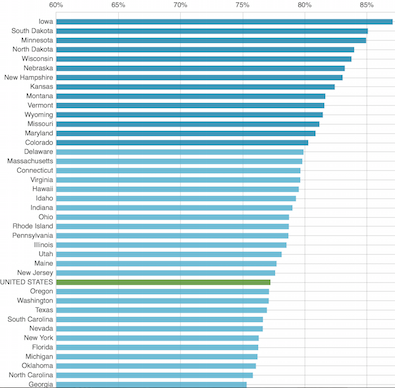
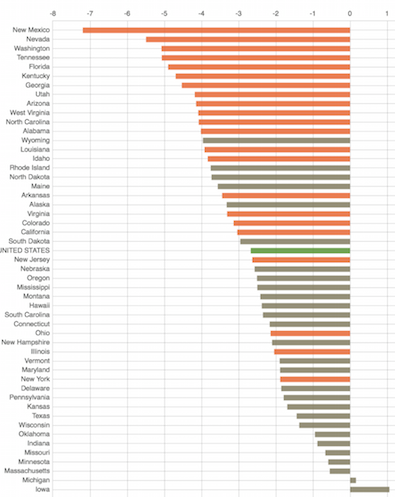
* The Pew Charitable Trusts’ “Fiscal 50” interactive has updated its 50-state employment data…
Employment Rates Inch Closer to Prerecession Levels
The U.S. employment rate for adults of prime working age has been rising for four years, and the number of states with lower employment rates than before the Great Recession has been shrinking. Despite these signs of improvement, however, the labor market had not completely recovered from the economic downturn by mid-2015.
Tuesday, Mar 1, 2016 - Posted by Advertising Department
[The following is a paid advertisement.]
As Police Chief in Clinton, I know firsthand of the significant impact the Clinton Power Station has on my community. It employs nearly 700 of our friends and neighbors and funds local government services including schools, fire and emergency response through the $12.6 million it pays in taxes every year.
Outdated energy policies are forcing nuclear energy plants nationwide to close down and Clinton could be next. These closures devastate local communities. Jobs are lost. Services are cut. In 2014, a Vermont town eliminated its entire police department after its local plant closed down.
A State of Illinois report found that if some of the plants in Illinois close, it could cost us $1.8 billion in lost economic activity and 8,000 jobs. Clinton cannot afford this and neither can Illinois.
I encourage our state legislators to adopt energy policy reform legislation the would help preserve our state’s nuclear plants. Taking action is necessary for our state’s economic health and would help prevent plants like Clinton Power Station from closing.
Learn the facts about Illinois’ nuclear plants at www.NuclearPowersIllinois.com
Illinois House Speaker Michael Madigan is backing Ald. Howard Brookins against veteran U.S. Rep. Bobby Rush in the March 15 Democratic primary.
The powerful speaker — who also is chairman of the state Democratic Party — customarily supports the party’s incumbents. But Brookins is listed as the preferred candidate of Madigan’s 13th Ward Democratic Organization on the newly printed “sample ballots” sent to voters in the speaker’s Southwest Side power base. […]
Rush said he did not know why Madigan would support a challenger against him.
“In 23 years, we haven’t had any reason to have any major differences,” Rush said.
As explained in the story, Brookins asked Madigan for help with his petitions and Madigan complied. Madigan’s 13th Ward has just two precincts worth about a hundred votes two years ago in that district, so it won’t mean much, anyway.
Preliminary/unofficial numbers suggest the best Early Voting start yet for a Presidential Primary with more than 11,000 ballots cast in Chicago. That’s a number more in line with a first day before a November Election.
Unofficial ward-by-ward data are below.
Regards,
Jim
On the first day of early voting, 1,003 people voted in the 13th Ward, by far the most of any ward and almost ten percent of the citywide total. Second place went to the 19th Ward, with 419.
* Here’s a roundup of stories about yesterday’s epic Bruce Rauner press conference…
* Rauner: Madigan manipulating university leaders in funding crisis: Rauner charged the president of beleaguered Chicago State and those of Northeastern Illinois and Eastern Illinois universities are playing puppet to Madigan. “Folks at Northeastern said they had been instructed never to step out and support any legislation that hadn’t been proposed by Madigan, not to support any other solutions to a problem unless the Speaker blessed it,” Rauner said.
* Universities And Their Funding Caught In Rauner, Madigan Vitriol: “You know what the Speaker has told them? I haven’t verified this directly, but I have good sources. What Speaker Madigan has gone to each of the universities and said: “If you step out and support anything that the governor’s proposin’, I will cut you out of the final budget solution.’” “Governor sounding a little more irrational than usual today,” said Madigan’s spokesman, Steve Brown, in response. “The only one who has cut higher ed, or threatened cuts to higher ed, is himself.”
* Rauner Accuses Madigan Of Blocking Higher Education Spending Bill: “Speaker Madigan and his folks in the legislature are trying to create a crisis and create headlines around the crisis to impact the primary voting that’s going on right now,” Rauner said. “Political games are being put ahead of students’ lives and we’ve got to stop this.” A spokesman for Speaker Madigan said the bill is being studied but it doesn’t guarantee money to the schools and it eliminates $180 million in school construction money. He said the governor has been trying to cut money for higher education for a year-and-a-half.
* Rauner tries to pin blame on Madigan for university funding crisis: Rauner said Madigan is holding up a compromise to score points ahead of the March 15 legislative primaries. The powerful speaker is running “a dictatorship of one individual who cares about politics over people,” said the governor, who called Madigan’s veto override attempt “a sham vote.”
* Gov. Bruce Rauner is accusing House Speaker Michael Madigan of prolonging Illinois’ higher education funding crisis for political gain: “Political games are being put ahead of student lives and we’ve got to stop this,” the Republican said, adding that Madigan is trying to “spin” the issue ahead of the March 15 primary. The comments prompted some laughter and a sharp response from Madigan spokesman Steve Brown, who noted Rauner last year proposed cutting the higher education budget by 30 percent then vetoed a budget bill to fund colleges and universities. More recently Rauner vetoed a measure to fund grants to help students pay tuition, saying it would “explode the state budget.” Representatives from two of the three universities that Rauner claimed had been threatened also denied that Madigan or his office had done so. “Sounds like the governor’s getting a little wobbly on us,” Brown said. “He’s under a lot of pressure because he’s wrecking higher education.”
* Rauner tweaks Cullerton with ‘Madigan’s shadow’ quip: “You know what President Cullerton said to me in private?” Rauner said, as he was making his case that Madigan is the cause of Springfield’s problems. “He said, ‘Bruce, I lived in Mike Madigan’s shadow for 37 years. I’m not gonna step out now.’ Can you believe that? Can you believe that? You wonder why Illinois is in such deep yogurt, ladies and gentlemen. We’ve got a dictatorship of one individual who cares about politics over people.” Cullerton said he was “not going to dignify that with a comment.” “Could we please get back to governing?” Cullerton’s statement said. Rauner has alternately wooed and tweaked Cullerton since taking office in January 2015, but the governor’s disdain for Madigan has been consistent.
* But you really should listen to the whole thing to get the full flavor. First, his opening remarks, when he makes his initial allegations about Madigan and reveals contents of an alleged private conversation with Senate President John Cullerton [fixed link]…