* You get the feeling we’re heading for something big? The full letter from AFSCME to the governor’s office can be read by clicking here…
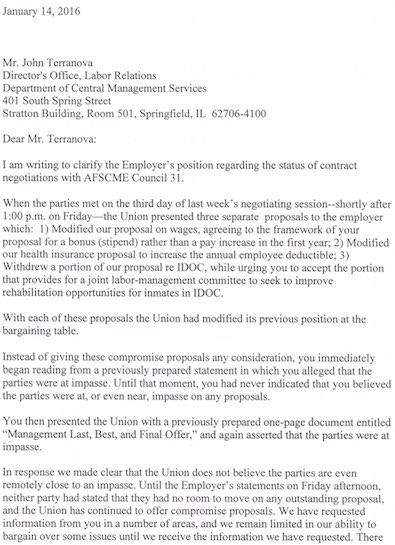

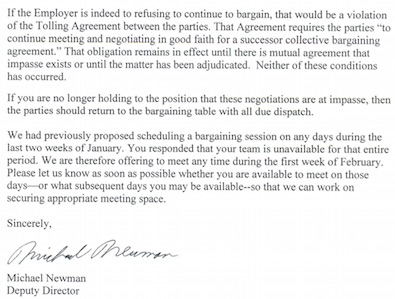
That’s a pretty darned big difference of opinion about what was said last Friday.
* By the way, the governor’s chief legal counsel Jason Barclay had this to say to Jim Dey earlier in the week…
As negotiations continue, AFSCME’s previous contract remains in place, meaning benefits they might lose under a new deal remain as well.
Barclay said that gives AFSCME a “perverse incentive to drag out the negotiations as long as possible.”
*** UPDATE *** Governor’s office…
Hi, Rich:
Passing along the following.
“This letter is filled with more falsehoods and misleading statements from AFSCME, the most glaring of which is that we have been expressing our frustration and concern to them for many months about their refusal to seriously bargain on the Governor’s core proposals. This is exactly why we asked last Friday whether future negotiating sessions would be worthwhile.”
Thanks,
ck
91 Comments  
|
Question of the day
Thursday, Jan 14, 2016 - Posted by Rich Miller
* From Charles Thomas’ interview of Gov. Bruce Rauner…
Again, he blamed the budget impasse on Democratic House Speaker Mike Madigan, renewing his most inflammatory charge that Madigan, an attorney in private practice, is personally profiting from Illinois’ dysfunction.
“He doesn’t want to change anything because he loves the status quo because he’s making a lot of money from high real estate taxes in Chicago,” Rauner claimed.
When it was pointed out that Rauner seemed on the verge of calling Madigan corrupt, he responded, “The political class in Illinois has been running the government for their own benefit for decades.”
And the governor admonished Chicago Mayor Rahm Emanuel, with whom he shared an expensive bottle of wine a few years ago after the two millionaires worked together on a merger deal. Rauner said Emanuel is a lot more conservative than the mayor puts on in public.
“(I want the mayor to) say publicly what he’ll say privately. He’s not fighting for his city,” Rauner said. “Its outrageous that the Mayor’s trying to blame me and others for his failure.
“But you guys are supposed to be pals, friends. Are you not friends anymore?” we asked.
“Anybody who helps me improve the quality of life and future for Illinois residents is my friend. Anybody who blocks it is not my friend,” Rauner saud,
* Hizzoner’s response as reported by the Tribune…
The mayor was asked Wednesday to respond to the “litany” of criticisms Gov. Bruce Rauner has leveled at him in recent days as the two continue their public tango over education spending in Chicago Public Schools and the governor’s call for the mayor to help him pass his agenda in Springfield.
Emanuel noted Rauner has been making the rounds in recent days to talk to reporters about his first year in the governor’s mansion, and suggested he was attacking others because he can’t follow the usual playbook of touting his own victories.
“First of all, this is the governor’s one-year anniversary in office as the governor,” he said. “There’s a great phrase by a former chief executive in public life, Harry S Truman: The buck stops here. And on the one-year anniversary, a lot of people note what they’ve gotten done. I think it’s a reflection on the governor that he is taking his one-year anniversary and talking about everyone else except for the one person that’s accountable — where the buck stops for the state of Illinois — and that’s him. And so my recommendation is rather than pointing fingers at everyone else and talking about their work, he should take the time to talk about his work and the accomplishments, or the lack thereof, that would reflect the one year of his tenure.”
* The Question: How do we get out of this mess?
79 Comments
|
No dupes? Oops!
Thursday, Jan 14, 2016 - Posted by Rich Miller
* It’s been rumored for weeks that Trump was gonna do this (I wrote about it last month sometime), but then he blew it…
Donald Trump’s campaign tried to get his rival Republicans kicked off the ballot in Illinois – but the attempt failed when his state chair failed to bring duplicate copies of the required forms.
The Guardian has learned that on Wednesday, the last day for candidates to object to signatures submitted by rival campaigns to get on the ballot, chair Kent Gray showed up at the Illinois board of elections a few minutes before it closed. Illinois has some of the toughest ballot access laws in the country, and qualifying for the ballot requires gathering a different number of signatures in each of the state’s 18 congressional districts. Candidates often stumble trying to fulfill the state’s requirements; conservative challenger Rick Santorum faced major obstacles in 2012. […]
State politicians have long had a “gentleman’s agreement” that candidates would not attempt to contest each other’s signatures and throw each other off the ballot. But challenging petition signatures as a form of political chicanery in the Land of Lincoln has a long history. Barack Obama first won election to the state senate in 1996 by successfully challenging the signatures of his incumbent opponent and getting her removed from the ballot.
It had been widely reported that the campaign of Governor John Kasich of Ohio, a vocal Trump critic, had problems gathering signatures in Illinois, and representatives of Kasich, along with the campaigns of Florida senator Marco Rubio and neurosurgeon Ben Carson, were monitoring for any objections from rival camps. It seemed that they had dodged a bullet until Gray walked in attempting to object to a number of candidates on the grounds that some of their signatures were invalid, although exactly who he focused on is unclear.
But Illinois law requires that someone objecting to a candidate’s nominating papers bring both the original and two duplicates. Gray only brought the original. His arrival in the board of elections office with just minutes left set off a scramble among those campaigns who had representatives there to monitor proceedings. Several had brought objections of their own to file defensively, only if someone objected to their presence on the ballot.
Apparently, money can’t buy everything.
Even so, for all the big talk from the Kasich supporters here about how Trump probably wouldn’t even make it to the ballot, they narrowly missed a stinging embarrassment.
24 Comments
|
Doom and gloomers proved wrong… Again
Thursday, Jan 14, 2016 - Posted by Rich Miller
* Remember these predictions from just last week about Illinois’ bond sale?…
“They’re definitely going to have to pay a higher yield,” said Dan Solender, head of municipals at Lord Abbett & Co. in Jersey City, New Jersey, which manages $17 billion of the debt, including Illinois bonds. “They’re going to be penalized compared to other bonds of similar ratings.” […]
Illinois is going to have to price the deal “pretty attractively” in order to get a good reception from investors, said Dan Heckman, a senior fixed-income strategist in Kansas City at U.S. Bank Wealth Management, which oversees $130 billion.
* The sale was today. Did the bond vigilantes win the day? Nope…
Hi, Rich –
Wanted to pass along this info on today’s bond sale.
The winning bidder of today’s $480 million General Obligation bond sale was Bank of America Merrill Lynch at a rate of 3.99%. This is a better rate than the last four tax-exempt GO bond sales. The previous rate of the last GO competitive bond sale in April 2014 was 4.08%.
The state received nine bids in today’s competitive bid. The bonds were issued to continue Illinois’ road construction programs, which are essential to maintain public infrastructure, improve public safety and create construction jobs.
Thanks,
ck
* One significant caveat…
The 161-basis-point spread over MMD’s scale is down from Illinois’ 170-basis-point spread in the secondary muni market heading into the bond sale. But the spread is wider than the 111 basis point spread for 25-year bonds in Illinois’ last sale in 2014.
So, the spread is definitely wider, but we saw plenty of bids and a rate that isn’t crazy high, considering.
Rauner and his team speak their language, so that probably helped. Not to mention that bond payments are made first. We’ll have to go a very long time without a budget before those payments are endangered.
26 Comments
|
* From Emily Miller at Voices for Illinois Children…
Hi Rich.
I noticed that you posted about the Governor’s projection that his policy agenda would bring an increase in revenue of about $510 million to the state. Given that we are billions in the hole as the result of the loss of revenue from tax cuts and the ever growing backlog of bills, I wonder why his policy agenda gets so much air time when it’s clear that the revenue generated doesn’t come close to what this state needs to even keep the lights on.
That aside, what’s really clear right now, and perhaps what everyone needs to be reminded of, is who is not “winning” right now under anyone’s definition. Here is a small sampling of the ongoing impact of the budget impasse:
* The central office of The Autism Project, which is the largest network of autism service programs, closed on September 30th, leaving virtually no services for children on the autism spectrum who are non-verbal in Illinois.
* 5,458 people, including children, who receive emergency and transitional housing have had their services reduced or eliminated. An additional 2,729 clients will have their services reduced or eliminated if the budget impasse continues through the first quarter of 2016. It’s winter, so while there’s never an ideal time to lose housing and become homeless, winter is probably the worst.
* The Sudden Infant Death Program no longer provides free training for parents, health providers and law enforcement. They receive 4 or 5 requests for safe cribs weekly, but they haven’t had money for safe cribs since September. Meanwhile, the program director has reported that death reports of infants who died in unsafe sleeping environments continue to come in.
* Redeploy Illinois, a DHS program that saves the state millions by diverting youth from incarceration in the Department of Juvenile Justice, is shut down in 23 counties. 6 additional counties are considering closing their operations. Last year, 316 youth were successfully diverted from the DJJ system, so elimination of the program entirely would lead to a roughly 45.6% increase in the DJJ population.
* Even the bills to provide funding patches don’t actually relieve the problem. While domestic violence money got passed in SB2049 and payment for services to date were received, agencies are holding off on rehiring laid off staff because they are not certain about the sustainability of future funding.
We have to start acknowledging that every day that goes by without a budget makes getting to a fully-funded budget even harder. Bills continue to pile up and infrastructure continues to crumble. Voices for Illinois Children certainly hopes leaders can start talking solutions sooner than the Governor has suggested.
31 Comments
|
Today’s number: 1.4 percent
Thursday, Jan 14, 2016 - Posted by Rich Miller
* As you already know, Gov. Bruce Rauner promised that he would send over documentation on how the state would benefit from his Turnaround Agenda.
The documentation is here and here. It was originally sent to legislators last September.
* Some of it is quite exaggerated. For instance…
[Reforming the prevailing wage] lowers the costs paid by taxpayers for construction projects by implementing true competitive bidding. In many cases, prevailing wage increases labor costs by more than 20 percent. From 2002-2011 state and local governments overspent by $1.6 billion on education construction projects alone due to our prevailing wage laws. Altogether, local units of government could save $1.1 billion per year with prevailing wage reforms. That is money that could go directly into classrooms and our communities, but instead we spend it overpaying for projects.
Labor’s cost is usually somewhere around 20 percent, so that’s a fantasy unless we can eliminate workers entirely. Plus, I’ve already looked at this…
A June, 2014 study conducted by the Anderson Economic Group for the far-right Illinois Policy Institute, the Illinois Association of School Boards, the Illinois Chamber and the Illinois Black Chamber found that eliminating the prevailing wage would’ve saved local school districts $126.4 million in 2011 (that’s in 2013 dollars, by the way). […]
So, even if every single local school district throughout Illinois immediately stopped paying prevailing wage rates on construction projects (not gonna happen) and even if eliminating the prevailing wage does indeed save as much as the Anderson study projected (doubtful), school districts could’ve saved a grand total of 0.74 percent of their property tax budgets, which is not much more than a rounding error. Now figure, in reality, savings of at most half that amount and we’re looking at about a third of a percentage point. That’s not even a rounding error.
Not to mention that the total percentage saved from allowing local governments to opt-in to eliminate the prevailing wage in their actual operating budgets is quite a bit smaller because to get an accurate count you’d have to add in revenues from local sales taxes, state and federal money, etc. Charitably, are we talking maybe a quarter of a percentage point saved here? If that?
* Keep in mind that Chicago’s janitorial and cafeteria contracts have become a nightmare…
Every year state government adds mandates onto our school districts and local governments. Additionally, under Governor Blagojevich, the state severely restricted the ability of school districts to contract with outside vendors for things like busing, janitorial and cafeteria services.
Chicago Public Schools is already relieved of many of these mandates and restrictions, but we impose them on every other district, despite the fact that schools districts have requested relief from these requirements for years. Just last month, the Large Unit District Association (LUDA), which represents the 55 largest school districts in the state and educates more than half of the state’s school children, wrote to our administration to again request relief from these mandates. A copy of LUDA’s letter is enclosed. Let’s give our schools the help they are asking for – it doesn’t cost us anything and can save them more than $200 million.
* And what would these reforms do for the state’s economy?…
Economic Growth
• Personal Income Tax Savings by Ending Out- Migration: $140 million
• Revenue Growth by Making Illinois “Average” in Unemployment: $150 Million
• Revenue Growth if Average Gross State Product: $220 Million
All this pain inflicted to maybe produce an additional $510 million in revenues?
For crying out loud, that’s a 1.4 percent increase over Fiscal Year 2015.
Good grief.
…Adding… As a pal just pointed out, the additional projected revenue probably won’t even cover the interest on the state’s backlogged bills from this impasse.
…Adding More… From a Republican friend…
Plus you need to factor in the cost of their tax increase into their economic growth calculation. The point is that they can’t argue that these anti-labor changes will magically produce $510 million of economic growth/revenue and then discount the negative effect of a tax increase on economic growth.
True.
139 Comments
|
* The full report is here…
CHANGE ILLINOIS RESEARCH EXPLAINS HOW PARTISAN VOTING MAPS LED TO DECLINE IN VOTER CHOICES IN LEGISLATIVE ELECTIONS
CHICAGO – Partisan redistricting of Illinois state legislative district maps has created continuing partisan bias in election outcomes while making it far less likely that voters will have a choice between candidates of both major parties in the general election, and voters in primary elections have even fewer choices, according to a new research report published by CHANGE Illinois.
“By any measure, the level of competition and competitiveness in legislative elections under the last four partisan maps is extremely low and getting worse,” according to Partisan Advantage and Competitiveness in Illinois Redistricting. “These findings call into question the effectiveness of legislative elections in providing a meaningful incentive for citizen engagement. They also undermine the conventional wisdom that the members of the Illinois General Assembly are elected by the consent of Illinois residents.”
CHANGE Illinois published the new research, which was conducted by political reform veteran Cynthia Canary and Kent Redfield, professor emeritus of Political Studies at the University of Illinois at Springfield. It examines questions about whether the partisan advantage gained through a new legislative map has lasting effects beyond the first post-redistricting election and whether the lack of contested and competitive elections under such partisan legislative maps extends to primary elections as well as general elections. The new report updates and expands the Canary-Redfield 2014 report, Backroom Battles & Partisan Gridlock: Redistricting in Illinois.
The report’s findings include:
* In 2012, Democratic candidates in the House won 52 percent of the total vote and 60 percent of the seats, and Democratic candidates in the Senate won 54 percent of the vote and 68 percent of the seats. In 2014 in a midterm election favoring Republicans, the partisan bias in the 2011 maps still delivered for Democratic candidates. While the margin in total votes cast for Democrats running in legislative elections shrank to a near-tie statewide, Democrats still won 71 House seats, a 60 percent majority. The Democrats also won 11 of the 19 Senate seats that were up in 2014 while receiving less than a majority of the total votes cast in those 19 districts.
* The percentage of General Assembly elections featuring at least two candidates has decreased significantly over time. In the first election under a new map in 1982 and 1992, a strong majority of the elections were contested. By 2012, 60 percent of House elections and 51 percent of Senate elections were uncontested. In 2014, 58 percent of House elections were uncontested. Due to staggered terms, there was an election in only one-third of the Senate districts, and 12 of the 19 (63 percent) were uncontested.
* The degree of competition in Illinois legislative elections is low and declining. When a winning candidate’s vote total is 55 percent or less, the district is considered “competitive.” On average over the past four decades, 88 percent of voters (104 of 118 House races, 52 of 59 Senate races) had no choice at all on the ballot or a choice between a sure winner and a sure loser.
* There has been a dramatic increase in the number of legislators elected without even a token opponent in both the primary and the general election.
* In 1982, 20 of the 177 legislators elected faced no opponent in either the primary or the general. In 2012, 69 legislators had no opponent in both the primary and the general election – essentially given a free pass.
* The number of “free pass” legislators elected increased in 2014 even though only one-third of the Senate was up for election. In 2014, 58 (49 percent) of those elected to the House did not have an opponent in the primary or the general election, as did 12 of 19 (63 percent) of those elected to the Senate.
* Voters in primary elections have even fewer choices for participation, engagement, and communication than voters in general elections. In the 2014 primary election, 89 percent of House and 95 percent of the Senate legislative primaries were uncontested.
* The level of primary activity in districts dominated by one party is very low and has decreased significantly under the last two partisan maps. Under the 2001 and 2011 maps, the average number of same-party competitive primaries in districts dominated by one party was 11 percent in the House and 4 percent in the Senate. This clearly indicates that voters in districts dominated by one political party in the general election were rarely presented with meaningful choices in the primaries.
“Illinois’ partisan redistricting process undermines our democracy and discourages civic participation,” said Ra Joy, Executive Director of CHANGE Illinois. “We need to put people before partisanship and have fair maps drawn by an impartial commission listening to voters and acting in the open. That’s why CHANGE Illinois supports the Independent Map Amendment
Discuss.
*** UPDATE *** Decent points…
46 Comments
|
Find another way
Thursday, Jan 14, 2016 - Posted by Rich Miller
* I saw yet another TV ad last night for “Start-Up New York” on my local station. So, I surfed over to the website…
What is START-UP NY?
START-UP NY offers new and expanding businesses the opportunity to operate tax-free for 10 years on or near eligible university or college campuses in New York State.
Partnering with these schools gives businesses direct access to advanced research laboratories, development resources and experts in key industries.
Who is START-UP NY for?
To participate in START-UP NY, your company must meet the following requirements:
* Be a new business in New York State, or an existing New York business relocating to or expanding within the state
* Partner with a New York State college or university
* Create new jobs and contribute to the economic development of the local community
* New York isn’t a “right to work” state, yet this program appears to be having some success after a very slow roll-out and expensive national ad campaign…
157 business have already joined START-UP NY and committed to create 4,278 new jobs and invest over $225 million across New York [over five years]. That’s a great start.
We don’t have to copy it. We don’t have to spend as much as NY on advertising. And, like with NY, it will take time to accomplish whatever we set out to do.
* All I’m saying here is that perhaps we can look at doing other things besides lowering the pay, benefits and job protections of working people to get something moving in Illinois.
…Adding… Molly Parker has an interesting piece in The Southern about federally mandated workforce development changes in Illinois…
They are drafting policies to refocus economic development strategies that leverage viable business clusters already blooming in a particular area. In the five-county region covered by the Southern Illinois Workforce Development Board – Jackson, Williamson, Perry, Jefferson and Franklin – those clusters have been determined as, in this order, health care, transportation, distribution and logistics and manufacturing.
They also are attempting to close skill gaps identified in the regional workforce by beefing up access to technical education programs for high school students, and offering access to technology training for older adults.
They are reshaping programs that train people new to the workforce, or who are being retrained for a second career after a layoff or other life event, and they are crafting new programs for incumbent workers to keep their skills updated as companies adapt to new technologies or ways of doing business.
With regards to adult education, bridge programs are being implemented to transition someone from a high school equivalency degree to a post-secondary education to a job. There’s a greater emphasis being placed on vocational rehabilitation to help people overcome barriers to achieving employment, as well as targeted programs to help youth enter the job market, particularly those who drop out of school and lack employable skills.
27 Comments
|
Simple answers to simple questions
Thursday, Jan 14, 2016 - Posted by Rich Miller
* From the Tribune’s interview of Gov. Bruce Rauner…
“I am the head of the Republican Party, so I’ll be involved in advocating for candidates,” said Rauner, who insisted his primary focus will remain on government, a stance he accused the speaker of not sharing.
“(Madigan) has always been focused on the next election. It’s not policy, it’s the next election. But he’s taken it to another level right now,” Rauner said. “And I don’t know all the reasons why. I don’t know. But he’s very focused on positioning and posturing.”
For the answer, scan through IllinoisGO’s (for the primary) and the governor’s (for the general) multi-million dollar contribution disclosure reports. There’s also the little matter of the possibility that the Speaker could be slammed with millions of dollars in spending by or on behalf of his pro-business Democratic primary opponent.
Other than that, I, too, am befuddled.
/snark
16 Comments
|
Foxx is slated by county Dems
Thursday, Jan 14, 2016 - Posted by Rich Miller
* No surprise…
* Self-serving grandstanding, but also no surprise, considering she knew she wasn’t going to be slated and, like State’s Attorney Anita Alvarez, will attempt to somehow use the party slating against Foxx in a partisan primary (all the while being accused of supporting Bruce Rauner - not an easy feat)…
Unlike More, Alvarez was a no-show.
25 Comments
|
* DNA Info…
Police officers are making drastically fewer investigative stops and confiscating fewer guns as murders and shootings have increased so far this year, DNAinfo Chicago has learned.
So far this year, the number of so-called investigative stop reports — formerly known as “contact cards” — has decreased by about 80 percent compared to the same time period last year, police sources told DNAinfo.com.
There also been a 37-percent decline in gun arrests and a 35-percent decrease in gun confiscations compared to last year, according to police data.
Meanwhile, there have been 72 more shootings (a 218 percent increase) and 10 more murders (a 125 percent spike) than the same time period in 2015, according to police data. […]
“I’ll leave that up to by the common sense of the citizens as to why things are not as productive … investigative stop wise,” Fraternal Order of Police president Dean Angelo said.
“I’ve been out to roll calls and so have our board of directors … and what we’re hearing is that officers think that the FOP is the only group of people who have their back. … I’ve never seen things like this in my 35 years. … I’ve never seen morale this bad in my career.”
They’re playing right into Rauner’s hands.
If the cops aren’t doing their jobs, and the union is making cynical excuses for them, well, then perhaps the state has to go after the union.
I’m not saying that, I’m just sayin’.
* CBS 2…
The superintendent acknowledged there has been a recent decrease in gun seizures, but said he doesn’t believe the increased scrutiny on the department has affected morale.
“We have to be concerned, always, about morale; but right now I’m not overly concerned, no,” he said.
Escalante said there has been some confusion over new procedures, and that might be slowing things down for officers.
Officer Enrique Delgado-Hernandez – in front of the boss – said heightened scrutiny, new training in the use of force, and extra paperwork amid the fallout from the McDonald scandal have not led to a slowdown of policing.
Then what is it?
61 Comments
|
Gross, Phelon leaving SDem staff
Thursday, Jan 14, 2016 - Posted by Rich Miller
* I told subscribers about this earlier in the week. Here’s Bernie…
DAVE GROSS of Jacksonville, chief of staff to Senate President JOHN CULLERTON, D-Chicago, is leaving that post to go into political consulting and lobbying.
“It’s going to be interesting,” Gross told me. “It’s going to be challenging, and I’m excited about it. The president’s been great about this, and I’m looking forward to trying my hand at it.” […]
Also leaving the Senate Democratic staff is RIKEESHA PHELON, 38, who has been press secretary to Cullerton since 2009. She is forming her own company, Phelon Public Strategies.
Phelon, who will not be a lobbyist, said she can help her clients with a mix of knowledge of “what’s going on under the dome,” combined with “Chicago media reach.”
Those are two top-notch people. Phelon is a particular favorite on the blog, winning a Golden Horseshoe Award last month.
* Tribune…
Cullerton, in turn, took to the microphone to note the departure of his spokeswoman Rikeesha Phelon, who is leaving state government to start a consulting firm.
“She’s the one who says the things I need to say, but says them better than I do,” said Cullerton, who is known for his sarcastic sense of humor that can sometimes get him in trouble.
Yep.
21 Comments
|
* Tribune…
Chicago was a finalist to score General Electric’s corporate headquarters — and 800 jobs — but the state’s pension crisis and the condition of Chicago’s public schools helped remove it from the running, sources close to the selection process told the Tribune on Wednesday.
On Wednesday, GE announced it would move its headquarters from its longtime home in Fairfield, Conn., to Boston.
Mayor Rahm Emanuel “did a good job” and “worked hard at presenting the case for Chicago” and Illinois Gov. Bruce Rauner “did a fantastic job,” one source said.
Many factors went into the decision, including a strong presence and thousands of employees GE already has in Connecticut, Massachusetts and New York, the source said.
* I’m sure this little factoid (unmentioned by the Trib) from the Boston Globe had absolutely nothing whatsoever to do with it…
The decision by GE to move its headquarters — and deliver about 800 jobs — from suburban Connecticut to the Seaport District follows a feverish campaign by Massachusetts officials, who beat out New York, Providence, and several other cities.
City and state officials are offering what could be one of the richest incentive deals in the state’s history — together valued at as much as $145 million — to lure the company here.
A generous offer like that from Illinois and Chicago would’ve been sharply attacked in this current political climate, to say the least.
* Also…
But GE officials pointed to Greater Boston’s concentration of elite universities and nimble tech firms as the main draw.
“We want to be at the center of an ecosystem that shares our aspirations,” chief executive Jeffrey R. Immelt said in a statement.
GE’s new TV ad campaign is really an employment recruitment tool aimed at tech grads. And, unlike us, Massachusetts and Boston aren’t starving their universities and taxing the cloud, not to mention making a general mess out of everything with a protracted political war.
So, perhaps if this state’s leaders weren’t fighting so much, some of those pension and school issues could’ve been addressed and perhaps GE would’ve been more amenable to moving here. Notice, the GE sources didn’t mention the prevailing wage and “right to work.” A stable political climate may have also made a big economic development package possible.
* Even so, there’s also the regional issue mentioned above. GE already has lots of employees fairly near Boston, and when GE Healthcare announced its headquarters move to Chicago this week, the company’s existing regional presence ranked high…
GE Healthcare announced Monday it will move its global headquarters from the United Kingdom to Chicago.
The company said the move would be effective early this year and is designed to move the top leadership for its health care business “closer to operations in Chicago and Milwaukee, while remaining near an international transportation hub.”
GE Healthcare, which employs about 6,000 people in Wisconsin and 51,000 worldwide, had total revenue of $18.3 billion in 2014.
* Look, I don’t doubt that pensions and schools were in the mix. But I also don’t doubt that a less dysfunctional political system could’ve made those issues far less important. Could we have still scored the GE headquarters? I don’t know. Regionalism concerns were definitely working heavily against us.
Whatever the case, this ought to be a wakeup call. The state needs to get moving again.
End. The. War.
*** UPDATE *** Greg Hinz…
Emanuel and Rauner personally met with GE brass, both here and on the East Coast. The state offered $50 million in Edge tax credits. While there were doubts at the beginning that GE would really consider moving its HQ to the Windy City despite having numerous business lines in this area, “they were totally blown away” after a meeting here in September, one insider says.
But during that meeting, Rauner said some things about soon ending the state’s budget wars. Accounts differ, but some say he effectively promised action within a few months.
He obviously hasn’t delivered. Shortly thereafter, the McDonald shooting flap erupted, and Emanuel “lost all of his clout in Springfield, at least for now,” says one insider with firsthand knowledge of the situation.
Did that make a difference in GE’s decision?
Chicago was in it until late fall, says one source familiar with the search process. “It was the entire budget picture between Chicago and the state,” the source says. “CPS was a big concern of theirs.”
“It absolutely was not the city’s situation,” counters another. “The business atmosphere of the city was a huge plus.”
Says a third insider, “Any shot that Chicago did have disappeared when Rauner couldn’t deliver on his promise.”
103 Comments
|
|
 Support CapitolFax.com
Visit our advertisers...
  ...............
 ...............
 ...............
 ...............
 ...............
 ...............


|
   
|
Hosted by MCS |
SUBSCRIBE to Capitol Fax |
Advertise Here |
Mobile Version |
Contact Rich Miller
|




