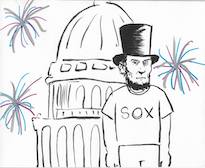
* Gov. Pat Quinn went all Popeye on the General Assembly yesterday over tax hikes…
“Sometimes politicians of both parties want to wait ’til after the election. I’m not one of those. I wanted to do it before the election. But now it is after the election … you gotta eat your spinach. You gotta eat your spinach to grow-up big and strong.”
Gov. Pat Quinn has a reputation as a spendthrift, so he’s promising a “frugal” but not “chintzy” inauguration next month.
Quinn says the celebrations will be meaningful, yet “thrifty,” when he and the other state constitutional officers are sworn in to office Jan. 10 in Springfield.
The full Q&A is below. At the end, reporters asked if he would be dancing at the ball, and also asked if he could dance. Listen…
Isn’t it time to dump the entire idea of inaugural festivities at all levels of government? Take your oath, go out to dinner with friends, then get the heck to work. Ask those “private donors” to fund a few inaugural commemorative reading tutors or buy a few thousand inaugural commemorative library books.
As lawmakers talk about big plans to expand gambling, the man charged with regulating the industry in Illinois called the proposal “overloaded” Wednesday. […]
Jaffe criticized the legislation as having “everything for everyone” because it calls for casinos in Park City, Ford Heights, Chicago, Rockford and Danville, along with 1,200 slot machines at Arlington Park.
Cook County Board President Toni Preckwinkle made it clear Thursday that she and Assessor Joseph Berrios remain political allies, even if she’s not keen about him putting relatives on the public payroll.
“Joseph Berrios is my friend,” Preckwinkle said. “He is the chairman of the (Cook County) Democratic party, and I’m a Democratic committeeman.”
Preckwinkle was reacting to the news that Berrios hired his sister and son within days of being sworn in Monday. The family members had long worked at the county property tax appeals board, where Berrios was a commissioner.
“I never hired any family members,” Preckwinkle said at a news conference to introduce top aides. “And I think it’s inappropriate.”
* Now, to the city, where Carol Moseley Braun just announced that she’s heading to New York for a fundraiser. There’s a bit of a problem, however…
Last month, Moseley Braun criticized mayoral candidate Rahm Emanuel for “hanging out with bankers and billionaires” at a Hollywood fundraiser.
“Moseley Braun is going where necessary to raise money in order to compete in the race for mayor,” said spokeswoman Renee Ferguson. “As a senator, she built a national constituency and there are many who would like to continue to support her policies of fighting for working people.”
“I’ll generally be here [in Champaign County]. I will go to Washington quite often, but I’m going to be working out of Champaign-Urbana and making some trips to D.C.,” he said. “I think early on there will be more of them than later. I will definitely spend the vast majority of my time here.
“I think this will work out pretty well because one of the big changes the Republicans are making is to reduce the number of days Congress is in Washington, D.C.”
Shelden, who makes about $87,000 a year as county clerk, will get what he called “a substantial raise.”
“Chiefs of staff out there make in the 150s and 160s,” he said. “I don’t know what I’m going to make, but it’s going to be a substantial raise.”
A chief of staff who doesn’t live in DC?
Shelden, by the way, is replacing Jerry Clarke, who is moving over to freshman Congressman Randy Hultgren’s staff. Jerry ran Bill Brady’s campaign. Our old friend and former Illini Pundit blogger extraordinaire Gordy Hulten is in the running to replace Clerk Shelden. Good luck, Gordy.
* Fewer people gambling in Illinois; numbers challenge expansion plans
* Jackson urges action on south suburban airport: “I fear if this is held up until after the Chicago (mayoral) election, it’ll be put off,” Jackson said. “Our state is almost insolvent. It’s a unique opportunity to spread economic growth. Let’s take this project to its logical conclusion.”
* City could save on pension reform - New Police, firefighters could retire at 55 instead of 50
The second anniversary of Rod Blagojevich’s arrest was this week. It passed mostly unnoticed. Maybe nobody felt like celebrating. I sure didn’t.
One of the few commemorations I saw was in Chicago Magazine, which ran an article titled “Why is Illinois so Corrupt?”
There was the usual list of suspects, mainly focused on Chicago. For instance, there was Mayor Richard J. Daley’s institutionalizing the city’s corrupt systems while business and whites looked the other way in a grand, unspoken bargain for lucrative construction projects, jobs and keeping the blacks at bay.
There are as many theories as there are solutions. But what we do know for sure is that this entire state has long had a serious problem with corruption. It’s not just one party, and it’s certainly not just one region.
“If you’re out on a farm, there isn’t all that much to be corrupt about,” former Illinois Republican Party Chairman Gary MacDougal told Chicago Magazine.
Back in the mid 1970s, my father was a deputy sheriff in Iroquois County. Most Chicagoans probably don’t even know where that is, but it’s a huge, rural farm county with almost no people. Its northern border is only about 70 miles south of the city on I-57.
It may be geographically close to Chicago, but it’s a whole other world. Iroquois is and always has been one of the most Republican counties in the state. It was one of the few that went for that wacky Marylander Alan Keyes over Barack Obama in the 2004 U.S. Senate race, for instance.
Anyway, my dad says the sheriff back then had a company that leased the deputies’ police cars to the county. The sheriff had a company that sold police uniforms to his own officers. Every week, as dad tells the story, the sheriff would stop by the jail to pick up a big package of meat that the county ostensibly bought for the inmates.
So much for MacDougal’s theory.
OK, so it’s a given. But what do we do? Two years ago, I argued that the citizenry should try to remake the entire government right down to the local level by voting for a state constitutional convention. Change the structure, then maybe things might get better. The proposal lost by a huge margin.
The biggest reason Rod Blagojevich was re-elected four years ago was because a real effort wasn’t made to defeat him in the Democratic primary. The people who run the Democratic Party didn’t go after Blagojevich because the last time they primaried out a sitting Democratic governor, the Republicans took control of the office for the next 26 years. But that decision was a huge mistake. The Republicans were too weak in 2006 to make any sort of inroads. Illinois’ independent voters are as scared of the GOP as Iroquois County voters are of the Democrats.
What we witnessed this year with Toni Preckwinkle’s Democratic primary defeat of Todd Stroger was a rarity in Illinois. Cook County will have a far better, cleaner government because of her victory. We ought to learn from that.
We need far more primaries in this state. Legislative, ward and county board districts are drawn throughout Illinois to elect one party over the other, so running in the general election is pretty much useless, except for a few swing districts here and there.
New district boundaries will be drawn next year. So people who want things to change should start thinking soon about running for office against members of their own party. It won’t solve all our problems, but some new, honest blood certainly wouldn’t hurt.
* Meanwhile, the Zephyr, Galesburg’s alt weekly, has just published its final edition. Publisher Norm Winick is ill, so the decision was made to pull the plug on the paper. I’ve known Norm for a long time. He’s one of the good guys. Some of you may know his son, Ben, who is Gov. Pat Quinn’s House liaison. Norm’s wife Christine is a gem of a human being.
An editor at the paper asked me to help send off the Zephyr this week, and here is my contribution…
I understand why the Zephyr has to go, but I sure don’t have to like it. Five of my friends have died in the last year. Now this. The Zephyr may just be a newspaper to some, but it’s always been a friend of mine.
I’ve grown to love this paper since Norm Winick began publishing my weekly column almost 12 years ago. Its quirky eccentricities delighted me, its sharp graphics made it a pleasure to read, its 1995-era website amused me. But its reporting and its philosophy of being “the world’s first public access newspaper” kept me coming back week after week. You just never knew what you’d see.
The Zephyr is not only a local treasure, it’s a state treasure and Norm oughtta be canonized for keeping it going and keeping it relevant through the many lean years.
For instance, I read the first real, in-depth story on Congressman-elect Bobby Schilling right here on these pages. Mike Kroll wrote a fascinating profile of a long-shot candidate who firmly believed he would win the race. Just about everybody else thought the guy was a goofball dreamer, but the Zephyr gave Schilling respectful, evenhanded treatment when everybody in the political world was doing their best to ignore the guy.
Norm’s story this fall about how Gov. Pat Quinn’s payroll was smaller than his last four predecessors’ was a calm tonic in a political environment overly outraged that Quinn had given some of his staffers pay raises.
There’s also a personal angle for me. Befitting his “public access” bent, Norm gave me wide latitude as a writer. Back in 1999 I wrote a long piece about a trip to Cuba. The story contained some racy language, which is not something you usually see on these pages. Norm inserted a little warning at the beginning, but didn’t touch a single word of my copy. He’s a writer’s editor - a rarity in the publishing world. I’ll always love him for that.
I’ve had the privilege of appearing in these pages through three governors, beginning with George Ryan. We’ve gone through a lot together. Two convicted governors and a populist who can’t seem to get his arms around the job. I’ll miss sharing my thoughts with you week after bloody week.
People always love to complain about their local media outlets, but I’m betting that Galesburgians will miss this paper until they, too, go the way of the Zephyr. You’ll never again see anything else like this beautiful little publication. Norm and Mike and everyone else here made it what it is: A one of a kind beauty in a fast-food, prepackaged world.
I sense a great disturbance in The Force, like when the Death Star destroyed Alderaan. You’re not the only ones losing something valuable. The entire state is as well, whether mere mortals realize it or not.
A pair of bills jammed through the Illinois House in the veto session last week amount to an enormous tax increase for utility customers across the state. The legislation would require millions of Illinois residents and businesses to purchase gas and electricity at above-market prices from two “green energy” plants to be constructed with state backing.
Naturally, legislators tout the measures as “jobs bills.” The plants would create a couple thousand construction jobs and a few hundred permanent positions.
The rest of us would get to pay higher utility bills for decades. Illinois businesses figure the Taylorville plant would cost them hundreds of millions a year in higher electricity costs.
This is taxation. It’s government propping up businesses that can’t compete in the open market by requiring the people of Illinois to underwrite their extra costs.
And it’s an example of Illinois politics at its worst.
Backroom deals and backdoor tax hikes—they go together.
*** UPDATE *** Rockford is getting passenger rail service for the first time since 1981…
The Illinois Department of Transportation today announced the selection of the proposed southern route for Amtrak’s new Chicago-Rockford-Dubuque service from Chicago’s Union Station to downtown Rockford. The $60 million service will create 650 construction jobs, with trains running by early 2014.
[ *** End Of Update *** ]
* Illinois will get some of the high speed rail cash rejected by Wisconsin and Ohio, but not a huge amount…
In a move announced Thursday by U.S. Transportation Secretary Ray LaHood, Illinois will get a $42 million share of the $1.2 billion that had earlier been earmarked for Wisconsin and Ohio.
It remained unclear Thursday exactly how the new money would be used in the Land of Lincoln, which already has received $1.2 billion in federal funds to upgrade the Chicago-St. Louis line to allow for 110 mile per hour passenger trains.
The route, which roughly parallels Interstate 55, includes stops in Lincoln, Bloomington-Normal and Pontiac.
“Illinois will be able to use this funding to break ground on projects that were included in the state’s application for high-speed rail along the Chicago to St. Louis corridor, but not funded earlier this year,” said U.S. Sen. Dick Durbin of Illinois. “Improvements to this route will decrease travel times even further and create jobs that our state badly needs.”
Talgo Inc., the Spanish manufacturer of high-speed train cars, will abandon its plant in Milwaukee in 2012, according to Nora Friend, a spokeswoman for the company.
The decision was made after U.S. Secretary of Transportation Ray LaHood announced Thursday that the federal government was rescinding the $810 million allocated to Wisconsin. Wisconsin Gov.-elect Scott Walker had strongly opposed the state’s high-speed rail plan.
“We can’t stay and manufacture in Milwaukee without the high-speed rail to Madison,” Friend said. “This is terrible news.”
Friend said the state’s decision to back away from the high-speed rail project sends a terrible message to businesses considering locating in the state.
Gov. Pat Quinn, you will recall, sent a letter to Talgo during the campaign urging it to move to Illinois if Wisconsin rejected the money. That’s looking more likely.
* Most of the money originally meant for Wisconsin and Ohio is going to California and Florida…
Most of this high-speed wealth was spread to California, which will receive up to $624 million for its trains. Transportation Nation reports that the bulk of this sum — $616 million — will be used to extend the first segment of the state’s bullet line, which will now stretch from Madera to Bakersfield, rather than ending in Corcoran. Florida will get up to $342.2 million of the pot; Washington (state), $161.5 million; Illinois, $42.3 million; and New York, rounding out the top five, $7.3 million. (A full list of the recipients, including $2 million to Wisconsin for its Hiawatha line, can be found here.)
* But there’s still a small chance that Illinois could get more money because Florida’s Republican governor-elect isn’t 100 percent sold on the idea, even though he’s happy for the cash…
Governor-elect Rick Scott is pleased with the federal government’s commitment of $342 million more to Florida’s planned high-speed rail line between Tampa and Orlando.
But the Republican indicated he’s still not committed to it in a statement released Thursday by his transition office in Fort Lauderdale. The latest allocation would give Florida nearly all of the $2.6 billion needed to build the route.
Scott, though, first wants to review its feasibility “in terms of return to Florida’s taxpayers” and find out the private sector’s interest in funding it.
* This new governor-elect in Wisconsin is a bit on the clueless side…
Even though he remains opposed to a high-speed rail corridor from Chicago through Milwaukee to the state capital in Madison, Wisconsin Governor-elect Scott Walker did not rule out the possibility of state financing for other new rail projects during a Milwaukee Press Club-sponsored luncheon held Dec. 7.
Walker envisions a continuing role for railroads as part of intermodal transportation budget priorities in his administration, he said.
“I don’t have a problem with rail in general. Funding for the Hiawatha between Chicago and Milwaukee, and the train to Minneapolis is fine,” he said. “Freight rail offers a great opportunity to build up our [shipments] of grain and iron ore.”
The dirty little secret of this high speed rail program is it’s a direct subsidy to freight carriers to update their tracks. If Walker wanted money to help freight carriers transport grain and iron ore, he should’ve taken the federal cash. And “the train to Minneapolis is fine”? Um, that was the stated purpose of the Wisconsin grant. Sheesh. At least Wisconsin will get a couple of mil to upgrade the Hiawatha…
Wisconsin now will receive up to $2 million to improve the existing Milwaukee-to-Chicago Hiawatha line. That amount won’t cover the more than $19 million needed to renovate the shed at Milwaukee’s downtown train station or the $52 million needed to build a maintenance facility for new trains. Those improvements would have been covered by the original $810 million awarded to the state.
t’s unclear whether Wisconsin will need to repay the approximately $9 million it’s already spent on the train project or the more than $5 million it would owe in contract cancellation fees.
“Nothing’s been returned yet,” Walker said when asked about the money. “We’ve had our folks working with federal rail administration folks to sort that out. We’ll be crunching the numbers.”
All this over $7 million a year in new state operating costs. Actually, it might be as low as $700,000 a year.
* AFSCME agreed to defer a pay increase in order to help save the state some cash in the coming fiscal year, but the union also got a retirement bump of sorts for some of its members. From the SJ-R…
Union members were scheduled to get a 4 percent pay hike on July 1, 2011. Instead they will receive 2 percent on July 1. The other 2 percentage points will be deferred until Feb. 1, 2012.
The union pledged during the campaign to find $100 million in savings in exchange for a highly controversial agreement not to lay anyone off or close any state facilities until the end of June, 2012. They announced $10 million in savings when the agreement was announced. That raise deferral (including Social Security savings) adds up to another $30 million. Another $20 million will be saved this way…
— Reducing mandated overtime in facilities that are open 24 hours a day, seven days a week by hiring more staff.
– Extending the voluntary furlough program. The program gives workers one paid day off for every two furlough days they take. The program will be expanded to include additional employees in the Departments of Corrections, Human Services and Veterans Affairs.
– Three contracts that have been out-sourced will be brought in-house for state employees to do.
– Other efficiencies, including reducing the use of paper, expanding salvage and recycling programs at state prisons, improving operations of the state’s Corrections Industries, making correctional facilities more energy-efficient and changing how parole agents travel.
* But, as mentioned in the lede, the union also preserved a pension bump for state workers who agree to retire at the end of calendar year 2011.
If state employees pledge to retire at the end of 2011, they get the full 4 percent raise next July 1st, instead of just 2 percent. The workers have to make their decision by May 1st.
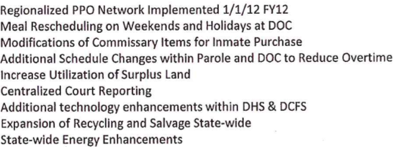
* According to the agreement, the union is also discussing these ideas with the administration to arrive at the $100 million cost savings…
* Best state legislative secretary/admin assistant
* Best Illinois state Representative
* Best Illinois state Senator
Once again, keep in mind that I look at intensity lots more than numerical strength. Explain your votes.
I’ll announce yesterday’s winners later today. Still deciding.
…Adding… If you would like to nominate a legislative secretary/admin assistant in each chamber, feel free. I probably should’ve done that to begin with.