* At the end of the first week of veto session, Gov. Pat Quinn demanded that the General Assembly’s Inspector General investigate what the media quickly termed “Buttongate.” As you’ll recall, about 20 Democratic members were off the House floor attending one of the day’s three scheduled budget briefings when the ComEd “Smart Grid trailer bill” was called for a vote. Several opponents of the bill were voted “Yes” by others in the chamber…
“The people of Illinois, I think, back home, if they hear that their legislator was letting some staff member vote their switch, or somebody next door to them who wasn’t elected by the people back home, this is not right,” Quinn said during a stop in Normal in central Illinois on Friday. “And the legislators know this. And I think any wrongdoing there, any monkey business, needs to be investigated by the proper authority.”
* Anyway, I just received this e-mail from Inspector General Tom Homer…
I sent a letter to the Governor on Monday relative to the voting procedures on House Bill 3036. I also have provided copies of my letter to the four leaders through their respective legal counsel. In addition, I submitted my report to the Legislative Ethics Commission this morning and provided the commission members with copies of my letter to the Governor.
While I am not able to discuss the particulars, I have no plans at this time to pursue the matter further and consider it closed.
Apparently, there was no there there. No surprise. Quinn completely overreacted.
*** UPDATE *** If you’re watching our veto session live blog, you already know that the revised regional superintendent funding bill just passed the House after two tries. The bill now goes to the Senate.
Under the governor’s new proposal, the Department of Human Services would reduce the number of residents served by state-operated developmental centers by at least 600. That would allow the agency to close up to four of the state’s eight developmental centers by the summer of 2014.
An outline of the proposal did not identify which facilities, including centers in Anna, Dwight, Dixon and Centralia, may be on the future chopping block.
The new plan also calls for the closure of two unidentified state psychiatric hospitals by mid-2014. The proposal would at least temporarily end Quinn’s threat to close Logan Correctional Center and the youth prison in Murphysboro. […]
It appeared Quinn’s decision to cut money for school transportation costs may stand, leaving local districts scrambling to pay for busing.
“There’s not a lot of support for education in the negotiating room,” said state Rep. Will Davis, D-Chicago.
Less than two weeks after an earlier proposal fell 12 votes short of passage in the House, state Rep. Frank Mautino, D-Spring Valley, said he was still rounding up support for a package that would dip into a fund dedicated to local governments for the $13 million needed for the salaries.
He said he’s included a number of legislative tweaks that could draw enough support to move the proposal to the Senate for further action during the final two days of the General Assembly’s fall veto session. […]
Cities, counties and school districts say the money should come from a different source, but Mautino and supporters say the one-time use of the money can correct what they see as a mistake by Gov. Pat Quinn.
* In other news, the Southern Illinoisan published an editorial slamming striking SIU faculty members. The edit is entitled “Go to work, or get out!”…
Striking faculty members at SIU Carbondale have no valid issues. They should return to the classroom today or be replaced Monday.
For anyone driving Thursday on U.S. 51 near Southern Illinois University the sight of pickets at the campus’ main entrances was both historic and emotional. Striking faculty got salutes and toots of the horn from supporters, but a larger group of motorists responded with silent stares or insulting hand gestures.
Were they angry or offended? It is an interesting question to consider as the first strike at SIU moves into a second day. Our region is chronically beset with poverty and joblessness - troubles exacerbated by the nation’s deep and long recession. Employment at SIU is a career goal for many, a source of envy for many more.
It was especially troubling to see the highest-paid, most-protected class of workers, the Faculty Association representing tenured and tenure-track educators, feigning hardship because of their inability to attain what they loftily describe as a “fair contract.” What actually is being sought, and won’t be attained, are ridiculous demands they say are not financial.
In their own words, the FA said it has been offered raises of 0, 1, 1 and 2 percent in the coming four years of a proposed contract. When was your last raise? Can you even remember?
The stumbling blocks for the FA are differences over a new conflict of interest policy, and the procedures following sexual harassment claims. The FA also opposes the tuition hikes needed to yield the raises, wants a say on what constitutes financial hardship for SIU, insists on linking any raises to improved revenues at SIU and makes nonsensical demands for transparency and accountability in matters of tenure. All are senior-level-management issues, but it would be interesting to see what faculty strikers say accepting wage cuts if SIU revenues decrease.
Wednesday, Nov 9, 2011 - Posted by Advertising Department
[The following is a paid advertisement.]
Critics of SB 678 suggest the closure of hundreds of coal plants is a non-issue. But is it?
At an ICC hearing in Chicago yesterday on this supposedly “nonexistent problem,” the CEO of MISO, one of Illinois’ two power grids, said, “Environmental regulations pose a serious threat to the deliverability of reliable low-cost energy.” John Bear, CEO MISO.
Industry analysts expect Illinois to lose up to HALF of its coal plants, which currently provide 45% of Illinois electricity. 239 coal plants (40 GIGAWATTS) have already announced they will close because of the new EPA rules.
While closing old plants may be good for the environment, the cost of doing nothing in response to these closures is high. A recent Chicago Tribune story found:
“Consumers could see their electricity bills jump an estimated 40 to 60 percent in the next few years.”
According to CUB, consumers ARE ALREADY GOING TO PAY between “$107 and $178 a year” more beginning in June, 2014 because of a recent energy auction.
The problem is real and Illinois legislators have a choice.
The Comprehensive Energy Efficiency and Investment Act is supported by a diverse coalition of consumer, environment, labor and business groups because it will both cut demand and increase supply to help offset these closures. It will also create at least 16,000 direct and indirect jobs, according to a University of Illinois study.
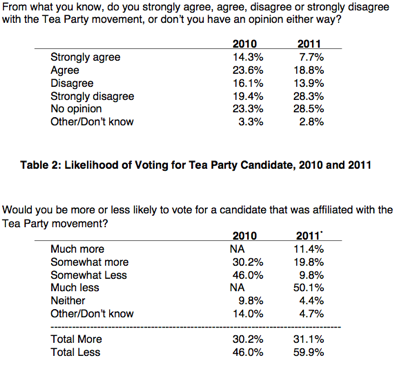
Likelihood of voting for or against a Tea Party-affiliated candidate fell fairly predictably along party lines: 72.1 percent of Republicans said they would be more likely to vote for a Tea Party candidate, while 89.7 percent of Democrats said they would be less likely to do so.
More interesting, however, was the response of Independent voters: 30 percent said they would be more likely to vote for a Tea Party-affiliated candidate, while 57.5% of Independents said they would be less likely to cast a Tea Party vote.
Pro-Tea Party and anti-Tea Party voters view the political world quite differently. Only 11.6 percent of those who said they would be more likely to vote for a Tea Party candidate approved or strongly approved of the job President Obama is doing, while 87.8 percent disapproved.
By contrast, 80.3% of the anti-Tea Party voters approved of the job the president is doing and only 18.5 percent disapproved.
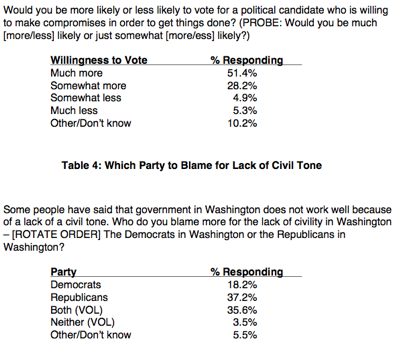
Over a majority, 51.4 percent, said they were much more likely to vote for a political candidate who is willing to compromise, and another 28.2 percent said they were somewhat more likely. Those who said they were much less likely to vote for such a candidate constituted only 5.3 percent of the sample and those who chose somewhat less likely were only 4.9 percent of the total.
“It is interesting to note that a total of only 10 percent of Illinois voters regard the willingness to compromise to be a negative quality in their candidates, while almost 80 percent understand that the democratic process cannot function without compromise,” Jackson added.
The poll also posed a related question regarding who was to blame for the lack of civility, Republicans or Democrats. Almost four in ten (37.2 percent) blamed the Republicans most, while about two in ten (18.2 percent) blamed Democrats. Another 35.6 percent blamed both parties equally and 3.5 percent blamed neither party. There were 5.5 percent who said they did not know which party to blame.
However, the pro-Tea Party voters blamed the Democrats over the Republicans by a margin of 46.7 percent to 7.0 percent. The anti-Tea Party respondents blamed the Republicans over the Democrats by a margin of 67.2 percent to 3.6 percent.
Even Tea Party backers said they’d like to see candidates willing to compromise. A total of 71.5 percent of the pro-Tea Party respondents said they were much more or somewhat more likely to vote for a candidate who is willing to compromise, leaving 16.3 percent who were somewhat less or much less likely to vote for such a candidate. The anti-Tea Party group produced 85.9 percent who were much more or somewhat more likely to vote for a candidate willing to compromise, compared to only 8.8 percent who were less likely to vote for a compromise-oriented candidate.
* The tea partiers may be losing support because one of their national icons is kinda on the goofy side. Don’t watch if your office has super-strict rules on bad words, but Congressman Joe Walsh held his usual “Cup of Joe” constituent event Sunday at Gurnee’s UNO Bar & Grill and then totally went off on some constituents…
“I need more coffee,” he said. Joe, take their advice and drink decaf from now on.
I do these cup of joe’s every wkend, I show up at a coffee shop or restaurant anywhere in district and anyone can come meet with me and talk to me about anything. They are fun, engaging sessions, I often get people who disagree w me on issues at these events and the conversation can be very spirited.
I am very passionate at these events as well as at my town halls. This was no different except I was working on an empty stomach and had a quicker fuse than normal.
The woman I had the heated exchange with was great and she appreciated how open and unusual these events are. I apologized to her for getting a bit to passionate and she smiled and didn’t mind at all.
Regarding the substance rich of what I was trying to say - I’m no pal of the big banks and I wouldn’t have voted to bail any of them out. If they’ve abused their charters they need to be prosecuted fully. But they didn’t get us into this mess - goverment policy which has dictated for years that everyone should own a home got us here. The banks only followed the rules government set. And further government meddling will only exasperate the problem.
* By the way, Walsh says that the Family Research Council candidate support statement I linked to the other day was outdated. The PAC isn’t backing a candidate as of yet, he insisted.
*** UPDATE *** Why the chairman of the Gaming Board would feel a need to express his views on policy issues like slots at tracks and school funding is beyond me, and he doesn’t offer up any other specific criticisms, so we don’t know exactly what so displeases him, but Aaron Jaffe went off on the new gaming bill today…
The state’s top gambling regulator today said a revised gambling package being considered by lawmakers is “a pile of junk” that does little to address concerns outlined by Gov. Pat Quinn.
Illinois Gaming Board Chairman Aaron Jaffe said the latest proposal making its way through the Capitol would place unrealistic time limits for regulators to vet applicants and “passes out money like popcorn” to various gambling interests.
“These guys never learn,” Jaffe told the Tribune in a phone interview. “It’s basically the same bill, worse in some places, a little better in others, but it’s still a pile of junk. No one really takes into consideration any criticism.”
Jaffe said he doesn’t understand why the bill still contains slot machines for horse racing tracks when Quinn has expressed his opposition, and argued the measure would undermine education because of what he calls a “regressive” tax structure that would allow more successful casinos to pay less.
The director of the Gaming Board was asked to testify at a Senate committee hearing on the new gaming bill today. He said the Gaming Board doesn’t take positions on legislation.
[ *** End Of Update *** ]
* If, as expected, Gov. Pat Quinn prevents Mayor Emanuel from getting a casino, there’s gonna be trouble with a capital “T”…
Chicago Mayor Rahm Emanuel said he believes the state is close to passing a bill that could put a casino in the city. […]
Emanuel said he’s had multiple conversations with Governor Pat Quinn about the revised bill says the plan is a good compromise.
“I think it reflects what I call an honest compromise to finally move forward and close up a point of discussion for 25 years and achieve a win for the people of the city of Chicago and the taxpayers,” Emanuel said Tuesday.
I’d like to have been a fly on the wall during those “multiple conversations” between the two.
We are disappointed that the bill does not include a ban on campaign donations from gaming interests and, like Quinn, we’d like to see a change in the legislation that authorizes video poker in taverns and restaurants.
Municipalities should have to vote to opt into video poker in their communities, rather the current requirement that they have to vote to opt out.
Rep. Lou Lang, the bill’s sponsor, called the new gaming bill a “good faith effort to comply with many of concerns” of the original bill.
We agree. Now it’s Gov. Quinn’s turn to compromise.
SB 1849 does not include a controversial provision that called for the Gaming Board to issue temporary licenses within 60 days of application to bars and restaurants seeking video gaming. The proposal was meant to spur the board to implement video gaming, which was approved as part of the funding for the state’s capital construction plan. So far, no licenses have been issued and no revenue from video gambling has come in.
Lang said some lawmakers were uncomfortable with issuing the temporary licenses. His new bill calls for the board to begin implementing video poker before any new casinos can be licensed and before horse tracks can get a license for a permanent location for slots. However, they would be able to operate out of a temporary facility, such as a tent. Lang said he wanted to ensure that the board did not “skip over” video poker to begin work on a gaming expansion. “That could be one machine, it could be 10,000 machines, but they’ve got to get it up and running.”
State Rep. Lou Lang, D-Skokie, told a legislative panel Tuesday morning that his new plan is the best chance now for Illinois to expand gambling and tap into the billions of dollars in revenue the new casinos would generate.
“If we don’t make it happen this week — because of getting into a new session, because of the primary election, because of all sort of things — it is clear to me that we won’t have a gaming (plan) to vote on until next April or May,” Lang said.
* Anybody up for a Lou Lang caption contest?…
Keep it clean, people. As always, try to elevate yourselves. Thanks.
*** UPDATE 1 *** Greg Hinz says Terry Duffy was OK with a delay earlier. And Hinz believes a November 28th special session may very be called to deal with the tax issues…
Aides to Mr. Madigan today are saying it will “take some time” to put together a bill that can fly — likely into next week, and quite possibly until after Thanksgiving.
Mr. Duffy Tuesday suggested his exchange couldn’t wait. But earlier, he told my colleague Lynne Marek that working this out in a special legislative session would be okay.
*** UPDATE 2 *** This Crain’s story is from Sept. 28th…
Mr. Duffy said the Chicago-based company, which operates the biggest futures market in the country, aims to reach an agreement on a corporate tax revision with Illinois officials before the Legislature’s October veto session, or for consideration during a special session this year. […]
Mr. Duffy said he doesn’t want to set a deadline for reaching an agreement with Illinois officials because he doesn’t want to put pressure on them. But he thinks it isn’t unfair to expect an agreement to be reached within a year of starting negotiations, which began in January. [Emphasis added,]
So, at the end of September, he was OK with waiting until January. Now, all of a sudden, he has to have a decision by Thursday.
[ *** End Of Updates *** ]
* If you watched the House Revenue Committee hearing yesterday afternoon, you saw an obviously tense but polite exchange between CME Group Executive Chairman Terry Duffy and Chairman John Bradley…
CME Executive Chairman Terrence Duffy said his hands are tied by “fiduciary duty” to shareholders, who want to know why the big trading company pays tens of millions of dollars a year more in Illinois taxes than it would in another state.
Legislative leaders had told him they would deal with this matter in this week’s General Assembly veto session, and Mr. Duffy said he intends to hold them to that promise.
Asked by a lawmaker if he could give them “a few more days,” Mr. Duffy replied: “I have shareholders that are very concerned about this issue. I have a fiduciary responsibility. . . .I will do what I need to do, in the best interests of the CME Group.”
Mr. Duffy gave a similar response when House Revenue Committee Chairman John Bradley, D-Marion, asked about an extension until a date specific — say, Nov. 29.
“With all due respect, I cannot put the CME Group (there) and limit their options,” Mr. Duffy said. “That decision would have to made by the (CME) board, not by me. . . .I am not going to commit the company to anything other than what I have.”
I wish I had video of that debate, but I don’t. Sorry.
Duffy explained that he couldn’t limit the options of CME’s board of directors, which is considering leaving Illinois after 163 years as the exchange’s home base.
“I will do what I need to do in the best interests of the shareholders of CME Group,” said Duffy, who intends to remain at the state capital in Springfield the rest of this week.
The committee did not take action Tuesday night, but Bradley indicated the panel will work through the issue “as quickly and as thoughtfully as we can.”
“We’ve got to get this right, because there’s too much at stake,” Bradley also said.
“To expect one company to pay 6 percent of the aggregate tax liability of all companies … and think that’s acceptable, that’s not acceptable,” Duffy told the House Revenue and Finance Committee.
“We’re not threatening anybody,” Duffy continued, disclosing his firm paid $108 million in taxes to Illinois in 2010. “We like Chicago. We love Illinois. We want to remain a big part of it.”
“We understand the need for appropriate review by the legislature and we are willing to work with them on this matter,” said Sears spokesman Chris Braithwaite. “As a retailer, our fourth quarter is the most important time of the year and we hope this can be resolved as soon as possible so we continue our focus on the upcoming selling season.”
Sears is asking for an extension of its current tax deal, as well as job-creation credits from the state.
Rep. David Harris, an Arlington Heights Republican, said that the complex deal might not move as quickly as the kind of Internet stock trade CME deals with every day.
“It just doesn’t move quite as fast in the legislature, and I ask you to understand that,” Harris said.
The bill that started out as a vehicle for providing tax relief for financial exchanges has evolved into a broad, potentially costly tax-break bill. It not only aims to keep CME Group and Sears Holdings Corp. from moving operations out of state, but also includes a range of breaks for other businesses and individuals.
House Majority Leader Barbara Flynn Currie, D-Chicago, said she introduced the bill on behalf of Gov. Pat Quinn.
Not exactly a ringing endorsement, although she told me she is working to pass it.
* CME, by the way, has released a statement about the impact it has on the local economy…
CME Group jobs impact alone (not including other exchanges, clients or support industry):
3.37 employment multiplier
2,060 CME Illinois employees produces an additional 4,880 jobs
Trading Industry in Chicago:
50,000 Trading employees in Chicago metro
85,000 Additional jobs created to support those trading jobs
135,000 Total Illinois jobs reliant on the trading industry – estimated $330 million in state income taxes
CME Group is a hub of job creation and innovation
Notional value of CME Group 2010 trades was $994 Trillion
Approx $25.5 billion of CME Collateral (margin) is held at Chicago Banks
550 new trading companies added to Illinois in last 5 years
CME has customers in 150 countries with access to its electronic trading platform
Other Losses to Illinois if CME Group were to relocate:
CME Group and its related foundations and charitable programs donated $22 million to Illinois nonprofits in the past 5 years
Other taxes, eg. utility and sales and use tax
Increased unemployment
* And if you’re wondering what this decoupling aspect to the tax package is about, here’a primer…
The federal government created a new economic incentive involving depreciation on major purchases. Basically, it let companies write off the full depreciation at once instead of doing it over several years. Because Illinois law is tied to the federal tax code, Illinois suddenly found itself offering the same tax break.
By decoupling from federal law, Illinois would no longer automatically offer that tax break. Illinois businesses would pay what they’ve always paid and do it on the same old schedule.
That would prevent a $570 million hit to state revenues this year and a $350 million hit next year.
* I have yet to hear anyone say that the pension reform bill is definitely moving forward to a floor vote this week. And even if it does, and even it it passes, barring a miracle, there’s little to no chance of Senate passage by Thursday.
An Illinois House committee has approved a measure to change pension costs and benefits for state employees.
The bill heads to the full House where its fate is uncertain. It would create three different “tiers” of pension benefits and costs. One of those is a 401k-style “defined contribution” plan.
Supporters say the state needs to change its pension plans because it can’t afford them. Unions strongly disagree with the changes being proposed.
* But a provision designed to calm the nerves of current employees will also end up costing the state a lot more cash than the original bill. Read carefully…
Unlike the version of the bill considered in the spring, Tier 1 employee pension contributions would not be re-calculated every three years to determine the actual cost of Tier 1 pensions as Tier 1 members die or migrate to other tiers. Unions had protested that the payments would become so cumbersome as to eventually make Tier 1 unaffordable.
The current version of SB512 allows a review of employee contribution rates in 2015 and allows them to be raised by 2 percentage points. After that, no further increases would be permitted.
But that would mean employees in Tier 1 would receive a larger contribution from the state than employees in other tiers, noted Rep. Kevin McCarthy, D-Orland Park, the pension committee chairman. It will also reduce savings – estimated by supporters to be in the the tens of billions of dollars – supporters believe the state will achieve under the bill.
Biss asked an actuary from the Civic Committee of the Commercial Club of Chicago, a group of the city’s top business leaders pushing the legislation, whether she had calculated how much it would cost the state if no Tier 1 members migrated to another tier of benefits. She had not, leading Biss to wonder why the legislation had to be acted upon this week.
The proposal still saves the state money, just not as much.
In a recognition of the bill’s political sensitivity, state Rep. Karen May (D-Highland Park) voted for the measure during the committee roll call, but changed her vote to “no” after realizing the bill had enough votes to pass.
We’ve heard the overheated rhetoric from both sides of this issue. We’re not out to demonize teachers, firefighters or any other public employees. They have a right to be concerned and they deserve a fair deal. But all public employees need to realize what the numbers show. At some point, there will be no money to distribute to retirees under the current structure.
They also need to look at their situation in the context of the American work force as a whole. Many private sector employees have seen defined-benefit pensions end. Many employers no longer match employee contributions to their 401(k) plans. In Illinois, these are the workers who saw their income tax increase by two-thirds.
And the lawmakers who have the power to do something about this situation?
They need to stop quaking with fear of lost union endorsements and take responsibility for correcting years of irresponsibility.
In other action, the [House Personnel & Pensions Committee] approved a bill that would rescind a 2007 law that allowed lobbyists Steven Preckwinkle and David Piccioli of the Illinois Federation of Teachers to get in line for sizable state teacher pensions. They merely had to work a single day as substitute teachers. They had no prior teaching experience, prompting sponsoring Rep. Jack Franks, D-Marengo, to call their arrangement “obscene.”
“The bill is so blatantly unconstitutional on its face that Mr. Preckwinkle and Mr. Piccioli think it merits no other comment,” said David Ormsby, the lobbyists’ spokesman.
In the Senate, lawmakers introduced a separate proposal that would boot the two lobbyists from the teachers pension system but also sought to stop a series of pension abuses by leaders from a variety of Chicago-area labor unions.
It’s interesting that so many legislators say they can’t support the big pension reform bill because of its doubtful constitutional validity, but can support clearly unconstitutional legislation that does almost nothing except attract media attention.
I’m not going to defend what Preckwinkle and Piccioli did, but I’m also not gonna continue hanging them in the public square.
* Another long day ahead, campers. Committees start early today, so look alive.
Live House audio/video is here. Live Senate audio/video is here. BlackBerry users click here. iPad and iPhone users remember to use the “two-finger” scrolling method…