…according to the top Republicans, Senate GOP Leader Christine Radogno and House Republican Leader Tom Cross, Mr. Quinn indicated he’d like to hike the earned-income tax credit as part of any deal to help CME Group Inc. and CBOE Holdings Inc.
Mr. Cross said expanding the earned-income tax credit would cost the state $90 million to $180 million a year.
So, Senate President John Cullerton wants $100 million to CME, House Republican Leader Tom Cross wants almost $500 million in additional corporate tax breaks, and now this. Add in EDGE tax credits for Sears and the total on the table is now as high as $800 million. A year. Every year.
This state can’t afford to buy new paperclips, and yet it’s trying to give money away hand over fist.
Single with one child and earned less than $35,450 single with 2 or more children and earned less than $40,250
Married and earned less than $18,400 married with one child and earned less than $40,450 married with 2 or more children and earned less than $45,250
Over 600,000 families received earned income tax credits last year. It’s a good program. The question is the affordability of any of these plans, not just EITC.
Someone at the Chicago Board of Trade issued another message to the Occupy Chicago protesters by blanketing them with these McDonald’s job applications. The protesters are understandably offended by both the message and by the hundreds of pieces of new litter around them.
CME Group Inc , the biggest U.S. futures exchange operator, reported a higher-than-expected quarterly profit on Tuesday as expense growth slowed and Chief Executive Craig Donohue said he would keep costs down. […]
The company, which operates the Chicago Mercantile Exchange, the Chicago Board of Trade and the New York Mercantile Exchange, said third-quarter net income rose 29 percent to $316.1 million, or $4.74 a share, from $244.3 million, or $3.66 a share, a year earlier. Analysts on average expected $4.69 a share, according to Thomson Reuters I/B/E/S.
Gov. Pat Quinn used his veto pen in an attempt to cut $376 million from the $33.2 billion budget the Legislature sent him this spring, but lawmakers and Quinn already might have found a new way to spend the money. […]
Instead of reversing Quinn’s actions, the idea that seems to be solidifying among lawmakers involves taking a good portion of what Quinn vetoed — between $230 million and $250 million — to fund the seven facilities Quinn has targeted for closure because a lack of money, according to House Republican Leader Tom Cross, R-Oswego. […]
Quinn’s office estimates that it will cost $313 million, or about $64 million more than Cross’ number, to keep the facilities open through June 30.
* But even if Cross’ numbers are right, can they really use all that vetoed cash? I’m not sure they can without it hurting the budget elsewhere. Here’s the breakdown…
Quinn’s cuts this summer came in the form of $276 million from Medicaid, $89 million for school transportation and more than $11 million for regional offices of education. Last month, Quinn announced he was shuttering the seven state facilities and laying off about 2,000 workers because the Legislature didn’t budget enough money.
The Medicaid cuts were basically just delayed payments into next fiscal year. Gov. Quinn said he wanted the General Assembly to reduce Medicaid provider rates, but if that didn’t happen then the payments would simply be delayed. Reducing provider rates was already rejected by the GA this year. If they now use all or part of that Medicaid money for something else, then the state would lose a very big federal Medicaid match.
Also, using that vetoed school transportation money won’t be popular at all with most Downstate legislators. This isn’t as easy as it may look.
Quinn’s Office of Management and Budget, or OMB, said it is working with the Legislature to agree on where to spend the money the governor vetoed.
“Gov. Quinn wants to work with the legislative caucuses to determine how best to identify and utilize any additional funds. Beyond the needs of the agencies (that run the seven state facilities), there remains great necessity in the areas of education, health care and public safety,” said Kelly Kraft, a spokeswoman for OMB.
After asking for gaming negotiations and then quickly reneging, this governor has zero credibility.
Nearly two dozen state workers will get pink slips today, becoming the first casualties in the bruising budget battle between Gov. Pat Quinn and the General Assembly.
The 21 employees, who range from security guards to food safety analysts at the Illinois Department of Agriculture, are among more than 1,900 workers targeted to be laid off in the coming months by Quinn. […]
In September, Quinn said he would close seven facilities because the budget sent to him by lawmakers doesn’t contain enough money to keep a number of agencies operating for the entire fiscal year. […]
Closures and layoffs at agencies like the Illinois Department of Corrections aren’t set to take place until Dec. 31.
*** UPDATE 2 *** HB 3793, which would block more local property tax funding for schools is being opposed by a wide variety of folks, including Stand for Children Illinois. From their roundup…
The Illinois General Assembly is wrongly considering a property tax bill that will handicap local school districts from raising their own revenue and hinder existing streams of revenue from being collected. This will severely impact our schools and we must contact our Representatives and Senators and ask them to vote NO on this detrimental piece of legislation.
The loss to our school districts around the state would be staggering. Here are just a few examples of the impact:
Chicago Public Schools could see $144 million dollars taken away from their budget.
Crete Monee CUSD #201- $500,000 reduction for this year with anticipated loss of $32 million over 10 years.
St. Charles CUSD #303 - $2,600,809 reduction for this year with anticipated loss of $36 million over next 10 years = 52 teaching positions/5.4% of teaching staff.
Naperville CUSD #203 - $4 million reduction = 57 teaching positions. Ultimate impact by 2015 would be $23 million, 11.5% of budget to be reduced, resulting in a cumulative loss of 327 teaching positions.
* Illinois economy down slightly: After reporting a sharp increase in September, the University of Illinois Flash Index fell half a point to 98.3 in October. But, the index remains above the 97.8 level that was in place through much of the summer and is significantly higher than when it was hovering around 90 during the same period in 2009.
* Health insurance exchange bill moves forward: “What I think they’re trying to put in place is something that can organize the market and see how it functions and, based on performance, either crank up the involvement of the exchange or if the market responds appropriately, letting it do so,” said John Bouman, president of the Sargent Shriver National Center on Poverty Law, a Chicago-based nonprofit.
* Time critical, questions linger for Illinois health insurance exchange
* Timeline for smart grid-related matters, new ComEd rate process
* Last week, Gov. Pat Quinn’s press office issued this statement about the gaming expansion bill…
Governor Quinn looks forward to moving past the political games and towards sincere negotiations to reach a legitimate proposal that meets the framework he laid out to protect the interests of the people of Illinois.
* I highlighted “sincere negotiations” because of what Gov. Quinn said today when asked about the gaming bill…
“I don’t think the word ‘negotiate’ is appropriate. I have laid out a framework. OK. They know what it is. It’s crystal clear. If the General Assembly wants to take that guideline and use it to guide their work, so be it.”
So, Quinn offers to negotiate last week in order to stop the Senate from handing him yet another embarrassing defeat, but this week tells legislators to take it or leave it.
And he wonders why he’s having so much trouble with the General Assembly?
*** UPDATE *** The governor’s office has been saying they believe, via backchannel reports, that the racetrack owners would take a subsidy instead of slots at tracks. But Dick Duchossois’ mouthpiece says no way…
The state’s biggest horse racing track is rejecting a plan to give it a big subsidy in lieu of slot machines — the latest bump for the gambling expansion bill that’s been snagged by Springfield wrangling. […]
A prior subsidy plan was stymied for years because it was linked to the state’s ill-fated 10th casino license, which got caught in a decade-long legal dispute after regulators balked at putting the 10th riverboat casino in Rosemont.
The subsidy “never materialized,” Mr. Serafin says, and any new subsidy plan surely would be challenged in court, too, perhaps for many years.
“We don’t want the subsidy,” Mr. Serafin says. “All we want is a level playing field . . . (and) the right to run our business as a business.”
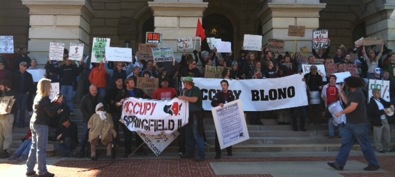
* Ellen Beth Gill was at Occupy Springfield over the weekend and filed a report…
I didn’t see a single [police] officer or squad car and there was no need for them. The fire department was out, but they appeared to be just passing by to answer a call elsewhere.
The entire event was peaceful and orderly from start to finish. The organizers would not let a participant jaywalk or litter. I met a lot of nice people from all walks of life. There were young people from the universities at Champaign/Urbana and Bloomington/Normal. There were several women about my age from the Springfield area and there were senior men and women.
I checked with the Secretary of State’s office, which is responsible for Statehouse security. They did have officers present and worked with the Springfield cops, but they apparently stayed back far enough so as not to be noticed. The SoS office said security was comparable to a similar event held by tea party organizers last year.
* Gov. Pat Quinn was asked about the occupiers yesterday and tried to bring them into the ComEd issue, but they refused…
“Last week, we had the biggest consumer battle in a generation in Illinois,” Quinn said. “It’s important if you’re doing an ‘Occupy’ movement, maybe to get down to the state capitol, help with the program y’know?” Quinn said to laughter. “We’re trying to win for the 99 percent of consumers who aren’t very happy about Commonwealth Edison’s big increase. You’ve got to be an organizer, figure out where the people are. I know the people are on our side. Consumers did not get a fair shake. We’ve got to come back and win in the days ahead. Maybe the folks outside could beat the drums for that.”
Micah Philbrook, one of the 20 protestors outside, said they would have liked the governor to come out and talk to them.
“The governor is using one [issue] to throw a red herring in the middle of the Occupy Chicago message,” Philbrook said.
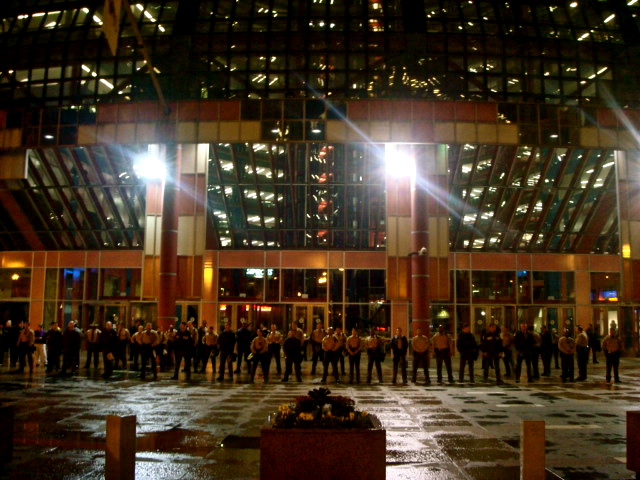
He wanted Quinn to explain why 40 armed state troopers cleared protestors away from the Thompson Center during a vigil [Thursday] night.
“I would love to,” Reinsdorf said, asked if he wanted to work with La Russa again. “We really haven’t discussed it. We’ve talked off and on about what he might do in the future, but we haven’t talked about anything specific. I’m sure now that he’s available he’s going to get a lot of opportunities, chances to do a lot of things inside the game. I just want him to do what’s in his best interest, what’s best for him.” […]
In a 2010 interview with the Tribune during spring training, La Russa said that if he were to stay in baseball after managing, he’d have to do it with an owner he already knows.
“It would have to be for an owner like Reinsdorf, the Haas family, the people here (in St. Louis),” La Russa said. “Those are the owners I’ve known, the ones I’d want to make happy.” […]
A role with the White Sox seems to make the most sense, especially given how stale management has become heading toward the 12th season of the Ken Williams era. La Russa wants a job that allows him to have an impact without the time-intensive responsibility that comes with running a team.
* The Question: Should the White Sox try to hire La Russa as a senior advisor? Take the poll and then explain your answer in comments, please.
Count 2 – Conspiracy to Extort – Cellini knowingly joined a conspiracy – He knew what Rezko and Kelly were about and he didn’t walk away and he knew they were trading state contracts for campaign contributions to Blagojevich.
Count 4 – Aiding and Abetting Bribery – Cellini knowingly aided and abetted an agent of a state agency (Levine in his role as a TRS trustee) in corruptly soliciting something of value in connection to official state action.
He was found not guilty of:
Count 1 – Conspiracy to defraud – Defendant knowingly joined a conspiracy to use Levine’s role as a public official to defraud the people of Illinois, specifically the teachers who entrusted Levine to act with their best interests at heart.
Count 3 – Attempted Extortion – Cellini knowingly attempted, with Levine, to get money from Rosenberg. They threatened to hold back Rosenberg’s $220 million allocation believing that that would force Rosenberg to pay the bribe. This count also requires that the extortion could have potentially affected interstate commerce which it would have as the $220 million would have been invested in companies nationwide.
*** UPDATE 2 *** Chris Wetterich talked with Dick Ciccone, Bill Cellini’s spokesman, about an appeal…
Cellini plans appeal, Ciccone says. They were pleased that he was found not guilty on “the two most serious charges.”
Ciccone noted that Cellini was convicted of conspiracy to extort but not attempted extortion.
“Inconsistencies in a verdict are fertile ground for appeal,” Ciccone said.
*** UPDATE 3 *** Statement from defense attorney Dan Webb…
“We are very gratified that the jury found Mr. Cellini not guilty of the most serious charges in the indictment. Mr. Cellini was found not guilty of the major conspiracy count, Count 1, in which the government alleged a conspiracy to commit honest services crimes for 15 months. Further the jury found Mr. Cellini not guilty of even attempting to extort money from Mr. Rosenberg, Count 3.
“Whatever the jury determined Mr. Cellini did to be guilty of a conspiracy to commit extortion, Count 2, that conduct did not even rise to the level of being an attempted extortion.
“As far as the counts on which Mr. Cellini was found guilty, we are confident we will be able to obtain a reversal on appeal.”
* BlackBerry users click here. iPhone and iPad users remember to use the two-finger scrolling method…
Hutchinson, who chairs the Senate Revenue Committee, addressed the question about fairness in taxation and the state’s ongoing tax breaks to keep major companies in the state.
“Statewide, 60 percent of corporations don’t pay any [state income] taxes,” she said. “Only some 300 paid more than $1,000. Our corporation tax base is very narrow. If a corporation comes to Springfield and yells loud enough” the state will give a tax break.
Discuss.
*** UPDATE *** As pointed out by a commenter, Sen. Hutchinson appears to be incorrect. For tax year 2006, 380 corporations paid more than a million in income taxes and overall paid 73 percent of all income taxes. 67 percent paid no income taxes, however, so that’s essentially correct.
“Part of the role of the governor sometimes is not to be a pal of the legislature,” Quinn said [yesterday] afternoon while addressing the Leadership Greater Chicago Luncheon at the Union League Club.
“I am very proud that I vetoed the ComEd bill. I read somewhere that I enraged the General Assembly when I did it. Well, so what? The governor is there to protect the consumers.”
The ICC is there to protect consumers. The governor is supposed to be there for all of Illinois. All of organized labor supported the smart grid legislative package. Major environmental organizations like the Sierra Club, Environment Illinois and the Natural Resources Defense Council backed it as well. From the Sierra Club’s blog…
This will be a huge boost to clean energy in Illinois. By deploying solar energy across Illinois, we’ll see new jobs and businesses, and cleaner air as we move away from dirty coal. A smarter power grid will also save consumers money by giving us new tools to manage our power consumption. […]
SB 1652 will increase the amount of energy savings we get through energy efficiency by about 1.5 million mWh, roughly the amount of power that would be used in 150,000 homes for one year. Further, it allows both utilities and non-utility energy efficiency companies to participate in the market, and ensures that the expanded efficiency programs are incorporated into the annual Illinois Power Agency procurement plans. […]
NEW JOBS: Up to 5,000 new jobs in renewable energy – good jobs installing clean energy projects, operating and maintain them, and manufacturing clean energy components. In addition, the American Council for an Energy Efficient Economy estimates that the energy efficiency provision alone will create 3500 new jobs by 2015, and more than 10,000 new jobs by 2020. […]
CONSUMER SAVINGS: Helping consumers use less energy is a way to permanently reduce bills. The energy conservation programs in SB 1652 will not only provide new tools and products to help consumers cut their bills, they will also reduce the peak power prices that drive our electric rates. Smart meters will empower consumers to take charge of their energy consumption. Participants in smart meter pilot programs consistently save 15-20% per month after installing a smart meter.
CLEANER AIR: Cleaner power sources and energy conservation mean cleaner air – fewer asthma attacks, premature deaths, and a better future for our children and grandchildren. We also need the smart grid to move beyond oil, to power the electric vehicles of the future.
Despite what the governor says, this was not an “evil” bill. And the $3 a month from ComEd consumers and $3 a year from Ameren consumers probably won’t even be noticed on anybody’s bills.
Fox Chicago News has learned that ComEd lobbyists are telling legislators who voted for a new rate increase law that the utility will seek less money than it previously wanted.
One reason: if Gov. Quinn signs a so-called trailer bill to the rate increase law, ComEd’s guaranteed annual profit will shrink by about 3 per cent.
In declaring himself the “reform governor,” Quinn echoed Blagojevich, his two-time running mate. The then-lieutenant governor took over after Blagojevich was arrested on corruption charges and removed from office.
“I wasn’t elected prime minister by the legislature,” Blagojevich said in 2003, his first year in office. “I was elected governor of this state and I’m here to do my job with the mandate the people gave me — and I think they want me to change things here.”
The Blagojevich comparisons will undoubtedly increase in the coming weeks and months. But I still don’t think that’s quite fair. Quinn is not a criminal. The better comparison is to Dan Walker, Quinn’s role model and another failed governor who alienated everybody with his holier than thou positioning.
Tuesday, Nov 1, 2011 - Posted by Advertising Department
[The following is a paid advertisement.]
Three different times the Illinois legislature has considered legislation to approve Tenaska Energy’s Taylorville Energy Center (TEC), which would have Illinois consumers pay seven times today’s market rate for electricity and cost $286 million per year. Three different members have sponsored versions of this bill. And three different times, including a vote last week, the Senate has rejected Tenaska’s proposal.
But legislation to support the TEC is still being pursued by Tenaska. Here’s why the Illinois legislature should again say, “You’re Outta Here!” to the TEC:
• Burden on Job Creators: Tenaska touts a cost cap for non-residential electric customers, but loopholes allow them to pass on all cost overruns due to low estimates and market price fluctuations.
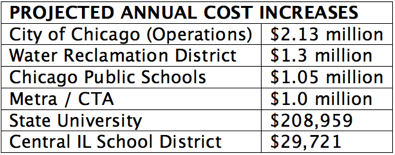
• State and Local Budget Buster:
• Consumers on the Hook: New language in the legislation suggests Tenaska will try to recover their full costs even if the TEC never produces more than a single megawatt of power.
• Unneeded, Costly Power: The TEC would generate 544 megawatts of base load power – that’s only two-tenths of one percent of overall capacity at a cost of $8.6 billion. The market doesn’t support this project because power demands are already being met.