* Peoria County Sheriff Chris Watkins…
Governor JB Pritzker recently suggested he’s open to revisiting and improving the SAFE T Act. With the spring legislative session upon us, let’s see if the governor will stand by his word.
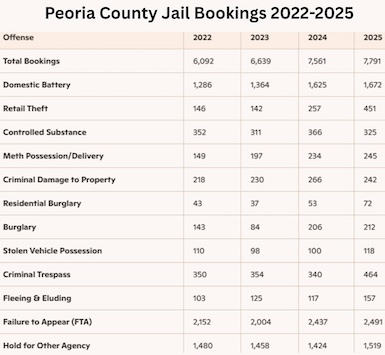
Law enforcement across Illinois has consistently raised concerns about how the current law limits our ability to detain violent and repeat offenders. The Peoria County data below comes directly from our jail management system and reflects individuals arrested on new charges and booked into our jail. Failure to Appear numbers represent Peoria County warrants, while Hold for Other Agency numbers represent out of county warrants.
The SAFE T Act took effect in September 2023. Since then, the promises made about reduced crime and improved court appearance rates simply haven’t materialized. In fact, court appearance failures have increased, and while shootings and murders may be down, non detainable offenses have gone up.
No cash bail has weakened accountability for repeat, high impact offenders who fall outside the narrow detainable categories. Here’s what lawmakers can do to fix it:
1. Expand the List of Detainable Offenses
Current law only allows detention for a limited set of charges or when prosecutors can prove a “real and present threat.” This leaves out serious non violent and some violent offenses that still harm our communities. Burglary, and Fleeing and Eluding are very hard, if not impossible, to detain someone on.
Most of our shooters and murderers are being held without bond. This has shown to decrease some of our violent crime. But Judges and State’s Attorneys need to stop being handcuffed by poor legislation and given more authority to detain offenders who clearly pose ongoing risks. Let them do their job.
2. Restore Bail Eligibility for Certain Offenses
Eliminating cash bail removed an important middle ground option. Right now:
•Repeat low level offenders cycle through the system with no accountability
•Judges lack the tools to ensure compliance and court appearance
•Victims and neighborhoods see the same individuals reoffending almost immediately
Reintroducing bail for low level offenses would restore balance. It would also allow us to intervene with drug and alcohol involved offenders, many of whom benefit from the treatment programs we offer in the jail, including Vivitrol.
3. Reinstate Daily Credit Toward Bail
Before the SAFE T Act, defendants earned daily credit toward their bail amount. This system:
• Encouraged good behavior
• Reduced unnecessary pretrial detention
• Helped resolve cases more efficiently
• Provided a fair, structured incentive
Bringing this back would restore a proven tool that supported accountability without compromising safety.
The no cash bail system was intended to promote fairness and reduce unnecessary detention. But in practice:
•Repeat offenders charged with serious property crimes are routinely released
•Judges have limited discretion for offenses like retail theft or fleeing
•Communities feel the impact as these crimes rise and accountability erodes
Peoria County’s data shows that while most violent crime is decreasing, the system is failing to contain repeat, high impact criminal behavior that undermines public safety and public confidence. When violent offenders are released because prosecutors cannot meet an unfair burden, victims are betrayed, and communities lose faith in the system.
This doesn’t even account for our juvenile justice issues. Police need the authority to detain juveniles accused of violent crimes or felonies at a juvenile detention center until they see a judge. It makes no sense to send a 16-year-old home after vehicle break-ins, thefts, or property damage. I support reform, but not at the expense of public safety.
* From the Illinois Network for Pretrial Justice…
Misinformation continues to be the gas fueling calls to make changes to the Pretrial Fairness Act. In recent weeks, we have seen law enforcement officials across the state telling lies to generate headlines as they continue to carry the banner for President Trump and return Illinois to a system that criminalized poverty. Most recently, Peoria County Sheriff Chris Watkins got into the mix with a press release that featured multiple factual errors and a proposal to roll back the Pretrial Fairness provisions of the SAFE-T Act, including a call to reinstitute money bond in low-level cases.
Throughout the state, we have seen significant decreases in violent and property crime since the law went into effect, a stark difference from the surge in violence predicted by the law’s opponents. This is also true in Peoria, which saw a 45% decrease in homicides and 18% fewer shootings in 2025 than in 2024.
All the jail bookings for every category of offense shared in the Sheriff’s Facebook post (with the exception of a slight decrease in non-meth drug possession bookings) were higher in 2025 than in 2022. The Sheriff does not explain how this relates to his claim that the Pretrial Fairness Act prevents jailing people for certain property and drug offenses, nor is it clear how the booking numbers listed by offense relate to the numbers of people booked for failure to appear, all of whom of course have a pending case of some kind.
The Sheriff claims expanding pretrial detention or restoring use of money bond for property crimes and other lower-level offenses will enable people to receive treatment for substance use disorders while in custody. However, National Institute on Drug Abuse (NIDA) research has found that less than 18% of individuals who are incarcerated receive substance use disorder treatment either during or following incarceration.
Jails are not places where physical and mental health issues are successfully addressed. Incarceration exacerbates problems, often with fatal consequences. People suffering from substance use disorder are particularly endangered by pretrial incarceration. People who use opioids are 40 times more likely to die of an overdose in the two weeks following release from jail.
The results are clear: Illinois is making progress towards creating true public safety and justice by dismantling a system that transferred wealth from working families to pad county budgets.
Discuss.
















- JS Mill - Tuesday, Jan 13, 26 @ 10:52 am:
=This doesn’t even account for our juvenile justice issues.=
Sorry, I have to call baloney on that one. Since the early 2000’s at least, judges and law enforcement in all areas of the state have been releasing juveniles for these types of offenses. It is absolutely NOT a result of the SAFE-T act. DOesn’t matter if it was Dupage, Will, or Kane counties (where I was from 98-03) or rural counties, juveniles were regularly given diversion or released (I am not judging those practices, simply saying it happened). In one case I am familiar with, pre SAFE-T Act, a student brought a loaded gun to a high school with intent and was released to his parents and this occurred in a very red county.
I was always, and I mean always told one of two things- 1) a judge would not hold them (then=m being the juvenile), 2) there wasn’t space available at the juvenile detention center.
So spare me in blaming the SAFE T Act when many of us have receipts.
- Norseman - Tuesday, Jan 13, 26 @ 10:52 am:
=== Misinformation continues to be ===
Polite way of saying lies. Looks to me that this Act has succeeded in achieving its goals. Not perfect but good. Although opponents goals has more to do with money than a fair effective system.
- Aaron B - Tuesday, Jan 13, 26 @ 11:02 am:
His arguments would be more persuasive without part 2. It always comes down to trying to pad the budget isn’t it? I’m guessing he’s still upset that they can’t contract with federal immigration authorities for inmates either.
- Just Me 2 - Tuesday, Jan 13, 26 @ 11:10 am:
If you have to lie to me to convince me to support you, then I’m not supporting you.
Remember “They’re eating the dogs. They’re eating the cats?” Vance later admitted they made that up as a way to put a story to their beliefs. Incredibly that lies count as solid arguments today.
- TheInvisibleMan - Tuesday, Jan 13, 26 @ 11:23 am:
–
[…]benefit from the treatment programs we offer in the jail
–
Is it the treatment part he likes, or the jail part he likes?
Because nothing is stopping him from working with the county to make those treatment programs available to people *before* they get to jail.
This guy is showing up at the burned out remains of a house, and patting himself on the back for bringing a fire extinguisher to the families involved.
He’s so afraid of change, he can only see the option which makes other suffer for his fear, instead of making a change in his own life and beliefs.
- Incandenza - Tuesday, Jan 13, 26 @ 11:30 am:
=== Vance later admitted they made that up as a way to put a story to their beliefs. ===
This is the central question of our time. Will journalists call out what is just a lie? The point of journalism is to describe reality, not to just repeat lying quotes from lying leaders. Even if you make mistakes, describing reality should always be the goal of journalism. And voters should not reward liars.
- here we go again - Tuesday, Jan 13, 26 @ 12:03 pm:
Let’s face it, some local Republican officials in GOP controlled counties are just Big Mad over losing the 10% or whatever “administrative fee” the countries raked off the top of the bond before refunding it to the accused. They may have other legitimate beefs with the Act, but as usual money is the main one.
- Who else - Tuesday, Jan 13, 26 @ 12:04 pm:
“Keep people in jail so we can treat their substance use issues” is a novel argument. I’m not sure that fits in with the Jim Kaitschuck view of the world.
- btowntruthfromforgottonia - Tuesday, Jan 13, 26 @ 12:35 pm:
here we go again:
That right there.Loss of revenue.
- 44 - Tuesday, Jan 13, 26 @ 1:01 pm:
Always defending so called safety act in here. All critics “don’t understand”. Paleese. Your headline choice says it all.
- Rich Miller - Tuesday, Jan 13, 26 @ 1:03 pm:
===Your headline choice says it all. ===
1) I stand by the post.
2) Bite me.
- Demoralized - Tuesday, Jan 13, 26 @ 1:07 pm:
==Always defending so called safety act in here==
Apparently your comprehension is lacking. posted two things - one by the Sheriff and one by the Illinois Network for Pretrial Justice. And his headline is a quote.
- Excitable Boy - Tuesday, Jan 13, 26 @ 1:33 pm:
- All critics “don’t understand”. -
As the great wordslinger liked to say, don’t hide your light under a bushel. I, for one, am waiting with bated breath for your point by point refutation of the post.
- H-W - Tuesday, Jan 13, 26 @ 2:41 pm:
=== Fleeing and Eluding are very hard, if not impossible, to detain someone on ===
As they should be. Look at Minneapolis, sheriffs. Treating fleeing and eluding as detainable offenses has led to dozens and dozens of law enforcement and protective services killings of civilians.
Let them go and find them later, especially if they are not relevant to the reason you are there.
- Da big bad wolf - Tuesday, Jan 13, 26 @ 3:23 pm:
=== Repeat low level offenders cycle through the system with no accountability===
How so? Aren’t they held accountable after they lose their case in trial, if they lose their case?
- charles in charge - Tuesday, Jan 13, 26 @ 3:29 pm:
==Aren’t they held accountable after they lose their case in trial, if they lose their case?==
Yes. You’d think that as law enforcement officers and jailers, every sheriff would know that the purpose of pretrial jailing is to ensure court appearance and safety, not to punish people for unproven accusations. But here we are . . .
- Stephanie Kollmann - Tuesday, Jan 13, 26 @ 3:55 pm:
hit “comment” to note that if a sworn law enforcement officer uses the word “accountability” 4 times about PRETRIAL status, he is explicitly advocating against the Constitution(s) he swore an oath to
but I see the last 2 commenters mentioned this
(the characterization of the nature and purpose of juvenile court is similarly misinformed, but I need not belabor that point here)
It’s interesting that even after allll of this time, none of the SAFE-T Act detractors have come up with a suggested “reform” of the PFA that is a) based on what is actually happening and b) will actually do what they say they want it to.
- Stephanie Kollmann - Tuesday, Jan 13, 26 @ 3:58 pm:
==[…]benefit from the treatment programs we offer in the jail
–
Is it the treatment part he likes, or the jail part he likes? ==
A great question.
No idea about what is motivating this sheriff
but many like the budget part