* ABATE Illinois press release…
Illinois Residents Demand Safety Reforms Before Embracing Driverless Taxis, Survey Reveals
As driverless taxis are increasingly being introduced in cities and states across the country, for the safety of our members and everyone who shares our roads, ABATE believes it is important we slow down and ensure the right safety regulations are in place before allowing this new technology in our communities in Illinois.
To that end, we surveyed residents in two regions proposed for testing—Cook County and the Metro East (Madison County and St Clair County)—to get their opinions on driverless taxis and some of the safety measures contained in driverless vehicle regulations proposed by ABATE of Illinois in HB4789 & SB3308.
Only 38% of Illinoisans in these counties are favorable towards the idea of driverless taxis sharing the road with them, compared to 50% who are unfavorable towards the idea. Suburban Cook County showed the largest opposition with 61% unfavorable vs 25 % in favor of driverless taxis.
The numbers grew worse after respondents were given four potential common sense safety reforms based on real world issues with Waymo vehicles. After hearing these, respondents are 36% favorable towards driverless taxis, compared to 54% who are unfavorable with Chicago residents & self-identified Republicans showing the greatest growth in opposition.
Another key takeaway is how much stronger opposition grows to driverless taxis the more people hear safety regulations have not yet been put into place. 22% are very unfavorable towards driverless taxis before learning this, while after, 35% are very unfavorable.
Residents strongly support four key reforms contained in legislation proposed by ABATE. First, they support requiring independent testing of driverless taxis before allowing them on the road. 66% support this reform while only 24% oppose it. Support is strong among all demographics, though it is even stronger with Chicago residents.
72% of respondents favored allowing driverless vehicles to be pulled off the road when they present a clear safety hazard with 77% of Chicago and Cook County residents favoring this regulation.
When informed about Waymo’s problems with passing over 20 stopped school buses, residents again strongly support requiring driverless taxis to be pulled off the roads, and favor testing by an independent group before they are allowed back on the road. 73% support the additional required testing after failure and only 21% oppose it.
Residents also show solid support for a 4th reform: allowing cities to regulate driverless taxis and restrict their operation based on complaints and safety problems. Waymo backed legislation does not allow cities to regulate their vehicles even though they behave like taxis. Meanwhile 58% of residents support allowing cities to regulate the operation of driverless taxis while 34% oppose it (net +24%). Chicago residents favor this reform by a 75% to 22% margin.
Based on the results of this survey, ABATE will continue to support common sense safety reforms through HB4789 & SB3308 before allowing driverless taxis in Illinois. Driverless systems have not been independently tested and use technologies that present problems in accurately seeing and avoiding motorcycles on the roadway in addition to other drivers, pedestrians, and bicyclists. We encourage residents to echo our calls for these reforms so we can ensure Illinois roadways are kept safe for everyone.
Results are here and here.
Methodology…
Results for this survey are based on interviews conducted among a sample of likely voters in Chicago, Suburban Cook County, Madison County and St. Clair County. Data for this survey research was collected by Cor Strategies.
Interviews were conducted via live calling, texting, online panels, and automated calling. The surveys were conducted from Tuesday, January 19 – Friday, January 23. 503 responses were gathered for a margin of sampling error of ±4.37%. The margin of sampling error may be higher for certain subgroups.
This survey was coordinated with XLN Services on behalf of ABATE of Illinois, who paid for all costs associated.
* International Brotherhood of Teamsters with a statewide “online panel” poll of 600 likely voters…
I wanted to reach out about a new poll. It demonstrates that even though autonomous vehicle companies want to expand into Chicago, most Illinois voters would be perfectly happy if driverless cars and trucks turned around and never came back. Specifically, some of the poll findings include that:
Almost two-thirds of voters oppose allowing any driverless vehicles on the road in Illinois.
78 percent of voters oppose allowing driverless heavy trucks on our roads.
A majority of voters said their biggest concern with driverless vehicles was that they will put lives at risk.
N= in Illinois (Online panel)
From the toplines…
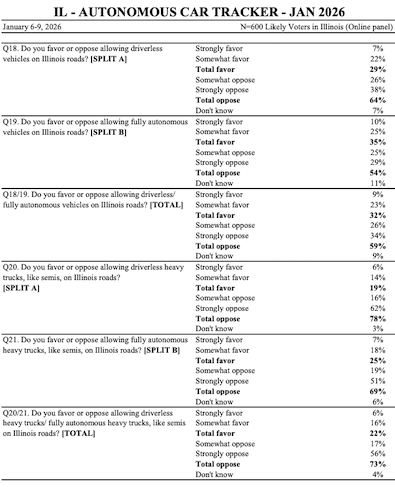
Crosstabs are here.















- Larry Bowa Jr. - Thursday, Feb 19, 26 @ 11:59 am:
Generally not a fan of driverless cars but if the Teamsters are against it I might have to rethink my position.
- City Zen - Thursday, Feb 19, 26 @ 12:03 pm:
Luddites gonna luddite.
Driverless taxis beget driverless big rigs, so I get why the Teamsters are invested here. But with an aging population unwilling to give up their cars, driverless cars are the next step.
- Helmets increase safety - Thursday, Feb 19, 26 @ 12:03 pm:
Cool, still need to advocate to require motorcyclists to wear helmets though ABATE
- JustMe - Thursday, Feb 19, 26 @ 12:41 pm:
Data from California shows that driverless cars are many orders of magnitude safer than human-driven cars, and the technology will only improve. Widespread adoption of driverless cabs would save lives. My gut reaction was to oppose them too–it’s an understandable impulse–but when you look at the facts I don’t really think it’s a hard question.
- Thomas Paine - Thursday, Feb 19, 26 @ 12:45 pm:
=== Luddites gonna luddite. ===
Or, hear me out here: the technology is half-baked and overhyped.
Segway was suppose to “revolutionize” walking 25 years ago. A mere 30 million users worldwide today, almost all rental companies in tourism.
- CA-HOON! - Thursday, Feb 19, 26 @ 12:48 pm:
I do not feel drive-less cars are safe enough yet, but I do find it amusing that ABATE chose to weigh in for the “safety” of their members when ABATE’s main reason for existing is to oppose helmet laws for motorcycle riders.
- Dotnonymous x - Thursday, Feb 19, 26 @ 12:48 pm:
Driverless cars seem to be hitting one obstacle after another.
- Rich Miller - Thursday, Feb 19, 26 @ 12:51 pm:
===main reason for existing is to oppose helmet laws===
And as such, they’d rather not be hit by driverless cars.
Not too hard to figure out.
- 47th Ward - Thursday, Feb 19, 26 @ 1:40 pm:
I’m opposed to this, and while I share ABATE’s safety concerns, I also am concerned about what this does to employment options for unskilled workers.
At some point, you have to wonder how people are going to support themselves if they can’t get jobs because robots are doing all of the work. Driving a cab, a ride share, a delivery vehicle, those are jobs that anyone with a drivers license can do. They aren’t the most high-paying, but they do provide some income.
And before you scoff, think about truck drivers. They’ll be next. I realize I sound like a luddite, but there will be profound social impacts as technology eliminates what is left of traditional employment.
- Bored Chairman - Thursday, Feb 19, 26 @ 1:44 pm:
Driverless cars are demonstrably safer than cars driven by human beings. https://www.nature.com/articles/s41467-024-48526-4
- SKI - Thursday, Feb 19, 26 @ 2:02 pm:
Bored Chairman - from your study cited “However, accidents involving Advanced Driving Systems occur more frequently than Human-Driven Vehicle accidents under dawn/dusk or turning conditions, which is 5.25 and 1.98 times higher, respectively.”
So they’re good, as long as you don’t let them operate in dusk or evening, or rain, or snow, or dust, or around Austin school bus stops ( Waymo is working to determine the lighting patterns there as a result of their vehicles passing 24 buses at this point)
ADS has the potential to save lives, but only if developed properly. Putting profits over people is not a viable method. True oversight is needed, which is why ABATE and Teamsters are calling this out.
ABATE has been talking about safety issues since the beginning. ABATE fought to protect the funding for free motorcycle safety classes by placing a fee on ourselves as riders. Just last year ABATE worked to expand the availability of those classes through legislation, and we should see that pay off in 2027. Those classes teach people to wear helmets. ABATE doesn’t mind helmets, they mind government mandates, especially when the data doesn’t show a reduction in fatalities in states with mandatory helmet laws.
The only way to stop a fatal collision is to prevent it from happening in the first place. Tesla full service driving cars have killed motorcyclists by running them over from behind at highway speeds. Waymo has serious limitations in its ability to see smaller vehicles in traffic.
All ABATE and Teamsters are saying is take the time to get this right and don’t treat riders lives as a field test for technology.
- Rudy’s teeth - Thursday, Feb 19, 26 @ 2:06 pm:
While waiting for a cab in front of NWMH on St. Clair, I observed a cab driver get out of his cab to assist an elderly passenger. He offered his arm and helped her into the back seat. Then he folded her walker and placed it in the trunk.
That’s not happening with driverless taxis.
- Perrid - Thursday, Feb 19, 26 @ 2:30 pm:
Most if not all the data we have suggests driverless cars today are safer than humans, at least some of them. Tesla seems worse than Waymo, for example. And there are some caveats where Waymo doesn’t operate in all conditions or everywhere, but if anything I’d think that would make people feel safer, knowing Waymo is concerned about safety and expanding slowly.
- ArchPundit - Thursday, Feb 19, 26 @ 2:32 pm:
Driverless cars are generally safer but still have some needed improvements before I think we should turn them loose. I would anticipate they will be harder to adopt as private cars because we love our cars. On top of that they appear to be very expensive, and new car prices are already increasing at far too fast of a rate and we need to think about how to keep those prices down and this is an accelerant on costs.
That said, there’s no reason why any jurisdiction such as the State of Illinois could just say, not yet. There is a more natural way of getting there as car makers add safety features you build towards it instead of having car companies insist they can and must do it all at once.
- Mike Murphy - Thursday, Feb 19, 26 @ 3:32 pm:
I am in favor of driverless cars, especially excited about having Springfield as a test for this in Illinois. We have had numerous occasions where people have been stranded due to lack of an Uber in Springfield. I used an Uber in Phoenix and had a great experience. Regarding taking away someone’s job, it is obvious that no one wants to do this now in Springfield.
- Leslie K - Thursday, Feb 19, 26 @ 3:57 pm:
@Rudy’s Teeth 2:06pm–You make a beautiful and poignant observation. There are more nuances to the driverless taxi conversation.
- Flapdoodle - Thursday, Feb 19, 26 @ 4:44 pm:
@Rudy’s Teeth 2:06pm — An excellent point. Thank you.
So far it seems to me that the decision on driverless taxis is being framed in terms of transportation services. But as the comment by Rudy’s Teeth makes clear, there are also human services involved that are being overlooked. Important as safety is, it does not exhaust the range of possible difficultIes arising from the absence of a driver (e.g., response to passenger distress). We need to slow our roll and take some time to address these possibilities more openly.
- Pundent - Thursday, Feb 19, 26 @ 5:20 pm:
=Important as safety is, it does not exhaust the range of possible difficultIes arising from the absence of a driver (e.g., response to passenger distress).=
Between 2017 and 2022 Uber received over 400K complaints of sexual assault or misconduct. That works out to a report every 8 minutes. That’s a lot of distressed passengers.