* 25News Now…
Last week, the Illinois House approved Senate Bill 1486 which would “hold insurance companies accountable and help make coverage more affordable,” said Secretary of State Alexi Giannoulias, who has attached his name to the legislation. […]
The measure includes a requirement that insurers provide at least 60 days’ notice before increasing premiums by 10% or more. It would also give the Illinois Department of Insurance the power to review rate hikes, hold hearings, determine if rate increases are unfair, and order rebates to its customers. […]
A State Farm spokesperson released the following statement to 25News this weekend:
“We are disappointed by the outcome of the Illinois House vote. This state has had the most competitive and stable insurance market in the country for more than 50 years. We believe this action will undermine auto and homeowners’ insurance rate predictability, market stability, and reduce competition while ultimately leading to higher insurance prices for Illinois residents.
State Farm is committed to continuing to work with lawmakers and the Department of Insurance to address the issues within the legislation and to support real solutions that tackle the root causes of rising homeowners’ insurance rates. Meanwhile, State Farm recently announced that it has lowered auto insurance rates in 40 states over the past year, including Illinois.”
The Illinois Public Interest Research Group…
The Illinois House passed legislation Thursday that will empower the Illinois Department of Insurance to reject excessive homeowner and auto insurance rate hikes, starting in July, 2027. A similar bill, which did not cover car insurance, passed the Illinois Senate last fall. Today’s legislation will have to go back through the Senate for concurrence. […]
In response, Illinois PIRG Director Abe Scarr made the following statement:
“This bill is an important step forward for Illinois insurance customers. If the bill becomes law, it will finally be illegal to charge excessive or unduly discriminatory home and auto insurance rates in Illinois. Residents of every other state enjoy these basic consumer protections, which are long overdue in Illinois.
“Along with our coalition partners, we will continue to advocate for stronger policies, including doing more to empower the Department of Insurance to reject or modify excessive rate hikes, and to address the growing risks from extreme weather that are driving up homeowners insurance premiums.”
More react…
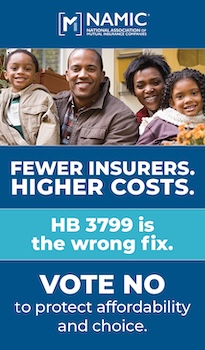
The Illinois Insurance Association (IIA), the American Property Casualty Insurance Association (APCIA), and the National Association of Mutual Insurance Companies (NAMIC) today issued the following joint press release opposing Senate Bill 1486 - Amendment 2 after its advancement through the House Executive Committee and then passage in the House of Representatives. The groups warn that the bill represents one of the most sweeping and harmful insurance regulatory overhauls in state history – one that will likely raise premiums, reduce consumer choice, and destabilize Illinois’ insurance market.
“Illinois families are already facing an affordability crisis with property taxes, gas, grocery, and utility bills all rising. Inflation is squeezing household budgets from every direction. At a moment when lawmakers should be laser-focused on affordability, the General Assembly is instead advancing radical legislation that would make both auto and homeowners’ insurance more expensive for nearly every Illinois household. These are added burdens Illinoisans simply cannot afford. We urge Illinois lawmakers to protect the individuals and families who rely on a competitive and stable insurance market by rejecting SB 1486 – Amendment 2.”
Key Concerns
If enacted, SB 1486 Amendment 2 is likely to:
• Cause homeowners insurance premiums to increase up to 20% or $230 on average. Auto insurance premiums are also likely to increase.
• Reduce consumer choice as insurers scale back or leave the state.
• Inject politics into rate decisions, slowing filings and delaying needed adjustments.
• Destabilize a market that has historically been one of the most competitive markets in the nation, offering Illinoisians many options to shop around for a policy that fits their needs and budget.
* Daily Herald…
Two bills that would transfer oversight of state-run charter schools to local school boards and emphasize accountability are making their way through the Illinois Senate, causing concern for two suburban charter schools that fought hard to exist. […]
Senate Bill 4040, sponsored by state Sen. Cristina Castro of Elgin, would cede control of any state-authorized charter school back to the local school boards for oversight and eliminate the ISBE appeals process for approving or renewing charters.
A separate Senate Bill 3391, sponsored by state Sen. Celina Villanueva of Chicago, would require charter school operators to execute renewal agreements within 90 days of approval and establish stronger financial safeguards to protect students, staff and public resources if a charter school closes. […]
SB 4040 would eliminate two protections for families and schools that have been part of Illinois’ charter school law for nearly 30 years: a statewide authorizer and an independent appeal process, [Andrew Broy, president of the Illinois Network of Charter Schools,] said.
Both bills have passed out of committee.
* Press relase…
Today, the Greater Chicagoland Black Chamber of Commerce, Illinois Black Chamber of Commerce and Illinois Hispanic Chamber of Commerce sent the following letter to the Illinois General Assembly in support of APR for All legislation that would save Illinois Small Businesses more than $1.25 million every day:
“There is a straightforward solution to a problem that costs Black and Brown small businesses in Illinois at least $118 million every year. The solution would cost taxpayers nothing and would help stem the tide of increased prices for consumers.
“HB 744 HA #1 (Canty-Mayfield) would require nonbank lenders to disclose to small businesses the annual percentage rate (APR) of the loans being offered to them. This would enable small businesses to shop for the best price when seeking financing.
“Currently, lenders use different sets of terms and fine print that make it impossible to compare the cost of different loan products. The millions of dollars saved by small businesses who are empowered to shop for the best deal would be reflected in customer prices because the cost of financing is already passed on to customers. In this way, this bill would help to address the affordability crisis for all of us, not just for small businesses.
* Rep. Marty McLaughlin…
On Friday, State Rep. Martin McLaughlin (R-Barrington Hills) and Chairwoman, State Rep. Joyce Mason (D-Gurnee) worked in bipartisan fashion to unanimously pass HB2190 through the Illinois House of Representative’s Child Care Accessibility and Early Childhood Education Committee.
The bill seeks to protect children in Illinois daycare centers by requiring at least two adults certified in CPR and the Heimlich maneuver to be present in facilities with more than 12 children.
During his testimony, the lawmaker from Barrington Hills said: “As someone who has worked with children for more than 22 years and coached young women in athletics, it was always a minimum requirement to have two people CPR-certified and trained at every athletic event. When we discovered that was not a minimum requirement in daycare centers, we were surprised. What we are attempting to do here is apply a minimum safety standard for children in daycare centers, and that is the impetus for this bill.”
Representative McLaughlin was joined by Felicia Walters, the mother of a 23-month-old toddler who was found unresponsive only an hour after being dropped off by his parents at daycare. “We would never again see our son’s eyes open, hear his laugh, or hold him without cords and wires. The love of our lives was taken from us in an instant. Not everyone at Callum’s daycare was CPR-certified and fully equipped to care for children, and precious time was wasted. We are fighting to make this change so that no other parent has to endure the heartbreak we live with every day.” said Walters.
McLaughlin concluded his committee testimony by saying: “We are going to be referencing this as ‘Callum‘s Bill’ in honor of Callum. Together we can show the public it’s possible to produce important legislation without political division. Please join me as we move forward on this legislation so it can become ‘Callum’s Law’ by the end of this session and help to protect children all across Illinois.”
* More…
* WAND | IL bipartisan bill could ban indirect quotas for police: Rep. Patrick Sheehan (R-Homer Glen) said officers are meant to protect and serve the public instead of providing revenue sources for local governments. “Performance should be judged on the legality, judgement, problem solving, community outcomes and case quality, not how many people an officer stops or detains,” Sheehan said Friday. “Other states have already moved to ban the arrest and stop-based quotas. Illinois should close the loophole and do the same.”
* Press release | Ortíz Advances Proposal Looking to Make Community College More Affordable for Adult Learners: Ortíz’s House Bill 5135 removes the maximum reimbursement rate per credit hour for community colleges, allowing for more tuition assistance to flow to in-state adult learners pursuing their education. Currently, state adult education fund rules unnecessarily follow federal requirements found in the Workforce Innovation and Opportunity Act and other regulations. Ortíz’s plan would remove the state from this self-imposed restriction, providing greater flexibility to prioritize adult learner funding.
* Press release | IL State Rep. Du Buclet’s Advances Legislation to Expand Youth Civic Engagement in Illinois: House Bill 4339, also known as the Jesse Jackson Sr. Young Voter Empowerment Act, passed the House Ethics and Elections Committee with unanimous support. The legislation ensures that all public high schools offer students of voting age the opportunity to register during the school day in a safe, accessible, and nonpartisan environment. Too often, voter registration efforts are tied to political campaigns or outside organizations that may influence how someone votes. This bill removes that pressure and ensures young people have a first-time voter experience rooted in trust, education, and independence.
* Press release | Rep. Sheehan Introduces the Law Enforcement Mental Health Leave Act to Support Officers After Traumatic Events: HB 4715 establishes a statewide standard granting officers five days of paid mental health leave within a 12‑month period when they experience a mental illness resulting from a traumatic event. The bill requires every law enforcement agency in Illinois to adopt a clear, confidential mental health leave policy and prohibits retaliation against officers who use the leave they are entitled to. This bill also extends these protections to campus police officers, Department of Corrections and Department of Juvenile Justice employees, and local correctional staff who routinely face high‑stress, high‑risk situations.
* River Bender | Harriss Pushes Bill Requiring Solar Developers to Cover Cleanup Costs: Senate Bill 3953 would require companies seeking to construct commercial solar facilities to secure a surety bond before receiving county approval. The bond must be sufficient to cover the full cost of decommissioning the facility and address any environmental damage caused during construction or operation. “Taxpayers should not be forced to clean up after private energy companies,” said Senator Harriss. “This legislation ensures that those who profit from these developments are also responsible for properly maintaining and ultimately removing them.”
* WCIA | Illinois lawmakers propose new kratom regulations: If passed, the bill would set boundaries for what can be sold or consumed. Last year, Monticello banned the sale of kratom products in the city, and supporters of that move said they’re on board with this one too. “The problem is, it’s kind of the Wild West. There’s absolutely no regulation for kratom right now, the synthetic or the purely,” said Piatt County Board member Michael Beem. “And I feel like any substance can be synthesized and made into something more dangerous. There needs to be stopgaps in place.”














- 309Resident - Monday, Mar 23, 26 @ 10:41 am:
Ticking off State Farm is a bad strategy. They’ve already moved thousands out of Illinois and are shrinking their footprint at HQ.
Cat already left Peoria, and we are suffering daily because of it.
- H-W - Monday, Mar 23, 26 @ 10:59 am:
Re: Insurance industry PACs
=== The groups warn that the bill represents one of the most sweeping and harmful insurance regulatory overhauls in state history ===
Right. I’ll believe this when donkeys fly. What the Illinois Legislature has done is equalize Illinois with dozens of other states who regulate insurance to prevent gouging.
Actuarial sciences are notorious for finding statistics to show cause for increasing. Many of these statistics are spurious - they are unrelated to causes of accidents. Take for example the use of credit scores. People have good and bad credit scores for scores of reasons; not because they drive poorly or well. My credit score went down when I declared bankruptcy years ago, not because I was a risky driver. Yet using credit scores to leverage higher costs from those having poor credit scores means that the people paying higher premiums are paying higher premiums regardless of driving ability.
If insurance companies want to argue that they charge rates because they assume risks, then they should assume risks, rather than build actuarial models that eliminate risks. Having a state agency that oversees the pricing of insurance makes enormous sense. Indeed, not doing so is a pound foolish.
Historicall
- Homebody - Monday, Mar 23, 26 @ 11:06 am:
Possibly a stupid question, but does anyone know where one could find statistics or any sort of analysis that would show what percentage of filed bills tend to actually go anywhere? Sometimes it is hard for the less informed of us (like me) to differentiate between meaningful bill filings versus grand standing that will never actually impact anyone.
- Fred Garvin - Monday, Mar 23, 26 @ 11:14 am:
Certainly a lot more donkeys in Illinois than elephants but neither can fly.
Build actuarial models that eliminate risk?
California tried it your way H-W and insurance companies left.
How exactly does a mutual insurance company like State Farm “gouge” it’s customers who are by definition also it’s only shareholders?
- H-W - Monday, Mar 23, 26 @ 11:35 am:
=== How exactly does a mutual insurance company like State Farm “gouge” it’s customers ===
Straw horse, right?
Let’s see, paying executives excessive wages.
Paying employees excessive wages.
Allowing agents to receive excessive commissions.
Charging higher premiums and then distributing and then not sharing those excessive premiums with “shareholders.”
Investing excessively in commercials.
Your suggestion that the use of the term “shareholders” means there is no way to profit off insurance borders on arrogance.
As a State Farm “shareholder,” I can attest that the last time I received a refund was so long ago that I cannot remember. But I can remember my prices going up, and I can remember local agents spending lots of money on sports programs and local schools.
Shareholder as used in the insurance industry is a false model of what is occurring. It is a straw horse argument, unless customers equals shareholders, and shareholders are paid equally with agents.
People go into insurance sales to get rich and retire very, very well. The do not go into insurance sales to “share the wealth.”
- Fred Garvin - Monday, Mar 23, 26 @ 11:53 am:
This horse is 100% real.
State Farm is issuing the largest dividend in it’s 103 year history- over 5 billion dollars which will average $100 for car insurance customers.
They also lowered car insurance premiums by 4.6 billion last year.
So you want the government to decide how much the company should pay its employees that paid out 78 billion in claims last year?
Does this apply to every company or just State Farm?
https://money.com/state-farm-car-insurance-refunds-2026/
- JS Mill - Monday, Mar 23, 26 @ 11:57 am:
=California tried it your way H-W and insurance companies left.=
State Farm left the business utopia of Florida.
- Brave New World - Monday, Mar 23, 26 @ 11:58 am:
Gee H.W. if you’re correct surely some other insurance company can easily undercut State Farms’ rates. Shop around recently?
=Paying employees excessive wages.=
Hilarious. Middle management at SF makes less that many State of IL janitors before even considering total compensation (benefits).
- Rich Miller - Monday, Mar 23, 26 @ 12:10 pm:
===State Farm left the business utopia of Florida. ===
State Farm says the biggest problem with homeowners insurance costs here is hail damage. Illinois just broke a hail-size record.
As the climate changes, insurance costs will rise. We’ve known this forever.
Florida, California, etc. have tried to legislate their way out of this. It hasn’t worked. Just the opposite.
I have yet to see any solid proof that what State Farm is alleged to be doing (subsidizing ratepayers in California by jacking up rates here). If that’s happening, then stop it. But only a fool would think that insurance costs are not going up anytime soon.
Also, the rising costs of automobiles means fixing damage is far pricier than it was. Heavy SUVs/passenger trucks cause a lot of damage in accidents.
Too many pitchforks, not enough thinking.
- Pundent - Monday, Mar 23, 26 @ 12:16 pm:
Illinois is currently one of a handful of states that allows insurers to “file and use” rates without any sort of restrictions. By moving to a “prior approval” standard Illinois would be using the same methodology as 31 other states. The insurance industry seems to be holding up just fine in these states.
- H-W - Monday, Mar 23, 26 @ 2:02 pm:
Okay. I give. Between the Insurance PACs arguments and the story on Kratom, my blood started to warm and I was angry this morning. I wrote a response to the Kratom story as well, but I might have forgot to click “say it,” or perhaps it was problematic and was discarded.
As to my remarks on the insurance industries comments that regulation is going to cause harm, I still disagree. I believe it is needed, and do believe there is a lot of money to be saved, too.
But I think Rich is right. Grabbing at pitchforks is rarely a good strategy.