* The basic gist of the appeal…
In this case, Plaintiffs filed a complaint in the Circuit Court of Cook County alleging that a referendum question placed on the ballot by the Chicago City Council proposing to raise the real estate transfer tax on some properties, and in the same question, lower the tax on other properties, was constitutionally ineligible to appear on the ballot because the question violated both the free and equal elections clause and the applicable provisions of the Municipal Code. … As a result of this combination, a voter wishing to support the decrease portion alone must also support the increase with the same vote, and a voter wishing to support only the increase, must also support the decrease.
The Circuit Court agreed and enjoined the Defendant, the Chicago Board of Elections, from counting or releasing any votes cast on the question. The Appellate Court reversed that decision, concluding that Plaintiffs’ “complaint is premature” because the referendum “is a step in the legislative process.” The Appellate Court’s decision is incorrect and should be reversed because it fails to recognize the critical fact that the “free and equal elections” clause protects voting rights, and once a voter is forced to vote on an unconstitutional question, the violation of that right has occurred and the injury to that right cannot be subsequently remedied. Indeed that is why, nearly fifty years ago, this Court recognized that “the framers of our constitution intended this court alone to determine whether constitutional requirements for a proposed amendment were satisfied.” […]
The Appellate Court’s decision, if permitted to stand, eliminates any pre-election challenge to the constitutionality of a referendum question placed on the ballot by municipal alderpersons, regardless of how blatantly unconstitutional the question may be. The possibilities for ballot abuse by municipal councils across the state are endless.
The Appellate Court’s decision also stands in direct conflict to the same court’s most recent decision regarding municipal referenda. In Henyard v. Municipal Officers of Dolton, 2022 IL App (1st) 220898, the First District Court explicitly considered its jurisdiction over a pre-election complaint that two referendum questions placed on the ballot by municipal alderpersons violated Article III, Section 3. The Court concluded it had jurisdiction and then invalidated the questions as being “fatally vague and ambiguous” in violation of Article III, Section 3.
The Appellate Court’s decision also sets two up different standards for judicial review of municipal referenda questions. Under the Appellate Court’s decision, courts would have no jurisdiction to consider a pre-election constitutional challenge to a referendum placed on the ballot by municipal alderpersons, but courts would have jurisdiction over a question (even the same question) placed on the ballot by citizen initiative. Why questions initiated by citizens should get more judicial scrutiny than questions initiated by alderpersons, the Court does not say. The free and equal elections clause draws no such distinction. […]
In its decision, the Appellate Court attempts to distinguish Henyard by pointing out that in that case the Court issued its decision after the election, and not before. In both cases, however, the Article III, Section 3 challenge was filed before the election, not after. In fact, the Henyard Court enjoined the County Clerk (the election authority for suburban Cook County) from counting or publishing the results before the election, not after. The fact that the Henyard court waited until after the election to issue its final decision should not affect the court’s jurisdiction.
More at the link.
10 Comments  
|
Isabel’s afternoon roundup
Monday, Mar 11, 2024 - Posted by Isabel Miller
* Illinois Fuel and Retail Association…
Local State Senator Dave Koehler is leading the push in Springfield for legislation that will increase prices at the gas pump in our area and across Illinois.
Sen. Koehler is the chief sponsor for Senate Bill 1556, which mandates two state regulators – the Illinois Environmental Protection Agency (IEPA) and the Illinois Pollution Control Board – to establish a “clean transportation standard” and reduce the use of carbon-based fuels by Illinois drivers on our roads.
The two agencies would assign state-mandated “deficits” to fossil fuels like gasoline and diesel, which for consumers means they will pay more every time they put those products in their vehicles.
The Illinois Fuel and Retail Association (IFRA), on behalf of more than 4,000 gas stations, convenience stores, and truck stops across Illinois who serve millions of customers, is standing up to strongly oppose the proposal.
“Our member stores in Illinois have had enough, and our customers have had enough,” said Josh Sharp, IFRA’s CEO. “Illinois doubled the gas tax in 2019 and consistently raised it every year since then, with two increases in 2022. Federal data shows Illinois topped California for the highest taxes on gas in the country last year. And even worse, this legislation would do nothing to fix our roads and bridges. It simply will punish drivers and put more costs on consumers at the pump that they cannot afford.”
The proposed legislation gives the state regulators authority to decide how the fossil fuel “deficits” work, how much they will cost, and how any phase-out processes might be developed. Similar clean transportation standards, or low-carbon fuel standards, have been a disaster for fuel consumers in other states.
* Greg Pratt…
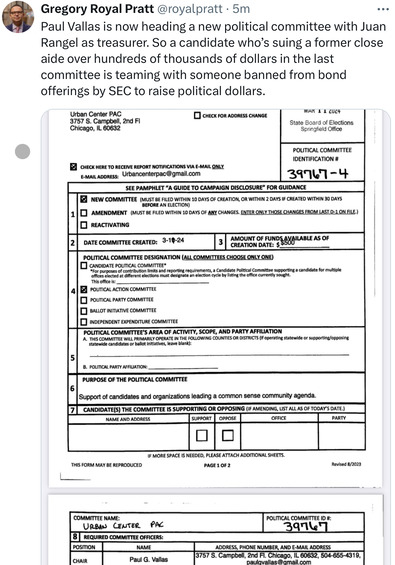
* WAND TV…
While deadlines for traditional forms of voter registration have passed for the 2024 primary in Illinois, those wanting to cast ballots can still do so under the state’s “grace period registration” laws.
The grace period began after March 3, which was the final day for residents to register to vote online. Traditional voter registration closes 28 days prior to an election, with late February serving as the deadline for this month’s primary.
Residents who still haven’t registered to vote still have an opportunity to cast a ballot if they choose to do so, but there are additional steps that must be taken. […]
In order to register to vote less than 28 days prior to an election, a voter must do so in-person at a designated grace period registration site.
* What are your thoughts?…

* Here’s the rest…
* BND | IL’s Mike Bost, Darren Bailey trade attacks on immigration issues. How did they vote?: Like other issues, they agree on some things related to immigration. In BND interviews and in response to the BND’s 2024 candidate questionnaire, both identified border security as the most important issue facing the U.S. Both believe finishing former President Donald Trump’s border wall is part of the solution to fixing the nation’s immigration system. And both oppose the bipartisan immigration reform deal with new border laws that federal lawmakers proposed earlier this year.
* Daily Herald | Cook County circuit court clerk race heating up: In her Daily Herald candidate questionnaire, Martinez, a former state senator, cited as her accomplishments the digitization of 70 million court records; the establishment of a domestic violence survivor center that provides a safe place for individuals seeking protective orders; and processing thousands of backlogged expungement requests. […] Spyropoulos said in her Daily Herald candidate questionnaire bail bonds have not been refunded in a timely manner during Martinez’s tenure. To that end, she cited an August 2023 ABC 7 report about a man who waited more than a year for a refund of the $100 bail he posted for his son after his son’s case was dismissed. That same man, according to ABC 7, waited months for the refund of a separate $500 bail he posted for his son in 2023 after his son agreed to serve probation. According to ABC 7, bail bond refunds were due four to six weeks after the case closed.
* BND | Two Republicans look to challenge U.S. Rep. Budzinski in Illinois’ 13th district: Republicans have an uphill battle in the Democratic-leaning district. Democrats in the Illinois General Assembly redrew the congressional districts in 2021 to gain a U.S. House seat. In 2022, Cook Political Report projected Democrats would have a 3-point advantage in the 13th district. However, Budzinski cruised to victory, beating now state Rep. Regan Deering, R-Decatur, 56.6% to 43.4%.
* Daily Herald | Foster, Rashid square off in 11th District over health care votes: While proclaiming support for the landmark Affordable Care Act, Democratic U.S. Rep. Bill Foster of Naperville is defending his votes on three Republican-led bills his current political challenger says would’ve chipped away at the legislation commonly called Obamacare. Foster’s foe in the March 19 Democratic primary, Naperville attorney Qasim Rashid, has attacked Foster’s “yes” votes in interviews, advertisements and elsewhere. Then-President Barack Obama threatened vetoes if the proposals made it to his desk, and most House Democrats opposed them.
* BND | Using legal tool, Belleville group shifts into high gear renovating derelict homes:The Illinois Abandoned Housing Rehabilitation Act allows nonprofit organizations to file lawsuits and get circuit courts to force owners of “nuisance” properties to bring them into compliance with local codes. If they decline, there’s a path for the organizations to take ownership.
* Chicago Reader | Inside the Cook County State’s Attorney’s Brady lists: Despite a history of expanding obligations on prosecutors and police, the Cook County State’s Attorney’s Office (SAO) and Chicago Police Department (CPD) fail to comply with Brady in several ways, according to interviews with experts, successive outside reviews, and an investigation into the agencies’ practices by the Invisible Institute and the Reader.
* Tribune | Despite frozen police discipline, COPA closes 143 investigations, including some involving alleged repeat offenders: The findings and recommendations in each case were not yet known, but during February’s meeting of the Chicago Police Board, Superintendent Larry Snelling said COPA recommended 28 officers be fired from the Police Department in just the first two months of 2024.
* Tribune | Second child develops measles in Pilsen migrant shelter, officials say: The first case in the shelter was confirmed Friday. That child has recovered and is no longer infectious. An additional, unrelated case outside of the shelter was announced Thursday — the first in Chicago since 2019.
* ISBA | Quick Take on Illinois Supreme Court Opinion Issued Friday, March 8, 2024: In 2019, the plaintiff, M.U., was a freshman in high school and signed up to play hockey with a girls’ hockey team run by Team Illinois Hockey Club, Inc. According to the allegations contained in the complaint, M.U. had a history of treatment for anxiety, depression, and suicidal thoughts. M.U.’s parents informed the team’s coach of her mental health struggles and that M.U.’s participation in team activities was supported by her mental health professionals as an important and supportive aspect of her life. The day after this conversation, the teams’ coach as well as a member of the board of directors for the Amateur Hockey Association of Illinois, Inc., decided to ban M.U. from all Team Illinois activities until she was “able to participate 100%.”
* Sun-Times | Black Catholics at Joliet’s Sacred Heart Church worry what its closing will mean: Diocesan officials have blamed declining Sunday Mass attendance, financial troubles and costly building repairs and, though, the diocese faces potentially costly settlements over accusations of clergy sex abuse, won’t say how much of an impact those costs are having.
* Daily Herald | Round Lake Area Library seeks voter approval to borrow $36.4 million for new building: According to district figures, the owner of a home valued at $228,200 — the district median — would pay an additional $345.84 in annual property taxes if the measure passes. The current bill for that home is $382.90.
* IPM | University of Illinois’ first vice chancellor of Native affairs: “I feel very disrespected” : Rand is a citizen of the Choctaw Nation of Oklahoma. Before being appointed as a top administrator at UIUC in 2021, she worked at the National Museum of the American Indian and the University of Iowa. Her role was to mend relationships with Native tribes pushed out of central Illinois, but she said the university did very little to support her after the hire.
* PJ Star | Peoria’s city manager is the highest-paid city employee and may be getting a raise: Peoria City Manager Patrick Urich will be up for a raise at Tuesday night’s City Council meeting. The council will vote on whether to give Urich a 3% raise ($6,412), which would bring his base salary to $220,149.83. He is also eligible for a longevity bonus of $5,000.
* Chicago Mag | The former mayor, 61, on her enemies, lessons from COVID, and why she’s finished with politics: Being a big-city mayor is a really, really hard job. There are a lot of people shooting at you. You’ve got to know who your enemies are and know that they’re working every single day to undermine you. I don’t know that I totally appreciated that early on.
* Bloomberg | Magic mushrooms are risky new tool touted by executive coaches: “Adderall, caffeine and stimulants helped with getting things done, but with the advent of AI, productivity is becoming less valuable. Psychedelics can help with the kind of divergent, creative thinking that’s more required now,” says Paul Austin, a lanky, bearded 33-year-old “microdosing coach” and founder of Third Wave, which offers courses costing as much as $14,000 to certify psychedelic guides.
* Crain’s | Gold Coast home of Jay Doherty, convicted as one of ‘ComEd Four,’ sold: The four-bedroom condo, a combination of two adjacent units, sold for $575,000. That’s about two-thirds of what Doherty paid for the pair. According to the Cook County clerk, he bought one in 2002 for $490,000 and the other two years later for $378,500, for a combined $868,500.
* Daily Herald | Déjà vu all over again? Some of the suburbs the Bears have checked out through the decades: In the first of many plays to land a stadium deal in Arlington Heights, Chicago Bears founder George Halas speaks at a luncheon hosted by the village’s Chamber of Commerce and says, “I hope and pray that 1977 will find the Bears contending for a title in a new stadium in Arlington Heights.”
* PJ Star | Downtown Peoria restaurant receives ‘prestigious recognition’: Less than 850 restaurants throughout the United States have received the award, according to the organization’s website. The Distinguished Restaurants of North America, known as DiRōNA, also recognizes restaurants in the Caribbean, central America, Canada and Mexico. Saffron Social, which is part of Travis Mohlenbrink’s Spice Hospitality Group – opened on Sept. 13, 2023. The restaurant’s dinner menu features a roasted bone marrow appetizer, filet, cherry glazed salmon, breaded pork piccata and more.
* The Atlantic | The People Rooting for the End of IVF: Those in the wider anti-abortion movement who oppose IVF are feeling hopeful. Whatever the outcome in Alabama, the situation has yanked the issue “into the public consciousness” nationwide, Aaron Kheriaty, a fellow at the conservative Ethics and Public Policy Center, told me. He and his allies object to IVF for the same reason that they object to abortion: Both procedures result, they believe, in the destruction of innocent life. And in an America without federal abortion protections, in which states will continue to redefine and recategorize what qualifies as life, more citizens will soon encounter what Kheriaty considers the moral hazards of IVF.
* Nieman Lab | Five of this year’s Pulitzer finalists are AI-powered: Last July — the same month OpenAI struck a deal with the Associated Press and a $5 million partnership with the American Journalism Project — a Columbia Journalism School professor was giving the Pulitzer Board a crash course in AI with the help of a few other industry experts.
* Jewish Telegraphic Agency | White supremacists, seizing on Israel-Hamas war, have accelerated their antisemitism since Oct. 7: At a recent city council meeting in Evanston, Illinois, a man in dark sunglasses stepped up to the podium during the public comment period to accuse the Anti-Defamation League of stifling free speech. Wearing a hat with the logo of the neo-Nazi group Goyim Defense League, the man — who claimed to be a local resident — held up what he said was an “ADL toolkit that was sent to city councils across this nation.”
* Block Club | Your Guide To St. Patrick’s Day In Chicago: Parades, Bar Crawls, Concerts And More: The Chicago River is going green for the 69th year this weekend, dyed by the Plumber’s Local 130. A longtime tradition, Chicagoans can catch some of the best views of the newly colored river from Upper Wacker Drive between Columbus and Fairbanks. The annual Chicago parade kicks off shortly after at 12:15 p.m., starting at Columbus Drive and Balbo Avenue then continuing north. Entry to the parade route opens at 11 a.m. at Jackson Avenue and Ida B. Wells Drive.
* WGN | How are body clocks impacted by the time change?: Northwestern Immediate Care Specialist Dr. Tom Moran joins Bob Sirott to talk about how the time change can impact our body clocks. He also discusses who should get the measles vaccine and whether or not magnesium is effective when treating tinnitus.
8 Comments
|
Question of the day
Monday, Mar 11, 2024 - Posted by Rich Miller
* From the Chicago Tribune’s story about Illinois Republican National Convention delegate candidates…
Joining Rickman as a delegate candidate in the 2nd Congressional District is Kelly Vera, a Navy veteran and a nurse at the state Veterans’ Home at Manteno since February 2020, according to her social media and public records.
Vera joined Manteno at a time when COVID-19 was spreading rapidly and, after a vaccine was developed in December 2020, the state imposed a vaccination mandate on health care workers in veterans’ homes. Court records show she was among a number of state employees who filed losing lawsuits challenging the directive.
Vera’s social media is filled with COVID-19 conspiracies and repudiations of the vaccine, including links to movies alleging the disease was a government plot. At least three COVID-19 outbreaks occurred at the Manteno facility since her employment.
Vera also has shared links to a conspiracy account on TikTok that includes an explanation of how human technology is used to stage alien visits from outer space and a fake video using a fake voice of Apollo 11 astronaut Edwin “Buzz” Aldrin saying he never went to the moon and that the International Space Station is fake. The account also features a false report that Ukrainian President Volodymyr Zelenskyy is moving to the United States and is getting Secret Service protection.
Last August, she posted a meme reading: “Go out and get yourself a conspiracy theorist friend. You’re going to need one to explain what’s about to happen.” Above it, she wrote: “That’s me. I’m that friend! Grab some popcorn and a bottle of adult beverage and hold on to your boot straps. ITS A BUMPY RIDE!”
* The Question: Have you seen any new conspiracy theories floating around? Explain.
38 Comments
|
* Crain’s…
Catholic Charities of the Archdiocese of Chicago will lay off 300 employees as it cuts government contracts.
On March 7, the organization announced the job cuts and plans to end 75 government contracts starting in July due to what board Chair Michael Monticello described as an “increasingly complex and uncertain government funding environment.”
The charity expects to conduct the layoffs over the next few months — impacting 280 staff whose work is related to government contracts and 20 who work in related administrative areas.
The nonprofit said the contracts cover services like child care, youth programs, behavioral health counseling and senior care. According to its 2023 impact report, government fees and grants make up the bulk — 73% — of its revenue.
* This is not happening in a vaccuum. From December…
Heartland Alliance, a Chicago-based social service organization that dates from 1888, is shutting down its division that operates affordable housing developments in Chicago and Wisconsin after laying off 65 workers.
Ed Stellon, the group’s chief external affairs officer, said the nonprofit is “managing a very severe cash flow challenge.”
He said the layoffs were among 125 workers who got temporary furloughs in recent months. “It’s just a terrible situation for them,” Stellon said.
More on Heartland…
Chicago social services nonprofit Heartland Alliance is working to spin off its health care division and other units and then plans to dissolve itself amid financial troubles.
Discussions about breaking off Heartland Alliance Health and other segments of the parent organization began in fall 2023, when severe financial challenges surfaced, Ed Stellon, chief external affairs officer, said in a statement to Crain’s. […]
Aside from Heartland Alliance Health, units being considered for separation include Heartland Human Care Services, Heartland Alliance International and a program within Heartland Alliance called National Immigrant Justice Center, according to Stellon. Heartland Housing, which provided affordable housing services, is shutting down. […]
Stellon pointed to the destabilizing effect on health care organizations of the COVID-19 pandemic and the inflation wave that followed. A growing demand for services, combined with rising costs on everything from labor to equipment and supplies, put pressure on the already-thin margins providers typically face. The situation for Heartland Alliance Health worsened once migrants seeking asylum began arriving in Chicago last year, further stretching its resources.
* WBEZ last month…
Dozens of employees are taking a 20% pay cut at Alivio Medical Center, a key health care provider for migrants and asylum seekers on the West Side.
Those getting their hours reduced from 40 to 32 a week range from executives to medical assistants, nurses and front-desk staff, spokeswoman Terri Rivera said in a recent interview. She has since left Alivio. Doctors were spared from the cut so they can take care of more patients to generate more revenue, Rivera said, though they could be trying to do so with less help. For example, she said a medical assistant now might share their time between two doctors instead of one. […]
Rivera said a host of factors fueled the furloughs, including supplies becoming more expensive, COVID-19 money that is running out and treating fewer patients. Alivio’s CEO Esther Corpuz was not available for an interview, nor was anyone who could discuss the health center’s financials.
But Igoe said information Alivio shared with the union shows that patient visits have increased since at least the summer and as of November surpassed 6,000 visits that month.
* Sun-Times last month…
Two of Chicago’s largest medical groups laid off employees Thursday, citing money troubles.
University of Chicago Medical Center officials say the hospital is facing the “same challenges” other health systems have, which led to the 180 layoffs.
“The fact is many outside pressures including higher supply and labor costs are converging as healthcare delivery rapidly evolves,” president Tom Jackiewicz and Mark Anderson, executive vice president of medical affairs, wrote in a memo to employees on Thursday. “Additionally, we grew our staff to address the pandemic, which was necessary for that moment but cannot be maintained.”
* Last September…
Illinois Times has learned Memorial Health’s recently announced layoffs totaled about 300 – with 120 involving people in leadership positions – and that the cuts will save the Springfield-based health care system an estimated $40 million a year.
The new information, expanding on an earlier statement from the nonprofit system that said there were “several hundred” layoffs, came from Memorial Health’s president and chief executive officer, Ed Curtis. He told Illinois Times in an interview that the cuts were part of “tough choices” to sustain the nonprofit system through an unprecedented nationwide staffing shortage that sent payroll costs soaring.
Curtis said the cuts, mostly to administrative and support positions and mostly avoiding frontline care staff, were a “last resort” after other cost-trimming measures. They were all needed to preserve core services and help return the system to “break-even” by fall 2024, he said.
* Last June…
St. Margaret’s Health is shuttering its 120-year-old Spring Valley hospital Friday, just months after the abrupt closure of its hospital in nearby Peru.
SMH president and CEO Tim Muntz pinned the blame solely on “one bank’s actions on June 5, 2023.” He told the Illinois Health Facilities and Services Review Board that the hospital’s primary lender is cutting off access to their funds.
* Last May…
On Nov. 1, 2022, the CEO of the only hospital in Logan County — Lincoln Memorial — announced in a news release that the three maternity suites dedicated to obstetrical care at the 25-bed hospital would close the following month, “ending labor and delivery services at the nonprofit hospital.”
After the Dec. 31 closure, the release said, then-current Memorial Health patients could coordinate with the two OB-GYN doctors who delivered babies at Lincoln Memorial to “choose another hospital” for their delivery.
On Jan. 29, a mother delivered a baby on an Interstate 55 off-ramp near Elkhart.
According to 911 call audio obtained by WGLT, the mother and the driver of the vehicle were heading from Lincoln to Springfield, likely toward Memorial Health’s flagship hospital in the state capital.
* Full Catholic Charities press release…
Catholic Charities of the Archdiocese of Chicago – the region’s largest private human services provider – announces the launch of its Vision 2030 strategic plan and, with that, several decisions designed to realign its services for greater impact over the years ahead.
This week, Catholic Charities is notifying government funders that, beginning July 1, it will transition out of 75 government contracts that together fund 12 percent of its current operating budget.
“After careful evaluation and discussion, we have decided to reduce our footprint as a government contractor – in order to increase the time, attention and resources we devote to the services we are uniquely equipped to offer as a private humanitarian organization,” said Sally Blount, President and CEO of Catholic Charities. “Over the last decade, navigating the government services sector has grown more complex, and funding has not kept up with the high rates of inflation. That means that many contracts no longer cover their direct costs, much less the increasing costs of administering them.”
“We remain steadfast in our founding mission to serve people in need across Chicago, Cook and Lake counties – regardless of their faith, ethnicity, nationality, gender, or race – while adapting to the changing needs of our times,” said Blount. “Going forward, Catholic Charities will continue to serve the same populations and provide many of the same services but will do so with greater reliance on private funding.”
Catholic Charities will work closely with government and peer partners to minimize disruptions in service during the contract transitions, including setting up special helplines for the people affected by the changes. The contracts cover various services, from childcare and youth programs to behavioral health counseling, senior care, adult protection, veteran services, and call centers.
This announcement comes after a comprehensive, year-long, strategic planning effort undertaken by the Board of Directors and leadership in partnership with nonprofit expert The Bridgespan Group, thanks to the funding of a long-time donor. This planning came as the final step in a more than three-year journey, undertaken by the Board after Blount was recruited to be CEO, to strengthen Catholic Charities’ governance, operations, and financial oversight.
“As a humanitarian organization that served non-stop during the COVID-19 pandemic, this was an important time for our Board and staff to reflect, learn, and re-imagine together,” said Michael Monticello, Board Chair. “Over the past year, we have come to understand that if we want to increase our impact over the years ahead, we must sharpen our strategic focus, while simultaneously reducing the time our staff spends navigating an increasingly complex and uncertain government funding environment.”
This decision means that over the coming months, Catholic Charities will reduce its staff by roughly 300 employees: 280 who work across the affected government contracts and 20 in related administrative areas.
“We announce these personnel decisions with a heavy heart and profound gratitude and respect for the contributions and many years of service given by each of these team members,” said Blount. “We will support them through advance notice, severance benefits, and assistance with job searches, including applying for open positions within our organization and our sister organizations (Mercy Home, Misericordia, and Maryville) and with our peer providers who will take over these contracts.”
Caring for the nearly 1,000 staff who will continue to provide essential programs and services is also a top priority. “Carefully balancing the needs of the people we are called and honored to serve with the needs of the amazing employees who serve them is critical to our mission,” said Blount.
“Our Board and staff remain committed to serving as our region’s cornerstone partner, employer, and provider. We will continue to operate at a significant scale, between $175-200 million annually, and provide essential programs and services across our three impact areas – immediate access to basic needs, children and family services, and seniors and housing – while preparing for the future needs of our region,” said Monticello.
Under the new strategic plan, Catholic Charities will pilot several new programs and expansions designed to increase services for low-income mothers and seniors across Cook and Lake counties. Through the Church’s parish network, it will expand its community-based footprint on Chicago’s south, west, and southwest sides. The Board also recently voted to open a new community center in the southwest suburb of Summit in Fall 2025 and to fund a standing Rapid Response Team – formalizing the crisis response capabilities created during the COVID-19 pandemic that have been further honed by collaborating with community and government partners to resettle 20,000 migrants over the past 18 months.
“Over the past four years, Catholic Charities’ Board and leadership have undertaken an important strategic exercise – one that all organizations of substance must regularly do,” said Cardinal Blase J. Cupich, Archbishop of Chicago. “I laud them for their courage, vision and commitment to deepening the Church’s impact on behalf of the region’s most vulnerable.”
15 Comments
|
|
Comments Off
|
* Subscribers were also briefed this morning. Tribune…
The Chicago Bears are prepared to provide $2 billion in private funding for a new publicly owned enclosed stadium and park space in the city, the team confirmed Monday.
The lakefront site would replace Soldier Field and increase open space on the museum campus by 20%, and provide a prime location to host the Super Bowl, NCAA Final Four and year-round community events, a source familiar with the deal said. […]
“This investment will enhance our reputation as a world-class city and tourist and convention destination,” [Chicagoland Chamber of Commerce President and CEO Jack] said. “And it will encourage more investment.”
A city ordinance generally prohibits private development on the lakefront. The nonprofit group Friends of the Parks filed suit and defeated a previous plan by Star Wars creator George Lucas to build a museum south of Soldier Field. The team is expected to meet with the group soon to share its plans.
* ESPN…
Although the team has not released renderings of its proposed lakefront stadium, a source confirmed the location would be immediately south of the current site of Soldier Field and would maintain parking in the south lot. […]
The public component for the proposed lakefront stadium is not yet known. […]
Should the Bears succeed in their plan to build a new lakefront stadium, a source indicated the team likely will put the Arlington Park property up for sale.
* NBC 5…
The Bears plan to invest more than $2 billion of private funding into the project, which would also increase open space in the area by 20%, the source said.
That open space would include plazas, paths, landscaped areas, lakefront access and more. That effort — creating more public spaces in the redevelopment of the area — appears aimed at placating preservation group Friends of the Parks, which successfully sued to prevent George Lucas from building a museum along the lakefront and has previously voiced opposition to the team’s construction of any new stadium project on Museum Campus. […]
Complicating the ask for public funding is the money still owed on both teams’ stadiums. The Illinois Sport Facilities Authority, which issued bonds for the construction of both stadiums, owes $589 million on the 2002 renovation of Soldier Field and $50 million on Guaranteed Rate, which opened in 1991. Those bonds are paid in part through the state’s 2% hotel tax, but if those revenues can’t make the multi-million dollar payments, Chicago’s share of the state income tax picks up the shortfall. Guaranteed Rate’s bonds are slated to be paid off in 2029, while the Soldier Field deal runs through 2032.
* ABC 7…
A previously floated plan, included a partnership between the White Sox and the Bears to build two new stadiums in the city at the same time, but in this new version, sources said the Bears would go it alone. […]
Arlington Heights Mayor Tom Hayes said in a statement, “We did not receive a courtesy call from the Bears about this and have seen nothing in writing, so no comment at this time other than we know it’s a long way from a done deal at either location.”
* Mayor Brandon Johnson…
I have said all along that meaningful private investment and a strong emphasis on public benefit are my requirements for public-private partnerships in our city. The Chicago Bears plans are a welcome step in that direction and a testament to Chicago’s economic vitality.
I look forward to subsequent talks with the Bears, State leadership and community stakeholders about how we can continue to responsibly support the aspirations of the team, its fans and all residents of the City of Chicago.
* Bears President and CEO Kevin Warren…
“The Chicago Bears are proud to contribute over $2 billion to build a stadium and improve open spaces for all families, fans and the general public to enjoy in the City of Chicago. The future stadium of the Chicago Bears will bring a transformative opportunity to our region—boosting the economy, creating jobs, facilitating mega events and generating millions in tax revenue. We look forward to sharing more information when our plans are finalized.”
* After laying out the plan in quite a bit of detail, Fran Spielman has some questions…
• Where is that private money coming from, and how much of it is from the National Football League?
• Would the team sell naming rights to the new stadium? That wasn’t viable at Soldier Field, given its war memorial status.
• If bonds are issued to help fund the stadium, which public entity would issue them, and what tax would be used to pay off those bonds?
• What are the infrastructure costs at the lakefront site?
• Would public transit along the lakefront be improved to allow better access to the stadium?
The team also released a few poll results, but they didn’t include the questions asked and several other important aspects, so I’m choosing not to share the numbers they did release.
…Adding… Rep. Mark Walker (D-Arlington Heights)…
“From the Bears’ first announcement to purchase Arlington Park, I’ve been open to the team’s move to Arlington Heights, but reaching a fair deal for all has always been the priority. As I’ve said before, I trust the Bears when they say they’re exploring all options in the best interest of their company. If they go forward with their lakefront plan, it’s our responsibility to make the best decision for Arlington Heights, Rolling Meadows, and our neighboring communities as well. I look forward to the many interesting proposals to come on the future of Arlington Park like new business development, more affordable housing, or welcoming centers for new arrivals.”
40 Comments
|
It’s just a bill
Monday, Mar 11, 2024 - Posted by Isabel Miller
* SJ-R…
Meta is threatening to terminate news availability on Facebook and Instagram in Illinois as state lawmakers contemplate legislation forcing online platforms to pay publishers for using their content.
Senate Bill 3591, known as the Journalism Preservation Act, would require platforms such as Meta and Google to share advertising revenue with eligible online news outlets. Jamie Radice, a Meta spokesperson, told The State Journal-Register passage of the bill would force their hand.
“If faced with legislation that requires us to pay for news content that publishers voluntarily post on our platforms and is not the reason most people come to Facebook and Instagram, we will be forced to make the same business decision that we made in Canada to end the availability of news in Illinois,” Radice said in a statement.
Negotiations are admittedly early, bill sponsor and state Sen. Steve Stadelman, D-Rockford, said during a Senate Executive Committee subject matter hearing last week. Given a challenging climate for newsrooms nationwide and locally, he urged lawmakers to get behind his legislation.
* Sen. Laura Ellman…
State Senator Laura Ellman advanced legislation that would target critical water issues and make appropriate recommendations to ensure the quality of local water resources.
“Water is a vital natural resource – we need to continue treating our local rivers, lakes and streams with care,” said Ellman (D-Naperville). “This measure will ensure recommendations from the State Water Plan Task Force are implemented in a sensible and timely manner.”
Senate Bill 2743 would require the State Water Plan Task Force to address water issues and reevaluate environmental needs by assisting state and local authorities in the implementation of recommended plans. The measure would also require the task force to publish a State Water Plan at least once every 10 years, meet once per quarter each calendar year. […]
Senate Bill 2743 passed the Senate Environment and Conservation Committee last Thursday and heads to the full Senate for consideration.
* Sen. Sara Feigenholtz…
State Senator Sara Feigenholtz passed Senate Bill 3679 — a bill three years in the making — out of the Senate Executive Committee on Wednesday with bipartisan support, meaning Illinois could soon join 45 states with permissive language to establish Business Improvement Districts. […]
Senate Bill 3679 sets the foundation for businesses to form a BID and collectively fund improvement projects. Business owners would have direct oversight on how the funds are utilized for projects within the district. BIDs only apply to commercial properties, meaning homeowners and residential properties would not pay any additional fees.
BIDs provide a nimble economic development tool modeled on self-governance. It carves a path for participating businesses to be empowered to address shared goals for their BID’s unique needs.
A BID’s governing board can adjust how the BID is designed to ensure each business shares burdens and benefits equitably. Projects funded by BIDs can include crime reduction, community beautification, job creation and more — all of which will attract new businesses and fill empty retail space. […]
* WAND…
Independent pharmacies are pushing for state legislation to be passed to put tighter controls on Pharmacy Benefit Managers (PBMs) while creating greater choice for patients filling their prescriptions.
Two bills in the Illinois legislature are being considered which pharmacists hope pass in the current spring legislative session. HB4548 and SB2790. […]
Among the main points:
- Assuring Patient Choice – prohibiting PBMs from directly or indirectly forcing patients toward their own mail order pharmacies.
- Allowing patients to be able to chose their pharmacies without being forced to use a pharmacy owned by a PBM.
- Requiring PBMs to provide data and information to the Department of Insurance to ensure open transparency on how patient, plan sponsor, and taxpayer monies are distributed through the claim process.
* Journal & Topics…
State Sen. Laura Murphy (D-28th), who filed a bill in the Illinois Senate to legislatively dissolve the Elk Grove Rural Fire Protection District (EGRFPD), said Thursday that the bill is on hold pending the results of a referendum question on the March 19 ballot. […]
Those bills join a referendum question to dissolve the district on the Tuesday, March 19 Primary Election ballot placed by a Cook County judge after a petition was filed by attorneys for the fire district. A hearing with that judge is scheduled for next month after the election.
Mount Prospect village officials are in the process of distributing a “fact sheet” to residents of unincorporated Elk Grove Township informing them about the recent history of the district — including the fact that it is no longer operating. […]
The Elk Grove Township Fire Dept., overseen by EGRFPD trustees, ceased operations on the morning of Sunday, Oct. 1, 2023, with little public notice to neighboring area fire departments or the public, as the district was quickly running out of money to operate because of annexations by neighboring municipalities.
* Capitol News Illinois…
The Senate Agriculture Committee heard testimony Thursday on two bills that seek to make Illinois-grown food more accessible to the state’s consumers.
Senate Bill 3077, by Sen. Dave Koehler, D-Peoria, would establish a $2 million per-year grant program within the Illinois Department of Agriculture to help fund projects to enhance local food processing, aggregation and distribution within the state. Those could include projects such as food hubs, canneries, mills, livestock processing and other kinds of infrastructure that help move food from a farm to communities.
“And this is important because while we have some of the best farmland in the world, we don’t actually have the infrastructure in place to feed ourselves,”said Molly Pickering, deputy director of the Illinois Stewardship Alliance. “Ninety-five percent of the food that we eat here in Illinois is imported from out of state. That means every dollar that anyone spends on food is not going into our local communities. It’s being exported.”
Senate Bill 3219, by Sen. Doris Turner, D-Springfield, would establish another kind of grant program through the Department of Commerce and Economic Opportunity to help fund equipment upgrades at farmer-owned grocery stores. […]
Both bills advanced out of the Senate Agriculture Committee Thursday and could be taken up soon by the full Senate.
6 Comments
|
You do realize this is a trap, right?
Monday, Mar 11, 2024 - Posted by Rich Miller
* My weekly syndicated newspaper column…
“Mayors slam Pritzker’s proposal to eliminate grocery tax,” was the Daily Herald’s headline above a story last week about several mayors of upper-income suburban communities complaining about a proposed tax cut.
I don’t know if the mayors quite understand this, but headlines like that are basically an in-kind campaign contribution to the governor and the Democratic super majority. The fact that Rep. Marty McLaughlin (R-Barrington Hills) was the center of that press conference arguing against a tax cut, even though he will face a hard-charging Tier One opponent this fall just makes it even weirder. McLaughlin walked it back later in the week, but the damage was done.
This grocery tax elimination proposal is a pretty darned solid play by Gov. Pritzker on multiple political and legislative levels. Whether it’ll become an actual law is, at this early stage, almost beside the point. And whether it’s wise is quite another story.
The “best” part is that this is a state tax cut that doesn’t cost the state budget a dime. You just can’t ask for more than that in this business. The money raised by the tax is collected by the state and then distributed to local governments.
It’s also a regressive tax, which hurts people at the lower rungs of the income ladder. As one top Senate Democrat told me recently, eliminating a regressive tax allows the governor and the General Assembly’s Democrats an opportunity to play the good guys for a change.
The proposal has divided the Republican party, which has to delight the Democrats. On the one hand, you had people like Rep. McLaughlin, providing fodder for whoever writes the direct mail in his opponent’s campaign. On the other hand, you have Rep. Blaine Wilhour (R-Beecher City), who is facing a primary challenge and knows better than to oppose a tax cut. Rep. Wilhour said this to his local newspaper: “The penny tax on groceries is punitive for working families, and we should end it in Illinois.” Smart dude.
The tax cut is easy to explain and is therefore receiving a lot of news media coverage. Everybody in politics loves issues like this, even if they’re not all what they seem to be. A bipartisan tax cut that also puts some Republicans in a trick bag, including some politically vulnerable members? Sure, sign me up.
And the more attention this $325 million tax cut receives, the less time reporters will have to flesh out the governor’s fast move on the income tax. Instead of allowing the standard income tax exemption to rise to its previously inflation-tied statutory levels after freezing it for a year, the governor proposed saving the budget some money by not giving people their fully entitled exemption this year. That technically qualifies as a tax hike, but is not so easy to explain.
The Illinois Municipal League was all set to play some big splashy offense this year by again pushing to raise the percentage local governments receive from state income tax collections. But, for now at least, the IML is forced to play defense against a popular idea. The governor and some Democrats have pointed out that the legislature could give local governments the ability to impose their own grocery taxes, which the mayors definitely do not want to deal with (they’d much rather the state impose a regressive tax than them). So, convincing the Democrats to drop the idea could mean the IML might have to withdraw its own proposal, or something in between.
The grocery tax elimination also whacks the City of Chicago’s budget by $60-80 million, according to the city’s estimates. Remember how Mayor Brandon Johnson reneged on his pledge last month to partner with the state and Cook County to provide $70 million in funding to maintain migrant services? At the very least, this Pritzker proposal puts the rookie mayor on notice that there are multiple strings which can be pulled on him.
In the end, I’m not certain this will actually pass, but it’ll be fun to watch for a while anyway. Few legislators care about Barrington’s budget, but they do care about the burden this could put on poorer communities and on Chicago. Not to mention that narrowing our tax base is a huge mistake this state has repeatedly made for generations.
However, I also don’t get the impression that Democrats are in much of a hurry to resolve the issue because they can continue soaking up the publicity, courtesy of the mayors and some Republicans.
19 Comments
|
Isabel’s morning briefing
Monday, Mar 11, 2024 - Posted by Isabel Miller
* ICYMI: Bears would put $2B in private money in publicly owned lakefront stadium under new push. Sun-Times…
-The Bears have confirmed they have shifted plans from building a new stadium in Arlington Heights back to the Museum Campus.
- The team says it will invest more than $2 billion in private money in a publicly-owned stadium and park space.
-The plans call for creating nearly 20% more open space than exists now.
-The plan also presumes that much of Soldier Field — except the historic colonnades and war memorial — would be torn down to create the additional promised green space.
* Related stories…
* Isabel’s top picks…
* Here’s the rest…
* WBEZ | Ex-Ald. Ed Burke keeps his law license after most Illinois Supreme Court justices recuse themselves: And it’s not clear whether a mechanism exists that would allow the state to touch Burke’s law license. “It is a most Chicago and most Illinois of absurdities that you have identified,” Civic Federation President Joe Ferguson told WBEZ when asked about the Supreme Court’s surprising incapacity to discipline the former alderman.
* WBBM | Pritzker’s $52.7B budget plan falls short in 2 key areas, allies say: Illinois Rep. Carol Ammons, who represents Urbana and chairs the Legislative Black Caucus, said there’s been widespread praise for the new Evidence Based Formula (EBF) that’s currently being used to distribute school funding. She credited the new formula with bringing more help to underfunded districts, but she said the state needs to take it further.
* Sun-Times | Women in Illinois make 80% of what men make, and advocates want to close the wage gap: Illinois is among the first states to pass legislation requiring employers to disclose salary ranges and banning employers from asking about salary history, according to the National Women’s Law Center, but Chicago advocates say there’s more to be done to level the playing field for women.
* Tribune | Illinois abortion providers praise Walgreens, CVS plans to carry mifepristone: Dr. Amy Whitaker, chief medical officer at Planned Parenthood of Illinois, said the availability of abortion pills at drugstores with a prescription will “let people get the care they need in the way that works best for them.” “We believe medication abortion pills should be treated like any other prescription,” she added. “Abortion care should be treated like any other health care. Making medication abortion pills available in pharmacies moves in the right direction toward making abortion care considered and treated like the basic health care that it is.”
* Tribune | Democratic incumbents face primary competition as party seeks to keep hold on Illinois legislature: In 2022, Democrats, aided by a newly drawn map of district boundaries, held on to their supermajority in the Senate and built on it in the House, expanding to 78 members, the most for that chamber in modern times. The Democrats have controlled both chambers of the General Assembly since 2003. This year, all 118 House seats and 23 of 59 Senate seats are on ballots.
* IPM | Two Republicans look to challenge U.S. Rep. Budzinski in Illinois’ 13th District: Thomas Clatterbuck, R-Champaign, and Joshua Loyd, R-Virden, are vying for their party’s nomination later this month in the contest for Illinois’ 13th Congressional District, which snakes from a majority of the Metro East to Springfield and on to Urbana-Champaign. Republicans have an uphill battle in the Democratic-leaning district. Democrats in the state General Assembly redrew the congressional districts in 2021 to gain a U.S. House seat. In 2022, Cook Political Report projected Democrats would have a 3-point advantage in the 13th District. However, Budzinski cruised to victory, beating now-state Rep. Regan Deering, R-Decatur, 56.6% to 43.4%.
* Sun-Times | Is time running out for April Perry to become Chicago’s first female U.S. attorney?: Perry’s confirmation has instead been blocked by U.S. Sen. J.D. Vance, R-Ohio, to protest the indictments of former Republican President Donald Trump. Vance also blocked the confirmation of the top federal prosecutor in Cleveland. Senate rules allow any senator to hold up a nominee.
* Sun-Times | Dem candidates for Cook County state’s attorney distance themselves from FOP head’s encouraging words: Both Burke and Harris released statements Friday saying they had not sought the endorsement of the FOP or its controversial president — and seeking to tie the other to the union. Burke’s campaign said she “rejects” the endorsement and called Catanzara’s comments “inappropriate.”
* Patch | IL State Rep Candidate Once Censured For ‘Mishandling Client Funds’: Oak Lawn attorney Rick Ryan asserts he never stole clients’ money and accused his 36th District Democratic primary opponent of mudslinging.
* Daily Herald | Hanson, Boxenbaum meet again in 83rd state House race: Hanson bested Boxenbaum to secure the Democratic nod in their first matchup in 2022. Hanson went on to defeat four-term Republican Keith Wheeler in the redrawn 83rd Illinois House District, now a long strip encompassing parts of St. Charles, Batavia, North Aurora, Aurora, Montgomery and Oswego.
* Crain’s | Bally’s hunting for $800 million to kick off Chicago casino project: The financing challenge puts Bally’s in the same boat as many real estate developers looking to jumpstart ambitious projects, with higher interest rates over the past two years and a tight lending environment hampering new construction. While Glover said during the meeting that Bally’s still projects the 1 million-square-foot project will be open by the third quarter of 2026, nailing down a construction loan remains a formidable hurdle.
* Tribune | Chaperones may offer one solution to sexual abuse of patients by medical providers: The Tribune found that Endeavor and other health systems have faced few consequences from state or federal regulators for allowing providers accused of sexually abusing patients to continue working. Sometimes, all regulators required was a plan to do better in the future. The Tribune also found that the state agency that regulates many medical licensees can be slow to take disciplinary action, and providers who worked outside of hospitals sometimes practiced for months while police investigated allegations against them, because of loopholes in state law.
* PJ Star | Magazine recognizes Illinois and Texas for positive business climates: Illinois was ranked the second-best state in the nation for corporate projects for a second year in a row by Site Selection Magazine. Illinois had 552 projects in 2023, up from 487 in 2022. Texas was No. 1 in the country with 1,254 projects, according to the magazine. Illinois also was second in projects per capita, up from No. 4 the previous year, according to a press release. South Dakota was No. 1 in that specific metric.
* Tribune | Johnson to choose from 15 candidates for civilian police oversight board: Mayor Brandon Johnson has 30 days to make final selections from the pool, per the ordinance. Those he chooses will be the first permanent members of a board established after years of advocacy and negotiation, intended to improve public safety as well as accountability for cops accused of misconduct.
* Sun-Times | With shelter evictions looming, migrants worry about access to housing, work permits: “We know that the people that are being evicted do not have the resources they need,” said Merita Bushia, an organizer with Community Care Collective and 33rd Ward Working Families — two of the groups organizing the protest. “People say this is a migrant crisis, but it really isn’t. It’s a housing crisis, and it just has illuminated what many houseless Chicagoans have faced for years. We need to build permanent housing that is affordable to everyone.”
* Tribune | Why the ‘A League of Their Own’ TV show continues to resonate with fans — and why the Rockford Peaches remain timeless: Justine Siegal founded Baseball for All in 2010, a nonprofit providing opportunities for girls to play, coach and lead in baseball, because she was tired of waiting for opportunities. Siegal is a trailblazer in the sport, most notably becoming the first female coach of a professional men’s baseball team in 2009 and to be employed by a Major League Baseball team when the Oakland A’s hired her in 2015 to coach in their instructional league. Between MLB now supporting girls baseball programming and involvement at the international level, including a Women’s World Cup, the growth for girls and women in baseball has been phenomenal, Siegal said.
* Gregory Royal Pratt | ‘They won’t burn my city down.’ How Mayor Lightfoot handled the rioting in 2020: As protests enveloped the country, Chicago Police leaders felt they were in good shape for expected demonstrations. Department chief of staff Bob Boik, however, had some concerns and proposed the idea of raising bridges to limit downtown access. Chicago has 18 drawbridges over the river around the central business district. The brass and Lightfoot aides thought raising the bridges would be overkill and didn’t like the optics of cutting downtown from the rest of the city. They also felt they were best in the country at handling protests, a reputation Chicago police feel they earned after successfully handling left-wing demonstrations against NATO in 2012 and every action since. The lack of widespread violence over McDonald’s murder also inspired a sense that the city would be OK.
* WGN | The Workers’ Mic with Local 150’s Jim Sweeney: This week on The Workers’ Mic, Powered by the MCL, Ken Edwards flies solo in the captain’s chair while Ed Maher is out on assignment and Phil Davidson enjoys spring break shenanigans! Ken shares the conversation from the live taping at Café Bionda with Jim Sweeney, President-Business Manager of the International Union of Operating Engineers Local 150, as he tells “Scabby the Rat” stories as well as the exceptional time to organize is right now.
8 Comments
|
|
Comments Off
|
Live coverage
Monday, Mar 11, 2024 - Posted by Rich Miller
* You can click here or here to follow breaking news. It’s the best we can do unless or until Twitter gets its act together.
Comments Off
|
|
 Support CapitolFax.com
Visit our advertisers...

 ...............
 ...............
 ...............


|
   
|
Hosted by MCS |
SUBSCRIBE to Capitol Fax |
Advertise Here |
Mobile Version |
Contact Rich Miller
|



