Federal prosecutors have asked that former Gov. Rod Blagojevich, convicted last month of public corruption, appear before a judge this week about his lawyers’ failure to provide paperwork to secure his bond, according to court documents.
After Blagojevich was convicted last month of 17 counts of wire fraud, extortion, bribery and conspiracy charges, U.S. District Judge James Zagel required that he post his personal residence and a second residential property to secure his continued release on bond.
Since then, the government has tried to get current appraisals, title reports and other documents on both properties, according to a prosecution filing this week in federal court. Although the information on Blagojevich’s personal residence has been provided, the government is still seeking details on the undisclosed second property.
I’m pretty sure that second property is his DC condo.
On June 28, 2011 [the day after Blagojevich’s conviction], the government provided defense counsel a list of four items that the government needed in order to expeditiously prepare the paperwork necessary to post the two properties. These items include: (a) a current title report; (b) a current appraisal; (c) a mortgage statement; and (d) an insurance certificate.
On June 30, 2011, after inquiry from the government, defense counsel informed the government that they were working to get the paperwork together.
On July 5, 2011, after inquiry from the government, defense counsel informed the government that it was continuing to work on the necessary paperwork and would have an update for the government in several days.
On July 11, 2011, and July 12, 2011, the defense provided several documents related to the defendant’s personal residence. To date, the government has not received any documents related to the second residential property at issue.
And the conclusion…
Instead of continuing to wait for paperwork, it is the government’s position that the defendant and any additional necessary parties (e.g. those individuals also on the title to the properties) should appear before the Court on July 15, 2011, and enter forfeiture agreements related to the two properties necessary to secure the defendant’s bond.
WHEREFORE, the government requests that on July 15, 2011, the defendant and all other necessary parties appear before the Court, sign the paperwork to secure the defendant’s bond, and be admonished by the Court regarding the consequences of violations of the defendant’s conditions of release.
ComEd ranks 112th out of 124 utility companies nationwide and next-to-last among large Midwestern utilities in J.D. Power and Associates’ residential customer satisfaction survey released this morning.
ComEd did not immediately respond to requests for comment.
ComEd’s score of 590 out of a possible 1,000 topped that of the Illuminating Company, a utility based an Akron, Ohio, that scored 586, the study shows. Ranking No. 1 among large Midwestern utilities was MidAmerican Energy, based in Des Moines, Iowa, which scored 679.
ComEd’s 2011 customer satisfaction score by itself —one of six criteria that make up the total score — is next to the bottom nationally, said John Hazen, senior director of J.D. Power.
Sheesh.
* The storm’s impact was particularly ferocious in Lake County, and the local county board chairman has declared a state of emergency…
To assist with the response efforts, Lake County Board Chairman David Stolman proclaimed a “State of Emergency” in Lake County. This action facilitates the sharing of resources and supports the County’s request to the Illinois Emergency Management Agency for assistance with debris removal. While it isn’t clear that any state or federal disaster assistance will become available, Lake County Emergency Management is compiling initial damage and cost assessments from communities in regard to all of the recent storms.
* A few more stories…
* Storm outages send ComEd customers flocking to hotels - Rooms fill quickly as families seek air conditioning, Internet access, electricity for medical equipment
* ComEd: Smart Grid would have cut storm power outages
The $3 billion plant is set to be built on a former industrial site on the city’s southeast side. The so-called “coal gasification” plant will turn Illinois coal and refinery waste into a natural gas substitute, without having to burn the coal.
Democratic Gov. Pat Quinn originally vetoed the project, saying it would jack up consumer energy prices. But he says the new plan has been revamped.
“Natural gas that’s gonna be produced here will be purchased by our four major natural gas companies,” Quinn said. “And there are rate caps to protect consumers.”
Forby said the plant will utilize, for the first time in Illinois, the clean coal technology known as gasification. Coal and petroleum coke will be used to produce substitute natural gas to be sold to Illinois gas utilities. Carbon dioxide and other harmful emissions will be sequestered underground, which dramatically reduce greenhouse gas emissions.
Chicago Clean Energy expects that the plant will create tens of thousands of jobs directly and indirectly in Illinois, including 1,100 construction jobs, 200 permanent jobs, and an additional 165 mining jobs.
Forby hopes the governor will act quickly on Senate Bill 2169 that passed earlier this year, which gives the green light to begin construction on a clean coal facility in Jefferson County.
“Coal’s future is looking bright. These new facilities, combined with the new or expanded mining operations in Saline, Franklin and Jefferson counties, are great indicators that coal’s future is on the upswing in Southern Illinois,” Forby said in a news release.
“Creating synthetic natural gas is a very dirty way of getting our natural gas,” Becki Clayborn, a representative for the Sierra Club’s Midwest Clean Energy Campaign. “It’s dirty, it’s dangerous and it’s unnecessary.”
Clayborn said the law will saddle consumers with expensive natural gas for decades to come.
* If this is correct, then the fears may be way overblown…
The plant’s emissions are expected to be on par with those of the Art Institute of Chicago, [Rep. Marlow Colvin] said.
Rather than burning coal and sending byproducts through a smokestack, the plant would convert coal and refinery waste into gas and byproducts that are collected, sold or reused. The synthetic natural gas produced would then be used to heat Illinois homes.
Leucadia needs permission to add pollution to a crowded industrial area in Chicago and has not pinned down a buyer for its carbon dioxide emissions. The owners of the proposed plant site also are locked in a legal battle to persuade the state to let it sell its permission to pollute to Leucadia along with the site. The Illinois Environmental Protection Agency has opposed the sale of the pollution offsets.
“We’re going to be reclaiming a site that needs some remediation,” Quinn said. “We know what has happened here in the past in this part of our state of Illinois. This area a mighty area when it came to steel and industrial products, we want to make sure that its going to be mighty again.”
No mention of Abe Lincoln?
…Adding… Roundup…
* Press Release: Senator Mike Jacobs (D-Moline) is working to inform local seniors that they may have received a letter from the Department on Aging stating their prescription drug benefits have been terminated. Hundreds of seniors are receiving this letter in error.
* Lynn Sweet reports on a very early poll in the 8th Congressional District Democratic primary race. It’s probably no surprise that Tammy Duckworth has a big early lead over Raja Krishnamoorthi…
The poll of 400 likely Democratic primary voters in the new 8th district–anchored in the northwest suburbs–was conducted July 10-12, with a margin of error of 4.9 percent.
Duckworth–whose has had a fairly high profile since her 2006 run for Congress from the current 6th district–she lost to Rep. Peter Roskam (R-Ill.)– starts the contest with a big lead over Krishnamoorthi, 69 percent to 8 percent.
Krishnamoorthi–who lost a Democratic primary bid for comptroller last year– lags far behind in name identification over Duckworth, 76 percent to 15 percent.
Duckworth also starts the primary with higher favorables, 61 percent to 5 percent.
She holds seven or eight-to-one leads in every region of the district. Duckworth is strongest with key primary constituencies including frequent primary voters, women, older voters and liberals.
There is no indication that Duckworth’s lead can be overcome with positive messages.
• Among the small number of voters who know both candidates, Duckworth still leads 54% to 32% indicating that even when he is well-known, Krishnamoorthi falls well short.
• Voters were also given detailed descriptions of the candidates comparing Krishnamoorthi’s ties to President Obama, previous run for State Comptroller, strong record on job creation and raising his family in the district to Duckworth’s personal story, record on veterans’ issues and commitment to job creation. After this simulation of millions of dollars worth of communication in the expensive Chicago market, Duckworth still leads 60% to 21%.
It seems likely that the only way Krishnamoorthi could narrow the race would be to launch a series of negative attacks against Duckworth. Not only would these be unlikely to succeed given the high esteem in which voters hold Duckworth, but these attacks would damage Democrats’ chance to pick up this lean Democratic seat. Any path back to the majority in the House, goes through Illinois-08.
It looks to me like they’re already trying to elbow Krishnamoorthi out of the race. I doubt that’ll happen any time soon.
* The Krishnamoorthi campaign’s response…
We are not surprised that a poll released by the Duckworth campaign shows a favorable position for Tammy, but the reality is that any poll conducted 8 months before an election is based solely upon name recognition. In the State Comptroller race, Raja started with just 6% support and came within an eyelash of winning the Democratic statewide primary against a party-backed, well-funded state legislator with a great ballot name. Today, even with modest name recognition, Raja has quickly raised over $400,000 in 5 and a half weeks, and he has assembled a formidable base of political and grassroots support. The fundamental issue in this election is who has the private sector experience and ideas to help revive the economy and protect the middle class. On that issue, Raja will fare very well.
*** UPDATE *** This is the super-positive statement used in the poll about Raja Krishnamoorthi. It barely moved the needle…
Raja Krishnamoorthi, age 37, is the President of Sivananthan Laboratories, a high tech company specializing in national security and renewable energy products. Before that, he was the Deputy Treasurer for Illinois where he helped revamp the state’s unclaimed property system and ran the technology venture capital fund, which has helped create hundreds of good-paying jobs in Illinois. Last year he ran for State Comptroller. Raja served as issues director for Barack Obama’s U.S. Senate campaign in 2004 and as an advisor to his presidential campaign. He is raising his kids right here in the district. As the only candidate with private sector experience creating jobs, Raja will focus on economic growth and putting people back to work. He says that is the only way we can really put the government’s fiscal house in order and keep our commitments to educate our kids and take care of seniors. Raja wants to bring common sense and practical problem solving to Washington D.C. — not mindless, hyperpartisan politics based on rigid ideologies.
[ *** End Of Update *** ]
* Meanwhile, it looks like Springfield state Sen. Larry Bomke is going to retire…
State Sen. Larry Bomke, a member of the Illinois General Assembly since 1995, said Wednesday he’s unlikely to run again unless the courts overturn the new Senate district map enacted this year by state Democrats.
Freshman state Sen. Sam McCann, R-Carlinville, is expected to announce today that he will run for the Senate from the 50th District, Bomke’s new home district. The new 50th includes much of Springfield.
McCann said in a statement Wednesday he will announce his plans today, and a McCann supporter, Pike County GOP Chairman John Birch, said McCann will run in the 50th.
Bomke, who had said earlier he was undecided about running again, reiterated his doubts that he could adequately serve constituents in the new 50th, because it covers so much territory. He said he also is busy with his insurance business, which recently became part of a firm with 20 locations across the state.
“If the map stays the same way, I probably would not run,” Bomke said.
A longtime alderman is weighing a Democratic primary challenge to Cook County Circuit Court Clerk Dorothy Brown following her poor showing in a failed run for County Board president.
Ald. Ricardo Munoz, 22nd, told the Tribune he will decide whether to take on Brown within two weeks. He said her office has failed to fully enter the computer age and hinted at the scandals that surfaced in last year’s election.
“It needs to be automated,” Munoz said of Brown’s office. “It needs to be digitized. It needs to be cleaned up.”
Brown, who first ran without regular Democratic support in 2000, said she plans to run for re-election and is “very surprised” by Munoz’s interest in her job.
* Related…
* Bustos makes it official: She’ll seek 17th Congressional seat
* Democrat Gill announces candidacy in new 13th Congressional District
* The John Howard Association visited the youth correctional facility in St. Charles in May and filed a very troubling report. For instance…
Safety beds are a particularly important and relevant focus for St. Charles. On September 1, 2009, a youth tragically committed suicide in the facility’s special treatment (mental health) unit. Soon after the incident, JHA visited St. Charles and recommended that all beds within the facility be replaced with the safer slab-beds. These beds eliminate the possibility of a youth using the bed as a tie-off point or harming themselves on sharp corners.
Unfortunately, this change has not been made. Although budgetary constraints are severe for DJJ and St. Charles, these beds must be replaced. Only a total of 48 slab-beds have been installed in a facility which currently houses 259 youths. While all of the beds in the special treatment unit were replaced with slab-beds, older, more hazardous beds remain in the rest of the facility. Most disturbingly, the confinement unit in St. Charles has no safety beds whatsoever. This is absolutely unacceptable, particularly because confinement cells double as suicide watch cells.
* The group claims that the picturesque campus is in “desperate need of repair.” At least five buildings are “essentially condemned,” with the roof collapsed on one of them..
The housing units have been repainted on the outside in an effort to make them look nicer; however, they are still in very bad shape on the inside. Throughout the housing units, door frames and window frames are rusted and, in some cases, corners are completely disintegrated. The youths’ rooms are also in need of repair, with rust and general age showing throughout. Almost every area is in need of new paint. Many of the youths complained about problems with heat and air conditioning as well.
During JHA’s visit cleanliness appeared to be an issue in the facility. In the housing units, the showers were particularly dirty, with trash in the drains, mildew covering many areas, no toilet paper, and no switch plate cover for light switches, leaving wiring exposed. In other areas of the facility, trash was piled up in receptacles to the point they were overflowing.
Recently, a number of bicycles were donated to the facility, and it was proposed that youth on Level A status (the best behavioral level) be allowed to ride the bikes on a path surrounding the pond. The decision was made that this was not possible at St. Charles and, therefore, the bikes were sent to IYC-Pere Marquette, a minimum-security facility.
JHA was given several reasons for this, ranging from issues with the union because there was not a union member to do the maintenance on the bikes, to security concerns, to inadequate staffing levels. Regardless, this would have been a wonderful program for the youths. More importantly it could have been used to train youths in bicycle maintenance, creating possible job opportunities upon release. St. Charles and DJJ as a whole cannot afford to turn away donations given the current budget constraints.
Administration also indicated that having youths help with maintenance, painting, or other activities would result in a union grievance being filed. However, administration had not asked the union about these issues recently. Union members have indicated to JHA that the current budget crisis has caused the union to re-evaluate youths’ participation in what were traditionally union jobs.
Good managers work with the unions to get things done. Bad managers let the unions dictate policy.
A major change for Illinois’ youth prisons is on hold. Gov. Pat Quinn last year pushed to merge the Department of Juvenile Justice into another agency, the Department of Children and Family Services. Quinn said it would lead to more treatment for incarcerated youth, though some lawmakers and a public employee union resisted the move. And, like many big ideas, the merger fell by the wayside.
The Elgin council’s resolution calls for the General Assembly to “introduce new gaming legislation with protections that will require such new gaming licenses to be issued in depressed economic areas of the state and in markets that are not adequately being served by an existing riverboat casino.”
It also opposes further gambling at horse-racing tracks, calling the introduction of slot machines at them at odds with the “overarching purpose of the Riverboat Gambling Act — to enhance the economically depressed regions of the State — but rather confers a substantial benefit on a discrete industry.” Elgin’s declaration also states that “Illinois cities and regions with riverboat casinos should not be subject to cannibalization of their markets by racetracks that have been long afforded the privilege of wagering by the State.”
However, “the City of Elgin is not opposed to the proposed gaming expansion within the city of Chicago, recognizing Chicago’s stature as a first level, ‘world’ city, and that the addition of gaming to Chicago’s diverse, international economy will enhance that city’s appeal in the global marketplace,” the document states. […]
Elgin primarily uses its share of Grand Victoria Casino money to fund capital projects and assist local nonprofits.
Leaders of the local arts community put their support behind a plan to build a casino in Rockford.
Rockford Area Arts Council, Coronado Performing Arts Center, Rockford Art Museum and local artists will speak at the Rockford Area Arts Council this afternoon to show their support.
“Money from gaming helps us offer arts programs, services and events to residents and visitors to ensure all facets of our community have access to art,” she said in anews release.
Several groups have already signed on to support the casino initiative, including the Rockford Park District, union laborers and the Rockford Area Visitors & Convention Bureau.
* Springfield would get several months of horse racing dates at the Illinois State Fairgrounds and some slot machines. Springfield Mayor Mike Houston is fully on board…
“I would support anything that is going to create activity and excitement at the Illinois State Fairgrounds,” Houston says, adding that “overall, it would be a good thing for the city.”
Houston rejects Bedell’s claim that proposed changes at the fairgrounds would be like putting a casino in Springfield. “We’re not talking about a full-fledged casino and I think that is an important distinguishing factor,” Houston says. “You have things other than slot machines at a casino.”
He also notes that some Springfield residents travel to riverboats like Par-A-Dice Casino, outside of Peoria, to gamble. “I think that if there are people who are having problems with gambling, they are having problems in the city of Springfield today. They are just using riverboats.”
It’s a sentiment echoed by agricultural interests, which expect to get millions of dollars in additional funding, should the measure become law in its current form.
“It’s a bad bill,” Jaffe said of a casino expansion package that passed during the final days of the legislative session in May. “There are too many loopholes in that bill. I’ve said it before and I’ll tell you again: It’s 409 pages of garbage”
The board’s 215 staff members are trying to manage the implementation of video gaming, which lawmakers approved two years ago, while facing the potential of yet another expansion of casinos—unless Gov. Pat Quinn vetoes the bill.
“Yes, he should veto it,” said Jaffe, who met with Quinn last week. “We talked about the bill, and I told him exactly how I felt, and he listened very carefully.” […]
“There are 400 items put in that bill by special interests,” Jaffe told reporters Wednesday. “Do I have to spell that out for you? Special interests were involved in that bill. These are back room deals.”
The legislation, which would allow for a Chicago casino, four other new land-based gambling halls and the addition of slot machines at horse racing tracks, is filled with regulatory loopholes, Jaffe said.
“I’ve said before and I will tell you again, it’s 409 pages of garbage,” Jaffe said, later adding: “Use your imagination, and whatever evil thoughts come into your minds, it will probably be worse than that.”
The City Council voted 3-2 to approve an ordinance forbidding the low-riding pants common among young people over the objections of the city staff and the mayor.
The ordinance forbids pants that sag more than 3 to 4 inches below the waistline of the underwear. A first offense is punishable with a $100 fine; a second offense would carry a $300 fine plus 40 hours of community service. The citation would not allow arrest or detainment.
Are the coppers going to carry tape measures so that when they line up the kids they can make sure everybody’s in strict compliance? Amazing. Read on…
Councilwoman Liz Dalton said she proposed the ordinance because her constituents asked her to do so.
“If there is a problem (the people) want us to address, then it is our responsibility to address it,” she said.
There’s some logic for you.
* Collinsville Mayor John Miller tried to stop the goofiness, but to no avail…
Miller said that unlike Dalton, most of what he had heard was against the ordinance, not the sagging pants.
“I must live in a different city,” he said. “I find it very strange that we would spend taxpayer money to facilitate something the taxpayers don’t want. I find it irresponsible as a council, and as a human being.”
He likened the issue to people with piercings, tattoos and even the bouffant hairstyle. All have been hugely popular at some point, he said.
“It might be offensive to the person viewing it,” he said. “But that doesn’t just give them the right to prohibit it.”
What is it with some folks who hate the government unless it’s being used to suppress an activity (or a group of people) they don’t like?
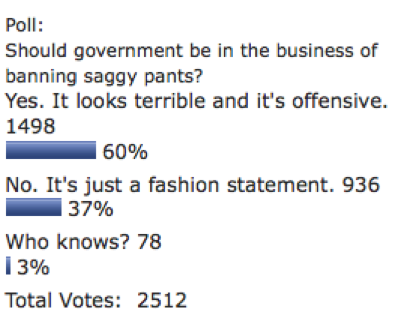
*** UPDATE *** A large majority of a nearby town may actually be nuts. From the Belleville News-Democrat’s unscientific reader poll…
Minnesota’s state government shutdown is causing a big problem for brewing giant MillerCoors. The state has told MillerCoors it needs to pull its products from stores, bars and restaurants statewide because of a licensing problem caused by the shutdown.
Department of Public Safety spokesman Doug Neville said Wednesday that MillerCoors’ “brand label registrations” with the state have expired. The employees who process renewals were laid off when state government shut down July 1 in a budget dispute.
Neville says Chicago-based MillerCoors LLC has been told to come up with a plan for pulling its products in a few days.
* The Question: With this latest development, can Illinois finally shed its image as the most screwed up state in the nation?
* Back on March 1st, when the Wisconsin labor protests were still raging strong, the Democratic Governors Association announced that Gov. Pat Quinn would be their new finance chairman. Quinn’s strong fundraising record the previous year among unions, particularly public sector unions, was a major asset at the time, and a counterpoint to what was happening in Wisconsin, Ohio and other states with Republican governors…
DGA Vice-Chair North Carolina Gov. Beverly Perdue said Quinn’s “strong record of fighting for working families has earned him the support of Democratic donors, and I have no doubt he will be successful in his new role as Finance Chair. Gov. Quinn knows the importance of successful fundraising and will be a tremendous asset for us as we expand the ranks of Democratic governors.”
* That relationship has since soured, of course. And as subscribers found out several weeks ago, Quinn’s legislative push to strip some state workers of their union cards and prevent others from joining the union brought a nasty little rebuke from the the AFL-CIO, which ominously tied the issue to DGA’s fundraising…
Governor Quinn has recently taken a more active leadership role in the National Democratic Governors’ Association, particularly in fundraising efforts. He has, as recently as April 2011, chided Republican Governors for stripping public employees’ collective bargaining rights around the country. Behind the scenes, national labor leaders, including National AFL-CIO President Trumka, called Governor Quinn to request further negotiations on this issue. Quinn continued to pursue SB 1556 despite the calls. It remains unclear whether Governor Quinn will be an effective fundraiser for the Democratic Governors’ Association following his pursuit of this anti-worker legislation.
Trumka’s involvement set off some serious alarm bells. But, so far at least, this conflict hasn’t impeded DGA fundraising. In fact, the group just broke its own six-month fundraising record…
The DGA’s $11 million intake doubles what the committee raised in the first half of 2007, when the same set of governorships were up for election. In that cycle, the DGA raised $5.38 million in the first six months of 2007 and ended the reporting period with $3.7 million in the bank.
This time, the DGA finished June with $8.6 million cash on hand for this year’s elections in Kentucky, West Virginia, Louisiana and Mississippi, and the larger set of races coming in 2012. […]
“While Republican governors have focused on divisive and partisan politics, Democratic governors are leading the way by creating jobs, improving schools, and making the responsible budget cuts necessary to live within our means,” said O’Malley, who became DGA chairman this year amid speculation about his national aspirations.
The Republican Governors Association doubled the DGA take, by the way. The governor is heading for Salt Lake City tomorrow for another DGA fundraiser.
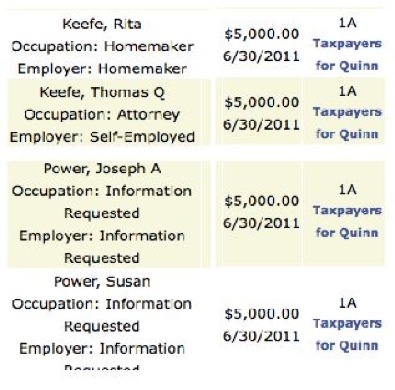
* Meanwhile, Gov. Quinn appears to be getting around the state’s new individual fundraising cap by soliciting contributions from husbands and wives at the same time. For instance…
Former Illinois state Rep. Mike Boland said Tuesday he won’t announce a final decision on whether to run for Congress until after Labor Day. But he rejected the idea that waiting until then will put him at a disadvantage with three others who already are in the race.
You gotta give the guy credit. I mean, heck, Cheri Bustos announced last night that she planned to kick off her congressional campaign today and was barely covered at all.
* But Boland is an amateur compared to Congressman Bobby Schilling. First, he leaked a little item to a Rockford TV station that he would be in town last weekend…
The man who could represent parts of Winnebago and Stephenson Counties in Washington, D.C. will be in Rockford this weekend. Congressman Bobby Schilling plans to go to a Rockford Forrester’s game Saturday night at Marinelli Field.
Because of the newly approved congressional boundaries, Schilling would take over areas that Congressman Don Manzullo used to represent. The new maps put parts of Winnebago and Stephenson Counties in the 17th U.S. Congressional District. They used to be in the 16th District.
Schilling also says he’s holding off on campaigning in his new district until the lawsuit is over.
“We’re not doing that much preparing for it we’re waiting to see what the lawsuit holds. We could end up with the same district we had before. We’ll let the courts decide what they consider to be a fair and balanced map and that’s pretty much all I can say on the map.”
The leader of one of the five major trade unions working at McCormick Place announced it has agreed to abide by the state-imposed labor rules that were recently tossed out.
Under a new three-year pact, the Machinery Movers, Riggers & Machinery Erectors Local 136 agreed to follow the blueprint laid out by the General Assembly last year, with work-rule changes that allowed exhibitors to do more of their own booth setup and that limited overtime pay and crew sizes.
Gov. Pat Quinn suggested Tuesday calling state lawmakers back to the capitol before their fall veto session to pass new convention-friendly, labor-rule changes at McCormick Place to replace those stricken by a federal appeals court.
“If it’s necessary to reconvene in the General Assembly before October to get this mission accomplished, then that’s what I’m ready to do,” Quinn told reporters after a bill-signing ceremony on the Southwest Side.
McCormick Place officials on Monday lost a second court battle to keep disputed labor changes in place at the convention center.
The U.S. Court of Appeals for the 7th Circuit denied McCormick Place’s request to temporarily continue the labor changes while two unions challenge them. But the court approved an expedited appeal. In June, U.S. District Judge Ronald Guzman had nixed McCormick Place’s plans to continue operating under the labor-law reforms.
* Meanwhile, the new state workers’ comp reform law required firing all the arbitrators. Some of them have filed suit…
Five arbitrators likely to lose their jobs in an overhaul of the Illinois workers’ compensation system are suing the governor.
The employees say they did nothing wrong, but will probably be replaced anyway under a law passed this year. They also complain that Gov. Pat Quinn damaged their reputations by saying their replacement was among needed workers’ compensation reforms.
“These people had vested rights in their employment, and they (the rights) can’t be taken away from them when they haven’t done anything wrong,” said Carl Draper, the Springfield lawyer who filed the case in federal court in Springfield. The five live in the Chicago and Elgin areas. Each makes more than $100,000 annually, Draper said.
Newspaper stories have questioned a rash of workers’ compensation awards to employees of the Menard Correctional Center, but Draper said his clients had nothing to do with those awards.
“A contract is a contract,” one union member after another told me.
I replied that many Americans think public employees are overpaid, lazy and have pensions that tax dollars can no longer support. […]
With taxes increasing, government budgets being cut and the rise of the Tea Party movement, government employee unions may be facing a perfect storm. There may not be the money, nor the will, to meet their demands in the future. […]
The climate is changing rapidly for public employees. The anti-union Ice Age may already be here.
As motorists drive by the demonstrators, many honk their horns as a sign of support. But I’m not convinced that they represent a majority of taxpayers.
Even so, Kadner concluded that the workers should get their promised raises.
Unions and legislators who worked on Illinois’ landmark education reform legislation are upset with an advocate who bragged in Aspen last week that he snookered them into accepting drastic cuts in teacher union’s rights.
“There was a palpable sense of concern if not shock on the part of the teachers’ unions of Illinois that Speaker [of the House Mike] Madigan had changed allegiance and that we had clear political capability to potentially jam this proposal down their throats the same way that pension reform had been jammed down their throats six months earlier,” Jonah Edelman, chair of Oregon-based Stand for Children, said in Colorado last week.
“They essentially gave away every single provision related to teacher effectiveness that we had proposed — everything we had fought for in Colorado,” Edelman said in Aspen.
An education activist’s blunt tale of wooing House Speaker Michael Madigan and outfoxing teachers unions created a stir Tuesday by violating a cardinal rule of Statehouse power plays — what happens under the dome stays under the dome.
The Illinois Federation of Teachers, still inexplicably, went to war with Speaker Madigan [over the pension reform bill]…
The union could have – well, probably should have – thanked Madigan for not going further. Instead, they decided that the $2 million they had been giving him reliably for election campaigns – they would take that away … that they would refuse to endorse any Democrat who voted for that legislation, even those that had been loyal supporters for years. They went to the AFL-CIO trying to get them to do the same. So, a major breach. […]
My position was we had to be involved to show our capabilities, to build some clout. … While there were a lot of folks, I think, who thought the Republicans were going to take over in Illinois, our analysis was that Madigan would still be speaker. … That wasn’t what I think a lot of our colleagues wanted to hear.
So our analysis was he’s still going to be in power, and as such the raw politics were that we should tilt toward him, and so we interviewed 36 candidates in targeted races.
I’m being quite blunt here. The individual candidates were essentially a vehicle to execute a political objective, which was to tilt toward Madigan. The press never picked up on it. We endorsed nine individuals – and six of them were Democrats, three Republicans – and tilted our money toward Madigan, who was expecting because of Bruce Rauner’s leadership … that all our money was going to go to Republicans. That was really a show of – indication to him that we could be a new partner to take the place of the Illinois Federation of Teachers. That was the point. Luckily, it never got covered that way. That wouldn’t have worked well in Illinois – Madigan is not particularly well liked. And it did work. [Emphasis added]
Chicago Teachers Union officials say they can meet the 75 percent vote required under a new education reform law should they choose to strike.
Union officials were responding to controversial comments made by Stand for Children’s national director Jonah Edelman in a youtube video that has surfaced of a talk he gave at the Aspen Ideas Festival on June 28. Edelman described his group’s strategy for getting approval of Illinois Senate Bill 7, which he said would effectively end the union’s chance of striking. […]
The bill, which also makes it more difficult to get tenure and streamlines the process for firing bad teachers, requires that 75 percent of the Chicago Teacher Union’s eligible voting membership—not just a majority of members–authorize a strike.
On Tuesday, CTU spokeswoman Liz Brown said the union can meet the 75 percent requirement. She said teachers would understand that not voting would essentially mean a “no” vote, and would “vote accordingly.”
* But the CTU’s past performance was looked at by Catalyst…
In 2003, the last time the union had a strike vote, 15,965 out of 33,000, or 48 percent of eligible members, voted. Before that, in 1991, nearly 60 percent of teachers participated in a strike vote. In both cases, teachers authorized the strike, but an agreement was reached before it took place.
In the 1980s, during which five strikes took place, the numbers of teachers who participated in the votes was low. In 1987, about 15 percent voted and, in 1985, about 14 percent. But in those years, more than 90 percent of teachers who participated voted to authorize a strike, and union leaders said they had overwhelming support, according to newspaper accounts.
Still, union leaders dispute Edelman’s basic premise that they will never be able to get a strike authorized.
CTU spokeswoman Liz Brown says she was told by someone with historical knowledge that, in different years, CPS locked the schools to prevent voting from taking place, forcing teachers to go downtown to vote. This created artificially low participation, she adds.
The union will need 75 percent of all eligible members to vote for a strike. It looks pretty darned difficult to me. Then again, the CTU didn’t have to get that sort of turnout in the past. They could structure a strike vote to really anger and fire up their membership.
After the election we went back to Madigan, and I confirmed – reviewed the proposal that we had already discussed and I confirmed the support. He said he was supportive. The next day he created an Education Reform Commission and his political director called to ask for our suggestions who should be on it. And so in Aurora, Ill., in December, out of nowhere, there were hearings on our proposal. In addition, we hired 11 lobbyists, including four of the absolute best insiders, and seven of the best minority lobbyists – preventing the unions from hiring them. We enlisted a state public affairs firm. We had tens of thousands of supporters. … We raised $3 million for our political action committee. That’s more money than either of the unions have in their political action committees.
Madigan spokesman Steve Brown said Tuesday that the speaker had an early meeting with the group and, believing that it would be likely to back GOP candidates, “urged them to look at balance” by supporting Democrats. Brown also said it was common practice for Madigan’s issues staff to “reach out to groups all the time” about legislation.
* The IEA, IFT and CTU released a joint statement yesterday on Edelman’s comments…
By falsely claiming to have manipulated people engaged in honest negotiations, Stand for Children’s leader jeopardizes the ability of education stakeholders to work collaboratively in the future. That can make it harder to improve education quality for children. That’s wrong.
What’s worse is that these false claims clearly show an organizational agenda that has nothing to do with helping kids learn.
Jonah Edelman’s mischaracterization of the SB7 negotiations will not change our commitment to do what is right for kids and to make sure the adults are treated fairly.
However, his openness about Stand for Children’s tactics and agenda will make it very difficult for any education advocate or politician to interact with the organization in the future.
So in the intervening time, Rahm Emanuel was elected mayor … and he strongly supports our proposal. Jim [apparently Crown] … talked about the talking point that we made up and he [Emanuel] repeated about a thousand times, probably, on the campaign trail about the Houston kids going to school four years more than the Chicago kids. That was another shoe that dropped, and it really put a lot of pressure on the unions, particularly on the Chicago Teachers Union because they didn’t support it.
Emanuel spokeswoman Chris Mather said the campaign came up with the Houston comparison on its own. She also said the mayor “worked with the CTU to pass the legislation to provide better education for children.”
I deeply regret that I had an “us vs. them” tone. That tone contradicts my deeply held view that key aspects of the current education system are the problem, not teachers’ unions, and that the us vs. them far too often prevents real dialogue that results in better solutions like Senate Bill 7. […]
I’m disappointed in myself for the way I framed the Senate Bill 7 story – a framing that does not reflect the good-faith and substantive negotiations that drove this process on all sides. […]
I was wrong to state that the teachers’ unions “gave” on teacher effectiveness provisions when the reality is that, indeed, there were long, productive negotiations that led to a better outcome than would have occurred without them. […]
I was wrong to make assumptions or comments about the unions’ political strategy. […]
I know from conversations with [IEA and IFT leaders] that Illinois’ union leaders are deeply committed to teaching and learning, that they have exhibited that consistently in the past, and that they exhibited that commitment in spades throughout the negotiations on a series of Senate Bill 7 provisions that will improve teaching and learning.
I want to apologize specifically to [leaders and staff of IEA, IFT and CTU] who represented their membership and negotiated creatively and seriously to help craft a bill that addressed tough issues in a fair and thoughtful way.
Edelman’s apology for misrepresenting the negotiations with unions did not explain other comments made in Aspen suggesting that his organization attempted to purchase political influence.
Edelman’s threats to lawmakers who didn’t go along with his anti-union proposal last year were noted by, among others, Sen. Kimberly Lightford, who presided over the SB7 negotiations.
At the IEA Lobby Day last May, Lightford called out Edelman for engaging in ”Pay to Play” politics.
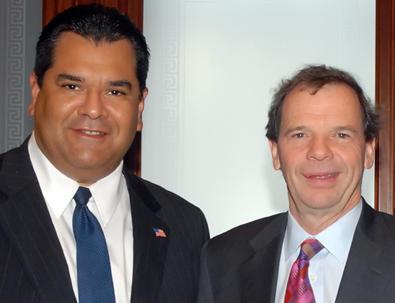
* I’ve debated for a few days about whether to post this, but in the end decided that I simply could not resist. Sen. Martin Sandoval and Senate President John Cullerton posed for a recent photograph…
Please, keep it clean and printable, people. Have fun, but don’t get yourself banned.
Winner gets a free ticket to the July 25th White Sox game.
* OneMan was at the Thompson Center today and interviewed AFSCME Council 31 Executive Director Henry Bayer about the feud with Gov. Pat Quinn. Have a look…
Two locals of the Illinois Federation of Teachers, Illinois Federation of Public Employees (IFPE) Local 4408 and Illinois Federation of Teachers, Local 919, have joined the American Federation of State and City Municipal Employees in their lawsuit against the state and Gov. Pat Quinn for his decision to freeze state worker pay despite a contractual two percent raise promised to the employees.
“This suit is about much more than workers not receiving pay raises, this is about upholding a collective bargaining agreement” IFPE Local 4408 President Tom Kosowski said. “These men and women, who perform quality services for the tax payers of Illinois, deserve to know that their employer, the governor, will honor his commitments under the law.”
* The Question: Should Gov. Quinn rescind his decision to block contractual union pay raises? Take the poll and then explain your answer in comments, please.
* The same Chicago Tribune editorial board which dismisses contract rights specifically embedded in the Illinois Constitution for state employees and pensioners now says that breaking a union contract is a bad idea…
We don’t see a lasting way for Quinn to enforce cutting the [AFSCME contract] raises, if that’s genuinely his game here. Breaking contract promises is perilous business — even if the promise in question was made by another governor, one Rod Blagojevich, during his reckless reign over state finances. Blagojevich showered pay increases on AFSCME, and Quinn inherited the task of paying for them. […]
If Quinn felt the need to break a promise, he should have broken the foolish promise he made in 2010 to insulate his then-friends at AFSCME from every economic reality that might come along. Instead he has unilaterally broken a labor contract.
In response to Gov. Pat Quinn’s decision to freeze state worker pay, the American Federation of State and City Municipal Employees (AFSCME) Council 31 will be setting up statewide picket lines tomorrow at more than 75 locations “in defense of collective bargaining.”
A bipartisan panel of state lawmakers will put off a decision tomorrow on a request by Gov. Pat Quinn to block scheduled 2 percent pay increases for 30,000 unionized state workers, the co-chair of the committee says.
The workers’ union filed a federal lawsuit Friday in Springfield asking a judge to order the administration to pay the wage hikes that were scheduled to start July 1. The union has accused Quinn of violating terms of its labor contracts.
In light of the lawsuit, the co-chairman of the Joint Committee on Administrative Rules decided to keep lawmakers out of the legal fight, at least for now.
State Rep. Angelo “Skip” Saviano, R-Elmwood Park, said after talking to various panel members, he felt it was prudent to defer action on the pay-raise issue. Saviano also said the 376-page proposed emergency rule was not on the panel’s agenda. The committee, however, may have to take up the matter at its scheduled mid-August meeting, barring any court ruling, Saviano said.
McCormick Place [yesterday] lost a second court battle to keep sweeping labor changes intact while it appeals a federal court ruling against new work rules.
The U.S. Court of Appeals for the 7th Circuit denied a request by the Metropolitan Pier and Exposition Authority to keep the exhibitor-friendly labor changes, designed to keep trade shows in Chicago, in effect temporarily. It’s the third legal blow to the organization that oversees McCormick Place.
In June, a federal judge denied the Authority’s initial attempt to stay an injunction on the labor rules.
* Roundup…
* Money Missing From Education Reform Bill: Lawmakers stripped more than $500,000 from Quinn’s proposed budget that would have helped implement Senate Bill 7, a sweeping education reform bill lauded as a national model, partly because it eases the process of dumping poorly rated teachers. The money would have paid for a contract with a private firm to handle training to revamp teacher and principal evaluations.
* I’ve said it before and I’ll say it again, one of the biggest mistakes the General Assembly has made in the past two years was to give the Gaming Board oversight of the video gaming law. This program should’ve gone to the Lottery, which already had a statewide network and a long list of approved vendors. The Gaming Board is intent upon reinventing the wheel, and it is obviously in over its head…
The biggest issue yet to be resolved is when video gambling will begin. Illinois Gaming Board Chairman Aaron Jaffe called it an “open-ended question” and said he doesn’t have an answer. He said his agency is understaffed and struggling to keep up with background checks and security screenings that must be done on hundreds of businesses seeking a piece of the new industry. They range from machine manufacturers to distributors to owners and repair workers.
Another major holdup is the need to hire a company to operate the centralized computer system that will oversee the thousands of gambling machines spread across the state. Bids are being reviewed, but Jaffe said major questions about such a system remain.
For instance, Jaffe said, it will be easy to tell if machines are being tampered with and if payouts are fair, but it will be nearly impossible to monitor who is using the machines, be they children or intoxicated adults.
That last sentence just blows my mind. The state doesn’t “directly monitor” who buys alcohol or cigarettes, either. Instead, police investigations and stings are used to weed out vendors who sell products to kids. And why should Jaffe be concerned if somebody who has had a few beers slips a dollar into a video poker machine? I mean, the machines are going to be in taverns, after all. Focus, man. Focus.
The Illinois Gaming Board continues to review bidders to supply a statewide communications system that links video poker machines, an essential element before legal gambling can begin.
“We hope to get video gaming off the ground four to six months after the bid is awarded,” spokesman Gene O’Shea said Monday. “We’re still working on those bids.”
O’Shea said he couldn’t predict when the bid would be awarded.
They’ve been working on this for a year, after the Board abandoned its initial award to Scientific Games of New York. Back then, O’Shea said the system might be operating by July of 2011. Well, it’s now July of 2011 and there is no end in sight.
The Gaming Board hates it when I say this, but one could be excused for wondering whether Jaffe, et al are deliberately dragging their feet.
“I think gambling expansion is not going to be a reliable source of revenue for any of the communities in our state,” [Sen. Christine Johnson] told me.
“Gambling can bring a lot of social ills. A lot of seniors on fixed incomes don’t have financial wherewithal to gamble,” she said. “I think we have adequate opportunities to gamble already.”
[Sen. Dave Syverson] said the issue comes down to a competition between Rockford and Beloit, not the merits of gambling.
“A Rockford casino will be taxed and the benefits will be used for economic development right here. It’s true you can’t build an economy on gaming, but if Beloit develops a massive casino, water park, conference center and hotel on the Illinois border, it will be devastating for northern Illinois,” Syverson said.
“We’ll still provide the gamblers, but we’ll get none of the taxes. That’s why I’m involved in this effort. I think most people get this,” Syverson said.
* It’s usually the case that when a reporter isn’t aware of a rule or a law, he or she then deems it as “obscure.” Motions to reconsider a vote are not commonly used, but they have been used forever, often for political reasons. Just ask Sen. Gary Forby about how Senate President Emil Jones used the motion to kill his ComEd proposal. The motions are clearly defined in both House and Senate rules and I’ve seen them used more times than I can count.
The motions are usually only effective when used by the majority party. If a Republican made such a motion, the majority could simply go to that order of business on the calendar and kill it. Even so, Mark Brown does have a point that Senate President John Cullerton probably ought not to get in the habit of using this motion, as he did this spring with both the ComEd bill and the gaming expansion bill…
…Senate President John Cullerton, a Chicago Democrat, is using an obscure parliamentary maneuver to keep both bills on hold in his chamber, in effect holding them hostage while he and others try to convince Quinn not to veto them.
Despite a Constitutional provision that gives the Legislature 30 days to present any bill to the governor after its passage, Cullerton says he could, in theory, hold both bills in this manner until the end of the legislative session in January 2013, when they would die without ever getting to the governor.
That strikes me as a bad way of doing business that fouls up the legislative process, and it ought to be nipped in the bud before it becomes a normal element in the Springfield give-and-take.
Cullerton tells me I’ve got it all wrong and that this is an unusual situation that calls for a rare use of an otherwise well-established parliamentary procedure — a motion to reconsider. Holding these bills is not just legal but will produce a better outcome for the public than if he were to rush the bills along to the governor, Cullerton says. Action could come this fall, he said.
A judge in Springfield today ordered that Catholic Charities can keep serving foster children despite the state’s decision to eliminate their contract.
The order is temporary and a hearing will take place in August on the issue.
Sangamon County Judge John Schmidt issued the ruling after both sides offered lengthy arguments in court this afternoon. Schmidt said that his order freezes the state’s contract with Catholic Charities as it was before the state decided to cut it off earlier this month.
Sangamon County Judge John Schmidt said he was returning the situation to what it was on June 30, before the Department of Children and Family Services terminated contracts it held with Catholic Charities in Springfield, Joliet and Peoria.
“I’m putting a freeze on this case until we can (argue) the issues,” Schmidt said. “We’re not going to be removing children from homes.”
[ *** End Of Updates *** ]
* As I see it, there are two very different, yet very persuasive arguments in this battle over whether Catholic Charities ought to be allowed to continue to provide foster care services even if the group refuses to comply with the civil unions law mandate. First up, Rep. Greg Harris, the sponsor of the civil unions law…
“They’re totally within their rights to determine who can or cannot be married under their church law or who can be married by a priest or rabbi or in their facilities, but this is different,” Harris said of the religious groups. “But here, they’re coming to the state to get contracts to provide government services on behalf of the state. They can’t pick and choose which Illinoisans they think are worthy of those services.”
It’s hard to argue with that. This is state money, which is controlled by state law. If you want some of that state money, it naturally follows that you should comply with state laws. If you don’t want to comply with the laws, then don’t ask for the money. After all, obtaining state contracts is not an inherent right. Simple, right?
* Well, it’s actually not that simple. For a very long time now, Catholic Charities has had an agreement with the state that allows it to get around some government requirements…
Before the civil unions law, DCFS and Catholic Charities had operated with the understanding that the agencies could refer co-habitating couples to other agencies.
So, it looks as if DCFS and the governor’s office have changed longstanding practice. However, the civil unions law did change the facts on the ground. That’s why it’ll be up to the courts to decide whether Gov. Pat Quinn’s administration has become radicalized, or whether Catholic Charities’ practices are so out of step with the law of the land that they cannot be allowed to continue in the foster care program.
Breen said it is clear the General Assembly did not intend to force religious institutions to recognize civil unions if it conflicted with their beliefs.
“We think we have a strong legal position and a reasonable interpretation of the law,” Breen said.
I would never want the state telling a religious institution how to practice its beliefs. Period. But that doesn’t mean those institutions are guaranteed a share of our tax money.
* Meanwhile, two conservative religious charities have decided to remain in the state’s foster care program, even with the new mandates…
Lutheran Child and Family Services and the Evangelical Child and Family Agency both have had policies that require foster care parents to be married. LCFS has renewed its contract and promised to abide by state law. Marlowe said the state will seek a similar promise from ECFA.
Ken Withrow, executive director of ECFA, said the agency will continue to uphold the same policies and principles, which includes licensing only married, evangelical Christian couples unless the prospective foster parent is related. Family comes first, Withrow said. He added that lawyers reviewed this year’s DCFS contracts before signing them and saw no language that prevented them from signing in “good faith.”
Lutheran Child and Family Services should not be confused with Lutheran Social Services of Illinois. Those are two very different groups.
* But what about the children? There are about 2,000 foster kids in Catholic Charities’ system, according to the state…
Peter Breen, a Thomas More Society lawyer who represents the three dioceses in the dispute, called the state’s termination of the diocesan foster-care and adoption contracts with DCFS “surprising and shocking.”
“It just seems reckless to take almost 25 percent of the state’s foster children and rip them out of the agency that’s been caring for them. They’ve been caring for Illinois children for over 100 years,” Breen said.
Indeed, Catholic Charities founded the first foster care program in Illinois back in the 1920s, then convinced the state to institute its own program shortly thereafter. But DCFS seems confident it can find groups to help all the kids…
Earlier this year, Catholic Charities in Rockford bowed out of foster services rather than have to place children in the homes of same-sex or unmarried couples. All 300 children in the Rockford agency’s care were placed with Youth Services Bureau of Illinois Valley by the end of June. Also, DCFS placed 1,000 children who were with Catholic Charities of Chicago with other agencies after ending contracts with it.
“Illinois has a strong non-profit child-welfare community that stands to reach to take these cases if necessary,” Marlowe said.
Catholic Charities of Chicago had to terminate its participation in the foster care program after it couldn’t find an insurance carrier to cover it. The organization was sued for millions of dollars over child abuse allegations. The vast majority of other states protect state-sanctioned, private foster care providers from lawsuits like the ones which hit Chicago’s organization, and the State of Illinois is itself immune from the same sort of suits.