Governor Pat Quinn today announced several top appointments to state agencies. Today’s actions are the latest in a series of appointments the Governor is making as he continues to fulfill his commitment to creating jobs, fostering economic development and increasing efficiency and accountability in all areas of state government.
Governor Quinn today named Jay Rowell as director of the Illinois Department of Employment Security. Rowell is a former deputy director in the Chicago City Clerk’s Office, where he modernized operations and dramatically enhanced transparency by making 27 years of searchable city information available online. He holds a juris doctorate from Loyola University Law School, and is a former writer for the school’s Consumer Law Review and Public Interest Law Reporter. Rowell replaces Maureen O’Donnell, who now serves as Director of Human Resources for Cook County. His appointment takes effect Monday.
Curiously, Quinn’s release didn’t mention that Jay runs the Senate Democrats’ political operation. Whatever the case, his nomination is obviously going to zoom through the Senate.
* 4:23 pm - Gov. Pat Quinn just signed the state legislative redistricting bill. From a press release…
“Ensuring that everyone’s voice is heard in government is crucial to our democracy. For the first time, the people of Illinois have been able to participate in public hearings and have their voices heard in drawing their legislative districts. I would like to commend lawmakers for significantly increasing openness and transparency in the remap process,” said Governor Quinn. “I commend Sen. Kwame Raoul and Rep. Barbara Flynn Currie for their leadership in drafting a map that better represents the interest of our diverse communities.”
* The congressional redistricting bill is still awaiting his signature. More on that topic…
In a letter to Gov. Pat Quinn, several Illinois businessmen and former GOP members of Congress called on him to veto the new congressional redistricting map, arguing that it is both unconstitutional and unfair.
The letter senders represent a nonprofit group, the Committee for a Fair and Balanced Map, that has been raising money for months to mount a legal challenge to the remap.
The letter telegraphs the grounds for a potential lawsuit, arguing that the preliminary map drawn by the Democrat-controlled Illinois House and Senate does not meet Constitutional requirements that districts should be compact and center around communities of interest while protecting the interests of minorities.
“Instead, this proposal fractures longstanding communities with gerrymandered boundaries for apparent partisan purposes,” said the letter, signed by former Rockford GOP Rep. Lynn Martin, chair of the committee, and seven others.
* 4:12 pm - Sen. Kyle McCarter has issued another statement about the ruckus on the Senate floor. It’s a bit weird. First, notice that his statement doesn’t use the word “punch”…
In debate on the Senate floor, Sen. McCarter pointed to other procedural problems which included $70,000 in political donations from Ameren to political funds controlled by some of the Senate leaders, and a lobbyist for Com-Ed who also happens to be the father of the committee chairman. That disclosure led Sen. Jacobs to walk across the aisle to personally confront Sen. McCarter. Jacobs’ speech was laced with profanity ending with him striking Sen. McCarter on the chest and knocking him backward.
* Then Sen. McCarter blames Senate leadership for not stepping in quickly…
“If the leadership of the Senate would have immediately admitted and documented that I was assaulted and then proactively stepped up to invoke a type of censure, filing a report with the Capitol Police would not have been my only option,” said McCarter.
He doesn’t say whether he asked for such documentation and censure, however.
* He also appears to contradict the Sergeant at Arms, who said yesterday that he asked McCarter if he wanted to file a complaint and McCarter refused…
“The Senate’s Sergeant At Arms kindly asked if I was ok or needed an escort to my office but did not provide a legal process for filing a complaint. His concern for my safety was obvious and I thank him.”
Those are awfully lawyerly words, if you ask me.
* And he even suggests an attempted cover-up…
“However, the parliamentarian came to my desk afterwards to suggest this could be dealt with somewhere else when “cooler heads prevail,” not admitting the assault happened or that Sen. Jacob did anything out of order. Sen. Jacob’s party was making an attempt for this to just go away quietly. As legislators we need to set an example for ethical and appropriate behavior. Trying to sweep the incident under the rug sends a very poor message to the public and especially to young people who are skeptical of government anyway.”
Mayor Rahm Emanuel and Chicago Public Schools chief Jean-Claude Brizard on Thursday announced $75 million in cuts to the school district’s central office and hinted that the state and the Chicago Teachers Union should do the same.
“We need to make those cuts, but it makes a statement as powerful as the money about where you set the priorities,” Emanuel said. “Everybody has to have some skin in the game to make the changes necessary.” […]
“The fact that there is $75 million in achievable savings in administration and bureaucracy underscores the need for more transparency about CPS spending,” Lewis said. “The citizens of Chicago need to see every line of school spending—how much is spent, on what and to whom.”
Trouble is, the new state budget approved by the General Assembly cuts Chicago schools by $77 million. So, Chicago didn’t even tread water with yesterday’s announcement.
A day after Cook County Board President Toni Preckwinkle blamed him for the county health and hospital system’s financial woes, Gov. Pat Quinn in Chicago Thursday steered clear of any commitment to fork over some $38 million in Medicaid reimbursements.
Preckwinkle said she was “disappointed” in the governor’s response to her requests for Medicaid reimbursements, money desperately needed against the county health and hospital system’s projected shortfall of $40 million in the first five months of the year.
“Here’s what we’re trying to do, on the 30th of this month is a deadline for us to get enhanced Medicaid match (money) from Washington. We can get more money from the federal government for our healthcare,” the governor told reporters.
“We have to focus on that, it’s worth about $100, $200 million. That’s what we have to focus on,” said Quinn.
Asked when the county might see the money, the governor walked away, saying: “Pretty soon. OK. Thank you.”
Education and human services, along with the workers who deliver them, take the biggest hit in the state budget just approved by Illinois lawmakers.
Groups that provide services for the state will feel the pinch, too. Legislators took no steps to catch up on more than $6 billion in overdue bills from small businesses, charities and local agencies.
Lawmakers insist they had no choice but to rein in spending. Anything else would have deepened a budget hole that state government has been trying to escape for years now. […]
The University of Illinois, for instance, loses all $40 million of the money set aside for contractual services. The Corrections Department and its overcrowded prisons lose $4.5 million for personnel.
The state’s key social services agencies, the Department of Human Services and the Department of Healthcare and Family Services, lose a combined $227 million for personnel and contracts, or almost one-third of their total.
Regional superintendents of education expressed relief that, for now, funding for their offices would not be cut out of the state’s budget.
The General Assembly sent Gov. Pat Quinn a budget package Tuesday night that keeps most of the offices’ funding with a $11.4 million appropriation. Quinn’s original budget proposal had suggested eliminating the money.
Although local government officials have been fearing the move for more than a year, Illinois legislators do not plan to reduce the amount of income tax revenue the state shares with municipalities like the cities of Champaign and Urbana.
The budget proposal they sent to Gov. Pat Quinn this week maintains that disbursement, which local officials say keeps them from looking for even deeper budget cuts than they have already made.
“It’s good news,” said Champaign Finance Director Richard Schnuer. “Our budget was based on receiving revenues under current legislation.”
* Illinois slow to launch new aid program for delinquent homeowners - Federal government provided $445.7 million last year - ‘It takes time to put it on the street properly,’ state official says
* Editorial: Don’t alter new state bidding process
* ‘Tier 1′ status will allow state workers to keep Clinic doctors
* State keeps public notices requirement but cuts costs to cities and schools
* As we discussed yesterday, there’s some dispute over whether Sen. Mike Jacobs punched Sen. Kyle McCarter with his fist or whether it was more of a poke or an open-handed whack during a Senate floor scuffle. Whatever the case, the matter has been referred to the state’s attorney’s office…
‘’The Capital police report will be fowarded to the Sangamon County States Attorney’s office for determination on filing charges. It could be as early as tommorow. It could be next week'’, said Henry Haupt, spokesperson for the Secretary of States Office. ‘’The investigator is being thorough and complete.'’
Sen. Kyle McCarter says he is pursuing charges against Jacobs, who he says confronted him after he called out the East Moline Senator for sponsoring a bill allowing utility companies to raise their rates without approval from the Illinois Commerce Commission.
Under state law, assaulting a state employee in a public place could be charged as a Class A misdemeanor, which is punishable by under one year in jail or up to two years probation.
Threatening a public official is a Class 3 felony, punishable by two to five years in prison or up to 21/2 years probation.
* The Question: Should Sen. McCarter pursue charges against Sen. Mike Jacobs? Take the poll and then explain your answer in comments, please. Thanks.
* It really is amazing how local newspapers have bought into the contradictory spin on gaming expansion. For instance, Phil Luciano’s column…
Take a good, long look at the [East Peoria] Par-A-Dice [casino]. Maybe even take a picture, while you can.
Could the dock and hotel become a post-gambling ghost town? It’s happened elsewhere. It could happen here.
The culprit? A lazy, shortsighted state government. […]
Now, all they see is dollar signs. And rather than work to base the state’s economy on creating solid jobs and businesses, they’d rather take the easy way out and grab for gambling.
Right now, the Par-A-Dice generates $7 million in local revenue a year. Kiss that sum goodbye. Maybe all of it.
Riverboat reps and local leaders fear the same thing I’ve carping about for years: Chicago will suck away business. It’s not as if the Par-A-Dice is supported solely by area bettors. Tourists and gamblers come in from elsewhere. But if they have a choice between making a trip to Peoria or the Windy City, where do you think they’ll go?
So, the state should be working to create good jobs, but it absolutely should not mess with East Peoria’s admittedly evil jobs in the process by adding some competition far away? OK. And a Chicago casino will kill the Peoria-area’s facility, even though it’ll be 160 miles from there? Right. Even Luciano’s own newspaper thinks that last point is a bit much, although it still wrings its hands…
As such, it’s no surprise that not one local legislator voted for this expansion, with the Par-a-Dice in our backyard producing some $7 million annually to East Peoria and Peoria city coffers. Local government officials fear that number will plummet with downstate competition in Danville and Springfield.
There seems to be less objection to a casino in Chicago, which already is a global tourism draw that could be in line to capture even more outside dollars, of which there is no surplus in Illinois. […]
Again, gambling is the easy yet desperate path here. It’s a substitute for genuine fiscal discipline that for too long has been lacking in Springfield, which is what led to this fiscal meltdown in the first place. If anyone thinks Illinois can sin its way to prosperity - through reliance on gambling and taxes on smoking, drinking, etc. - they’re delusional, looking to quick fixes rather than real ones.
Gambling is the “easy and desperate path” except when it’s in our town!
As happy as the track operators are with SB 744, operators of Illinois’ nine existing casinos are as worried. Revenue was off 4.2 percent last year to $1.37 billion. The bill would add five new casinos, including the mega-casino in Chicago, plus allow slot machines at racetracks and at Chicago’s two airports. That would take Illinois from 12,000 gaming positions to 39,000, putting a saturated market under water.
In the St. Louis market, adding 800 new gaming positions at the two Metro East casinos and 900 at Fairmount would mean a nearly 15 percent expansion. The bistate market is still struggling to absorb the competition from the River City Casino in Lemay that opened last year.
We tend not to worry about the problems of an industry that preys on human weakness. But Missouri and Illinois both have become addicted to gambling taxes. And then there’s the question of the thousands of employees who make their livings in the gambling industry. Hundreds of casino workers could suffer if Mr. Quinn signs SB 744. Hundreds of workers in the thoroughbred industry could suffer if he doesn’t.
He should veto it. The whole thing, including the Chicago casino.
Yes, more competition in an Illinois industry that’s been protected for decades would be just terrible, wouldn’t it?
Illinois Gov. Pat Quinn must be tired of seeing signs that say “Wisconsin is open for business.” He can take a shot at our neighbors to the north by signing the bill that would bring a casino to Rockford. […]
What about the social costs? Studies have found that there are likely to be increases in divorce, separations, marital problems and bankruptcies to name a few. Those problems also occur when a person is unemployed or underemployed.
Other studies show the disadvantages of gambling are exaggerated. In 2000, the Public Sector Gaming Study Commission found “no link between gambling, particularly casino-style gambling, and crime.”
Gambling is not the holy grail of economic development, but if any community in Illinois should be able to expand its tourism and entertainment options, Rockford should.
The governor, like us, is unhappy about lumping in so many other gambling sites with Chicago’s, calling the bill “excessive” and “top-heavy.”
He’s absolutely right about that.
But here’s what Quinn will see when he finally gets his microscope in focus: A bill that will draw in much-needed revenue for Chicago and the state. The state is already slashing social services, education funding and threatening deep cuts to state employee pensions. Adding new revenue is one of the only ways available to soften that blow slightly, to ward off even more draconian cuts in years to come.
We’ve long supported efforts to reduce state spending, but Illinois is quickly reaching a point where the government’s ability to provide core services is in jeopardy.
The bill really sucks, but we need the money, so sign the darned thing.
Since 1934 the URF has been known as the United Republican Fund: an organization dedicated to electing conservative Republicans to office. Run by a volunteer board of business and civic leaders, the URF has fairly and efficiently raised and distributed millions of dollars to countless candidates, organizations, and projects.
This year the URF board of directors reorganized and expanded into three entities:
United to Restore Freedom (URF): a 501c3 not-for-profit organization dedicated to advancing conservative thought and ideas by educating and engaging policy makers, opinion leaders, and citizens on the URF LIFT principles of limited government, individual liberty, free markets, and traditional values.
United to Restore Freedom-Action (URF Action): a 501c4 membership organization formed to mobilize those citizens who subscribe to the URF LIFT principles; and are dedicated to changing our culture through grassroots civic action.
United Republican Fund (URF PAC): a connected, political action committee dedicated to helping elect conservative candidates who espouse the URF LIFT principles. URF PAC provides qualified candidates direct financial support while working independently to mobilize voters on their behalf.
* The press release piqued my curiosity, so I went over to the State Board of Elections’ website and looked up the group’s financials. The URF raised an impressive $505K during the last six months of 2010.
But the group only contributed about $40K to candidates while it racked up $487,592 in expenditures. Of those expenditures, almost $150,000 went to consultants alone. Most of the rest went to expenses for staging the Right Nation 2010 conference, including $75K for speakers, $95K for “event production” and “event videos” and $105K to rent the Sears Centre Arena in Hoffman Estates.
Of course, the largest program run by URF is Right Nation. This year, they plan to take the event to new heights - building on last year’s unprecedented gathering, which drew nearly 6,000 attendees and coverage from over 50 media outlets. This year’s Right Nation 2011 celebrataion will take place over three days and will include a number of prominent national organizations and influential figures, including exciting activities never before seen at a political event in the Midwest.
I sure hope they learned some lessons from last year’s event. It looks like they spent way, way, way too much on overhead.
Daniels told WLS Radio’s The Don and Roma Show, that while Mayor Rahm Emanuel wants a casino to stop Chicagoans from gambling in Hammond, Indiana, Emanuel should have other concerns.
“What he ought to worry more about is the stampede of businesses leaving Illinois. You know your traffic gal Wendy left out one traffic hazard, you stand near the state line now you might get hit by a moving van,” Daniels said Thursday.
“We are talking and signing up businesses left and right. The gambling revenue, I mean, pays a few of our bills but you don’t build a strong state on casinos. You build it on factories and new business startups and you know, places that provide really high paying jobs,” Daniels said.
Daniels also claimed he “never raised” taxes, which is simply not true. He did raise taxes. And if our state tax rates were as high as Indiana’s we’d have a huge surplus to pay off all those back bills. Not to mention that Indiana also allows local income taxes. Listen to the whole thing…
*** UPDATE - 3:52 pm *** The government’s cross-examination has finally begun.
* Could he be cross-examined today? That’ll be fun. By the way, if you have a BlackBerry and can’t access the feed, try clicking here. Otherwise, read on. To get us started, I’ll post Natasha Korecki’s stories from yesterday afternoon…
*** UPDATE 1 *** I talked to Sen. Tim Bivins this morning. Bivins saw the fracas and says he say Sen. Jacobs make “what looked like a fist” and then heard a “thud” as Sen. McCarter was “knocked backward.” Bivins then helped separate the two and got a “huge bruise” in the process when he accidentally slammed into a desk.
*** UPDATE 2 *** Sen. Matt Murphy sits next to Bivins. Murphy told me he saw Jacobs “punch” McCarter. However, Murphy said, “I don’t know whether it was his open hand or a closed fist.”
*** UPDATE 3 *** Hmm. An interesting statement from Joe Dominguez, Senate Sergeant-At-Arms…
The Senate Sergeant-At-Arms is charged with preserving the rules of decorum and orderly behavior in the Senate chamber. While incidents of disorderly conduct are rare, they are not tolerated on the Senate floor.
On Tuesday, immediately following the alleged confrontation between Senator Mike Jacobs and Senator Kyle McCarter, I approached Senator McCarter to inquire whether he wished to file a complaint. Senator McCarter responded that he did not. [Emphasis added]
Joe is top notch, by the way.
[ *** End Of Updates *** ]
* Sen. Kyle McCarter says he will ask the Sangamon County State’s Attorney to file a criminal complaint against Sen. Mike Jacobs. McCarter says Jacobs punched him in the chest with his fist…
State Sen. Kyle McCarter said Wednesday he wants charges filed against a fellow senator he accused of punching him following a contentious, end-of-session debate over a rate hike for utilities.
“I plan on pressing charges against Sen. Jacobs,” McCarter said. […]
McCarter said Sen. Darin LaHood, R-Peoria, and Sen. Tim Bivins, R-Dixon, pulled Jacobs away. Bivins served as Lee County sheriff for 20 years. “Sen. Bivins and Sen. LaHood have given statements to the Capitol police, verifying what happened,” McCarter said.
McCarter observed aloud [during a Senate floor debate on the ComEd bill] that Jacobs, chairman of the Senate Energy Committee and sponsor of a controversial utility-backed bill, is the son of former Sen. Denny Jacobs, a ComEd lobbyist. The 150-page bill came up for a vote in the last hours of the session after a six-minute committee hearing, McCarter said.
Jacobs’ statesmanlike response was to walk across the aisle and punch McCarter in the chest. He accused McCarter of attacking his family and violating Senate rules about civil debate. […]
Jacobs said his constituents are aware of the relationship and can make up their own minds about whether he has a conflict of interest. Give us a break. A lawmaker who carries the water on a bill pushed by his lobbyist father is going to hear about it, over and over. Better get used to defending yourself with something besides your fists.
* Legislators engaging in fisticuffs on the floor is a rare event, but not unheard of…
The last time two lawmakers got into a similar public confrontation on the floor of either legislative chamber came when former state Rep. Bill Black (R-Danville) got into a shoving match with former Rep. Terry Parke (R-Hoffman Estates) in a 1992 school-funding dispute.
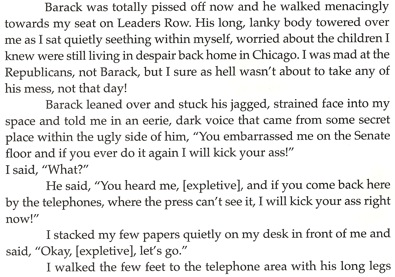
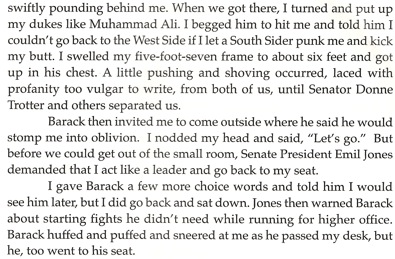
Even President Barack Obama was involved in shoving match with another legislator, former Sen. Rickey Hendon (D-Chicago). That altercation came during former Gov. George Ryan’s stint in office and occurred in the rear of the Senate chamber out of public view, Hendon wrote.
I was in the House press box when Parke shoved Black, and I was in the Senate box when the altercation began between Obama and Hendon. From Hendon’s book…
Nobody in either of those fights pressed any sort of charges. What do you think about McCarter’s announced move?
The map drawn and approved by Democrats in the state legislature creates congressional districts that look like floodplains stretching out from Lake Michigan, starting in relatively small sections of Chicago before stretching over vast tracts of land in the suburbs and across farm fields.
“It’s the most blatant example of gerrymandering I’ve ever seen,” said Will County Republican Party Chairman Richard Kavanagh, one of a chorus of Republicans likely to raise ever louder complaints of the remap that would reduce their numbers in Congress.
But the map does something else, Kavanagh said.
“It gives Chicago control over Will County and brings Cook County politics into Will County,” he said.
U.S. Rep. Jesse Jackson Jr. (D-Chicago) picked up territory throughout eastern Will County where he supports construction of an airport outside Peotone. The strategic move gives him more credibility on the project because he can no longer be criticized for engaging on an issue outside his district. Jackson’s opponents during election time often urged him to mind his own district, not the airport. Now he can do both.
It wasn’t just Jackson’s political opponents who told him to mind his own business. Will County leaders did the same. So, now the airport is his business.
Oops.
* Meanwhile, Lynn Sweet talked to US Rep. Steve Israel (D-N.Y.), the Democratic Congressional Campaign Committee chairman, and came up with these district rankings…
† Eight safe Democratic seats: 1. Bobby Rush; 2. Jesse Jackson Jr.; 3. Dan Lipinski; 4. Luis Gutierrez; 5. Mike Quigley; 7. Danny Davis; 9. Jan Schakowsky, and 12. Jerry Costello.
† Five competitive or swing seats: 8. Considered open, now held by Walsh; 10. Dold; 11. Open; 13. Tim Johnson; 17. Schilling.
† Five Republican lean to GOP safe: 6. Peter Roskam; 14. Hultgren; 15. John Shimkus; 16. Don Manzullo; 18. Aaron Schock.
Rep. Judy Biggert (R-Ill.) left homeless in the Democratic map, may run from the open 11th; Kinzinger is likely to head to the Manzullo district; Walsh may switch to the 14th.
Both in Springfield and in Washington, the GOP reaction to the grim reality of the state’s new congressional map is downright funereal, with some Republicans shaking their heads and marveling at the evil genius behind a gerrymander that could end up costing the GOP as many as five House seats.
A group of Republican business leaders and former members of Congress from Illinois is gearing up to challenge the state Legislature’s new congressional redistricting map, which heavily favors Democrats.
Led by former U.S. House Speaker J. Dennis Hastert and former U.S. Rep. Thomas Ewing, fundraising by the Committee for a Fair and Balanced Map has been quietly under way for months, anticipating that Republicans would not fare well in a process steered by a Democratic-controlled Legislature and a Democratic governor. […]
“Now that we’ve got a map that’s not fair, it will probably take off,” said Ronald Gidwitz, a Chicago investor and former CEO of Helene Curtis Industries Inc., who has contributed to the committee but is not otherwise involved.
Others on the committee are former Rockford Congresswoman and Labor Secretary Lynn Martin, North Star Investments President Alexander “Sandy” Stuart of Lake Forest and Don Wilson, CEO of DRW Trading Group, a derivatives trading firm in Chicago. Also involved is Mayer Brown LLP partner Ty Fahner, who represented Illinois GOP members of Congress in redistricting litigation 10 years ago and a decade before that.
According to published reports and indications from two northern Illinois Republican leaders, Kinzinger, R-Manteno, may now be in the early planning stages of organizing a re-election campaign in the newly-drawn 16th Congressional District — territory now represented by U.S. Rep. Don Manzullo, R-Rockford.
Even though Kinzinger placed his name on a blanket statement the Illinois Republican Congressional delegation issued Friday condemning the new boundaries, the freshman legislator has yet to make any official public comment regarding the Democratic-drawn maps. […]
Susan Thornton, La Salle County Republican Central Committee chairwoman, told The Times last week she remains optimistic about the upcoming boundary changes on the local level for Kinzinger.
“Adam’s numbers were very strong in last November’s elections and I think voters in new and expanded areas of the 16th will find him well-equipped to represent them in both the rural counties and up north through Rockford,” said Thornton.
Republican state Rep. Jason Barickman will announce Thursday that he is running for a seat in the Illinois Senate from the new 53rd district, according to an announcement from his office.
Barickman, a lawyer and chairman of the Champaign County Republican Party, currently represents the 105th District in the Illinois House of Representatives.
He has scheduled announcements Thursday in five communities within the new 53rd District: Bloomington-Normal, Paxton, Watseka, Pontiac and Eureka.
Under the newly drawn Illinois House and Senate legislative maps, Barickman would be running in the same district that includes current state Sen. Shane Cultra, a Republican from Iroquois County. Cultra has not yet announced his intentions, but Barickman’s office indicated he will run whatever Cultra decides.
I’ve just head from a very reliable source that State Sen. Dave Koehler, D-Peoria, will run for Congress in the 17th District. He would face freshman U.S. Rep. Bobby Schilling, R-Colona. Schilling, a Tea Party candidate, defeated Phil Hare in 2010.
“You will not see Koehler make the same mistakes Hare made,” my source said. “Hare shot from the hip too often, Koehler is more in control of his emotions.”
Koehler says he’s talked to a number of people, so that’s why the word is getting out. He said he’ll make an announcement in the next several days.
* No governor likes to be ignored or treated as if he was irrelevant. Pat Quinn is no exception. But that’s just what the General Assembly did to him all spring. I’ve been writing about Quinn being cut out of much of the process since the end of March when I asked Speaker Madigan about it. But it eventually became so obvious that even Chicago reporters started writing about this problem in recent days. Gov. Quinn tried hard to dispel that notion during his press conference yesterday.
* For instance, on the ComEd bill, Gov. Quinn sounded a whole lot like a spurned Rod Blagojevich…
Quinn repeated his vow to veto legislation that would allow Commonwealth Edison to raise its rates to invest in its power grid — coming down on the side of consumers rather than lobbyists in “three-piece suits and fancy shoes.”
* Quinn wanted to delay a billion dollars in payments to local governments, but that didn’t survive the process…
The state budget lawmakers have sent to Gov. Pat Quinn doesn’t touch the 6 percent of income taxes that are sent to local mayors for their own budgets.
“I don’t think anyone who looks at it would say they would be happy with the investment in education. I mention early childhood, scholarships for students who are needy who have the ability to do college work, very disappointed in the fact that they cut funding for kindergarten through 12th grade in our grammar schools and our high schools. That’s no way to build a better Illinois,” the governor said.
“And I will tell legislators of both parties and both houses how I feel about education and how I think the public feels. They didn’t get the job done properly there. It’s incomplete, and I think we need to keep working with them,” Quinn said.
* Quinn didn’t elaborate about whether that would mean a special summer session (a la Blagojevich) or not. But Speaker Madigan controls that fate…
At the last minute, [Senate] Democrats added about $430 million in operations spending to a capital bill. The money would restore money cut from general state aid to schools and the Monetary Award Program for college scholarships and provide additional funds to a couple of dozen human services programs.
The House refused to consider the bill before adjourning. Instead, House Speaker Michael Madigan, D-Chicago, said he wanted a conference committee of representatives and senators to work out a solution over the summer.
…Adding… It was early in the morning when I posted this, so I just agreed with something that I actually knew was not true. I knew that Madigan passed a non-concurrence motion. Heck, I told subscribers about it. That bill is in the Senate now.
He voiced particular concern about the proposed cuts to early childhood education. “You don’t get to be a 3-year-old two years in a row. And I’ve told the leaders of the Legislature that we have work to do when it comes to early childhood education,” Quinn said.
There’s hope by many legislators that money will be added back in the fall or (more likely) in January if state revenues pick up.
“I have told the legislators over and over again the people of Illinois do not want an excessive gambling bill that’s top heavy, and I think I reflect the public sentiment on that,” Quinn said.
“In Chicago, I have said I can see if it’s properly done, an opportunity for a gambling casino. But once the General Assembly got this subject, both House and Senate, it got more and more top heavy. Well my job is to make sure the people of Illinois come first, not the gamblers, not the insiders,” the governors told reporters in his Statehouse office.
Quinn also revealed that about 10 days ago he had a conversation with Chicago Mayor Rahm Emanuel “about the general subject of a casino in Chicago.” The governor said he told the new mayor, who was a vital force in winning support for the gambling package, that “we can’t have an excessive gaming bill in Illinois, that I thought the public wasn’t for that.”
“In my conversations with him he sees the strengths,” Emanuel said.
There could be an amendatory veto on the bill, but there might not be enough votes in both chambers to sustain such a move.
And as subscribers were told yesterday morning, Quinn won’t even get the bill until Senate President John Cullerton takes a procedural brick off it…
Sen. Dave Syverson, R-Rockford, said a procedural maneuver by Senate President John Cullerton, D-Chicago, to move for reconsideration of the bill, actually protects it and works to Rockford’s benefit.
Syverson said the motion to reconsider means Cullerton can control when the bill is forwarded to the governor.
“It’s probably good news from a Rockford standpoint,” Syverson said. “This way he can control it until he has a chance to negotiate and talk to the governor about it.”
* The best way for a governor to flex his muscles and prove his relevancy is through vetoes, and the ComEd bill isn’t the only bill that’s heading for the chopping block…
Although the governor has not officially decided on Senate Bill 178, State Rep. Chapin Rose said Governor Pat Quinn made his decision on the House floor Tuesday night.
A group of the bill’s supporters approached Gov. Quinn Tuesday, Rose said, and asked him to strongly consider passing the bill.
The bill would allow Health Alliance and other health insurance providers to stay with their customers for two more years.
* Quinn vetoed this project during the spring, so the GA revamped it and sent it to him again…
In the waning hours of the state’s legislative session, lawmakers on Wednesday sent Gov. Pat Quinn a revamped bill that could pave the way for construction of a $3-billion synthetic gas plant on Chicago’s South Side.
Mr. Quinn in March vetoed a previous version that would have forced the state’s natural gas ratepayers to shoulder the higher costs of the gas the plant would produce. But Leucadia National Corp., the New York-based conglomerate developing the facility, agreed to consumer protections that limit rate increases and spread the burden of higher prices to businesses that buy gas from non-utility providers. […]
Unlike the version Mr. Quinn vetoed, the current bill would cap the rate increase at 2%. The earlier bill would have exempted customers of alternative gas suppliers, but this one includes them.
* Listen to the governor’s press conference in two parts…
* Elgin may lobby Quinn against gambling expansion
* Gambling’s expansion gets a poor reception - No Peoria area lawmakers voted for bill that many officials say will draw business away from East Peoria casino
* I checked my website’s usage stats this morning and found that we had near-record traffic on May 31st, the last day of session. Unique visits and page-views were almost equal to the day Rod Blagojevich was arrested, which still holds the all-time record. We actually used more bandwidth on Tuesday than we consumed on RRB’s arrest day, so that’s a new record. And Sunday’s traffic in all categories was higher than any previous Sunday ever recorded here.
The idea is not to make this the biggest website in the world, of course. We’ll never be that. The object is to make this place the focal point of Illinois political life. The combination of the in-depth posts, the timely and comprehensive automated news feeds, the ultra-superior commenters and the breaking news reporting have all contributed to the success of this endeavor.
I simply can’t thank you enough.
* And now that I have your attention, how about taking a quick moment and writing a check for the “Southern Illinois Together” flood relief effort? Many of our fellow Illinoisans are still hurting down there, and they could use your help.
The fundraiser is this Saturday at the Black Diamond Warehouse in Marion (2400 Black Diamond Drive). Tickets are $25 in advance and $30 at the door. They’ll have free food and wine samples, and both a silent and a live auction.
I’m planning to be there, but you don’t have to attend the fundraiser to contribute. Just write a check for whatever you can afford and make it payable to the Poshard Foundation. Make sure to put “Flood Victims” in your check’s memo line. Here’s the mailing address…
Poshard Foundation
700 Logan College Dr.
Carterville, IL 62918
This is a prime opportunity to use the community we’ve created here to do some good. Please help if you can. Thanks.
* OK, kids, I am one tired puppy dog in dire need of sleep. I’ll leave you with live coverage of the Rod Blagojevich trial, which is already in progress…
* Gov. Pat Quinn is planning an 11 o’clock press conference this morning. Quinn dodged reporters all day yesterday, promising he’d have plenty to say today. Listen to or watch the live feed by clicking here. I’ll be posting my own updates as well as Twitter feeds and news links, but please help out with the blogging duties in comments below. Thanks…
People who file piles of requests under the Illinois Freedom of Information Act would have to wait longer for responses from public bodies under legislation that’s cleared the General Assembly.
Government bodies could declare someone a “recurrent requester” for filing more than 50 FOIA requests in a year, 15 in a month or seven in seven days. They could take 21 business days — it’s five days for others — to answer.
Media, not-for-profit organizations and academics are exempt.
* This was an agreed bill with the Illinois Press Association, but not everybody is happy…
Emily Miller, policy and government affairs coordinator for the Better Government Association, explained why her organization opposed the measure.
“If someone files seven requests for information in one week, they are labeled a recurrent requester for a year and would have to wait longer for a response, while a person who realizes you can bundle all seven requests into one FOI request will not be classified as a recurrent requester,” Miller said.
“You can actually ask for an unlimited number of documents in one request and not be deemed a recurrent requester, but the average person isn’t going to know that so we think it is unfair.
“In addition, people are entitled to government information just like they’re entitled to fire and police protection,” Miller continued.
* The Question: Do you agree with this bill to allow governments to delay FOIA responses for “recurrent requesters”? Take the poll and then explain your answer in comments, please. Thanks.
* ComEd had been predicting for days that they could find veto-proof majorities in both chambers. But the bill fell four votes shy of that three-fifths margin in the House and five in the Senate…
Before the House vote Monday, ComEd lobbyists had been telling opponents they were confident they had more than enough support. Then several African-American representatives, who normally vote with ComEd on contentious energy bills, surprised the utility and voted “no.”
Mr. Quinn could veto the bill outright or amend it. When the Legislature meets in November for its annual veto session, it could try to override or agree to the governor’s changes, if he opts for an amendatory veto. Many are expecting ComEd will enter into negotiations with Mr. Quinn over the summer.
“This means that ComEd and (Downstate electric utility) Ameren will have to work with the governor’s office to see if there are changes they can agree to,” said David Kolata, executive director of consumer watchdog Citizens Utility Board, which opposes the bill.
Areas the governor would be expected to focus on include strengthening the consumer protections in the bill. In particular, the bill doesn’t allow electric rates to rise more than 2.5% in a given year, but the rate cap is only good through 2014. From 2015 to the end of 2017, there are no rate caps. In addition, the bill mandates that the utility earn a return on equity of at least 10.25%, but that figure rises as the yield on the 30-year U.S. Treasury bond does—with no ceiling. So, if interest rates rise from their rock-bottom current levels, as many expect, electric rates will, as well.
Quinn’s “position has not changed” from days ago, when he vowed to veto the bill, Quinn spokesman Grant Klinzman said.
Sponsoring Sen. Mike Jacobs, D-East Moline, is taking a wait-and-see approach.
“I know what he says, but let’s see what he does,” Jacobs said. “When people move away from the intense lobbying of the attorney general, the governor and every state agency in Illinois, I think at some point people will look at it for what it is: It’s progress.”
State Sen. Kyle McCarter, R-Lebanon, accused state Sen. Mike Jacobs of “using profanity and pointing his finger before he punched me with his fist in my chest” following a heated debate.
McCarter said he gave a statement about the incident to the Secretary of State police.
Jacobs, D-East Moline, brushed off the incident as an emotional outburst common at the end of a legislative session when big issues are being debated and tempers are flaring.
Jacobs was infuriated that McCarter had accused Jacobs and his father of a conflict of interest on a controversial measure Gov. Quinn has threatened to veto.
Jacobs was chief sponsor of the utility-backed Smart Grid bill. It included an electric utility rate increase worth tens of millions of dollars to Com Ed. Among Com Ed’s army of Springfield lobbyists: former state Sen. Denny Jacobs, father of Sen. Mike Jacobs.
“He stood in front of my desk while I was completing a bill…then he proceeded to verbally just curse at me, then he punched me in the chest with his fist,” McCarter told the Chicago Sun-Times. “It’s totally inexcusable. I think the citizens expect more.”
Shortly before midnight, McCarter said he filed a complaint against Jacobs with the Secretary of State Police, who provide security at the Capitol.
Offering a different account, Jacobs demanded an apology from McCarter, whom Jacobs said “came at me.”
“If he wanted to say something about me, that’s one thing. For him to attack my family members, that’s out of bounds,” Jacobs said, holding a copy of the Senate rules book that bars personality-laden debate. “In effect, what he’s saying is I’m a 50-year-old man that does whatever my father tells me, which is a bunch of crap.”
Reporters were attending a media availability by Senate President Cullerton, so there was no video of the alleged fisticuffs.
* As you know by now, the workers’ compensation reform bill passed the House on the second try…
House Speaker Michael Madigan, D-Chicago, could be seen walking the floor talking to his members before taking the speaker’s podium to moderate the debate.
During the debate, Rep. Ken Dunkin, D-Chicago, sat behind the speaker’s podium and had a brief exchange with Madigan.
Dunkin had voted “present” the first time the measure was addressed, but supported the plan Tuesday.
When asked if the speaker addressed his concerns, Dunkin said “Yeah, he did,” but declined to provide specifics.
The bill went from 55 votes on Sunday to 62 yesterday. Despite strong bipartisan support in the Senate, state Rep. Chris Nybo was the only House Republican to vote for the bill yesterday. His statement…
As the sole House Republican voting for this measure, it was an extraordinarily difficult vote to cast. I share the deep disappointment of my colleagues that we were not included in the negotiations of this bill and that medical providers are being singled out exclusively to reduce workers’ compensation costs. This bill does not achieve comprehensive workers’ compensation reform, but there is no doubt that Illinois businesses will realize millions of dollars in annual savings on workers’ compensation costs and that some of our largest employers in the state, including United, McDonalds, Walmart, Ford, Navistar and Dominicks strongly supported this bill. With workers’ compensation costs identified as the biggest impediment by our business community, this bill will improve our business climate, save jobs and create employment opportunities. That’s why I supported it.
“I’m very pleased that the General Assembly passed this historic reform. It’s now incumbent on all of us to work to implement these changes and improve the business climate of this state,” said Greg Baise, president of the Illinois Manufacturers Association, which pushed for the bill.
The cornerstone of the legislation, a 30-percent reduction in fees that businesses must pay to doctors, would save companies between $500 million and $700 million.
The measure sponsored by Rep. John Bradley (D-Marion) also establishes a medical network for workers compensation claims, cuts the period during which someone can draw payments for carpal tunnel syndrome from 40 weeks to 28 weeks and switches the burden of proof from employers to workers in proving whether alcohol or drugs contributed to workplace accidents.
Republicans argued that the cost savings don’t add up, and again argued that most of the savings come from cutting medical fees for doctors and hospitals. They urged Democrats to re-negotiate the bill with lower cuts, a move pushed by the Illinois Medical Society.
“I think there are ways that there would be a lot of people willing to support this bill,” said Rep. Roger Eddy, R-Hutsonville. “The problem remains that perhaps your idea and my idea of shared sacrifice are different.”
Opponents said there needs to be a higher standard of proof that an injury happened on the job and contended the issue of doctor shopping goes unaddressed because of loopholes in the proposal when it comes to requiring injured workers to see a network of doctors.
“The people on this side of the aisle support workers compensation reform,” said House GOP Leader Tom Cross of Oswego. “But this is not reform. It doesn’t look like reform, it doesn’t smell like reform, it isn’t reform. And that’s a shame because we had an opportunity to do something very real today.”
Rep. Dwight Kay, R-Glen Carbon, said experts question the savings claim. He said the measure wasn’t real reform.
“We have simply said we’re going to cobble together some numbers, we’re going to cobble together some expectations…” Kay said. “And we’ve called it reform.”
Opponents argued that more needed to be done to prevent fraudulent claims, and that there needed to be a higher standard of proof that injuries are job-related.
Watch for the Democratic-drawn Illinois congressional map — the one that screws Republicans passed by the Illinois Senate Tuesday — to be challenged in federal court by the GOP or a front group representing their interests.
The potential basis for a legal challenge: A second Hispanic district should have been created and not doing so violated civil rights provisions in the Voting Rights Act.
How does this help the Illinois GOP members of Congress, since a second Hispanic district would likely elect a Democrat? It would force the redrawing of district lines — and a court ordered map, the reasoning goes, could not be worse than the partisan, gerrymandered plus Democratic map.
The Republicans will be hard-pressed to find any major Latino groups to support them. Pretty much everybody who is anybody in the Latino community agreed not to push for another Latino district. Here’s why…
Josina Morita, executive coordinator of the United Congress of Community and Religious Organizations, said it’s not possible to draw two districts where Latinos make up about 65 percent of the population.
“The Latino population is so dispersed,” Morita said. But she said they had hoped for a second district with a much higher Latino population than they got.
Cullerton was also asked whether the Democratic Congressional Campaign Committee was behind a last-minute change made Monday that placed Johnson in the 13th Congressional District instead of the 15th and U.S. Rep. John Shimkus in the 15th instead of the 13th.
“As far as any individual district, I don’t think I want to address it. I’m sure people will be wanting to file lawsuits and take my words – I’ll tell you this, the D-triple C is very happy with the fact that it’s a very fair map,” Cullerton said.
Yes, they are, but not for its “fairness.”
* More proof that just because this process was more fair and open than it’s ever been, doesn’t mean it actually was fair and open…
Senate President John Cullerton, D-Chicago, said the map is fair. The public had more than a day to look at it, he said, compared to a map drawn 10 years ago by 19 of the state’s 20 incumbent congressmen, which Cullerton said was released and voted on in an hour.
An extremely low bar was set a decade ago.
* Related…
* New map drawn by Democrats hurts Dold: Democratic map makers are apparently betting that Schakowsky can afford to absorb some Republican areas, as she won her seventh term with 66 percent of the vote. The new map is designed to erase the Republican gains in the last election and adjust for Illinois’ loss of one seat following the 2010 census.
* Congressional map sent to Quinn amid GOP protests
A bill containing hundreds of millions of dollars worth of capital projects was sitting in the House awaiting final action late Tuesday, although an operations budget passed the General Assembly Monday and went to Gov. Pat Quinn.
The problem was that, in addition to capital projects in House Bill 2189, Senate Democrats on Monday added about $430 million in spending for state operations, restoring some cuts made by the House in various state agency budgets. […]
The capital budget includes some construction projects financed with state bonds and a number of “pay-as-you-go” projects that are not. Mautino said it is possible some of the pay-as-you-go projects could be jeopardized if the House doesn’t approve the capital budget. The number of those projects and their cost was not available Tuesday night.
House members said construction projects already begun, but not yet finished, will not be in danger if the House didn’t act on the capital bill Tuesday, but senators weren’t so sure.
(T)he House refused to sign off on more than $431 million in budget cut restorations the Senate sought involving programs for preschoolers, needy college students and seniors dependent on home-delivered meals.
That disagreement means funding for $26 billion in construction projects could be disrupted, likely meaning at least the Senate will have to come back to Springfield before the fall veto session.
“We’ve passed a balanced but incomplete budget,” Senate President John Cullerton (D-Chicago) told his chamber shortly before the Senate adjourned around midnight Tuesday. “I can’t tell you when we’re going come back. You have the schedule for the [fall] veto session, but it may be before that.”
If just the Senate comes back, it would mean they’re receding from the budget add-ons in that bill. That will be a tough sell for rank-and-file Democrats, who want more spending, not less.
The largest portion of the Senate spending, about $151 million, would have replaced the House’s 4 percent cut to general state aid to schools. Because the Senate proposal, House Bill 2189 (Senate amendment 1) did not pass, the cut is in the final budget. By contrast, Gov. Pat Quinn had called for an increase of about $260 million to general state aid for schools
“Where’s the money coming from? It’s not within the [spending] caps we established. It’s not the conservative estimate. And we still haven’t done anything to pay the schools for the money we owe them for fiscal year 2011. [The payments] are going to be several months late. I understand why they took the action, but it doesn’t do anything to solve our problem,” said Eddy, the minority spokesperson on the House’s K-12 budget committee.
On Monday, Sen. Dan Kotowski, a Park Ridge Democrat, said that if the House did not approve the additional expenditure, the spending for the capital construction programs would also go down.
Rep. Frank Mautino, a budget point man for House Democrats, disagreed: “We’ve sold bonds and the money is there, though it may be tied up in court. The bond proceeds are there. The projects will continue.”
He said that because lawmakers also voted to extend the period in which they can pay off bills for the current fiscal year through January 1, contractors working on construction projects would be able to submit bills to the state through the rest of the year. The so-called lapse period that the state uses to catch up on bills from the previous fiscal year normally lasts through August. “So now, all those projects that are ongoing can just continue without a re-appropriation. … So we don’t need to do that bill,”said Mautino, a Spring Valley Democrat.
The day’s biggest news involved the Senate’s 30-27 vote in favor of a massive gambling expansion that would lead to casinos in Chicago, the south suburbs, Lake County and downstate, plus permit slot machines at racetracks and, possibly, the city’s two airports.
The plan, sought by Mayor Rahm Emanuel and sponsored in the Senate by Sen. Terry Link (D-Vernon Hills), faces an uncertain future with Quinn. While supportive of a city casino, the governor has repeatedly expressed opposition in recent weeks to “top-heavy” gambling expansion.
Aides to the governor declined to state his intentions after a vote that represents the biggest expansion of gambling since lawmakers authorized 10 casinos in 1990 and ends two decades of stymied legislative efforts to add casinos.
But the new mayor, in his first month in office with a huge legislative win, was effusive.
“Today’s vote brings us one step closer to a significant victory for job creation and economic growth in Chicago,” Emanuel said in a prepared statement. “A Chicago casino will create 7,000 to 10,000 jobs and help energize our city’s economy.”
Gov. Rahm Emanuel — you can call him “Mayor” if you’d prefer — is running the table in this state.
Our elected governor, Pat Quinn, opposed a major expansion of gambling in Illinois. But Emanuel had a hand full of aces, and Quinn was left holding the joker. Thus, Chicago is on track to get a big, new casino of its own, along with four more casinos around the state. Add to all that slot machines at racetracks and at Midway and O’Hare airports.
Quinn can pull out his veto pen if he wants.
But that veto is in serious doubt given the budget hole he’s in and given his own party’s refusal to give him the budget he wanted.
Not only has he expressed his opposition to widespread gambling expansion, the bill comes at an awkward time. Quinn has been criticized—including by Senate President John Cullerton (D-Chicago)— for introducing a budget in February that neither the House nor the Senate accepted as realistic. That got the session off to a rough start with both chambers developing their own spending plans. It also made Quinn irrelevant in the budget crafting process, according to Cullerton.
And some gambling supporters worried Quinn might remind the legislature of his relevance by vetoing the bill.
Cullerton softened his criticism Tuesday night, saying the governor “is always relevant. The governor is the one who has to sign these bills and if he doesn’t sign them, that shows you how relevant he is.”
Some supporters counted on the financial enticement of a bill that would generate at least $1.5 billion in upfront licensing fees. It’s money earmarked to help pay some of the state’s overdue bills, and the cash would free up other dollars for social programs. Backers conservatively estimate the plan would add another $500 million a year to the state treasury.
Block 37. The development between Macy’s and the Daley Center could serve as a podium for a casino, and the location meets the demand of downtown business interests that want it next to hotels and restaurants. But shoppers and college students on State Street form an odd mix with gamblers. Would the proximity to local government headquarters be too much symbolism?
Northerly Island. Open-space advocates would howl, but that might not deter Emanuel, who badly needs a new source of city revenue. Developer J. Paul Beitler said of the site, “It is controllable. It is containable. It is on the lake. It could be the next Navy Pier.”
Old Chicago Main Post Office. It’s Chicago’s incredible bulk, at 2.7 million square feet. It’s big enough for a casino, hotel, parking and other uses but coordinating such a development would be a challenge. The owner, globe-trotting investor Bill Davies, is an unknown commodity here. “It’s hard to do a little bit of that building,” said an expert who asked not to be named.
Lakeside Center. The oldest building at McCormick Place is on the lake and might be the best choice to get a casino up and running quickly. It might take only a few weeks. But the convention industry doesn’t want a giant distraction from its normal business, and the building is remote from hotels and restaurants. The McCormick Place bus lane would get a workout.
There are other sites in the mix, all with significant drawbacks. They include Navy Pier, Trump Tower, the old Michael Reese Hospital at 31st and the lakefront, the Congress Hotel at 520 S. Michigan, the vacant U.S. Steel site on the lakefront south of 79th Street, a Chicago River site near the NBC Tower and a development site at the northeast corner of Randolph and Franklin.
Considering what Donald Trump said about Mayor Emanuel’s former boss a few weeks ago, I seriously doubt he’s in contention. The Congress Hotel site would rid the city of a non-union, strike-plagued eyesore, so it’s been pushed in the past by some union leaders.