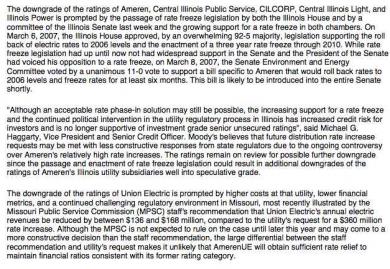
The downgrade of the ratings of Ameren, Central llinois Public Service, CILCORP, Central Illinois Light, and Illinois Power is prompted by the passage of rate freeze legislation by both the Illinois House and by a committee of the Illinois Senate last week and the growing support for a rate freeze in both chambers.
December 15, 2005 - The agency said the downgrades reflect a difficult political and regulatory environment for electric utilities in Illinois, while the company is working on plans to buy power and to raise rates starting in 2007. […]
“The downgrade of parent company Ameren’s ratings reflects the importance of the Illinois utility businesses to its consolidated financial profile, particularly since the acquisition of Illinois Power last year,” the report said.
Moody’s said the ratings remain under review for possible further downgrade.
*** UPDATE 1 *** Statement from Lt. Gov. Pat Quinn…
“You reap what you sow,” said Lt. Gov. Pat Quinn. “Ameren’s shareholders and Illinois ratepayers should understand that they’re being asked to foot the bill for years of fumbling and bumbling by the utility company’s overpaid top executives.â€
*** UPDATE 2 *** One thing to remember about ratings agencies and utilities is that they sometimes work hand in hand to influence public policy. As this NY Times article showed, one agency allegedly assisted an Oregon utility in its quest for a rate hike…
The documents show that Standard & Poor’s solicited comment from the utility on a draft report and then made at least 48 changes that the utility sought before releasing its report on Sept. 25. Those changes included adding the words “uncertain regulatory environment†and a second crucial phrase supporting Portland G.E.’s request to shift all fuel-cost risks off its shareholders and onto customers. The utility then used the report as independent corroboration of its request to raise rates. […]
S.& P. said that there was nothing unusual about the revisions, which it said were made in light of new facts and in accord with the standards of the International Organization of Securities Commissions. […]
[Jason Eisdorfer, a lawyer with the Oregon Citizens Utility Board, a consumer group] said he disagreed with Standard & Poor’s assertion that most of the changes were factual, contending that they “seem to be an attempt to influence a commission decision.†“This was meddling in the rate-making process,†he added.
*** UPDATE 3 *** Citizens Utility Board executive Director Dave Kolata…
“Ameren had record profits under our old rate structure. This is part of a political strategy of bankruptcy blackmail… There’s been a massive transfer of wealth from consumers to generating companies… We certainly think that this type of approach is very unfortunate and we don’t think it’s justifiable.”
So do you think Ameren had anything to do with this rating change, I asked?
“I don’t know. It’s worth investigating… What I do know is Ameren is making windfall profits off this auction scheme… Trying to force one part of its business into bankruptcy is the wrong way to go and would be unfortunate if they moved in that direction.”
The Standard & Poor’s credit rating agency said it would immediately downgrade the credit ratings of Ameren Corp.’s three Illinois utilities to junk status if state lawmakers pass electric rate freeze legislation.
Credit downgrades can increase a utility company’s cost of borrowing and reduce access to capital, meaning consumers ultimately could pay even more for their electricity. […]
While some people have likened Ameren’s claims to fearmongering, Ameren Corp. spokesman Leigh Morris said Friday’s Standard & Poor’s bulletin shows the company was not making hollow threats.
“It confirms our ongoing concern that the credit ratings of the three Ameren Illinois utilities will be downgraded,†if the Legislature passes electric rate freeze legislation, Morris said.
*** UPDATE 5 *** Earlier today, the Illinois Commerce Commission approved Ameren’s consumer “relief” plan that has been all but completely rejected by the General Assembly as not nearly enough…
Ameren’s plan to give customers a one-time credit on their electric bills received approval from the Illinois Commerce Commission today.
The utility giant wants to spend 20 (M) million dollars on rebates for residential customers who use the most electricity. The proposal would also eliminate the interest customers currently pay to defer bill payments.
During hearings with state lawmakers this week, Ameren President and Chief Executive Officer Scott Cisel offered to give credits to customers who use more than 1,250 kilowatt hours of electricity each month. Generally speaking, the credits range from $40 to $300, and customers with electric heat are most likely to benefit.
Ameren spokesman Natalie Hemmer didn’t know how many residential customers would be eligible for the credit. But according to Cisel’s testimony, the average customer uses about 867 kilowatt hours each month, so many would likely not qualify.
*** UPDATE 7 *** Much of the company’s debt was downgraded to “Baa2,” but some was downgraded to “Ba3.” And the “Probability of Default Rating” for CILCORP is set at “Ba1.” Here’s an explanation of Moody’s ratings…
* Speculative Grade
Ba1, Ba2, Ba3 – speculative elements
B1, B2, B3 – lack characteristics of a desirable investment
Caa1, Caa2, Caa3 – bonds of poor standing
Ca – highly speculative
C – lowest rating, extremely poor prospects of attaining any real investment standing
Ameren spokesman Neal Johnson said Monday night that the company would be contacting the ICC Tuesday to inform them of the credit downgrade.
“This credit action triggers a most regrettable event in the history of the Ameren Illinois utilities,” spokesman Leigh Morris said in a statement.
“The Company’s next steps are being finalized.”
*** UPDATE 9 *** Well that didn’t last long. Ameren’s rate “relief” plan is now off the table…
Citing the state’s attempt to refreeze newly deregulated utility rates, a bond rating agency on Monday downgraded Ameren’s Illinois utilities to junk status.
That move, in turn, prompted the embattled utility to pull back a $20 million give-back program aimed at easing the rate hike pain of customers.
Margaret Blackshere. Treasurer
Margaret Blackshere. Chairman
Kenneth C Robbins Chairman
Sheila Lyons Chairman
Blackshere is the former president of the Illinois AFL-CIO. Robbins is president of the Illinois Hospital Association. And that’s a misspelling for Sheila Lyons, it’s actually Sister Sheila Lyne, who is now president and CEO of Mercy Hospital.
A proposal to ban hundreds of models of popular sporting rifles and shotguns is raising the ire of gun owners across Illinois.
Sponsored by Senate President Emil Jones, SB16 prohibits the manufacture, sale and possession of a host of rifles and shotguns widely used for hunting and target shooting. Owners of affected firearms would have 90-days to surrender their property to the Illinois State Police or risk felony prosecution.
Besides the debate on the merits of the bill, the move calls into question the political tightrope that must always be walked with gun legislation in this state.
The press release continues, quoting ISRA-PVF spokeman Richard Pearson:
“If SB16 passes, many of those relationships will come to a screeching halt. Southern Illinois politics are in a state of change, with senate races getting closer all the time. If the senate Democrats who elected Emil Jones to the presidency cannot control him, then we’ll do what we can to take his majority away from him. No friend of Emil Jones is a friend of ours.”
Question(s): Is there any credibility to Pearson’s claims? How dangerous is the gun-control issue to downstate Democrats? How would you play this politically?
* Blagojevich says he is ready to do battle over tax proposals
Meanwhile, critics began chiming in with what has become a familiar refrain in the wake of Blagojevich policy speeches: That the populist governor isn’t happy unless he is setting up Hollywood stock villains to knock down.
“Government-run programs stymie innovation and flexibility,” he said. “This plan does not address quality of care, rising health care costs or how expansion of subsidized health care may disrupt the system for those who already have insurance.”
* Governor’s DCFS budget not getting good reveiws
* Governor enlists teachers for help with school plan
The governor received a rousing ovation and an endorsement for his plan, a much different response than he drew during the gubernatorial campaign when the IEA decided not to endorse any candidate.
* David Greising: GRT levy reaches too far: “A million in gross revenues doesn’t mean you’re a millionaire,” Applebaum said. “It makes you about a teacher’s salary.”
* Blagojevich’s plan for tax on business gets cool response from many in the state
“What if you’re a small business in Peoria or the surrounding area, and you have two lines of widgets that you sell, Widget Line A and Widget Line B, and you have $2 million in sales? What’s to prevent you from incorporating Widget Line A, incorporating Widget Line B and being under $1 million?”
* Firms fear big tax hike fallout: “What you tax us for today, we’ll charge you for tomorrow, maybe earlier,” said David Sykuta of the Illinois Petroleum Council.
* Editorial: Budget proposal is bold but leaves some questions
* Phil Kadner: Explaining balance between wasteful spending and higher taxes
Some readers tell me spending more money on the public schools will not solve the problems of education. They are right. But you’re certainly not going to solve any of the problems by doing nothing, while allowing property taxes to increase, school buildings to deteriorate and education programs to collapse.
* Governor pledges long battle with Ameren: Blagojevich said it’s his goal to see the rates frozen and then help negotiate a new plan with the utilities.
* Ameren’s credit rating would be downgraded to junk status if freeze passes
* Flider wants public comment time during ICC meetings
His administration has clamped down on sharing public information. It refuses to release government documents. It has defied the attorney general’s legal opinions and punished people suspected of cooperating with reporters.
When asked if they’re making a profit charging 50 cents a page for paper that costs less than a penny per page at Office Depot, Urich said, “I doubt we even break even.” Kinko’s charges 8 cents a page for black-and-white copies.
* Editorial: You have a right to know, Sunshine Week
The state borrows money and gives it to hospitals. The hospitals give it back to the state. The state gives it back to the hospitals. The exchange triggers federal reimbursement for state Medicaid expenses that would not otherwise occur.
* Blagojevich allies help state sell off student loans
* Giannoulias polishes off Bright Start with new manager and lower fees
However, some lawmakers and school officials are balking at the proposal. They argue such legislation would upset student calendars and waste one of five state-allotted institute days in an academic year.
*** UPDATE *** If you’ve got a Treo, like I do, then you need to update it so it can deal with the longer Daylight Savings Time period. Go here for the easy instructions.
Some of you just can’t stop yourselves from venting about Gov. Rod Blagojevich, particularly with this new budget/tax proposal of his. So, I thought that rather than chastise you for your often over-the-top remarks in other posts, I’d let you go for it here.
Standard restrictions for comments will apply (see the item in red type in the comments section), but other than that have at it.
Not that you need it, but to get you in the mood here’s a very funny mash-up of a couple of the governor’s campaign ads from last fall…
And here’s a button that the business groups were distributing at the Statehouse this week…
My Sun-Times column this week is about a “secret weapon” that the governor will use to pass his tax hikes and health insurance plans: churches, particularly black churches.
‘’Part of the plan that we’ve been working on for the past months is this: We are going to mobilize the African-American churches across our state,'’ the governor said during an interview this week.
The black churches will play an integral role, or even serve as the core, of what the governor called an ‘’interfaith movement behind the moral imperative of providing health care to everybody, to all of God’s children.'’
The governor explained that part of the idea is to organize a Springfield rally this May of ‘’thousands of people'’ from churches all over the state to demand that the General Assembly approve his health care package. As far as I can tell, nothing like that has ever been done on the liberal side of the equation. The rally could make a powerful statement in Springfield.
Beyond that, though, activating churches will likely scare the living daylights out of some state legislators who might not be willing to support the governor’s multibillion-dollar corporate tax plan to pay for his health insurance program.
There’s a lot more in the column, so please read the whole thing before you comment. Thanks.
* On Wednesday, the governor told me during an interview that if state Sen. James Meeks wanted property tax relief included in his education proposal, then he would make it happen. Meeks had told me earlier that if he couldn’t get property tax relief included then he would seriously consider attempting to block the governor’s gross receipts tax plan. Here are some Blagojevich quotes that I provided to subscribers…
“Absolutely. That is the type of constructive input that we are looking for.” […]
“We discussed whether we should maybe be a little less ambitious with the school funding and provide property tax relief. We netted out on more for school that would naturally relief the pressure on local governments. But if Rev. Meeks and others are interested in putting a property tax relief component in there, count me in.”
Blagojevich told the Tribune’s editorial board that he was “very interested in trying to develop” a more targeted property-tax relief plan that would help poor districts that can’t raise enough local money for their schools.
“Oh, come on, give me a break. For four years, I’ve been talking to you guys every single day,” Blagojevich said […]
A Chicago reporter continued to press Blagojevich on why he has not taken a question for such a long time in his home base. Blagojevich cited the media’s interest in the presidential bid of U.S. Sen. Barack Obama and the re-election of Chicago Mayor Richard Daley. […]
The governor’s remarks underscored his strained relationship with the media. Many believe Blagojevich is trying to avoid questions about federal investigations of his administration, but several policy issues also have taken center stage since the governor cut off access. Chief among them may be the soaring electric bills some have received since a decade-old rate freeze expired in January.
* My intern Paul put together this roundup of budget stories…
But as Blagojevich stirred support in Chicago, questions mounted at the Capitol. Key business groups representing oil companies, homebuilders and farmers all said the governor’s new tax would drive up their costs and consumers would pay more.
* Will your wallet suffer under the gross receipts tax?
* Blagojevich tries to sell state on budget plans:
The governor was once again portraying business owners as selfish tax dodgers Thursday. But, as CBS 2 learned, that’s not always the case, especially when dealing with small businesses. […]
[Chicago] schools would get about $2 billion more over the next four years.
* Blagojevich’s new budget plan become dinner topic
* Governor’s budget includes project for Metro East
Instead of requiring cameras at every licensed business open more than 12 hours a day, Ald. Ray Suarez (31st) has narrowed his focus to businesses open during the eight-hour window when most crimes are committed.
Lawmakers opposing the proposal said they aren’t condoning youth smoking but are concerned it doesn’t focus on education and could give teens early criminal records that would follow them later in life
* Editorial: Impact fees good, but loopholes should be fixed
The leader of the “Illinois Democracy Project” goofed in a big way and just sent this “Urgent recall order” out to editors. The group is hoping to amend the Illinois Constitution to require state legislation to have a 21-day review period before lawmakers can approve it….
Hundreds, perhaps thousands, of Illinois citizens supporting the Illinois Democracy Project are now asking their families, neighbors and acquaintances to sign petitions to put the “Show Us Amendment†on the statewide ballot for the elections to be held in November of 2008.
THE PETITION SHEETS ARE FLAWED AND SHOULD NOT BE CIRCULATED. […]
What was the flaw? The petition forms originally posted at the web site – and distributed to Illinois PTA chapters throughout the state – incorrectly reflected the election date as November 11, 2008. The correct date for the election is November 4, 2008. […]
How did this error occur? “It was entirely my fault,†Project Chairman Jim Broadway said Thursday. […]
“Everyone had a right to assume I was at least smart enough to know the correct date. Now that they know better, they have every right to impeach me.
“I deeply regret my error and apologize to everyone who has been out circulating this flawed petition form…”
I’ve noticed lately that Sen. Bill Brady seems to be popping up all over the place. He hasn’t really slowed down much since he lost the GOP gubernatorial primary last year. Bernie Schoenburg has this bit today…
I think that state Sen. Bill Brady, R-Bloomington, whose district includes a bit of Sangamon County, is still in the run-for-governor mode.
Brady’s campaign fund is sponsoring a new Web site, www.StopRod.org, as a vehicle to oppose the tax restructuring proposed by the governor in his speech Wednesday.
A bit of the tone of the thing: “This is the governor again sticking his (the press release erroneously said “its”) hands into the pockets of every business and every consumer in Illinois, to the tune of $6 billion just to pay for programs the state cannot afford today,” Brady is quoted as saying.
The site also provides a suggested letter to let the governor know of the reader’s concern.
Question: Do you think Brady will run for governor in four years, or US Senator next year? Do you think he has a chance at either office? Explain.
* The Chicago Tribune disgracefully redbaited Gov. Blagojevich in a blistering editorial today [emphasis added]…
This constant quest for new hills to climb conveys the governor’s eagerness to solve problems and be noticed. Unfortunately, at a moment when he wanted to sell his state on some controversial concepts, he delivered a divisive populist rant (”middle-class families,” good–”corporations,” bad, bad, bad) that only confirms the perception of him in some quarters as a lightweight. Illinois citizens might have been swayed Wednesday by the bring-us-together touch of Barack Obama. Instead they got Hugo Chavez.
Unconscianably ridiculous accusations like that pretty much negates everything else in the editorial. No matter what I might think of Blagojevich (and the record clearly shows it ain’t much) I’d delete a comment here if the commenter compared the governor to a commie dictator. That editorial board ought to be ashamed of itself and issue a retraction.
Anyway, the goofy editorial goes on to nitpick the proposals to death, proposes alternatives that would have less chance of passing than even the governor’s own plan (like cutting pension benefits for new state employees), and shamelessly flip-flops on its prior support of the guv’s proposed gross receipts tax (probably because the owners sent the message down after the first editorial appeared that Mother Tribune pays little corporate income tax and the GRT would impact the bloated company’s bottom line).
I understand completely the argument that big business is making against the GRT, and I’m sympathetic. But I can’t help but wonder why my own little company is paying more Illinois corporate income taxes than mega corporations like the Tribune. Call me Hugo Chavez, but it’s not fair, and it’s not right.
* To illustrate my point, here’s an excerpt from the Sun-Times coverage…
Buttressing his argument, the governor claimed the average individual taxpayer pays $1,500 in state income taxes. By contrast, he said, 12,521 corporations with Illinois sales of $263 billion paid an average state tax tab of $151.
* For future reference, any time there’s a proposal for a tax hike over $500 million or so, it can be classified as the “largest tax hike in state history.”
Drawing a muted legislative response, Gov. Blagojevich on Wednesday proposed a record $60.1 billion budget reliant on the largest tax increase and biggest borrowing spree in state history.
* Sen. Mike Jacobs, D-East Moline, on launching major new programs: “Do we really need new programs if our situation is so desperate we have to raise this kind of tax?”
* Senate Minority Leader Frank Watson, R-Greenville, on people who lack health care: “I think health care is a laudable goal for everybody. I feel bad for them. But is it government’s responsibility to take care of people from birth to the grave? I’m not so sure that’s my philosophy.”
* Douglas Whitley, Illinois State Chamber of Commerce president, on the economy: “Gov. Rod Blagojevich’s budget plan for state taxpayers is a reckless and irresponsible affront to every employer and worker in Illinois. If this plan is approved, Illinois will most certainly lose jobs and businesses to other states for lack of regard for the economic consequences of his political ambitions for big government.”
* Senate President Emil Jones, D-Chicago, on raising business taxes: “It’s a good plan. It’s a fairness plan. I expect that (criticism) from the Republicans. I expect that from the Republicans, to stand up for the big corporations that pay little or no taxes and the big corporations want to shift it to the individual.”
* You can listen to more reaction to the governor’s budget address by various Senate Democrats by clicking the thingy below (Do you recognize that interviewer’s voice, by the way?)…
* The Tribune coverage focused on Democratic legislative reaction…
(T)he reaction of fellow Democrats who control the legislature was mixed, at best, portending a long debate among already feuding political leaders over how Illinois will move forward. […]
[Senate President Emil Jones’] top budget negotiator, Sen. Donne Trotter (D-Chicago), was more cautious after the combined State of the State and budget address. He said that Blagojevich’s plans were “real short” of the support needed to pass and that the governor’s “broad brushstrokes” may well be scaled back by lawmakers.
In the House, Speaker Michael Madigan’s lack of a formal reaction to Blagojevich’s proposals was telling.
Madigan (D-Chicago), who has questioned the wisdom of leasing the lottery, has made no public comment on the governor’s plan for a new $6 billion tax on business gross revenues. But in an analysis of Blagojevich’s budget to House Democrats, Madigan’s staff said the governor offered no rationale for refinancing the state’s public retirement system with the “largest pension obligation bond in history.” […]
“The immediate thing my voters, my citizens, want me to deal with today is not health care, education funding or pensions, but utility bills,” said Rep. Gary Hannig of Litchfield, the House Democrats’ top budget negotiator. “A lot of Downstaters … have to get that issue corrected before we can ever think about anything else.”
“This is a long way from finished. (We) want to look at the numbers because we’ve had too many times down here where we say there is going to be revenue that doesn’t turn out to be,” state Rep. Kevin McCarthy (D-Orland Park) said. “We’re having a hard time meeting our current obligations. Taking on new obligations, unless we have some rock-solid numbers on the revenue side, I think it’ll be very tough.”
State Rep. David Miller (D-Calumet City) predicted “a long hard road for the governor to sell this to the people and the members of the General Assembly.” […]
Key to winning support for Blagojevich’s budget is House Speaker Michael Madigan (D-Chicago). Madigan did not hint Wednesday of his position on Blagojevich’s ideas. Madigan spokesman Steve Brown said they met face-to-face Tuesday night in Blagojevich’s office for a brief overview.
“We think it’s going to require bipartisan cooperation and a lot of stamina,” Brown said of Blagojevich’s plan. “But we really need to see the details.”
That “bipartisan cooperation” line is key. Blagojevich and Jones would like Republican votes, but are prepared to go ahead without them. If Madigan wants to include the Republicans, then the GRT is definitely in deep trouble.
There’s a lot of coverage to wade through and my intern Paul and I have compiled a list…
* It wasn’t exactly a huge crowd, but a Republican-backed rally did manage to draw some very upset people to the Statehouse yesterday.
Fired up over unexpectedly high power bills, more than 60 people gathered outside Gov. Rod Blagojevich’s State Capitol office Wednesday, which three Republican senators tagged as “Bring Your Electric Bills to the Governor” day. […]
Charles Chandler of Washington said his power bill had been $87 last October. In February, it was $547.
“That is ridiculous,” said Chandler, who was one of several central Illinois residents at the demonstration.
Ron and Rita Willeford of East Peoria also traveled to Springfield for the peaceful protest. The Willefords’ most recent power bill for their 1,800-square-foot retirement home totaled $592, or $200 more than the previous month, Rita Willeford said.
Senate President Emil Jones said Wednesday that he hasn’t recently talked to the governor about the electric rate issue. But he didn’t budge in opposing a new rate freeze.
“A freeze only delays the inevitable,†the Chicago Democrat said. […]
And Jones, who can control legislative priorities, said the issue should be left to the Illinois Commerce Commission, whose members opened an investigation last week.
“The Legislature really wasn’t supposed to be involved in this,†Jones said. “Once the Legislature gets involved, then you have nothing but politics involved.â€
* But one of Jones’ committees moved a temporary freeze to the Senate floor, mostly as a bargaining chip with the utilities and the House…
Following up on the Illinois House’s approval a day earlier of a three-year electricity rate freeze, a Senate committee took action Wednesday morning on a six-month freeze for Ameren customers.
The Environment and Energy Committee unanimously sent to the full Senate a bill that would offer temporary rate relief to Ameren consumers who have been hit hardest since electricity rates were deregulated in January after nine years of frozen rates.
Committee chairman Sen. James Clayborne, D-Belleville, said the bill is a way to ease the burden on businesses and residents while the state negotiates a more permanent solution.
The bill contains a provision that would extend the freeze past six months if no compromise is reached in the Legislature and no competition develops in the market.
* And Jim Monk of the Illinois Energy Association takes umbrage today with a recent State Journal-Register editorial…
The “reverse auction†was deemed by the commission and most stakeholders to provide the best opportunity to achieve the lowest price for reliable power for those nonshopping customers. Rather than being a tool to “gouge†customers as stated by your editorial, in reality it was a tool to try to provide as many of the benefits of the competitive power market as possible for the so-called “default†customers.
The reverse auction was rigged against consumers. Period.
* Alderman wants settlement made public: “Alderman Tom Becker wants everyone to know how much Des Plaines paid to settle a sexual harassment lawsuit targeting him.”
The study’s primary conclusion was there was no long-term negative impact in sales tax revenue received from restaurants and bars in towns that enacted a smoking ban.
* NEW “Amazing Grace” a must-see movie for political junkies
* NEW Lyons: Just maybe foie gras issue doesn’t matter
* NEW Woman with ties to Governor’s wife charged with illegal firm work
Sources familiar with the investigation said Wednesday the firm allegedly bilked taxpayers out of at least $400,000. That number could soar to $3 million as investigators continue their work.