* Cardinal George and the rest of the state’s Catholic bishops issued a press release this afternoon blasting Gov. Pat Quinn…
We have recently been made aware of Governor Quinn’s decision to present a Pro-Choice Leadership Award at an upcoming event for a political organization known as Personal PAC. This organization describes itself as a “political action committee (PAC) dedicated to electing pro-choice candidates to state and local office in Illinois.” Personal PAC has raised and spent millions of dollars in this effort and supports the lobbying efforts of Planned Parenthood in Springfield.
We deeply regret the Governor’s decision to present this award, which so closely associates him with a political action group whose purpose is contrary to the common good. With this action, Governor Quinn has gone beyond a political alignment with those supporting the legal right to kill children in their mother’s wombs to rewarding those deemed most successful in this terrible work.
They’re obviously very upset about this Personal PAC event. But check out the next two paragraphs…
Pope John Paul II asked in his Letter to Families (1994), “How can one morally accept laws that permit the killing of a human being not yet born, but already alive in the mother’s womb?” Governor Quinn not only accepts these laws, he promotes them and publicly presents awards to their advocates. This approach is irreconcilable with any honest profession of the Catholic faith. While we deeply regret and oppose his actions, we continue to pray for his conversion and the protection of unborn human life.
To our Catholic institutions statewide, we reaffirm our desire and policies that those acting in the manner of the Governor should not be given special recognition on Church property or at functions held in support of Church ministry. [Emphasis added.]
* Not being a Catholic myself, I asked the Catholic Conference for a clarification, including whether this somehow meant Gov. Quinn would be barred from receiving communion. A spokesperson responded…
The Catholic dioceses in the state have policies prohibiting any politician who has voted in favor of policies that go against the Church’s teaching from speaking at or receiving an award from a Catholic institution, like at a school.
The bishops have not banned Quinn from receiving Communion. An individual priest could make the decision not to give Quinn Communion.
The bishops’ statement further underscore existing policy, and expresses extreme disappointment in Quinn’s intention to give out the Personal PAC award.
It seems highly irregular for a sitting governor to give out an award on behalf of any Political Action Committee.
Quinn is also involved in a lawsuit over his administration’s refusal to allow Catholic Charities to continue doing adoption and foster care services as long as the institution won’t work with gay parents in civil unions. A major fight has been building for some time now.
Cosgrove says the bishops should not try to “enforce their religious dogma” on a woman’s private decision and asked them to join in efforts to promote contraception and sex education that would lower the number of unwanted pregnancies.
I’ll let you know if the governor’s office responds.
*** UPDATE 1 *** From the governor’s office…
The governor is scheduled to attend, but on the political side. [The event is] Not on state calendar.
Quinn is presenting an award to a victim of sexual assault who is also a rape victim advocate.
*** UPDATE 2 *** From Personal PAC…
A few minutes ago, the Catholic Conference of Illinois released a statement to the press attacking Personal PAC, Governor Quinn and the reproductive rights of all Illinois women. The Bishops’ objection stems from our support of Governor Quinn and all other candidates who stand on the side of women in believing that the profoundly personal decision to use birth control and seek a legal abortion should rest with women, and not politicians. The Bishops take issue with Governor Quinn attending our Annual Awards Luncheon on Thursday, November 17th. In their statement about our luncheon, the Bishops state “With this action, Governor Quinn has gone beyond a political alignment with those supporting the legal right to kill children in their mother’s wombs to rewarding those deemed most successful in this terrible work.”
While I don’t expect the Bishops to apologize for this inflammatory and outrageous language accusing women of killing children, I do hope that each of you, and everyone you know, will join us at the luncheon to demonstrate that we fully support elected officials who refuse to back down in the face of threats. The absolute best response we can have for the Bishops is to pack the Hilton Ballroom on November 17th and show them that we intend to protect the reproductive rights of EVERY woman in the State of Illinois.
You can slice and dice the legalese all you want, but one message came through loud and clear in Tuesday’s conviction of William Cellini: Times changed, Cellini didn’t.
* But Chris Mooney, the Arrington professor of state politics with the Institute of Government and Public Affairs at the University of Illinois Springfield, wasn’t so convinced…
“I was actually kind of surprised that he was convicted, because I didn’t think the case seemed that strong. But I wasn’t in the courtroom. But I do think that it also shows you that you don’t want the federal government knocking on your door, because, my God, if they can convict him on this, boy, they can get you.”
Before the trial started, I thought the feds had a pretty weak case. After Tom Rosenberg’s testimony, I figured they had Cellini on everything. So, to me, the most surprising aspect of the verdict was that jurors found Cellini not guilty of the actual Rosenberg shakedown (”attempted extortion”), but then convicted him on conspiracy to extort.
“What really got him was the wiretaps,” juror Candy Chiles said. “It was right there. . . . All the evidence was overwhelming . . . He did the crime, and when you do the crime you have to do the time.”
The evidence apparently wasn’t “overwhelming” enough to convict Cellini on the most important count of attempted extortion.
I’m not talking about a big belly laugh, the kind of laugh where the jaw almost unhinges and sound comes out full throated, the eyes bugging, and what you see is a body shaking with confident, honest, joy.
No, this laugh was different. I heard it Thursday at a corruption trial involving Illinois politics, and what passes for honest laughter among politicians using your government to cash in isn’t loud and honest and confident. […]
It was Illinois Combine boss William Cellini laughing with informant and convicted weasel Stuart Levine on federal tape played during Cellini’s corruption trial. On tape they were talking about using their political connections in then-Gov. Rod Blagojevich’s office — specifically Blagojevich’s convicted influence peddler Tony Rezko — to squeeze another man, Thomas Rosenberg. […]
How could they laugh?
Because they were the guys with the juice, they were the ones who allegedly controlled the government, and when you can use the government as your hammer, that’s better than a dozen tough guys because the government carries the force of law. So corruption is only a piece of it. That’s just money. But corrupting the government, which is supposed to be fair, and the effect that corruption has on the people, that is stealing something too. It steals the presumption of honest treatment.
A Cellini friend cited that very thing yesterday after the verdict. I think both are probably right.
“I really believe he extorted,” juror Paulette Green of Round Lake Park said of Cellini. “I don’t think he went in it wanting to. I believe it just happened.”
Green said it was clear from Rosenberg’s angry testimony last week that he felt shaken down.
“Oh, he knew it,” she said.
* So, if Cellini extorted and Rosenberg believed he was being shaken down, then why not convict him on attempted extortion? Perhaps because nothing was explicitly demanded on the tapes? Likely…
The jury felt prosecutors fell short in proving two other criminal counts, conspiracy to commit mail fraud and attempted extortion.
“There were (nuances) in the law that had to be proven that we didn’t think were proven beyond a reasonable doubt,” Nast said. “We really took each count independently.”
Jurors felt the recordings didn’t prove Cellini’s guilt on those two counts because he was not recorded directly implicating himself, he said. The charge of conspiracy to commit mail fraud relied too much on the word of Levine, Nast said.
* A strong sense of jury camaraderie might have also led to a desire to compromise…
Jurors in William Cellini’s trial got along so well during their deliberations, that after reaching a unanimous verdict on Tuesday, they assembled at the nearby Elephant & Castle restaurant and bar near the downtown federal courthouse.
About eight jurors who spent the last 3 ½ weeks or so listening to evidence in Cellini’s trial toasted their conclusion to the case, which ended in a split verdict with two guilty counts and two not guilty counts.
Wednesday, Nov 2, 2011 - Posted by Advertising Department
[The following is a paid advertisement.]
Enough is enough. Let’s look at their claims:
STOP Claim: “Taylorville Energy Center electricity will cost SEVEN times market price.”
The Truth: STOP compares today’s historically low market prices with a price that includes 30 YEARS OF INFLATION. It’s like comparing the price of gas at the pump today with what we’ll pay between now and 2041.
STOP Claim: “Tenaska wants Illinois consumers to pay even if their plant produces no power.”
The Truth: The legislation was changed six months ago at the request of ComEd so this remote possibility could never happen. Consumers aren’t “on the hook.” Which part do STOP and ComEd not understand?
STOP Claim: “We don’t need any new baseload. The speculation on the closure of baseload plants is just that, it’s speculation.”
The Truth: So far, 239 coal plants are scheduled to close because of the new EPA rules. Industry analysts expect Illinois to lose up to HALF of its coal plants, which currently provide 45% of Illinois electricity.
A diverse coalition of elected officials, business and labor, consumer and environmental groups from around the state knows the truth and supports SB 678, the Comprehensive Energy Efficiency and Investment Act.
The 2012 budget passed by the state legislature and signed by Gov. Pat Quinn earlier this year cuts funding for homeless prevention services by 52 percent, eliminating $4.7 million for shelters, emergency housing and transportation. Homeless advocates are fighting for that funding to be restored, but neither party seems optimistic about that happening.
Numbers from the Chicago Coalition for the Homeless indicate that more people were turned away from homeless services last year than were taken in. That’s 45,673 turn-aways compared with 40,542 intakes.
But, hey, the state apparently has $800 million in extra cash laying around for tax breaks.
* Roundup…
* Big business big winner so far in legislative talks
* Quinn wants to increase tax credit for working poor: Senate Republican Leader Christine Radogno of Lemont said the meeting served as acknowledgement by Democrats that “we have a real problem in this state in the business climate and environment.” That’s the message of Republican lawmakers heading into the second week of the fall session next week.
* Editorial: Do-nothing veto session was inexcusable
* Editorial: Time to debate lawmakers’ roles in contract talks
* Top lawmakers, Gov. Quinn meet to talk jobs: Unemployment in Illinois has risen for five straight months and in September hit 10 percent for the first time since August 2010.
* Kadner: 4-day waits in ER for the mentally ill: Five area hospitals have agreed to treat patients from the Tinley Park center, state officials said Tuesday. When Crotty asked them to name the hospitals, they could not. They’ve just been in talks, not real negotiations, the governor’s people said. This is crazy. Insane. Plain stupid. And that’s your government at work.
* Parents, patients and advocates ask state to keep mental health center open
* State urged to keep open Tinley Park Mental Health Center
* Quinn: Gaming negotiations aren’t taking place: Link, a Waukegan Democrat, said he held the bill, SB747, from a floor vote last week at Quinn’s request. “The governor called and didn’t want it and [said] he wants to talk.” But Link said that meeting has not materialized. ‘We have done everything in our power to try to set up [meetings] and discuss these things. I just hope that the governor doesn’t get to this point where he wants to draw a line in the sand.”
* Quinn sends mixed message on gambling: In one breath, Quinn made his annual pitch for the Veterans Cash lottery game, encouraging people to buy the scratch-off tickets. In the next breath, Quinn warned that the state cannot gamble its way to prosperity.
* The Paul Simon Public Policy Institute has released more results from its annual statewide poll. This set of numbers is about reform…
Exactly three-fourths (75 percent) of the voters favored term limits for legislators. They support five consecutive two-year terms for state representatives and three consecutive four-year terms for state senators. Only 19.4 percent opposed the term limits proposal. […]
Seven in ten (71.4 percent) favored or strongly favored a proposal to put limits on the amount that people could contribute to judicial campaigns, while 21.2 percent either opposed or strongly opposed the idea. […]
Voters were asked whether they favored or opposed eliminating contributions to judicial races by providing public funding for all candidates who qualify for it. More than half (53.6 percent) of voters surveyed either favored or strongly favored this proposal, while 34.4 percent either opposed or strongly opposed public financing for judicial races. […]
A total of 71.8 percent of the voters supported the change to an open primary [in which no party declaration is required] while only 19.9 percent opposed it. In 2010, voters favored the open primary plan by similar margins: 75.4 percent favored or strongly favored the open primary system and only 17.7 percent opposed it. […]
Voters overwhelmingly favor a proposal to have legislative district maps created and recommended by a commission that is independent of the elected representatives. In the last year, when the statewide redistricting process has played out in a very public way, support has increased and opposition has decreased for this system.
This proposal was favored by a total of 65.1 percent and opposed by a total of 19.1 percent of the respondents. In the 2010 poll a total of 53.5 percent approved or strongly approved this plan while 27.1 percent opposed or strongly opposed it. […]
Voters also strongly support a second proposal, which would provide that the Illinois Supreme Court add a neutral person to the legislative redistricting panel in case of a partisan tie. The survey showed that a total of 70.1 percent of the respondents said they favored or strongly favored this change while 16.6 percent either opposed or strongly opposed it. […]
Voters also backed a third reform — limiting what party leaders can give to other candidates for the Legislature in a general election. Illinois voters favored this proposal to limit the power of their party leaders by a margin of 61.4 percent in favor compared to 28.3 percent who opposed. [Emphasis added.]
* The Question: Which one of these reforms do you support the most, and which do you support the least? Please, don’t forget to explain your answers in comments, please. Thanks.
Wednesday, Nov 2, 2011 - Posted by Advertising Department
[The following is a paid advertisement.]
Last week, thousands of police, firefighters, teachers and caregivers – working men and women who serve their communities across Illinois – stood tall against the scare tactics of a group of wealthy Chicagoans.
These public servants sent a strong but simple message: The middle class shouldn’t pay for an economy ravaged by the corporate elite. Slashing the modest pensions of those who give their working lives to public service is not the answer to Illinois’ debt problems.
First, for the only time in 22 years, his older brother Rich is not mayor of Chicago. This will remove the stigma of one family having too much political control. Bill Daley can run as his own man and let the voters decide.
Second, Daley has nothing left to prove in his other chosen professions. He has had great success as a government official, political consigliore and businessman. A resume which includes U.S. Secretary of Commerce, White House chief of staff and Vice Chairman and member of the executive committee at JPMorgan Chase does not need any more bulking up. Daley is an ambitious man and winning elective office is one of his few life goals that he has yet to accomplish.
Finally, Daley has a good chance of winning the next race for governor of Illinois. Pat Quinn, the current governor, has a dismal approval rating of 30% and sixty percent of Illinois voters disapprove of his performance. Quinn is a nice man, but lacks the necessary leadership strength to govern. Illinois needs a more effective chief executive in order to begin working its way out of it unsustainable budget deficits and outrageous pension liabilities. There is a very low probability that Quinn will be re-elected as governor.
This political vacuum will present Daley with the opportunity to challenge Quinn to become the Democratic candidate. Daley has the fundraising expertise, political savvy and connections to win the primary. Daley would also stack up well against the likely Republican opponents he might face in the general election. His corporate experience and moderate social views would make him an attractive candidate for both business executives and middle-of-the-road voters.
*** UPDATE *** Gov. Quinn held a press conference today and managed to answer questions for over eight minutes without uttering a negative word about anybody. Raw audio…
* By the way, Quinn told reporters today: “I think we can explore pension reform ideas that are within the bounds of our Constitution, and we plan to do that as well and we’ll be working on that in the next few months.”
Mike Lawrence, a longtime statehouse journalist and press secretary for former Gov. Jim Edgar, said Quinn’s inability to work with lawmakers could make him irrelevant.
“There have been times when the governor and the General Assembly have had strained relations, but I don’t think we’ve seen anything like we’re seeing now,” Lawrence said.
Only during the end of Rod Blagojevich’s tenure as governor can Lawrence remember lawmakers and the governor simply ignoring each other, Lawrence said.
“There is a lack of trust of Gov. Quinn for a different reason than there was a lack of trust in Gov. Blagojevich,” Lawrence said. “The lack of trust in Quinn stems from the belief from lawmakers that the administration doesn’t have its act together.”
Even with total Democrats in control of the statehouse, Quinn, a Democrat himself, has had a difficult time working with legislators. State Rep. Lou Lang, D-Skokie, points to the governor’s preference for bombastic public statements over one-on-one conversations with lawmakers as an example.
“There was a thought that once (Quinn) became governor … he would grab on to the job and the gravitas that comes with it” said Lang.
“He’s tried in his way to do that, but in some issues, it’s not working too well.” […]
“We need an engaged governor,” Lang said. “Not one that says, ‘Don’t pass that. It’s going to get vetoed.’”
Some officials in cash-strapped Chicago believe they’ve found a way to bring in millions of desperately needed dollars while freeing up police: marijuana.
Alderman Danny Solis plans to introduce an ordinance Wednesday that would make possession of small amounts of marijuana a ticketable offense with a $200 fine rather than a misdemeanor. He estimates the change would generate $7 million a year and, since the vast majority of such cases are dismissed, would save police and courthouse workers money and thousands of hours of time.
Similar laws exist around the country, but unlike in other states and cities where debate has often focused on marijuana use, the discussions in Chicago are centered almost entirely on money and wasted resources.
“In these trying times of the economy, we could really use the revenue generated by fines versus arrests,” Solis said. “And each (arrest) means police officers are spending an inordinate amount of time outside the neighborhoods, inside the district offices doing paperwork.”
* Better yet, just legalize and tax it. A recent Gallup poll shows a majority of Americans favor legalization…
A record-high 50% of Americans now say the use of marijuana should be made legal, up from 46% last year. Forty-six percent say marijuana use should remain illegal. […]
Support for legalizing marijuana is directly and inversely proportional to age, ranging from 62% approval among those 18 to 29 down to 31% among those 65 and older. Liberals are twice as likely as conservatives to favor legalizing marijuana. And Democrats and independents are more likely to be in favor than are Republicans.
More men than women support legalizing the drug. Those in the West and Midwest are more likely to favor it than those in the South.
* In my opinion, the real legislative tipping point will come when moms are OK with legalization. Mothers tend to rule these sorts of issues. They brought on Prohibition, then they helped end it. Ronald Reagan was elected president with big help from moms who were repulsed by skyrocketing marijuana use. Right now, 46 percent of women favor legalization. That’s close, but it has to rise a bit more before any widespread change will come.
One day, hopefully, we’ll stop locking adults in steel cages simply because they put something into their bodies that other people don’t like. It’s ridiculous.
In Broomfield’s only contested local race of the 2011 election season, voters elected incumbent Pat Quinn to his third term as Broomfield mayor Tuesday night by a margin of nearly 3-to-1 over challenger Paul Madigan.
Though results will not be finalized for another two weeks, as of Tuesday night Quinn had received nearly 72 percent of the vote to Madigan’s nearly 28 percent. Turnout for the election was at about 46 percent, or 12,481 ballots cast out of 27,243 registered voters in Broomfield, in an all mail-ballot election.
Quinn was first elected mayor in 2007 in a three-way race that also involved Madigan and former City Councilman Clark Griep. He kept up on election return numbers Tuesday evening alongside City Council members and other city officials at Bumpers Grill.
“It feels great,” Quinn said of being elected for third and — due to term limits — final term. “At the end of this term, I’ll have completed 25 years of service to Broomfield. I’ve worked on open space and budget and development issues and just making Broomfield a place we all want to live.”
Quinn first got started on the community service path by serving on the Boulder County Parks and Open Space Advisory Committee in 1988, when parts of Broomfield were still in Boulder County. […]
Madigan, who was running for mayor for the fourth time this year, said via e-mail Tuesday afternoon that he would be spending the day with his children and would not be watching election returns. He could not be reached for comment Tuesday night.
…according to the top Republicans, Senate GOP Leader Christine Radogno and House Republican Leader Tom Cross, Mr. Quinn indicated he’d like to hike the earned-income tax credit as part of any deal to help CME Group Inc. and CBOE Holdings Inc.
Mr. Cross said expanding the earned-income tax credit would cost the state $90 million to $180 million a year.
So, Senate President John Cullerton wants $100 million to CME, House Republican Leader Tom Cross wants almost $500 million in additional corporate tax breaks, and now this. Add in EDGE tax credits for Sears and the total on the table is now as high as $800 million. A year. Every year.
This state can’t afford to buy new paperclips, and yet it’s trying to give money away hand over fist.
Single with one child and earned less than $35,450 single with 2 or more children and earned less than $40,250
Married and earned less than $18,400 married with one child and earned less than $40,450 married with 2 or more children and earned less than $45,250
Over 600,000 families received earned income tax credits last year. It’s a good program. The question is the affordability of any of these plans, not just EITC.
Someone at the Chicago Board of Trade issued another message to the Occupy Chicago protesters by blanketing them with these McDonald’s job applications. The protesters are understandably offended by both the message and by the hundreds of pieces of new litter around them.
CME Group Inc , the biggest U.S. futures exchange operator, reported a higher-than-expected quarterly profit on Tuesday as expense growth slowed and Chief Executive Craig Donohue said he would keep costs down. […]
The company, which operates the Chicago Mercantile Exchange, the Chicago Board of Trade and the New York Mercantile Exchange, said third-quarter net income rose 29 percent to $316.1 million, or $4.74 a share, from $244.3 million, or $3.66 a share, a year earlier. Analysts on average expected $4.69 a share, according to Thomson Reuters I/B/E/S.
Gov. Pat Quinn used his veto pen in an attempt to cut $376 million from the $33.2 billion budget the Legislature sent him this spring, but lawmakers and Quinn already might have found a new way to spend the money. […]
Instead of reversing Quinn’s actions, the idea that seems to be solidifying among lawmakers involves taking a good portion of what Quinn vetoed — between $230 million and $250 million — to fund the seven facilities Quinn has targeted for closure because a lack of money, according to House Republican Leader Tom Cross, R-Oswego. […]
Quinn’s office estimates that it will cost $313 million, or about $64 million more than Cross’ number, to keep the facilities open through June 30.
* But even if Cross’ numbers are right, can they really use all that vetoed cash? I’m not sure they can without it hurting the budget elsewhere. Here’s the breakdown…
Quinn’s cuts this summer came in the form of $276 million from Medicaid, $89 million for school transportation and more than $11 million for regional offices of education. Last month, Quinn announced he was shuttering the seven state facilities and laying off about 2,000 workers because the Legislature didn’t budget enough money.
The Medicaid cuts were basically just delayed payments into next fiscal year. Gov. Quinn said he wanted the General Assembly to reduce Medicaid provider rates, but if that didn’t happen then the payments would simply be delayed. Reducing provider rates was already rejected by the GA this year. If they now use all or part of that Medicaid money for something else, then the state would lose a very big federal Medicaid match.
Also, using that vetoed school transportation money won’t be popular at all with most Downstate legislators. This isn’t as easy as it may look.
Quinn’s Office of Management and Budget, or OMB, said it is working with the Legislature to agree on where to spend the money the governor vetoed.
“Gov. Quinn wants to work with the legislative caucuses to determine how best to identify and utilize any additional funds. Beyond the needs of the agencies (that run the seven state facilities), there remains great necessity in the areas of education, health care and public safety,” said Kelly Kraft, a spokeswoman for OMB.
After asking for gaming negotiations and then quickly reneging, this governor has zero credibility.
Nearly two dozen state workers will get pink slips today, becoming the first casualties in the bruising budget battle between Gov. Pat Quinn and the General Assembly.
The 21 employees, who range from security guards to food safety analysts at the Illinois Department of Agriculture, are among more than 1,900 workers targeted to be laid off in the coming months by Quinn. […]
In September, Quinn said he would close seven facilities because the budget sent to him by lawmakers doesn’t contain enough money to keep a number of agencies operating for the entire fiscal year. […]
Closures and layoffs at agencies like the Illinois Department of Corrections aren’t set to take place until Dec. 31.
*** UPDATE 2 *** HB 3793, which would block more local property tax funding for schools is being opposed by a wide variety of folks, including Stand for Children Illinois. From their roundup…
The Illinois General Assembly is wrongly considering a property tax bill that will handicap local school districts from raising their own revenue and hinder existing streams of revenue from being collected. This will severely impact our schools and we must contact our Representatives and Senators and ask them to vote NO on this detrimental piece of legislation.
The loss to our school districts around the state would be staggering. Here are just a few examples of the impact:
Chicago Public Schools could see $144 million dollars taken away from their budget.
Crete Monee CUSD #201- $500,000 reduction for this year with anticipated loss of $32 million over 10 years.
St. Charles CUSD #303 - $2,600,809 reduction for this year with anticipated loss of $36 million over next 10 years = 52 teaching positions/5.4% of teaching staff.
Naperville CUSD #203 - $4 million reduction = 57 teaching positions. Ultimate impact by 2015 would be $23 million, 11.5% of budget to be reduced, resulting in a cumulative loss of 327 teaching positions.
* Illinois economy down slightly: After reporting a sharp increase in September, the University of Illinois Flash Index fell half a point to 98.3 in October. But, the index remains above the 97.8 level that was in place through much of the summer and is significantly higher than when it was hovering around 90 during the same period in 2009.
* Health insurance exchange bill moves forward: “What I think they’re trying to put in place is something that can organize the market and see how it functions and, based on performance, either crank up the involvement of the exchange or if the market responds appropriately, letting it do so,” said John Bouman, president of the Sargent Shriver National Center on Poverty Law, a Chicago-based nonprofit.
* Time critical, questions linger for Illinois health insurance exchange
* Timeline for smart grid-related matters, new ComEd rate process
* Last week, Gov. Pat Quinn’s press office issued this statement about the gaming expansion bill…
Governor Quinn looks forward to moving past the political games and towards sincere negotiations to reach a legitimate proposal that meets the framework he laid out to protect the interests of the people of Illinois.
* I highlighted “sincere negotiations” because of what Gov. Quinn said today when asked about the gaming bill…
“I don’t think the word ‘negotiate’ is appropriate. I have laid out a framework. OK. They know what it is. It’s crystal clear. If the General Assembly wants to take that guideline and use it to guide their work, so be it.”
So, Quinn offers to negotiate last week in order to stop the Senate from handing him yet another embarrassing defeat, but this week tells legislators to take it or leave it.
And he wonders why he’s having so much trouble with the General Assembly?
*** UPDATE *** The governor’s office has been saying they believe, via backchannel reports, that the racetrack owners would take a subsidy instead of slots at tracks. But Dick Duchossois’ mouthpiece says no way…
The state’s biggest horse racing track is rejecting a plan to give it a big subsidy in lieu of slot machines — the latest bump for the gambling expansion bill that’s been snagged by Springfield wrangling. […]
A prior subsidy plan was stymied for years because it was linked to the state’s ill-fated 10th casino license, which got caught in a decade-long legal dispute after regulators balked at putting the 10th riverboat casino in Rosemont.
The subsidy “never materialized,” Mr. Serafin says, and any new subsidy plan surely would be challenged in court, too, perhaps for many years.
“We don’t want the subsidy,” Mr. Serafin says. “All we want is a level playing field . . . (and) the right to run our business as a business.”
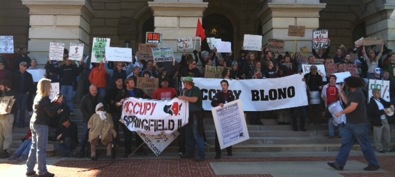
* Ellen Beth Gill was at Occupy Springfield over the weekend and filed a report…
I didn’t see a single [police] officer or squad car and there was no need for them. The fire department was out, but they appeared to be just passing by to answer a call elsewhere.
The entire event was peaceful and orderly from start to finish. The organizers would not let a participant jaywalk or litter. I met a lot of nice people from all walks of life. There were young people from the universities at Champaign/Urbana and Bloomington/Normal. There were several women about my age from the Springfield area and there were senior men and women.
I checked with the Secretary of State’s office, which is responsible for Statehouse security. They did have officers present and worked with the Springfield cops, but they apparently stayed back far enough so as not to be noticed. The SoS office said security was comparable to a similar event held by tea party organizers last year.
* Gov. Pat Quinn was asked about the occupiers yesterday and tried to bring them into the ComEd issue, but they refused…
“Last week, we had the biggest consumer battle in a generation in Illinois,” Quinn said. “It’s important if you’re doing an ‘Occupy’ movement, maybe to get down to the state capitol, help with the program y’know?” Quinn said to laughter. “We’re trying to win for the 99 percent of consumers who aren’t very happy about Commonwealth Edison’s big increase. You’ve got to be an organizer, figure out where the people are. I know the people are on our side. Consumers did not get a fair shake. We’ve got to come back and win in the days ahead. Maybe the folks outside could beat the drums for that.”
Micah Philbrook, one of the 20 protestors outside, said they would have liked the governor to come out and talk to them.
“The governor is using one [issue] to throw a red herring in the middle of the Occupy Chicago message,” Philbrook said.
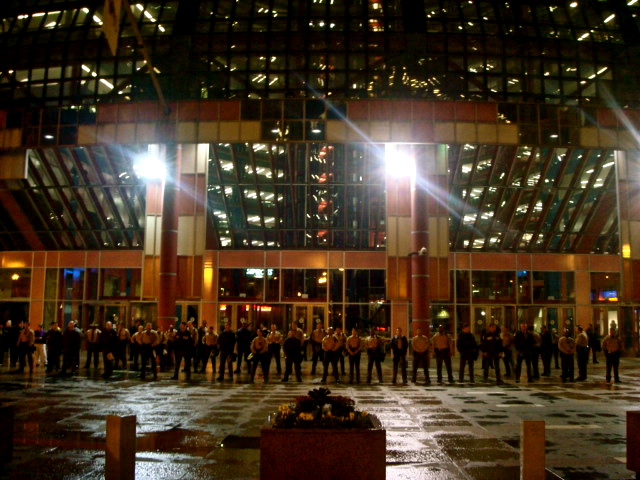
He wanted Quinn to explain why 40 armed state troopers cleared protestors away from the Thompson Center during a vigil [Thursday] night.
“I would love to,” Reinsdorf said, asked if he wanted to work with La Russa again. “We really haven’t discussed it. We’ve talked off and on about what he might do in the future, but we haven’t talked about anything specific. I’m sure now that he’s available he’s going to get a lot of opportunities, chances to do a lot of things inside the game. I just want him to do what’s in his best interest, what’s best for him.” […]
In a 2010 interview with the Tribune during spring training, La Russa said that if he were to stay in baseball after managing, he’d have to do it with an owner he already knows.
“It would have to be for an owner like Reinsdorf, the Haas family, the people here (in St. Louis),” La Russa said. “Those are the owners I’ve known, the ones I’d want to make happy.” […]
A role with the White Sox seems to make the most sense, especially given how stale management has become heading toward the 12th season of the Ken Williams era. La Russa wants a job that allows him to have an impact without the time-intensive responsibility that comes with running a team.
* The Question: Should the White Sox try to hire La Russa as a senior advisor? Take the poll and then explain your answer in comments, please.
Count 2 – Conspiracy to Extort – Cellini knowingly joined a conspiracy – He knew what Rezko and Kelly were about and he didn’t walk away and he knew they were trading state contracts for campaign contributions to Blagojevich.
Count 4 – Aiding and Abetting Bribery – Cellini knowingly aided and abetted an agent of a state agency (Levine in his role as a TRS trustee) in corruptly soliciting something of value in connection to official state action.
He was found not guilty of:
Count 1 – Conspiracy to defraud – Defendant knowingly joined a conspiracy to use Levine’s role as a public official to defraud the people of Illinois, specifically the teachers who entrusted Levine to act with their best interests at heart.
Count 3 – Attempted Extortion – Cellini knowingly attempted, with Levine, to get money from Rosenberg. They threatened to hold back Rosenberg’s $220 million allocation believing that that would force Rosenberg to pay the bribe. This count also requires that the extortion could have potentially affected interstate commerce which it would have as the $220 million would have been invested in companies nationwide.
*** UPDATE 2 *** Chris Wetterich talked with Dick Ciccone, Bill Cellini’s spokesman, about an appeal…
Cellini plans appeal, Ciccone says. They were pleased that he was found not guilty on “the two most serious charges.”
Ciccone noted that Cellini was convicted of conspiracy to extort but not attempted extortion.
“Inconsistencies in a verdict are fertile ground for appeal,” Ciccone said.
*** UPDATE 3 *** Statement from defense attorney Dan Webb…
“We are very gratified that the jury found Mr. Cellini not guilty of the most serious charges in the indictment. Mr. Cellini was found not guilty of the major conspiracy count, Count 1, in which the government alleged a conspiracy to commit honest services crimes for 15 months. Further the jury found Mr. Cellini not guilty of even attempting to extort money from Mr. Rosenberg, Count 3.
“Whatever the jury determined Mr. Cellini did to be guilty of a conspiracy to commit extortion, Count 2, that conduct did not even rise to the level of being an attempted extortion.
“As far as the counts on which Mr. Cellini was found guilty, we are confident we will be able to obtain a reversal on appeal.”
* BlackBerry users click here. iPhone and iPad users remember to use the two-finger scrolling method…
Hutchinson, who chairs the Senate Revenue Committee, addressed the question about fairness in taxation and the state’s ongoing tax breaks to keep major companies in the state.
“Statewide, 60 percent of corporations don’t pay any [state income] taxes,” she said. “Only some 300 paid more than $1,000. Our corporation tax base is very narrow. If a corporation comes to Springfield and yells loud enough” the state will give a tax break.
Discuss.
*** UPDATE *** As pointed out by a commenter, Sen. Hutchinson appears to be incorrect. For tax year 2006, 380 corporations paid more than a million in income taxes and overall paid 73 percent of all income taxes. 67 percent paid no income taxes, however, so that’s essentially correct.
“Part of the role of the governor sometimes is not to be a pal of the legislature,” Quinn said [yesterday] afternoon while addressing the Leadership Greater Chicago Luncheon at the Union League Club.
“I am very proud that I vetoed the ComEd bill. I read somewhere that I enraged the General Assembly when I did it. Well, so what? The governor is there to protect the consumers.”
The ICC is there to protect consumers. The governor is supposed to be there for all of Illinois. All of organized labor supported the smart grid legislative package. Major environmental organizations like the Sierra Club, Environment Illinois and the Natural Resources Defense Council backed it as well. From the Sierra Club’s blog…
This will be a huge boost to clean energy in Illinois. By deploying solar energy across Illinois, we’ll see new jobs and businesses, and cleaner air as we move away from dirty coal. A smarter power grid will also save consumers money by giving us new tools to manage our power consumption. […]
SB 1652 will increase the amount of energy savings we get through energy efficiency by about 1.5 million mWh, roughly the amount of power that would be used in 150,000 homes for one year. Further, it allows both utilities and non-utility energy efficiency companies to participate in the market, and ensures that the expanded efficiency programs are incorporated into the annual Illinois Power Agency procurement plans. […]
NEW JOBS: Up to 5,000 new jobs in renewable energy – good jobs installing clean energy projects, operating and maintain them, and manufacturing clean energy components. In addition, the American Council for an Energy Efficient Economy estimates that the energy efficiency provision alone will create 3500 new jobs by 2015, and more than 10,000 new jobs by 2020. […]
CONSUMER SAVINGS: Helping consumers use less energy is a way to permanently reduce bills. The energy conservation programs in SB 1652 will not only provide new tools and products to help consumers cut their bills, they will also reduce the peak power prices that drive our electric rates. Smart meters will empower consumers to take charge of their energy consumption. Participants in smart meter pilot programs consistently save 15-20% per month after installing a smart meter.
CLEANER AIR: Cleaner power sources and energy conservation mean cleaner air – fewer asthma attacks, premature deaths, and a better future for our children and grandchildren. We also need the smart grid to move beyond oil, to power the electric vehicles of the future.
Despite what the governor says, this was not an “evil” bill. And the $3 a month from ComEd consumers and $3 a year from Ameren consumers probably won’t even be noticed on anybody’s bills.
Fox Chicago News has learned that ComEd lobbyists are telling legislators who voted for a new rate increase law that the utility will seek less money than it previously wanted.
One reason: if Gov. Quinn signs a so-called trailer bill to the rate increase law, ComEd’s guaranteed annual profit will shrink by about 3 per cent.
In declaring himself the “reform governor,” Quinn echoed Blagojevich, his two-time running mate. The then-lieutenant governor took over after Blagojevich was arrested on corruption charges and removed from office.
“I wasn’t elected prime minister by the legislature,” Blagojevich said in 2003, his first year in office. “I was elected governor of this state and I’m here to do my job with the mandate the people gave me — and I think they want me to change things here.”
The Blagojevich comparisons will undoubtedly increase in the coming weeks and months. But I still don’t think that’s quite fair. Quinn is not a criminal. The better comparison is to Dan Walker, Quinn’s role model and another failed governor who alienated everybody with his holier than thou positioning.
Tuesday, Nov 1, 2011 - Posted by Advertising Department
[The following is a paid advertisement.]
Three different times the Illinois legislature has considered legislation to approve Tenaska Energy’s Taylorville Energy Center (TEC), which would have Illinois consumers pay seven times today’s market rate for electricity and cost $286 million per year. Three different members have sponsored versions of this bill. And three different times, including a vote last week, the Senate has rejected Tenaska’s proposal.
But legislation to support the TEC is still being pursued by Tenaska. Here’s why the Illinois legislature should again say, “You’re Outta Here!” to the TEC:
• Burden on Job Creators: Tenaska touts a cost cap for non-residential electric customers, but loopholes allow them to pass on all cost overruns due to low estimates and market price fluctuations.
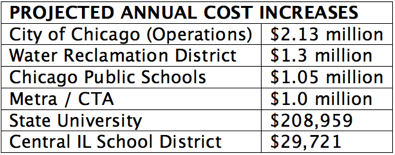
• State and Local Budget Buster:
• Consumers on the Hook: New language in the legislation suggests Tenaska will try to recover their full costs even if the TEC never produces more than a single megawatt of power.
• Unneeded, Costly Power: The TEC would generate 544 megawatts of base load power – that’s only two-tenths of one percent of overall capacity at a cost of $8.6 billion. The market doesn’t support this project because power demands are already being met.
* The State Journal-Register published an angry editorial demanding action right freaking now on a solution to the state’s terrible problem with past-due bills. While eloquent at times, there was only one paragraph on what’s holding up a solution…
Republicans are dead set on a “no borrowing” pledge, even though they concede that the current situation forces ordinary Illinoisans to carry the state’s debt load. Gov. Pat Quinn has pursued a borrowing plan that is too big. Rank-and-file Democrats say they’re hamstrung by the GOP.
Borrowing requires a three-fifths majority in both chambers. It’s never easy, and it’s impossible if one political party is dead set against any borrowing. It’s also impossible as long as Gov. Quinn is sticking to a large borrowing plan.
The Republicans want more cuts to pay off the old bills, but they’ve yet to put those cuts into an actual bill, and even they agree that their idea wouldn’t pay off all bills right away. Until they show their hand, or the Democrats can come up with cuts on their own (don’t bet your house on that ever happening) this thing is going nowhere. Gaming expansion would’ve provided some money for old bills, but Quinn is against that, too. So, everybody will just do their best to ignore the problem for as long as they can.
Obviously, what’s needed here is some sort of consensus, but there is no magic wand we can wave to achieve that consensus or even figure out what it should look like. I’m stumped as well.
* But there was some progress on facility closures, mainly for political reasons…
Illinois House Minority Leader Tom Cross, R-Oswego, said he and other legislative leaders will work with him on shifting existing funds around in the budget to find the approximately $230 million needed to keep open the prisons, mental health centers, and developmental centers.
Cross said those seven facilities have one thing in common.
“To be blunt with this, I think (the governor’s) goal was to generate support for increased spending and/or his restructuring plan, and I think he thinks he needs to aim at Republicans. They were mainly Republican districts,” he said.
The clock will be ticking on efforts to overhaul the state’s pension systems when lawmakers return to the Capitol next month for the final three days of the fall veto session.
Although Republican leaders in the House say they can put up half of the votes, 30, on a controversial reform plan, Democratic leaders aren’t yet committing to a vote.
Any delay on a vote in the House could leave the Senate without enough time to debate the measure before heading home until next year on Nov. 10.
“I would be really surprised if anything happens on pension reform,” said state Sen. Shane Cultra, an Onarga Republican.
Even so, Rep. Kevin McCarthy, an Orland Park Democrat who chairs the House Personnel and Pensions Committee, said backers might not want to call the bill for a vote unless they’re sure it will pass, because “it could be more of a hindrance to get something done in the future.”
If it is brought back during the Legislature’s spring session, he said, “I think the support would be there with the general public.”
Again, there is no magic wand that can be waved to find a majority on this bill in both chambers.
Without giving away many details, Kotowski laid out what he calls a “framework” for an eventual agreement.
First, Sears’ 20-year-old tax deal with Hoffman Estates would be extended so the company could recover some of the millions it says it has spent on roads and bridges in the area. Whether Sears would have to give up any of the $125 million in total tax benefits it’s seeking is unclear as the company keeps some of the details of its proposal secret.
Then, Sears would be penalized if it left for another state while the deal was still in effect.
And finally, more money would be sent to District 300. How much is still unclear, as money the school district would get might have to come at the expense of other local governments or Sears.
*** UPDATE *** On the one hand, this may actually be a bit of good news for the Democrats because it means that the Madison and St. Clair county parties won’t go to war over this seat…
Madison County Chief Judge Ann Callis said Monday she will not seek the congressional seat held by U.S. Rep. Jerry Costello, D-Belleville, who is not seeking re-election.
Callis issued a statement: “After receiving strong encouragement from numerous people that I respect and admire, discussing with my family, and seriously considering it, I have decided not to run for the 12th Congressional District, a seat currently held by a man I admire very much, Rep. Jerry Costello.”
The statement continues: “I came to the conclusion that at this time, I could not leave a community that I love, employees and colleagues of Madison County Circuit Court that have become like family to me. I consider it an honor to serve the people of the 3rd Judicial Circuit as their chief judge, and my immediate plan is to run for retention and hopefully continue to serve the citizens of the 3rd Judicial Circuit to the best of my ability.”
On the other hand, Callis would’ve probably been a far better candidate than the guy the St. Clair County people are backing.
[ *** End Of Update *** ]
* The number of Democrats declining to run for Jerry Costello’s seat keeps rising…
Office-holding Democrats are falling all over themselves not to run for the seat long held by outgoing U.S. Rep. Jerry Costello, D-Belleville.
The latest name to surface as a possible Costello replacement is Democratic Lt. Gov. Sheila Simon. Her campaign office said Friday she was approached about entering the race by some individuals in the southern part of the 12th Congressional District, which runs from Madison County to the southern tip of the state. But she declined to do so in order to fulfill her four-year term that began in January.
Simon is at least the eighth prominent Democrat to decide against running for the seat since Costello made his surprise announcement Oct. 4 not to seek re-election to a 12th term.
I had a story for subscribers about this district today, but it got cut for space. I’ll probably run it Wednesday. The Democrats are in real trouble here if they don’t get their act together.
Former Belleville mayor Rodger Cook says the Republican Party chairmen of Madison and St. Clair counties Saturday tried to get him to drop out of the race for a congressional seat, but he’s in it to win it.
The two party leaders, Jon McLean of St. Clair County and Deb Detmers of Madison County, said the purpose of their meeting Saturday with Cook wasn’t to dissuade him from running. Detmers said the purpose was to give Cook “a realistic assessment” of what it will take to win the race.
Cook said McLean and Detmers “made it pretty clear” that they want him to bow out of the race so that fellow GOP candidate Jason Plummer of O’Fallon can win the party’s nomination in the primary election, which is March 20.
Republican State Senator Suzi Schmidt has announced she will not seek re-election in the wake of the fallout from a domestic disturbance.
Last December Schmidt called 911 following an incident with his husband. she implored a dispatcher not to respond to her husband if he called police. Initially Schmidt refused to step down.
“I am grateful for the outpouring of support; however, at this point in my life, my personal life and my family are my priority, and I hope to dedicate more of my time with them in the coming months and years. Therefore, I will not be a candidate for re-election in 2012.
“I want to extend my heartfelt gratitude to my constituents for the tremendous honor and opportunity to serve in the Senate and for the opportunity to serve Lake County for the past 25 years. I am thankful for the trust they bestowed upon me to serve them for so many years. I am humbled by their unwavering support and honored to have been able to represent them.”
On a 911 call her husband made during another fight, on Sept. 26, Schmidt can be heard in the background admitting she had bitten him. At first, she denied doing it but later is heard saying: “You bet I did.”
Neither Schmidt nor her husband ever was charged as a result of any of the calls.
In the aftermath of those disclosures, Schmidt clung to the possibility she could put the dispute behind her and remain politically viable, issuing a public apology, announcing she intended to seek counseling and stating she planned to keep circulating nominating petitions.
Her refusal to step down or drop plans to seek re-election triggered potential primary opposition. Former Lake County Board member Larry Leafblad stepped forward to say he intended to run against Schmidt in a Republican primary.
The word is that Joe Neal (who happens to be the son of Bob Neal, a long-time Lake County GOP Chairman) will run, and he may have the backing of some prominent Lake County GOP-ers. Joe Neal is currently Newport Township GOP chairman.
Round Lake’s Lennie Jarratt is announcing the formation of an exploratory committee to seek the 31st State Senate District.
Illinois has a spending problem, not a revenue problem. Springfield and local politicians have raised taxes and fees driving businesses out of state. Illinois now has an unemployment rate of 10% and Lake County has the highest property taxes in the Midwest. We must change the people and the culture in Springfield. I am running to change Illinois; restore jobs; and lower taxes.
* In other news, I think I’ve told you about this before, but I don’t think we really discussed it. The state’s GOP chairman is making a big endorsement in a local primary race…
The state’s Republican Party chairman will help lead Kevin Burns’ campaign in the Geneva mayor’s quest to become the chairman of the Kane County Board.
Party chairman Pat Brady was named Tuesday as the first of Burns’ campaign chairmen. Burns will face state Sen. Chris Lauzen in the Republican primary in 2012. […]
It’s no secret that the powers that be despise Sen. Lauzen, but this is an unusual move for a party chairman.
* Freshmen struggle to meet 2012 bar: Among those drawing quiet scorn on the GOP fundraising circuit are… Rep. Joe Walsh, the cable news mainstay buffeted by personal and financial issues who raised just $150,000 last quarter and faces a tough primary against fellow GOP freshman Rep. Randy Hultgren
* 17th District: Gaulrapp behind in campaign fundraising
Several Occupy Illinois groups came together Saturday in Springfield for Occupy Your State Capital Day. […]
Next came the first reading of an eviction notice delivered to the lobbyists for the 1% and their servants in elected office who currently occupy the Illinois Capitol Building. It reflects that the same issues raised by the Wall Street Occupiers exist in Illinois state government. Rather than a request for temporary fixes, it’s an indictment of a broken, corrupted political system that’s largely unresponsive to the 99%.
* Again, an “eviction notice,” no matter how symbolic, is not in any way democratic. From their press release…
TO ALL MEMBERS OF THE PRESS: The General Assembly for Occupy Springfield has agreed to stand in solidarity with National Occupy Your State Capital Day by posting a Notice of Eviction on the door of the State Capitol. Lobbyists and their servants in elected office will be notified their tenure in the Capitol Building is over.
A handful of protesters has no right to overturn elections nor deny people from exercising their 1st Amendment right to petition the government, no matter how much one might disagree with their employers. I fully support the occupy folks’ rights to protest. I flat out oppose any attempt to take away constitutional rights from others. When we overturn elections we don’t like or allow the government to decide who can and who cannot lobby, we’re gonna be in really big trouble.
* The Sun-Times asked Rep. La Shawn Ford last week how he felt about his voting button being pressed “Yes” during the “Smart Grid trailer bill” vote when he actually opposed the bill…
Rep. La Shawn Ford (D-Chicago), a rate-hike opponent who wound up having his vote cast mistakenly in favor of ComEd by a seatmate on the first of two measures, expressed frustration that the important vote was allowed to proceed when Democratic leadership knew members were off the floor.
“It’s not usual for a bill as important as this to not have the full body in the chamber in their chairs. I think there should be some explanation as to why a bill like this came up without checking out the chambers,” said Ford, who later wound up voting Quinn’s way on the override.
Ford, like several others, was off the floor during the vote.
“I would go on record to say he’s wildly out of line,” said Rep. LaShawn Ford, D-Chicago.
* At least one member was accidentally voted “No,” when he meant to vote “Yes”…
Freshman Rep. Tom Morrison, R-Palatine, said he had just left a committee hearing when he arrived on the House floor and learned that the bill had already been voted on. He supported the ComEd legislation but was recorded as voting “no.” […]
“Obviously, the recorded vote makes the governor look bad, and so it doesn’t surprise me that he would make such a request (for an investigation),” Morrison said.
Black noted that if lawmakers believe there is something fishy about the votes cast to pass a bill, they can always demand a “verification.” That gives opponents a chance to determine whether everyone recorded as voting is present. They can eliminate the votes of anyone who isn’t actually in the room. Quinn’s legislative allies did not take this step on the vote that triggered his anger.
Black said he suspects Quinn is speaking out because he lost, not because of deep concerns about lawmakers voting for one another.
“To say that shouldn’t go on is technically true,” Black said, “but it’s been going on since time immemorial.”
The aggrieved legislators who were recorded as voting “Yes” when they wanted to vote against it also could have asked to reconsider the vote. None did.
* The Tribune paints this as an attempt by Gov. Quinn to save face and change the subject after losing so badly on both ComEd-backed bills. But saving face while blaming everybody else and implying dark motives by those who won puts Quinn directly in the same lineage as Dan Walker and Rod Blagojevich. It’s governing by press release, and it doesn’t work.
* By the way, Gov. Quinn also said during Friday’s press conference that he’d heard that the House had made a motion to reconsider the vote on the trailer bill, which, if true, could prevent the bill from reaching Quinn’s desk…
“I heard that they had a motion to reconsider. I don’t know if that’s true or not. I hope they’re not going to be like the gambling enthusiasts who passed a bill on May 31st and thought so highly of it that they put it in their pocket for the last four and a half months. Sometimes that does happen, and it is kind of a disturbing trend that their motions to reconsider are starting to interfere with the proper function according to the Constitution of our legislative and executive branches of government when they look at laws.”
* Unfortunately for Quinn this was yet another case of needlessly crying wolf. If Quinn had bothered to check the bill’s online history, he would’ve seen that the motion to reconsider was immediately tabled. From the House rules…
When a motion to reconsider is made within the time prescribed by these Rules, the Clerk shall not allow the bill or other subject matter of the motion to pass out of the possession of the House until after the motion has been decided or withdrawn. Such a motion shall be deemed rejected if laid on the table.
A plan to modernize Illinois’ utility infrastructure through customer rate hikes sailed through the Legislature. Lawmakers overrode Quinn’s veto of legislation that will have Commonwealth Edison Co. customers paying $36 more a year for electricity and Ameren Corp. customers paying $40 more a year for the next decade. […]
Facility closures
The state’s Commission on Government Forecasting and Accountability, or COGFA, voted against Quinn’s recommendation to close four downstate facilities that serve people with mental and developmental disabilities. […]
Roadkill recovery
The Legislature overrode Quinn’s full veto of a measure that allows residents to collect the carcasses of animals dead on roads.
* That last bill, sponsored by Rep. Norine Hammond (R-Macomb) was the subject of Carol Marin’s column and the inspiration for today’s headline…
The governor could use a friend in Hammond’s part of the world. Though he loves to talk about how “The Land of Lincoln” is a big state, it’s really two states. There’s Chicago/Cook County and then there’s Downstate.
In the 2010 election, Quinn carried Cook but lost 98 out of 102 counties.
Quinn, who enraged lawmakers by slamming a veto stamp on the ComEd bill, got slammed right back this past week.
And the same thing will happen in a week when the Senate joins the House in overriding him on Hammond’s bill. What a wasted veto. And a squandered opportunity. And a perfect name for what happened: Roadkill.
In another blow to Gov. Pat Quinn, the Legislature voted this week to pull the Illinois Power Agency from beneath Quinn’s wing and hand it over to the Executive Ethics Commission.
The move was led by House Speaker Michael Madigan who tried through legislation in the spring session to have the IPA removed from Quinn’s oversight. On Wednesday, the General Assembly voted to override Quinn’s veto of that legislation.
The development comes less than a month after Quinn replaced Mark Pruitt, head of the IPA, with a retired 35-year veteran of Commonwealth Edison, a move that raised the ire of Illinois Attorney General Lisa Madigan’s office.
Quinn’s appointment of Arlene Juracek stunned political insiders who expect she will have a difficult time gaining the Senate’s confirmation because she helped spearhead an electricity auction in 2006 that caused consumer rates to jump and led to the creation of the power agency.
* The House also voted against Quinn’s solution to his summertime veto of regional superintendents’ pay last week, and some of Quinn’s other budget solutions appear to be in jeopardy…
Covering union pay raises may be a non-starter for budget negotiators. House Minority Leader Tom Cross, R-Oswego, said the four caucuses agreed to consider how they could reallocate at most $250 million. That would not include the $76 million the administration said is needed to cover the pay raises.
“That would avoid immediate closures and stay within the cap of $33.2 million,” Cross said of the $250 million reallocation.
The Quinn administration said enough money is available if lawmakers agree to additional budget cuts the governor made last summer. However, a significant part of those cuts - about $276 million - involve Medicaid payments, which will have to be made at some point.
Another $100 million involves cuts Quinn made to the salaries of regional school superintendents and to school transportation reimbursements. A plan to pay regional superintendents from personal property replacement tax money failed an initial House vote last week. And an increasing number of lawmakers are seeking restoration of some or all of the $89 million in transportation reductions.
The appointments Gov. Pat Quinn made to the Illinois Tollway board Monday were invalid because his office failed to file the correct paperwork — thus negating the actions the would-be directors took at a meeting Thursday, the Tribune has learned.
As a result, the tollway has had to schedule a new meeting of the board for Monday so the properly confirmed appointees can reconduct tollway business, including tentative approval of the agency’s $973 million budget for 2012.
Like his predecessor, Quinn often admonishes the legislature publicly. He criticized lawmakers’ support of the original casino bill and accused them of being bribed by campaign contributions on the electricity bill.
Representative Lou Lang, Democrat of Skokie, said the governor’s attacks had backfired. Support that Quinn might have received on a revised casino bill, Lang said, evaporated once he took aim at the Legislature.
“I like the governor,” Lang said. “I just don’t like how he has handled this issue.”
Most of those who were asked about the governor said Quinn’s heart was in the right place. His credentials as an honest person carried him through the 2010 election and still influence lawmakers’ feelings about him.
“I think he really cares about the people of Illinois, about people of limited means and education, and those are values a lot of us share,” said Representative Greg Harris, a Chicago Democrat who works with the Quinn administration on Medicaid spending. “But there isn’t a clear, thoughtful path to get from point A to point B, and that lack of a comprehensive plan sometimes makes it difficult for us.”
I don’t think I’ve ever seen a governor have a worse veto session week than Quinn did last week. It was a total trainwreck. And we haven’t even talked about his over the top antics on the ComEd vote. I’ve saved that for another post.
* My weekly syndicated newspaper column is about an unknown, but very big campaign finance loophole. I told subscribers about this last week, but as yet nobody else has picked it up. So, here it is…
An apparent legislative drafting error has created a massive loophole in the state’s new campaign contribution limit law, and ComEd and its parent company Exelon have been aggressively exploiting it since early this year.
State campaign finance reform laws that capped campaign contributions went into effect this past January 1st. One provision of the new law set a $50,000 cap on what political action committees could receive from other political action committees during a calendar year.
Yet, despite that cap, Exelon’s federal PAC has transferred over $189,000 this year to a state PAC controlled by its subsidiary ComEd. Those transfers appear to be almost four times higher than the law allows.
ComEd has, in turn, taken that Exelon PAC money, pooled it with its own cash and given large numbers of contributions to state legislators as it worked to pass a so-called “Smart Grid” bill, then override Gov. Pat Quinn’s veto of that legislation. The company succeeded at both those tasks last week. Gov. Quinn claimed campaign contributions were behind the company’s legislative success.
So, how did Exelon and ComEd get around the contribution cap law?
Well, ComEd officials insist that what they did was completely within state law. But the Illinois Campaign for Political Reform says otherwise.
“ICPR believes that these transactions are in violation of the Election Code,” said David Morrison, the group’s deputy director. “Only political parties are allowed to make these kinds of transfers, by our reading of the statute.”
ComEd officials claim they cleared these contributions with the Illinois State Board of Elections. The Board’s executive director, Rupert Borgsmiller, said he wasn’t aware of any specific contacts with ComEd, but said the statute in question “hasn’t been fully tested.” He also said the statute has been discussed quite a bit.
“By the plain reading of it, I would say that ComEd has a very good point,” Director Borgsmiller said.
Indeed, the company does have a decent point.
What I’m about to tell you may look technical and complicated, but it’s really not. Stay with me here.
The new campaign caps were outlined in Section 9-8.5 of Illinois law. Paragraph “c” of that section deals with limits on what can be given to state political party committees. Also in that same paragraph is this language: “Nothing in this Section shall limit the amounts that may be transferred between a State political committee and federal political committee.” That language is then followed by more limitations on political parties.
A spokesman for House Speaker Michael Madigan said the intent of the law was to allow state political parties, and only state political parties, to transfer unlimited money from their federal PACs. The law, he said, was absolutely not designed to give companies like ComEd a way to skirt the PAC caps.
But the sentence that ComEd relies on clearly says: “Nothing in this Section.” The “Section” deals with campaign caps of every kind, not just political party caps. If it had said “Nothing in this Paragraph,” then ComEd and Exelon wouldn’t be able to use that sentence to their advantage.
This was a very dangerous mistake by the people who wrote the law. Left unchanged, this loophole could be used to get around all state caps.
Why? Well, under the ComEd/Exelon reading of the law federal PACs do not have to abide by any of the state’s new caps. They can give as much as they want to any candidate, political party, legislative leader, whomever. And, of course, state PACs could form federal PACs to get around all of Illinois’ campaign cap laws.
Neither Exelon nor ComEd have done any of that beyond transferring that money to the ComEd PAC, at least so far, according to an ICPR analysis.
But this is, without a doubt, a truly gigantic loophole that could easily be exploited unless the General Assembly closes it soon.
Director Borgsmiller said his office has been contacted numerous times about the cap rules. A Board of Elections’ task force recently recommended that the loophole be closed during the spring session. It ought to come even sooner.
Madigan’s spokesman said last week no decision had been made about whether to proceed with legislation. He suggested that the Board ought to just enforce the law the way it was intended. But the Board is so far interpreting the laws the way they are written.
Discuss.
* Related…
* Jones says Legislature, not governor, looked out for consumers on ’smart grid’
* Lawmakers deny contributions affected their ’smart grid’ votes: State Rep. Wayne Rosenthal, R-Morrisonville, and state Sen. Sam McCann, R-Carlinville, each in their first legislative terms, received $2,000 apiece from the utility during their 2010 campaigns. McCann and Rosenthal voted against overriding the governor. McCann voted against the follow-up legislation, while Rosenthal voted for it.
* Editorial: Illinois utilities use ’smart grid’ to bypass regulators