* Background for this post is here. From Emily Miller on some of Gov. Rauner’s proposed budget cuts for DHS…
After school programs are zeroed out, immigrant services were zeroed out, epilepsy grants zeroed out, ARC of Illinois was zeroed out, autism services for children were zeroed out
* Also, these…
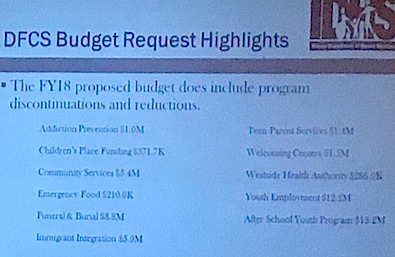
…Adding… A more complete list of zeroed-out lines…
Welcoming Centers
Epilepsy Services
ARC of Illinois Life Span Project
Best Buddies
Project for Autism
Children’s Place
Teen Parenting Services
Youth Employment
Teen Reach (afterschool programs)
Emergency Food Program
Funeral and Burial Aid
Immigrant Integration
71 Comments  
|
Today’s number: $5.1 billion
Wednesday, Feb 15, 2017 - Posted by Rich Miller
* Did anyone else notice that the governor asked for a bunch of additional state spending, outlined some reforms to save some money, but did not propose a single state program cut in his budget address today? This is why…
Go see it all for yourself by clicking here.
40 Comments
|
Leaders respond to budget address
Wednesday, Feb 15, 2017 - Posted by Rich Miller
* Senate GOP Leader Christine Radogno…
I am heartened by the Governor’s speech today –and his very public demonstration once again of his willingness to work with Republicans and Democrats to bring Illinois out of this crisis.
I share his sense of urgency – the time is now. Illinois goes $11 million further into debt each and every day we continue to spend without a budget in place. Today the Governor also acknowledged the great deal of groundwork that has gone into negotiating a package that can pass in a Democrat-controlled Senate and encouraged us to keep working. We can now consider the Governor’s advice in our discussions as we move forward.
We want what the Governor wants – a bipartisan compromise that is a good deal for the taxpayers.
Notice that she pointedly did not embrace the governor’s advice.
* Senate President John Cullerton…
“Right now the Senate is working on this year’s budget because there isn’t one. We need to restore stability and sanity to Illinois’ finances. That begins with a budget for the here and now. That’s what the Senate is trying to do.”
Nothing whatsoever about the governor’s advice, which isn’t going down so well, to say the least.
* Speaker Madigan…
Madigan: Democrats are Proposing a New Way Forward on Budget, Economic Reforms
SPRINGFIELD, Ill. – House Speaker Michael J. Madigan, D-Chicago, issued the following statement Wednesday after Gov. Bruce Rauner’s Budget Address:
“Throughout my time in state government, legislators and governors from both parties have agreed that the state budget must be a priority. While the House has passed a number of budget bills to fund critical services for seniors, children and public safety, it appears that for the third straight year Governor Rauner has failed to introduce a balanced budget.
“As the governor told a newspaper recently, his plan is to ‘stay the course.’ That means continuing to use the disabled, the elderly, school children, victims of abuse, and many others as negotiating tools in his effort to increase profits of big corporations at the expense of middle class and struggling families. ‘Staying the course’, as the Governor wishes, means billions of dollars in new debt, and lost services for tens of thousands of Illinois’ most vulnerable children, seniors and families.
“Unlike the governor’s ‘stay the course’ plan, Democrats are proposing a new way forward. We want to work cooperatively with the governor to pass a full-year balanced budget and improve our economy, but we don’t accept that the only way to create jobs is by cutting wages and stripping away protections for workers in an effort to increase profits for businesses – all at the expense of middle-class families. We will pass reforms that lift up the middle class and provide good jobs for working families while also helping businesses grow and expanding our economy.
“We want solutions that address the challenges Illinois is facing right now. We continue to urge the governor to join us and pass a full-year budget that provides for the needs of middle class and struggling families, cares for the elderly, invests in our schools, and keeps our communities safe.”
Nothing new there.
And nothing yet from the House Republican Leader. Check back.
…Adding… Leader Durkin…
The Governor fulfilled his constitutional obligation with today’s budget address. It is now time for the legislature to fulfill its constitutional obligation by working jointly to pass appropriations that do not exceed funds estimated by the General Assembly during the year, or otherwise, pass a balanced budget. Again, this will only be accomplished when both parties respect the priorities of each. Our caucus is prepared to negotiate a fair compromise and break this unprecedented impasse on behalf of all Illinoisans.
26 Comments
|
* Subscribers knew some of this already. From Gov. Bruce Rauner’s budget address…
The current Senate proposal calls for a permanent increase in the income tax rate but offers only a temporary property tax freeze in exchange. That’s just not fair to hard-working taxpayers across the state.
We need a permanent property tax freeze in Illinois, just like the one the House passed last month. Over time, as our economy grows and revenues expand, any increase in the income tax could be stepped down – dedicating future surpluses to taxpayers, not more government spending.
The current Senate proposal would expand the state’s sales tax to cover everyday services, and raise taxes on food and drugs. We’re open to a broader sales tax base to mirror neighboring states like Wisconsin, but let’s make sure it’s best for the people of Illinois, not for the lobbyists in Springfield. We cannot raise taxes on people’s groceries and medicine – just as we cannot tax people’s retirement incomes. We can find a way to balance the budget without hurting lower-income families and fixed-income seniors.
We must all support raising the earned income tax credit to help low-income families. And we must support making the research and development tax credit permanent to encourage innovation and job creation.
MOST IMPORTANTLY, a good deal for taxpayers comes with economic and regulatory changes that are significant enough for job creators to get excited about the future of Illinois.
Term limits get job creators excited. Passing term limits is one of the most important things we can do to send a positive recruiting message to job creators: “it’s a new day in Illinois, we’ve turned the corner.”
Workers comp changes get job creators excited. We must get our worker’s compensation costs in line with other states. We’re asking for a worker’s compensation system that matches Massachusetts. Massachusetts is a blue state with a strong middle class–and it’s growing.
Now, those parameters aren’t controversial– they’re right in line with what Democrats and Republicans have said they agree with. And while the Senate package is still evolving, it wouldn’t be that hard to reach a good deal for taxpayers.
I firmly believe that we can come to agreement on these issues. And I pledge to you that I will sign that good deal for taxpayers the minute it arrives at my desk.
This is now a question of political will. I’m know I’m willing– I hope you are too.
So, a permanent property tax freeze and a stepped-down income tax hike. In the briefing earlier today, I thought there was some willingness to go with a temporary property tax freeze if the income tax is stepped down within the Senate plan. Not sure at the moment by reading what was written for delivery.
The broadening the sales tax base like Wisconsin is a reference to the service tax proposal, which is in the Senate’s grand bargain.
The Senate’s proposed sales tax on food and medicine polls horribly, and the governor wants no part of it. Same goes for the tax on retirement income, which the Senate hasn’t proposed.
The Senate’s proposal for term limits for legislative leaders, I was told, will be sufficient in this context.
I would have to go back and look at the Massachusetts stuff to get a good grip on that one.
Your thoughts?
93 Comments
|
On a lighter note
Wednesday, Feb 15, 2017 - Posted by Rich Miller
* Gov. Rauner’s Facebook Live event yesterday started late because of problems with the captioning feature. During the delay, nobody noticed that Rauner’s mic was hot. The Tribune tells us what happened…
Rauner complimented the attire of an off-camera female aide, saying, “You’ve got that good red dress going. It’s a good … very …”
The aide responded that it was “a day of love,” and lamented that her boyfriend had moved to Chicago and that it would be “just me and my dog tonight.”
“Are you going to wish everyone Happy Valentine’s Day?” the aide asked Rauner. The governor replied, “I wasn’t, but now maybe I will.”
“You don’t have to but,” the aide said before Rauner cut her off, adding, “I think it’s a good idea.”
“It’s humanizing,” the aide responded as Rauner laughed.
Apparently, the governor needs advice on how to appear more human. /s
* And check this out from when they were testing the caption feature…
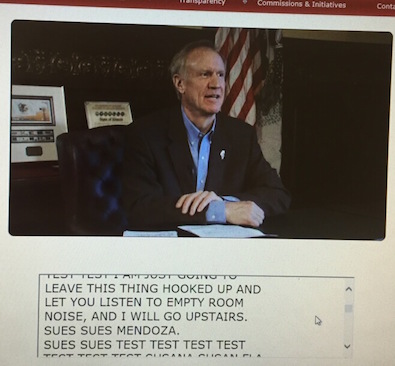
Wow. Even their techies are on-message.
24 Comments
|
Just get it done already
Wednesday, Feb 15, 2017 - Posted by Rich Miller
* Greg Hinz…
Though he and his people are loathe to admit it, they seem to have realized that, to win new term, Rauner needs to show some accomplishments, more than standing on a pile of junk that used to be the state’s economy and declaring that he fought Madigan to a tie.
So what will he do and how far will he go? We’ll know more later today.
* Not exactly clean hands here…
“Tomorrow, our governor is gonna give a speech, a budget. He has to deliver a balanced budget that funds education. Our kids are too important. They’re making all the reading gains and math gains,” [Mayor Rahm Emanuel] told his audience of movers and shakers.
“I see a bunch of CEO’s and business leaders and people working in business. If I’m the mayor, I’m the chief executive of this city. You expect me to deliver a balanced budget, which I do. Dan Cronin in DuPage County — you expect him to deliver a balanced budget. Toni Preckwinkle — you expect her to deliver a balanced budget. We need a balanced budget that funds education and moves this state forward.”
Emanuel noted that the “biggest adverse effect” for Chicago and its drive to recruit even more corporate headquarters is “the uncertainty the state is creating over the business climate. … Uncertainty is our biggest threat. Our kids can’t afford it. Our businesses can’t afford it and the state can’t.”
Pounding the podium for emphasis, the mayor said, “I want the governor to hit the re-set button by having a balanced budget that finally moves this state forward. We cannot be the last state in the union without a budget.”
* Laurence Msall is tired of the finger-pointing…
LAURENCE MSALL: “I would say there’s very little benefit in trying to point (to) who’s done the worst job in the past. The question is: Who’s actually presenting something in the present that has the potential to move our state forward?”
Msall says between the governor’s proposals and Democrats’ own unbalanced budget legislation, there’s plenty of blame to go around, and the problem is only getting harder to solve.
MSALL: “But that doesn’t relieve them of their obligation to do the best they can to make it better for the citizens and for our state. And that’s why we need a budget.”
Rauner says in today’s budget address, he’ll finally weigh in on some of the elements in the so-called grand bargain. That’s the bipartisan plan hatched by top leaders in the Illinois Senate to finally slow Illinois’ long fiscal decline.
* As is the Jacksonville Journal-Courier…
Gov. Bruce Rauner is preparing to step up to the lectern a few hours from now and go through the motions of presenting a plan for a state budget. It will be followed within minutes by leaders of the controlling Democratic Party summarily dismissing it.
It’s a tired plot line at this point. Rauner will talk about the need for controls and reform. Democrats will try to convince anyone who will listen that the status quo will work just fine if taxes are raised to allow uncontrolled spending to continue. […]
Forget that the state constitution is clear about the roles of both the governor and the General Assembly when it comes to a budget. The governor has to present a balanced budget each year to lawmakers. Lawmakers are required to approve a budget.
Not every now and then.
Not most of the time.
Each year.
13 Comments
|
* The Senate President’s chief of staff sent this e-mail to members today…
Senators,
This email is intended to inform you that the Senate’s office supply vendor of choice has effectively stopped accepting orders for paper, printer ink and toner, and other office supplies.
While we have alternative options in place to address immediate needs, it is unclear how long we can make them work. Employees of the Office of the Senate President have been asked to conserve supplies by limiting printing and copying activities, and lean heavily on sharing documents electronically when they are able to do so.
We will do our best to manage through this situation. Please let me know if you have any questions.
35 Comments
|
Lawsuit filed to block the Exelon bill
Wednesday, Feb 15, 2017 - Posted by Rich Miller
* Steve Daniels at Crain’s…
When Gov. Bruce Rauner signed legislation bailing out two money-losing nuclear power plants, operators of Illinois coal- and natural gas-fired facilities promised to take the state to court.
Done.
A group of competitors of Chicago-based nuclear giant Exelon filed a lawsuit in federal court in Chicago today to stop the ratepayer-funded bailout from going forward.
They include Houston-based Dynegy, the second-largest generator in Illinois after Exelon and dominant player downstate, and Princeton, N.J.-based NRG Energy, which operates coal and gas plants in northern Illinois. […]
In the lawsuit, the competitors allege the subsidies undermine wholesale power markets that are the exclusive jurisdiction of the federal government via the Federal Energy Regulatory Commission (FERC). They challenge the law on jurisdictional and constitutional grounds.
The competitors say the law unfairly tilts the playing field in Exelon’s favor, keeping open two plants that otherwise had announced they would close.
The lawsuit is here.
* AP…
“It will profoundly disrupt the FERC-approved energy market auction structure and result in the transfer of hundreds of millions of dollars a year of ratepayer funds to Exelon at the expense of other generators that would have been economically viable without discriminatory subsidies,” the lawsuit stated.
Exelon contends the legislation provides it similar mechanisms that have aided renewable energy development for years.
“Exelon opposes misguided and parochial efforts to block state lawmakers from taking legitimate steps to protect the environment and promote sound economic policies for their citizens,” Exelon said in a statement Tuesday. […]
The plan, to go into effect in June, would cost 3.1 million northern Illinois customers of Exelon’s power-distributing subsidiary, ComEd, an average of 25 cents more per month during the life of the plan. In central and southern Illinois, Ameren’s 1.2 million customers would pay an additional 12 cents or less monthly, the company said.
* And this is from the Illinois Clean Jobs Coalition…
“This lawsuit will not stop Illinois from implementing the biggest clean energy breakthrough in its history, which will create tens of thousands of new jobs across Illinois, save customers billions on their electric bills, and make Illinois a national leader in the clean energy economy. Solar and wind energy are already out competing fossil fuels and energy efficiency is the cheapest energy resource to help lower demand and monthly bills while cutting harmful pollution. Today’s lawsuit suggests that big polluting industries would rather shackle Illinoisans to higher costs and dangerous fuels of the past rather than invest in Illinois’ bright clean energy future.”
4 Comments
|
Legislators criticize Rauner over AFSCME impasse
Wednesday, Feb 15, 2017 - Posted by Rich Miller
* Tribune…
Democrats and their union allies also used the eve of Rauner’s budget speech to bash the governor for his handling of his contract negotiations with state workers.
“This governor has been nothing but a disaster,” said Rep. Mary Flowers, D-Chicago. “This governor made it plain and clear that he is here for his business community and his business friends. That’s not our goal. And if he wants a strike, a strike it will be.”
The American Federation of State, County and Municipal Employees Council 31 is in the midst of a strike authorization vote, asking its more than 30,000 state worker members if they are willing to go on strike to resist Rauner’s attempts to impose a new contract. Rauner’s contract would increase employees’ out-of-pocket health care costs and give the state greater freedom to privatize jobs currently performed by unionized workers. AFSCME contends that the contract would cost the average worker $10,000.
“That might not be much to someone who can spend $50 million and put it in their political PAC, or someone that makes over $184 million a year, but to these people and the people from our communities and the people of the state of Illinois, $10,000 is a lot of money, Gov. Rauner,” said Sen. Omar Aquino, D-Chicago, referring to Rauner’s contribution late last year to his 2018 re-election campaign account.
* AFSCME also sent out a release about yesterday’s media event…
Bridgette Mittons, an employee of the Department of Healthcare and Family Services and a member of the union’s rank-and-file bargaining committee said, “In Cook County, two-thirds of the state workers represented by AFSCME are African-American or Latino, two-thirds are women, and more than half, like me, are women of color. Governor Rauner is trying to weaken our ladder to the middle class.” […]
“The governor’s demand for a 100% increase in what employees pay for health care would cost the average worker $10,000 and hurt communities of color most of all,” state Sen. Omar Aquino said.
“Governor Rauner, how do you ask these working people to pay $10,000 more while asking nothing of your rich friends?” state Rep. Mary Flowers asked. “Just like the state budget, Rauner’s refusal to negotiate is causing big problems for the people of Illinois.” […]
“Unless Bruce Rauner is willing to compromise, our only other option is to go out on strike. The governor doesn’t seem to care about the harm a strike would cause,” said Roberto Botello, a mental health worker and member of AFSCME. “As public service workers, we are very concerned. We know that in the Chicago area a strike would hit African-American and Latino communities hardest.”
“Bruce Rauner should return to the bargaining table today and keep Illinois working,” state Rep. Emanuel Chris Welch said.
Senator Cristina Castro and representatives Jaime Andrade, La Shawn Ford, Sonya Harper and Christian Mitchell were also in attendance.
33 Comments
|
Pritzker talks a bit about a possible run
Wednesday, Feb 15, 2017 - Posted by Rich Miller
* Bloomberg’s John McCormick interviewed JB Pritzker this week…
“If I ran, I would self-fund,” said Pritzker, an investor, philanthropist and heir to the Hyatt hotel empire, who has an estimated net worth of $3.5 billion in the Bloomberg Billionaires Index. Pressed on how much of his own fortune he’d be willing to spend, he said: “Whatever it will take to run a winning campaign.” […]
Pritzker, 52, downplayed his own family’s status in the party, while offering what could be viewed as a subtle jab at a likely future primary opponent.
“I don’t consider my family name to be a super high-profile Democratic name,” said Pritzker, who is a major Democratic donor nationally and one of the top supporters to groups backing Clinton in 2016. “I don’t come from a political dynasty.”
Pritzker declined to discuss timing for a possible announcement, but said he’s bullish about his prospects if he enters the race. “I’m going to work to elect the most viable candidate running, and if I’m running, I think I’ll be the most viable candidate,” he said.
Not much there, but it’s still early.
25 Comments
|
* Tina Sfondeles…
Calling himself the “most frustrated person in the state,” Gov. Bruce Rauner on Tuesday offered a glimpse into his third budget address — saying he’ll try to push along the Illinois Senate’s “grand bargain” plan.
Noting the high-pressure stakes of the plan – which includes a temporary property tax freeze, an income tax hike and changes in pension reform — Rauner spoke on Facebook Live to urge senators to “stay strong and do the right thing for the long-term for the people of Illinois.” […]
On Tuesday, Rauner called criticism that he’s never submitted a “balanced budget” a “common spin.”
“This spin is wrong. I have submitted budgets for two years and now I’m submitting a third budget,” Rauner said, adding that his 2015 budget with $6 billion in cuts was “ignored.”
He has indeed submitted budgets for two years and neither of them were even close to being balanced.
* Garcia, Geiger, BeMiller…
“There are individuals and special interest groups on both ends of the political spectrum, both ends, who don’t want to see any compromise, who don’t want to see any grand bargain, who don’t want to see a budget deal, and they are sending attacks left and right,” said Rauner, who has yet to pass a full-year budget since becoming governor. “But we have got to find compromise. We need to listen to each other, respect each other and come up with some solutions that give us a better future for the long term.”
Rauner’s focus on the Senate plan underscores the likelihood that his own budget address is unlikely to offer much in the way of new ideas. He’s already said that his proposal will mirror the format that was shot down last year, in which he presented a plan that was at least $3.5 billion in the red and asked the Democratic-controlled General Assembly to work with him toward an agreement or to give him the power to make massive cuts on his own.
That approach is again garnering opposition from Democrats who contend the governor is shirking his constitutional duty to present a balanced budget. Rauner was quick to shrug off the criticism, saying Democrats repeatedly have passed out-of-whack spending plans that helped create the state’s money problems.
In person, anyway, the governor is now trying to sound more like “Mr. Rogers’ Neighborhood” than “Hardball.”
Also, the Democrats make a valid point with their criticism, but the Rauner response is also quite valid.
* Finke…
Rauner said a great deal of criticism has been leveled “against those who are trying to find a common sense, bipartisan, centrist compromise.”
“I am a big advocate of compromise,” Rauner said. “We’re all going to have to give in on what we’d love in on what we’d love in a perfect world.”
More Mr. Rogers.
28 Comments
|
|
Comments Off
|
[Bumped up from last night for visibility purposes.]
* Press release…
Governor Bruce Rauner’s administration today filed an opposition to the Attorney General’s irresponsible attempt to cut off paychecks for hardworking state employees.
“As we explain in our opposition, federal and state law requirements support continuing the Court’s July 2015 order that would ensure that state employees receive the paychecks they have earned,” said Dennis Murashko, General Counsel to the Governor. “Instead of fighting to cut off employee pay in the middle of the Senate’s work on passing a balanced budget with changes to the system, the Attorney General should become a productive partner in the process.”
Former Comptroller Leslie Munger retained her own counsel to fight vigorously for state employees to continue being paid for the work they do. Comptroller Mendoza has taken a different path, abdicating her responsibility to fight for state employees.
Our administration unequivocally stands with state employees. Last week, Governor Rauner sent a video message to state employees reiterating his dedication to ensuring they continue to be paid for their work. We continue to call on the Attorney General to abandon her quest to deprive Illinois state workers of their hard-earned wages.
* This is kind of an odd legal filing. Check it out…
Although the Attorney General focuses exclusively on the appropriations process, numerous other legal grounds support paying state employees in the absence of specific appropriations for state employee payroll. As described below, federal law requires the State to pay its employees under the Fair Labor Standards Act, superseding state law. In addition, roughly eighty federal court consent decrees direct the State to perform a wide range of services, which tens of thousands of state employees must be paid to provide. Next, state employees must be able to protect the health, safety, and welfare (including the economic well-being) of the people under the State’s police powers. And finally, numerous legislatively-enacted commands mandate that state agencies perform a wide variety of services and functions, operating as a continuing appropriation of all funds necessary to provide them. Thus, even if the Attorney General could demonstrate that no specific appropriations existed to pay state employees (a factual matter that the Attorney General simply assumes to be true), the Attorney General would be required (but completely fails) to specify which employees’ pay can be stopped despite the above legal grounds for paying them.
Notice the incredibly broad police powers claimed in this filing. Even if AG Madigan wins this motion, they’re going to fight like heck to keep every possible function operating.
* More…
For these reasons, or any combination of them, the Attorney General has not met her burden to upset the status quo requiring that state employees continue to be paid in full. This Court should therefore continue its July 2015 Order. In the alternative, this Court should reject the Attorney General’s invitation to create an artificial emergency and instead should continue its July 2015 Order until such time as it can oversee the fact-specific inquiry necessary to determine which state services must be provided. In the event that the Court elects to follow this course, the Attorney General should explain which employees she believes must be deprived of a paycheck and which services she believes should no longer be provided to the people of this State.
And now they want to put the burden on the attorney general to decide who should and shouldn’t be paid?
Clever.
*** UPDATE *** The Tribune has the AG’s react…
Madigan spokeswoman Maura Possley said Rauner “is asking the court to relieve him of his responsibility to ever sign a budget covering the state employee payroll.”
“The governor should do his job instead of asking the court to do it for him,” she added.
57 Comments
|
|
 Support CapitolFax.com
Visit our advertisers...

 ...............
 ...............
 ...............


|
   
|
Hosted by MCS |
SUBSCRIBE to Capitol Fax |
Advertise Here |
Mobile Version |
Contact Rich Miller
|



