What in the heck?
Thursday, Feb 2, 2017 - Posted by Rich Miller
* From a story entitled “Rauner talks education funding in Rockford, not questioned by reporters there”…
At a school in Rockford Wednesday morning, Rauner fielded questions from an audience of school children. One question concerned Illinois’ crime problem.
“For young people not to be drawn into the gang life, it’s very important that we help every young person see that they can have a great education, and have every school in every community have the proper support, so teachers can really be properly helped to help every student,” Rauner said. “And we need every young person to see a good future for themselves so being drawn into a gang is not very appealing.”
While the governor complimented the children on their tough questions, suggesting they have a future in journalism, the real reporters were given an opportunity to question the governor and declined.
Rauner would not have gone unchallenged in Chicago or Springfield. [Emphasis added.]
I don’t think I’ve ever seen that happen or heard of it happening anywhere. No questions?
* Raw audio…
“And with that, I’ll open it up to questions,” the governor says at the end. “Anybody have questions? No? That’s good? OK.”
44 Comments  
|
*** UPDATED x1 *** Hearing set for AG motion
Thursday, Feb 2, 2017 - Posted by Rich Miller
* The attorney general’s office just called to say they have a hearing set in St. Clair County on their motion to vacate the order to pay state employee salaries without an appropriation.
The hearing will be held February 16th at 1:30 in the afternoon.
* By the way, if you watch the Tribune interview video, Gov. Rauner shook his head “yes” when asked if state employees should be paid without an appropriation and without a court order to do so.
Those are some very dangerous waters.
Rauner wasn’t asked, however, whether social service providers should be paid without an appropriation even though they have signed state contracts in hand.
*** UPDATE *** The governor’s office has now responded to the competing legislative proposals by House Democrats and House Republicans to pay state workers…
“It is only right that state employees are paid for the work they do, which is why we were so disappointed by the Attorney General’s motion. We are reviewing the proposals but appreciate that lawmakers on both sides of the aisle are working on solutions.”
27 Comments
|
Unclear on the concept
Thursday, Feb 2, 2017 - Posted by Rich Miller
* From a CBS 2 story on the Illinois Policy Institute’s budget proposal…
State Rep. Jeanne Ives (R-Wheaton) said she thinks the public will press for approval of the IPI budget plan.
“That four-person family where the dad’s working his tail off, and maybe has a second job, and they know that they’re funding the Medicare for an able-bodied single adult who doesn’t want to get a job; I’ll tell you what, they’re all in on this plan, sir. All in,” she said.
Um, Medicare is federal. Medicaid is state. But way to go on the class division stuff.
Also, if that four-person family has a kid in college, I’m not so sure they’ll be loving a billion dollar cut to higher education. But, hey, maybe they’ll just send their kid to an out of state college.
Audio is here.
* Related…
* State Rep. Allen Skillicorn filing bill to carry proposed balanced budget
17 Comments
|
* WaPo…
Democrats are moving urgently to harness the wave of grass-roots protests that have greeted President Trump in his first weeks in office to reclaim the House majority in next year’s midterm elections.
As of this week, the Democratic Congressional Campaign Committee is hiring full-time operatives to do political organizing work in 20 key Republican-held districts — an unusually early investment in House races that do not even have declared candidates yet.
Rep. Ben Ray Luján (D-N.M.), the committee’s chairman, called the move “unprecedented” for Democrats, who need to pick up two dozen GOP-held seats to win the majority. […]
The 20 targets include many of the districts where Democrats hoped to unseat Republicans last year — including suburban districts in California, Minnesota, Pennsylvania and Colorado. But they are also going into districts represented by veteran GOP lawmakers — such as Reps. John Abney Culberson (Tex.), Peter J. Roskam (Ill.), Edward R. Royce (Calif.) and Pete Sessions (Tex.) — who did not face a strong 2016 challenge but where Democratic presidential nominee Hillary Clinton ended up beating Trump.
I dunno about Roskam. Do you think he’ll be vulnerable?
* Then again…
A group of 16 constituents that arranged to meet with staff members at the West Chicago district office of U.S. Rep. Peter Roskam (R-Wheaton) Wednesday about their concerns with a repeal of the Affordable Care Act were abruptly told they would have to reschedule after staff realized a member of the press was present.
Sandra Alexander said she scheduled the meeting weeks ago and was stunned that they were turned away. “We are going to be respectful and see if they will change their minds,” Alexander said. […]
“He just ran off,” Alexander said. “They never told me that the media could not be here, and the reporter was willing to leave so that we could have our meeting,” she said.
* The DCCC might also want to look at Rodney Davis’ district, which is the home to something like ten universities and colleges, including UIUC and ISU. And speaking of ISU…
Josh Knight of Normal said he brought his 8-year-old son to a Not In Our Town Bloomington-Normal rally Wednesday night in Bloomington to show him how to be an American.
“I wanted to show him that we treat all people equally and that we instill in him the values of American culture that we believe in and that is freedom for all people and to be an open and welcoming person,” said Knight. […]
They were among about 1,200 people who filled the Bloomington Center for the Performing Arts auditorium to capacity in a show of support for their immigrant neighbors and to protest President Donald Trump’s executive order on immigration, making the rally one of the largest in recent memory in the Twin Cities.
1,200 people turned out for a pro-immigration rally in Bloomington? Something’s up.
Davis supported the president’s executive order, but that midterm could be rough if that district can be organized.
The problem with that idea, however, is the district is so spread out. Bloomington and Urbana aren’t far away geographically, but they are worlds apart in many other ways. The campuses appear to dominate the district on paper, but people on those campuses almost never work together. Also, I think about 40 percent of the district is in the St. Louis media market. It’s all over the place.
*** UPDATE *** Many thanks to a commenter who pointed us to this DCCC memo, which reveals that Congressman Davis is on the DCCC’s target list, along with Congressman Randy Hultgren (which may be a bit of a stretch). From the memo…
History Isn’t On Their Side:
* Since 1900, there are only three examples of the president’s party gaining seats in the first midterm: 2002 (George W. Bush), 1934 (Franklin D. Roosevelt) and 1902 (Teddy Roosevelt).
* In modern history- since 1982- the president’s party has lost an average 28 seats in the first midterm election, even accounting for Republican gains in 2002 under President Bush.
President Trump’s Historic Unpopularity:
* In all midterms over last 23 years, the sitting president has needed a net-positive job approval in the double-digits in order to stave off losses.
* According to a new Quinnipiac University Poll conducted over Donald Trump’s first five days as President, only 36% of voters approve of his job performance.
* Trump has reached majority disapproval (Gallup Poll) in a record-shattering 8 days.
Deeply Unpopular Agenda:
* On policy, House Republicans are taking the wrong lessons from 2016: kowtowing to Trump’s most divisive policies like his border wall, while opposing him on popular plans to preserve Medicare or action on trade.
* The Republican plan to repeal the Affordable Care Act is deeply unpopular, and will continue to create political backlash across the country.
* Republican attacks on Medicare, Social Security and Planned Parenthood, and efforts to gut ethics and transparency safeguards will have repercussions at the ballot box.
74 Comments
|
Question of the day
Thursday, Feb 2, 2017 - Posted by Rich Miller
* Gov. Rauner is at a Daily Herald editorial board meeting today…
As Oswego Willy would say, that quote is “restaurant quality.” I laughed out loud.
* The Question: Your own description of the Thompson Center?
69 Comments
|
Why did CTU call for Claypool’s resignation?
Thursday, Feb 2, 2017 - Posted by Rich Miller
* Tribune…
The governing body of the Chicago Teachers Union called for the “immediate resignation” of schools chief Forrest Claypool on Wednesday, a symbolic gesture that also denounced budget cuts and layoffs implemented by the city amid ongoing budget turmoil.
Mayor Rahm Emanuel, who appointed Claypool to lead Chicago Public Schools in 2015, responded by saying he had “complete confidence” in the former mayoral chief of staff and Chicago Transit Authority chief.
* DNAInfo…
Chicago Public Schools CEO Forrest Claypool should resign immediately “for his efforts to dismantle and sabotage” Chicago’s public schools, the leaders of the Chicago Teachers Union said.
The resolution, adopted Wednesday evening by the union’s House of Delegates, came in advance of the first of four unpaid days for teachers ordered by Claypool to save $35 million to help fill a $215 million hole in the school district’s budget caused by the state budget impasse. […]
The resolution adopted by the union’s House of Delegates, accuses Claypool and the Chicago Board of Education — all appointed by Mayor Rahm Emanuel — of “frivolously lining the pockets of wealthy investors” while students suffer the effects of deep cuts to school budgets.
OK, but how is Claypool allegedly lining those pockets and why?
* For the answer, go to the CTU resolution…
WHEREAS, the efficiency measures proposed by Chicago Public Schools and imposed by the Chicago Board of Education have led to mass privatization, costly contracts, program cuts, mass layoffs, and an increased inefficiency of our public school services all while frivolously lining the pockets of wealthy investors
RESOLVED that the Chicago Teachers Union calls for the immediate resignation of CEO Forrest Claypool and a member vote of no confidence for his efforts to dismantle and sabotage the Chicago Public Schools; and be it further
So, basically what the CTU is talking about here are the CPS privatization programs. Coincidentally, part of the Senate’s grand bargain would expand those very same Chicago Public Schools privatization standards to the rest of the state.
The CTU probably should’ve been more specific, citing dollar amounts or specific privatization failures. This is, after all, a hot topic. But it’s not just some empty personality fight over who should resign.
* From last week…
One of Chicago Mayor Rahm Emanuel’s campaign contributors is in line to get more business from the city’s school system.
The Chicago Board of Education will vote Wednesday on three new contracts — worth around $500 million over three years — that will further privatize the management of school building engineers. One of the two companies listed on the board report is SodexoMAGIC, a company that NBA-star-turned-businessman Earvin “Magic” Johnson has a stake in.
Johnson donated $250,000 to Emanuel’s 2015 reelection bid through an organization he established called Inner City Youth Empowerment, LLC. If approved by the board, the new contract would expand a pair of contracts awarded in 2014 worth $340 million.
When SodexoMAGIC and Aramark began overseeing the cleaning and management of school facilities, principals complained about dirty classrooms and a lack of communication.
Some documentation of those complaints are on the CTU’s website.
* And those complaints against Aramark included this one from last June…
Students at a West Side Chicago public high school were surprised to find something extra in their breakfast Wednesday morning - mold.
CPS is now investigating what went wrong after a box of expired breakfast snacks was served at the West Town Academy.
“I opened the package and once I opened it I noticed the corner had mold on it,” said student Janiah Dean. […]
CPS has launched an investigation and Aramark, it’s vendor that supplies food to the school, says: “Unfortunately, at West Town Academy today a student received (food) that did not meet our high quality standards. Out of an abundance of caution, we immediately removed the product line and are working to determine how this happened. The incident appears to be isolated and did not pose a health risk to students.”
13 Comments
|
Cullerton does the media’s job for them
Thursday, Feb 2, 2017 - Posted by Rich Miller
* Ted Dabrowski, vice president of policy and spokesman for the Illinois Policy Institute, on why it wants to end revenue sharing via the $1.75 billion Local Government Distributive Fund…
“Illinois government encourages local governments to spend more, sending billions of dollars to thousands of local governments each year,” Dabrowski said. “All this does is allow governments to spend it on things that their constituencies would never approve of. We end that charade.”
Really? Local governments are spending that revenue sharing money on stuff their own constituents wouldn’t approve of?
* I’ve looked for, but haven’t yet seen any actual reportage on local react to this claim. But Sen. Tom Cullerton (the rank and file Senator, and that’s Cullerton with a “C” not an “F” who is not the chamber’s “majority speaker”) sent out a press release with one local mayor’s thoughts…
In addition to funding everyday core services to Illinois citizens, LGDF distributions play a role in keeping the local tax burden low.
“This idea is ridiculous,” Mayor Frank Saverino, Village of Carol Stream said.
“Municipalities like Carol Stream rely on the Local Government Distributive Fund to repair potholes, plow our roads in the winter and provide area residents with basic services. We wouldn’t be able to serve the people of Carol Stream without this essential fund.”
28 Comments
|
Our sorry state
Thursday, Feb 2, 2017 - Posted by Rich Miller
* The Pew Charitable Trusts took its annual look at the fiscal conditions of all 50 states. Illinois is a mess, of course.
Since the the Great Recession began at the end of the fourth quarter of 2007, Illinois ranks 49th in personal income growth - a mere 0.9 percent. Sheesh.
Illinois did a bit better in that same time period, 38th, in percentage change of employment rates - a 1.5 percent reduction.
Illinois is third highest, after Alaska and Hawaii, for debt and unfunded retirement costs as a share of state personal income - 31.7 percent.
More here.
18 Comments
|
“Serious brain drain”
Thursday, Feb 2, 2017 - Posted by Rich Miller
* Chicago Magazine…
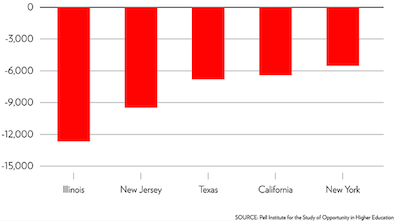
Illinois has bled more students than it’s brought in for a while, but the trend has accelerated in the past couple of years as the state’s budget woes have exacted a toll on the University of Illinois and other public schools. In 2014—the most recent year for which data are available—Illinois saw a net emigration of 12,700 students, a 70 percent increase over a decade.
The big repercussion is that talented students may never return. “It’s a serious brain drain,” says William Morrison, a college counselor at Highland Park High School. It’s common for students to stay put after graduation: Almost half of the Urbana alumni who are alive still reside in Illinois.
At the root of all this are cuts in state funding that have forced Illinois schools to raise base tuition and fees. At Urbana, in-state rates rose 59 percent over the past 10 years, to a minimum of $15,700 and a maximum of $20,700 (not including room and board), depending on the major. At the same time, financial aid through the state’s Monetary Award Program, which provides need-based grants to residents, doesn’t go as far as it used to. It’s not even clear from term to term whether funds will be available: In a survey released in December by the Illinois Student Assistance Commission, 47 percent of Illinois schools said they couldn’t guarantee that students would continue to receive in the spring semester awards they got in the fall. […]
Illinois had the highest net migration of college freshmen to other states’ public schools in 2014 (the latest year for which figures are available). While 3,300 students came to Illinois from elsewhere, almost 16,000 fled. California lost about as many students but saw a bigger influx—9,500.
* Chart…
* Related…
* State of the Standoff: Some universities ‘running on fumes’: Southern Illinois University President Randy Dunn said the budget uncertainty has created “a crisis of confidence that caused students to go elsewhere.”
90 Comments
|
* Press release…
The governor’s school funding reform commission completed its work on deadline today, but fair and adequate education funding remains out of reach for too many children across Illinois, Senator Andy Manar said.
“If we can get a bill in front of lawmakers this spring, then that will be the true measure of success for the governor’s commission,” said Manar, a longtime advocate for school funding reform and the Senate’s point person on the issue. “But forgive me if I’m not ready to unfurl the mission accomplished banner just yet.”
During the summer, Gov. Bruce Rauner appointed a 25-member commission tasked with studying Illinois worst-in-the-nation school funding formula, which creates winners and losers among students and school districts across Illinois because of its overreliance on local property taxes to fund schools.
The commission met 18 times between August and today. Its final recommendations include moving Illinois to a new funding formula, a hold-harmless clause to prevent districts from losing state funds, more local control and greater transparency about spending, mandate relief for school districts, additional money for English learners and low-income students and more.
The bipartisan commission also recommended an increase of at least $3.5 billion for school funding.
“The commission should be commended for its work the past six months. I am pleased that we have a new level of awareness of the state’s school funding crisis because of this bipartisan, bicameral discussion,” Manar said.
“But in terms of a product, that work yielded another report on Illinois’ already well-documented school funding reform problems. We have a loose framework – a guide – for moving forward. What we do not have today is a piece of legislation to debate in the General Assembly. That has to be the next step.”
Manar commended Beth Purvis, Rauner’s secretary of education, for her leadership role with the commission and said he looks forward to the governor’s staff translating the recommendations into a bill that will be introduced in the Legislature this spring.
“The commission’s work was substantial, but what happens now is up to Gov. Rauner,” Manar said. “The goal has always been and should continue to be permanent reform that guarantees fair funding for all Illinois schools.”
The report and my own underwhelmed take is here.
* Related…
* Governor’s commission urges more state money for poor students
9 Comments
|
* You should really click here and watch all of Gov. Rauner’s interview at the Chicago Tribune editorial board. It’s very interesting.
With that in mind, the governor again said yesterday that he has zero involvement with the Illinois GOP’s attacks on Speaker Madigan. This passage is from the Tribune’s coverage, with emphasis added by me…
Asked whether the attacks on Madigan could undercut efforts to reach a compromise to end the stalemate, Rauner said, “I don’t think it matters one way or the other.”
“This is the life we’ve chosen. We all live in a world — I take incoming every day. … I couldn’t care less. Say what you want,” he said.
“That’s one of the best advices Rich Daley ever gave me: He said, ‘Don’t read any press about you and don’t watch any of the ads’ and I never have, I never have. And you know what? Life is good. Just spell my name right. I don’t really care. And anybody on the other side thinks, ‘Oh, I’m a politician but you can’t say anything mean about me otherwise I won’t negotiate?’ Oh come on. Grow up. I mean, we’re not in third grade,” he said.
* From another part of that Tribune interview when the governor was asked about his veto of the Chicago teacher pension subsidy and its impact on CPS employment as transcribed by me with emphasis added…
“Well, this is one of the ways I’ve been disappointed in you guys, but this is the media. Chicago has been responsible for its own teacher pension for a hundred years, OK? Allright, so let’s not think this is some, you know, a hundred years. And Chicago has received $250 million extra since at least the mid 90s, I’d have to go back and get you the exact year. $250 million in our school funding formula. A block grant that no other district gets. It’s above and beyond any of the standard stuff because they cover their own teachers pension. They have not been at a financial disadvantage. They claim that this is wrong, they’re abused, they’re treated different, and they are different because they fund teacher pensions and they get extra money because of that. There’s been a deal, there’s been an understanding. […]
“So, the headline is: ‘Bruce Rauner caused furlough days in CPS.’ No. No.”
43 Comments
|
Another punt in the works?
Thursday, Feb 2, 2017 - Posted by Rich Miller
* Yesterday’s Tribune…
In 2015, Rauner offered a budget that contained a $2.2 billion hole because of proposed pension savings that the governor eventually acknowledged might not pass constitutional muster. Last year, he offered lawmakers the choice of working with him to cut the budget or letting him do it himself. He did not spell out how he would close a hole of at least $3.5 billion.
* Today’s Tribune…
Republican Gov. Bruce Rauner said Wednesday that he will offer state lawmakers this month a budget proposal in the same format that the Democratic-led General Assembly rejected last year — either work with him on crafting a balanced spending plan or give him more power to make cuts on his own. […]
Rauner’s decision last year to present a spending plan that included the option of letting lawmakers give him the power to make massive cuts was never really considered by Democrats in the General Assembly. They said Rauner needed to specify where he intended to cut spending.
“Either the General Assembly authorizes me to make cuts, not my first choice but I’ll do that, or let’s work together to do a balanced budget with cuts and, what I prefer is, a balance of cuts, some revenues and major structural change. The real important thing is the structural change,” Rauner said [to the Tribune yesterday]. […]
“I think a deal is more likely to happen if it’s organic, coming from the rank-and-file members of the General Assembly, and the important thing is to get a good compromise. I’ve been very clear. I mean, the good news and bad news is nobody’s wondering what I think is the right thing to do,” he said.
That last line was probably intended as a joke, but it is close to being true. And if it is true, that’s a pretty sad commentary on the governor’s tenure.
27 Comments
|
Is this the end of the line for Cullerton?
Thursday, Feb 2, 2017 - Posted by Rich Miller
* From the inimitable one…
Sneed hears powerful Illinois Senate President John Cullerton (D-6th) has told some of his closest Senate colleagues he is so frustrated with the budget logjam, he is thinking about not running for re-election when his term is up in two years, according to two sources.
“Cullerton is stressed and frustrated by all the nonsense going on in Springfield and the ability to get things done,” said a source who spoke to Cullerton.
“He indicated he is not going to pull the plug now, but he did say he was considering not running for re-election,” said a state senator who asked to remain anonymous. […]
“The budget logjam is frustrating — personally, professionally and politically. That’s no secret,” [Cullerton] said. “As for my future? I’ll decide that at the appropriate time. But that time isn’t now. Right now the only priority is getting a budget for the state of Illinois.” […]
“If I want to run for re-election as a state senator, I’ll need to make that decision by the end of the year. Right now, we’ve got problems to solve. I’ll deal with the other stuff later,” Cullerton said.
Your thoughts?
39 Comments
|
Downstate continues to be hollowed out
Thursday, Feb 2, 2017 - Posted by Rich Miller
* Not encouraging news for folks who don’t live in the Chicagoland area…
Dating back to the recession that began in 2008, statistics reveal that the Chicago area is up by 110,000 jobs while the rest of the state has lost 42,000 jobs.
Over the past year, state job data show, Illinois has added 30,800 jobs, a total reached by adding the 33,500 jobs Chicago gained and subtracting the 2,700 jobs lost in the rest of the state.
Discuss.
41 Comments
|
Maybe take your own advice?
Thursday, Feb 2, 2017 - Posted by Rich Miller
* Tribune…
Gov. Bruce Rauner on Wednesday called Trump’s executive order on immigration and curbing refugee resettlement “overly broad and a little bit hurried.” […]
“Emotion is guiding too much of the conversation,” he said. “The system is not working and we shouldn’t try to deal with it on a piecemeal basis.”
* Elsewhere in the Tribune…
Sometimes in politics, emotions get involved. Gov. Bruce Rauner on Wednesday brought up emotions when discussing his December veto of legislation that would have provided $215 million for Chicago Public Schools.
“You know, I’m a human being, I get a little emotional sometimes,” Rauner said at an appearance before the Chicago Tribune Editorial Board.
Rauner was explaining his abrupt veto of a plan that had been part of a larger deal he struck over the summer with the Democrats who control the General Assembly — House Speaker Michael Madigan and Senate President John Cullerton.
* By the way, Senate President Cullerton’s spokesman John Patterson explained his boss’ side of the veto story a while back…
Cullerton’s aide suggested it was understood that pension reform was to be deferred because of the election. On June 30, a motion filed to reconsider the bill was passed to extend the 30-day deadline to send SB 2822 to Rauner because the Illinois General Assembly would not be able to discuss pension reform until after the November election, according to Patterson.
According to a transcript of Senate Minority Leader Christine Radogno at the Senate on June 30 provided by Patterson, the senator of the 41st District said the agreement was to pass the legislation and return to the issue of pension reform at another time when the General Assembly was in session.
According to Patterson, on the same day Rauner vetoed the bill, reporters asked Cullerton whether there was an agreement after a meeting between the two, and he said no, in reference to pension reform.
Patterson said the interview was live streamed on the internet and speculated that it was seen by Rauner or an aide of his, who interpreted it to refer to the entirety of the agreement. Patterson thinks this led to the bill’s veto by Rauner and that there needs to be stronger communication between legislative leaders and the governor.
Yeah. About those gubernatorial emotions. Maybe control them?
19 Comments
|
|
Comments Off
|
|
 Support CapitolFax.com
Visit our advertisers...

 ...............
 ...............
 ...............


|
   
|
Hosted by MCS |
SUBSCRIBE to Capitol Fax |
Advertise Here |
Mobile Version |
Contact Rich Miller
|



