Ugh. I sure hope he’s going to be OK. I’ll let you know if there are any official updates.
…Adding… The press release announcing the ribbon cutting included a quote from Director Poe that was obviously written before the event, but no update on his condition.
Illinois Department of Agriculture Director Raymond Poe said he is OK after taking a tumble during Thursday’s ribbon-cutting ceremony to open the Illinois State Fair.
Poe was standing in a line with Gov. Bruce Rauner, Mayor Jim Langfelder and several other officials holding the blue ribbon in front of the Main Gate as Rauner clipped the ribbon.
As the crowd applauded Poe turned around and apparently lost his balance and fell backward.
Rauner’s amendatory veto of SB1 hurts our public schools even more. Because what he isn’t telling you is that behind closed doors he’s working to privatize those funds and redistribute them to private schools in the area. He is calling for a $100 million school voucher program.
This school voucher program is being decided on behind closed doors and just proves what we’ve known all along — Rauner doesn’t care about the families of Illinois, he only cares about his own interests. Whether it’s a budget for the state or school funding, Rauner does not care about the damage he’s causing our state.
Rauner wants to rob our public schools to enrich private schools. We cannot let this happen.
Mayor Rahm Emanuel dodged questions on school vouchers Thursday even as negotiations continue on a new statewide funding formula — talks that, at Gov. Bruce Rauner’s request, include vouchers. […]
Emanuel was asked where he stands on school vouchers before heading off to O’Hare for a flight to the U.S. Conference of Mayor’s meeting in New Orleans.
“My primary focus is on public education,” the mayor said.
Pressed on whether he opposes vouchers, Emanuel said, “I have a history and my record is clear as it relates to public education. And my record is clear as it relates to vouchers and using public money for private schools.”
I wish the media would stop calling this a voucher program. These aren’t vouchers. This is a private school scholarship fund underwritten, as proposed, by 100 percent state income tax credits.
* The Cardinal lobbied the mayor a few months ago about this topic…
Cupich, who invited Emanuel and his wife, Amy Rule, to Rome to witness his elevation to cardinal in November, emailed Emanuel in April about the plan. He said he supported U.S. Education Secretary Betsy DeVos’ proposal to give credits to taxpayers who donate to a fund that covers private school tuition.
“I am convinced that this would be an enormous boost to the Chicago schools and the thousands of parents who use our schools,” Cupich wrote in the email sent April 11.
Emanuel responded in an email back the next day, saying, “Of course we will discuss,” as first reported by WBEZ.
Enrollment at Chicago’s Catholic schools has been dropping for several years, leading to closures of several schools — including St. Benedict High School in North Center — and the merger of four Far Northwest Side Catholic schools into Pope Francis Global Academy.
* Now that JB Pritzker has chosen Rep. Juliana Stratton as his running mate, whom should the other Democratic candidates choose? And please don’t forget to explain your answer. Thanks.
* From Hari Sevugan at 270 Strategies, who is with the Daniel Biss campaign…
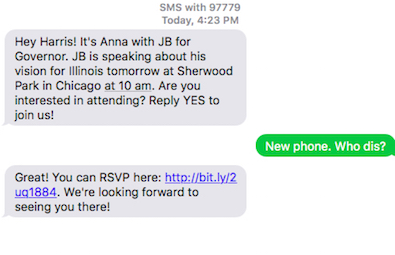
JB’s campaign was using Hustle to get me to come to an event. The idea is to use texts to allow real people to organize through one-on-one conversations. Instead, it looks like I got a bot. I wrote “new phone. who dis?” And got an instant reply with “great. RSVP here.”
Given how much money JB has and is spending, you’d think they could do better than this.
* The screen cap…
To me, anyway, it’s not so much that they’re using a bot, but that their bot doesn’t appear to be properly programmed. He didn’t reply with a “Yes,” so why the follow-up text?
Cook County’s sweetened beverage tax could land the state in hot water with the feds, resulting in roughly $87 million in federal food stamp money being withheld if the problem isn’t fixed, Illinois officials said Thursday.
The problem: While Cook County has informed retailers that purchases made with federal food stamp benefits are exempt from the soda tax under federal law, it’s also allowed retailers to tax those purchases and provide refunds as a workaround for stores that haven’t been able to properly update their point-of-sale systems.
As a result, the U.S. Department of Agriculture’s Food and Nutrition Services, the federal agency overseeing the food stamp program — officially known as the Supplemental Nutrition Assistance Program, or SNAP — earlier this week warned the Illinois Department of Human Services that federal money could be withheld. The state passed along that warning to the county on Wednesday.
*** UPDATE 1 *** The US Department of Agriculture’s letter to IDHS reveals that it “advised Cook County via phone call on on June 28, 2017 that this option for managing the tax was unacceptable.” Click here to read the letter.
A spokesman for the Illinois Retail Merchants Association says IRMA also told the county this same thing and used it as part of its lawsuit.
*** UPDATE 2 *** From the county president’s office…
The Cook County Department of Revenue has been in collaboration with the retail community since the approval of the Sweetened Beverage Tax last November. We have worked with the retail community to address their concerns and have implemented regulations to provide further guidance.
The regulation addressing Sweetened Beverage purchases made with SNAP benefits was put in place to further address the tax-exempt nature of sweetened beverage purchases made with SNAP benefits. In drafting the regulation, the Department of Revenue discussed the regulation changes with the USDA on June 27th. After speaking with USDA on June 27th, the County was not aware that Regulation 2017-3 was unacceptable. We believed that USDA was taking our regulations under consideration and would communicate back with the County if there was a concern.
If we were specifically told that the Regulation 2017-3 was unacceptable, we would have worked with USDA, just as we had been doing since January, to further modify as needed. It was never our intention in drafting the sweetened beverage regulations to put federal SNAP funding for the state in jeopardy, nor do we think Regulation 2017-3 jeopardizes the State’s participation in SNAP. At this time, we believe we are in compliance with existing SNAP rules. We do however recognize that USDA’s powers against the State in this regard are substantial and we will work collaboratively with both the State and USDA to address USDA’s concerns.
* You’ll recall that the Illinois State Board of Education claimed this week that the Department of Revenue staff reported “a significant error in the TIF EAV data that the Department of Revenue submitted to the State Board of Education for modeling.” I immediately FOIA’d the board for all e-mail correspondence. This is their reply today…
Dear Mr. Miller:
This letter is in response to your request for information under the Illinois Freedom of Information Act. Your request was received on Aug. 8, 2017.
You have requested all e-mail correspondence on August 7 and August 8, 2017 between the Illinois Department of Revenue and the Illinois State Board of Education.
The attached document (18-029-miller-doc.pdf) has been provided in response to your request.
* This is the sum total of all e-mails between ISBE and the Illinois Department of Revenue about the mistake in Revenue’s calculations, according to ISBE…
Jason
It has been brought to my attention that the queries that were built for the Chicago TIF values were not correct. I pulled these distributions from cook county and I think what was sent to you for U299 did not include all city of Chicago TIF’s. Please give me a call.
Brad Kriener
Illinois Department of Revenue Property Tax Division
Democratic Comptroller Susana Mendoza is again raising the pressure on Republican Gov. Bruce Rauner, calling on him to move forward with a proposal that would allow the state to borrow $6 billion to begin paying down Illinois’ massive pile of unpaid bills. […]
At an unrelated news conference at the Thompson Center, Rauner said the borrowing plan was “not an optimal answer” and suggested he’s looking to work on new plans. Democrats who control the General Assembly, though, might not be interested in renegotiating a budget they approved to break the stalemate last month.
“We will be working with the General Assembly on proposals to actually have an appropriation to pay down debt and have a plan to reduce it and also to have reforms so we don’t stay in this position — where we actually have truly balanced budgets today and going forward,” Rauner said.
Rauner was unable to win changes including freezing property taxes, curbing workers’ compensation costs and weakening union rights. He said, though, that his proposals are “the only answer for our indebtedness, and going out and borrowing more is not going to help the problem.”
There is $6 billion in new financing authority in the budget package, but even optimistic projections say the state could only borrow maybe $3 billion.
That being said, it almost sounds like the governor wants to use the state’s bill backlog as “leverage” to finally get some of his reforms passed.
With a history of unbalanced budgets and the budget impasse, the state has accumulated $11 billion in unpaid bills. The Governor is willing to work with the legislature to sell bonds or take other actions to reduce the backlog of bills owed by the state in conjunction with an overall balanced budget agreement. Financing would enable the state to stop accruing high interest on some unpaid bills.
So, he was all for a borrowing program for unpaid bills back then. And he was right because, as the comptroller often notes, the state is paying $2 million a day in interest on its unpaid bills.
“The comprehensive balanced budget we are offering today will provide care for our state’s most vulnerable citizens,” said Deputy Republican Leader Patti Bellock. “With last week’s court ruling on the $2 billion backlog of unpaid Medicaid bills, it is critically important we take immediate action to address this backlog. Our plan includes more than $4 billion in bonding to help pay off old bills. We must address this crisis now. The consequences of not taking action now would be devastating to human services.”
So, why the sudden change in tone?
As we’ve already discussed today, the governor’s policy director Michael Lucci used to be a commenter on this blog when he was with the Illinois Policy Institute. He was a bit of a hothead and occasionally liked to personally insult me, so I eventually got tired of dealing with him and put him into automatic comment moderation. As a “free market” enthusiast, you’d think the Looch would respect a private company owner’s modest rules about decorum.
* Anyway, before Lucci was hired as Rauner’s chief policy guy, he was the Illinois Policy Institute’s chief policy guy and posted several comments on this site about state debt.
This is how Lucci responded July 5th to Rep. Greg Harris’ contention that money should be borrowed to pay down that mountain of overdue bills…
Harris’ plan is to borrow more from the banks and sweep funds to pay $8 bil from the backlog of bills.
In other words, put the debt on a different credit card and drain your liquidity.
This is exactly what a debt crisis looks like.
In other words, he prefers owing money to struggling social service providers and business owners at insane interest rates rather than borrowing money on the market.
* On July 5th, when Gov. Rauner vowed to stop a veto override and shrugged off warnings that Illinois could be downgraded to junk bond status, Lucci wrote…
Illinois is in a debt crisis.
In a debt crisis, what is good for Wall St. is bad for the people.
It’s worth noting that Dems carried 5 pieces of legislation to bail out the banks this spring. So we know where they stand.
* Also on July 5th, on a post I did about looking at the tax hike in a different way, Lucci wrote…
Illinois has a debt crisis, and this tax hike is addressing a cash-flow issue. And you’re cheerleading it. And it solves nothing but a political cash-flow issue. The debt crisis worsens by the day.
But glad to see another “tax-eater” (that’s you, Rich) is getting to work campaigning on behalf of the tax increase. Someone’s gotta do it.
So, the debt caused by the impasse is merely a “political cash-flow issue.”
Lucci isn’t wrong about the state’s long-term debt, of course. The state absolutely has to get a handle on that and this budget didn’t do it. Heck, as I’ve said before, it didn’t even adequately address the shorter-term debt from the impasse and didn’t adequately fund government’s current spending levels.
But, from his comments (and there are more), he seems to not care a whit about the plight of providers, vendors, state leaseholders, etc. who are owed billions of dollars by the state government despite contracts signed by the governor, nor about the huge resulting state interest payments.
So, pardon me if I’m a bit suspicious about how the governor seems to now be brushing aside questions on refinancing that debt.
* Related…
* GOP Lawmaker Urges Rauner To Resolve Bill Backlog with Bonds: “Unless there’s some alternative, then I strongly encourage the governor to take advantage of the borrowing authority that he has and lower those old bills and start eating away at these outrageous interest charges that we have built up.”
* You just knew this was coming. From the Illinois Republican Party…
Pritzker Chooses Madigan Ally as Running Mate
Pritzker Doing Everything Possible to Cozy Up to Madigan
“J.B. Pritzker’s decided that funneling over $1 million to Mike Madigan and his allies wasn’t enough to prove his loyalty to Madigan. Pritzker’s going even further by choosing a Madigan ally as his running mate.
Juliana Stratton owes her political career to Mike Madigan. Stratton took millions from Madigan-backed groups to win a state house seat and had Mike Madigan’s top political operative run her campaign. J.B. Pritzker is making it clear that he will allow the governor’s office to be annexed over to Speaker Madigan.” – Illinois Republican Party Spokesman Steven Yaffe
Just last year, Pritzker gave LIFT, a Madigan-aligned front group, nearly $1 million dollars in an attempt to increase Madigan’s power and block efforts to reform Illinois. And Pritzker secretly funneled another $200,000 to Mike Madigan and his hand-picked candidates for the state house.
Now Pritzker is doubling-down on his alliance with Madigan, picking a running mate that owes her political career to Madigan.
Juliana Stratton Owes Her Political Career to Mike Madigan:
Stratton’s 2016 Primary Campaign Was Run By Marty Quinn, Madigan’s Top Political Operative. “As hard as it is for me to believe—and I still can’t get over it—one of the most powerful operatives in Illinois house speaker Michael Madigan’s mighty Democratic Machine is a mild-mannered alderman who rarely says a word during City Council debates. That’s alderman Marty Quinn-of Madigan’s home 13th Ward, on the southwest side. In the March primary, Quinn oversaw three legislative campaigns on Madigan’s behalf, including Juliana Stratton’s successful run against state rep Ken Dunkin—one of the most expensive and high—profile legislative campaigns in state history.” (Ben Joravsky, “Quiet In The City Council, Marty Quinn Is Madigan’s Behind-The-Scenes Muscle,” Chicago Reader, 4/5/16)
Stratton’s Campaign Was Funded By Madigan’s Allies. “Stratton has raised $1.2 million, about two-thirds of it from organized labor, which opposes Rauner’s push for legislation to weaken collective bargaining rights. She’s also received contributions from downtown law firms that donate heavily to political funds controlled by Madigan, who has led the resistance to Rauner’s efforts to tighten rules on civil lawsuits.” (Monique Garcia and Kim Geiger, “Rauner, Madigan Feud Flows Down,” Chicago Tribune, 3/10/16)
During The Campaign, Madigan’s Spokesman Claimed “We Have No Involvement In That Race” – 30 Minutes Later A Van Was Seen Arriving At Madigan’s 13th Ward Office To Drop Off Juliana Stratton Campaign Signs. “On Thursday afternoon, Madigan spokesman Steve Brown was asked about the Dunkin-Stratton contest and what role the speaker played in getting the Obama endorsement. ‘We have no involvement in that race,’ Brown said. A half-hour later, a delivery van pulled up to Madigan’s Southwest Side 13th Ward office and two men unloaded hundreds of blue-and-white yard signs with the message ‘President Barack Obama endorses Juliana Stratton.’” (Monique Garcia and Kim Geiger, “Rauner, Madigan Feud Flows Down,” Chicago Tribune, 3/10/16)
* Considering that the chairman of the county party is also the county assessor, I’m betting this guy ain’t getting onto the slate..
Today Fritz Kaegi, progressive candidate for assessor in the March 2018 Democratic primary election, presented his credentials to the Cook County Democratic Committeemen and asked for their support, along with the support of Democratic voters of Cook County. The session was held at the Erie Cafe in Chicago.
Kaegi told the Committeemen, “the assessment system we have right now in Cook County is making things worse. We’ve seen the local coverage. We know the outcomes are unjust. Every time we tell people they should appeal– it is an admission of failure. We can immediately reduce regressivity by getting the assessments right in the first place.”
Kaegi continued “Massive benefits go to downtown corporate, high-rise property owners whose lawyers fund the campaigns of those overseeing the process. Voters in Cook County know this system not working and we owe it to them to do better.”
Finally, Kaegi laid out his vision for the office, “There’s a better way. Eliminate pay to play. Use a less regressive model. Pay attention to the effect of foreclosures, underwater mortgages, and vacancies on neighborhoods. Tell people how you arrived at their assessment. Focus your resources on getting it right the first time. Because the true measure of the office is how it’s doing for the person who doesn’t appeal.”
* Assessor Joe Berrios has taken so much heat and the property tax issue is so white hot that he is undoubtedly vulnerable to a challenge. His daughter, former Rep. Toni Berrios, was soundly defeated in 2014 partly because of her last name.
Kaegi reported raising about a hundred grand last quarter and loaned himself another $30K. He spent about $47K, mainly for a consultant, a couple of staffers and VAN access.
Now, while Berrios does appear to be quite vulnerable, that doesn’t mean Kaegi is the one to defeat him. We’ll just have to see how this unfolds.
On the day Gov. Rauner’s void in leadership caused the state to miss General State Aid payments to K-12 schools for the first time in its history, Comptroller Susana Mendoza directed the payment of $429 million in Mandated Categorical grants to help provide needed cash flow to schools.
Our office has been preparing for this contingency. Failure to sign General State Aid funding legislation allowing payment to school districts statewide meant monies reserved this week for that purpose, combined with additional cash management strategies, could be utilized to pay the grants already owed to those districts. Categorical payments cover transportation, special education and other costs.
Comptroller Mendoza strongly urges the legislature to override Governor Rauner’s veto of Senate Bill 1 so that Illinois schools can finally be equitably funded. The Categorical payments are no substitute for the General State Aid that parents, school administrators and, most importantly, the students, deserve to keep schools open through the entire school year. They will provide some relief, but this does not solve the current K-12 funding crisis the Governor’s veto of Senate Bill 1 has created.
The Looch is loose. @GovRauner's deputy policy director is engaging in Twitter fights alleging he's been censored…in the comments section. https://t.co/teMH6EyNhV
* Huh? Let’s back up a bit. After Dusty Rhodes tweeted yesterday about how Gov. Rauner’s amendatory veto would hurt local school districts, Gov. Rauner’s Deputy Chief of Staff for Policy Michael Lucci weighed in…
BIMB costs shifts for TRS. SB1 picks up norm cost + legacy debt for CPS. Pension switcheroo. Bailout Chicago & tax the rest. #twillhttps://t.co/v0k5gWLJIK
Sorry you haven't had the chance to repeatedly block my comments from your site lately, @capitolfax. I'll come back 2 you later. https://t.co/Kwy3YmCMS3
You sure you want to talk about your record of being right all the time when you didn't know how many votes it takes to accept an AV? #twillhttps://t.co/IA4deK6Tgn
“I’m glad they’re holding meetings, I hope that they vote to uphold my amendatory veto. It’s the right thing to do I think SB-1 as it originally passed is unfair to children around the state,” Rauner said.
However, some administrators disagree.
“It seems like each one of the amendatory vetoes is going against exactly what SB-1 was designed to do, which is to provide equity for all students in the state of Illinois,” said Chris Bobek, business director of the Grayslake District 46.
“It looks like at a very rough and light estimate instead of getting an additional half million dollars we would definitely be losing at least that half million dollars. Most likely more,” said Supt. Nathaniel Cunningham, of the Crete-Monee District 201.
One of his changes could have a big impact on schools hiring new teachers: Thanks to a new state pension law, school districts will now have to pay their pensions. But Rauner’s amendatory veto cut the part of SB 1 that would’ve recognized those pension payments as part of a school’s cost of doing business.
Under the new formula, that’s known as the “adequacy target.” It’s calculated for each school district based on student demographics and other needs. The amount of new state dollars each district receives would be based on how capable it is of meeting its adequacy target. So shifting pension costs to districts, and then not counting those costs in their adequacy targets, would impact the amount of state aid a district gets.
Mike Jacoby, executive director of the Illinois Association of School Business Officials, explained it this way: “So the AV language, eliminating any of the reference to normal cost in the adequacy target, means that those are costs the district is going to have on all new teachers that will never show in their adequacy target.”
The more new teachers a district hires, the more it will be affected by these two measures. At a hearing today in Chicago, several suburban superintendents told lawmakers they’re worried about those costs. Andy Henrikson, superintendent of Mundelein Elementary District 75, says he’s constantly losing staff to neighboring districts that offer higher salaries.
“The shift in pension costs of new teachers will affect districts like mine more than it will affect the wealthier districts,” he said.
* Related…
* Lawmakers hear how education-funding impasse will affect schools: Rauner, during an unrelated event in Chicago, said he did not think he sabotaged an opportunity to change the state’s education funding system. He called on lawmakers to back his veto and suggested he was open to other ideas.
* Rauner urges quick approval of amendatory veto — Dems favor override: Also on Wednesday, the Illinois House held a lengthy committee hearing in Chicago on an amendment that replicated Rauner’s amendatory veto. That was filed in order to have public hearings about the changes. And Democrats may choose to vote on that amendment next week. If it fails, it would show that lawmakers don’t support Rauner’s changes.
* This is either the closest thing we’ll ever see to a Bruce Rauner admission that he made a mistake or just a bit of gubernatorial misdirection…
Lawmakers are not expected to uphold the changes the governor made with his amendatory veto, but he is pushing for them to do just that, despite lingering uncertainties.
Rauner has been asked to explain why he didn’t discuss his proposed changes earlier. For weeks, he toured the state urging Democratic leaders to send him the education bill, so he could issue an amendatory veto. He didn’t specify what changes he wanted to make, but repeatedly blasted the existing bill as a “Chicago bailout.”
On Wednesday, reporters asked the governor whether it was a mistake to not have publicly discussed changes earlier — especially since an analysis by the Illinois State Board of Education is being re-tabulated based on a data error. State aid payments to school districts were to be sent out on Aug. 10 — but the state needs an “evidence-based” school funding formula approved before it can release those funds, per an agreement Democratic leaders inserted into a budget package.
“I’ll never claim to be a perfect person. Never have been, never will be. I don’t know anybody who is perfect,” Rauner said. “We can all try to do better. But let’s be clear. There is no legitimate reason for the General Assembly to have sat on that education bill for two months doing nothing. No excuse. From here we need to try to move quickly,” Rauner said, urging lawmakers to uphold his amendatory veto.
It’s difficult to disagree with the governor on the Senate’s decision to hold the bill for so long. But it’s also difficult to understand why he didn’t release his AV language weeks ago so that we’re not sitting around waiting for the Illinois State Board of Education to revamp its numbers after the Department of Revenue’s mistake.
* Meanwhile, the Ottawa Times editorial board takes up the issue of ISBE’s policy of allowing only the “sponsor” of a school funding reform bill to release the board’s numbers crunching…
When we called the state board’s PR person, she acknowledged an open records request would force the state board to release the documents, but that process can take five business days — a long time when financially struggling schools are set to open in a few days.
We wonder why the board must show such deference to politicians.
Here’s a better idea: Show deference to taxpayers — the folks who pay state board employees to do the analysis.
As soon as the board completes a study, it should post the results on its website. It can give a courtesy call to the governor to let him know it’s online. And he can view it there along with the rest of us.
When analyzing school funding bills, the state school board should see itself as a version of the Congressional Budget Office. In Washington, this agency scores legislation without any special courtesy for either Democrats or Republicans.
On the one hand, I agree. On the other hand, however, ISBE is often asked to score preliminary proposals. Those proposals are quite often revamped when ISBE’s results show problems.
* I think if I had to choose a running mate for Pritzker, or any other Democratic gubernatorial candidate for that matter, it would be Rep. Stratton (D-Chicago).
1) She’s a woman, obviously. It’s an all-male field right now and lots more females vote in Democratic primaries than men.
2) She’s an African-American female. African-Americans make up a huge chunk of the Democratic primary electorate and black women are the party’s most hardcore of hardcore supporters.
3) She’s relatively new to politics. Rep. Stratton hasn’t really been around long enough to do something stupid or ethically questionable.
4) She works hard and she’s already vetted. Remember, she was the victor of an incredibly hard-fought, multi-million-dollar Democratic primary last year against Rep. Ken Dunkin. She was tireless, and if there was something there, we’d probably already know about it.
5) She was personally endorsed by President Barack Obama in the 2016 primary. How many Illinois lt. governor candidates can say that?
6) She’s smart, is an accomplished public speaker and has an engaging personality. Nuff said.
All of those advantages in the primary can also be applied to the general.
Yeah, she was backed by Speaker Madigan against Dunkin, but Pritzker is going to be tagged as the Madigan candidate no matter what, so does it really matter?
And, yeah, she’s a “Chicago Democrat.” That will help in the primary, but could have an impact in the general. Even so, Pat Quinn failed to adequately turn out the city and he lost.
Anyway, maybe I’m wrong. Correct me if you think I am. I’m all ears.
…Adding… Something else to consider for the primary is that SEIU and AFSCME were huge supporters of her race against Dunkin last year. Neither of those unions have yet made an endorsement and they aren’t exactly big fans of billionaires. So, she at least gives Pritzker a shot with them.
Does this win the primary for Pritzker? Of course not. There’s a long way to go, campers, but she’s a solid choice all around.
* Related…
* Sneed: Pritzker poised to get Cook County Dems’ endorsement for gov
* Lynn Sweet: Pritzker gets boost from Stratton pick for running mate: Though Obama is not expected to get tangled up in the large field running for Illinois governor, the Pritzker/Stratton ticket can certainly talk about – it would be political malpractice if they did not – the the Obama endorsement for Stratton that helped her defeat now-former State Rep. Ken Dunkin, D-Chicago in March 2016.
*** UPDATE *** The campaign has released a new video…
But Illinois House Republican Leader Jim Durkin called the scheduling “no coincidence.”
“They just didn’t pick this date out of thin air. They know it’s Republican Day. I think the whole point is to create some type of controversy for the day. And this is old school. It comes out of the old playbook. We’ll deal with it,” Durkin said. […]
Brown said the House will be addressing a potential override of Rauner’s amendatory veto of the school funding bill, as well as a House amendment which replicates Rauner’s veto. That amendment was discussed during a lengthy House hearing on Wednesday morning in Chicago.
“We’ll look at the school funding situation. We’re probably going to look at both, the override and the amendment. A lot of it is up to the sponsors of Senate bill 1. So we’ll look at the amendment, see how things develop. There have been talks along the way. I think those are continuing.”
* The State Board of Elections’ website is down (again), but the last time I checked Hardiman didn’t have an active committee.
Press release…
Democratic Candidate for Governor, Tio Hardiman has selected Patricia Avery from Central Illinois as his running mate for Lieutenant Governor. Avery will bring her governmental experience, and her ability to work with people from all walks of life to the ticket. “Power, money, and influence are drowning out the voices of everyday people. That is why Tio Hardiman and I are running the “People’s Campaign,” representing all citizens and giving voice and the power back to the people of Illinois.”- Patricia Avery
“It’s a great honor to have Avery on board because she brings a wealth of experience and her passion for public service to the ticket. The primary election is crowded but we will never under estimate or take for granted the voters of Illinois and their desire for change. Illinoisans over the past three years have witnessed a Governor whose “turn around agenda” has left Illinois in the ditch, with a six billion dollar deficit, and with no real solutions. Our citizens are hurting, and left with nothing but empty promises. Avery and I, with the people’s help aim to bring back the sunshine with our strong ticket and put Illinois back on track. This is what you call a match made in Illinois -Powered by the People.” – Tio Hardiman
We will make our announcement on at 11:00 am on Thursday, August 10, 2017 in West Side Park, near the Lincoln monument, 400 W. University, Champaign, IL 61821
Patricia Avery is a transformational leader whose life’s work has been in public service, community organizing and advocacy. Her work in activism covers every student rights to a quality education, equity, and excellence, and economic, racial, social, and juvenile justice.
Patricia currently serves as the Executive Director for the non-profit Champaign Urbana Area Project, whose mission is juvenile delinquency prevention, and is also the current President and CEO of the Champaign County NAACP. As Executive Director of CUAP, Patricia began the now international Mentoring Young Sisters Program, with programs in Hawaii, Canada, and other cities in the United States. She also founded the Cuper Star Performing Arts and Enrichment Program celebrating its 10th consecutive year.
But Barb Wheeler, who’s also walking away, says those Republican defectors — like [Rep. Mike Fortner, who voted for the budget and tax hikes] — wiped out Rauner’s leverage.
“That’s why I felt that strong betrayal. We were so close to getting real compromise in a budget that was so desperately needed. And our own members had cut that conversation short,” she said. […]
Another reason Wheeler’s leaving: She’s lost hope for Rauner shaking up Springfield, saying, “I’m not optimistic towards further reforms during his tenure.”
With a lack of GOP reforms so far, Wheeler said she believes Rauner will face significant headwinds in his re-election bid. Furthermore, she said she expects, in a non-Presidential year, Republicans will face losses nationally, as well.
* The DGA sent out a press release with that CBS 2 link, without the stuff about the “defectors,” of course, and added this comment at the end…
“Governor Bruce Rauner’s failed leadership has become so obvious members of his own party can no longer defend him,” said DGA Illinois Communications Director Sam Salustro. “Under Bruce Rauner, the state is doing worse as debt soars, jobs and people flee, and the state’s education system is pushed to the brink. Illinois voters have already turned on Rauner - it was only a matter of time before his own party did too.”
* The Senate Republicans have produced a retort to the claims that Gov. Rauner’s amendatory veto of SB1 undercuts the evidence-based model…
Rauner’s AV did not impact the 27 research-based “Essential Elements” that have been present in every single proposal seen this far. In fact, Rauner’s AV left in place a poverty concentration in the classroom metric that was not in the original version and that advocates of the EBM said was not necessary because the model takes into account poverty with a Low Income element and other elements that support Low Income students.
If you look at the AV, you will see that the elements have not been changed. These are applied to individual districts based on demographics. For example, the model looks at the demographics of a school district and calculates how much it would cost to provide:
· Teachers for Full Day Kindergarten
· Smaller class sizes
· Specialist Teachers
· Instructional Facilitators
· Intervention Teachers
· Substitute Teachers
· Guidance Counselors and Nurses
· Librarians
· Principal/Assistant Principal
· School Site Staff/Supervisory Aids
Additional Funding for Diverse Learners (Low Income/EL/Special Ed):
· Intervention Teachers
· Additional Pupil Support Teachers
· Extended Day Teachers
· Summer School
· English Learner students
· Special Education Teachers, Psychologists, Aides
Funding for:
· Gifted and Talented
· Professional Development
· Instructional Materials
· Assessments
· Computer Technology and Equipment
· Maintenance & Operations
· Central Office Operations
· Employee Benefits
The AV takes into account that every school district will have its own unique Adequacy Target. Which is identical to SB 1 and every single proposal seen thus far.
In fact, I would argue that Rauner’s AV goes even farther by removing the money that has been baked into the Base Funding Minimum for ONE school district and distributes it to ALL school district’s in an EVIDENCE-BASED WAY. Run it through the Tiers of your new and improved model so that all school districts can benefit. Don’t bake dollars into the Base for one school district and reinforce, forever, the metrics of your old, tired formula. And as a result, prevent all other school districts from seeing any benefit from that money even if they are less adequately funded than that one District you are subsidizing.
Today, in a speech at the Young Achievers Academy, JB Pritzker released his five-point plan to expand early childhood education in Illinois. JB was joined by Zuli Turner, the President of the Young Achievers Academy and a leading provider of early childhood educational services on the South Side of Chicago. Read the full plan here.
JB’s proposal outlines what he will do as governor to build a comprehensive birth-to-five educational system so every child has the opportunity to achieve their full potential. The plan is an extension of JB’s lifelong passion and over twenty years of advocacy for increasing access to high-quality early education:
Ensure every child participates in kindergarten by lowering the compulsory school age from 6 to 5 years old.
Put Illinois on a path towards universal preschool for 3 and 4-year-olds, starting with the children who would benefit the most.
Increase access to the Child Care Assistance Program by raising income eligibility to 200% of the federal poverty level (FPL) and creating an exit ramp at 300% of the FPL, which will allow working parents to increase their wages without losing assistance.
Expand birth-to-three services and create a new ‘Family Engagement Portal’ that will provide every new and expecting parent with comprehensive information about child development.
Invest in adding more teachers and classrooms so we can build capacity to make a universal early childhood system a reality.
“I’ve spent my whole life fighting for early childhood education, and that won’t stop when I get to Springfield,” said JB Pritzker. “That’s why I’m so grateful to be here at Young Achievers Academy. I’m grateful to be in a room full of people I know share a common goal — we want to set our children up for success and give them the tools they need to build better lives. I am proposing this plan because I believe there is no greater investment we can make in our children and our middle-class families than early childhood education.”
* What’s missing, however, is a cost estimate. I asked for one and was told it’s $210 million. Here’s the breakdown…
* Lower compulsory school age: About $50 million per year to help 5,000 kindergarten-age kids who don’t currently go to kindergarten.
* Universal preschool: First year is $95 million for about 16,400 kids. But it would rise exponentially as more kids are covered.
* CCAP: $53 million, assuming the governor returns the program to 185 percent of FPL as he’s said he would do. The increase would benefit about 10,500 kids.
* Expand birth-to-three: $7 million for about 160,000 children.
* More teachers: $5 million to provide $10,000 in financial incentives for about 500 prospective teachers, which would eventually benefit about 20,000 kids per year.
There’s also a capital component, but they don’t have a cost estimate and say it wouldn’t be funded through GRF.
Continuing his push for criminal justice reform, Gov. Bruce Rauner today signed Senate Bill 1413, which allows men and women to receive their birth certificate for no fee upon their release from the Department of Corrections.
“I am proud to sign this legislation that removes an unnecessary obstacle standing in the way of an offender’s second chance at life,” Gov. Rauner said. “When men and women leave a correctional facility and don’t have a birth certificate, they can’t do the most basic things. People need birth certificates to prove their identity, to find housing, to get a job and earn a decent wage. This legislation is just one more step in our effort to reduce the prison population and give people a real second chance.”
The bill, which was unanimously approved in both chambers of the General Assembly, removes a financial barrier for men and women who are trying to get back on track following release from prison. It is part of the governor’s efforts to reduce recidivism and, in turn, the prison population to give more Illinoisans a second chance. Gov. Rauner set the goal of reducing Illinois’ prison population by 25 percent by 2025. As of August 2017, the prison population is down approximately 11 percent since Gov. Rauner took office.
Specifically, SB 1413 amends The Vital Records Act, which currently provides that the State Registrar of Vital Records shall search birth records upon request for a $10 fee. The State Registrar can then issue a certified copy of the birth certificate upon request, for an additional $5 fee. This bill provides for a one-time waiving of the $10 and $5 fees for a person upon release on parole, mandatory supervised release, final discharge, or pardon from the Department of Corrections if the person presents a prescribed verification form from the Department of Corrections verifying the released person’s date of birth and social security number.
* This reaction to the announced CPS budget cuts by the Chicago Principals and Administrators Association contains some interesting information…
School staffing is the strongest measure of our investment in students. The AVERAGE Illinois school has 58 staff members for every 600 students. CHICAGO only has 38*. With this latest round of cuts and layoffs Rahm Emanuel’s CPS continues to disinvest from our students. If you believe in students, you invest in their potential. Investment is belief made visible. It’s time we show we believe. While Illinois needs to act, City Hall must generate revenue of its own and stop using our children as pawns in their chess game with the state. Inaction in Springfield is no excuse for inaction in Chicago.
* The Tribune’s Inc. column on Michael Madigan breaking former South Carolina Speaker Solomon Blatt’s record as the longest serving state House Speaker in American history…
His office didn’t mark the milestone, according to his spokesman, Steve Brown, who said any celebration of the record “didn’t come up — I haven’t discussed it with him.”
Asked whether the speaker was proud of his achievement, Brown offered only the blandest of comments. “He’s had a long career,” Brown said.
And though he has now outlasted Blatt’s 32-1/2 years as House speaker, he still has another six years to go before he bests the 53 years Blatt spent as a member of the South Carolina House.
As children across Illinois prepare to return to school in the fall, lawmakers are putting politics before students by holding up the school funding reform bill.
There’s no good reason to hold up school funding. There is a simple and fair amendment that the current bill needs, that is that funding is put towards students in the classrooms not towards paying off Chicago’s pension debt.
Let’s put the politics aside and do the right thing to ensure equitable education funding regardless of zip-code. Support education to set our student up for success.
I usually let people off the hook for typos. But, as the governor might say, this is outrageous.
The Illinois Senate will return to a regular session at 2 p.m., Sunday, Aug. 13 with the intention of acting on school funding legislation. The governor’s veto of Senate Bill 1, the historic overhaul of Illinois’ much-maligned school funding system, awaits Senate action. Meanwhile, there are ongoing efforts to try to reach a reasonable compromise on the issue.
Illinois Senate President John J. Cullerton issued the following statement:
“The Illinois Senate will return to session on Sunday to take action on education funding. This is a priority Senate Democrats have been working on for the better part of four years. I remain optimistic that there is a path to a reasonable compromise on a fair school funding system that improves public education across all of Illinois. That has been our goal from day one.
“One way or another, we are going to get a fair funding system that improves education in all public schools in Illinois for the long term.”
* This Peoria Journal Star editorial has one of the better critiques of Gov. Rauner’s “hold harmless” plan for school funding…
Second, in having the “hold harmless” provision sunset in two years and then applying it on a per-student rather than per-district basis, the governor would have most Illinois school districts — about 60 percent, more than 500 total — losing under the new formula starting in 2020 because their enrollments are dropping. For Peoria schools, about $4,000 in general state aid is attached to every student. Peoria has 700 fewer students than it did five years ago. Do the math; were that provision in place, Peoria would be looking at $2.8 million less coming its way.
On the one hand, it stands to reason that state support should be tied to the number of students. On the other, this would defeat the very purpose of the reform, arguably making the rich richer, exacerbating the problem, not correcting it. And pragmatically, how can any measure that makes losers of a majority get the votes of a supermajority of legislators?
Rauner said in his radio interview that leaving the permanent funding guarantee is place is “unfair.”
“Let’s say, a small district in a rural community, their families move out to find jobs in other states, which has been happening forever. Should the state continue to send the same amount of money to a school district where maybe two-thirds of the students are gone?” he asked. “Is that fair? Should that always be true, off into the future for another 10 or 20 years? Is that fair to taxpayers? And is that fair to the parents who live in areas that have more needs and have more students to educate?”
OK, how many school districts have actually lost two-thirds of their students? Even if there are some, that’s a dorm room debate.
It also completely ignores the “adequacy” aspect of school funding reform. As was explained here yesterday, if a district loses enough kids that it no longer needs as much money as before, funding will be reduced.
Taxpayers in Chicago and the collar counties paid the majority of incomes taxes collected by the state in 2015 — and that share is at its highest level in at least eight years, according to individual income tax data released this week by the Illinois Department of Revenue.
Seventy-one percent of income taxes paid by individuals in Illinois came from Cook, DuPage, Kane, Lake, McHenry and Will counties, totaling $14.2 billion.
That reflects a steady rise over at least eight years, from 68.7 percent in 2009.
Local governments don’t get the same share back, however. A portion of income tax funds are sent back to local governments based on population, and the six counties contain less than 65 percent of Illinois residents.
6,150,656 individual income tax returns were filed in 2015, and 2,321,850 were from Cook County, about 38 percent. Cook County residents paid $5,821,194,532 in income taxes, about 41 percent of the statewide total.
DuPage County taxpayers were 7 percent of all those who filed statewide and paid 10 percent of the total income taxes.
Sangamon County taxpayers were 1.5 percent of those who filed and paid 1.2 percent of the total.
Some school officials say the governor’s changes to how property in tax increment finance districts figure into the formula for distributing state aid will mean less money for districts, including in the Quad-Cities.
“This would hurt us in a bad way,” said East Moline Superintendent Kristin Humphries, a supporter of SB1, the school funding proposal state lawmakers passed in May. […]
Humphries said it would cost his district about $1 million. […]
In the Quad-Cities, state Rep. Tony McCombie, R-Savanna, said Tuesday she is “extremely nervous” about the TIF provision and doesn’t know where it originated. McCombie, a former mayor, said the idea of a TIF is to help local economies.
“I’m afraid if this were to be passed this way, and I’m not sure where it came from, I’m afraid it would take away the economic tool aspect of it,” she said.
Rep. McCombie should ask the Illinois Policy Institute.
* The Peoria Journal Star editorial board eviscerated the governor’s amendatory veto of SB1 today. It’s worth reading the whole thing…
Third, it gets worse for local schools, since Rauner also removed the allowances made in the funding formula for districts subjected to tax increment financing (TIF) districts, used in many communities to try to stimulate economic development, if at the expense of local classrooms. Reportedly that would deprive Peoria schools of another $1 million annually. The governor also would punish tax cap counties, such as Tazewell.
The governor says TIF districts and tax caps permit communities to under-report their property wealth, or their local “capacity” to fund schools, and are therefore “subsidies” that should no longer be permitted. Fair enough. If it were up to us, we’d get rid of all market-distorting economic development incentives. But that’s not the fault of schools that have no say in the matter and in any event would no longer be able to make up for the revenue lost to TIFs, which already exist and have contractual obligations that can’t be undone now.
Meanwhile, Rauner repeatedly has said property taxes in Illinois are too high. With this amendment he is encouraging them to go higher here in central Illinois. It’s a huge contradiction.
* And here’s the take from the Chicago Reader’s Ben Joravsky, who has been railing against TIF districts for what seems like decades…
The amount of state aid any school system receives is partly based on the worth of the property it has to tax. The more property a wealthy town such as Winnetka can tax, the less state aid it receives. This makes sense, right? You want state aid to go to the folks who need it the most.
Not included in the formula currently is property that’s in a TIF district, which in Chicago means some of the hottest communities on the near south and west sides. So there’s a perverse incentive for Chicago to create more TIF districts—a point I’ve been wailing about for years.
Rauner’s proposing to change the law so the property in TIF districts is included in the school aid formula. That means less state aid for Chicago.
I’m torn on this issue. On the one hand, it’s about time someone took a wrecking ball to the TIF scam. On the other hand, if it means less money for CPS, then once again the people hit the hardest are the low-income children of Chicago. The poorest people get the short end of the TIF stick even when the program’s being “reformed.”
* Anyone else notice that the ILGOP has been awfully quiet this week? From the Pritzker campaign…
This week it was reported that Metro East doctors have been “pushed to the brink” by Bruce Rauner’s 736-day budget crisis, and the ones feeling it the most are treating high numbers of Medicaid patients.
To make up for extraordinarily late bills under Bruce Rauner’s failed leadership, doctors are maxing out their credit, dipping into personal savings, forgoing their salaries, and cutting staff and hours. Some patients may see their doctors run out of business and have their treatment plans disrupted.
Dr. David Norman, a Belleville doctor specializing in child abuse pediatrics, told Side Effects Public Media:
“I don’t want to turn these highest-risk patients away, because you feel like, these are the kids that you really can intervene and make a difference,” Dr. Norman says. “And they’re making it harder and harder and harder to do it.”
“While Bruce Rauner remains silent on Donald Trump’s attacks on healthcare in Illinois, Rauner’s manufactured budget crisis continues to devastate medical providers across the state,” said Pritzker campaign spokeswoman Jordan Abudayyeh. “With doctors forced to turn away patients and jeopardize treatment plans, it’s clear that Bruce Rauner’s damage is done. Illinois needs a leader like JB, who recognizes that healthcare is a right and not a privilege.”
Doctors across Illinois are struggling, according to Jennie Pinkwater, executive director of the state’s chapter of the American Academy of Pediatrics. She says the doctors who have been hit the hardest throughout the budget impasse are private practice physicians in areas with high concentrations of Medicaid patients.
Pinkwater says that she’s concerned to see so many doctors, who’ve made it their mission to serve areas with great medical need, pushed to the brink.
“We’re certainly hopeful the state will be able to step up,” she says, “and make sure that these practices will be able to stay open.” […]
But now, while she waits for the state to release the money to pay her overdue bills, [Dr. Kristin Stahl] is moving forward on a plan B. She’s nearly $100,000 in debt now–it’s been as high as $200,000 in the past two years. Next month, she’ll be opening a new practice in St. Louis. The new place will be upscale and marketed to patients with private insurance. She’s already purchased the building, which she is in the process of remodeling. Initially, Stahl plans to travel back and forth between her two practices. Once her practice in Missouri gets established, she says she’ll consider selling or closing the Illinois clinic.
This weekend we held our town hall, which went all right for a bunch of amateurs (long video here).
What was Mike Bost doing? Watch for yourself: [Link removed at the request of a family member of a participant.]
I spent the last two days creating a video putting these two “events” side by side, hopefully to humorous effect. I will be officially sharing tomorrow morning, but I thought you might be interested in breaking this bizarre video.
Here’s ours: [Link removed at the request of a family member of a participant.]
Enjoy!
* Well, since they went to all the trouble…
[Video removed at the request of a family member of a participant.]
Whew.
*** UPDATE *** From Congressman Bost…
On Saturday, August 5th, Indivisible activists hosted a town hall meeting at 2pm. From 10am-3:15pm that same day, Congressman Bost participated in a long-planned visit to Scott Air Force Base where he reviewed operations of the 932nd Airlift Wing. Later that weekend and on his own personal time, Congressman Bost recorded a lighthearted video at the request of family friends who were working to raise money for charity. While doing so in no way interfered with his congressional duties, we’re aware that some folks will never let facts get in the way of a good story.
It was always our intention to protect the revenue that finances the County’s critical public health and public safety services. Now that the Appellate Court has rejected the emergency motion that would again prevent us from collecting the sweetened beverage tax, we believe we should move forward cooperatively and in good faith with the County’s retail industry. As a result, the County has determined that withdrawing its petition for damages would serve the public interest.
The fight over Cook County’s new soda pop tax may have earned County Board President Toni Preckwinkle a re-election opponent.
In a phone interview today, West Side County Commissioner Richard Boykin, who has been increasingly critical of the president and particularly of the penny-an-ounce levy on sweetened beverages, said the county faces “a real crisis in leadership” that has prompted him to ponder his options.
Running for board president “is something we’re considering, something we’re going to take a strong look at,” Boykin said. “We’re beginning to put together a team to look at it. We’ll get there.” […]
“I think the tax has been handled in a very incompetent manner,” said Boykin, who voted against the levy when it cleared the board earlier this year; Preckwinkle cast the tie-breaking vote. “I’ve met with thousands of my constituents in the last week or so, and they’re mad as hell. . . .They’re going to go to DuPage County to buy not only their soda but their groceries.” […]
Boykin had only $81,000 in his campaign war chest as of June 30, and owed himself $140,000. But that figure could grow quickly if the uproar over the new tax continues.
Chicago city Alderman and Democratic gubernatorial candidate Ameya Pawar criticized party leadership for nixing an open air rally in lieu of a private brunch with donors.
“If we continue shutting people out of the conversation about the future of our state, then we will never grow as a party and we won’t stand a chance to beat Bruce Rauner next year,” Pawar said. “We can’t just be talking to each other behind closed doors at fundraisers.
Pawar plans to host his own ‘Progressives Day Rally’ at Springfield’s Douglas Park on Thursday, August immediately after the brunch. The Pawar campaign is reaching out to invite other candidates to join him at the event, which is located three miles from the fairgrounds. Part of the itinerary includes stump speeches, hay bales and a band. […]
Madigan spokesman Steve Brown bristled at the notion that party leaders were neglecting individual voters in favor of donors, saying only conservative groups would make such a suggestion.
Brown then offered to help promote Pawar’s event, although he has not said if Speaker Madigan would attend.
“If they want to tell us where it is, we’ll put it on our website and let people know about it,” Brown replied.
The only time most Springfieldians ever see hay bales is when Chicago-area politicians use them as props. Also, I’m betting they’ll be bales of straw, not hay, but I quibble.
The ever-popular butter cow will be unveiled Wednesday, August 9 at 11:00 a.m. in the Dairy Building on the Illinois State Fairgrounds.
Illinois Agriculture Director Raymond Poe, State Fair Manager Kevin Gordon, Miss Illinois County Fair Queen Claudia VanOpdorp and Dairy Building superintendent Marla Behrends are scheduled to attend the ceremony. Dairy refreshments will be served.
“The Butter Cow is one of the most photographed and most visited attractions of the Illinois State Fair,” said Illinois Ag Director Raymond Poe. “For more than 90-years, fairgoers have looked forward to this buttery bovine creation. We are extremely proud of our partnership with the Midwest Dairy Association, which allows us to keep this long-standing tradition alive at the Illinois State Fair, and we cannot wait to see what they have in store for this year’s sculpture.”
The Illinois State Fair is planned for August 10 – August 20 in Springfield, Illinois. Start planning your visit today by visiting our website (www.IllinoisStateFair.info) and download our free mobile app.
* The Question: Your prediction for how the Best Team in America™ will mess this up? Snark is heavily encouraged, of course.
* Mike Flannery of Fox 32 sent me some scripts from some school funding stories he did last week…
Sources tell Fox 32 News Republican leaders in Springfield believe any public school shutdown would likely be short lived. They’re confident that, just as Downstate judges have repeatedly ordered government paychecks be delivered, a judge can be found to order payment of school aid money. […]
Illinois Policy Institute’s Ted Dabrowski: I certainly think that there are some kids who could sue and say, “Hey, listen! They depend on schools. They need schools.” the funding formula, the way they designed it, was very tricky. They purposely didn’t fund — the only thing they didn’t fund was schools.
* And then Flannery followed up with Ralph Martire on Friday…
Ralph Martire: But there’s no legal basis for a judge to pin that order on. So, that’s not gonna happen — I mean it’s just gonna waste taxpayer money and time. It’s wonderful that conservative groups like wasting taxpayer money so much.
Yeah, well, there’s no sound legal basis for paying state employees without an appropriation, but they found a judge to do it anyway.
Chicken Little is now running around saying the sky is going to fall (in the form of schools not opening on time) unless the Governor signs Senate Bill 1, or some other education funding bill that includes an “Evidence Based” funding model. But is that really the case?
Senate Bill 6, the budget bill that was passed over the Governor’s veto several weeks ago contains the following language:
“The following amounts, or so much thereof as may be necessary, are appropriated to the Illinois State Board of Education for Evidence-Based Funding, provided for in Section 18-8.15 of the School Code.”
While it’s true that Senate Bill 1, if it became law, would add Section 18-8.15 to the Illinois School Code and that section would define “Evidence-Based Funding,” (as of this writing) Senate Bill 1 has not yet been sent to the Governor, so neither the term “Evidence-Based Funding” nor its model of funding is defined in statute. Section 18-8.15 of the Illinois School Code simply does not exist and may never exist. It is a nullity.
What that means is that funding under Senate Bill 6 using the “Evidence-Based Funding” model is contingent upon the happening of a future event (the passage of a bill containing a definition of “Evidence-Based Funding”). There was no language in Senate Bill 6 that made its passage contingent upon the passage of Senate Bill 1. In fact, such contingent language was contained in Senate Bill 1 as introduced, but was omitted by House Floor Amendment 2, which became the bill. The omission of such contingent language is an unambiguous expression of legislative intent that passage of Senate Bill 6 was not contingent upon passage of Senate Bill 1, or vice versa.
What is then left is the phrase.
Under Illinois law, undefined terms in the statute must be given their ordinary and popularly understood meaning. However, in this case, there is no ordinary and popularly understood definition of “Evidence-Based Funding” because any school funding formula, including the formula Senate Bill 1 is intended to replace, is based on evidence. Therefore, the term “Evidence-Based Model” is simply too broad to constrain the appropriation of money for education funding to that particular term.
While the sponsor of SB 1 did a very good job on the floor laying out an argument for the legislative intent behind the term and its application in SB 6, there’s a stronger public policy argument which runs against holding school funding hostage to an undefined term. The idea that an appropriation for education could be halted by language in a bill that may never pass runs afoul of Article X the Illinois Constitution and the clearly expressed legislative intent to fund Illinois’ public schools.
Contained within both SB 1 and SB 1124 is a provision that every school district in the State of Illinois be held harmless, meaning that each school district is to receive at least the same amount of money from the State as it did in the last fiscal year. For example, Senate Bill 1 provides:
“For the 2017-2018 school year, the Base Funding Minimum of an Organizational Unit…shall be the amount of State funds distributed to the Organizational Unit during the 2016-2017 school year prior to any adjustments and specified appropriation amounts…”
Whether a court would look at Senate Bill 1124 (Republican version) or Senate Bill 1 (Democrat version), an identical and consistent feature is this hold-harmless provision.
You may point out that I’m trying to have it both ways, that I’m arguing that neither SB 1 nor SB 1124 is yet law but still I’m trying to cleave unto a provision contained in those bills that provides for a minimum level of funding that can only be calculated by making reference to provisions contained within those bills.
I won’t argue with you. However, given the strong Constitutional and public policy imperative noted above, the legislature cannot shirk its duty and must provide an appropriation of no less than the amount sent to each school district as was sent in the prior year, adjusted, if necessary, using the formula under which that amount was determined in the prior year.
* Illinois State Board of Education press release…
“State Board of Education staff transmitted a model of the Governor’s Amendatory Veto to SB 1 on Monday afternoon. At 9:27 a.m. today, August 8, 2017, State Board of Education staff received an email from Department of Revenue staff reporting a significant error in the TIF EAV data that the Department of Revenue submitted to the State Board of Education for modeling.
“Once State Board of Education staff receive a revised data set from the Department of Revenue, agency staff will update the model and re-transmit to the Governor’s Office. As with past funding reform models, it will be at the discretion of the sponsor, in this case the Governor, when and how to distribute the file.”
…Adding… Here’s something to ponder. Sen. Andy Manar is the actual “sponsor” of SB1, so shouldn’t he be the one who gets the ISBE funding reform model? I’ve asked the ISBE that question. I’ve also filed a FOIA request for all e-mail correspondence between the Department of Revenue and ISBE that occurred yesterday and today.
…Adding More… I’m told Rep. Will Davis has also requested the analysis from ISBE. Davis is the chief House sponsor of SB1.
*** UPDATE 1 *** From ISBE…
Governor Rauner is the author of the Amendatory Veto, which is what ISBE is modeling. How and when the model is distributed is at the discretion of the Governor. At this moment, there is not a final model to share.
*** UPDATE 2 *** Press release…
With funding for schools across the state hanging in the balance, the Rauner administration is one upping its record of incompetence. After waiting days for the Illinois State Board of Education (ISBE) to score Rauner’s amendatory veto, ISBE now says a Department of Revenue model used in scoring had a “significant error” and the process needs to start all over again.
“Bruce Rauner and his team of ‘superstars’ have made one thing abundantly clear: they don’t have the slightest clue what they’re doing,” said Pritzker campaign spokeswoman Jordan Abudayyeh. “First, Bruce Rauner didn’t know what was in his own plan, then he didn’t know how to pass it, and now his administration can’t even get their numbers straight. Focus, Bruce. Illinois schoolchildren are waiting.
*** UPDATE 3 *** Yep…
For 2 months, Rauner admin had every lever of govt to prep AV & supporting docs to show how it works. Today they still aren't prepared. #SB1https://t.co/xtUkAa2qDL
Crisis Creatin’ Rauner released a new video today called ‘Get Educated,’ highlighting the fact that Bruce Rauner doesn’t know what’s in his own education funding plan, let alone how to pass it.
Over the past few weeks, Bruce Rauner and his team of “superstars” have stumbled over basic questions about his school funding plan. Rauner could not answer simple questions about where the numbers in his plan came from and did not know the basic legislative process needed to pass it. As Rauner would say: outrageous.
“Bruce Rauner and his team of ’superstars’ need to get educated on their own school funding plan and the basic legislative process needed to pass it,” said Pritzker campaign spokeswoman Jordan Abudayyeh. “It’s outrageous that funding for schoolchildren across the state is being held hostage to this incompetent administration and this failed governor’s radical agenda.”
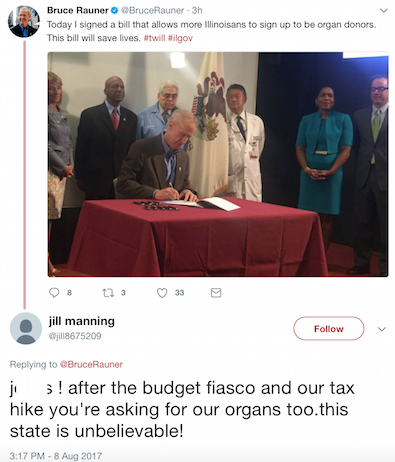
Gov. Bruce Rauner today signed House Bill 1805, also known as the Drive for Life Act. The bill, which received bipartisan support, allows 16- and 17-year-olds to express their wishes to become organ and tissue donors. Signing the bill into law will give hundreds of thousands of additional Illinoisans the opportunity to join the registry each year.
“So many people are waiting for life-saving organ transplants,” Gov. Rauner said. “In Illinois alone, more than 4,700 people are on the waiting list, and every year, around 300 people die waiting for a transplant. It’s tragic. We need to give everyone who wants to become an organ donor the opportunity to do so, and that’s exactly what this bill does.”
The Drive for Life Act will allow Illinois residents 16 years old and older to join the First Person Consent Organ and Tissue donor registry when they receive their driver’s licenses or state ID cards. While the law gives 16- and 17-year-olds the right to express their wishes to become an organ donor, parents and guardians still will have the right to give or revoke consent until the donor turns 18.
Secretary of State Jesse White and state legislators have been working with organ procurement organizations Mid-America Transplant Services and Gift of Hope Organ and Tissue Network to get the Drive for Life Act written into law.
“My goal for the Illinois Secretary of State’s Organ and Tissue Donor program is to save lives by ensuring that organs and tissue are available for those in need,” Secretary of State White said. “This new law is a major step toward reaching that goal. I was proud to work with the advocacy groups, legislators and the governor to help make this law a reality.”
Illinois joins 47 other states that currently allow 16- and 17-year-olds to register as organ donors.
Not sure why we’re one of the last states to do this, but at least it’s done now.
Speaker Madigan’s spokesman said it was filed “so people can review all this.”
I’ve heard about a possible joint House/Senate education funding committee hearing this week, so will that amendment be part of any hearing? Brown replied with his standard “under review” comment, but said “that could change.”
When communities choose to limit their tax base to fund schools that’s a choice that a local community can make. They’re entitled to make it, they should make it. But when a community chooses to take significant part of its property wealthy and take it off the tax rolls for their schools, that’s a choice, it’s a legitimate choice, but it has consequences. And it’s unfair to all the other taxpayers in this state and all the other communities and school districts in this state to say ‘OK, you took your property out of supporting your schools, so therefore we’re gonna spend a lot more money to send you extra to make up for your choice. That’s not fair to taxpayers, that’s not fair to other school districts that keep all their property tax base for funding their schools. So we need a more equitable system in that regard.
By state statute, DuPage, Kane, Lake, McHenry, and Will counties became subject to PTELL for the 1991 levy year and Cook County was added for the 1994 levy year. Public Act 89-510 allows county boards to put the issue before the voters by placing a referendum on the ballot. Home rule districts (primarily communities over 25,000 in population) are exempt from the law.
Since 1996, 28 counties have approved PTELL. Nine have voted it down.
GREG HINZ: In dealing with PTELL the way you are, aren’t you effectively busting the state’s property tax law by telling local communities that if they want to get full state aid that they have to go to a referendum that would raise their property taxes? Isn’t that counter to everything you’ve talked about in this?
GOV. RAUNER: No. In fact, just the opposite Greg. It’s exactly what we need to do. What I’ve recommended is that we give, at its core, give local residents the ability to control their own property taxes themselves. This is at the core of what I’ve recommended and it’s part of what we were trying to negotiate with reforms in our budget negotiations. And what we recommended was to do a freeze, for some period of time, 2, 3, 4, 5 years, and, and then give local residents the ability through a simple referendum process, to either raise their total levy, reduce their levy or continue to freeze it, but give the local residents, for their own schools, for their own public safety and issues, to control that themselves. And this, our recommendations are very consistent with that.
HINZ: Alright, but if I can follow up, if a community is property tax capped now, under PTELL, under your amendatory veto to get full state aid wouldn’t they have to raise their property tax?
RAUNER: All the districts, um, are treated the, the same way under the amendatory veto that I’m recommending.
HINZ: It’s still a property tax hike, and you’re supposedly against property tax hikes.
RAUNER: I’m sorry, what we’re, what we’re doing, is allocating state aid for schools. And how a specific community chooses to handle their own property taxes, how they choose to, um, fund their schools themselves, that’s up to them. What we’re recommending is a equitable way to take the state aid, um, and and distribute it across the state in a fair and sustainable way.
Again, lots of counties don’t “choose” to cap property taxes.
And Hinz is right. Under the Rauner AV, in order to avoid a state school funding cut, local school districts under PTELL would have to increase their property tax levies.
This is one bizarre amendatory veto, campers. And it appears directly aimed at CPS.
The Illinois State Board of Education has completed an analysis of Gov. Bruce Rauner’s amendatory veto of an education funding bill, but the administration said it won’t release the results until a review is completed, a spokeswoman for the governor said. Rauner spokeswoman Laurel Patrick said the education board delivered its analysis to the governor’s office late Monday afternoon. That analysis is expected to show how his changes affect school districts across the state.
“Given the complexity of the education funding formula and the fact that this type of analysis requires cross-collaboration between multiple state agencies and departments, the governor’s office has requested a meeting with ISBE Tuesday morning to review the analysis. We will release the numbers once the review is complete,” Patrick said. Rauner has predicted the analysis will show that what he is doing is “right and just and fair” and that his plan will “carry the day” even as independent government watchdogs have found that his changes could mean school districts across the state gradually lose money in future years.
But spreadsheets are the school-funding equivalent of Cliff Notes, a shortcut that skips nuances that might show up on the test. That’s especially true with this new funding model. It has built-in recalibration mechanisms to annually rebalance what each district needs to achieve adequacy against its capacity to bear that cost.
Take, for example, student enrollment: “Under SB1, if you lose student population, you’ll get less money from the new state distribution,” said Ralph Martire, director of the bipartisan Center for Tax and Budget Accountability, “because your adequacy target will be reduced. It’s not as if the formula ignores it.”
Martire has been working on this school funding model since 2010.
“But, if you’re below adequacy, you still get more money than you got the prior year, so you can move towards adequacy,” he added. “That’s the beauty of how SB1 works. The math actually accommodates all situations — student population growth or loss.”
This particular feature got the axe under Rauner’s veto. He would cut dollars for schools with declining enrollments, even if they’re already underfunded. The prime example of such a district is Chicago Public Schools.
* The governor sidestepped questions yesterday on “refinancing” part of the state’s gigantic bill backlog to avoid paying what the comptroller says is $2 million a day in interest…
At an unrelated news conference at the Thompson Center, Rauner said the borrowing plan was “not an optimal answer” and suggested he’s looking to work on new plans. Democrats who control the General Assembly, though, might not be interested in renegotiating a budget they approved to break the stalemate last month.
“We will be working with the General Assembly on proposals to actually have an appropriation to pay down debt and have a plan to reduce it and also to have reforms so we don’t stay in this position — where we actually have truly balanced budgets today and going forward,” Rauner said.
“I would also encourage the Comptroller to take advantage of the fact that under her control, there is over half a billion dollars in cash that is available to pay down debt and if she chose to actually pay down some of the medical bills we could actually leverage that 2-for-1 with other dollars. That action has not been taken yet by the comptroller. I’d certainly encourage her to do that.”
He’s talking about the federal Medicaid match.
* The comptroller’s office pointed to this July 26th press release…
The Office of Illinois Comptroller Susana Mendoza released a total of $740 million in Medicaid payments this week. In part, these payments help satisfy a June court order requiring the state to pay at least $586 million in Medicaid vouchers in the month of July.
This action was made possible under new provisions in the budget that allow existing Drug Rebate Funds to be leveraged for federal matching dollars for payments to Managed Care organizations (MCOs). The payments were made in cooperation with the Illinois Department of Healthcare and Family Services.
A total of $740 million was issued to eleven MCOs throughout Illinois, and the Comptroller is hopeful that frontline providers will see relief for the Medicaid services already provided on behalf of the state. “The enactment of a state budget, with the support of courageous legislators from both parties who overrode the Governor’s veto, allows my office to begin to address critical payments to the healthcare networks serving some of the state’s most vulnerable residents,” Mendoza said.
Overall, these payments lower the backlog of medical related bills pending at the Comptroller’s Office by 18 percent, to $3.5 billion.
The ability to access existing revenues held in special funds is an important tool to begin to pay down some of the state’s nearly $15 billion Rauner Bill Backlog. But the Comptroller also urges the Governor to follow through on the legislatively authorized borrowing plan of up to $6 billion in order to address other outstanding medical payments, including a staggering $4.9 billion in state group health insurance bills. All of these bills continue to accrue high interest penalties as they await payment. Until a borrowing plan is implemented to more aggressively tackle the Rauner Bill Backlog, the Comptroller’s office estimates the state is incurring roughly $2 million in interest penalty payments each day.
Ameya Pawar, 47th Ward Alderman and Democratic candidate for Illinois governor, today released a new digital spot, “Stop the Violence.” The video, part of the One Illinois video series, features Pawar’s participation in Danville’s Three Kings of Peace March.
“It makes me feel good when I see people organizing for their communities when the cameras aren’t here, when the media isn’t here. They’re just doing their work. They are marching in the street, bringing community together, praying together, all in the hopes of stopping violent activity, showing that there’s a different path,” explains Pawar.
The Three Kings of Peace are a group of Danville pastors dedicated to promoting peace amidst a surge of gang violence. They hold regular marches, organize school activities, and provide training on keeping teens out of trouble.
“I talk about race and class, and about how we’re all one state, and that we’re neighbors. You can see that in the march today. You have communities in Danville that have been hard hit by violence and poverty. That’s the same thing that’s happening on the south and west sides of Chicago, and in other parts of the state like East St. Louis.
“So, when are we going to start talking about poverty, and helping people? Moving beyond dividing the state, and actually bringing people together, transcending race and class?”
As part of his plan to visit all 102 Illinois counties—not just the urban centers—to listen to Republicans, Democrats and independents, Pawar has traveled more than 8,000 miles over the last 8 months and visited more than 60 counties.
Gov. Rauner on Monday announced that former state Rep. Darlene Senger of Naperville will serve as his deputy chief of staff for legislative affairs.
Senger was in the Illinois House from 2009 to 2015, leaving after an unsuccessful 2014 bid for Congress against Democratic U.S. Rep. Bill Foster.
After that defeat, she joined the Illinois Policy Institute, the conservative think tank that has provided many of the new hires in Rauner’s recent staff shake-up.
Most recently, Senger worked as chief financial officer of the Illinois Workers’ Compensation Commission.
A former legislator? Hmm. Maybe he is learning a bit.
* Interestingly enough, the governor’s press release made no mention of her work for the Illinois Policy Institute…
Senger joins the governor’s office after a year-and-a-half as CFO for the Illinois Workers’ Compensation Commission. Before that, she served as a state legislator from 2009-2015, representing the Naperville area. She also served on the Naperville City Council from 2002-2008.
But her bio is still on the Institute’s website. Click here.
…Adding… The governor was asked about the hire today…
Rauner asked about hiring former legislator and IPI staffer Darlene Senger: "We're striving to be the best team…always looking for talent"