* The Illinois Supreme Court rejected a bid by the Republican legislative leaders to keep their lawsuit alive against the new district map…
House Republican Leader Thomas H. Cross III and Senate Republican Leader Christine Radogno filed a complaint in February against the State Board of Elections and other state officials, claiming the redistricting maps are unconstitutional.
The complaint contends that 27 representative districts, including districts 113 and 114 in St. Clair County, violated provisions of the Illinois Constitution requiring districts to be compact and politically fair. Republicans claim that Democrats gerrymandered the districts in a way that would benefit their party in the next election.
The court in March ordered both parties to file briefs on whether the motion was timely under Supreme Court Rule 382, which governs actions related to redistricting challenges. The Board of Elections argued that the Republicans waited more than eight months after the maps were approved to file the complaint in an effort to delay the primary election.
The majority Democrats did not provide any reasoning for their decision. The vote was along party lines, with the three Republican justices dissenting. Justice Bob Thomas pointed to the lack of timelines in the state Constitution and in Supreme Court rules.
* House Republican Leader Tom Cross and Senate Republican Leader Christine Radogno issued a joint statement…
“It is unfortunate the Illinois Supreme Court issued a partisan decision,” it read. “The majority took the unusual step of providing no grounds for their decision to prevent the people of Illinois from getting their day in court. The ruling is further evidence of the need for true redistricting reform in Illinois.”
Thursday, Jun 7, 2012 - Posted by Advertising Department
[The following is a paid advertisement.]
Illinois’ energy and economic future is looking brighter than ever. Why? Natural gas is domestic, affordable, and reliable. Thanks to innovation and advanced technologies, large deposits of natural gas are now being tapped to provide cleaner, affordable electricity for communities all across America.
We can have that here in Illinois simply by converting our power plants to run on natural gas. Using this abundant, reliable energy source will immediately translate into lower electricity costs for Illinois consumers, manufacturers, hospitals, and schools. And switching from gasoline to cleaner-burning natural gas to fuel commercial truck fleets and public transit will help Illinois businesses; cities and towns lower operating costs and dramatically reduce emissions that pollute our air.
Lower energy and fuel bills will help Illinois’ economy prosper and save families money while moving America toward a secure energy future.
* Bill Knight, the deputy director of the journalism program at Western Illinois University, has a new column about a bill that passed both chambers which would remove campaign contribution caps when independent expenditures reach $250,000 in a statewide election or $100,000 in other races…
“Citizens throughout Illinois were angered by Rod Blagojevich’s corrupt actions and the state’s history of corrupt agreements involving political contributions, and voters demanded reform of Illinois’ loose campaign finance regulations, which allowed unlimited contributions to all candidates,” [Brian Gladstein, the executive director of the Illinois Campaign for Political Reform] said. “This bill would be a step backwards and open the door to more corruption in the future.”
Democrats argued that they need limits lifted to make campaigns “fairer,” by leveling the playing field against SuperPACs. They’re concerned after the U.S. Supreme Court’s 2010 “Citizens United” decision and an Illinois court ruling in March that the federal case applies to Illinois, too, that they need to respond if a SuperPAC spends a lot of money against them. […]
Various opponents of the bill note that Illinois’ first campaign-finance reform restricting political action committees to $50,000 hasn’t had a chance to work yet.
“This is an inappropriate and hasty response to recent court decisions which have enabled the creation of so-called SuperPACs,” Gladstein said. “The proposal’s adoption by the General Assembly comes less than two years after Illinois’ corruption-fighting campaign contribution limits system went into effect. SB 3722 would allow a return to the environment that allowed corruption to flourish in our too-recent past, if the governor signs it.
“There are other ways to address the issue of independent expenditure committees, such as better and stronger definitions to what it means to be coordinating with a candidate,” Gladstein continued. [Emphasis added.]
Each quarterly report shall include the following information regarding any independent expenditures made during the reporting period: (1) the full name and mailing address of each person to whom an expenditure in excess of $150 has been made in connection with an independent expenditure; (2) the amount, date, and purpose of such expenditure; (3) a statement whether the independent expenditure was in support of or in opposition to a particular candidate; (4) the name of the candidate; (5) the office and, when applicable, district, sought by the candidate; and (6) a certification, under penalty of perjury, that such expenditure was not made in cooperation, consultation, or concert with, or at the request or suggestion of, any candidate or any authorized committee or agent of such committee. [Emphasis added.]
* The Question: Should Gov. Pat Quinn sign the bill lifting contribution caps when bigtime independent money is spent? Take the poll and then explain your answer in comments, please.
* A top Moody’s analyst is fine with the progress Illinois has made on the budget and pensions so far this year…
Moody’s analyst Edward “Ted” Hampton praised the session’s achievements and said the agency at the moment remains comfortable with the state’s current rating level, though pensions remain a central concern. “Obviously this session yielded some progress on some fronts and not on others,” he said.
[S&P analyst Robin Prunty] said in an interview that while the state retains some breathing room to act, she is concerned over the difficulty of achieving the three-fifths majority needed to approve legislation in a special session: “We are watching to see if there is credible action but it’s hard to know if they will come to an agreement.”
I pointed out S&P’s misreading of the Illinois Constitution to subscribers today, but since the analyst repeated the assertion made in the firm’s original report, I figured I’d pile on some more. Here we go…
The General Assembly shall provide by law for a uniform effective date for laws passed prior to June 1 of a calendar year. The General Assembly may provide for a different effective date in any law passed prior to June 1. A bill passed after May 31 shall not become effective prior to June 1 of the next calendar year unless the General Assembly by the vote of three-fifths of the members elected to each house provides for an earlier effective date. (Source: Amendment adopted at general election November 8, 1994.) [Emphasis added.]
So, yes, they could pass a pension reform bill with an immediate effective date and try in vain to round up 71 House votes and 36 Senate votes. That would be hard. Maybe impossible.
Far more likely, though, is that any pension reform bill (if there is one) will have a delayed effective date, requiring only simple majorities.
This ain’t rocket science.
* Related…
* Will Walker election affect pension debate?: While the Wisconsin vote Tuesday is seen by some as a jumping-off point for GOP leaders in states like Michigan, Minnesota and Missouri to push for anti-union measures, Illinois public employee unions remain part of the discussions that are focused entirely on benefit costs. “I have a difficult time drawing a lot of parallels between them,” said Illinois Education Association director of government relations Jim Reed.
* State pension talks stalled: “My position on pension reform is that we have to eliminate the free lunch for local school districts,” Madigan said after emerging from the meeting. But Senate Republican Leader Christine Radogno, of Lemont, said the proposal amounts to a “poison pill” designed to hold up action on other pension reforms. She noted the idea has little support among suburban and Downstate lawmakers because it could force property taxes to go up as schools seek to cover the added expenses. Radogno said the cost-shift idea should be separated from other pension proposals that do have support.
* Officials to meet again on pension solutions: Illinois officials will spend the next two weeks gathering financial information from the state’s more than 800 school districts to get a better idea of how shifting pension costs away from the state would affect those districts… Quinn said the next two weeks will be spent collecting financial data from school districts, including “what their reserves are, what their current contracts are, what exactly they have right now as to their costs.” “The more facts we could gather regarding what the impact would be on school districts, it would be very important facts we should know,” Quinn said.
*** UPDATE 1 *** According to a top source, General Enyart is submitting his resignation today from his position with the state and the National Guard to pursue the 12th Congressional District seat. I should have his official letter around one o’clock. Enyart’s announcement is set for 2 o’clock.
*** UPDATE 3 *** Enyart says he won’t announce his decision about whether to try for the ballot appointment until next week…
Maj. Gen. William Enyart, commander of the Illinois National Guard, retired from the military effective today, and said he was seriously considering seeking the Democratic nomination to replace U.S. Rep. Jerry Costello.
Costello, who has represented the 12th Congressional District since 1988, announced in October that he won’t seek re-election in November. That threw up for grabs a seat that had been considered safe for Democrats since World War II.
“I want to step down and take some time with my family and weigh the prospect of a candidacy.” Enyart said while standing at the Veterans Memorial in the Public Square here.
“I would not resign if I was not prepared to look at it very hard.”
[ *** End Of Updates *** ]
* I received this via e-mail earlier today…
Major General William L. Enyart will make an announcement regarding his future plans at 2 pm, Thursday, June 7 at the Veterans’ Monument, Belleville Public Square, Main and Illinois Streets, Belleville, IL.
Enyart is considering a bid for the 12th District. As you already know, this is longtime Democratic incumbent Jerry Costello’s seat and his hand-picked replacement dropped out of the race last month. Whoever is chosen for the spot will face Republican Jason Plummer in the general election.
Enyart said he had spoken with Costello about his possible candidacy but wouldn’t discuss specifics. “I’ve had the best job in the world with the Illinois National Guard,” Enyart said. “But this could be an area where I could a have significant impact.” […]
Metro East politicos say Enyart would be a formidable candidate with his military experience and contacts at Scott Air Force Base, which is the district’s largest employer and an important touchstone in Washington.
But a wild card in the mix is Circuit Judge John Baricevic, a Fairview Heights man who has a long résumé with decades in public office and who said he’s considering a run for the seat.
Baricevic said he enjoys public service but added that his decision could hinge on Enyart, whom Baricevic said would be a good candidate.
“If he’s serious about it, then I’ll probably step aside,” Baricevic said.
Baricevic was considered by insiders to be the guy who would be the most likely to get the weighted vote from St. Clair and Madison counties. If he’s willing to step aside for Enyart, and Enyart has talked to Costello about a bid, and Enyart is making an announcement today, you don’t have to be blind to see the signals here.
* Enyart, by the way, is a military lawyer who lists no combat experience on his resume…
ASSIGNMENTS:
1. November 1982 - November 1984, Trial Counsel, 66th Infantry Brigade, Decatur, Illinois
2. November 1984 - February 1985, Executive Officer, Company C, 2nd Battalion, 130th Infantry, Litchfield, Illinois
3. February 1985 - August 1985, Assistant Trial Counsel, 86th Army Reserve Command, Urbana, Illinois
4. August 1985 - September 1990, Selective Service System Officer, Detachment One, State Area Command, Springfield, Illinois
5. September 1990 - August 1993, Assistant Judge Advocate, State Area Command, Springfield, Illinois
6. August 1993 - May 1996, Deputy Staff Judge Advocate, 66th Infantry Brigade, Decatur, Illinois
7. May 1996 - September 1997, Command Judge Advocate, 33rd Area Support Group, Chicago, Illinois
8. September 1997 - October 2002, Deputy Staff Judge Advocate, State Area Command, Springfield, Illinois
9. October 2002 - December 2005, Staff Judge Advocate, State Area Command, Springfield, Illinois
10. December 2005 - May 2006, Deputy Commander, Joint Forces Headquarters, Springfield, Illinois
11. June 2006 - September 2007, Assistant Adjutant General-Army, Illinois National Guard, Joint Forces Headquarters, Springfield, Illinois
12. September 2007 - Present, The Adjutant General, Illinois National Guard, Springfield, Illinois
* Illinois Cares Rx is a program for low-income seniors and the disabled. Here’s a brief description…
Illinois Cares Rx pays Medicare Part D premiums and reduces co-pays, deductibles and other pharmaceutical costs.
The program’s clients must have incomes below $22,340 a year for a single person and $30,260 for a two-person household.
* That program was eliminated under the Medicaid restructuring agreement. The human cost…
Bonita Turley gets emotional when she thinks about the $100 in additional medical expenses she could have to pay each month.
The Buffalo resident is among a chorus of seniors and advocates who hope Gov. Pat Quinn decides not to sign a budget-cutting bill that would eliminate Illinois Cares Rx, a statewide prescription-assistance program for low-income senior citizens and people with disabilities.
“I want to be as independent as I can,” said Turley, 65, a former insurance clerk who takes medicine for diabetes, seizures and thyroid problems.
Assuming that Ms. Turley is single, that $100 a month cost increase would be 5.3 percent of her annual income if she is at the top of the scale. That percentage could be a whole lot higher depending how far she falls under the cap.
Anne Dias Griffin, a rare woman at the helm of a hedge fund as well as wife of billionaire hedge fund manager Kenneth Griffin, is starting a for-profit digital media company called Reboot Illinois.
The website will promote “political, educational and fiscal reform in Illinois and the Midwest,” according to an online job posting.
Political reform? Really? This is the same person who, partnering with her husband, sidestepped campaign contribution caps by contributing big bucks to small Downstate county party committees, which then turned around and contributed the majority of that cash to the state Republican Party. I wrote this back in January…
Back when the reformers demanded that state campaign contributions be capped, they said it would limit the dollars flowing into Illinois political funds.
But contributions have only barely decreased from four years ago, according to a search of the Illinois Board of Elections’ database. That may have as much to do with the economy these days compared with what it was in 2007, when Illinois’ unemployment rate was half what it is now. […]
Individuals now are capped at $5,000 when donating directly to a candidate, but they can give up to $10,000 to PACs and political parties and PACs can contribute $50,000 to candidates. You probably can see where this is going.
The Griffins made $305,000 in contributions between Dec. 29 and Jan. 6, with the vast majority confined to the last three days of 2011. A bunch of that cash went to small, downstate Republican Party county committees.
For instance, the Griffins each contributed the maximum $10,000 to the Stark County Republican Central Committee on Dec. 29. The tiny county party reported raising just $5,700 in cash over the past three years until the Griffins came along.
Republican parties in Christian, Jefferson, Douglas, Logan and Richland counties all were showered with similar Griffin beneficence. Such political party committees can contribute unlimited amounts to candidates in a primary election.
And then when the next campaign finance reports were filed, we found out that much of that money went right back to the state GOP. From Bernie…
While the Griffins combined to donate more than $200,000 to more than 10 GOP organizations, including GOP committees in Logan, Douglas, Fayette, Madison and Richland counties, those groups then — coincidentally? — combined to donate more than $120,000 to the Illinois Republican Party in the first three months of this year.
Griffin and her husband, founder and chief executive of Citadel LLC, are among the largest donors to the Illinois Republican Party and have been active in organizations trying to reduce the influence of teachers unions.
The Griffins also have given approximately $1.5 million over time to David and Charles Koch’s conservative causes, which operate under the umbrella Americans for Prosperity.
A family spokeswoman who declined to be named said Ken Griffin was not involved in the media venture and that it would be nonpartisan. A launch date has not been set.
The spokeswoman declined to be named? Huh? What’s with the secrecy? Even the new site’s Tweets are “protected”…
Only confirmed followers have access to @rebootillinois’s Tweets and complete profile. Click the “Follow” button to send a follow request.
And this will be a “nonpartisan” operation? OK. We’ll see. The Griffins were the top contributors to the Illinois House Republicans during the last cycle. I just can’t wait to watch this little venture sprout forth.
Reboot Illinois is a non-partisan, reform-based digital and social media company serving as the voice of reform in Illinois. We aim to educate and engage citizens and to encourage measurable actions on the critical issues facing our state. We aim to inform citizens with our educated political analysis, data, and local perspective to inspire action through digital/social media channels, at live events, and to facilitate citizens to participate fully in the the democratic process.
That’s awfully wordy.
* The Question: Can you please streamline Reboot Illinois’ mission statement? Snark is heavily encouraged, of course.
There was no action during the regular legislative session on pension reform and we consider this negative from a credit standpoint. Given that the pension reform legislation did not pass during this session, it will now be a much more significant challenge to implement, in Standard & Poor’s opinion, requiring a three-fifths majority if addressed in a special session in 2012.
We have kept our outlook on the state of Illinois (’A+’ general obligation debt) negative since January of 2011. Despite significant revenue enhancement and ongoing revenue recovery, structural budget balance has been elusive and liquidity remains strained due to the state’s growing accumulated deficit (accounts payable and general fund liabilities). We expect to resolve the outlook on Illinois this year based on our review of the fiscal 2013 enacted budget and the state’s progress, if any, on addressing its significant pension
liabilities and associated cost pressures.
“It is clear from this (S&P writeup) as well as past ratings agencies’ comments that pension reform must happen immediately,” Mr. Quinn’s office said in a statement. “(The governor) cannot act alone and continues to work with legislators to make certain we address this challenge.”
* Quinn met with the other leaders today and is now back to insisting that some pension cost-shifting to local school districts be enacted. Quinn dropped the idea last week when the Republicans wouldn’t agree to it, but then the resulting pension reform bill died because Speaker Madigan was opposed.
Quinn also dismissed Senate President John Cullerton’s proposal to just do the state and General Assembly retirement systems right now and put everything else off for a while. “I think it’s very important to understand that this issue can’t be delayed, it can’t be a partial solution,” Quinn said.
Quinn said today that the leaders will meet again sometime around the “19th, 20th or 21st of this month” to look at data for the various ideas which were offered up at the meeting. He didn’t specify what those ideas were.
*** UPDATE *** Via the AP, it appears the leaders are divided into two camps…
Senate President John Cullerton, Senate Minority Leader Christine Radogno and House Minority Leader Tom Cross want to pass measures where there’s already broad agreement and keep negotiating the others.
But Gov. Pat Quinn says he wants a complete overhaul, and House Speaker Mike Madigan says any pension reform should address the schools issue.
* The House’s Special Investigating Committee has voted unanimously to recommend that indicted Rep. Derrick Smith be referred to another House committee for punishment. The committee’s report is here. Live broadcast of the press conference is here.
*** UPDATE *** If you missed the live feed, here’s the raw audio…
The committee’s task was only to determine whether Smith should be punished. Another committee will choose whether to reprimand, censure or expel Smith — or to take no action.
The seven-page report said the alleged misconduct legislators should examine is that Smith “abused the power of his office by participating in a scheme to obtain a personal benefit in exchange for his official acts.”
Smith, 48, allegedly took the bribe for backing a $50,000 state grant application on behalf of a day care center that turned out to be fictitious. Authorities say it was an FBI sting with an undercover informant wearing a recorder. […]
In making its finding, the special committee had a much lower standard of fault-finding than Smith would face in federal court.
“Accepting a cash bribe in exchange for an official act, or even plotting or attempting to do so, constitutes a breach of Rep. Smith’s obligation as a public official to faithfully discharge his duties in the best interests of the people of the state of Illinois and warrants disciplinary action by the House of Representatives,” the report states. […]
Smith faces the potential of censure, reprimand or expulsion under the House procedures, which started with the investigative panel that convened Thursday and could eventually bring his case before the full House.
* Reps. Lou Lang and Jim Durkin have been appointed House managers. Twelve “jurors” from the House - six from both parties - will listen to the case presented by the managers. The committee must convene no later than 30 days from today.
* The Chicago Tribune published yet another series of stories about House Speaker Michael Madigan’s power. But like past investigation, some of this series is a bit of a stretch.
Chicago’s largest operator of assisted living homes for the poor was looking to grow its business when it decided to add a new member to its legal team: the law firm of House Speaker Michael Madigan.
Within months of that decision, the most powerful lawmaker in Illinois and the chamber he controls voted in 2005 to create a state program that would send tens of millions of dollars to his new client. […]
There are other tax lawyers to see in Chicago. But nothing gets done in Springfield without Madigan, who wields unilateral control over the movement of every bill in the House.
That was true in 2005, when a coalition came to the state Legislature seeking to turn a pilot project on assisted living homes for the poor into what is now the permanent Supportive Living Program.
A founding member of that coalition was Pathway Senior Living LLC, Chicago’s largest developer of such homes.
The idea was to save money by moving the most able-bodied nursing home patients into these less expensive facilities where they could get the help they need at 60 percent of the Medicaid cost to taxpayers. It was supported by advocates for the poor and politicians from both parties.
Pathway and other companies wanted to expand, but investment money and state incentives were hard to come by because of the tenuous nature of the pilot program.
At about the same time, Pathway, which has long used another law firm for all its property tax business, hired Madigan’s firm for a single Chicago property. Public records show Madigan’s firm filed its first paperwork on behalf of the company on April 12, 2005.
On May 20, Madigan and the House voted 113-0 to create the permanent program.
* OK, to the bill in question. The legislation was introduced in the Senate on February 24, 2005 by Sen. Kwame Raoul (D-Chicago). Raoul is not exactly known as a tool of the Madigan machine. The bill passed the Senate on April 8th, four days before that paperwork was filed. Then the House voted unanimously in favor of it.
Too often in journalism, particularly at the Tribune, correlation is causation. But that bill was a measure supported by Gov. Rod Blagojevich’s administration, and RRB was never an MJM fan.
Pharmacies face cuts in drug reimbursements under the legislation, but lawmakers largely went with the industry’s own suggestions for trimming rather than harsher proposals.
Supportive living homes and nursing homes face rate cuts, but they are lower than first proposed. The supportive living industry got some protection against potentially damaging changes in eligibility rules. And nursing homes won concessions on new rules to increase staffing.
As subscribers already know, pharmacies negotiated their own cuts months ago, but then got whacked again by the new bill. They are hardly winners here.
And pretty much every provider ended up with cuts that were lower than first proposed by Gov. Pat Quinn. Physicians have no cuts at all, and that’s mainly because the House Republicans (who get tons of campaign cash from the docs) stood up for them. Hospitals avoided huge cuts. And the AP claimed nursing homes were a big session loser.
* Now, on to the banks. Madigan’s property tax law firm represents Bank of America, which would’ve taken a very big hit if this bill had passed…
In addition to stopping that legislation, the other priority for the banking industry this legislative session was to pass a measure that would allow them to much more quickly foreclose on and dump abandoned properties from their books. In an effort to win over critics, the banks offered to pay more to help cities around the state maintain abandoned homes.
The bank-backed bill passed the Senate after weeks of closed-door meetings but stalled in the House Rules Committee. Lawmakers and advocates who opposed it credited Madigan, saying he didn’t think it raised enough money from big banks for the foreclosure funds.
Then, on the final day of the session, Yarbrough countered with her own version of the fast-track bill. It would raise twice the money — an estimated $50 million — to help municipalities and fund foreclosure counseling services. But it would only impose higher fees on the very largest banks, which have at least $10 billion in assets.
Smaller community banks and credit unions would be spared, and their lobbying association joined housing advocates in supporting it. The Illinois Bankers Association, which was representing the interests of bigger banks, opposed it.
Yarbrough said Madigan, who voted for the bill, provided counsel and was involved in the process nearly the entire time. “He held my hand all the way,” she said.
She said she wasn’t aware it helped some Madigan banking clients and said Madigan didn’t come up with the idea to exclude community banks from the bill. She said those ideas came from housing advocates who were assisting her with the bill and added that Madigan was an advocate for her concerns this session.
But Madigan also represents small, community banks, so he’s made to wear the jacket, even though the bill passed the House and stalled in the Senate. I was at that House committee hearing (I needed to talk to a committee member about another issue, so I was staking him out and watched the hearing), and a BoA lobbyist testified against it. That’s a very big MJM client, so I’m not sure what the problem is here.
Banks, like hospitals, are in every legislative district and are usually run by some of the most important people in those districts. Beating them ain’t easy, to say the least.
* The overall point of the series is that Madigan is a walking conflict of interest. He’s all-powerful and has grown personally wealthy by using that power to his own advantage. No argument there.
No state benefit is ever offered to gain a client and any potential client who seeks a state benefit is not accepted.
If a client of the law office requests my intercession with a state agency, I refuse; and
If a client of the law office expresses an interest in legislation such as to create a conflict of interest, I recuse myself from consideration of the bill.
In real-world politics, you never specifically ask for a quid pro quo. Ever. That’s what got Blagojevich in trouble. You just assume that you’re buying good will and let it go at that. Madigan would toss an idiot out his window if he offered to sign up with the law firm in exchange for a Springfield benefit.
Bank of America is, according to the Tribune, a Madigan client. BoA lobbyist Pat Holden testified against the foreclosure bill, so shouldn’t that have created a conflict of interest?
“Power and secrecy are a potentially lethal, or at least an unhealthy, combination. Too much secrecy is absolutely wrong whether or not it’s combined with as much power as one individual has.
“I think there could be a much clearer definition of what constitutes a conflict of interest. That could be more precisely defined.
“Everything ought to be out on the table. Does that stop it from happening? No. But I think at least it provides the basic information that it seems to me citizens have a right to have in evaluating their elected representatives.”
More openness would obviously be better.
* Now, on to campaigns. I told subscribers months before the primary that Madigan’s organization would be backing Aurora Ald. Stephanie Kifowit over two other primary opponents. The Tribune finally reported on it this week like it was some great revelation…
And because Madigan controls both a state staff and a campaign war chest, he has a ready reserve of public employees he shifts off the payroll at will to add muscle to the most powerful election force in the state.
Decremer and other Democratic staffers are deployed to answer phone calls, schedule campaign events and scour petitions of competing Democrats to get them kicked off the ballot.
Republicans also have pulled dozens of staffers off the state payroll in election years, but after nearly 30 years as speaker, Madigan is the master at using the levers of government to his political advantage.
So, everybody does it and Madigan is the best and that makes it particularly bad. OK. But the Tribune does point out the consequences of using state staffers for campaigns…
During the March primary season, records show, nearly two dozen state staffers went off the state payroll, being paid instead by Madigan’s political funds to work for more than 30 candidates. In many of the less competitive races, the staffers worked for less than a day, simply checking to see if a Madigan-backed candidate had any opponents. In nearly half of the races, which were more competitive, the staffers worked for weeks at a time. […]
Soon after the primary campaign was done, Decremer and other Madigan staffers were back at work in Springfield.
Decremer is a fixture at major committee meetings and can often be seen in the House chamber conferring with top Madigan lieutenants. He also moves easily through the aisles and to the desks of rank-and-file lawmakers, chatting some up and checking over the shoulders of others.
In Illinois, it’s all one thing. And it’s not just Madigan or Madigan’s staff, either. It’s everybody. He just does it better, and has done it better for longer than anyone else.
* The Daily Herald looks at what the compounding of annual pension cost of living increases has done to the system…
Retired Illinois teachers received a collective $900 million bump above their original pension benefits last year.
These “cost-of-living adjustments” amounted to 21.3 percent of the $4.2 billion total retirement benefits paid to 101,288 former educators from around the state, officials from the Illinois Teachers’ Retirement System reported. That’s up from 18 percent of the total teacher pension payout just five years ago. […]
Simply compounding a 3 percent increase to the current average teacher pension of $46,452 over a 25-year period produces an additional $114,238 over that span, compared to the same 3 percent increase if it had not been compounded. In year 25, the teacher’s compounded pension would be $94,427. Not compounded, the pension would amount to $79,897.
* But not everybody is convinced that getting rid of compounding COLAs is the right answer…
West Chicago Republican state Rep. Mike Fortner said he’d prefer to see an increase to employee contributions rather than risk a protracted legal battle over changing employee retirement benefits. He said increasing teacher retirement contributions by 1 percent would essentially pay for the compounded pension bump perk.
“They can keep the compounded plan as long as they’re paying for it,” Fortner said.
If Fortner is right, why wasn’t that route taken instead? The teachers’ unions reportedly offered to kick in two more percentage points into the system. We need more data. Fast.
*** UPDATE 1 *** Rep. Lisa Dugan just called to say that she asked that very question and was told in no uncertain terms that the additional kick-in by employees wouldn’t produce nearly enough cash to solve the compounding problem.
*** UPDATE 2 *** From AFSCME…
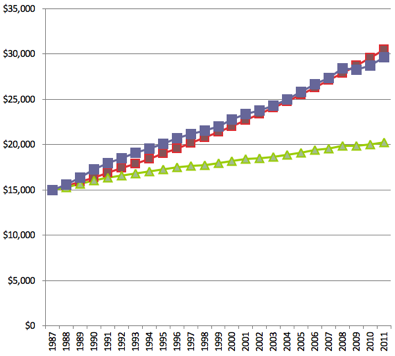
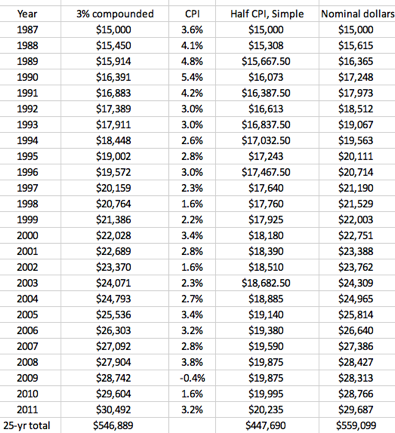
This chart shows how the 3% compounded COLA is critical to protecting retirees from inflation. Imagining someone who retired with a $15,000 pension in 1987, the chart shows the amount of their pension in each of the 25 subsequent years under two scenarios: Red is what the retiree has earned under current law, with a 3% annual compounded COLA; green is what they would have earned if the Tier 2 COLA provision had been in place (half of CPI capped at 3%, simple). The purple line shows the amount the retiree would have needed in each year for the pension to keep pace with the actual rate of inflation.
Under current law, the 1987 retiree is today an aggregate $12,000 behind, or 2% less than, the amount required to keep pace with CPI for the period. The benefit has exceeded the real value of the base plus inflation in just 3 of the 25 years. Had the Tier 2 COLA been in effect, the retiree would have lost $111,000 or 20% of the value of the base plus inflation.
* Maybe the CTU thought that scheduling a strike authorization vote the day after the Wisconsin recall election would give the union a big morale boost…
Chicago Teachers Union President Karen Lewis Wednesday joined thousands of teachers across the city — and even some from hospital beds — in voting on whether to authorize a strike of the nation’s third-largest school district.
Although she cautioned a gaggle of watching media at King College Prep that “do you all know the meaning of a secret ballot?” observers could clearly see her determined vote of “yes” on the question of whether to “authorize a strike on such a date as may be determined by the House of Delegates.’’
Lewis later predicted the union would make a new 75 percent approval threshold needed from all members — not just those who vote.
She said a strong voice was needed now from members “to make some movement at the table,’’ where the union has been sitting since November.
* But Gov. Scott Walker survived yesterday’s recall effort. This Forbes piece is a representative sample of the conservative react…
Public sector unions have reached their high water mark. Let the cleanup begin as the red ink recedes.
Despite a last-minute smear campaign accusing Scott Walker of fathering an illegitimate love child, the governor’s recall election victory sends a clear message that should resonate around the nation: The fiscal cancer devouring state budgets has a cure, and he has found it. The costly defeat for the entrenched union interests that tried to oust Walker in retribution for challenging their power was marked by President Obama’s refusal to lend his weight to the campaign for fear of being stained by defeat. We’ll see how well this strategy of opportunistic detachment serves in the fall as Obama reaches out to unions for support.
As Wisconsin Gov. Scott Walker emerges victorious from a union-backed recall campaign, it is time to step back and look at the larger picture. It is one in which unions, especially those that supposedly represent government employees, are coming under increased scrutiny and their powers are being pared back throughout the five Great Lakes states.
Gov. Walker attracted the anger of those unions when he sharply limited their bargaining authority and gave individual employees the right to decide for themselves whether or not to join or support a union.
“Turnout was extremely high during this election, and this only shows one thing: voters are fed up with big spending Democrats running their state governments. Walker’s reforms are exactly what Illinois needs right now. Illinois could use more fiscally courageous leaders like Scott Walker and less like Pat Quinn, Mike Madigan and John Cullerton who think the solution to every problem is a tax increase.”
* Indeed, the exit polling showed that 52 percent favored the state’s new limits on collective bargaining and that Walker had a job approval rating of 54 percent.
Some 60 percent of Wisconsin voters said a recall was only appropriate when a public official was accused of some kind of official misconduct. Walker’s recall was triggered when he led the drive to grind down the collective bargaining rights of state government employees — a major policy difference, not a personal failing.
That resistance to the use of the recall tool suggests why some voters in Wisconsin were comfortable in casting a ballot for a Republican with roots in the Tea Party movement and turning around and saying in November they could vote for Democrat Obama.
Illinois Senate President John Cullerton will push for quick action on changing pension rules for state employees and lawmakers even if top state officials continue to disagree on similar changes for teachers and university workers.
In an interview Tuesday with The State Journal-Register, Cullerton argued that taking steps to reduce costs of the State Employee and General Assembly retirement systems will signal bond rating agencies that Illinois is willing to tackle its pension funding problems.
“If we pass a bill in a bipartisan fashion that deals with 25 percent of (the pension shortfall) as soon as possible, it would go a long way towards showing the rating agencies that we are getting serious about this,” Cullerton said.
That process would be made easier because, in the closing hours of the spring session Thursday, the Senate passed House Bill 1447, which would cut the state’s expense for state employee and legislator pensions. The House did not take up the bill, but could if a special session is called.
* Cullerton got almost no publicity (and even less credit) for passing a pension reform bill last week. So, the media interviews serve to highlight his chamber’s achievement. The reaction from other leaders was not overwhelmingly positive ahead of today’s planned meeting in Chicago…
Steve Brown, spokesman for Democratic House Speaker Michael Madigan, said the value of Cullerton’s proposal will depend on reaction from the governor and from the rating agencies that are threatening to downgrade the state’s credit yet again if Illinois doesn’t fix its pension problems.
A better way to deal with the situation, Brown said, would be making it clear that state government can no longer pay the retirement costs of local employees.
House Minority Leader Tom Cross, R-Oswego, will not comment on the proposal before discussing it with Cullerton, a spokeswoman said.
A wave of retirements at the Illinois Department of Natural Resources could result in no full-time employees at some parks.
DNR confirmed Tuesday that 80 of the department’s 1,100 employees have filed notices of their intention to retire.
“There are some sites that if they were down to one or two people, if they decide to file for retirement, … then there would be nobody there,” DNR spokesman Chris McCloud said.
However, McCloud said the department is still deciding what it will do in the event of those retirements.
* The Pantagraph had one of the best analyses of the Rep. Mike Bost tirade this week.
Unlike most news outlets, the editorial page reported that Bost voted for the very House rules that he complained had been “forced down our throats.” The paper also admitted the obvious that House Speaker Michael Madigan has too much control over the chamber and criticized Republicans for their stance against the cost-shifting plan that would gradually put more responsibility for pension costs in the hands of local school boards. Here’s the end…
The ultimate solution is for Republicans to win more elections and become more of a force in the General Assembly. Until that happens, outbursts may garner some attention, but won’t have any real effect.
The ultimate cure for the woes of being in the minority is more members. Also, if the Republicans had nominated a more electable candidate in 2010 (and they didn’t need much in a year like that), then they would’ve had a legit shot at drawing the new district map.
* Also missed in the coverage is that Rep. Bost is a Republican floor leader. It’s his job to create trouble during debate. If you watch the video closely, you won’t see Republicans around him jumping up and down with anger like Bost was. They sit quietly during the show. And that’s what it was. A show. But what a show it was. When pressed, Bost refused to back down…
A day after the episode, state Rep. Edward Acevedo, D-Chicago, called for decorum to be restored to the House.
“Folks. Enough is enough,” Acevedo said.
Bost would not apologize. “My job is to represent my people. The people I represent in the 115th District have been slapped enough. I do not apologize for saying or raising my voice.”
Slapped? Really?
Meh.
* Like the late Rep. Zeke Giorgi always used to say when things got out of hand in the House: “It’s the greatest show in Illinois.” Sneed…
A GOP source tells Sneed the Bost rant was rehearsed and based on the antics of another retired Southern Illinoisan: former Senate GOP Leader Frank Watson (R-Greenville), who tossed a red faced diatribe a few years ago. Both men are pals and once threw hundreds of unstapled pages of bills up in the air while screaming at the opposing party. Rumor has it Bost even weighed the bill in his office and practiced punching it!”
* And it still is a show. David Letterman showcased the outburst this week…
* Bost has appeared on several national news programs since his tirade. And there have been more than a few tribute videos made. Here’s my favorite. “Mike Bost is Furious for SPARTA!!!…