* It ain’t over ’til it’s over, but things appear to be humming right along. Even so, nobody wants to start talking about the end quite yet…
(L)egislators tackled some huge problems and seem to be on track to wrap up by Thursday, the last scheduled day of session. But no one will tempt fate by predicting a smooth finish.
“That’s when the wheels go flying off,” warned Rep. Joe Lyons, D-Chicago.
The House’s schools plan would cut how much state money suburban schools get by nearly 4 percent. Suburban schools typically rely on state money less than less-wealthy downstate schools, and the House budget would leave alone money for buses — an issue that local officials have focused on in particular in recent years.
But the Senate plan doesn’t cut schools at all, meaning the two sides will either have to compromise soon or pick one plan.
And at least some suburban lawmakers could foresee missing the deadline, a move that would make Republicans more relevant in a legislature dominated by Democrats because budget plans would require more votes for approval. […]
The Senate didn’t meet Saturday, and House lawmakers don’t believe they’ll be bowing to the Senate’s budget plan, which generally doesn’t cut spending as far.
“They’re going to have to come down,” said state Rep. Jack Franks, a Marengo Democrat. “We cannot, because of our own rules, spend more than what the revenue estimates are. So they’re going to have to come down, there’s no other way around it. I hate to say there is no compromise, but that is a fact.”
* Even the grouchy curmudgeons at the Tribune seem fairly pleased. But they’re not happy with everything…
Our concern here is that some lawmakers are more determined to impress voters — See? We saved the day! — than to salvage the nation’s worst-funded pension system. Once more, with feeling:
The only enduring solution to Illinois’ pension debacle is … an enduring solution to Illinois’ pension debacle. That means rolling all employee groups into a legislative package. We’re focused on that because some timid legislators would rather pass reforms affecting some employees today, but leave, say, teachers, police and firefighters for another day — which may never arrive.
Not good enough, lawmakers. You’ve come a long way since the Civic Committee of the Commercial Club of Chicago presciently warned in 2006 that pension and health costs were driving Illinois toward “financial implosion.” If you leave Illinois pension protocols unreformed, every voter — and every rating agency — will see through your little charade. Settle on fixes that begin to solve the problem right now and keep it from ever recurring.
Maybe an editorial board member ought to run for the General Assembly so the rest of the board can be informed that waving a magic wand does not pass legislation. There are no magic wands.
* Related…
* Record tax hike isn’t fixing Illinois’ problems: Quinn aides are quick to note that Democrats alone didn’t create the pension problem. They point to a 1995 pension law passed under Republican Gov. Jim Edgar. Billed as a way to stabilize the pension system and get it 90 percent funded by 2045, the law backloaded pension payments so that they were minimal in early years but increased over time.
* State Considers Tax Break To Video Game Industry: Illinois lawmakers are talking about spending cuts. But they’re also advancing a tax break for one industry. Video games are a huge business. So much that 20 different institutions in Illinois offer classes that teach how to design them. But few jobs are available in this state. Senator Toi Hutchinson, a Democrat from Olympia Fields, is pushing a tax credit for video game companies that set up shop in Illinois… Actually, about 15 states have them. Hutchinson points out Electronic Arts, one of the biggest game makers, left the Chicago area in 2008. She says her plan won’t cost taxpayers, as the credit only would apply once the number of employees goes above a certain level. But not everyone agrees with it. Some Republicans say the state should consider breaks for small businesses, including a roll back of the state’s income tax.
* Medicaid cuts threaten nursing home reforms, advocates say
* Thousands will feel pinch of Illinois’ Medicaid cuts
It looks like the controversy over Joe Ricketts’ conservative politics won’t stand in the way of a $300 million deal to renovate Wrigley Field, but it could pave the way for Mayor Rahm Emanuel to play hardball with the Cubs.
With Cubs chairman Tom Ricketts running around doing damage control and admittedly in a weakened political position, it’s advantage Emanuel — which is precisely where Chicago’s controlling mayor likes to be. […]
Emanuel said “the point has been made” and that he sees no need to prolong the dispute, nor will he allow the controversy to sabotage Wrigley negotiations that were rounding third and heading home before Joe Ricketts started the political fire.
“We will [talk] at the appropriate time. … At the appropriate time, they’ll represent their interests, and I’ll represent the taxpayers,” the mayor said.
* Greg Hinz is a bit dubious, and so, by the way, am I…
In his comments today, Mr. Emanuel is quoted as saying “the point has been made” and that he “will (talk to the team about Wrigley) at the appropriate time.”
I wouldn’t want to read too much into that. The “appropriate time” might never arrive.
But Tom Ricketts took it as a good sign.
In an interview earlier today on the Mully and Hanley Show on WSCR-AM/670, Mr. Ricketts said he had “pretty good discussions” with the city until the flap. “We need to keep going and put it behind us,” he said.
* My weekly syndicated newspaper column was due before the House vote on the cigarette tax hike. So while there is no House vote total in the piece, the prediction was solid…
As state legislative support for a cigarette tax hike grew in late May, anti-tax crusader Grover Norquist and other conservatives stepped into the Illinois fray.
A top House Republican said over a week ago that the roll call in favor of a dollar a pack cigarette tax hike was in the double digits within his caucus. The tax would raise $700 million, including the federal match, to help close the Medicaid program’s gaping $2.7 billion budget hole.
In return, Republicans won concessions from the Democrats, particularly when it came to sparing doctors from Gov. Pat Quinn’s proposed Medicaid provider rate cuts.
For the past several decades, the House Republicans’ most reliable campaign supporter has been the Illinois State Medical Society. The House GOP always sticks with the docs, no matter what. The Medical Society was against last year’s workers’ compensation reform agreement that the Senate Republicans, including former gubernatorial candidate Bill Brady, supported. The House Republicans sided with the doctors and took a hard line against it. The decision not to cut physicians’ Medicaid payment rates was a huge win for the House Republicans, so they agreed to put votes on the cigarette tax.
Norquist is probably best known for his anti-tax pledge that most Republican members of Congress have signed, and that he aggressively holds them to whenever they start thinking about revenue enhancements. Norquist first allied himself with tobacco companies in the 1990s as part of the national Republican effort to defeat President Bill Clinton’s health care proposal, which was funded in part by a cigarette tax hike. He has since fought against cigarette tax hikes in numerous states.
Cigarette tax hikes are by far the most popular tax increases with the public. A poll of southern Illinois voters taken by the Paul Simon Public Policy Institute last year found that 60 percent of them backed a dollar a pack tax hike. A statewide poll taken in 2010 found that 74 percent of Illinoisans - including 71 percent of Republicans - supported a dollar per pack tax increase.
But Joshua Culling, the state-affairs manager for Norquist’s group, wrote that Cross’ caucus could “ruin the GOP brand in the state for a generation” if it backed the cigarette tax increase. “Tom Cross seems content to cut a deal that will further imperil Illinois’s economic outlook while simultaneously eroding the national party’s messaging on the toxicity of Obamacare,” Culling wrote.
Since April, Cross has done several public events outside Springfield and Chicago to urge that President Obama’s health care reform bill be repealed and said he was adamantly opposed to any moves in Illinois to implement the federal law. That refusal led directly to the death of a bipartisan effort by Democratic state Rep. Frank Mautino to set up a health insurance exchange in Illinois.
But Cross’ attempts at appeasing his party’s right wing apparently didn’t go far enough. In a letter sent to supporters, the Illinois Policy Institute’s director singled out Leader Cross for criticism, saying the Medicaid proposal “destroys the credibility of leaders who talk about economic freedom only to vote in favor of more heavy-handed government.”
And the United Republican Fund, one of the oldest and most conservative GOP organizations in the state, also sent out a press release about the Medicaid compromise and the cigarette tax hike. “The time has come for legislators to stop being the unwitting (or intentional) co-conspirators in the slow demise of our great state. The time has come for leadership and courage. For statesmen instead of politicians. For competence instead of compromise.”
The Republican Party’s more pragmatic, governing wing has been in full retreat for the past few years as national politics has invaded state government as part of the GOP’s messaging against the President from Illinois. That aggressive national push has resulted in far more Illinois Statehouse partisanship, so legislators who supported cigarette tax increases in the past, like Senate Republican Leader Chris Radogno, are now vocally against any tax hike of any sort. Her caucus is even against a proposal to close a loophole that allows commercial roll your own cigarette operations to avoid most state sales taxes.
But, in Illinois, some things still trump national party interests. The Medical Society is one of those things. Sorry, Grover. You may have all the Washington, DC Republicans scared out of their wits, but things are a little different here.
* Related…
* The Medicaid money trail?: Roughly 16 percent of the state’s 47,000 doctors aren’t signed up for the program. Even among those who are, the overwhelming majority infrequently see patients, leaving the care concentrated in the hands of a few, according to a Crain’s analysis of payment records. About 25 percent of Medicaid doctors account for just 0.4 percent of the $2.8 billion paid from 2009 through 2011 and make less than $1,400 a year in the program, Crain’s finds. At the other end, the top 10 percent of Medicaid earners received more than 55 percent of the total payments, making at least $70,000 a year, the analysis shows. The shortage of doctors, particularly specialists, is likely to get worse, experts say. In 2014, an estimated 611,000 additional residents will be eligible for Medicaid, a 22 percent increase over the 2.7 million people with full benefits under the Illinois program. Meanwhile, the rising number of aging baby boomers already is increasing demand for doctors.
* The House is in at noon, the Senate returns at 2 o’clock. Committee are scheduled until 4 o’clock. Here are some late Morning Shorts from my intern Owen Irwin…
* `You shouldn’t be a legislator!’ Illinois lawmaker tells colleague: “I want to know why you’re allowed to do something when someone else isn’t,” Mulligan said in floor debate, looking across the House chamber at Sente. Mulligan suggested that “because you’re considered a target, you’re getting special treatment” from the Democratic leadership of the House. A “target” is an incumbent who the other party considers to be weak enough to possibly be defeated in the next election. As a Democrat from the northern suburbs of Chicago, Sente is part of an endangered species. After Mulligan pressed Sente on whether that was the reason she was being allowed to sponsor the popular legislation, Sente shook her head slightly and didn’t respond. That angered Mulligan, who said to rising shouts from both sides of the chamber: “You should answer questions or you shouldn’t be a legislator!”
* The House will be back Monday at noon, so I’ll re-open comments late Memorial Day morning. The Senate comes back Monday at 2 o’clock. I hope to extract as much fun as I can out of our truncated holiday weekend and I hope you can as well.
I’ll keep the automated live-blog up and running in case we have some breaking news. But at this point, breaking news would probably be bad news, so let’s hope all is calm and quiet for the next couple days.
This song was famously written in one white hot night of creation, along with one of his other favorites, “Unlocked Doors” (”And all these broken clocks had met their deaths. I measure time in steady breaths.”), when he was about 20 years old. By John’s standards, this is an old song.
He’s utterly brilliant, and one of the most grounded people I am privileged to know. So, so happy to see so many people getting on the Fullbright bus.
Also? He is semi-distantly related to Leon Russell by marriage. Trufax.
* Saturday is, by far, the lowest traffic day of the week on this website. I’m not expecting too many comments today, but after I close everything down when the House adjourns I’ll reopen all the posts on Monday morning before the House comes back.
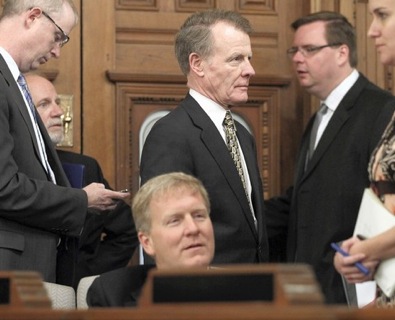
In an admittedly desperate effort to attract some comments, let’s do a funny caption contest instead of a question today. Speaker Madigan and Leader Cross with staff…
A stripped down version of a new tax on Illinois strip clubs advanced in the General Assembly on Thursday.
On a 53-0 vote, the Senate forwarded a proposal to the House that would raise an estimated $1 million to help finance rape crisis centers throughout the state.
The measure initially called for the clubs to charge $5 per patron with a goal of raising an estimated $6 million. […]
“After all of the uncomfortable jokes and snickers, we must pass this important law,” said state Sen. Kirk Dillard, R-Hinsdale.
“It is a serious issue,” added Republican state Sen. Tim Bivins, a former county sheriff from Dixon.
As I told you back in March, some Senate Republicans had balked at the fee before the March primary. That’s over, and the bill has been revised since then, so on board they climbed.
Club operators can choose two different ways to be taxed. They can either pay a $3 surcharge for each customer they serve, or they can pay a certain amount to the state depending on their gross receipts for the calendar year.
Under the second approach, if a venue made less than $500,000, it would pay a $5,000 fee. Venues making between $500,000 and $2 million would pay $15,000. Venues making more than $2 million would pay $25,000.
* Roundup…
* Eavesdropping reform bill stalls in Senate: Advocates for allowing recordings are angered by Noland’s stance. Joshua Sharp, the director of government relations for the Illinois Press Association, said Noland is welcome to vote against Nekritz’s measure, but should remove his name as a sponsor. Sharp called Noland a “hostile” sponsor who seems to want unlimited police surveillance of citizens.
* Business incentives transparency bill goes to Quinn: The program, known as Economic Development for a Growing Economy, or EDGE, offers tax breaks to companies that create or retain jobs and make investments in the state. The Department of Commerce and Economic Opportunity, which administers the program, annually releases the names of companies receiving the credits, but details of the agreements, such as the dollar value of the incentives, are often kept secret. If the bill is signed by Gov. Pat Quinn, the department would post on its website the terms of each agreement after it is reached.
* House votes to cut some Illinois regional superintendents: Senate Bill 2706, unanimously approved by the Illinois House Friday, would cut the number of superintendents from 44 to 35 and fund the positions out of the state’s general revenue fund.
There’s a lack of consensus at the Capitol on raising the retirement age from 65 to 67 for many government workers, so that’s out. And there’s no agreement on requiring current workers to take more out of their paychecks. […]
Instead of a compound-interest formula that more quickly escalates pension checks, one plan gaining traction would see the state switch to a simple-interest-style system installed a few years ago for new hires. Cost-of-living adjustments would be equal to half the consumer price index or 3 percent, whichever is less. […]
Under one plan being considered, a retired worker could keep collecting 3 percent annual cost-of-living increases based on compound interest but would have to give up access to a retiree health care plan. At the same time, a retired worker willing to take the lower cost-of-living adjustment would have the opportunity to stay in the state’s health insurance plan, said Rep. Elaine Nekritz, D-Northbrook, a key pension negotiator. […]
Current workers also would have choices. Workers willing to accept a lower pension cost-of-living increase would be eligible for whatever health care plan is in place when they retire. In addition, future salary increases would be calculated into the size of their pensions, Nekritz said.
But current employees who want to keep the 3 percent compound interest in their pensions would be unable to count any more pay raises into the salary that their retirement checks are based upon. They’d also lose any state health care when they retire.
Nekritz said another change being considered would delay the start of giving cost-of-living adjustments to retirees. Under that scenario, cost-of-living increases would start at either age 67 or five years after retirement, whichever is earlier.
I’m not so sure that this is going to save all that much money. How do you force people into the lower-benefit retirement package? Giving up access to government health insurance in order to keep compounded cost of living increases would be a no-brainer for a whole lot of people. The magic of compounded interest adds so much more income over time that it’s probably worth it to find private insurance until a retiree reaches Medicare age.
Chairing a committee in the Illinois Legislature can be a boon or bust to lawmakers’ campaign war chests, depending on the committee and the chamber.
In the Illinois House, those heading the appropriation, judiciary or revenue committees usually are leading their colleagues in the campaign contributions arms race.
Leaders of the fundraising pack in the Illinois Senate are chairing the judiciary, executive appointments and revenue committees.
The appropriations, judiciary and revenue committees are, what Kent Redfield calls, “power committees.”
They determine “who gets taxed and who doesn’t get taxed, who gets funded and who doesn’t get funded,” said Redfield, author of “Money Counts: How Dollars Dominate Illinois Politics and What We Can Do About It.”
The numbers support Redfield’s assertion:
* Each chairman of the five House appropriations committees brought in $29,757.83 more than the average representative for every two-year election cycle since 2005-06, according to the campaign contribution database maintained by the Illinois Campaign for Political Reform, a government watchdog. That’s a fundraising advantage of 25 percent.
* Each chairman of the Senate Judiciary Committee since 2005-06 brought in an average of $147,161.36 more than the average senator for every two-year election cycle since 2005-06. That’s a fundraising advantage of 15 percent.
One of those approp chairmen is Rep. Fred Crespo, who has been heavily targeted for defeat in recent years. He’s probably moving the needle for everyone.
“It’s about access to power, getting meetings set up, getting a heads up on legislation, getting phone calls returned, all the things interest groups want,” Redfield said.
Former state Rep. Michael Smith, D-Canton, chaired the House Elementary and Secondary Education Appropriations Committee in 2005-06, during which he raised $826,603, or $643,577.09 more than the average House member.
Smith attributed his impressive fundraising more to a competitive race rather than his chairmanship.
“My fundraising was a little bit different in that time period. It was a very expensive and costly campaign,” Smith said.
Comparing Smith to legislators who never face Tier One challengers is more than just apples to oranges. It’s apples to horseshoes - the throwing kind, not the eating kind.
The top donors are interest groups that give to committee chairmen who may have power over legislation the groups are interested in.
The Illinois Trial Lawyers Association, a lobbying group, was one of the top donors to state Rep. Elaine Nekritz, D-Northbrook, chairwoman of the House Judiciary Civil Law Committee.
Notice how the article doesn’t say how much Nekritz raised from the trial lawyers. I always look up the numbers when I see stuff like that.
Starting way back in 1996, Rep. Nekritz has received 19 contributions from ITLA totaling just $39,710.98 (There’s another $2K contribution from “ITLA” that doesn’t show up on that link.)
That’s $2,481.93 per year, on average. Hardly a king’s ransom. And she hasn’t chaired the committee all along, either.
Someone elected to two positions in different local governments could not collect two pensions under legislation that passed the Illinois Senate Friday.
The bill’s chief sponsor, Sen. Don Harmon, D-Oak Park, said he believes state law was already clear about pensions for people who serve both as a county board member and another locally elected position. However, a legal opinion from a state’s attorney made the already “tangled web” even more complicated, he said.
House Bill 5078 clarifies that officials cannot get credit toward a pension for both jobs. It passed on a vote of 31-18 Friday.
Prohibits any person who holds elected office in a unit of local government from entering into an additional elected office in another unit of local government if he or she is: (i) earning service credit under the Pension Code as a result of holding the first elected office and (ii) will earn service credit under the Pension Code as a result of simultaneously holding the second elected office.
* The bill would also take away one person’s pension sweetener. From the Sun-Times…
A former suburban police chief who benefited from an obscure pension sweetener and unapologetically declared “I deserve every penny of it, and I deserve a lot f—— more” could wind up getting a lot less.
By a 31-18 vote, the state Senate Friday moved to repeal a state law that allowed retired Oak Brook Police Chief Thomas Sheahan — a member of one of Chicago’s better-known political families — to boost his pension by more than $30,000 a year.
The deal that originally benefited Sheahan passed the General Assembly in 2007 and was signed into law by former Gov. Rod Blagojevich, eventually blindsiding the western suburb with a tab of $750,000 in unfunded pension liabilities. […]
Sheahan was the only person to benefit from the 2007 provision that was tucked into a larger bill aimed at safeguarding the pensions of police widows. That bill was sponsored by state Rep. Robert Molaro (D-Chicago), who has since left the Legislature and signed on as a contract lobbyist for Oak Brook,
In short, the law that benefited Sheahan created a now-expired six-month window for members of one public-sector pension fund (the Municipal Employees’ Annuity and Benefit Fund or MEABF) to transfer credit into another (the “Sheriff’s Law Enforcement Personnel” program of IMRF) if they participated in both.
That enabled Sheahan to shift five years of credit from MEABF into IMRF so he could retire in 2011 with roughly 24 years of combined service. Without the legislation, he would have had fewer than 19 years of service and retired with two pensions worth a collective $45,000 rather than one worth $77,000.
Sheahan, who worked for Oak Brook for six years, is drawing that pension now on top of a $65,000-a-year salary he draws for being the part-time village manager of Lyons. […]
Even though the state Constitution bars any diminishment of pensions, Dillard said he believes his measure will pass constitutional muster and said that it is patterned after November legislation Gov. Pat Quinn signed that repealed the pensions of a pair of Illinois Federation of Teachers lobbyists, Steve Preckwinkle and David Piccioli.
“Section 1. Retroactive repeal. This amendatory Act of the 97th General Assembly hereby repeals and declares void ab initio Section 8-226.7 of the Illinois Pension Code as contained in Section 5 of Public Act 95-504 as that Section furnishes no vested rights because it violates multiple provisions of the 1970 Illinois Constitution, including, but not limited to, Article VIII, Section 1 and Article IV, Section 13. Upon receipt of an application within 6 months after the effective date of this amendatory Act of the 97th General Assembly, the System shall immediately refund any contributions made by or on behalf of a person to receive service credit pursuant to the text set forth in said Section 8-226.7, as well as any amount determined by the Board to be equal to the investment earned by the System on those contributions since their receipt.
“Void ab initio” means that a “contract is null from the beginning if it seriously offends law or public policy in contrast to a contract which is merely voidable at the election of one of the parties to the contract.”
* Check out the roll call for the House vote on the cigarette tax hike yesterday by clicking here.
This was an old-fashioned “structured” roll call, where the two parties work together to each put just enough votes on a bill to pass it. The bill received the bare minimum of 60 votes, with 18 House Republicans voting for it.
We haven’t seen one of these structured roll calls in years, mainly because the two parties just haven’t worked together all that well.
Another major reform to the state’s Medicaid program fell into place for Springfield lawmakers Friday with House passage of a $1-per-pack cigarette tax increase to help plug a $2.7 billion hole in the state’s health-care program for the poor.
The bill needed 60 votes to advance through the chamber and just reached that number, passing by a tally of 60-52. It now moves to the Senate, which passed a $1-a-pack cigarette tax hike in 2009.
After both chambers voted to send Gov. Pat Quinn a bill on Thursday that cut $1.6 billion in the program, legislators agreed to a tax on cigarettes and other tobacco products that supporters say will generate $800 million.
“This is an important revenue-generating measure so that we do not have to make further cuts in Medicaid,” said House Majority Leader Barbara Flynn-Currie (D-Chicago), the chief sponsor of the tax legislation.
Under the proposal, the state’s current 98-cent per pack state tax on cigarettes would increase to $1.98. In addition, the state would tax small cigars at the same rate as cigarettes. Taxes also would hit so-called roll-your-own cigarettes, and taxes on other tobacco products would double.
The tobacco taxes would generate $350 million, which the state could use to leverage another $350 million from the federal government.
Another provision would put in place a new tax on the state’s hospitals with the hopes of generating $50 million in new state revenues that also could leverage another $50 million from Washington.
William J. Fleischli, executive vice president of the Illinois Association of Convenience Stores, warned that stores in border areas like the Metro East would buy their cigarettes in the neighboring state. “This is an unfair tax,” he told lawmakers before the vote. “Smokers already pay more than their fair share.”
Rep. Jim Sacia, R-Pecatonica, whose district includes vast amount of border areas along Iowa and Wisconsin, acknowledged he didn’t have “a lot of constituents that support this legislation.” But, he said, his position has evolved.
“We are in the midst of the worst crisis financially this state has ever seen,” Sacia said, urging support for the measure. “It’s a tough vote but the right vote.”
Rep. Jim Watson, R-Jacksonville, voted in favor of the bill, saying it was the best option available based on the state’s financial needs. More cuts to Medicaid programs wouldn’t have passed the legislature, he said.
“I’m willing to step up and take what some people argue is a bad vote to be part of that solution,” Watson said.
Saturday, May 26, 2012 - Posted by Advertising Department
[The following is a paid advertisement.]
As opponents continue to ignore closing coal plants and rising electric costs, the REVISED SB 678 offers SAVINGS FOR RATEPAYERS and LOW, HARD RATE CAPS FOR ALL CUSTOMERS. The new SB 678 would:
• Save Illinois ratepayers an expected $437.7 million over 20 years with below-market energy costs – yes you read that right – the revised Tenaska plant would have BELOW MARKET COSTS
• Require Tenaska to absorb 100% of any cost overruns
• Cap even the possibility of a rate hike at .75% for residential customers (less than 60 cents per month);
• Cap even the possibility of a rate hike at $0.00085 per kilowatt-hour for ALL larger customers
• Postpone coal-to-natural gas portion of Taylorville plant and preserve it as a hedge against potential future natural gas price increases, a back-up plan that couldn’t go forward without General Assembly approval.
Illinois needs to take action now. As the Chicago Tribune reported on May 17:
Residential electricity rates are expected to spike more than 10% beginning in 2015, with consumers paying between $150 and $330 a year more than this year, as coal plants, the least expensive producers of electricity, continue to close.
Tell legislators you agree with CUB, the Attorney General, business, labor and environmental groups that you want a smarter energy future in Illinois.
* The Senate has adjourned until Monday at 2 o’clock, but the House is in session at 9:30 today. Appropriations-Elementary & Secondary is meeting at 8:30 and Appropriations-Public Safety is meeting at 9 o’clock. If there are enough members here today the House may move some of its budget bills. I was told yesterday that adjournment is expected around noonish, but that, of course, is subject to change. After adjournment, the House will return Monday at noon. You can listen or watch House floor debate and committee action by clicking here.
* Despite my best efforts yesterday, including trying some medicine, my left eye is almost swollen shut from that stupid, but harmless stye. It looks gorgeous (not). I finally made it out yesterday and wore my sunglasses everywhere except to dinner. Unless this thing starts getting better soon I won’t be going into the Capitol today. It just looks too horrid. Don’t wanna scare anyone.
* Anyway, on to the live coverage. Blackberry users click here…