* I’ve been telling subscribers about this over the past several days. I didn’t want to point it out when I posted the Speaker Madigan video because of that. The SJ-R watched the video and filed this report based at least partly on that…
[E]mployees will be offered a stark choice: Take a lesser COLA or you will not receive access to the state’s health care plan for retirees and your pay raises will not count toward your pension.
That’s different than Gov. Pat Quinn’s original plan, which would’ve simply cut off government subsidies for retiree health insurance if an employee didn’t move to the newly created, lower-tiered pension plan. This plan would mean employees would not be allowed to purchase state health insurance when they retire if they stay in the current retirement plan.
For employees that began work before Jan. 1, 2011 who are in the tier 1 set of retirement benefits, they receive an annual, 3 percent compounded COLA.
Madigan said the new COLA would be the same as it is for those employees who began work after Jan. 1, 2011 and receive tier 2 retirement benefits. They get the lesser of 3 percent or one-half the urban consumer price index and their COLA is not compounded.
That means if a retiree has a $50,000 pension and the consumer price index is 2 percent, they would receive a COLA adjustment of 1 percent, so their pension would be $50,500 the next year. If during the next year, the consumer price index was 4 percent, they would receive $51,000 the year after that.
The plan will also phase-in a shift of the pension costs to local school districts, universities and community colleges, an idea staunchly opposed by legislative Republicans.
* The Senate has adjourned until Monday at 2 o’clock. The House is, as I write this, planning to return tomorrow morning. But nobody wants to say yet whether they’ll be in Sunday. Check the live blog for updates.
* Meanwhile, I’ve been working out of my home all day today because I look like I got punched in the eye. It’s really just a harmless little eye stye, but it looks ugly and the hot rag trick ain’t working yet. And before you say anything, yes, it looks uglier than usual. Whatever. The roast was two months ago.
* Anyway, I haven’t decided yet what to do about comments. I’ll probably close them, though. While I decide, here’s some music that I’m sure you’ll like.
John Fullbright is one of the very best singer-songwriters to come along in years. He is burning up the Red Dirt scene and amazing critics far and wide.
The kid has literally blown my mind. You can hear some of his great new album here, but you must watch this…
Well the sky is raining fire
But I think I’ll go to bed
‘Cuz there ain’t much you can do
When it rains down on your head
Except pray and beg for mercy
From this hell you created
On the corner of Satan and St. Paul
Springfield, Illinois —State Senator Tony Munoz (D-Chicago) is sponsoring legislation that was brought to him by the Cook County State’s Attorney that will help in the prosecution of criminal gang activity.
“By passing this legislation, we are giving the State’s Attorney’s Office the ability to go after people who are using others to carry out illegal activities,” said Senator Munoz, a member of the Senate Executive Committee. “This measure closes a loophole in the law that currently does not allow for the prosecution of a person who dictates violence.”
House Bill 1907 creates the Illinois Street Gang and Racketeer Influenced and Corrupt Organization Law, an Illinois-focused version of the federal Racketeering Influenced and Corrupt Organizations (“RICO”) Act.
This amendment gives prosecutors a tool to target criminal enterprises and specifically target the organizers and leaders by proving that these individuals have engaged in a pattern of criminal activity.
“From my years on the force, I can tell you first hand that is how common it is for gang leaders to shield themselves by seeking out younger recruits to carry out their illegal schemes. The expectation is that these at-risk youth will avoid harsher penalties that are applicable to adults, especially those with criminal records,” stated Alfonza Wysinger, a First Deputy Superintendent of the Chicago Police Department.
This measure has passed the Senate and now goes to the House of Representatives for concurrence.
* Mayor Emanuel has weighed in as well…
I commend the Illinois State Senate on the passage of House Bill 1907 - a critical tool that will give local law enforcement the power to prosecute gang leaders for crimes that they ordered others to commit. I’d like to thank State Senator Tony Munoz, State Representative Mike Zalewski and State’s Attorney Anita Alvarez for their leadership on this important legislation that will close loopholes that have allowed violent gang leaders to escape punishment for their crimes. If someone wants to be part of a gang, we will hold them responsible for the actions of the entire gang. This law sends a clear message: the streets of Chicago belong to the law-abiding residents of Chicago. I urge the House to act swiftly in concurring with the Senate.
* I’m just wondering how long it’ll be before a new RICO law is expanded to include other stuff. This sounds good on paper, but criminal laws are always toughened and expanded every year. Plus, there are 102 state’s attorneys in Illinois of varying degrees of competence and partisanship.
Breaking up street gangs is a great thing. Don’t get me wrong. I’m all for it. But will this stay so narrow in the future?
* The Illinois Channel scored an exclusive interview with House Speaker Michael Madigan. The Speaker talked mostly about Medicaid and pension reform. I highly recommend that you watch the whole thing.
* For those of you who can’t watch videos at work, Madigan is asked: “Speaker, as you just mentioned, 42 years [of public service]. Do you think you have another decade in you?”
“That’s just the beginning,” Madigan joked.
* The Question: How would you rate Speaker Madigan’s job performance so far this session? Take the poll and then explain your answer in comments, please.
* Famed Statehouse lobbyist, primo White Sox fan and top notch election law attorney Andy Raucci’s birthday is today. Let’s all wish him a happy birthday with a caption contest, shall we? Get a load of that shirt, man…
* If you were watching yesterday’s live session coverage, you already know that large blocs of the Medicaid restructuring package were either passed or advanced yesterday. By far, the best story about yesterday’s action in any newspaper was written by Doug Finke. Some excerpts…
The House voted 94-22 and the Senate voted 44-13 to adopt the cuts in Senate Bill 2840, which range from outright elimination of some programs – like Illinois Cares Rx, a prescription drug assistance program for seniors – to taking extra steps to ensure that those receiving aid are entitled to it. The bill now heads to Quinn’s desk. […]
Also as part of the package, the House and Senate sent Quinn a bill that would allow Cook County to enroll more people in the Medicaid program using local and federal funds, but not state funds. The vote in the House on House Bill 5007 was 62-55 and 35-22 in the Senate. […]
In an attempt to appease Republicans, who came under fire from right-wing groups for considering something that helps implement Obamacare, Democrats offered another bill, Senate Bill 3397, that would restrict the number of unpaid Medicaid bills that the state can carry over from year to year. The state would be be allowed to carry over only $700 million to fiscal year 2013 and $100 million to fiscal year 2014. […]
Those three bills are linked — if one of them fails to pass or isn’t signed by the governor, the others also will fail.
“The governor likes the cigarette tax,” Cross said. “The governor does not like what we call section 25, which prevents him from putting bills off. That’s why you’re seeing some of those connections.”
Another piece of the package will combine a $1-per-pack cigarette tax increase and property and sales tax exemptions for hospitals, according to Danny Chun, spokesman for the Illinois Hospital Association. The bill number for this portion is expected to be Senate Bill 2194, but the language has not yet been filed.
Cross said he expects some Republican House members to vote for the cigarette tax increase. Most believe every bill in the package will have to collect support from both Republicans and Democrats, because the solutions are so unpalatable.
Sen. Dale Righter, a leader on Medicaid issues for Senate Republicans, said he doubted any of his GOP colleagues would support the tax increase. If the tax doesn’t pass, Democrats would be forced to return to the bargaining table to consider more spending cuts, he said.
The Senate Democrats have twice passed a cigarette tax hike without Republican votes, so they’re probably not needed this time, either.
Some of the most controversial cuts in the plan are the eliminations of maintenance dental care for adults and Illinois Care Rx, which is a prescription drug program that helps low-income seniors pay for their medicine. Approximately 180,000 seniors would be affected by the loss of the Illinois Care Rx program. The cut to adult dental care would affect 172,000 Illinoisans. “We believe that these cuts in human terms are very damaging. People will not get less sick because we made these cuts,” said William McNary, co-director of Citizen Action/Illinois. According to McNary, the cut to the Illinois Rx program is the biggest reduction in the plan, and it will cost the state more in the long run if seniors are not able to get the prescription drugs they need and end up in nursing homes.
Under the reductions, adults who have oral infections could get a tooth pulled. But Dave March, director of government relations for the Illinois State Dental Society, said most oral surgeons, who would perform an extraction in an emergency situation, do not take Medicaid. He said patients with oral infections often end up in emergency rooms, which have little to offer them. “All they can do is give them antibiotics and send them away.” He said that such infections left untreated can turn into life-threatening abscesses.
Those who opposed SB 2840 argued there are other options legislators could have considered, such as fund sweeps, applying sales tax to services and closing some of the corporate loopholes to help the state bring in more revenue instead of cutting Medicaid. “There’s lots of things, ladies and gentlemen, we can do rather than putting senior citizens and disabled people out on the street without having access to their health care,” Chicago Democratic Rep. Mary Flowers said during floor debate.
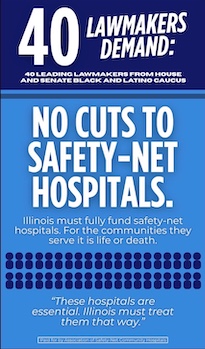
Members of the Black Caucus and the Latino Caucus came out strongly against the bill in both legislative chambers. “Once we push that green light, are we pushing people into the grave? That’s the question that we really need to ask ourselves,” said Sen. James Meeks, a Democrat from Chicago.
Proponents acknowledged the pain that the plan would cause but said the changes are needed to keep the system from collapsing because the state cannot afford to reimburse providers. “There are going to be people who get benefits today under the Illinois Medicaid program … who will no longer receive them. Or they’re not going to receive them in as convenient of manner as they do today, and that’s going to be tough on some people,” said Sen. Dale Righter, who served on the legislative working group that negotiated Medicaid reform.
“This is not immoral,” said Sen. Matt Murphy, a Palatine Republican. “What would be immoral in my mind would be to sit back, pretend there’s no problem” and let the system fall apart.
* Dave McKinney writes about something we pointed out yesterday…
Included in those cuts is a provision affecting 536 children with “medically fragile” conditions who live at home on ventilators or who require around-the-clock nursing care, like Letty Young. For the first time, their families would be asked to share more in the state’s costs for their children’s highly specialized services, saving the state $15 million.
Hamos told reporters that families in the agency’s Medically Fragile/Technology Dependent program will have to begin paying $400 a month co-payments, on average.
“We thought it was fair, in the world we live in, that there be some co-payments,” Hamos told a House panel Thursday.
But Myra Young, Letty’s mother, said that isn’t something her family can afford and may necessitate moving her daughter, who was born with congenital fiber-type disproportion, permanently from their two-bedroom condo at North and Clark into a hospital under a different Medicaid program that would ultimately wind up being more costly to the state.
“My daughter was in the hospital for her first nine months. She was diagnosed at about 2œ months old. She couldn’t breathe on her own. She had no muscle tone. She struggled to keep her eyelids open. She had no movement,” Young said.
“The cost-sharing is not really an option. We can’t afford it,” Young said. “There’s no way for families — my family — to be able to do this. The costs are so exorbitant. How they think that’s the place to make the big cuts is just unbelievable.
“This isn’t the life we expected,” she continued. “I think a lot of people don’t realize this could be them. This is a spontaneous, genetic thing. It could be anyone. People need to get behind us. This could be their loved ones.”
* Related…
* Illinois Legislature passes $1.6 billion in Medicaid cuts
* Illinois House passes bill to cut $1.6 billion from Medicaid
* Illinois Legislature approves $1.6B in Medicaid cuts
Illinois House Speaker Michael Madigan says it would be unconstitutional to force current state employees to work to age 67 before collecting full retirement benefits.
Madigan told The Associated Press Thursday that he will not raise the retirement age as part of package to cut pension costs. The Chicago Democrat says delaying retirement for current state workers would violate the Illinois Constitution.
“By no means am I a proponent of expanded gambling, but you take a look at this bill and the benefits to agriculture I think outweigh any detriments in the bill,” said Brown, a freshman lawmaker. “When agriculture is the number one industry in our state I think it’s got to be a priority, not only in this bill but in several other bills.”
Both Barickman and Brown, as well as Rep. Naomi Jakobsson, D-Urbana, said they would vote for an override if Quinn vetoed the bill. Until the recent past, Jakobsson had opposed any gambling expansion.
“Everyone knows we’re in a crisis as far as our revenue, and I believe that by putting people to work and giving them jobs, they’ll need fewer of our services. As people are working that will eventually balance things out.
“You know we talk about the social ills of gaming but look at the social ills of unemployment.”
I must hear that question a half- dozen times a day at the Illinois Statehouse. So, I’ve developed a standard retort.
“Man, there’s never any good news in this building.”
Despite struggling the past year or so to overcome decades of misrule and mismanagement, Illinois has not yet been able to right itself. Unemployment is falling, but it’s still way too high.
The state government’s credit rating has been bruised and battered for years and is now in danger of falling off a cliff.
Despite a huge income tax increase, the state is still carrying billions of dollars in unpaid, overdue bills. The tax increase was eaten up almost entirely by gigantic annual pension payments, which the state made worse by skipping or skimping on for years.
Pensions and Medicaid spending is are gobbling up almost 40 percent of the state’s budget. And if nothing is done right now, in just a few short years the mountain of overdue Medicaid bills alone will be higher than what the state spends on its annual budget.
In other words, even with the income tax increase, there’s no money left to dig out from under that pile of overdue bills. Not to mention that “natural spending growth” (without adding a single new program) is eating up every dollar and more of natural revenue growth. Even without those unpaid bills, the state simply can’t afford to keep paying for everything it already does.
A corporation or individual in this sort of trouble would probably just declare bankruptcy. But states can’t declare bankruptcy.
Instead, the state has to look for politically popular revenues and make politically unpopular budget cuts.
The new revenues have to be popular because yet another unpopular tax increase this close to the election would surely be the final kiss of political death.
Cigarette tax increases are consistently far and away the most popular revenue stream out there. So, that’s part of the plan to help patch the gaping Medicaid budget hole, which is a whopping $2.7 billion.
People always say they want budget cuts, but they never like the actual cuts. Cutting Medicaid programs and kicking a hundred thousand people off the system won’t be popular at all.
But the ugly, harsh political reality is that a large number of Medicaid recipients live in Cook County, where the Democratic primary is the real election. And that election was this past March.
So, politically, those cuts are easier to make.
But just because they’re politically easier, that doesn’t mean legislators who represents lots of poor people will be voting for those cuts. They won’t. I don’t blame them. All politics is local. I get it.
What cannot be allowed to happen, however, is one group of legislators dictating to everyone else how things should go.
Legislative Black Caucus members announced Wednesday that they wouldn’t be voting for the Medicaid cuts, but they also said they wouldn’t oppose the cigarette tax increase. Doing so would’ve created big problems because without that tax increase the cuts would have to be even worse.
Democrats, mostly, will be voting for the cigarette tax increase. Republicans, mostly, are voting for the cuts, despite the tax increase.
And that’s how it should be, as long as it gets done. Individuals can and should make their point about an individual issue without obstructing the entire process.
So, maybe I’m wrong. Maybe there is good Statehouse news.
Except that even the good news is bad. Snatching health care away from poor people is not exactly something to be proud of.
That column was due before the House and Senate overwhelmingly approved Medicaid cuts. Few expected that many Democrats to be for the bill, including me. But it’s still a good sign that spines are stiffening in Springfield.
* Illinois Review raged yesterday against Senate Republican Leader Christine Radogno for having “permitted (or urged)” five lame duck Republicans to vote for HB 5007, which allows Cook County to add 100,000 people to the Medicaid rolls without any cost to the state government…
HB 5007 - sponsored by State Senator Kwame Raoul (D-Chicago) and Jeffrey Schoenberg (D-Evanston) passed in a 35 to 22 vote, with no questions or discussion on the Senate floor. And despite the fact that its passage did not require Republican votes, Senate Republican Leader Christine Radogno permitted (or urged), five lame duck GOP Senators to cross over and vote with the Democrats.
The vote indicates how the Medicaid-Obamacare vote on SB 2840 is likely to go down. Shane Cultra, Tom Johnson, John O. Jones, John Millner and Suzi Schmidt broke ranks, damaged the GOP anti-tax brand, and possibly cost Republicans seats come November. None of them are on the ballot this year and therefore have no accountability to the voters.
Of course, Radogno’s deal did allow four Democrats in tough races to vote against the bill. Democrats Forby, Haine, Jacobs, and Sullivan got a pass thanks to Radogno and the five others.
Um, how, exactly did Radogno’s alleged deal allow “four Democrats in tough races to vote against the bill”? It takes 30 votes to pass a bill in the Senate. Five Republicans voted for it. The bill got 35 votes. If all five Republicans had voted against it, the bill would’ve still received 30 votes without those four Democrats. If anything, it showed how silly opposition was to this bill because people who aren’t running for reelection didn’t care about political threats over nothing.
And there wasn’t a single tax hike in that bill, so I’m not sure how it “damaged the GOP anti-tax brand,” or can see how it cost the GOP some seats. What’re the Democrats gonna do to a bunch of lame duckers anyway?
Friday, May 25, 2012 - Posted by Advertising Department
[The following is a paid advertisement.]
Something about HB3881 doesn’t smell good, and it’s not the Cook County landfills the bill seeks to ban.
The bill is just a solution in search of a problem. Not a single Cook County official, municipal mayor or village manager has asked for this legislation. South suburban mayors are opposing the legislation because it undermines their ability to do what’s best for their communities. More should join them.
Today, communities make their own decisions on how best to manage their own land use and waste issues. Local communities, for example, have authority to permit or deny new landfills from operating. That approach works, so why change it?
The bill, in one fell swoop, snatches home rule authority right out from under scores of communities. If Springfield lawmakers can legislate what’s best for communities on this issue, what’s to stop them from gutting their home rule authority even further?
Ultimately, this is an issue about communities doing what’s best for their residents and not having our future dictated to us by Springfield politicians, big businesses or their lobbyists.
Springfield has much work to do, so let’s keep local issues out of the hands of state lawmakers.
* Poll: City residents don’t want speed cameras: The survey logged opposition to speed cameras from 54 percent of those questioned, while 69 percent said money — not safety — was behind the mayor’s push to install automated equipment that will nab and ticket lead-footed drivers near parks and schools. The disparity between those results suggests that even some of the 43 percent of voters who said they back cameras nonetheless harbor doubts about the mayor’s stated reasons for wanting them. Just 22 percent of those surveyed agreed with Emanuel that the purpose of his speed camera program was to protect children.
* Subscribers knew about this development earlier in the week. Sen. Michael Noland sponsors the Senate Bill that was used as a vehicle for Rep. Elaine Nekritz’s “eavesdropping bill.” The proposal, which took months to craft, would decriminalize audio recording of on-duty police. Doing so is currently a felony punishable by up to 15 years in prison.
* Noland told me that he thought the Nekritz bill was “bad law” and “superfluous.” He didn’t repeat those claims to other reporters, but check out what he wants to do…
Senate Bill 1808’s chief sponsor, Sen. Michael Noland, D-Elgin, wants to include a provision that would allow police officers to make audio recordings of citizens in public places. The proposal currently allows only members of the public to record officers.
“We don’t want an unfettered ability for law enforcement to record our citizens, but if they have probable cause … to approach somebody on the street,” Noland said. “If you’re approaching someone on the street with a video camera, there’s notice that the whole world is watching. When the whole world is watching, people tend to behave better.”
Noland is refusing to give up sponsorship of the bill, and he also is refusing to call it for a concurrence vote in the Senate. That means the bill is dead.
Noland’s suggestion also might be unconstitutional, said Josh Sharp, director of governmental relations for the Illinois Press Association. Sharp referred to Article 1, Section 6 of the Illinois Constitution, which states that people have the right to be protected against “invasions of privacy or interceptions of communications by eavesdropping devices or other means.”
“That makes it clear to me that police can’t have unlimited surveillance power,” Sharp said. “If we were to pass that bill (with Noland’s changes), it would be found unconstitutional.”
Sharp is absolutely spot on.
* Despite the fact that Noland thinks Nekritz’s bill is “bad law,” he wants to combine both ideas on a new vehicle…
Noland told Illinois Statehouse News he’s not stalling the bill, but he wants to “reconcile” the move with recent court rulings that deem the law unconstitutional, and add additional provisions to allow police to record civilians.
Josh Sharp is government relations director for the Illinois Press Association, a media and First Amendment group. He says courts are all but asking the General Assembly to address the issue. Three courts have found the law unconstitutional, but prosecutors can still try to enforce the current law, Sharp said, leaving it in limbo.
“There’s no reconciliation needed. The courts have said you cannot criminalize activity protected by the First Amendment,” Sharp said. “We’re just looking for an up or down vote on the bill as it passed the House.”
Noland said he thinks the bill could pass before the end of the legislative session next week.
* The famed US Attorney is leaving office next month. But he says there will be no campaigns and no criminal defense work in his future…
Fitzgerald — who oversaw prosecutions that sent two Illinois governors to prison for corruption — said he’s 100 percent certain he won’t ever seek elective office.
“I am not wired to campaign for anything or run for elective office, period,” he said. […]
Asked if he might consider doing what many former federal prosecutors have done and become a criminal-defense attorney, a potentially lucrative field, Fitzgerald, who is paid $155,000 a year as U.S. attorney, smiled and said, “Can you imagine me as a defense attorney? I respect what defense attorneys do. I won’t do anything I don’t feel comfortable because that’s not me.”
Though he dismissed the prospect of running for office, Fitzgerald made clear he isn’t ruling out some future post in government.
“I love public service,” he told reporters, speaking in public for the first time since announcing his resignation Wednesday. “Public service is in my blood.”
* The Senate Republican aversion to any government increases in taxes and fees no matter what was highlighted again yesterday when a bill requiring “concentrated animal feeding operations” to pay permit fees passed the Senate and was sent to the governor.
The bill establishes a fee for Concentrated Animal Feeding Operations (CAFO) that have National Pollutant Discharge Elimination System (NPDES) permits to discharge pollution into waters of the U.S. The annual fees, though very minimal, are needed to fund the IEPA’s permitting program, which is required by federal law.
All other regulated industries such as municipal sewage plants and industrial processing facilities already pay permit fees.
To date, they have been paying for the CAFO program because livestock operations have always been exempt from paying fees. However, numerous CAFOs have been found discharging and they should contribute to the cost of regulating their own pollution.
The number of farms that will be required to have a permit will be extremely limited, impacting only a small number of farms… IFB supports HB 5642.
* Even with that farm-based support, 15 Republican Senators voted against the bill. Sens. Brady, Cultra, Dillard, Duffy, Tom Johnson, LaHood, Lauzen, McCann, McCarter, Murphy, Pankau, Rezin, Righter, Sandack and Syverson all voted “No.”
* There is another side to this issue. State funds are subject to sweeps. And while the state hasn’t done any sweeps the past few years, it’s always possible that the fee money will be snagged for use elsewhere.
* The Question: What do you think of a vote against a limited fee increase which is supported by the industry being targeted?
* I’ve been warning subscribers about this development for almost two weeks. The Black Caucus made it official yesterday via press conference…
Most people in Springfield have been planning for next year’s budget with the idea that there would be a $2.7-billion cut in Medicaid, the state’s program of health care for the poor.
That includes the budget Senate Democrats voted for. […]
Shortly before the Senate vote, black legislators came out as a united front, protesting the Medicaid reductions.
Rep. Mary Flowers, a Democrat from Chicago, says cutting benefits like prescription drugs is a lose-lose proposition. […]
With just a week left in the legislative session, the fight over Medicaid seems to be holding up a broader budget agreement.
There are more problems with Medicaid than this, but without Black Caucus votes, the benefit/eligibility/provider cut package can’t pass unless Republicans also support the plan. Subscribers know more about that aspect.
* Meanwhile, the Senate Democrats pushed through their own budget yesterday…
emocrats rammed a budget plan through the Illinois Senate Wednesday, but the state’s financial blueprint for the coming fiscal year is far from being complete.
With the House still working to craft a bipartisan spending plan, action in the Senate was viewed as more symbolic than a finished product.
Republicans in Senate called the $33.7 billion proposal budgetary “sleight of hand” and a “sham” and wondered why Democrats weren’t waiting until there was more agreement with the House and Gov. Pat Quinn.
“I don’t think that we want to be in a position of waiting for the House to pass a budget. We want to get the process rolling. We don’t know whether we will get to an agreement [on Medicaid] yet or not, yet. So we are going to move a budget to the House and continue negotiations,” said Sen. Heather Steans, who sponsored two of the three budget bills that passed tonight.” […]
“So it’s more important to beat the House than it is to pass a sound budget that’s premised on everything that’s necessary to pass a budget, like what’s going to happen with Medicaid, the central issue in the entire budget? We are in such a rush to beat the House that we would rather do it fast … than do it right?” Sen. Matt Murphy, a Palatine Republican, asked during floor debate. Murphy said that the proposal would not put the state on track for financial stability when the recent income tax increase rolls back in 2015.
Democrats argued that Republicans have not presented a plan of their own, and the massive cuts they say they want would never be politically viable on either side of the aisle. “We think we’re doing this right. I could also suggest, if you don’t like this approach, we’d be happy to entertain a bill from you suggesting how we might do the budget,” Steans said. Democrats say that their budget is responsible because doesn’t spend more than the state will take in next fiscal year, and it would address $1.3 billion in overdue bills. The proposal would dip into money that is usually automatically transferred out of the General Revenue Fund and special funds to pay down the bills, and Steans said the money would not be repaid to those funds. […]
Sen. Dale Righter predicted that the history of last year would repeat itself. “It’s … a chamber squabble for you folks. It’s to beat the House of Representatives. And here’s what’s going to happen: You’re going to go through all this turmoil over here and all this grief,” Righter, a Republican from Mattoon, said. “And what’s going to happen is these budget bills are going to zoom over to the House of Representatives, and they will meet exactly the same demise as your budget did last year.”
* This schtick of the Republicans not presenting their own cuts - even via amendments to the Senate Democrats’ budget bills - is really getting old. The Democrats extrapolated overall Republican budget demands (which I told subscribers about several days ago) and came up with some numbers…
Senate President John Cullerton, D-Chicago, said the kind of cuts being demanded by Republicans would slash $446 million from education and $350 million from human services.
“It would be impossible to pass a budget with those cuts,” he said.
* But the SGOPs did make one very good point. From a press release…
Buried within a budget plan approved by Illinois Senate Democrats on May 23 was a $1.5 million earmark for a little-known program that is supposed to recruit and train parents and community leaders to become teachers.
The problem is, the program has already received more than $19 million in its first six years and only produced 29 teachers. That’s an average of $662,000 per teacher.
In fact, only 54 individuals have ever graduated from the program, which works out to $356,000 per graduate. Although students who fail to graduate or who do not take teaching jobs are supposed to repay their educational costs, most are “counseled out” of the program, which does not require a repayment.
Digging deeper into the statistics – a total of 615 students have started the program since it’s beginning in fiscal year 2006. That works out to a dismal graduation rate of 8.7%.
Despite the massive failure of the program, the Senate Democrat budget would provide a total of $1.5 million for the program.
Where does the money go? The program hands out grants to 15 consortia around the state. One of the requirements of the program is that each consortia must include at least one “community organization,” one school district, one two- or four-year college, a teachers’ union or a regional office of education.
Before approving the budget, Democrats added back money to keep the Jacksonville Developmental Center open. It was slated to close under an earlier version of the budget.
The spending plan also provides money to cover only about half of state employee health insurance costs next year. That would give Gov. Pat Quinn more leverage in union contract negotiations, Steans said.
* In other news, I received a desperate call today from a woman who’s trying to stop what she says would be devastating cuts to a crucial Medicaid program. Here’s her e-mail…
Dear Rich Miller,
House amendment 4 to SB 2840 includes a section, on p. 81 of the new amendment, that guts the Medically Fragile Technology Dependent Waiver for children. This program provides home nursing for 500 children with ventilators and other medical technology. The result of this amendment would be hundreds of children taken away from their families and hospitalized permanently, at three times the cost of care under the current program.
The new amendment would limit this program to families who earn 500% FPL or less, and imposes exorbitant copays that many families will be unable to pay. It also (p. 70) removes a guarantee in current law that states children with an institutional level of care or higher are eligible for home and community based services.
Here are the most important things to know about this issue:
1) This legislation could lead to hundreds of children being cut out of this program. These children are so medically complex that most of them will end up hospitalized permanently. It only costs $188,210 a year to care for these kids at home, but it costs $660,000 to care for them in the hospital, three times as much.
2) SSA law requires that the state cover costs for these children in a hospital/institution, but does not require them to cover home based services. Therefore, the state will be paying three times as much per child for every child who is cut off the program. Only 23 children would need to be hospitalized to erase all of the proposed savings.
3) Both Equip for Equality (Illinois’ federally-appointed Advocacy and Protection agency) and the Arc of Illinois have stated this legislation is a violation of the Americans with Disabilities Act as interpreted by the Olmstead Supreme Court decision. Both groups have written letters to the Governor and others expressing this fact. [See http://www.thearcofil.org/arc-fights-changes-to-medically-fragile-technology-dependent-childrens-waiver for the ARC of IL; the Equip for Equality letter is not yet on their website–we have an advance copy if needed.]
4) A family of 3 who earns 500% FPL would have to pay 246% of their income in order to keep their child at home, which is obviously impossible. $188,210 is the average cost of care, and some children have much higher costs. You would have to earn 1500% FPL just to break even after taxes for the average kid, and more than 2500% FPL for a sicker higher-needs child.
We have at least 17 families who are willing to be interviewed and have invited media and legislators into their homes. Our families are desperate–their children are about to be taken away from them because on paper it would save money, when in reality it would actually cost more.
I have attached a background information packet for your reference as well as our most recent press release. Please help us!
* I’ve been telling subscribers about this development for the past several days…
One piece of Gov. Pat Quinn’s plan to overhaul state employee pensions may be facing a tough sell with lawmakers.
As part of his proposal to ease the cost of the state’s retirement programs, Quinn has called for the re-tirement age to be boosted to 67.
But, a key Democratic negotiator Wednesday raised red flags about the concept, saying it could trigger a wave of retirements that could result in far less savings for the state.
“There is some feeling that that is a tougher pill to swallow and that creates a rush to the door that we don’t necessarily want to create,” said state Rep. Elaine Nekritz, D-Northbrook.
Nekritz, however, cautioned that no provisions have officially been ruled out in the bid by lawmakers and Quinn to overhaul employee pensions.
Everything is still really fluid, but that specific Quinn proposal has hit a brick wall so far. We’ll see how it goes.
Thursday, May 24, 2012 - Posted by Advertising Department
[The following is a paid advertisement.]
At a time of tough choices, the single largest job-creation plan in decades is now before the General Assembly.
SB 1849 is a gaming solution that would create more than 20,000 jobs and bring in $200 million in new annual revenue to Illinois. It would be an economic shot in the arm for our state, and we can’t afford to pass it up.
Illinois workers need a jobs plan. Unemployment in the state stands at 9 percent, families are struggling to make ends meet and the effects of the recession have further endangered thousands of already existing jobs, like the more than 30,000 statewide agricultural jobs that SB 1849 will save.
The job creation boost SB 1849 would provide is why major voices from Illinois’ organized labor community support this gaming solution. Supporters include Illinois AFL‐CIO, Chicago Federation of Labor, IBEW Local 134, SEIU Local 1, and UNITE HERE Local 1.
These labor groups and over 80 members of the Illinois Revenue & Jobs Alliance know this bill would be a “win” for the state of Illinois and its residents. Legislators ought to pass SB 1849 – and start putting workers back on the job.
* As I’ve often said, gaming expansion is never accomplished without the support of all four leaders and the governor. This time, at this point, the governor is opposed, but legislators are hoping to do it without him…
Offering up a direct challenge to a resistant Gov. Pat Quinn, the Illinois House resurrected a huge expansion of legalized gambling Wednesday that includes a land-based casino in Chicago, four more on riverboats - including one in Danville - and allowing ailing horse-racing tracks to add slot machines.
Quinn responded to House approval with ridicule, asserting the measure “continues to have major ethical shortcomings.”
The 69-47 tally was two votes shy of what would be necessary to overcome a Quinn veto — something the Democratic governor promised to do last year with a similar bill. But in a state starved for cash, Rep. Lou Lang, the bill’s sponsor, was confident that tax revenue of at least $300 million a year would change the Democratic governor’s mind.
“I’m hopeful that with the vote total we got today that the governor will decide that economic development, job creation and saving an industry — the horse racing industry — is worth doing,” the Skokie Democrat said.
During the voting, the number of yes votes hit 71 at one point — the number of votes needed to override a veto by the governor — but two legislators changed their “yes” votes to “no” before the official record was taken.
Two lawmakers voted present, and several more legislators could have lame-duck status after the November election, making it easier to vote for more gambling. The measure heads to the Senate, where sponsoring Sen. Terry Link, D-Waukegan, plans to call a vote next week as the Legislature nears a May 31 adjournment date.
The two “Present” votes were Speaker Madigan and Majority Leader Currie. Madigan always votes “Present” on gaming bills, so that wouldn’t matter. Currie has voted for past gaming bills.
* Gov. Pat Quinn’s official statement…
“It’s ironic that on the very day that U.S. Attorney Patrick Fitzgerald announced his resignation, the Illinois House would pass a gambling bill that continues to have major ethical shortcomings.
“This new bill falls well short of the ethics standards I proposed in my framework last October. Most importantly, it does not include a ban on campaign contributions as lawmakers in other states have done to keep corruption out of the gambling industry and out of Illinois. Massachusetts, New Jersey, Pennsylvania, Louisiana and bordering states like Iowa, Michigan and Indiana have all approved such bans.
“It does not provide the Illinois Gaming Board with sufficient time to make critical licensing and regulatory decisions. This bill also does not provide adequate oversight of the procurement process. It does not ensure clear oversight of the proposed Chicago casino.
“As long as I’m governor, I will not support a gambling bill that falls well short of protecting the people of Illinois. It is clear that this gaming bill still needs significant improvement.
“Finally, Illinois cannot gamble its way out of our fiscal challenges. I urge the members of the Illinois House and Senate to pay close attention to the most pressing issues that we must address by next Thursday, May 31 –pension reform and Medicaid restructuring.”
OK, fine. I get it. He wanted the contribution ban. But he had an opportunity last week to cut a deal on that and he didn’t follow through. So, now, he’s getting it stuck in his eye, so to speak.
Also, and I’m probably only going to say this one more time, but chastising legislators for not focusing on the “real” problems and then flying home to do a TV press pop at a middle school didn’t help the governor’s cause at all. I’ve gotten a ton of pushback from the administration on this issue, but it was obviously a stupid move that had some consequences yesterday. Don’t do it again.
* Related…
* House passes bill allowing Chicago casino — but vote not veto-proof
* Illinois House passes gambling bill with more casinos, slots at racetracks
* I met Lance Tyson when he was working the Statehouse for city hall. He was a solid worker and respected in the building. He agreed to go to work for Todd Stroger to help settle things down over there and right the ship, but Stroger was not exactly the greatest boss in the world. Tyson did the right thing as a citizen, but he’s definitely tainted, even though his opponent probably won’t have the resources to exploit the problem…
A lawyer and aide to former Cook County Board President Todd Stroger has been chosen by Chicago Democrats as a third-party candidate to challenge indicted state Rep. Derrick Smith.
The group led by Secretary of State Jesse White met Wednesday. They’ve been vetting candidates for the newly formed 10th District Unity Party.
* Ald. Jason Ervin was quite petulant after the ward committeemen chose Tyson…
Committeemen chose Tyson after two rounds of voting Wednesday. The panel split 5-4 in favor of Tyson, with the rest of the support falling to Winters.
Conyears had been considered the front-runner the day before, but her support dropped after committeemen were told she was the girlfriend of 28th Ward Ald. Jason Ervin, who sits on the panel. Committeemen said that although Conyears was qualified, they were concerned about transparency because the relationship was not disclosed before they began private deliberations.
On Wednesday, Conyears implored the panel “to not allow outside forces” to affect the decision, saying she should be judged on her merits and “not such a simple label.”
Ervin said Wednesday that Conyears was not given a fair shake, arguing that their relationship was well-known.
“If her only crime is by association with the alderman that had the most votes in any contested race in the city of Chicago, then that’s unfortunate,” said Ervin, who added that “there need to be some discussions” before he decides whether to back Tyson.
Whatever.
A Chicago alderman tried to put his girlfriend into the Illinois House. There are worse crimes, but that was a supremely stupid move in the wake of the Derrick Smith fiasco. He should’ve known better than that.
Tyson said he’d already secured support from unions to run in the district on Chicago’s West Side.
“I’m incredibly humbled to have gotten an opportunity to present my ideas on the free market.” he said. “It’s time to roll up my sleeves and get to work.”
As a third-party candidate, he will have to get 1,500 signatures to put his name on the ballot. Tyson said he is aiming for 4,000.
Backing Tyson was the smart move. Eddie Winters has run before, so he has experience, but he came up way short, getting less than 12 percent of the vote in the 2010 primary.
Thursday, May 24, 2012 - Posted by Advertising Department
[The following is a paid advertisement.]
As opponents continue to ignore closing coal plants and rising electric costs, the REVISED SB 678 offers SAVINGS FOR RATEPAYERS and LOW, HARD RATE CAPS FOR ALL CUSTOMERS. The new SB 678 would:
• Save Illinois ratepayers an expected $437.7 million over 20 years with below-market energy costs – yes you read that right – the revised Tenaska plant would have BELOW MARKET COSTS
• Require Tenaska to absorb 100% of any cost overruns
• Cap even the possibility of a rate hike at .75% for residential customers (less than 60 cents per month);
• Cap even the possibility of a rate hike at $0.00085 per kilowatt-hour for ALL larger customers
• Postpone coal-to-natural gas portion of Taylorville plant and preserve it as a hedge against potential future natural gas price increases, a back-up plan that couldn’t go forward without General Assembly approval.
Illinois needs to take action now. As the Chicago Tribune reported on May 17:
Residential electricity rates are expected to spike more than 10% beginning in 2015, with consumers paying between $150 and $330 a year more than this year, as coal plants, the least expensive producers of electricity, continue to close.
Tell legislators you agree with CUB, the Attorney General, business, labor and environmental groups that you want a smarter energy future in Illinois.