* I think I’ve told you that I get my brains from my mother and my story-telling abilities from my paternal grandmother. Both women have been very important figures in my life, along with my mom’s late mother. I’ve been truly blessed by the presence and love of those women, not to mention all the wonderful aunts and great aunts who’ve influenced me over the years.
Despite all this love and inherited abilities, I spent much of my twenties kinda bumming around without any real direction or purpose. I finally realized I could write and tell interesting stories and decided I ought to figure out how to build a life around those skills. Somehow, it all came together, so this never happened, thank goodness…
Workin’ hours without rest, wanted me to have the best
Oh she tried to raise me right, but I refused.
Thanks, Mom. Thanks, “Grandma Cuz.” Thanks to all the mothers in my life. I love you all.
Roger C. Marquardt, a longtime Springfield lobbyist who served briefly as a state lawmaker from Lombard, has died, it was announced on the Illinois House floor Friday.
Marquardt served as head of the DuPage County airport starting in 1981, before later working under Gov. Jim Edgar in the Illinois Department of Transportation.
Later, in 2002, Marquardt was appointed to finish a term in the Illinois House, where he served for about a year.
Since then, he had run Roger C. Marquardt & Co., a lobbying firm with current clients including several DuPage County communities, College of DuPage, the Illinois High School Association and others. Past clients have included Blackhawks owner Rocky Wirtz.
My deepest sympathies to his entire family and his many, many friends. May he rest in peace.
Friday, May 11, 2012 - Posted by Advertising Department
[The following is a paid advertisement.]
Illinois residents want to cut the deficit and create jobs without tax increases or budget cuts. A recent independent analysis shows that a modest expansion of gaming in Illinois would create 20,500 jobs and $200 million in desperately needed new annual revenue.
That’s why Illinois labor leaders are united in support for the compromise legislation contained in Senate Bill 1849:
“With our unemployment numbers still hovering around 9 percent, the state can’t afford to take a pass on this vital piece of legislation. We’ve got men and women ready to go to work today, and SB 1849 would finally give them the opportunity to earn their living.” Tom Balanoff, President, SEIU Local 1
“More people at work means more tax revenues coming in to help balance our city, county and state budgets.” Dave Whitmore, Business Manager, Ironworkers Local 4
“More than 50,000 jobs are at stake! Not only would SB 1849 create 20,000 new jobs, it would save more than 30,000 agri-business jobs that effect nearly every single one of Illinois’s 102 counties!”Former Rep. Bill Black, Chairman, the Illinois Revenue and Jobs Allliance.
* I Tweeted this concept yesterday because it seemed pretty obvious. It turns out that I wasn’t the only one who saw things that way…
Call it the Rod Blagojevich defense.
Indicted state Rep. Derrick Smith, D-Chicago, refused to answer questions from the Illinois House committee tasked with recommending whether he should be impeached.
Instead, he read from a statement Thursday — “I intended to fight this charge and clear my name” — and then punted to his attorney, Victor Henderson, who didn’t confirm or deny accusations related to Smith accepting a $7,000 bribe to steer a $50,000 state grant to a day care.
Henderson ducked direct answers to questions posed by the committee members and House attorney David Ellis and recycled the strategy used by now-federal-inmate Blagojevich’s law team.
“We want all of the facts out,” said Henderson, a partner in Henderson Adam LLC, the same law firm that represented Blagojevich, during the House Special Investigative Committee hearing.
“We want everything to see the light of day,” Henderson said later.
Blagojevich used this strategy when the General Assembly impeached him and during the federal trial that led to his conviction on corruption charges for trying to sell the U.S. Senate seat vacated when Barack Obama became president.
Blagojevich and his lawyers would claim that if only the public could hear the whole tapes, not just excerpts like when Blagojevich said, “I’ve got this thing and its (expletive) golden and I’m just not giving it up for (expletive) nothing,” they would see he was innocent.
Henderson was unmoved by a warning from Rep. Dennis Reboletti, the committee’s top Republican, who said the panel has a much lower standard of fault-finding than Smith would face in federal court.
“I haven’t heard you disagree that the conversations that are in this complaint, on the wire, ever took place,” said Reboletti, who’s from Elmhurst. “I would suggest that is enough for this committee to take action and most likely deliberate and suggest we move forward with the House to punishment.”
Smith is accused of accepting a $7,000 cash bribe from a fictitious daycare center to write a letter of support for a state grant.
House prosecutor David Ellis told Henderson the panel wants to know if the letter exists, as alleged in the criminal complaint.
“The official act that Rep. Smith is accused of committing is writing this letter of support. Is there something that you want to tell us about this, something that you can point to in the criminal complaint that is incorrect, taken out of context?” Ellis asked. “We’re trying to figure out… did he write this letter?”
Henderson wouldn’t confirm or deny the letter exists. He said he’s waiting for the federal government to release all its information so he can compare it with the criminal complaint. The committee’s timetable is unclear, but Smith is expected back in court at the end of the month.
Victor Henderson, Smith’s attorney, said he will ask a federal judge May 30 to release all available information but noted that prosecutors oppose doing so.
Henderson told lawmakers that he is “not in a position to confirm nor deny” the allegations in the federal complaint because he has not received much information to date. He urged lawmakers to wait until more information is available before the House takes action in the Smith matter.
“You don’t want to shoot and ask questions later. You want to ask questions and then decide,” Henderson said.
Whatever. His client is doomed.
* Related…
* Indicted Rep. Smith refuses to answer House panel’s questions
Today, Congressman Walsh will finally have his first debate with Tammy Duckworth. You can watch the debate live on CTLV or wgntv.com at 6PM Central. For those who still would like to submit their questions for Joe and Tammy, you can submit them on the “Politics Tonight” website.
* The Question: What would you like to see asked at tonight’s debate?
* Back in October of 2010, Gov. Pat Quinn said he fully supported civil unions, but had this to say when he was asked about gay marriage…
Quinn said wasn’t opposed to legalizing gay marriage in Illinois. He said he wouldn’t “stand in the way, if the voters of Illinois want to have it come to pass.”
Asked on Valentine’s Day if he would sign a gay marriage bill, Quinn said, “I haven’t looked at that yet; I’ll take a look at it.”
Soon after, Quinn told Chicago public radio that he looks “forward to working with the advocates on this issue to build a majority.”
* But then President Obama announced recently that he supported gay marriage. The announcement came in the wake of North Carolina’s statewide vote against the issue. The Democratic National Convention is in NC this year, so the plebiscite became a big dealio with the national media. Then there was the uproar about Mitt Romney giving a gay high school classmate a forced haircut, and the vice president’s comments recently about supporting gay marriage.
Spokeswoman Matsoff maintained that Quinn isn’t changing his position, because he had said before that he wouldn’t stand in the way if a gay marriage bill passed the General Assembly.
State Rep. Greg Harris, an openly gay Chicago Democrat who helped lead the successful push to bring civil unions to Illinois, also suggested it was unlikely a push for gay marriage would take place anytime soon.
“I never put a time frame on the civil union vote. I won’t put a time frame on this one. I’ll keep counting noses,” Harris said.
But, Harris said Obama’s announcement this week represents a huge step forward for supporters of gay marriage.
“History was made by the president when he came out and made that statement,” said Harris, who is sponsoring a gay marriage bill. “Change is happening, and it’s happening more quickly than I would have thought.”
Strategically, Garcia said, gay rights activists in the state had no expectation that marriage rights would be politically palatable this soon after the civil unions law passed.
“Our plan was to pass civil unions and then let everybody who voted yes on civil unions get through their next election, which is this November,” he said.
There will be a ton of lame ducks who might be able to vote for this in January, when a simple majority is all that’s needed to pass a bill.
* If you were watching yesterday’s live session coverage post, you saw that the Senate passed a bill to repeal the state law giving retirees with 20 years of active service free health insurance premiums. Gov. Pat Quinn issued a statement not long after the bill passed…
“I am encouraged that legislators have taken this step towards restoring fiscal stability to Illinois. This legislation will help ensure that our retirees continue to have access to quality health care, while also lowering the cost to taxpayers.
“I would like to thank Senate President Cullerton, Senate Minority Leader Radogno, House Speaker Madigan and House Minority Leader Cross for their collaboration and leadership. I plan to sign this legislation and look forward to continuing to work together to make the difficult decisions necessary to return Illinois to sound financial footing.”
The legislation allows the Illinois Department of Central Management Services to negotiate the premium rates annually with the American Federation of State, County and Municipal Employees Council 31.
Whatever CMS and AFSCME negotiates will be applied to retired lawmakers, retired judges and retired university workers.
If the Legislature’s Joint Committee on Administrative Rules balks at the rate, AFSCME and CMS would return to the negotiating table.
“It will be a collectively bargained retiree benefit,” said Robb Craddick, who is deputy director of labor relations for CMS and the chief labor negotiator for the state. “The intent of this legislation is to allow the Department of Central Management Services to negotiate a means-based plan.” Craddick said that if JCAR rejects the number, then AFSCME and CMS would return to the table.
“I support and respect the collective bargaining process. … These benefits are going to be collectively bargained. So I certainly hope that in the public discussion, there’s no representation that it’s going to be anything but that,” Schoenberg said.
The benefits will be collectively bargained, but the GA has essentially given a super-committee veto power over the end result. So, it’s not exactly collective bargaining.
But union officials say the plan impedes the collective bargaining process and allows CMS to arbitrarily set the amount the state would pay. […]
Cameron argued that while working, retirees gave up other things through collective bargaining, such as raises, as a trade off for their paid health care. “The health insurance is a benefit that was earned. It’s not a perk, it’s not a privilege, it’s not a giveaway,” he said. “While working members, they negotiated to make sure that their retiree health care benefits were affordable. And as a consequence, they took less in salary, less in wage increases. That reduced their pension, so they have less [retirement] income. But again, they were operating under this framework that they were guaranteed affordable health benefits.” He said that the new plan does not give retirees a way to predict what their health care costs would be from year to year.
Cameron said the rising cost of health care is a serious issue, but he said the proposal does nothing to address that problem. “Let’s be clear: What we’re doing here is both breaking a promise to those retirees and shifting the cost of that health care liability onto their shoulders. We’re not reducing it. We’re not eliminating it. It remains unaffordable, but we have decided to stick the bill to those who can least afford it.”
* Not surprisingly, Springfield’s Republican state Senator voted against it…
Sen. Larry Bomke, R-Springfield, said he thinks the bill is unconstitutional because it applies to people who retired years ago from the state with the expectation of receiving health insurance at no premium cost if they worked 20 or more years for the state. The benefit was put into state law in 1997. Bomke said the change should only apply to future retirees.
“I don’t disagree we need to do something about the health care and the costs, there’s no question about it, but prospectively,” Bomke said. “To vote yes on this bill will simply mean that we’ll have a court challenge, we’ll spend millions of dollars we don’t have trying to defend it, only to realize it’s not constitutional.”
State Sen. Larry Bomke, R-Springfield, predictably voted against the bill. Too many state workers in his district. Too much union pressure. Not enough moxie.
I had a chance to sit down for half an hour with Mayor Rahm Emanuel when he was in Springfield on Tuesday.
Most of the conversation was off the record. Going off the record was my choice because Emanuel was sticking so tightly to his script that I wasn’t getting anything new or interesting out of him.
“I’m spending my Springfield political capital on pensions.”
“I’m serious about cleaning up this pension problem.”
“Blah, blah, blah, blah, blah.”
He didn’t actually say that last sentence, but that’s what it sounded like after a few minutes, so off the record we went.
The unscripted Emanuel was a lot more interesting, but off the record is off the record, so I can’t tell you what he said.
Suffice it to say that he’s pretty much on top of Statehouse events.
The mayor has some definite holes in his understanding of Springfield’s sausage-making process, but that’s to be expected from anybody who has never spent time down there. There’s a reason why people hire lobbyists. Navigating Springfield’s ever-complicated currents is treacherous work for all but the most experienced deckhands.
And while I can’t tell you what the mayor said, I can tell you what I told him.
Emanuel was in Springfield to ask the Legislature to include Chicago’s pension systems in its planned pension reform bill. The mayor had previously indicated to other reporters that he thought pension reform could be put off until the lame-duck session next January. Delaying a vote would give him and other mayors around the state more time to put pressure on the General Assembly.
The reality, though, is that at least one New York bond rating agency has warned Illinois that any delay in fixing pensions and Medicaid (which is bleeding red ink right now and facing a $2.7 billion deficit next fiscal year alone) would result in a dangerous double-downgrade of Illinois’ credit rating. The state has been threatened twice with double-downgrades in the past couple of years. The first time, in 2010, resulted in a drastically scaled back pension plan for new state employees. The second time, in late 2011, resulted in the 66 percent income tax increase. New York bond houses rule the state’s world, unfortunately, and they have to be heeded.
Since that conversation, I’ve been told that top legislative Democrats are hesitant to include a city pension fix in the mix because of worries that it could draw even more opposition to the bill. They think they have the votes for pension reform, but when the city unions crank up the heat, that might all fall apart.
I also talked to him about guns. Downstate is in the process of seceding from the Democratic Party. So every time the brash Chicago Democrat mayor starts screaming about guns, that secession movement grows even bigger.
This is a remap year. Downstate Democratic legislators have tons of new turf to represent. That means they have a lot of new voters who don’t know who they are and likely don’t care.
If Emanuel is perceived as hurting Downstate Democratic interests, he’ll be shunned at the Statehouse.
And, finally, I told him he should probably go a bit easier on Gov. Pat Quinn in private. Emanuel got all up in Quinn’s face last year during a meeting over a Chicago casino and angrily issued some not-so-veiled threats.
Quinn’s favorite line when he feels disrespected is, “I’m the governor!” — usually bellowed when he’s pounding on a table.
He’s like Eddie Murphy’s character on the old “Saturday Night Live.”
“I’m Gumby, damn it!”
Is a wide grin off the record?
* Related…
* Chicago teachers conduct ‘dry run’ for strike vote
Friday, May 11, 2012 - Posted by Advertising Department
[The following is a paid advertisement.]
It finally became obvious that Tenaska’s original proposal was too costly for Illinois consumers, didn’t make sense environmentally, and had little support in the Assembly. As a result, Tenaska’s proposal for the Taylorville Energy Center proposal has been seeing a lot of changes lately. But the facts about what remains the same just can’t be ignored. Tenaska’s plan would still mean:
• Electric rate increases for consumers and business;
• A giant subsidy for a private, out of state company that guarantees an 11.5 percent Return on Equity;
• 30-year long term power contracts guaranteed by state law; and
• Unnecessary and unneeded electric generation for Illinois.
Before Tenaska sought support from Springfield for this project, they too opposed the idea of states providing subsidies to private power generators. In fact, when New Jersey passed a law to build new power plants, a top Tenaska executive called it “confiscatory” and warned that it could “ultimately put the entire competitive market at risk”. Now Tenaska is singing a new tune.
The STOP Coalition’s goal, as it has been all along, remains ensuring that Illinois consumers aren’t subject to unnecessary rate increases. We urge legislators to vote “NO” on SB 678 or any legislation that supports the Taylorville Energy Center.
* Subscribers are already well aware of a report about several maxed out contributions by two very wealthy to little county Republican Party committees and groups all over the state. Much of those contributions then were contributed back to the Illinois Republican Party via tickets to a Karl Rove fundraising event. Bernie Schoenberg takes the story one step further, however, and connects those contributions to a 13th Congressional District hopeful…
Rodney Davis of Taylorville, one of four remaining candidates for the nod, ran the Republican “victory” coordinated campaign effort in Illinois in 2010. He spent most of 2011 as acting executive director of the state party.
Davis said he did have a role in helping the Griffins find GOP organizations to contribute to, but those donations were “absolutely not” linked to the Rove event.
“I introduced some of those county party chairmen to Mrs. Griffin, absolutely,” Davis said. “Each of those counties knew from Day 1, they have the ability to spend that money to help elect Republicans, and that’s what they’re going to do.”
* Davis worked for Illinois Republican Party Chairman Pat Brady when those contributions were raised. Brady is now chairing the search committee to replace retiring Congressman Tim Johnson on the ballot. From Bernie…
Pat Brady, as state party chairman, is overseeing the selection process and reiterated that he is staying neutral. Still, in defending Davis’ role in party activities, he also heaped praise on Davis.
Brady said Davis did “an unbelievable job” running the Illinois victory program in the 2010 cycle, when the GOP won a majority of U.S. House seats in the state. Brady also said he basically took five months off from party work last year to help his wife, JULIE, in her continuing battle with cancer. During that time, he said, Davis handled party restructuring and worked to pay off the party’s debt.
“He’s really transformed it into an effective organization and done everything that I’ve ever asked him,” Brady said of Davis.
Brady won’t have a vote on the final selection, but his close connection and high praise for one of the potential ballot appointees is causing some consternation with the other camps.
Jerry Clarke, another potential replacement, is a member of the Illinois Republican Party Central Committee.
* The Question: Should Republican Party Chairman Pat Brady recuse himself from the Tim Johnson replacement search? Take the poll and then explain your answer in comments, please.
* Subscribers were tipped to this bill earlier in the week. It passed the Senate Executive Committee yesterday and is now on the floor…
Illinois’ Senate leader wants to require publicly traded corporations operating in the state to disclose certain financial information, an idea Republicans and business groups criticized.
Senate President John Cullerton, D-Chicago, introduced the Corporate Disclosure and Responsibility Act on Wednesday and said the goal is to help the state and public evaluate the effectiveness and need for corporate tax breaks, such as the deal offered last year to the CME Group Inc. and Sears Holdings Corp., aimed at keeping them in Illinois.
“Publicly traded corporations already tell shareholders how their investments resulted in losses and profits,” Cullerton said. “The people of Illinois deserve the same transparency.” […]
Senate Minority leader Christine Radogno, R-Lemont, said it was “political gamesmanship” on the part of Cullerton and Senate Democrats, calling the measure “a cheap shot to the business community.”
As part of its economic development efforts, the state has awarded incentive packages to companies that agree to invest in the state and create jobs here, allowing them to take credits against their corporate income taxes. But since some companies pay no income taxes for a variety of reasons, the state has broadened some packages to allow them to retain a portion of the employee income taxes they withhold from paychecks.
“We are being asked to approve bills giving money to companies that apparently don’t pay (income) taxes,” Cullerton said. “It would be helpful to know what the situation is.”
* Cullerton made reference during the hearing to a similar Wisconsin law, but even before the hearing began some business lobsters were saying this was political payback to the Illinois Chamber…
But a source who would know says there’s another reason for the measure, perhaps the main reason. That would be the recent appearance by conservative GOP Gov. Scott Walker of Wisconsin at a Springfield luncheon sponsored by the Illinois Chamber of Commerce.
The appearance by a figure who has rankled organized labor in his state came as officials in this state are talking to unions about a pension-reform deal. So the timing was bad.
Moreover, it turns out, Wisconsin already has on its books a law that includes a portion of what Mr. Cullerton is proposing to do here.
Chamber chief Doug Whitley says he’s heard the same thing. And he sure isn’t happy about it.
“If it’s just a manner of having fun and sending a message I can understand that,” he emailed me. “But not only is it just totally unnecessary, it just sends off more warning bells” to companies that might want to set up shop here.
Adds Mr. Whitley: Mr. Cullerton takes “pleasure in reminding us” that things could be made worse for business in Illinois. And Mr. Whitley’s response: “Get over it, already.”
Others, however, said this bill was political cover for liberals who will have to make some tough budget and pension votes in the coming weeks. The same thing goes for the minimum wage bill that’s still pending in Senate Exec.
Thursday, May 10, 2012 - Posted by Advertising Department
[The following is a paid advertisement.]
Illinois residents want to cut the deficit and create jobs without tax increases or budget cuts. A recent independent analysis shows that a modest expansion of gaming in Illinois would create 20,500 jobs and $200 million in desperately needed new annual revenue.
That’s why Illinois labor leaders are united in support for the compromise legislation contained in Senate Bill 1849:
“With our unemployment numbers still hovering around 9 percent, the state can’t afford to take a pass on this vital piece of legislation. We’ve got men and women ready to go to work today, and SB 1849 would finally give them the opportunity to earn their living.” Tom Balanoff, President, SEIU Local 1
“More people at work means more tax revenues coming in to help balance our city, county and state budgets.” Dave Whitmore, Business Manager, Ironworkers Local 4
“More than 50,000 jobs are at stake! Not only would SB 1849 create 20,000 new jobs, it would save more than 30,000 agri-business jobs that effect nearly every single one of Illinois’s 102 counties!”Former Rep. Bill Black, Chairman, the Illinois Revenue and Jobs Allliance.
* The most interesting thing about this roll call is not that the bill lost. It was always destined to lose. It’s that Sen. Gary Forby decided not to fight another day by pulling the bill out of the record. This was theater designed for the folks back home, not much more…
An effort to give lawmakers the power to block Gov. Pat Quinn from closing large state facilities fell one vote short of passage in the Senate on Wednesday.
State Sen. Gary Forby, whose district includes Tamms Correctional Center, which Quinn wants to shutter as part of a budget-cutting plan, had sought to give the General Assembly a say in whether closures can go forward.
But, the measure received just 29 of the 30 votes needed to move to the House for further deliberations.
Quinn wants to close adult prisons in Tamms and Dwight, youth prisons in Joliet and Murphysboro, a center for developmentally disabled residents in Centralia and numerous other state facilities. At stake are more than 2,000 jobs.
* That vote gave Gov. Pat Quinn a big boost in his attempt to cut the budget and force AFSCME and other unions to the bargaining table on pensions. Quinn also got some backing for his pension plan from the Illinois Chamber…
Illinois and Springfield Chamber of Commerce officials endorsed Gov. Pat Quinn’s ideas to restructure the state’s ailing pension systems on Wednesday, while expressing reservations about his idea to shift pension costs from the state to local school districts, community colleges and universities.
“These funds are literally looking at insolvency if we don’t make changes,” Illinois Chamber President Doug Whitley said of the pension systems.
But Whitley acknowledged that local chamber officials, including those in Springfield, are concerned about Quinn’s desire to gradually make local officials responsible for paying their workers’ pension payments.
Erich Bloxdorf, interim president of the Greater Springfield Chamber of Commerce, said cost-shifting should not occur until other changes are passed, “and only if local governments can control their pension benefits.”
* And in a somewhat surprising move, the Chamber also believes Quinn’s proposal to shift employer pension costs to school boards and universities has some merit. From a press release…
Although sensitive to the cost shift this provision will have on local governments and property owners, the Illinois Chamber believes this policy change has merit and should be pursued provided that local districts and public universities are assured a sufficient number of years to phase in the costs and assume the management responsibilities. Beside the fact that “the devil is always in the details” and we are still waiting for a bill to emerge, this proposal is sufficiently complicated and controversial for local communities it likely to be left for another day.
* If you were watching yesterday’s live session coverage post, you knew right away that this had happened…
House lawmakers moved [yesterday] to reduce the $800 million annual cost of insurance for retired state workers by making them pay more for health care that some now get for little or nothing.
The action unfolded as House Speaker Michael Madigan, D-Chicago, and Minority Leader Tom Cross, R-Oswego, implored colleagues to make the legislation part of a major effort to rein in billions of dollars in health-care for the poor, public employee pensions and the state’s budget overall.
“The prescription on the table is huge,” Madigan said. “This is one small part of it. …If we can’t do this, what in the world are we going to be able to do?”
Under the legislation, retired state workers, judges, lawmakers and university employees would have premiums for their group health insurance program set each year by the Quinn administration. The bill went to the Senate on a 74-43 vote.
CMS could still negotiate the premium levels with the unions, but JCAR will have the final say. So, collective bargaining will be severely diminished on this issue, but not totally eliminated.
* CMS plans to use several pension income tiers to set premium levels…
The percentage of health care costs the retiree would pay also would be based on pension level, according to a Quinn administration letter. Pension amounts would be broken into seven tiers. The higher the tier, the more the retiree will pay. The cost increase isn’t expected to be as significant for retirees on Medicare, but no one is expected to pay less than he or she is paying now, the letter said.
“Not only are these benefits unaffordable given today’s fiscal situation, but they are far more generous than those provided by other governments to their employees and those provided by the private sector,” said House Speaker Michael Madigan (D-Chicago), who sponsored the bill along with House Minority Leader Tom Cross (R-Oswego).
“If you take this bill and compare it to other matters we’re being asked to do in this session, I say if we can’t do this bill, what are we going to be able to do?” Madigan asked.
Indeed, the health-care decision represents the first of several painful fiscal votes lawmakers face this month, when they are expected to impose $2.7 billion worth of Medicaid cuts and dramatically trim state and possibly city pension benefits.
Members voting “no” included state Reps. Adam Brown of Decatur, Bill Mitchell of Forsyth, Rich Morthland of Cordova, Brandon Phelps of Harrisburg, David Reis of Willow Hill, Chapin Rose of Mahomet, Keith Sommer of Morton and Pat Verschoore of Milan.
The House passed this by a fairly lopsided vote. But remember, this financial reform may be the easiest of the big three to accomplish. So when we see 43 “no” votes — including 18 Republicans —it makes us suspicious.
State Rep. Chapin Rose, of Mahomet, remember what you told us when you ran in the Republican primary this year? “A solution must be found” for unsustainable health care costs, you wrote in our questionnaire. The solution came to a vote Wednesday. You voted “no.”
Republican state Rep. Rosemary Mulligan, of Des Plaines, who voted against the bill, asked during debate how it would impact her own bottom line. She is retiring this year.
Our bottom line is this: Lawmakers, you created one unholy financial mess in this state. You know exactly what you have to do to fix it. Don’t come home until you do.
* Related…
* Savings From Eliminating Free Retiree Health Insurance Unknown
* The House Special Investigating Committee is meeting this morning at 10:30. Rep. Derrick Smith’s attorney is reportedly planning to attend the hearing and will speak. Expect fireworks.
* You can follow live Tweets here. You can find the House’s live audio/video feed for hearing room 114 here. The nice folks at BlueRoomStream.com have also provided us with a live embed…
[Embed removed because hearing is over.]
My intern Owen Irwin is at the hearing and we hope to have post-game media comments soon after. Check back here for updates.
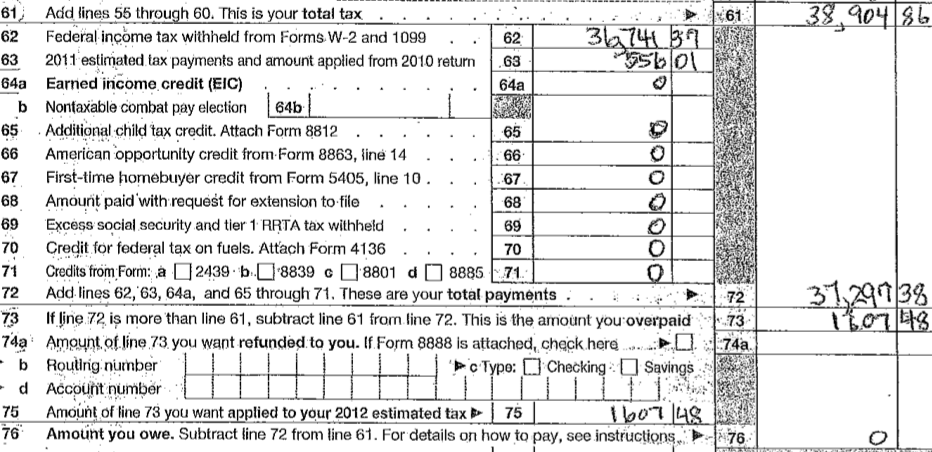
* Gov. Pat Quinn released his income tax returns to the public this week. From a press release…
In addition to his $157,321.60 in salary as Governor in 2011, Governor Quinn reported interest income of $4.81, a taxable refund of $1,222, $18.04 in income from the Foreign Currency Fee litigation settlement fund and a $42,500 withdrawal from his SEP (Simplified Employee Pension Plan).
Governor Quinn paid $38,094.86 in federal income tax and $7,750.73 in state income tax in 2011. Quinn also paid $3,938 in property taxes on his home on the west side of Chicago. The Governor donated $11,562.72 to charity.
With a big hat tip to a reader, check this out. Click the pic for a better view…
OK, we’re going to do a little math here, but stick with me anyway.
The federal tax he reported paying was actually $1,607.48 less than the tax he reported owing. But he looks like he reversed the numbers. Instead of subtracting what he owed from what he paid, which would have given him a negative result, he subtracted what he paid from what he owed, and then asked for a $1,607.48 refund when he actually appears to owe that amount.
* This is really no big deal. Mistakes happen all the time. And he can probably clean this up by filing an amended return.
But it looks like he did his own taxes. Perhaps he needs to realize that he’s just too busy being governor to do this stuff by himself.
I asked the governor’s office for a response and haven’t yet heard back.
* By the way, the income tax hike he signed into law hit Quinn but good…
In 2010, Quinn paid about $4,400 in state taxes, while in 2011 the figure was $7,750.73.
* Audit: IL employee used state investments for personal gain: George Egan, former director of portfolio management for College Illinois!, and others also were given combined bonuses of $176,003 after resigning or being fired. Egan was a partner in a company, which was not identified in the report, that invested $500,000 in the Balestra Capital investment firm at the same time the firm was bidding on a contract with College Illinois!, according to the audit by Illinois Auditor General William Holland.
* A downside to Illinois’ open meetings training: The first time she tried it, she could get in. But after 25 minutes or so, the website froze. So Zohfeld tried again. And again, as she demonstrated last week. “And I’ll tab it and put in my secret password,” Zohfeld said in a jokingly hushed voice. “And [the screen] says, ‘Your login attempt was not successful. Please try again.’ So, let’s try it with a capital T.” That didn’t work either.