Something really needs to be done about SIUC
Wednesday, Jan 30, 2019 - Posted by Rich Miller
* I never would’ve noticed this story if the Daily Egyptian didn’t run a tongue-in-cheek column entitled “8 things more likely to happen than SIU closing campus for weather.” Here’s the all-too-real Number 3…
Have an administration where the majority aren’t interim
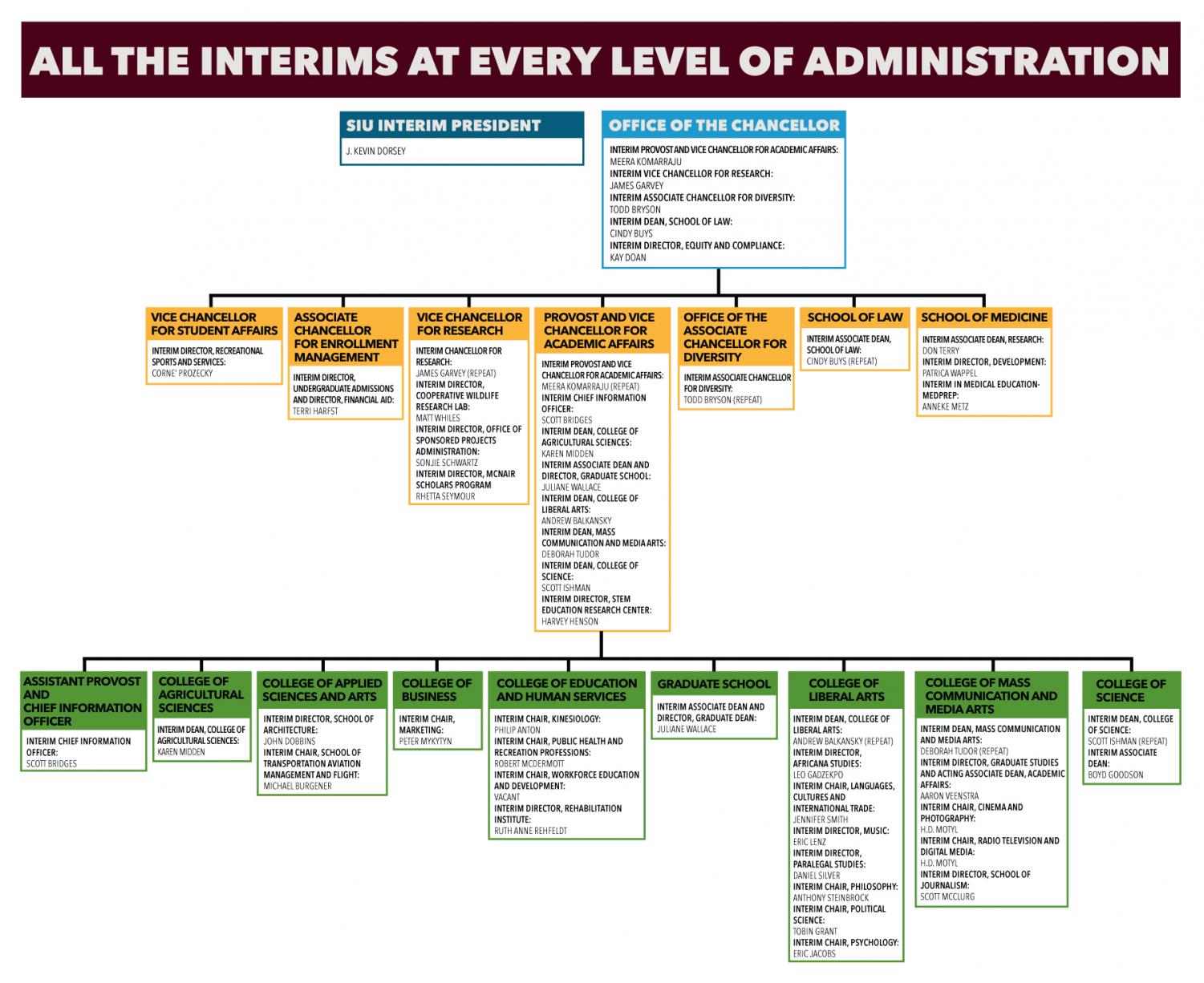
It turns out that 42 administrators at SIU-Carbondale are listed as “interim,” from the president on down. Click here for the chart. It’s insane. And that chart was made before the hiring of SIUC Interim Chancellor John Dunn in December.
* From the paper’s November story…
Southern Illinois University Carbondale currently has 41 employees in interim positions throughout administration, faculty and staff. […]
College of Mass Communication & Media Arts’ acting Associate Dean for Academic Affairs and Interim Director of Graduate Studies Aaron Veenstra said one of the reasons SIU has so many interim positions for administrators is the university lacks hiring power.
If everyone who is interim wanted to hire somebody to be the head of a school, the university would be required to do a national search, Veenstra said.
“But we can’t hire anybody,” he said.
Employees in interim positions of department faculty and administrative staff hold positions that are not permanent, SIU spokesperson Rae Goldsmith said.
“Typically, interim positions are no longer than one year, although we do have a couple now that are multiple years,” Goldsmith said.
That place has lacked any semblance of stability for years. This has to come to an end one way or another.
* Meanwhile…
Southern Illinois University could establish a presence in downtown Springfield under a plan introduced in the legislature today by State Senator Andy Manar.
Manar’s plan (Senate Bill 179) would set aside $50 million in state capital funds for a grant to SIU for costs associated with the construction of a campus and public policy center. The site would have to be within 1 mile of the SIU School of Medicine at 801 N. Rutledge St.
“There is enormous potential in the idea of SIU placing a public policy center steps from the Capitol,” said Manar, a Bunker Hill Democrat and chairman of a key Senate budget committee. “Coupled with a law school or something associated with the medical school, I think SIU could have a significant and lasting impact on downtown Springfield and the capital city at large.”
In March 2018, SIU officials indicated they were interested in putting a satellite law school campus in either downtown Springfield or in Edwardsville. Local officials have discussed the possibility of a higher education presence downtown, possibly on the long-vacant YWCA block just north of the governor’s mansion. The site would be a perfect location for an SIU campus, Manar said.
He also noted that the timing is right for the legislation with discussions about a potential capital bill under way.
“There should be something substantial for Springfield in the capital bill when it happens,” he said.
77 Comments  
|
It’s Time To Put Our Progressive Values Into Action
Wednesday, Jan 30, 2019 - Posted by Advertising Department
[The following is a paid advertisement.]
Illinois progressives ran, organized, voted, and won in 2018. Now it’s time to lead. Our victories this election showed there is strong support across Illinois for a bold, progressive agenda and leaders who can turn that agenda into action. We have the power to make Illinois a state that leads the nation on committing to 100% clean, renewable energy, reducing gun violence to keep our communities safe, expanding abortion access to all no matter where they live, their income or age. Working together, we can move Illinois forward on these issues and more — from workers’ and immigrant rights to criminal justice reform, LGBTQ equality, and affordable healthcare. We are one in the fight to build a state where all people can raise families in healthy, safe communities, with dignity and justice.
Forward Illinois is a coalition of leading progressive organizations representing more than 500,000 member-activists. Our work to mobilize voters around the progressive issues that impact us all didn’t end on Election Day. Now we’re taking our fight from the ballot box to the steps of our state Capitol to demand action. Learn more and join the fight at www.forwardillinois.com.
Comments Off
|
* Background on this crazy idea is here if you need it. From Lynda Lopez at Streets Blog Chicago…
Frigid temperatures hit Chicago this weekend, but that didn’t stop people from packing the National Association of Letter Carriers Union Hall for the Transit 4 All mayoral forum last Sunday. The Transit 4 All title refers to a campaign organized by the workers’ rights coalition Chicago Jobs With Justice, meant to transform Chicago transportation. Moderating the forum was Phil Rogers, an NBC5 reporter. […]
Candidates were also asked whether they support Elon Musk’s O’Hare Express proposal. Most, if not all, do not. “If we are going to make public transit investments, it should be to CTA and Metra,” Preckinkle said, noting the need to prioritize the Red Line extension to 130th Street and the creation of a universal fare card.
Chico didn’t hold back in his disdain for the O’hare project. “It’s going to die on its own. This thing is goofy,” he said.
Ford said that the project reflects the current mayor tendency to cater to the elite, and that we should instead be asking developers to invest in the local economy to help communities. Wilson echoed this sentiment.
“I’d kill it,” said Vallas about the O’Hare project. “I can’t wait to kill it.”
19 Comments
|
Question of the day
Wednesday, Jan 30, 2019 - Posted by Rich Miller
* SJ-R…
Springfield tied a low-temperature record Wednesday morning as the thermometer at Abraham Lincoln Capital Airport bottomed out at 14 below zero.
The official National Weather Service reading, taken between 5 and 8 a.m., tied the record for the lowest temperature recorded on a Jan. 30 in Springfield. It also got down to minus 14 on Jan. 30, 2004.
The city on Wednesday is likely to break the record for the coldest high temperature ever recorded on Jan. 30. The current record is 3 degrees, set in 2004. The predicted high temperature on Wednesday is expected to be 4 below zero.
* Tribune…
There’s a low of minus 8 degrees Wednesday at the South Pole, a few degrees above what suburban areas could see.
Barrow, Alaska, the northernmost town in the U.S., was about 9 below zero Wednesday morning.
Greenland’s capital Nuuk will have a high of about 18 degrees Wednesday, almost 35 degrees warmer than Chicago’s Wednesday highs of 10 to 15 below. […]
On Mars, the high will be almost 35 degrees warmer than Chicago, at around 19 degrees, according to NASA. But the low will be about 99 degrees below zero at night.
I ran the water in some of my faucets overnight, but one of my showers isn’t working, so I’m really bummed. My handyman advised me not to leave my house in case the pipe bursts, but I have session today, so I’m still deciding what to do.
* The Question: How are you and yours dealing with the cold?
52 Comments
|
* September of last year…
A surge in the construction of Chicago-area data centers has ballooned the industry’s regional vacancy rate from 2 percent to 11 percent since last year.
Pushed by businesses’ growing demand for cloud-computing storage, developers built almost 57 megawatts of capacity — enough to power more than 16,000 homes — around the metro area since last year, according to CBRE data reported in Crain’s. That’s about twice the region’s typical annual pace of data center construction.
Digital Realty accounted for the bulk of the expansion when it built a 305,000-square-foot data center in Elk Grove Village in fall 2018, adding about 29 megawatts of capacity. And ComEd broke ground last year on an expansion to its substation in Itasca, aiming to add 180 megawatts of capacity by the end of 2019.
* And now…
Illinois should offer financial incentives to get companies to build big data centers here, says a report released Friday by the Illinois Chamber of Commerce Foundation.
Otherwise, it will continue to miss out as centers build in states that do — including neighboring Iowa, where Apple is getting a $208 million break on local and state taxes for a $1.3 billion facility it is building.
ICC President Todd Maisch, speaking to business and civic leaders in Aurora, likened it to the value of railroad development in the 19th century or highways in the 20th century.
“This is that important. It is a growing market. Illinois is growing in this area, but we don’t get nearly enough of what we should get based on our history and based on the economic potential of our state,” he said.
They’re already building huge data centers. The problem is the customer base.
The study, by the way, is here.
* Tribune…
The only markets in the country with more data center capacity – measured in megawatts — than the Chicago area are Northern Virginia, home to many of Amazon’s data centers, and the Dallas-Fort Worth area, according to information from real estate firm CBRE. But Northern Virginia’s market is much larger and growing much quicker.
The Chicago market is 40 percent smaller than the Northern Virginia market, which grew 16 percent between June 2017 and June 2018, according to the Illinois chamber report. The Chicago market grew only 7 percent during that time.
Chicago developed as an attractive market for data centers for the same reason it became a hub for railroads: its central location. Much of the fiber optic cable the internet runs on was laid along railroad tracks, and Chicago acted as the connector between east and west. Plus, the city has reliable electricity and isn’t at risk for the hurricanes or earthquakes that threaten the coasts.
27 Comments
|
Let’s just squash this idea once and for all
Wednesday, Jan 30, 2019 - Posted by Rich Miller
* Charles Selle at the Lake County Sun…
But suppose Gov. Sunbeam indeed turns Illinois around, as he has promised, in the next two years? Using new revenue enhancements, like the fees gun shop owners will pay for the new state gun licenses they will need if they want to stay in business in Illinois. Or more casinos and a marijuana tax. And, don’t forget taxing the rich and even cutting expenditures.
Dragging the Venezuela of the Midwest flush into the next decade could make Pritzker a possible presidential candidate, or at least fodder for those inside-the-beltway folks. Stranger things have happened in Illinois. Most of us know about the freshman Illinois senator by the name of Barack Obama who became presidential timber.
Already there are a half-dozen Democrats ready to take on President Trump next year. Filing for the state’s beauty contest and convention delegate candidates is set for December unless changed by the legislature. […]
By January 2020, Pritzker will have a year of governing under his belt. We’ll see if his outlook for Illinois remains bright and he becomes a turnaround specialist. If so, he could become the leader of the sizeable Democrat presidential pack.
Hilarious.
I cannot figure out if he’s serious or if he’s setting the bar so high for Pritzker that it’ll be easier to knock the new governor down if it doesn’t happen. “Pritzker doesn’t live up to expectations - Illinois still Venezuela of the Midwest” or something.
Look, Barack Obama officially kicked off his presidential bid on February 10, 2007, more than two years after being sworn in to the US Senate. The comparable kickoff date for this presidential cycle would be 11 days from now, just 27 days after Pritzker was sworn in as governor.
Not gonna happen. Not even worth discussing. I should probably turn off comments.
48 Comments
|
The perils of specialization
Wednesday, Jan 30, 2019 - Posted by Rich Miller
* Mayor Emanuel did to City Colleges what former Gov. Rauner wanted to do to public universities…
Under Emanuel’s [2011] “Reinvention” plan, each City College would become a “center of excellence” in a particular field.
Enrollment is down 32 percent.
* As the article notes, there are likely several reasons for this enrollment drop, but here’s one…
When programs that used to be down the block were moved across the city, professors said many students couldn’t follow them. […]
He points to enrollment in Malcolm X’s nursing program as proof. Nursing enrollment dropped 70 percent between 2010 and 2018, from 1,218 to 376 students. Overall, enrollment dropped by 29 percent at Malcolm X, despite a new $250 million campus.
At Truman College, chemistry professor Mohamed El-Maazawi remembers a thriving nursing program. But since it moved to Malcolm X his classes have gotten smaller. Instead of following the nursing program to the Near West Side, some students told him they’ve stopped going. Some have transferred to more expensive four-year schools. He said Reinvention made City Colleges forget who community colleges are supposed to serve.
28 Comments
|
* Reuters…
Foxconn Technology Group is reconsidering plans to make advanced liquid crystal display panels at a $10 billion Wisconsin campus, and said it intends to hire mostly engineers and researchers rather than the manufacturing workforce the project originally promised. […]
[Louis Woo, special assistant to Foxconn Chief Executive Terry Gou, told Reuters] the company was still evaluating options for Wisconsin, but cited the steep cost of making advanced TV screens in the United States, where labor expenses are comparatively high. […]
Rather than a focus on LCD manufacturing, Foxconn wants to create a “technology hub” in Wisconsin that would largely consist of research facilities along with packaging and assembly operations, Woo said. It would also produce specialized tech products for industrial, healthcare, and professional applications, he added. […]
“In Wisconsin we’re not building a factory. You can’t use a factory to view our Wisconsin investment,” Woo said.
Earlier this month, Foxconn, a major supplier to Apple Inc., reiterated its intention to create 13,000 jobs in Wisconsin, but said it had slowed its pace of hiring. The company initially said it expected to employ about 5,200 people by the end of 2020; a company source said that figure now looks likely to be closer to 1,000 workers.
OK, so how are they gonna convince all those techies to live in the middle of nowhere Wisconsin? Those folks are gravitating to cities like Chicago.
* What a mess…
On Friday, The Wall Street Journal reported that the company “fell short of the minimum number of jobs it was required to create in 2018 to claim state-job creation tax credits.” The Wisconsin Economic Development Corp says that the company needed to create 260 full-time jobs, but only created 178. As a result, the company won’t receive tax credits for 2018. The WSJ cites the state’s low employment rate as a factor for the slow hiring, and notes that the company could earn $19.1 million in tax credits if it passes its hiring goal of 2,080 jobs this year. The company denied reports last November that it had been looking to bring in workers from China to bolster its workforce.
* More…
First, roughly half the Wisconsin taxpayer money is guaranteed whether or not Foxconn ever hires anyone. And second, even if the company’s dramatic re-imagining of the project does shrink the total that taxpayers will pay, it will likely prolong rather than shrink the 25-year optimistic timeline for recouping the state’s expenses here, as the Milwaukee Independent explained on the one-year anniversary of the deal’s formal passage through the state legislature.
I wonder if the Tribune editorial board still thinks this was a good idea.
72 Comments
|
Schillerstrom, Brooks resign tollway seats
Wednesday, Jan 30, 2019 - Posted by Rich Miller
* Daily Herald…
A pivotal figure at the Illinois tollway for the last four years has resigned amid scrutiny of the agency and a legislative push to clean house.
Chairman Robert Schillerstrom has submitted his resignation, a tollway spokesman said Monday.
Schillerstrom, former DuPage County chairman, spearheaded a massive expansion of the Central Tri-State Tollway (I-294), a controversial study of extending Route 53 north into Lake County, and the ongoing extension of Route 390 to O’Hare International Airport.
But a series of Daily Herald reports about the tollway board hiring individuals and firms with political or personal connections led to state Senate scrutiny this summer and drew censure from new Democratic Gov. J.B. Pritzker. […]
The Rev. Corey Brooks, a tollway director, also resigned, officials said.
You’ll recall that the General Assembly passed legislation to immediately get rid of all tollway directors. The governor has yet to sign the bill. I assume he’s waiting to line up new directors before he signs the bill.
25 Comments
|
“Prohibition plain just does not work”
Wednesday, Jan 30, 2019 - Posted by Rich Miller
* Rep. Kelly Cassidy (D-Chicago) on legalizing cannabis…
The proposal would also allow municipalities to opt out of the program, which means they could prohibit dispensaries from setting up shop within city limits. They can’t restrict residents from privately using the product, though. Localities would also be allowed to add an additional tax. However, the bill would cap how high that tax can be so it does not drive residents back to an illicit market.
“When we went out to Colorado, we met with the Boulder County District Attorney and he told us a cautionary tale that we’ve carried with us ever since,” said Cassidy. “His county, relatively affluent, not a lot of fiscal pressure there, they didn’t add a local tax. And they saw their illicit market all but disappear. In neighboring Pueblo County, a community with some significant fiscal challenges, they put the maximum tax on that they could and their illicit market grew.” […]
In terms of the tax dollars, Cassidy and Steans are still negotiating the “optimal tax strategy.” Recognizing that conversations about recreational cannabis almost always include talk of added revenue for the cash-strapped state, Cassidy said they are not creating the program to make money.
“Step one is ending prohibition, undoing the harm of the war on drugs, and then there will be revenue,” she said. “Estimates are $350 to $700 million. Put a pin somewhere in the middle, let’s say $500 million. That’s nothing to sneeze at, but it’s not the ‘why.’ It’s not the reason.” […]
“If a teen is caught drinking, their license can be taken away from them until they’re 21,” said Steans. “Right now, that’s not in place for cannabis. If a teen is caught smoking cannabis, they don’t lose their license. We’re going to change that in the bill. If they are found smoking, their license will be taken away until they’re 21.”
* And Sen. Heather Steans (D-Chicago) tells WBEZ why she supports legalizing cannabis use…
When I first got into the legislature, we were just starting to debate medical cannabis programs. … As I sort of had to start studying and learning about it to decide how I was going to vote on that, it came to me that prohibition plain just does not work, and that we really should be trying to go to a different structure overall around cannabis. I don’t think prohibition keeps it out of the hands of folks. In Illinois, you have 800,000 people who use cannabis on a regular basis. Ninety-eight percent are buying it from the illegal market. You don’t know what you’re buying. … [With legalization,] you can get a safe product. You know what you’re getting, and it gets out of the hands of teens a lot better when you do it in a regulated fashion. I just think it’s better policy.
54 Comments
|
More to come?
Wednesday, Jan 30, 2019 - Posted by Rich Miller
* I told subscribers about this earlier today, but here’s Greg Hinz…
Mike Madigan says he did nothing wrong. But the news that he was taped by Ald. Danny Solis, 25th, as part of a federal corruption probe is providing another stunning shock to Illinois politics and further roiling an already unpredictable race for mayor.
In separate statements, both Madigan and his longtime private attorney, Heather Wier Vaught, dismissed allegations in a Chicago Sun-Times report that Solis arranged a meeting with a zoning applicant who needed Solis’ backing for a Chinatown hotel project. Solis reportedly told the developer that hiring Madigan’s law firm to handle property tax appeals would clear the way for the zoning approval, but though the zoning was secured, Madigan’s firm was not retained and the hotel never was built. […]
From what I’m hearing, there’s lots more to come out on the speaker. Today’s news was colorful, but arguably not incriminating. Later developments could be of more legal significance.
Stay tuned.
30 Comments
|
Sun-Times fingers mole
Wednesday, Jan 30, 2019 - Posted by Rich Miller
* Mark Brown, Fran Spielman, Tim Novak and Jon Seidel…
See Y. Wong was a small-time developer with big dreams for reshaping Chinatown until his ambitious projects hit the skids in the last real estate recession.
Several projects failed. Investors lost their money. Lawsuits piled up, and some of Wong’s activities came to the attention of federal authorities.
By the spring of 2014, Wong was back with a more modest project, trying to help Chinese businessman Kin Kuong Chong build a 60-room hotel on a small patch of land on the northwest corner of Clark and Archer.
It was then that Wong agreed to co-operate in a federal investigation of Ald. Danny Solis (25th), according to a court document obtained by the Sun-Times.
Just three months later, Wong made an undercover recording of Solis with House Speaker Michael Madigan as they discussed whether the hotel developer would hire Madigan’s law firm to handle its real estate tax work. At the time, Wong was helping the developer seek a zoning change from the City Council Zoning Committee chaired by Solis, who allegedly steered them to Madigan.
Go read the whole thing.
13 Comments
|
|
Comments Off
|
|
 Support CapitolFax.com
Visit our advertisers...

 ...............
 ...............
 ...............


|
   
|
Hosted by MCS |
SUBSCRIBE to Capitol Fax |
Advertise Here |
Mobile Version |
Contact Rich Miller
|