Rauner is Rauner to the end
Friday, Jan 11, 2019 - Posted by Rich Miller
* HB 4637 was reportedly sent to Gov. Rauner by mistake. It was supposed to be held until JB Pritzker took over. Oops…
Today, I return House Bill 4637 of the 100th General Assembly with specific recommendations for change.
This legislation amends the process by which townships in McHenry County may be dissolved in an effort to consolidate and reduce Illinois’ excessive layers of local government.
While I applaud the effort to create a clear process that aligns with the Illinois Constitution’s vision that townships may be dissolved if approved by referendum, this is a process that should be available with equal clarity across the state.
This legislation also mandates the abolition of certain road districts in Lake and McHenry County. This question of consolidating services should also go to the voters through a referendum, a process that Lake and McHenry County—and all other counties—can already pursue under state law.
Therefore, pursuant to Section 9(e) of Article IV of the Illinois Constitution of 1970, I hereby return House Bill 4637, entitled “AN ACT concerning local government,” with the following specific recommendations for change:
He goes out the way he came in: Refusing to accept incremental change.
* From the bill’s sponsor, Rep. David McSweeney (R-Barrington Hills)…
Failed Governor and hypocrite Bruce Rauner showed his true colors again by vetoing my bill that would consolidate unnecessary levels of government and cut property taxes. The people of Illinois rejected phony, incompetent Raunerism in a landslide. Bruce Rauner leaves office with zero accomplishments and is widely regarded as the worst Governor in the history of Illinois. Good riddance to Rauner and his endless stream of lies! I look forward to passing my bill again during this General Assembly.
* This bill passed both chambers without a single “No” vote…
Today, I veto House Bill 982 from the 100th General Assembly, which would amend the process for filling a vacancy in the office of the President of the Cook County Board.
The legislation creates and amends a special set of conditions if the office of Cook County Board President is vacated, specifically during or after the period for filing nomination papers for the primary election. This process differs from that in place for any other elective county offices in the rest of the state. This is another example of special rules being legislated for certain parts of the state without compelling justification, while not applying those same rules to the rest of the state. We should seek more consistency in how state law regulates local governments, and less special legislation that addresses local concerns on an ad hoc, case-by-case basis.
Therefore, pursuant to Section 9(b) of Article IV of the Illinois Constitution of 1970, I hereby return House Bill 982, entitled “AN ACT concerning government,” with the foregoing objections, vetoed in its entirety.
He also vetoed HB200, HB5769 and SB938, which all passed both chambers on unanimous rollcalls. SB426 passed the Senate unanimously and just four House members voted against it, but he vetoed it.
All these vetoed bills are now dead because the 101st GA can’t override vetoes of bills passed by the 100th GA.
…Adding… In an apparent last-minute resume sweetener, the governor just appointed DCEO’s Chief Operating Office Travis March to be Acting Director of the agency.
…Adding… He also just appointed Jessica Baer, Director of the Division of Professional Regulation, to Acting Secretary of the Illinois Department of Financial and Professional Regulation. Her appointment is official come Monday, just before Pritzker is sworn in. She replaces Secretary Bryan Schneider.
14 Comments  
|
Question of the day
Friday, Jan 11, 2019 - Posted by Rich Miller
* If you watch the video, he has a somewhat tortured response, but I think it’s probably safe to say that he’s more than just “open” to a gas tax hike…
* The Question: Should the gas tax be increased to pay for a new infrastructure program? Take the poll and then explain your answer in comments, please (and if you vote “No,” explain how the program should be funded)…
survey services
34 Comments
|
* The Tribune has a profile up about new Democratic US Rep. Lauren Underwood. Excerpt…
Republicans are lining up to challenge Underwood. Matt Quigley, a 32-year-old Navy veteran and Republican from Naperville, already has announced his intention to run in 2020.
State Sen. Jim Oberweis, a Sugar Grove Republican who has run for Congress, Senate and governor before, also is considering a bid. He said, “We’re giving it serious thought, yes.”
“I don’t believe that Underwood represents the views of the majority of the people in the 14th Congressional District,” said the dairy magnate, who said he would make a decision in 30 to 60 days. “I believe I would be much closer to those views.”
Underwood beat a sitting Republican congressman by 5 points last November. She’s no slouch. And Oberweis will be a 74-year-old “career politician” (or, at least, “career candidate”) by 2020 with a whole lot of votes under his belt.
Even so, Gov. Bruce Rauner won the 14th CD by almost 8 points. The only statewide Democrats who won it were Jesse White (+23) and Susana Mendoza (+2).
Other possibles include state Rep. Allen Skillicorn (R-East Dundee), which could be why he’s been holding so many press conferences lately. Plenty of rumors about a few others.
27 Comments
|
* Out of curiosity, I pulled out my copy of the 1991-92 Blue Book today and turned to the Illinois Legislative Correspondents Association’s chapter. The ILCA had 44 members back then. All but eight or so (Chicago-based reporters) were stationed at the Statehouse. These days, the Statehouse press room is almost empty.
The Illinois Press Association’s foundation has decided that something needs to be done. From a press release…
Capitol News Illinois, the Illinois Press Foundation’s news service providing state government coverage to Illinois newspapers, has hired three full-time reporters for its launch Jan. 28.
Rebecca Anzel, Peter Hancock and Jerry Nowicki have been hired as reporters for Capitol News Service Illinois. Grant Morgan will work full-time this spring as an intern. IPF Director Jeff Rogers will serve as the Capitol News Illinois bureau chief.
Rebecca Anzel joined the Capitol News Illinois reporting team on Jan. 7. Anzel previously reported from the Chicago Daily Law Bulletin’s Statehouse bureau, where she pitched, reported and wrote pieces on state government, covering legislative efforts, committee hearings, courts and lawmakers for Illinois’ legal community. She earned her master’s degree in Public Affairs Reporting from the University of Illinois Springfield, and is a graduate of Stony Brook University’s School of Journalism on Long Island, New York, where she focused on multimedia techniques.
Peter Hancock will join the Capitol News Illinois reporting team on Jan. 21. Hancock has covered Kansas state government for much of the past two decades. For the past 4 years, Hancock has been the statehouse reporter for the Lawrence Journal-World. He provided year-round daily coverage of the Kansas Statehouse, state government, appellate courts, elections and Kansas’ congressional delegation. He previously worked for 8 years as a statehouse reporter for Kansas Public Radio, and with the Kansas Health Policy Authority and the Kansas Education Policy Report.
Jerry Nowicki joined the Illinois Press Foundation’s reporting team on Jan. 2. He is the former editor of the LeRoy Farmer City Press, which won the 2016 David B. Kramer Memorial Trophy for Illinois’ best small weekly newspaper. For the past 2 years, he served as a legislative aide to state Sen. Steve Landek. He grew up in Chicago’s southwest suburbs, has lived in five Illinois counties and now resides in Springfield. He has a bachelor’s degree in journalism from Illinois State University and will obtain his master’s degree in communication from Purdue University in May 2019.
Grant Morgan began his internship with Capitol News Illinois on Jan. 7. He is an Ohio native and holds a bachelor’s degree in philosophy, political science, economics and English from The University of Akron. There, he worked for 4 years at his student newspaper, including a stint as editor-in-chief.
“I am excited about the news team we have hired, and we’re eager to get to work,” Rogers said. “There’s a good mix of youth and experience, and they all share a passion for the Foundation’s mission with the news service, which is to bolster a Statehouse press corps that has been significantly depleted over time.”
The Capitol News Illinois news team will begin providing daily coverage of state government on Jan. 28, when the schedule for General Assembly sessions picks up in pace. Content (stories, photos, video and audio recordings, and newspaper graphics) will be made available on a Capitol News Illinois website, which the Foundation is working with a local third-party provider to develop. Member newspapers will be able to access content on the website with a username and password.
Capitol News Illinois plans to provide not only daily content, but also coverage of state government tailored for the 300-plus weekly newspapers that are IPA members. Coverage emphasis will be placed on legislative sessions, committee hearings, state agencies and the Supreme Court.
As the Capitol News Illinois team prepares for the official launch, reporters will work on stories about the General Assembly’s new lawmakers. Those stories will be emailed to each member newspaper in the lawmaker’s district over the next few days and weeks.
Welcome!
Hopefully, newspapers throughout the state will take full advantage of this service.
12 Comments
|
* I watched the first two episodes of this series and it was a nauseating, shocking experience. Sun-Times editorial…
If there’s a radio station in Chicago still playing R. Kelly’s music, shame on them.
If there’s a concert venue still willing to book him, shame on them, too.
They are turning a blind eye to the abundant evidence of Kelly’s sexual pursuit and abuse of underage girls.
“Surviving R. Kelly,” the 3-part documentary seen last week by an estimated 1.9 million viewers, laid it all out in explicit, harrowing details recounted by some of the survivors of Kelly’s abuse, including his ex-wife.
* Today…
Chicago’s 95.1 FM Clubsteppin station will no longer play any music by R.Kelly because of the controversy that resurfaced after Lifetime’s “Surviving R. Kelly” documentary series.
* Other stories if you’re not up to speed…
* Eye-opening R. Kelly documentary on Lifetime an ‘uneasy’ must-watch: “I want my story to be heard so people can take the situation seriously,” says Lisa Van Allen, one of Kelly’s former love interests, who first hooked up with him when she was 17. The series does just that, presenting credible, firsthand accounts of years of alleged abuse against young girls and women by Kelly, a Chicago native. According to several subjects, the singer and his entourage purposefully scoped out Kenwood Academy High School girls at a Hyde Park McDonald’s.
* The timeline of the R. Kelly child pornography case
* At least 2 women contact Cook County prosecutors with new R. Kelly allegations: One woman, who’s originally from Georgia, said that Kelly engaged in inappropriate conduct with her at his rented warehouse/studio space in 2002. She said she ran away from home in Georgia, met Kelly in Florida and eventually came back to Chicago with him.
* R. Kelly ordered to allow inspectors inside rented warehouse
* After ‘Surviving R Kelly,’ the #MuteRKelly movement gains momentum
* Lady Gaga apologizes for ‘poor judgment’ over R. Kelly song; stands with victims
* Chance the Rapper apologizes for ‘taking this long to speak out’ about R. Kelly
* Georgia prosecutor seeking info about R. Kelly, lawyer says
* Instagram post linked to R. Kelly’s daughter blasts performer: In the IG post, Buku Abi says she is “devastated” over “everything that is going on right now” and offered support to alleged victims. “I pray for all the families … that have been affected by my father’s actions.”
* ‘Surviving R. Kelly’ leads to spike in sales, streams for the singer
* And now this from WICS TV…
An organizer is selling tickets for Springfield Spring Break Jam, hosted by R. Kelly at the expo center on April 6, 2019.
But after allegations have come up against the R&B singer R. Kelly, it is unclear if the concert will go on as planned.
The Department of Agriculture confirmed organizers submitted an application for the Springfield Spring Break Jam, but said the application is still under review.
Officials said there are 13 factors they consider when reviewing an application for a concert.
That is the same State Fair Exposition Center where JB Pritzker’s inaugural ball will be held.
The Illinois Department of Agriculture needs to find a way to cancel this show. Period.
*** UPDATE 1 *** The person who runs Kity Promotions, which is putting on the show just told me via Facebook messenger that R Kelly “will not be performing,” at the concert.
*** UPDATE 2 *** From the Department of Ag…
Hey Rich! Just want to make a couple clarifications on the R. Kelly story – the event organizers submitted an application to lease space on the Illinois State Fairgrounds to host a concert featuring R. Kelly. However, that application was under review until yesterday, at which point IDOA staff contacted the organizer to let them know their application would not be approved. IDOA’s Administrative Code outlines 13 criteria that applicants must meet to lease space (ftp://www.ilga.gov/JCAR/AdminCode/008/008002700J04950R.html) and in this case, the event did not meet criteria C, E, and G.
Unfortunately, we cannot control when organizers start promoting an event – in this case, there was never a signed agreement to host the event at the Illinois State Fairgrounds, only an application.
17 Comments
|
Unclear on the concept
Friday, Jan 11, 2019 - Posted by Rich Miller
* Kyla Asbury at Prairie State Wire…
State Sen. John Cullerton (D-Chicago) was re-elected president of the Illinois State Senate on Wednesday.
Cullerton has held the office since 2009. Illinois Supreme Court Justice Mary Jane Theis administered the oath of office to Cullerton after the vote. Cullerton defeated State Sen. Bill Brady (R-Bloomington) 39-18. […]
Cullerton added that Brady would be a great minority leader.
Cullerton didn’t say Brady would be a “great” minority leader.
* From Cullerton’s prepared remarks…
To leader Brady, congratulations. The Republican caucus chose wisely in turning to you for leadership.
You’re going to be — and I really mean this — … a super … minority leader these next two years.
A “super minority leader.” Get it? The Senate Republicans are in the super-minority? It was a joke! Is this thing on? Hello?
10 Comments
|
* Mitchell starts a new job as deputy governor on Monday…
January 11, 2019
Mr. Speaker,
I’m writing this letter to tender my resignation from the Illinois House of Representatives, effective immediately.
Serving in the Illinois House has been one of the honors of my life, an honor bestowed upon me by the residents of the 26th District on three separate occasions. During the time I was fortunate enough to spend as a Member, we passed historic education funding reform, expanded Medicaid coverage to more Illinoisans, expanded background checks to cover private handgun sales, and extended the legal right to all Illinoisans to marry the person that they love. I am grateful to have had the opportunity to work with my colleagues in the General Assembly on behalf of my constituents in the 26th District, as well as the people of our great State.
We’ve endured a difficult time in the past four years, and have much to rebuild in our State: our roads and bridges, our neglected universities, our frayed social safety net, and perhaps most importantly, the trust of the people of Illinois that government is on the side of working people and those who are in need. As I move into a different branch of government, I look forward to working with all of my colleagues, friends and others in and around the legislature to restore the promise of Illinois for its citizens of today and for generations to come.
Sincerely,
State Representative Christian Mitchell
20 Comments
|
Oh, the humanity!
Friday, Jan 11, 2019 - Posted by Rich Miller
* JB Pritzker’s campaign manager and incoming chief of staff…
I’d earlier sent her a screen cap of a comment on that post which had been auto-moderated…
This is more proof that feminist do not care about men. Feminist love to complain when men dominate things. Yet, when women dominate things they cheer (see above comments)! That is the definition of hypocrisy. If feminist cared about equality, they’d be outraged that this list is 87.5% female, just like they would be if the list was 87.5% male. Feminist do not care about equality. Instead, what they care about is advancing women and the expense of me.
Sheesh.
But this was my favorite comeback of the day…
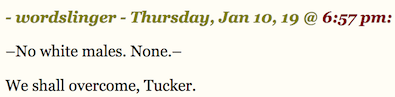
And that, my friends, is just one more reason why there’s an award named after Wordslinger.
As I said at my City Club speech and told my subscribers in November, white men, as a group, lost this election. Some of them obviously ain’t happy about it.
* But yesterday was just one day of announcements. There have been several such lists released and lots more are on the way. Hannah Meisel at the Daily Line did the math to date…
Pritzker has tapped 12 women and seven men so far. While Pritzker’s three deputy governors — former Comptroller Dan Hynes, Drinker Biddle & Reath LLP partner and former attorney general candidate Jesse Ruiz and State Rep. Christian Mitchell (D-Chicago) — are men, Pritzker’s inner circle will be made up of women. […]
Pritzker’s vast transition team and numerous committees ended up being 37.5 percent female, mirroring the approximate number of women in the legislature sworn in on Wednesday. […]
The a little more than half of the 19 people Pritzker has appointed so far are white, but the governor-elect said in the closing weeks of the governor’s race that it would be his “goal” if elected to have a cabinet and boards that mirror the diversity of Illinois.
Illinois is one of the nation’s most diverse states. According to the latest stats available from the U.S. Census Bureau, the people of Illinois were 61.3 percent white, 17.3 Hispanic, 14.6 percent black, and 5.7 percent Asian.
23 Comments
|
* I told subscribers about this earlier today. Tribune…
Billionaire Democratic Gov.-elect J.B. Pritzker, who pumped more than $171 million of his own wealth into his campaign to defeat Republican Gov. Bruce Rauner in November, now will use his own money to bolster his top government aides’ salaries, his transition team reported Friday.
Pritzker’s incoming Chief of Staff Anne Caprara will be paid a salary of $298,000 — $148,000 in state money and $150,000 more from East Jackson Street LLC, an organization Pritzker set up to “enable the governor-elect to personally compensate some staff in addition to their government salary,” a spokeswoman said in a statement.
Rauner’s chief, by comparison, made $180,000 in 2018, according to state records. […]
Pritzker’s transition pointed to former New York City mayor and fellow billionaire Michael Bloomberg supplementing his staff’s pay with his own money. The transition says Pritzker’s move means some aides will have lower taxpayer-funded salaries than Rauner’s, and they’ll have to report the supplemental income on ethics forms.
* Sun-Times…
The double salary will be apply to Pritzker’s chief of staff Anne Caprara, his three deputy governors Dan Hynes, Christian Mitchell and Jesse Ruiz and their special assistants, deputy chiefs of staff and other high-level employees. It will apply to 20 positions, including some that have not been filled. […]
The deputy governors will make $278,000: $139,000 each from the state and the LLC. Senior adviser Nikki Budzinski will make the same.
His deputy chiefs of staff, including Emily Bittner, who will run his communications staff, will make $174,000 and Abudayyeh, his press secretary, will have her state salary of $75,000 doubled to $150,000. […]
Staff who receive the additional pay will be required to publicly report it in line with other public disclosures.
* Press release…
The Governor-Elect is committed to recruiting top talent to state government to best address the challenges Illinois faces. As a result, an LLC has been created that will enable the Governor-Elect to personally compensate some staff in addition to their government salary, reducing the cost to taxpayers. This process will take place in a transparent manner with requirements that information be reported publicly.
Subscribers know more, but the Pritzker transition claims he will not take any tax deductions on the supplemental payments.
* Two former Raunerites told me the same thing earlier today…
*** UPDATE *** AFSCME…
115 Comments
|
* Eric Zorn…
Rauner pointed to some small-bore achievements during his farewell appearance Thursday before the Tribune Editorial Board — improvements in the criminal justice system and funding help for charter and private schools — but he didn’t come close to backing up his parting boast, “I’ll put our track record of accomplishment up against any governor in the U.S. in the last four years. And I will especially love to put it up against any governor who had an opposing legislature dominated by a supermajority and then a majority from the other party.”
I couldn’t help but think of the actual track record of accomplishment he might have had if he hadn’t chosen to relentlessly accuse Democratic legislative leaders of being crooked and corrupt when he needed their respect and cooperation to begin to advance his agenda.
I couldn’t help but think of the incremental but meaningful compromise advances for businesses and taxpayers Rauner might have pushed through had he understood that his narrow victory over unpopular Democratic incumbent Pat Quinn in 2014 gave him a bully pulpit and an opportunity, not a crown.
I couldn’t help but think of the appeal Rauner could have made to voters last fall — “I’m a moderating, common-sense voice of reason and a check on Democratic power” — if he hadn’t stubbornly, recklessly refused to negotiate a state budget unless the General Assembly knuckled under to his anti-union demands.
I don’t disagree, but Rauner is who he is, and that’s not who he portrayed himself to be in 2014. He ran as a businessman technocrat who would shake up Springfield and fix the state’s many problems. But that was just an act, a ploy to win the election. Rauner basically admitted as much during a recent press conference…
That said, if you’re gonna be a moderate to win elections, but you’re not going to be a reformer and fix the problems, what’s the point of winning?… If you’re gonna moderate to win and then do the same thing that the guy or gal that you were running against would do, what’s the point?
He was talking about Jim Edgar there. Rauner presumed that, like himself, the former governor campaigned as a “moderate” merely to win. But Edgar was usually just what he said he was (even though he did adopt Dawn Clark Netsch’s property tax swap after blasting her for it). Rauner was a “my way or the highway” anti-union zealot who campaigned as a moderate in order to win.
To this very day, Rauner claims he’s pro-union. It’s a completely laughable claim after a two-year impasse almost purely caused by his demand that the Democrats help him achieve his life goals of destroying most union powers and obliterating most collective bargaining rights for union members, but that’s just his “moderate” messaging kicking in and he’ll stick with it forever.
37 Comments
|
* From a Crain’s Chicago Business editorial, which is partially about Ald. Ed Burke and his property tax appeals business…
This is why outgoing Gov. Bruce Rauner, for all his faults, wasn’t wrong to advocate for term limits and to suggest that House Speaker Michael Madigan’s day job, like Burke’s, presents such a clear conflict of interest to his role as a public servant that it defies logic. In fact, it is well past time for it to be illegal to do what Burke and Madigan have done for decades—handling property tax appeals for businesses standing to benefit from or be harmed by government actions.
If the city or state were on autopilot, with finances in good shape, it might not matter so much. But with job one for both the newly elected governor and soon-to-be-elected mayor being to fix the city and state’s fiscal house—which likely involves overhauling state and city tax frameworks—they first ought to tackle the ethics issues and conflicts of interest highlighted in the Burke case once and for all.
If our elected leaders are going to go for the type of grand bargain that seems required—more taxes, fewer services—they should offer taxpayers something in return, like good government, or at least better government.
Incoming Gov. J.B. Pritzker would earn goodwill from both parties if he targeted what has now been shown in the starkest manner possible to be indefensible: the ability to represent businesses on their property tax appeals and hold immensely powerful political offices. Start there. It’s a no-brainer.
Regardless of the merits, I’m kinda thinking that if Pritzker wants to get big things done, trying to put Madigan & Getzendanner out of business right out of the gate probably wouldn’t be his most prudent move. But, hey, that’s just me.
* Illinois News Network…
[Gov. Bruce Rauner] said there should be controls on property tax appeal lawyers holding elected office. Rauner tried to use an executive order in January 2018 to prohibit state lawmakers from representing clients before the Illinois Property Tax Appeal Board.
“I did an executive order so we could at least stop it at the state level … and oh goodness, some legislators on [the Joint Commission on Administrative Rules] said ‘oh no, you can’t do that with an executive order,’ ” Rauner said. “I’m shocked.”
State Rep. Robert Martwick, D-Chicago, who’s also a property tax appeals lawyer, said blocking an entire profession from holding elected office because of one bad actor is wrong.
“One has nothing to do with the other,” Martwick said. “Illinois has a long and storied history of people committing corruption and abusing their public trust and not all of them have been tax lawyers. You can have good lawyers and bad lawyers. You can have good doctors and bad doctors. You can have good journalists and bad journalists.”
Every profession “has a conflict of interest in the state of Illinois. That is what a citizen government does,” Martwick said. “To pick out one and rule [them] out because one person has been overtly corrupt is really the wrong thing to do.”
Martwick said raising the issue is only meant as a political attack against House Speaker Michael Madigan, D-Chicago, who also is a property tax appeals lawyer.
Rauner has criticized Madigan for having a property tax appeals business while holding the most powerful office in the Illinois House.
Madigan hasn’t commented on Burke’s situation, Madigan spokesman Steve Brown said.
As to Madigan’s perceived conflict of interest being in control of legislation dealing with local property taxes while having a property tax appeals business in Chicago, Brown said “during his career in public service [Madigan] has used a personal code of conduct that prevents any possibility that his public office is used to benefit himself, the law firm or clients of the law firm.”
Thoughts?
70 Comments
|
Rauner leans toward Vallas for mayor
Friday, Jan 11, 2019 - Posted by Rich Miller
* First John Kass and now Bruce Rauner…
Outgoing Republican Gov. Bruce Rauner on Thursday picked former Chicago Public Schools CEO Paul Vallas and businessman Willie Wilson when asked which Chicago mayoral candidates he preferred. […]
“I don’t think I should opine too extensively on the mayor’s race at this point. I don’t think that’s appropriate,” Rauner said at a meeting of the Chicago Tribune Editorial Board. “I just think from a skills and a track record point of view, I think probably Paul Vallas might make the best mayor in my opinion, for what it’s worth.
“Although Wilson would be an interesting option too,” Rauner said. “A little more volatile.” […]
“I’m very concerned for taxpayers and job creators what would happen with a Preckwinkle or Mendoza administration,” he said. “Union officials. Spending proclivities. Ties to the machine.”
Man, I hope they post the raw audio/video of that chat.
38 Comments
|
|
Comments Off
|
|
 Support CapitolFax.com
Visit our advertisers...

 ...............
 ...............
 ...............


|
   
|
Hosted by MCS |
SUBSCRIBE to Capitol Fax |
Advertise Here |
Mobile Version |
Contact Rich Miller
|



