* Better Government Association…
The BGA looked at how the [the attorney general’s Public Access Counselor’s office — or PAC] ruled on 28,270 [Freedom of Information Act] and [Open Meetings Act] requests for review from April 6, 2010 to March 15, 2018. […]
Out of the top 5 public bodies that initially failed to respond to [FOIA] requests — and only responded after the PAC intervened — the Chicago Police Department ranked the highest with 672 requests that it did not respond to during this period. Additionally, there were 6 instances in which the Chicago Police Department did not respond even after PAC intervention during the time period we studied. In fact, the PAC issued a binding opinion as recently as December 31, 2018, based on CPD’s failure to respond to a request even after the PAC intervened. Based on a FOIA request we submitted to CPD recently, it does not appear that anyone at CPD was ever disciplined for these violations.
In our list of the top 5 offenders, the Illinois Department of Corrections ranked second with 519 FOIA violations — that is, they did not respond to 519 FOIA requests. The Illinois State Police ranked third with 200 violations, followed by Chicago Public Schools with 199 violations, and the Cook County State’s Attorney’s Office with 162 violations. Overall, there were over 4,600 of these instances for all public bodies across the state during the time period we examined. […]
The BGA examined the frequency with which public bodies claimed a FOIA exemption that was found to be improper from April 6, 2010, to March 15, 2018. The PAC Office determined that public bodies had asserted incorrect exemptions 1,345 times — approximately 30 percent of the times in which the PAC issued a substantive determination on an exemption claim. […]
According to the PAC data, out of the top 14 public bodies that incorrectly applied exemptions to deny FOIA requests, the City of East St. Louis was in violation 100 percent of the time, the University of Illinois 63 percent of the time, the City of Joliet following closely at 58 percent of the time, the Illinois Department of Central Management Services and the Illinois Department of Transportation both 46 percent of the time, and the Chicago Police Department 43 percent of the time. […]
The BGA also looked at the PAC dataset for entries on the Open Meetings Act and determined the frequency with which public bodies violated OMA or did not violate OMA, according to PAC. […]
Between April 2010 and March 2018, the PAC Office reviewed 717 OMA requests and found that public bodies violated the Open Meetings Act approximately 42 percent of the time. There were 301 instances in which the PAC determined that the public bodies’ denial of open meeting records violated OMA and 416 instances in which PAC decided the public bodies’ actions were not in violation of OMA.
* From the attorney general’s PAC office…
“Despite years of work to change the culture of secrecy in Illinois government, the BGA’s findings show that many government offices still routinely disregard their obligation to provide access to government records,” the statement read. “The role of the Public Access Counselor is to resolve open records disputes, and we devote thousands of hours to doing that every year. But, as these findings demonstrate, far too often, government offices are choosing to ignore the law and working to thwart the Public Access Counselor.”
9 Comments  
|
* Press release…
Governor-elect JB Pritzker and Lieutenant Governor-elect Juliana Stratton are continuing to build a strong team to lead the state. Today, the governor-elect and lieutenant governor-elect made the following personnel announcements for their incoming administration:
Emily Bittner will serve as Deputy Chief of Staff for Communications in the Office of the Governor. Bittner currently serves as Chief of Strategy for Chicago Mayor Rahm Emanuel, a role she began in 2017 after serving for three years at Chicago Public Schools, where she led the district’s communications and strategic efforts during the push for historic education funding reform. Bittner served as an adviser for Mayor Emanuel’s 2015 re-election campaign. Bittner previously led communications strategy serving as the chief spokesperson for the Democratic Congressional Campaign Committee, U.S. Senator Joe Manchin, and the Democratic Governors Association. She began her career as a reporter at The Arizona Republic covering public safety. Bittner is a graduate of Northwestern University, where she earned degrees in journalism and political science.
Jordan Abudayyeh will serve as Press Secretary in the Office of the Governor. Abudayyeh currently serves as press secretary of the transition and served the same role on Pritzker’s gubernatorial campaign. She joined the campaign after nearly 6 years in broadcast journalism. Abudayyeh previously was a political reporter for Springfield’s ABC affiliate WICS-TV, an anchor and producer for Naperville’s NCTV17, and an associate producer for Milwaukee’s WISN-TV. She received her Bachelor of Arts in broadcast and electronic communication from Marquette University.
Tiffany Newbern-Johnson will serve as Deputy Chief of Staff for Legislative Affairs in the Office of the Governor. Newbern-Johnson currently leads Chicago Mayor Rahm Emanuel’s state legislative agenda as the Deputy Director of Legislative Counsel and Government Affairs. She previously served as assistant counsel to House Speaker Michael Madigan in the Technical Review Unit and was an attorney in the City of Chicago Law Department’s Buildings and License Division. Newbern-Johnson received her Juris Doctor from the University of Detroit Mercy School of Law and her Bachelor of Arts in criminology, law, and justice from the University of Illinois at Chicago.
Alicia Tate-Nadeau will serve as Director of Homeland Security and the Illinois Emergency Management Agency (IEMA).* Tate-Nadeau currently serves as the executive director of the Chicago Office of Emergency Management and Communications where she oversees an over $291 million budget and 2,100 personnel. She previously served as the Assistant Adjutant General - Army in the Illinois National Guard and led a 12-person rapid response force for the Federal Emergency Management Agency. While serving as the FEMA Region V incident management assistant team lead, Tate-Nadeau was deployed to the Flint, Michigan, water crisis to serve as the deputy federal coordinating officer. Prior, Tate-Nadeau served over 32 years in the National Guard, becoming the first female General Officer in Illinois National Guard history. In 2005, she was deployed to Iraq with a Multinational Division serving as an information operations officer. Tate-Nadeau’s awards include the Legion of Merit, Bronze Star, Combat Action Badge, Polish Bronze Star and numerous other awards. She received her Master of Strategic Studies in Military and Strategic Leadership from the US Army War College, Master of Health Administration from Governors State University, and Bachelor of Science in Health Services/Allied Health/Health Sciences from University of Central Oklahoma.
Janel L. Forde will serve as Director of the Illinois Department of Central Management Services (CMS).* Forde currently serves as the chief operating officer of the City of Chicago after serving the same role at the Illinois State Board of Education. Previously, she served as a deputy commissioner of the Chicago Department of Fleet and Facility Management and as the director in the Office of the CEO at Chicago Public Schools. Forde was also a consultant at the Boston Consulting Group, a marketing manager at American Express, and a junior consultant at Roland Berger Strategy Consultants. She received her MBA from the Stanford University Graduate School of Business and Bachelor of Science in Economics from the Wharton School at the University of Pennsylvania.
Theresa Eagleson will serve as Director of the Illinois Department of Healthcare and Family Services (HFS).* Eagleson currently serves as the executive director of the Office of Medicaid Innovation at the University of Illinois system, joining in 2014 after spending over a decade in management at HFS. She served as the state Medicaid director, deputy administrator of the Division of Medical Programs, and senior adviser to the administrator during her 15-year tenure. Prior, Eagleson served two Republican governors’ administrations, leading the Medical & Child Welfare Division of the governor’s budget office and serving as Gov. Edgar’s policy adviser for health and human services and as senior budget analyst. A Mattoon native, she received her MBA from the University of Illinois at Springfield, formerly Sangamon State University, and her Bachelor of Arts in economics from the University of Illinois at Urbana-Champaign.
Heidi Mueller will continue to serve as Director of the Illinois Department of Juvenile Justice (IDJJ).* Mueller has spent nearly five years at IDJJ and was appointed to serve as director by Gov. Bruce Rauner in 2016 where she oversees the care, custody, and services provided to youth committed to the Department by Illinois Courts. Prior to joining IDJJ, Mueller served as the Director of the Illinois Juvenile Justice Commission, advising the Governor and General Assembly regarding juvenile justice policy and practice and administering the state’s federal grant funding under the Juvenile Justice and Delinquency Prevention Act. Her background includes development and management of community programs for justice-involved youth, legal practice, front-line youth services, and social science research. She received her Juris Doctor from the University of Chicago Law School, Master of Arts in social psychology from Stony Brook University, and Bachelor of Arts in psychology and history from Macalester College.
Matt Perez will continue to serve as Illinois State Fire Marshal.* With over 30 years of experience in public safety, Perez was appointed as Illinois State Fire Marshal by Governor Bruce Rauner in 2015. He previously served as fire marshal for the City of Aurora. During his 27 years with the department, Perez became certified as a paramedic and rose to the rank of assistant chief. Before beginning his career in the fire service, Perez worked as a patrol officer in the Kane County Sheriff’s Department. He received his Bachelor of Science in Fire Service Management from Southern Illinois University.
* Appointment pending confirmation by the Illinois Senate.
Go, Jordan!
Your thoughts?
50 Comments
|
* Press release…
Lake County State’s Attorney, Michael G. Nerheim announced that on January 10, 2019 Nicholas Sauer surrendered to the Lake County Sheriff’s Office and appeared before the Honorable Judge Paul Novak. Mr. Sauer posted 10% of the $30,000 bond and is scheduled to appear in court on February 6, 2018 at 9am in courtroom T510 before the Honorable Patricia Fix. Mr. Sauer is to follow the following bond conditions:
No contact with the victims
No use of social media
State’s Attorney Nerheim would like to remind the public that all suspects are presumed innocent until proven guilty in a court of law.
Meanwhile, the indictment has been released. Click here, but it’s not for the faint of heart. The reason he’s been charged with twelve felony accounts is because he allegedly posted twelve “intimate parts” photos of two women online.
*** UPDATE *** Press release…
My name is Mrs. Melissa Kreithen and I am a victim of non-consensual dissemination of private sexual images committed by former Illinois representative Nick Sauer. I started dating Nick Sauer in mid 2016 after he friend requested me on social media while I was single. At first, Nick seemed like a nice guy and as our relationship progressed, intimate and private images were exchanged with him in confidence. However, after a few months, I broke up with him due to his unusual and erratic behavior.
On August 2nd, 2018 I saw the news story about Nick’s ex-girlfriend who filed a complaint with the Chicago Office of the Legislative Inspector General, accusing Mr. Sauer of sharing private naked photos and personal details on a fake Instagram account to lure men into “graphic conversations of a sexual nature.”
Based on these allegations, I felt it was very possible that Nick was using my photos in a similar way. It has been extremely frustrating trying to find out how to proceed with the proper legal avenue. After many phone calls, we contacted Illinois State Senator Melinda Bush’s office and was referred to contact the Chicago Police, without success. We also contacted the FBI cyber division and left a complaint, without a response.
Fortunately, we finally connected with Illinois resident and victim’s advocate Denise Rotheimer who was interviewed on TV about the Nick Sauer story. She was able to contact State Attorney Michael Nerheim’s office about the potential crimes by Nick, and we were then referred to the Lake County Special Investigator Jim Magna. I was asked to make a voluntary statement and eventually confirmed evidence that Nick was using my intimate photos when the investigators subpoenaed Instagram and found a fake page that Nick had created using my images to solicit men.
As a victim of this deplorable crime committed by Nick Sauer, I wish that he be brought to justice to the full extent of the law as well as make a full, formal pubic apology to me and any other individuals he has committed crimes against. There’s no excuse for someone using private intimate photos of someone without their consent in this matter, especially a politician who was part of a sexual harassment task force in his home state.
I am also concerned there might be other victims of his crimes, and want to reach out and empower others to have the courage to come forward. If you suspect you were also a victim of Nick Sauer, please contact the Lake County Special Investigator at the Illinois State Attorney’s Office at JMagna@lakecountyil.gov
Also, if you feel that you are a victim of revenge pornography, or non-consensual dissemination of private sexual images, there are concerned people and organizations that can help you. You can contact the Cyber Civil Rights Initiative at 844-878-2274. Their website is www.cybercivilrights.org Another resource is HeartMob at www.iheartmob.org where you can report and document online harassment.
Due to my frustration in seeking justice, I found out that not all states have laws about these types of deviant and predatory crimes that were committed by former representative Sauer. Thankfully, there is a Federal Bill that was introduced by Senators Kamala Harris, Richard Burr and Amy Klobuchar called the ENOUGH Act. This legislation, if passed, will make it illegal everywhere to “knowingly distribute private, visual depictions of an individual’s intimate parts or of an individual engaging in sexually explicit conduct” without their consent. Please contact your local representatives to support this much needed legislation.
I realize that coming forward jeopardizes my personal and family’s privacy and puts me in the public eye, for better or worse. For additional information on this unfortunate situation, I will be updating periodically on my Instagram page Missy_kreithen
Sent to me with permission to send out to media
All my best, Denise Rotheimer
5 Comments
|
* This has been expected…
Speaker Michael J. Madigan issued the following statement Thursday announcing his appointment of state Rep. Greg Harris as House majority leader:
“At my request, Representative Greg Harris will serve as House majority leader. This is the first in a series of leadership appointments that will be announced in the coming days reflecting the diversity of our state, and reflecting our caucus’ approach to the coming legislative session.
“Throughout his tenure, Representative Harris has shown a dedication to meeting our state’s biggest challenges head on. Throughout his career, he has worked to advance progressive ideals, while also building bipartisan consensus. He led a historic effort to make Illinois one of the first states to pass legislation ensuring equal rights for same-sex couples; he has spearheaded complicated Medicaid reforms with an eye toward compassion and expanded access to health care; and his leadership was most critical during the budget crisis, when Representative Harris was instrumental in bringing together Democrats and Republicans to enact a bipartisan budget that protects lifesaving services like breast cancer screenings, child care, health care for the elderly and much more.
“In 1997, I asked Barbara Flynn Currie to serve as the state’s first female majority leader. Following in her historic tenure, today’s appointment again represents House Democrats’ commitment to building an inclusive, welcoming Legislature where all are represented. As the first openly gay majority leader, Representative Harris will also continue to reflect our caucus’ commitment to working across the aisle and making the tough decisions.”
…Adding… Statement from Brian C. Johnson, CEO of Equality Illinois…
We are excited by Speaker Michael J. Madigan’s appointment today of State Representative Greg Harris to be the next Illinois House Majority Leader. This is a historic appointment. Leader Harris is the first openly gay person to hold the important role of Illinois House Majority Leader.
We know Leader Harris as a true champion of advancing justice and equality for LGBTQ people and all historically marginalized communities. We look forward to working with him in this significant leadership role to continue advancing justice in Illinois.
We thank Speaker Madigan for his significant leadership in advancing LGBTQ equality in Illinois. Just yesterday, we heard in nominating speeches of the Speaker’s critical role in passing marriage equality legislation in Illinois. Today, his appointment of Leader Harris further demonstrates the Speaker’s commitment to LGBTQ equality and representation.
…Adding… Terry Cosgrove at Personal PAC…
State Representative Greg Harris has been a pro-choice leader in the Illinois House since the day he took office. Personal PAC is extremely pleased with Harris’s appointment to the position of Illinois House Majority Leader. Thank you Speaker Madigan and Representative Harris for your continued leadership to protect reproductive rights for all women in Illinois. States must now do more than ever to protect Illinois from right-wing attacks and your commitment as valued allies in our work is greatly appreciated.
22 Comments
|
Rauner claps back at Madigan
Thursday, Jan 10, 2019 - Posted by Rich Miller
* Speaker Madigan yesterday…
On Jan. 14, 2015, I stood before you and pledged to work cooperatively and professionally w/ Gov. Rauner. That was four long years ago.
Four long years of character assassination, personal vilification and strident negotiation positions which hurt our state government and led to inaction for the people of Illinois.
* Gov. Rauner on WJPF today…
I’ve heard, I’ve been told that Madigan’s been criticizing me again. You know what? I take pride in that. Mitch Daniels, the terrific governor of Indiana, who turned Indiana around, he once said to me about 8 years ago, he said ‘Bruce, you know we’re defined by our enemies. You’ve picked good enemies.’ I have. I’m proud of it. I don’t mind being Madigan’s enemy, that guy has has done more damage to our people than anybody. And I will always stand firm against that and I will always try to win for a better future for our kids and our grandkids.
One good turn deserves another, but Daniels told him that eight years ago about his enemies?
* From about eight and a half years ago…
Mayor Richard M. Daley today appointed Bruce V. Rauner, chairman of a Chicago-based venture capital and private equity firm, as chairman of the Chicago Convention and Tourism Bureau, the sales and marketing organization responsible for promoting Chicago as a meeting and tourist destination. […]
In March, Daley appointed Rauner as a member of the interim board of the Metropolitan Pier and Exposition Authority, which had been re-organized by legislation passed by the Illinois General Assembly.
Speaker Madigan pushed that McPier reorg through the General Assembly on Daley’s behalf and for Rauner’s benefit.
* From the same time period in 2010…
[Stand for Children’s national director Jonah Edelman] told the Aspen Institute’s conference participants that wealthy investor Bruce Rauner had approached him about expanding his group’s school reform efforts to Illinois. Rauner has long been a major supporter of Republican candidates, and many believed early on that his involvement with Edelman meant that Stand for Children would lean heavily toward the House Republicans and against Democratic House Speaker Michael Madigan.
But Edelman said he noticed a political opening that Rauner didn’t. The teachers unions were so upset by the passage of a pension reform bill that they were refusing to contribute to House Democrats [in the 2010 campaign cycle] who had voted for the reform, even though the legislators had long supported the unions.
Edelman said he then looked at the landscape and determined that no matter what happened in individual races, “Madigan would still be Speaker.” So, he said, the “raw politics” dictated that “we should tilt toward him.”
“The press never picked up on it,” Edelman said about how his group had endorsed twice as many Democratic candidates as Republicans. Those endorsements were a strong indication to Madigan, however, that they were clearly favoring him.
“Luckily, it never got covered that way,” Edelman explained. “That wouldn’t work well in Illinois. Madigan’s not particularly well liked.”
37 Comments
|
* Greg Hinz…
The richest person ever to become Illinois governor says he will take the strongest steps allowed by law to ensure that control and investment of his personal wealth is kept separate from his official duties.
In an announcement being made today, Gov.-elect J.B. Pritzker, the multi-billionaire who is scheduled to be sworn into office just days from now, says that all of his personal assets will be placed into a blind trust managed by Northern Trust. The firm will “control all aspects” of how to invest the money, and give him only the minimum of information needed to file his income tax returns and the state’s annual statement of economic interest.
Other assets, held in Pritzker-family trusts for him and other beneficiaries of the Hyatt Hotels empire, will be managed by those trusts without input from him, documents released by Pritzker indicate. As with personal assets, the governor will receive only “the minimum amount of information necessary to prepare and verify his statement of economic interests, his personal income tax returns and other financial filings required by law,” one document states.
Pritzker also will sell his personally-held interest in any company that has a contract wholly or partially funded with state money, aides said. And if any company in which his trusts invest ends up acquiring a state contract during his term and makes a positive return, Pritzker “will make a charitable contribution in the amount of that return.”
* From a press release…
Governor-Elect Pritzker believes that public service is a public trust, and he has taken steps to ensure that the Illinois Governor’s Office operates free of any financial conflict of interest and upholds the highest ethical standards during his term of office.
Governor-Elect Pritzker has created a blind trust to manage his personal assets, and has removed himself from decision-making authority and knowledge of decisions of family trusts that he is a part of. Extensive work has taken place to eliminate potential conflicts of interest while also ensuring the Governor-Elect can meet Illinois’ reporting requirements.
* From a Perkins Coie LLP memo…
* Governor-Elect Pritzker is divesting his personally-held direct interests in companies that have contracts that are wholly or partially funded with state dollars. Pursuant to 30 ILCS 500/50-13(a), neither Governor-Elect Pritzker, M.K. Pritzker, nor their minor children will have or acquire any direct pecuniary interest in a contract during his term of office that is satisfied with state funds.
* Governor-Elect Pritzker is voluntarily placing his remaining personally-held assets into a blind trust. Governor-Elect Pritzker has appointed the Northern Trust Company as independent trustee responsible for managing and controlling the trust. The blind trust terms prohibit the Governor-Elect from exercising any management or control over assets held in the trust. The terms further prohibit direct or indirect communication between Governor-Elect Pritzker and the trustee except to the extent described below. The terms severely limit the information he is entitled to receive about the trust, its assets, its performance, and its management. The only communication Governor-Elect Pritzker may have with the trustee is to receive minimum amount of information needed to (1) properly file his personal income tax returns and other filings required by law; (2) verify his Statement of Economic Interests under the Illinois Government Ethics Act; and (3) comply with the provisions of the Illinois Procurement Code. In the event Governor- Elect Pritzker becomes aware that he is entitled to receive a return from an investment held in trust in which the underlying company enters into or acquires a state contract during his term, the Governor-Elect will make a charitable contribution in the amount of the return.
* Governor-Elect Pritzker is a beneficiary of several domestic and foreign trusts. These trusts are irrevocable, and the preexisting trust instruments do not grant Governor-Elect Pritzker authority to alter or terminate the trust or its investments. Moreover, Governor- Elect Pritzker does not receive distributions from any foreign trust. For several of the domestic and foreign trusts, Governor-Elect Pritzker has the limited ability to direct trust distributions to certain beneficiaries (not including himself) who are specified in the trust instruments. The Governor-Elect has committed to the following rules further limiting his involvement in these trusts: (1) Governor-Elect Pritzker will not make asset allocation or risk decisions regarding assets held in these trusts. Instead, the respective trustees will control all aspects managing the trust investments. (2) Governor-Elect Pritzker will not receive regular reporting regarding the performance of assets held in these trusts. The Governor-Elect has instructed the trustees to provide him only with the minimum amount of information necessary to prepare and verify his Statement of Economic Interests, his personal income tax returns, and other financial filings required by law. (3) Governor- Elect Pritzker will not take any action in his official role or communicate with any office of Illinois government regarding assets held in trust, nor will any such assets receive any favor or advantage in any Illinois government proceeding. (4) In the event Governor- Elect Pritzker becomes aware that he is entitled to receive a return from an investment held in trust in which the underlying company enters into or acquires a state contract during his term, the Governor-Elect will make a charitable contribution in the amount of the return. The complete rules Governor-Elect Pritzker has outlined regarding these trusts are included as Attachment A to this memorandum.
* To ensure the highest levels of transparency and ethical compliance are maintained throughout his term in office, Governor-Elect Pritzker is appointing an independent compliance adviser. The advisor will oversee a team of attorneys and ethics experts to advise the connected parties on compliance considerations regarding potential conflicts that arise.
* Finally, Governor-Elect Pritzker will also continue to comply with the terms of the Illinois Government Ethics Act by disclosing his assets on a public Statement of Economic Interests. The Statement of Economic Interests will allow the media and members of the public to verify that none of Governor-Elect Pritzker’s holdings conflict with his ability to fairly and impartially execute the duties of his office.
Also, a transition spokesperson told me today that the sale of the Pritzker family’s Grand Victoria Casino in Elgin was finalized last year.
12 Comments
|
Question of the day
Thursday, Jan 10, 2019 - Posted by Rich Miller
* Um…
Yes, I know we already have one caption contest today, but…
* The Question: Caption?
49 Comments
|
Where does Pritzker want to take Illinois?
Thursday, Jan 10, 2019 - Posted by Rich Miller
* Brian Mackey spent time on JB Pritzker’s campaign website and pulled out an extensive list of the candidates “priorities and principles.” Here is the economic stuff…
* Raise the Illinois minimum wage to $15 an hour.
* Pass a big infrastructure spending bill — money used to build and repair highways, bridges, ports, public transpiration, and government buildings.
* Make high-speed internet access available everywhere in Illinois.
* Upgrading the locks and dams on the Mississippi and Illinois Rivers.
* Update lead pipes in water systems.
* Make “microloans” more widely available.
* Pass a Truth in Lending Act, aimed at protecting small business owners.
* Increase funding for Small Business Development Centers.
* Review the Enterprise Zone Program to make sure the state is stimulating growth in the most economically distressed communities.
* Promote wind and solar power while also supporting the Advanced Coal and Energy Research Center at Southern Illinois University Carbondale. He’s also pledged to ”set Illinois on a path toward 100% clean, renewable energy.”
* Make more money available to farms for investment in technology.
* Force “net neutrality” on internet service providers that have state contracts.
* Pursue legislation that prevents employers from asking about salary history.
* Support construction of a third Chicago airport near Peotone, in the far south suburbs, on the condition it doesn’t take jobs away from O’Hare or Midway airports.
* “Economic inclusion”…
* Increase the “aspirational goal” for the share of state contracts going to women- and minority-owners businesses to 30 percent.
* Create a cabinet-level position to make sure it that aspiration becomes a reality.
* Have a loan program that helps minority business owners compete for state contracts.
* Start minority- and women-owned business “accelerators” to provide mentoring, financing and other help.
* Fund pre-apprenticeship programs to help people from disadvantaged communities get jobs in the building trades, both union and non-union.
* Expand employment programs for disadvantaged youth.
* Help “unbanked” communities by encouraging financial institutions to provide services in libraries and other public spaces.
* Cap rates for check cashing.
* Higher education…
* Create a single, shared application for every state university in Illinois.
* Increase financial aid for low-income college students, known as Monetary Award Program or MAP grants, by 50 percent.
* Create a state-run program to help people refinance student loan debt.
* Restore funding for state universities and community colleges to levels that predate Gov. Bruce Rauner’s tenure.
* Assign a task force to study how Illinois might “set a course toward” free college.
* Make it so 90 percent of Illinois households can access the AIM-HIGH merit-based financial program.
* Ensure university credit for Illinois community college courses.
* Expand technical education and apprenticeships.
* Start new statewide competitions for university students to foster entrepreneurship.
* Have state grants seed start-ups based at universities.
* He also found this….
Not favor increases in the gas tax, expanding the sales tax to cover services, or ending the tax exemption for so-called retirement income. (All three topics were presented at debates — those who supported the ideas were asked to raise their hands; Pritzker kept his down every time.)
Interesting.
Click here to read the rest. Lots more at that link.
53 Comments
|
Stava-Murray roundup
Thursday, Jan 10, 2019 - Posted by Rich Miller
* Raquel Martin at WCIA TV…
All but one Democrat, Rep. Anne Stava-Murray (D-Naperville) voted for him.
Stava-Murray said she couldn’t vote for the Speaker because of a series of sexual harassment complaints in his office. The complaints became public last year, in the midst of a #MeToo fallout at the Capitol.
“I felt great, I was smiling before hand and it felt so empowering to do the thing that I promised,” said Stava-Murray.
Stava- Murray says Madigan apologized to her in private about the harassment complaints and promised to address the issue moving forward.
Much of her campaign was based on a promise to vote against Madigan and she kept her promise.
* Sam Dunklau at NPR Illinois…
Stava-Murray says voters in her district “factored into” her decision, since she campaigned on voting against Madigan. She says they did not support the longtime speaker’s leadership in the House, though some of her colleagues were “hard-selling” a Madigan vote.
But it was primarily Madigan’s stance on sexual harassment in the state legislature that drove Stava-Murray away. She says the Chicago Democrat hasn’t done enough to combat what she calls “a culture of sexual assault and violence.” She also claims she’s been harassed on several occasions by people working for Madigan since she was elected in November.
“When you have leaders who have to step down as a result of the “MeToo” movement, you’ve clearly been promoting people who display those aggressive behaviors,” she said. “Whether or not you know, you’ve chosen to know or not know.”
* Greg Bishop at Illinois News Network…
State Rep. Will Davis, D-Hazel Crest, said Stava-Murray should find ways to work with her colleagues.
“Don’t work to try to alienate yourself,” Davis said. “There are still things that you want to get done and you need 60 members in the House and 30 members in the Senate.” […]
Stava-Murray said she’s on the Democratic team, but that doesn’t mean staying silent when the leader isn’t doing enough to address harassment and intimidation at the statehouse.
“I think dissent is patriotic,” Stava-Murray said. “It makes us stronger to be able to say ‘that’s OK, I respect a difference of opinions. To me, only dictators get 100 percent of the vote.”
* Mark Maxwell at WCIA TV…
[Sen. Ann Gillespie, D-Arlington Heights] shrugged off concerns about the potential for witnessing harassment in a statehouse where so many stories of harassment had been reported.
“I came out of corporate America, so that didn’t scare me at all,” she said. She added that electing more women to office would be the only lasting solution to change the culture and cure the problem.
* Mike Riopell at the Tribune…
Even before Stava-Murray was sworn in to her first Illinois House term on Wednesday, she announced she’d challenge U.S. Sen. Dick Durbin in 2020. She has started referring to Durbin as “my opponent” on social media.
* She’s been advertising her US Senate campaign on Facebook. Here’s both of them…
In honor of Girl Scout cookie sales kicking off, I’m introducing a Couragous Cookie Contest:
This competition will be sponsored by my campaign and include 6 Prizes…
Grand Prize: $200 in sales (donated to the troops) and a pizza party for the winner’s troop
5 Runners-Up: 10 boxes each (donated to the troops)
If your IL Girl Scout is interested in participating, please have them create a 2 min video introducing themselves and sharing the most valuable lesson they learned in 2018.
Please email entries that include entrant first name, troop number, favorite badge she’s earned, age, school, and video to cookiecontest@teamstavamurray.com before ***midnight January 16th, 2019***
Winners will be announced 1/31/19.
Please tag a Girl Scout parent in the comments below to help spread the word!
Also, love the mission, my former Brownie days, and that they’ve accepted trans members since 2012 ????.
“Our fundamental value is empowering girls to be leaders in their own lives. By helping them build the courage, confidence, and character to lift their voices, champion their views, and be advocates for the issues and ideas important to them, Girl Scouts supports girls as they become catalysts for change who strengthen their communities.”
Posted by Anne Stava-Murray for U.S. Senate on Wednesday, January 2, 2019
* Madigan on joy ride after ‘four long years’ of Rauner’s ‘my way or the highway’
26 Comments
|
Edgar, Ives respond to Rauner criticism
Thursday, Jan 10, 2019 - Posted by Rich Miller
* Remember this quote from Gov. Rauner the other day when asked about criticism from former Gov. Jim Edgar?…
That said, if you’re gonna be a moderate to win elections, but you’re not going to be a reformer and fix the problems, what’s the point of winning? And, in Illinois, Republicans have won, in the 80s and 90s, but then they did the same bad stuff that the Democrats did. Kick the can on pension payments, don’t reform the system, raise taxes with no reforms, over-regulate businesses. If you’re gonna moderate to win and then do the same thing that the guy or gal that you were running against would do, what’s the point?
He also had some things to say about former Rep. Jeanne Ives.
* Bernie followed up with both…
“Governor Rauner lost the support of both Jim Edgar and me during his tenure as governor,” [Ives] said via email. “In what direction should the ILGOP head? Opposite Bruce Rauner.” […]
“We weren’t perfect,” said Edgar, who was governor from 1991-1999. “I do think, though, at the end of the ’90s, we had … a billion and a half dollar surplus, pensions were funded at the highest level they’ve ever been … we paid our bills off within 30 days, unemployment in Illinois was below the national average, which was a very unusual thing in Illinois. … It wasn’t perfect, but far better than it is today.”
He also said he doesn’t think “anybody ever accused me of rolling over to the Democrats” as governor, and while he had battles with House Speaker MICHAEL MADIGAN, D-Chicago, “we would work things out.” […]
“I think [Rauner’s] approach on the budget was wrong and I think his kind of confrontation approach, I don’t think that gets much done, particularly when you don’t control things,” the former governor said, referring to the legislature dominated by Democrats.
39 Comments
|
Even Pat Brady is an optimist these days
Thursday, Jan 10, 2019 - Posted by Rich Miller
* Weird times we live in when the outgoing governor’s favorite campaign attack dog is now talking about working together…
As a new Governor and lawmaking body take office in Illinois, former GOP chairman Pat Brady is advising both political sides to work together.
Brady says Republicans and Democrats have bashed each other for over a decade creating a political civil war in the state.
“It started with the Democrats, Rod Blagojevich and Mike Madigan, then Gov. Bruce Rauner against House Speaker Madigan,” said Brady. “I think most people are just kind of fed up with the blame game and are asking what can we do to move this forward.” […]
“This state is not too far right or left, it’s a pretty centrist state. I think there is an opportunity for Speaker Madigan and Senate President John Cullerton to work with Republican leaders Jim Durkin and Bill Brady to get something done.”
* Even the Chicago Tribune editorial board is seeing some green shoots…
One change agent could disrupt the cozy status quo: Gov.-elect J.B. Pritzker, whose inauguration is scheduled for Monday. Pritzker mingled with House members on stage at their swearing-in ceremony. He was the buzz. The circle of politicians waiting to shake his hand and snap a selfie marked him as more popular than any other figure in Springfield, even Secretary of State Jesse White.
Pritzker was, and is, the man of the hour. Every hour, as long as the honeymoon lasts. The clock starts now.
* Dennis Byrne is not buying it…
Over the next five days, J.B. Pritzker becomes the 43rd governor of Illinois, succeeding Bruce Rauner. Michael Madigan gets re-elected by his flock to yet another term as Speaker of the House. And Illinois will circle the drain. Heading toward the darkness below, even faster than before.
Put aside the absurd speculation that with the new dawn, Pritzker and Madigan will bring a bright, new day of cooperation that’ll cleanse the state in their brilliance and uprightness. That’s for child-like innocents, hopeless Democratic partisans, the gullible and simple-minded.
43 Comments
|
* Daily Herald…
As one of 44 Republicans in the House, Amy Grant of Wheaton said she wants to work for cooperation in the legislature.
Grant, a six-year DuPage County Board member, fills the legislative seat formerly held by Republican gubernatorial candidate Jeanne Ives.
“It is vital that the 101st General Assembly make its decisions based on the next generation and not the next election,” she said in a written statement. “I believe members must work in a bipartisan basis.”
Grant, a former teacher, said she also wants to focus on the state’s management of education with better budgeting, accountability and ethics.
Well, that’s certainly a different attitude in the 42nd House District.
12 Comments
|
Caption contest!
Thursday, Jan 10, 2019 - Posted by Rich Miller
* Politico…
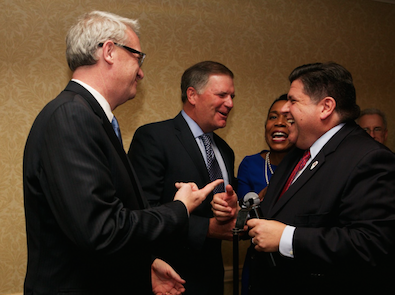
Yesterday’s General Assembly inauguration had Democratic leaders talking unity and Republicans calling for good will and good faith. But it wasn’t until Gov.-elect J.B. Pritzker and Lieutenant Gov.-elect Juliana Stratton dropped in on a GOP celebration that everyone understood they meant it.
“J.B. walked in and no one could believe it. We haven’t seen anything like that in years,” said one guest. “You could feel the energy in the room.”
House Republican leader Jim Durkin welcomed the crowd, then Stratton spoke and introduced Senate Republican leader Bill Brady, who introduced Pritzker. “They talked about working together and encouraged laughter,” said another guest. “It wasn’t an act. All four were genuine.”
* A photo posted online by Pritzker…
56 Comments
|
|
Comments Off
|
|
 Support CapitolFax.com
Visit our advertisers...

 ...............
 ...............
 ...............


|
   
|
Hosted by MCS |
SUBSCRIBE to Capitol Fax |
Advertise Here |
Mobile Version |
Contact Rich Miller
|



