* ABC 7…
[13th Ward candidate David Krupa] said he got a surprise call from an FBI agent today.
“An FBI investigator did reach out to me asked me, kinda what happened and allowed me to explain what we believe to be going on,” Krupa said.
What Krupa believes is going on is a case of election fraud by the campaign of incumbent alderman Marty Quinn. 2,600 people signed petitions to revoke nominating signatures for Krupa that they never gave him in the first place.
“I am encouraged, I think that, knowing that the FBI reached out to me means that somebody is listening and somebody is taking this matter seriously, which it needs to be taken seriously,” Krupa said.
21 Comments  
|
* ALG Research poll for Chicago Federation of Labor of 600 likely Chicago voters conducted Dec. 4 to 9…
Asked whom they would vote for if the election were held today, Preckwinkle came out on top with 21 percent of the vote. Mendoza was second with 16 percent.
That was followed by: Bill Daley (9 percent); Willie Wilson (8 percent); Garry McCarthy (7 percent); Dorothy Brown and Paul Vallas (both at 6 percent); Amara Enyia (5 percent); and Gery Chico (3 percent). […]
Although Preckwinkle comes out on top in the crowded field, Mendoza beats the County Board president one-on-one with 45 percent to Preckwinkle’s 39 percent.
Preckwinkle crushed Daley by a 51-to-32 percent margin. Mendoza did the same with 56 percent to Daley’s 29 percent. Mendoza also creamed Chico by a 58-to-23 percent margin.
Much more at the link.
18 Comments
|
SB 1226 Endangers Safe Drinking Water & Public Health
Wednesday, Dec 19, 2018 - Posted by Advertising Department
[The following is a paid advertisement.]
Illinois continues to reel from the fatal outbreak of legionella at the Quincy Veterans’ Home. School and park districts are scrambling to address troubling levels of lead in water lines and drinking fountains. Now the House is considering a radical measure that would eliminate longstanding protections that ensure the proper installation of drinking water systems and would, in so doing, endanger safe drinking water in Illinois.
SB 1226 would put the health of all Illinoisans, especially seniors and children, at risk by effectively deregulating the practice of plumbing for public works projects, commercial construction, and residential buildings over four stories. In addition, it:
* Would be a regulatory nightmare. Representatives of the Illinois Department of Public Health and Capital Development Board strongly oppose the bill and believe it conflicts with multiple statutes.
* Would compromise existing energy efficiency standards. The Illinois Environmental Council opposed the bill in committee.
* Is also opposed by: the Illinois Plumbing, Heating, Cooling Contractors Association; Illinois Mechanical & Specialty Contractors Association; South Suburban Building Officials Association; Central Illinois Chapter of the Illinois Plumbing Education Association; and organizations representing licensed plumbers, registered plumbing contractors, and plumbing inspectors across our state.
At a time of heightened awareness about threats to safe drinking water, the last thing Illinois needs is the creation of a legislative loophole that enables unqualified individuals to work on water supply systems.
Learn more here.
Comments Off
|
* Earlier today…
Today, Susana Mendoza’s campaign announced that, based on the current status of the records exam, their count shows more than 13,000 valid ballot petition signatures, with almost half of the challenged signatures still left to review. The number puts Mendoza far above the 12,500 required signatures to appear on the February ballot.
The announced numbers highlight the political motivations of Toni Preckwinkle’s desperate attempt to knock Mendoza and four other women of color off the ballot while draining taxpayer money.
“As we’ve said from the start, Susana Mendoza will be on the ballot,” said Susana Mendoza for Mayor Campaign Manager Nicole DeMont. “Preckwinkle’s petition challenge is nothing more than a desperate political attack made by a party boss willing to waste taxpayer dollars to maintain her grip on power.”
* A bit later…
* And now…
“Being Mayor of Chicago is a tough job. That’s why there are high standards for getting on the ballot. While the campaign is dropping its challenge to Susana Mendoza’s petitions, Chicago voters should know that she just barely met the bar to be included on the ballot. This fits a pattern of Mendoza being unprepared to tackle the critical duties of the office. Since getting into this race, Mendoza has repeatedly dodged questions and failed to bring any new ideas,” said campaign spokesperson Monica Trevino.
“Toni Preckwinkle is a tough, proven progressive leader who has taken strong stands on critical issues, including criminal justice reform, police accountability and demanding a fair, equal and representative public school system. In this campaign, Toni is going to fight for this City and that includes holding every candidate accountable who fails to bring the bold leadership and vision needed to be Chicago’s mayor.”
In the end, much ado about very little.
*** UPDATE *** CFL endorsements have been released. Staying neutral in the mayor’s race, so now it’ll be on candidates to roll out individual union nods…
Ald. Brendan Reilly also isn’t on the list, but he said it was no big deal. He’s unopposed.
…Adding… Mendoza campaign…
“Today Susana’s opponent decided to drop her bogus petition challenge that she knew was nothing more than an attempt at a self-coronation and a complete waste of nearly $1 million in taxpayer dollars. The boss of the party bosses desperately tried to keep Susana out of the race and she failed. Despite what boss Preckwinkle hoped, there will be an election and voters will hold her accountable for her record of raising taxes first and providing transparency last. Her political games are exactly why Chicago needs a mayor focused on the next generation, instead of just the next four years.”
18 Comments
|
* Sen. Chapin Rose (R-Mahomet)…
I was appalled to learn that Illinois Secretary of State Jesse White, who manages the operations of the State Capitol, approved a satanic statute for display in the Capitol Rotunda during this holiday season. This absurdity is right next to displays that celebrate Christmas and Hanukkah.
The response given by Secretary White is that the First Amendment requires its display.
As one of the fiercest defenders of the First Amendment, I respectfully point out to Secretary White that his reasoning is terribly wrong.
The First Amendment’s “free exercise clause” specifically guarantees all religions the right to freely exercise their beliefs and practices. In this instance, the Christian and Jewish faiths are engaged in their Constitutional right to “free exercise.” The satanic cult, by its own admission (not to mention the law of common sense), is not a religion – therefore, there is no claim to “free exercise” by such a group.
Indeed, its forced inclusion is robbing the Christian and Jewish believers of their own “free exercise.” Nowhere in the Constitution does it say that government, in this case Secretary White, must force Jewish and Christian believers to include the satanic temple in their holiday celebrations – indeed, such an interpretation can only be made through gross negligence or intentional misapplication.
Yes, the First Amendment allows for free speech, but it also allows for time and place restrictions. For example, if you reserve the public square for a certain time and place for your free speech demonstration – that is your right. However, nothing requires anyone to “double book” the same time and place for another organization – as Secretary White claims.
This is flat-out wrong, disrespectful, and hateful.
Secretary White should have declined this request to “poke people in the eye” – especially during a holiday season of hope, love, and peace.
* Sen. Paul Schimpf (R-Waterloo)…
“My understanding of the law was that the government can create a forum for public comment, but there can be limitations to it … it really depends on the nature of the displays, where they’re allowing the speech to take place, so I felt like the notice that was in the rotunda was not 100 percent legally correct,” he said.
Schimpf said the purpose of his letter was to ask the Secretary of State to “take a look at the issue again and remove the satanic monument because unlike the other two monuments that were there, it did not celebrate any type of religious holiday. It’s meant to present an opposing viewpoint to the Christian and Jewish displays that are in there … just saying that your display must celebrate a religious holiday, I think that’s viewpoint neutral. I don’t think you’re censoring anybody with that.”
* Except, in the past, the SoS allowed a Festivus pole to be placed near the tree…
Festivus is a secular holiday celebrated on December 23 as an alternative to the pressures and commercialism of the Christmas season. Originally created by author Daniel O’Keefe, Festivus entered popular culture after it was made the focus of the 1997 Seinfeld episode “The Strike,” which O’Keefe’s son, Dan O’Keefe, co-wrote.
* And…
“The display is an affirmation of our own beliefs, not an attack on anyone else’s beliefs,” [Lex Manticore, Satanic Temple-Chicago spokesperson] said. “I think misrepresenting us as attacking or this being a stunt is a misrepresentation of our intentions.”
[Lux Armiger, chairperson and co-chapter head] said The Satanic Temple is “a non-theistic religious organization determined to halt the dangerous encroachment of theocracy into American government.” […]
“The winter solstice is the catalyst for the other holidays of this wintertime,” Manticore said.
“The secular American tradition of x-mas … is something that is for everyone because it is a national holiday,” he said.
* Meanwhile…
A group of about 40 Catholics assembled in front of the Capitol on Sunday afternoon, praying a “rosary of reparation” and asking the Illinois Secretary of State’s Office to remove a display by the Satanic Temple-Chicago from the Capitol rotunda. […]
The American Society for the Defense of Tradition, Family and Property, a Catholic group headquartered in Pennsylvania, organized the Sunday prayer and has a petition on its website for the Snaketivity’s removal.
“No government entity should promote the father of lies, as this is contrary to the good they are called to uphold in society,” Preston Noell, with the society’s Chicago chapter, said Sunday. “These public Satanic offenses are a direct mockery of Christ’s nativity and these attacks must be met with opposition, which we are adhering to with prayer.”
Noell said the Satanic display was one of several attempts to “shut down” Christians and “attack Christian civilization.”
* Druker gets the last word…
Because the Capitol rotunda is a public place and the display wasn’t funded by taxpayer dollars, Illinois Secretary of State spokesman Dave Druker said the group has the same rights as other religious organizations to put a display there.
56 Comments
|
* Bloomberg…
One way to measure the economic fortunes of a place is by the concentration of households earning $200,000 or more, the highest threshold in the Census Bureau’s American Community Survey. […]
Nationally, 6.9 percent of American households bring in that much. What follows are the areas (known to the Census Bureau as tracts) that have shown the biggest increases in concentration of $200,000-and-up households since 2000, according to calculations by consulting firm Webster Pacific. It used data released Dec. 6 and adjusted for inflation. (The ranking excludes recently created tracts, those defined as tracts of significant change and any tract with fewer than 100 households in either 2000 or 2017.)
Cook County, which includes the county seat of Chicago, is home to the No. 1 and No. 7 fastest-growing concentrations of $200,000-plus households. No. 1 is, ironically, the area around where the Cabrini-Green public housing projects once stood. Cabrini-Green was notorious for violent crime, poverty and de facto racial segregation until its demolition beginning in the 1990s at the behest of the Chicago Housing Authority. […]
The census tract in question includes the still-standing, albeit largely vacant row houses where Palmer grew up. But now there are luxury condominiums and apartments, too. They sport rooftop terraces and sparkling views of the city’s affluent Gold Coast and Lake Michigan beyond. A three-bedroom penthouse can cost around $2 million.
About 20 miles to the north, Cook County has another top 10 neighborhood: the Glen, in the suburb of Glenview. Converted from what used to be Naval Air Station Glenview, the planned community has hundreds of families living in condos, town houses and single-family homes that go for as much as $2.5 million each, according to realtor Margaret Ludemann.
19 Comments
|
Yet another appeal filed over HB40
Wednesday, Dec 19, 2018 - Posted by Rich Miller
* Press release…
Attorneys from the Thomas More Society are appealing to the Illinois Supreme Court to stop a state law requiring taxpayer funding of abortions for Medicaid recipients. According to the December 17, 2018, filing on behalf of hundreds of thousands of Illinois taxpayers, the funding for the law violates the state constitution’s balanced budget requirement. In September 2018, an appellate court upheld the dismissal of a lawsuit against the funding for the law, previously known as “House Bill 40.”
Peter Breen, Thomas More Society Special Counsel, stated, “The decisions of the lower courts effectively write our balanced budget requirement out of the Illinois Constitution. We’re asking the Illinois Supreme Court to interpret and enforce the constitution and protect taxpayers against future unbalanced budget spending, including the unfunded spending for elective abortions required by House Bill 40.”
Breen said that, while House Bill 40 was validly enacted, funding was not validly provided, and its effective date was improperly determined. The petition alleges several issues with the new law, including that House Bill 40:
· Has not been legally funded, because the General Assembly has not made the estimate of available revenues to pay for the abortions, as required by the Illinois Constitution.
· Does not implicate the political question doctrine, a limited doctrine where courts decline to hear issues because of their politically character.
· Was passed after the deadline set for an early effective date by the Illinois Constitution and Effective Date of Laws Act.
* Brian Mackey…
“The lower court decisions read that requirement out of the Constitution altogether,” Breen says. “That is the only protection taxpayers have that they would get a balanced budget.”
Indeed those judges basically said the anti-abortion groups are over-reading the balanced budget language in the Illinois Constitution. They also said the dispute is a political question, and thus should be settled in the legislature.
* From the appellate opinion…
While the language of the constitution certainly seems to anticipate some estimate, absent is language imposing an obligation on the General Assembly to develop a revenue estimate. Plaintiffs argue that reading the language of the COGFA Act in conjunction with the constitution imposes such a duty. In reading the language of the COGFA Act into the constitution, plaintiffs skip an important step. Without a constitutional requirement of an estimate, there can be no legitimate probe into whether the General Assembly complied with that nonexistent requirement. […]
Under the constitution, the General Assembly must simply refrain from appropriating beyond funds estimated by the General Assembly to be available during the year. There exists no requirement that the General Assembly itemize appropriations for specific services. In this circumstance, the circuit court had no way to determine if the General Assembly properly appropriated funds specifically to cover services under HB 40. […]
Therefore, because the COGFA Act does not state that legislative appropriations are invalid if there is a failure to comply with section 4(a) or that legislative appropriations are valid only if the General Assembly follows section 4(a), we conclude the statutory provision is directory. […]
We agree with the circuit court that the filing of a motion to reconsider and withdrawal of that motion did not constitute a final legislative act changing the passage date of the bill.
I wouldn’t bet too much money on the likelihood of this new move’s success. That petition is here.
* Illinois News Network…
Abortion rights group Personal PAC CEO Terry Cosgrove said he was confident that the law would be upheld.
“This is a desperate attempt from right-wingers to put the lives of Illinois women at risk by trying to make abortion illegal and unsafe,” he said.
The law allowed for women who meet certain income requirements to qualify for an abortion assisted by Medicaid funds. It also allowed state health care plans to cover the procedures.
Illinois taxpayers paid for nearly four times more abortions in the first six months of 2018 than the year before. There were 84 abortion reimbursement requests in the first six months of 2017. During the same six-month period this year, there were 314 abortion reimbursement requests, a 247-percent increase, according to records from the Illinois Department of Health and Family Services.
The case was appealed directly to the Illinois Supreme Court, but the court didn’t take it up at that time.
7 Comments
|
* Gizmodo…
Elon Musk’s Boring Company unveiled its latest transportation experiment in Los Angeles last night. The Loop, not to be confused with the Hyperloop, was supposed to be a high-speed urban transportation system of the future. And the first reviews are in, but they’re pretty disappointing, to say the least.
Back when the concept was first announced, Musk promised that the Loop would utilize fully autonomous 16-passenger vehicles gliding along at speeds of 150 miles per hour. But the system that was demonstrated last night featured just regular Tesla cars driven manually on an underground one-mile track. And at an underwhelming speed of just 35-50 miles per hour. […]
Musk was reportedly making excuses throughout the night about why his system looked nothing like what he promised. And his concept now relies on every person having their own car.
“It’s much more like an underground highway than it is a subway,” Musk said, according to the Associated Press.
* Some Chicago aldermen were in LA for the unveiling…
Ald. Gilbert Villegas, 36th, chairman of the City Council’s Latino Caucus, was one of a group of aldermen and Chicago city officials who were in Los Angeles this week to take a ride through the tunnel, which runs just over a mile.
Villegas described the ride on Tuesday night as “a little bumpy” since Musk’s team had not yet smoothed out the surface of the tunnel. The top speed reached was about 34 mph, Villegas said, much slower than Musk’s promised future speed of 150 mph. Villegas said he believed the ride would have been twice as fast if the tunnel had been smooth. […]
In June, Mayor Rahm Emanuel and Musk announced plans for an express, high-speed, underground connection between downtown and O’Hare International Airport.
* AP…
On Tuesday, he explained for the first time in detail how the system, which he simply calls “loop,” could work on a larger scale beneath cities across the globe. Autonomous, electric vehicles could be lowered into the system on wall-less elevators, which could be placed almost anywhere cars can go. The cars would have to be fitted with specially designed side wheels that pop out perpendicular to the car’s regular tires and run along the tunnel’s track. The cost for such wheels would be about $200 or $300 a car, Musk said.
A number of autonomous cars would remain inside the tunnel system just for pedestrians and bicyclists. Once on the main arteries of the system, every car could run at top speed except when entering and exiting.
“It’s much more like an underground highway than it is a subway,” Musk said. […]
Tuesday’s reveal comes almost two years to the day since Musk announced on Twitter that “traffic is driving me nuts” and he was “going to build a tunnel boring machine and just start digging.”
So, lemme get this straight. You’re gonna have to wait in line inside your specially fitted autonomous vehicle (which doesn’t actually exist) along with hundreds of other people in their own personal autonomous vehicles (which don’t actually exist) and that’s not traffic?
Coulda fooled me.
* And the tunnel will have just one destination at each end?…
It does seem strange, though, that we’re taking this ride in a Model X — because until this evening, there were going to be “autonomous electric skates” that zip passengers around at 120 to 150 miles per hour. These skates were supposed to carry eight to 16 people in a pod or a single car. Unlike with a more conventional subway, these skates don’t stop between where a person gets on and where they might get off; every skate runs express to one’s final destination.
Anyway, the skates have been canceled. “The car is the skate,” Musk says.
* Imagine the traffic jams at O’Hare Airport to get into and out of this thing and the similar jams downtown. Also, they’d better be able to get into and out of those tunnels in a hurry or the whole tunnel system will be one gigantic traffic jam. Anyone who has ever tried to exit a completely full parking garage after a ballgame knows what I’m talking about here…
The lift slowly lowered our car into O’Leary Station, a circular hole Musk’s Boring Company had dug in the parking lot in Hawthorne, California.
And…
The car emerged from the tunnel on an elevator erected inside a round shaft lined with corrugated metal.
So, entrance and egress won’t be fast at all. Just the opposite. Great!
* Yep…
Personal rapid transit is subject to the same problems as every other kind. If the system is underused, it’ll take you immediately where you need to go, says Juan Matute, the deputy director of UCLA’s Institute of Transportation Studies. But if people find it truly useful, bottlenecks will be created: long lines of cars waiting to get on, just like on the interstate. “It could choke on its success or just not be successful,” Matute says. “Either way it’s unlikely there will be significant changes to existing traffic congestion.”
*** UPDATE *** Crain’s…
Robert Rivkin flew to L.A. to see a hole in the ground and came away impressed. […]
Rivkin, the city’s deputy mayor, was among 13 people from Chicago, mostly aldermen, who visited a Tuesday night demonstration by Musk’s Boring Co. staged at a test site in Hawthorne, Calif. The vision for the Chicago project is grand: autonomous pods whisking along at 150 miles per hour to O’Hare at a cost of $20 to $25. […]
The big issue for Rivkin and others has more to do with the digging than anything else. “The question is whether you can tunnel cheaper and faster than previously has been done,” he said.
So, after all that, the biggest hurdle is just digging the tunnel and not the autonomous vehicles that don’t exist or the other stuff we talked about above?
This is not gonna end well.
49 Comments
|
* From a letter sent to state workers by Mailee Smith, who is the Illinois Policy Institute’s policy staff attorney. Click the pic for a larger version and the form to fill out…
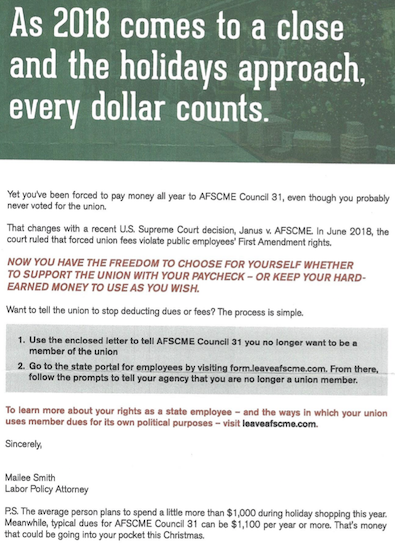
The ol’ self-interest angle.
* From AFSCME…
The mailer (pictured) tries to trick AFSCME members into quitting their union as a way to put “money into your pocket this Christmas”. Of course, what the IPI and Rauner really want is to dupe workers into leaving the union as a way to drain AFSCME’s resources and prevent us from standing together against Rauner and the IPI’s destructive anti-worker agenda.
This is just the latest in a series of ploys by IPI and their ilk who brought the anti-union Janus case, sent other phony mailers and even stole the identity of AFSCME local union presidents, activists and retirees in a desperate bid for legitimacy.
The tricks aren’t working on union members here or elsewhere. In Illinois and across the country, AFSCME members are seeing through the IPI lies — and union ranks are actually growing in the wake of the Janus case as former fee-payers sign up and become dues-paying members.
So what to do with the IPI’s junk mail? Trash it, recycle it, or use it to kindle your fireplace this Christmas season.
33 Comments
|
Tax opponents oppose tax hike
Wednesday, Dec 19, 2018 - Posted by Rich Miller
* Patch…
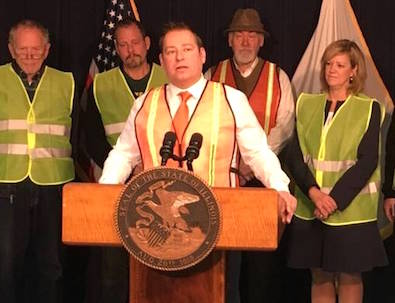
Donning yellow jackets, Representatives Allen Skillicorn and Jeanne Ives spoke out Tuesday against the idea of Illinois becoming the state with the largest tax on motor fuel at a press conference in Chicago.
“The worst kept secret in Springfield is a rumored massive gasoline and diesel tax hike,” Skillicorn said. “Just when gas prices are finally lower right before the holidays, greedy politicians, like the Grinches they are, seem all too willing to take more of our hard-earned money. Nothing like greedy politicians to ruin the holidays for middle class families.” […]
“There seems to be strong support for a major infrastructure funding bill at the federal level,” Skillicorn said. “We need to wait and see what is happening with transportation funding at the federal level and how Illinois will benefit from it. Let’s think strategically here for a change. Rushing in to approve a massive gas tax hike just because fuel prices are low is reprehensible. We need to be strategic about funding roads, not predatory.”
* Prairie State Wire…
Ives hinted there are other options, if only state lawmakers would be more responsible.
“Illinois doesn’t prioritize its spending,” she said. “Look at the $200 million spent on the Obama Center. That money should be used for infrastructure, not a political center for the former president.”
That money is actually being used for infrastructure spending around the center. And $200 million is a one-time drop in the bucket of what the state needs. If she can come up with a couple billion or so in permanent, perennial, do-able cuts, then she may be on to something.
* WBBM Radio…
Ives said the participants of Tuesday’s news conference were emulating the Parisian protesters because they were fighting fuel taxes, too.
If they were “emulating the Parisian protesters” they wouldn’t bother with a press conference.
* Photo that you may or may not wish to caption yourself…
63 Comments
|
* Crain’s…
The state’s pension funding is improving but not as fast as in other states, according to Moody’s Investors Service, which warns that favorable economic tailwinds may subside.
Illinois’ adjusted net pension liability dropped by an estimated 2 percent to 5 percent because of rising interest rates and better investment returns, the rating agency said in a report today. But “weak contributions and rising payouts” mean that Illinois continues to have the largest unfunded pension liabilities of any state, the report said.
“Like other U.S. public pension systems, Illinois’ pensions remain vulnerable to stock-market volatility,” Moody’s wrote. “Illinois also cannot rely on continually rising interest rates to keep reducing the adjusted value of its reported pension liabilities.” […]
Moody’s said that among U.S. state plans that have issued figures this year, all saw more funding gains than Illinois’ biggest, the $51.8 billion-asset Illinois Teachers’ Retirement System, which covers 417,292 members. The adjusted net pension liability for the plan dropped by less than 3 percent, compared with a 14 percent average decline for Indiana’s two teacher pension systems. TRS’ unfunded liabilities actually increased by 2.1 percent, to $75 billion.
* And now the bad news…
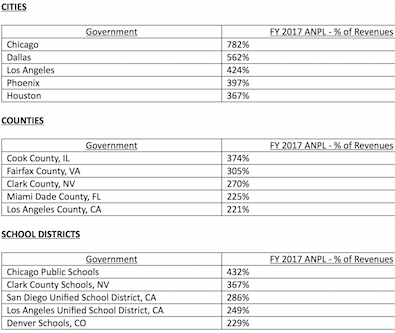
Moody’s has issued its adjusted net pension liabilities (ANPL) for the 50 largest local government (ranked by debt outstanding) for fiscal 2017, and most saw their unfunded liabilities rise due to poor investment returns and low market interest rates. Since most local governments report pension funding with up to a one-year lag, favorable investment returns in fiscal 2017 and 2018 will lead to a decline in ANPLs through many of those governments’ 2019 reporting. Nonetheless, pensions continue to drive historically high leverage and elevated annual costs for some governments, and risks from potential pension investment losses are significant.
The report’s highlights are:
ANPLs reached an aggregate $481 billion in fiscal 2017 for the 50 largest local governments, up 9% from fiscal 2016. Most individual governments’ ANPL increases were more significant, while several governments that report more current pension data had ANPL declines. San Francisco’s (rated Aaa/stable outlook) ANPL increased 82% due in part to recognition of certain benefit restorations from a judicial decision. New York City (Aa2/stable) saw the largest absolute decline (-$13.8 billion). ANPLs continue to far exceed bonded debt and unfunded other post-employment benefit (OPEB) liabilities.
Favorable investment returns and revenue growth will drive lower ANPLs and leverage ratios through many governments’ fiscal 2019 reporting. Liabilities are also falling in cities such as Dallas (A1/stable) and Houston (Aa3/stable) due to benefit reforms.
Risks from pension investment volatility vary widely across governments. As of fiscal 2017, nine of the 50 largest had a greater than 10% one-year probability of pension investment losses amounting to at least 25% of revenues. Negative non-investment cash flow (NICF), which occurs when a pension system’s benefit payments exceed its contributions, also constrains the ability of many funds to grow assets.
The combination of debt service, pension and retiree healthcare (OPEB) payments consumed more than 30% of some governments’ revenues, but less than 15% for others. Highlighting the general weakness of government pension contributions, only 10 of the largest 50 exceeded our “tread water” indicator in fiscal 2017.
Unfunded OPEBs are becoming material for some of the largest local governments. Using new disclosures based on updated accounting rules for OPEBs, adjusted net OPEB liabilities are very large for Suffolk County, New York (Baa1/stable) but relatively insignificant for Texas schools and Clark County School District, Nevada (A1/negative).
This year we broke down the top 50 local governments into cities, counties, school districts, and special districts. After determining the dollar amount of the municipality’s unfunded pension liabilities, we translate that number into a percentage of the municipality’s revenue. The higher the percentage, the higher the unfunded pension liability for that municipality. Here are the top five in each category except special districts:
* Whew…
* Related…
* Hedge fund rebel to leave Illinois pension board - Marc Levine led a charge against hedge fund investing on two Illinois pension fund boards. Now he plans to step away as a new administration arrives in Springfield.
26 Comments
|
Question of the day: Golden Horseshoe Awards
Wednesday, Dec 19, 2018 - Posted by Rich Miller
* The 2018 Golden Horseshoe Award for Best In-House Lobbyist goes to Adrienne Alexander with AFSCME Council 31…
Adrienne is smart and strategic and has great relationships. She understands politics and policy, from numerous angles. She’s been extremely effective as a lobbyist for years at both the state and city level. I wish I could steal her from AFSCME.
So do I.
Honorable mention goes to the entire team at the Associated Fire Fighters of Illinois…
Those guys are tough. They are there for the win. They will have your back. They are your friends. We are fortunate to have them at our Capitol.
* The 2018 Golden Horseshoe Award for Best Contract Lobbyist goes to Marc Poulos…
He is never unprepared, and, like Dave Sullivan, has an ability to work with people on both sides of the aisle. He spent four years under a vehemently anti-Labor Rauner administration working with Rs and Ds, and although much of it was defense, he was able navigate some key wins for Labor in a very hostile environment (see the years long fight over prevailing wage rates with Rauners IDOL that ended in a deal with the Rauner administration).
Dude has had quite the year.
Honorable mention goes to Tom Cullen…
Knows everyone and knows the process. Works hard for all his clients.
Tom has remained a good friend and unofficial mentor to many that have worked for him at some point through the years. This is very much appreciated. If you stood by him he will stand by you no matter how much time may have gone by.
That is very true. He could easily win this one every year.
Congrats to all!
…Adding… Today’s winners…
* I’m shutting down the blog tomorrow for the holidays (I have a bunch of stuff I have to do Friday), which means we’re running out of time. Here are today’s categories…
* Best “Do-Gooder” Lobbyist
* Best Legislative Liaison
As always, explain your nominations or they will not count. And do your best to nominate in both categories if you can. Thanks.
42 Comments
|
Caption contest!
Wednesday, Dec 19, 2018 - Posted by Rich Miller
* My old pal Dave Manning was elected Speaker of the Third House last week at the group’s annual holiday party. This pic was obviously not taken at the event…

28 Comments
|
* Ugh…
That’s like losing the equivalent of Elmhurst. Minnesota gained the equivalent of DeKalb and Indiana gained the equivalent of Danville.
* From the Census Bureau…
Population declines were also common, with losses occurring in nine states and Puerto Rico. The nine states that lost population last year were New York (down 48,510), Illinois (45,116), West Virginia (11,216), Louisiana (10,840), Hawaii (3,712), Mississippi (3,133), Alaska (2,348), Connecticut (1,215) and Wyoming (1,197). […]
Texas had the largest numeric growth over the last year, with an increase of 379,128 people. Texas grew both from having more births than deaths and from net gains in movers from within and outside the United States.
Florida had the highest level of net domestic migration in the last year, at 132,602. Since 2010, Florida has gained a total of 1,160,387 people from net domestic migration.
The voting age population, those 18 years and over, increased by 0.9 percent to 253,768,092 people in 2018.
The estimates are as of July 1, 2018, and therefore do not reflect the effects of Hurricane Florence in September 2018, Hurricane Michael in October 2018, and the California Wildfires.
*** UPDATE *** Births are slightly down, deaths are slightly up, international migration is relatively flat, but check out how domestic out-migration has nearly doubled…
113 Comments
|
But his e-mails…
Wednesday, Dec 19, 2018 - Posted by Rich Miller
* Deadspin…
In the few years after the Ricketts Family Trust purchased the Cubs, they repeatedly sought to use taxpayer money and subsidies to fund the development of Wrigley and its surrounding areas: They proposed using $200 million of public funds to develop the Triangle Building near Wrigley Field, sought the use of local amusement tax funds that might otherwise be spent on public services, and attempted to use a hefty federal subsidy to pay for renovations of the field. Though the negotiations, Chicago mayor Rahm Emanuel remained unimpressed: “I will not put my money in their field so they can take their money, and invest around the field, and get a greater economic value,” the mayor told ABC towards the end of negotiations, in 2012. “If it’s important, they should invest there.”
The angst over Emanuel’s public position apparently lasted even after the Ricketts family offered to put $300 million of their own money into the field, as well as an additional $200 million into surrounding businesses. Having received a final proposal for the Ricketts investment in the Cubs, Emanuel told the Chicago Tribune:
When I first started this discussion, the Cubs wanted $200 million in taxpayer dollars. I said no. Then they said we’d like $150 million, and I said no. Then they asked whether they could have $100 million in taxpayer subsidies, and I said no. Then they asked about $55 million in taxpayer subsidies. I said no. The good news is, after 15 months they heard the word ‘No.’”
* Todd Ricketts then sent two e-mails…
From: Todd Ricketts
To: Joe Ricketts, Tom Ricketts, Peter Ricketts, Laura Ricketts
Date: January 23, 2013
Subject: mayor emmanuel
Mr Mayor, would you like for the Cubs to stay in the city of Chicago… “No”
“When I first started this discussion, the Cubs wanted 200 million in taxpayer dollars. I said, `No.’ Then, they said we’d like 150 million taxpayer dollars and I said, `No.’ Then, they asked if they could have 100 million dollars in taxpayer subsidies, and I said ‘No.’ Then, they asked about 55 million dollars in taxpayer subsidies. I said ‘No’. The good news is after 15 months, they’ve heard the word, `No,’ “ Emanuel said.
I think we should contemplate moving, or at least recognize that we are maybe not the right organization to own the Cubs.
And…
From: Todd Ricketts
To: Joe Ricketts, Tom Ricketts, Peter Ricketts, Laura Ricketts
Date: January 23, 2013
Subject: RE: mayor emmanuel
I just hate the thought of Tom having to grovel to this guy to put money into a building we already own.
A response…
From: Joe Ricketts
To: Tom Ricketts, Peter Ricketts, Laura Ricketts
Yes Todd, it makes me sad, it hurts my feelings to see Tom treated this way. He is way superior to the Mayor in every way.
I have been brought up to deplore the type of value system adopted by the Mayor of Chicago. This is stating it mildly.
So, Todd resents his brother having to grovel to get taxpayer money and the father deplores the mayor’s value system.
…Adding… From comments…
This excerpt omits that there was far more than saying no to the Cubs request (to be treated like every other pro sports team in Chicago - heck, Rahm even built a new arena for DePaul). The City put up repeated roadblocks to the Cubs using their own money. That is a reference to having to grovel to put money “into a building we already own.” He is referencing having to grovel to put *his own* money into renovations.
42 Comments
|
The hollowing-out of state government
Wednesday, Dec 19, 2018 - Posted by Rich Miller
* The conclusion of Ralph Martire’s latest op-ed…
The bottom line: inadequate capacity on the front-end results in inadequate outcomes on the back-end. Period.
Want proof? Start with higher education, for which state funding has declined by over 51 percent in real, inflation-adjusted terms since fiscal year 2000. In response, tuition at public colleges and universities in Illinois over that sequence has increased at a rate that’s 62.6 percent greater than the national average. So it should come as no surprise that over the last decade enrollment in public institutions of higher learning has declined by 8.1 percent in Illinois, despite growing by 7.7 percent nationally.
Then there’s K-12 education — which is underfunded in Illinois by some $7 billion from what the evidence indicates is needed for every child to receive the type of educational experience that translates to academic success. That shortfall in education funding means the vast majority of Illinois school districts — 83 percent, according to the State Board of Education — lack adequate fiscal capacity to educate the children they serve. Given this significant lack of capacity on the front-end, one would expect inadequate student achievement outcomes on the back-end, which there are. For instance, just 37 percent of Illinois students met or exceeded the state’s standard for achievement on the most recent PARCC exams covering English Language Arts, meaning 63 percent didn’t.
I could go on, but there really aren’t any counter factuals. No matter how you slice it, the lack of an appropriate level of public sector investment in services on the front-end consistently generates less than desirable outcomes on the back-end. Which brings us to the biggest challenge facing Governor-elect Pritzker: the political process itself. In fact, the primary reason Illinois state finances are so shaky today is that designing sound fiscal policy requires long-term thinking — something political processes are poorly equipped to support.
That’s because political processes focus on short-term objectives, be it winning an upcoming election or getting through a current year’s budget negotiation. Rewards that are realized in the long-term, particularly if associated with imposition of short-term costs, are anathema to a process designed for generating an immediate advantage. Governor Rauner never found a way to overcome the myopic focus of the political process. Let’s hope Governor-elect Pritzker does.
34 Comments
|
|
Comments Off
|
|
 Support CapitolFax.com
Visit our advertisers...

 ...............
 ...............
 ...............


|
   
|
Hosted by MCS |
SUBSCRIBE to Capitol Fax |
Advertise Here |
Mobile Version |
Contact Rich Miller
|



