* Tribune editorial…
Empower Illinois is a tuition tax credit program the legislature approved in 2017 as part of a state education funding overhaul. The program encourages donations to private schools by offering donors a 75-cents-on-the-dollar tax credit on their Illinois income taxes. Critics of the program have excoriated it as a diversion of tax money from public schools (not true) and an exclusive tax write-off for rich people (also not true). […]
Gov.-elect J.B. Pritzker does not support the tax credit program. On the campaign trail he said he would “immediately” move to repeal it. He believes the tax credits hurt public education by diverting dollars that could be earmarked for those schools. Yet he exerts school choice, and that’s fine: His own children attend one of the nation’s premiere private schools, Francis W. Parker in Lincoln Park, not their neighborhood CPS school.
We urge the incoming governor and members of the General Assembly to think less about public-private rivalries and more about students who have different needs and should have different choices. Illinois lags most states in offering options outside the public school system. Affluent families have school choice. It’s the low-income families trapped by their ZIP codes in marginal public districts who do not. And they don’t have years to wait for their public schools to improve.
* Finke…
Pritzker said the tax breaks for private school scholarships essentially diverts tax resources from public schools.
“Money that could go to public education is being diverted,” he said. “It’s better to put those dollars in public schools.”
Although Pritzker wants to end the program, he said it should be done in a way that doesn’t disrupt families already taking advantage of it.
* Meanwhile, on to the inauguration. WJOL…
Illinois’ incoming governor is going to pick up the tab for his inauguration. Governor-elect J.B. Pritzker yesterday said that he will pay for the full cost of his swearing in, and the two days of celebrations leading up to it. Pritzker will take the oath of office on January 14th.
* More…
Some of the Pritzkers’ closest pals and confidantes are on the committee, including, Lee “Rosy” Rosenberg, chief of staff at the Pritzker Group and an adviser to Pritzker on the campaign; businessman Michael Sacks and Cari Sacks; businesswoman Linda Johnson Rice; Marko Iglendza, CEO and Founder of Terminal Getaway Spa, and Neal Zucker, CEO and co-founder of Corporate Cleaning window cleaners; and businesswoman Desiree Rogers, who oversaw 330 White House functions while she was social secretary in the Obama administration. […]
The rest of the committee consists of members from a broad and diverse swath—nonprofits, business, upstate, downstate. They include: Obama Foundation President Martin Nesbitt; real-estate developer Elzie Higginbottom and his wife, Deborah; high-end boutique owners Ikram and Josh Goldman; lobbyist Loretta Durbin (wife of U.S. Sen. Dick Durbin); educator Barbara Bowman (she’s Valerie Jarrett’s mom); activist Emma Lozano; media exec Eve Rodriguez Montoya; community leader Felicia Davis; nonprofit leader Sol Flores; Illinois Business Immigration Coalition’s Rebecca Shi; LIUNA labor President Nicole Hayes; and businessman Skip Braziel and Erica Annise Braziel.
Politicos on the committee: former Gov. Jim Edgar and his wife, Brenda; Illinois Democratic County Chairs’ President Kristina Zahorik; Chicago Housing Authority Board Chair John Hooker; Highway Commissioner Calvin Jordan and his wife, Lori; former Congressman Glenn Poshard and his wife, Jo; St. Clair County Auditor Patty Sprague and attorney Bob Sprague; former state Rep. Lauren Beth Gash and Studio Gang Principal Gregg Garmisa; North Aurora Village Trustee Mark Guethle and his wife, Louise; and Wanda Rednour, wife of the late John Rednour, a former Du Quoin mayor.
* Let’s move now to cannabis legalization…
Pritzker says he’s already been working out the details with legislators.
“There’s an opportunity for us to be the first state in the Midwest to make it available, and so I think the legislature should get at it,” Pritzker says.
Michigan legalized recreational marijuana last month by referendum. But the state legislature there is looking at rewriting what the voters approved — lowering the tax rate, changing where that money is spent, and banning home-grown plants.
“The good news about being eighth or ninth to get this done is we can look at what works and put it in place in Illinois,” Pritzker says.
* Pritzker isn’t governor yet, but he attended his first jobs announcement today…
JPMorgan Chase announced Wednesday that it was committing $10 million to Chicago’s South Side and its West Side as part of its five-year, $500 million AdvancingCities initiative.
CEO Jamie Dimon made the announcement in Chicago and was joined by the Chicago Community Loan Fund’s president, Calvin Holmes, and Governor-elect J.B. Pritzker. JPMorgan’s investment will be through long-term commercial real estate loans with low interest rates, distributed by the CCLF. The goal is to promote development in underserved neighborhoods where access to grocery stores and other retailers is significantly lower than it is elsewhere in the city.
* More…
The Chicago Community Loan Fund is receiving its largest capital investment to date: a $10 million low-cost, long-term loan from JPMorgan Chase.
The loan is designed to boost the Chicago nonprofit lender’s work financing small-business and commercial development on Chicago’s South and West sides — particularly projects that might struggle to get financing at traditional financial institutions, Chase said Wednesday.
CCLF expects to begin using the loan to fund projects in the first quarter of 2019, Chief Operating Officer Bob Tucker said. There are about 16 commercial real estate projects in the organization’s pipeline that could benefit, including entertainment, healthy food and retail businesses and tech hubs in neighborhoods like Bronzeville, Englewood, Pullman, Woodlawn, West Humboldt Park and Austin, Tucker said.
* And finally…
Gov. Bruce Rauner is urging the incoming administration to continue his work in rooting out waste, fraud and abuse in the state’s Medicaid system, and to clarify rules for state workers who belong to the same union as the employees they supervise.
Rauner said both issues cost taxpayers “hundreds of millions of dollars every year.”
The governor’s office said its Health Care Fraud Elimination Task Force saved $218 million while the Department of Healthcare and Family Services Inspector General saved or recouped $190 million in fiscal 2018.
“The effort resulted in 39 fraud convictions including $27.8 million in recoveries through criminal prosecutions, civil actions, and/or administrative referrals,” according to a statement from Rauner’s office. “The task force has saved the state more than $665 million since its inception in 2016.”
29 Comments  
|
Krupa roundup
Wednesday, Dec 12, 2018 - Posted by Rich Miller
* Kass…
To get on the [13th Ward aldermanic] ballot, [David] Krupa was required to file 473 valid signatures of ward residents. He filed 1,703 signatures to the Chicago Board of Election Commissioners.
Amazingly, an organized crew — of Quakers or unicorns — walked door to door in the 13th Ward and turned in 2,796 affidavits from residents asking that their signatures for Krupa be revoked.
Do the math. That organized crew got far more affidavits of revocation of signature than were needed. Affidavits are legal documents, and notarized.
It appears many residents of Boss Madigan’s ward have left themselves open to felony perjury charges. Madigan’s ward is chock-full of workers on one government payroll or another. Felony perjury convictions would cause them to lose their government jobs.
OK, first of all, the affidavits were filed before Krupa turned in his own petitions. For lots of reasons, campaigns almost never file all the signatures they collect. It’s therefore possible that people who signed the affidavits could’ve signed Krupa’s petition, but their sheets weren’t submitted. It’s also possible that people made mistakes and thought they’d signed Krupa’s petition when they’d actually signed another one.
There’s also an allegation that 13th Ward Ald. Marty Quinn’s campaign workers misled people at the doors. Derrick Blakley talked to some who’d signed the affidavits. Here’s his conclusion…
Many voters said they were falsely told the revocation petitions aimed at Krupa were simply signature verifications.
Derrick never got anyone to say that on camera, but it wouldn’t surprise me if that was the case.
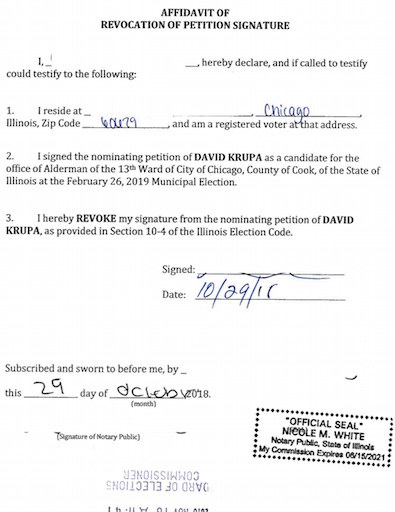
* Now, on to the claim that some of the affidavit signers committed felony perjury. I asked the spokesperson for the Chicago Board of Elections Commission if this was indeed a felony. He said the board was not making that claim, Krupa’s attorney is making that claim. I also asked the board for one of the affidavits that people signed. I’ve redacted some info…
* From the state election code…
The petitions, when filed, shall not be withdrawn or added to, and no signatures shall be revoked except by revocation filed in writing with the State Board of Elections, election authority or local election official with whom the petition is required to be filed, and before the filing of such petition.
* Also from the election code…
Sec. 29-10. Perjury. (a) Any person who makes a false statement, material to the issue or point in question, which he does not believe to be true, in any affidavit, certificate or sworn oral declaration required by any provision of this Code shall be guilty of a Class 3 felony.
(b) Any person who is convicted of violating this Section shall be ineligible for public employment for a period of 5 years immediately following the completion of his sentence.
So, this all hinges on intent. If anyone signed the affidavits knowing they were making a false statement, then it’s perjury. As far as I can tell, nobody has yet made that claim. And it’ll be really tough to do that in court. But if Blakley’s report is accurate, then suborning perjury might be a possible angle.
Maybe the 13th Ward should just drop this whole thing.
* Meanwhile, the Chicago Reader retweeted this, so it wound up in my timeline…
* The linked story was one of those “reporter goes on safari to Trumpland” pieces from 2016. But, despite the area’s portrayal in the story, Hillary Clinton wound up winning the 13th Ward with 70 percent of the vote to Trump’s 26 percent…
The 13th, 14th, and 23rd Wards, gerrymandered into skinny puzzle pieces through the neighborhoods of Clearing and Garfield Ridge, are where a lot of the working-class white people Trump was banking on reside.
This is the land of trucks with White Sox vanity license plates, warehouses that go on for blocks, Polish bars, and Midway Airport. Little yellow brick bungalows fill the spaces between aging strip malls. You can still meet old men with Irish brogues, but Latino families have also made a home for themselves here, and the local grocery stores now carry Mexican products alongside every variety of canned vegetable and nonorganic meat.
Upon arrival Tuesday afternoon, I didn’t have to search long for ardent Trump supporters. Eighteen-year-old Dave Krupa and 53-year-old Edna Bice were standing in front of a polling place at a Centro Cristiano. Krupa waved a giant Trump flag, while Bice worked with a sign reading “Hillary for prison 2016″ and a flag with a patriotic collage of stars and stripes, a bald eagle head, and military insignia. Many a passing car and semitruck honked at them in appreciation. Some people honked and flipped the bird.
Krupa was happy to have the day off from school due to a parent-teacher conference. He describes himself as a “day-one Trump supporter” and hopes Trump’s law-and-order politics will shake up both the “inner city” (which he defined as “State and Madison”) and his own neighborhood.
“In the inner cities, if you’ve got your pants down to your ankles, and it looks like you’re a shady character, stop and frisk is the way to go,” he says, “because chances are if you have a gun you don’t have a license to carry that.”
Interesting philosophy. The accompanying photograph…

* Krupa now…
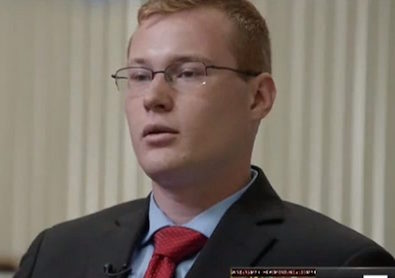
Looks like he’s cleaned himself up a bit.
* The only money Krupa has reported raising so far is $800 from himself. He’s also contributed about $3,300 in in-kinds to his own campaign, for a campaign office TV and for legal services that are not detailed. His attorney is Michael Dorf, who has been sparring with the Madigan machine for years.
47 Comments
|
Rauner taking final swing at AFSCME
Wednesday, Dec 12, 2018 - Posted by Rich Miller
* I’m not sure if Rauner’s claim of “record levels” is accurate, but his claim is just one more example of how the governor’s term is not ending like he’d hoped….
* The governor was asked if he had expected any sort of unionization bump after the Janus decision…
The issue of unit clarification is in no way related to Janus, completely different issue. Completely different process, no relation. Unit clarification is a problem of financial incentives and conflicts of interest with folks who looking out for their best economic interest who are managers have joined a union, been pushed to join a union. Basically economically extorted to join a union, um, uh, illegally.
That’s, Janus has nothing to do with that, Janus is just giving people a choice, um, about whether to join a union or not.
This is about having managers who it’s illegal for them to be in a union, join the union for political purposes to get the union support for financial, for contributions for elections and other political support. Prior governors pushed this level of unionization of managers. And it cost taxpayers significant amount of money because of the conflicts between managers and with the union that they are supposed to be on the opposite side of the table from.
Apparently, the governor has a ton of unit clarification cases before the Illinois Labor Board to kick people out of bargaining units.
* I asked AFSCME Council 31 for a response to the governor’s comments…
A unit clarification petition is filed with the state labor board in order to determine whether newly created job titles are eligible for union representation, or whether such determinations made previously are correct (e.g., if a job title was excluded from collective bargaining, a union could later use the unit clarification process to present evidence that in practice the duties of that title should not exclude it from representation).
In recent months the Rauner administration has brought an unprecedented avalanche of unit clarification petitions in a transparent attempt to strip the rights of large numbers of state workers. The first salvo of these petitions, targeting members of unions such as the Nurses and others who represent smaller numbers of state employees, was brought on the very day of the Supreme Court’s decision in Rauner’s anti-union Janus case. The second salvo launched in July and August included no fewer than 136 separate unit clarification petitions targeting more than 1,000 positions represented by AFSCME.
Our union contract has specific language to enable labor and management to jointly address such questions as they relate to the employer’s legitimate operational needs. The Rauner administration failed to engage the union in this contractual process, suggesting that they are more interested in achieving a political goal of stripping workers’ rights and not at all interested in solving real problems together. AFSCME has filed a grievance over the administration’s failure to follow the contract in this respect.
Many of the Rauner petitions filed with the labor board included no factual justification for their attempt to remove employees from the union. AFSCME has filed responses to every one of the Rauner petitions, which have now been assigned to administrative law judges who will schedule hearings where AFSCME members will be prepared to present evidence that their job duties do not merit exclusion from the bargaining unit.
Make no mistake, Bruce Rauner’s attempts to manipulate the unit clarification process to strip more than 1,000 AFSCME members of their right to collective bargaining is just another ploy to silence working people and weaken unions like ours that stand up to his harmful and destructive schemes. For more than three years in office he never raised an issue with the job titles he’s now targeting; like the failed anti-worker governors of Michigan and Wisconsin who were likewise defeated by the voters, Rauner is simply trying do as much damage as possible to working people before he’s drummed out the door. We’re going to keep standing up for public service workers and their right to a strong union to represent them.
74 Comments
|
* Kristi Dunn Kucera has served as spokesperson for Chicago mayoral candidate Amara Enyia. She sent this e-mail to reporters today…
As of December 12, 2018, I no longer represent Mayoral Candidate Amara Enyia as Communications Director. In light of several unknown and troubling factors that I was not privy to during the campaign, I am unable to effectively continue in this role. I wish her the best in her endeavor.
I’ve followed up by e-mail, phone and Twitter direct message. I’ve heard nothing back.
*** UPDATE *** Enyia campaign…
As we step into the next and final stage of this campaign, internal transitions and shifts are to be expected. We are excited for the opportunity to expand our growing team ahead of this critical next phase of work, and we remain grateful to all of our colleagues, past and present, for the exceptional work they’ve done thus far.
More details to follow.
* Meanwhile…
State Comptroller Susana Mendoza on Tuesday ripped fellow mayoral candidate Toni Preckwinkle, who chairs the Cook County Democratic Party, for challenging her campaign petitions and those of four African-American women in the race.
Mendoza’s campaign also said she has more than enough names to get on the Feb. 26 ballot and called Preckwinkle’s challenge of her petition signatures “shoddy.” The Mendoza campaign is planning to file a motion Wednesday seeking to dismiss the challenge filed by Preckwinkle, who also is the Cook County Board president.
“It’s ironic that in the year of the woman, in Trump’s America, the highest-ranking woman in Cook County government, who happens to be the boss of the party bosses, thinks it’s a good idea to challenge five women of color and no one else, by the way,” Mendoza said. […]
“After multiple reviews of Mendoza’s petitions, it is clear that she meets the requirements necessary to be on the February 2019 ballot and that fact further underscores that Preckwinkle’s sole motive in challenging her petitions was to deny voters their rights and stop Susana from making the ballot,” the Mendoza campaign said in a statement.
As we’ve already discussed, the Preckwinkle campaign will have to be successful on 85 percent of its challenges to kick Mendoza off the ballot. That’s likely only if Mendoza’s sheets were some of the worst ever.
* Interesting thread…
So, Amara Enyia has three bodyguards and her spokesperson just resigned because of “several unknown and troubling factors.” Hmm.
* Speaking of those two debates…
Last night’s mayoral debate at the Copernicus Center on the Northwest Side started calmly enough. Candidates made their opening statements, sticking to their bios. When it came to Gery Chico, he lit into Toni Preckwinkle, saying, ”Toni, that soda tax really hurt us. That sales tax you said you’d repeal hurt us.”
The discussion moved fast with 10 participating candidates covering TIFs, crime, workers’ comp and pension issues. The event was sponsored by the 38th Ward Dems.
A few zingers: Lori Lightfoot challenging Preckwinkle: “Join me in calling for taking away the $100 million ‘ATM’ that Ed Burke controls with the Workers Comp system.” Ja’Mal Green, whose petitions have been challenged by Willie Wilson, talked about Wilson, saying, “He’s not black first. He’s rich first.”
*** UPDATE *** Press release…
The mayoral campaign of attorney and neighborhood advocate Jerry Joyce on Wednesday withdrew its challenge to the ballot submission of William Daley, though the challenge process revealed a widespread pattern of forgery and fraud in the petitions gathered and submitted by Daley circulators.
Three individuals collected more than 11,000 signatures, all using the same notary. One of the three collected more than 5,000 signatures..
The Daley submission included thousands of examples of:
— incorrect addresses
— unregistered voters
— forged names
— duplicate signers
Said campaign spokesman Graeme Zielinski:
“The idea that a single individual collected 5,000 signatures and that three circulators collected more than 11,000 signatures, almost enough to qualify for the ballot, is unbelievable even by Chicago standards. Using paid-per-signature circulators with no idea about the campaign, candidate or election is a practice that screams for reform.
“In the end, we’re withdrawing our challenge. We can’t spend the next months scouring the earth for purported circulators who, in many cases, are gone with the wind or who don’t live at the addresses that were provided.”
*Click HERE to download a .zip folder containing images of examples from the Daley submission.
* Related…
* At odds with Obama: 6 Chicago mayoral candidates say presidential center should guarantee community benefits: On Tuesday night, Cook County Board President Toni Preckwinkle, Cook County Circuit Court Clerk Dorothy Brown, former federal prosecutor Lori Lightfoot, public policy consultant Amara Enyia, activist Ja’Mal Green and former Chicago police Superintendent Garry McCarthy all said Obama and the city should agree to protections for the nearby neighborhoods. It was a popular position in a room full of Chicagoans who have pushed for more equitable and affordable housing at an event hosted by the Chicago Housing Initiative.
* Progressive aldermen move to strip Burke of $100M-a-year worker’s comp program: Mayoral candidate Toni Preckwinkle is also on record as supporting the worker’s compensation shift—even though Burke held a recent fundraiser for her re-election campaign as county board president.
* Chicago aldermen raise white flag in $1.5 billion TIF fight: Add mayoral candidates Toni Preckwinkle and Paul Vallas to the list of those urging the city to slow down on the Lincoln Yards TIF. Said Preckwinkle in a statement: “Chicagoans deserve an open and transparent conversation on TIF reform before the approval of any new TIF moves forward. I stand with community groups and say delay the TIF.” And Vallas says that until the TIF program is completely reorganized, under a new mayor, no new TIF districts should be created at Lincoln Yards or anywhere else.
* Chicago mayoral candidates face off in 2 forums
16 Comments
|
Question of the day: Golden Horseshoe Awards
Wednesday, Dec 12, 2018 - Posted by Rich Miller
* The 2018 Golden Horseshoe Award for Best Campaign Spokesperson goes to Galia Slayen at the Pritzker campaign…
There is no doubt who owns this category - Galia. Having worked with the media in both campaigns and government, I can honestly say navigating the Chicago press corps is quite possibly one of the hardest jobs for both. What reporters and many outsiders forget is that the press secretary is not there to be their “secretary” but rather to be the spokesperson and voiciferous defender of their boss. Galia did that and then some. She is a smart, tactical operative who is 100% loyal to her candidate…and when running for office in a state like Illinois that’s exactly what one needs in from the head of their comms shop.
Also…
She frequently made more sense than her bosses. While persistent, she let you fight back when she knew you had a point. There’s a crazy line between protecting a campaign and the truth, and I don’t think she ever crossed the line into lying, which is super important to media in this day and age. Looking forward to seeing where she lands.
* The 2018 Golden Horseshoe Award for Best Government Spokesperson is a tie between Patty Schuh and Eleni Demertzis. Here’s my nomination of Patty, who spent decades with the Senate Republicans and then moved over to the governor’s office…
Grace under fire, decades of experience, volunteered for an impossible job with an impossible boss, excellent human being. It’s gonna take some truly great nominations for another gvt spox to convince me that Patty shouldn’t get this award in what will likely be her final full year of eligibility.
* But then I read this nomination of House Republican spokesperson Eleni Demertzis and I decided a tie was in order…
She dealt with a ton of challenging issues this year, including Jerry Long, Sterigenics, etc and always kept a balanced approach that put her boss in the best possible light. And she was never shy to tell a reporter their story needed to be “updated”.
Yep. Congrats to all.
* OK, let’s move right along to today’s categories…
* Best Illinois State Representative - Republican
* Best Illinois State Representative - Democrat
Please make sure to explain your votes or they won’t count. Also, do your best to nominate in both categories if you can. Thanks.
38 Comments
|
Where we’re heading and where we’ve been
Wednesday, Dec 12, 2018 - Posted by Rich Miller
* Daily Illini…
Brian Gaines, professor in LAS, said Pritzker’s plan implies substantial surges in spending, which may make it difficult for Pritzker to deliver on promises he made for higher education during his run for governor.
“The state, however, is in dreadful fiscal condition, effectively bankrupt,” Gaines said in an email.
* I asked Professor Gaines to define “effectively bankrupt.” His e-mailed explanation…
I had in mind something like: unable to pay creditors in a timely manner; Steadily incurring more obligations, so that overall debt and unfunded liabilities continue to grow, rather than shrink; and, having no plausible plan to reduce an extreme debt-to-income ratio.
It is, I grant, a somewhat careless or hyperbolic phrase given that states cannot declare bankruptcy right now (though that could change). Rules of thumb for unsustainable debt-income ratios for individuals and businesses don’t transfer easily to cities let alone states, and the accounting details behind estimating the state’s true fiscal imbalance are complicated. But I think we’re quite clearly mired in last (50th) place, in fiscal health, and setting a new record each year. The adverb is the clue that I was not making a legal claim, but an observation more like, “If Illinois were not a state, we’d have declared bankruptcy by now.” Four years ago, The Economist carried a piece about Illinois’s pension liabilities entitled “America’s Greece?” that concluded, “In 2015 Illinois will either sink further into a Greek-style morass of debt or start its long-delayed rehabilitation.”
* People usually point to the state’s horrific unfunded pension liabilities when they discuss state finances. For instance, here’s the Tribune editorial board…
First, the awful numbers: For several years we’ve cited the figure of $130 billion to represent Illinois’ estimated unfunded pension liability. Never mind that number, it was $133 billion as of June 2018 — and it’s getting worse — according to a new state report. The Commission on Government Forecasting and Accountability estimates the shortfall in commitments to future retirees will deepen to nearly $137 billion in the current July-to-June year, and to $139 billion in fiscal 2020.
Unfunded liabilities did, indeed, increase and will increase next fiscal year as well.
* COGFA explains…
At the end of FY 2017, the aggregate unfunded liability based on the actuarial value of assets was $128.860 billion. The unfunded liability based on the actuarial value of assets stood at $133.683 billion as of the end of FY 2018. It grew by $4.823 billion during FY 2018, an increase of 3.7% over FY 2017. The primary reason for the increase was, again, actuarially insufficient State contributions, which increased the unfunded liability by $3.187 billion, accounting for 66.1% of the total increase.
There were two more factors that worsened the unfunded liability. One was an actuarial loss that resulted from unfavorable experience from demographic and other factors, largely due to TRS’ unfavorable retirement experience. This brought the combined unfunded liability up by $1.603 billion. The other factor was the cumulative effect of the change in assumptions, which increased the unfunded liability by $1.245 billion. It is worth noting that SURS was the only system that generated a loss by altering actuarial assumptions, although the other four systems also changed their actuarial assumptions in their 2018 actuarial valuations. This means TRS, SERS, JRS, and GARS realized gains by changing their actuarial assumptions, but these gains were eroded mainly by the impact of SURS’ reduced investment assumption rate from 7.25% to 6.75%. However, actuarial gains from three components helped lessen the effect of actuarial losses; lower-than-expected salary increases, higher-than-expected investment returns and an estimated gain from TRS due to the new pension buyout plans decreased the unfunded liability by $342 million, $489 million, and $381 million, respectively.
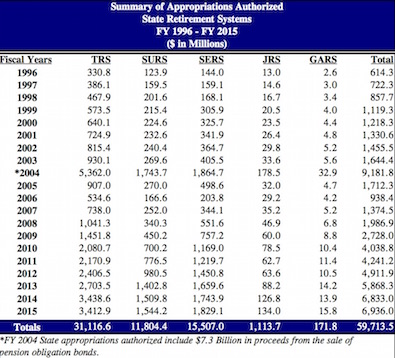
* Again, that unfunded liability is such a huge number that it simply boggles the mind. And, under the current “ramp” law, it’s gonna get bigger and therefore scarier over the coming years. From page 13 of the most recent COGFA pension report…
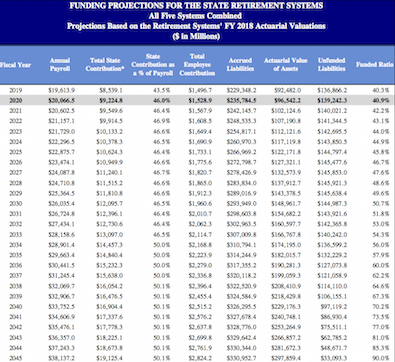
Click the pic if you’re having trouble seeing it.
From the current fiscal year through FY2028, when unfunded liabilities finally start trending downward, the state’s annual pension payments are projected to increase a total of $2.976 billion, or an average of about $300 million a year. That’s definitely not ideal, but it’s mostly manageable.
And the state is getting a break starting next fiscal year when its $1 billion annual payment on Gov. Quinn’s pension bond finally expires. That money could and should be put right back into the system, aside from the ramp.
However, there could be further changes in actuarial assumptions, which could drive these projected annual costs even higher. That’s happened often over the past several years.
In the 13 years starting in FY28, the back-loaded ramp will require total annual state pension payments to increase by $5.4 billion, or about $415 million a year. And, again, we don’t know what actuarial adjustments will be made. Annual payment increases continue to be pretty high every year through 2045, which is gonna have to be addressed.
* Speaking of the ramp, this COGFA chart from 2015 gives us a really good view of its back-loaded nature…
Whew.
74 Comments
|
|
Comments Off
|
*** UPDATED x2 *** Emanuel/Emmanuel
Wednesday, Dec 12, 2018 - Posted by Rich Miller
* Remember this post about the French riots?…
[Under French President Emmanuel Macron] pensions themselves have ceased to be indexed to inflation (and thus to retirees’ ability to buy consumer goods) […]
The tax will increase the price of fuel by about 30 cents per gallon and will continue to rise over the next few years, the French government says
* And then yesterday, Chicago Mayor Rahm Emanuel (one “m”) proposed doing away with the 3 percent automatic annual increase for pensions and proposed raising gas taxes by 30 cents a gallon, among other things.
Here’s how the mayor justified doing away with the pension AAI…
What kind of progressive, sustainable system guarantees retirees 3 percent annual compounded pay increases when inflation has been at basically zero
And here’s his reasoning for raising the gas tax…
Illinois last raised the gas tax from 16 cents per gallon to 19 cents in 1990. Emanuel said raising the tax by 20 cents would be about the equivalent to inflation over the past 28 years. He said the group of mayors settled on a range of 20 cents to 30 cents to serve as a guideline for state lawmakers when they take up debate on the issue next year.
So, inflation “has been at basically zero” to justify reducing future pension payments, but he uses more than 100 percent inflation to justify a gas tax increase.
*** UPDATE 1 *** Illinois AFL-CIO President Michael Carrigan and Chicago Federation of Labor President Bob Reiter…
“Too many politicians, including Mayor Rahm Emanuel himself, have wasted years pushing extreme, immoral and illegal schemes to slash pension benefits instead of working together to craft fair, sustainable and constitutional funding solutions.
“In Chicago and throughout Illinois, teachers, fire fighters, nurses, caregivers and other public service workers earn a modest pension and pay toward it from every check. Their pension is their life savings, and since most public employees aren’t eligible for Social Security, it is their main source of income in retirement. Reducing that already modest benefit—now just about $35,000 a year on average—is both unfair and unconstitutional.
“Those pushing to repeal the Illinois Constitution’s pension clause ignore the real problem, which is not the cost of benefits but the decades-long habitual failure of politicians to pay the employer’s share.
“They also ignore the clear, strong rulings of the Illinois Supreme Court, which have reinforced both the plain language of the pension clause and the sanctity of the contracts clause, which protect these obligations. Their unanimous decisions have forcefully made clear that any attempt to slash the modest benefits promised to employees already in a pension system would violate both Illinois and federal law.
“Real solutions are achievable, and we remain committed to working together with anyone of good faith to identify and implement them.”
*** UPDATE 2 *** Press release…
Following is a statement from Ald. Scott Waguespack (32), Chair of the City Council Progressive Reform Caucus, in response to Mayor Emanuel’s proposed constitutional amendment on pensions:
“Our caucus opposes Mayor Emanuel’s proposed constitutional amendment to eliminate pension protections.
“These workers have held up their end of their agreement. They served our communities honorably throughout their careers with the assurance that their retirement would be secure. Now, Mayor Emanuel is proposing going back on that promise, and making even more vulnerable the retirement security of tens of thousands of workers who cannot rely on Social Security.
“Mayor Emanuel has missed many opportunities over the last eight years to fight for progressive revenue options to fund our pensions. We urge the next mayor to work with Springfield to achieve a progressive income tax that asks the very wealthy and big corporations to pay their fair share, and the legalization and taxation of recreational marijuana to help fund our pensions.”
51 Comments
|
* Some people will believe anything, particularly on Facebook. From November 13th…
This was written by Carl Segvich, committeeman in Cook County. He friended me awhile back so I accepted. He is a…
Posted by Scott Finch on Tuesday, November 13, 2018
It got quite a bit of play on Facebook. I don’t spend much time on that site (partly because of silly stuff like the above post), but I did receive an e-mail the other day asking me if the Pritzker “proposal” was real.
* St. Louis TV station KSDK reached out to 11th Ward Republican Committeeman Carl Segvich to ask him about his post…
Pritzker’s transition team tells 5 On Your side it’s “not a real proposal” and there’s “absolutely no truth to that.”
We called the man whose name is on the post - a Chicago area Republican Committeeman Carl Segvich. Segvich confirms he shared the post, but insist he’s not the one who wrote it. And he concedes, he now knows it’s not true. There is no plan to tax people for leaving Illinois.
“It’s all fake. It’s all false,” said Segvich. “And, I believe I erroneously passed it along. No big deal really.”
5 On Your Side legal analyst, Jon Ammann from Saint Louis University Law School says this “departing tax” idea would also be unconstitutional. He says it goes against the 14th Amendment and the right to live and travel where we want.
He just “passed it along.” OK.
* Snopes even got into the act…
We reached out to Jordan Abudayyeh, Pritzker’s spokeswoman, who confirmed that the contents of post circulating on Facebook were “absolutely not true” and appeared to be nothing more than a hoax or an unflagged attempt at satire.
Prtizker, a billionaire and Hyatt hotel heir, won the Illinois gubernatorial race on 6 November 2018 by a wide margin over Republican incumbent Bruce Rauner. Pritzker and his Democratic colleagues supported replacing the state’s flat income tax with a progressive income tax, which would mean higher rates for wealthier Illinoisans with tax breaks for others. However, we found no evidence to suggest Pritzker had ever floated charging residents a special tax assessment for moving out of the state, and it’s unlikely any such plan could be legally implemented.
Segvich, by the way, has done campaign work for Bob Grogan, Adam Andrzejewski, Jim Oberweis and Tony Peraica. From his LinkedIn page…
It’s about The American CULTURE (Political) War. Voting for any democrat is a vote for deranged Public Policy.
56 Comments
|
|
 Support CapitolFax.com
Visit our advertisers...

 ...............
 ...............
 ...............
 ...............


|
   
|
Hosted by MCS |
SUBSCRIBE to Capitol Fax |
Advertise Here |
Mobile Version |
Contact Rich Miller
|