* Probably no surprise. The Supremes obviously did not want the Rauner-era cases reaching it…
The governor commented on it today…
It’s an unusual circumstance that the Supreme Court would in fact take a case directly from circuit court and not let it go through the normal process. But I think it was the right thing to do for the AG to seek the Supreme Court’s intervention. But the Supreme Court is not saying they’re not going to rule on this ever. They’re just saying that they don’t want to skip over the appellate court, I understand.
9 Comments  
|
* Gov. Pritzker began today by talking about some new modeling. The Sun-Times has a story out about this and you can read some excerpts here. On to the governor…
So far we are not seeing significant declines in key metrics like hospitalization. Updates to our models reflect that data, compared to the forecasts that I shared with you on April 23, which predicted peaking between the late April and early May. That timeframe of plateauing near a peak has been expanded from mid May into mid June. On April 23, which predicted peaking between the late April and early May, that timeframe of plateauing near a peak has been expanded from mid May into mid June.
In many ways, this news is, disheartening.
We have made great progress, but it’s forced us remain at a moderated though still high level of key metrics for this extended period. Pushing out of our estimated peak is a natural consequence of flattening the curve. Remember, no one can truly stop this virus without a vaccine.
What we’ve been aiming to do since early March is slow down the exponential rate of transmission. We do that, it leads to a slower rate of infections over a longer period of time, giving our healthcare system ability to treat those who have complications, giving our pharmaceutical researchers and to develop effective treatments, potentially a vaccine to the peak down and therefore to a longer timeframe might not sound like good news to some, but I promise you, is saving lives.
Remember to pardon all transcription errors.
* He then said that the R Naught value for Illinois is 1…
Once we get down to an R naught value below 1, that will be very good news.
* Regions…
Thus far, all of our regions are on pace, they hit all of the metrics for moving forward after the 28 day period with possibly one exception. The Northeast region. The positivity rate as of midnight on May 8 is at 22.3%, which is of course higher than the 20% cap this metric [needs] to move into the next phase. Positivity rate cap will be measured over a 14 day period. So there’s time for the Northeast region to fall below this.
For what positivity looks like in the other regions, the North Central Region is sitting at 9.1%, central region at 6.0%. The southern region is at 10.5%.
* From a press release…
All four of the regions are meeting many of the key metrics, with three of the four on pace to meet all of the Restore Illinois reopening metrics to move forward after the 28-day period: North-Central, Central and Southern.
As of midnight, May 8, the Northeast region’s positivity rate is at 22.3 percent, higher than the 20 percent cap on this metric to move into the next phase. The North-Central region is at 9.1 percent, the Central region at 6.0 percent, and the Southern region at 10.5 percent.
All of the regions have seen a dip in hospitalizations since May 1st: 18.6 percent decrease in the Northeast region, 35.8 percent decrease in the North-Central region, 44.4 percent decrease in the Central region, and 54.3 percent decrease in the Southern region.
A requirement to move forward to next phase is that a region sees no overall increase, rather stability or a decrease, in hospital admissions for COVID-like illness across a 28-day period.
As of midnight May 8, all four regions met the third requirement of available surge capacity of at least 14 percent for ICU beds, medical/surgical beds, and ventilators.
* On to questions for the governor. First of all, can we talk about your senior staff or could you give us some more information? How long have you known that the person tested positive how long do you expect to be working from home?…
We’re going to follow the doctor’s orders here. We’ve discovered a person who tested positive late in the week in fact I think that we were notified on Saturday. So, the test had been done a few days earlier in the week. That was when we discovered. And it’s slightly different lengths of time, but people depending upon their contact the person how recent that contact was etc.
* And do you plan to identify who the person is for those of us who might have been in the Thompson center, who wonder as well, should we be tested?…
No, we don’t want to reveal the name of the person who tested positive, that would be a breach of their privacy. However, they have given us all of their contacts or locations, they were in. They were not in the Blue Room at any time for any of the conferences. And so there’s no reason that you or any of the press would have been exposed to that person.
* How close in contact are you to that person?…
They work on the same floor down the hall, like, know how many feet but by the number of feet down the hall from me. I don’t have regular every day contact with that person directly, although that person would sometimes would every day sit in a large meeting room where we were all socially distancing. And so, you know, out of an abundance of caution I think we all that because that person is there every day and they interact with no other members of the staff on a regular basis and me on a slightly irregular basis that we wanted to make sure that we followed all the rules for socially distancing and, and in particular to isolate this person.
* This person works in a public job. It is different than working in a private company. The White House has released the names of the two people who would have tested positive. Would you not want to be as transparent as the White House?…
This is not a public person. And again, This person you know we’ve identified all this person’s contacts and just like the contact tracing protocols, a call for that there’s no release of the name of the person who was found to have COVID-19, but all of their contacts are notified that person had COVID-19 and what the options are for self isolating getting testing etc.
* How is that person feeling?…
Thank you. I was in contact with that person today. That person is still asymptomatic. And so feeling fine although obviously it’s, it’s, you know, an anxious written moment for that person just to know that they’ve tested positive.
* Some are asking, are you, where are you right now, are you in Chicago?…
I’m in Chicago I have been in Chicago for 60… I don’t know for quite a while. 60-some days and, and I’m at my home. Thank you.
* Even though you are feeling healthy does this incident make you consider about putting a succession plan in order, should you come down with COVID-19 and the Lieutenant Governor needs to step in?…
The succession plan is in fact in the Constitution. And as you know, we have a terrific lieutenant governor highly capable person who, if she needed to step in we would of course be terrific at managing everything. But, you know, but I feel fine and I have tested negative and so I don’t think at least at the moment that there’s any real danger.
* Today, the still persistent questions about the unemployment. I know that those filing and those who are freelancers and contract workers. Finally are able to get online and I would be remiss if I didn’t name all of the reporters who have asked me a question at least five have asked me to ask you, are still problems freelancers are not impressed at all with adding staff. It’s asking for driver’s license. Some people their driver’s license has expired. During this time, there are persistent problems even today…
Well let’s start with that. There have been 44,000 successful connections online for people who wanted to file today.
And those people have been able to connect their applications, many of them have been submitted their, the you know the challenges that exist for people who have an expired license, I can’t speak to the expiration of their license except that the Secretary of State has extended the expiration of licenses for everybody that whose license expired during this period so they shouldn’t worry about that. I think a bigger challenge is, we had some glitches again with phone calls today. The entire system for the state of Illinois actually had some interruption today. And so that went down, I believe it’s back up again. But other than that, the on the first day of launch of this new system, the number of people who’ve been able to successfully file, my understanding has been quite large.
* Today, House Minority Leader Durkin as well as Bill Brady sent a letter, and they’re saying and they’re asking again to reconsider your extension. They feel the 28 days is just too long, and would you possibly consider a 14 day measurement instead of the day that they announced it?…
Just to give you some perspective that we announced the restore Illinois, the metrics was actually the sixth of May, I believe, we were already six days into the 28 days so there were, I think 22 days left. If I’m wrong I’m off by one day.
But so the difference between 22 days and 14 days, we can have a discussion about certainly, but the effort here is the same I think. We all have the same goal, which is to get people back to work, but to do it safely. And remember that the 14 day guidance that was put out by the White House is actually more stringent than the guidance that we put out, guidance would have required 14 days of a decline. And what we require is simply following a flattened number for 28 days, which is a much easier metric, considering everything I’ve just told you in today’s update.
* At the same time, other places like even New York and New York is ground zero, Governor of New York today is going to start reopening on Friday, Massachusetts is going to start reopening on Monday. And yet we don’t hear in Illinois, a date, which has so many so anxious, whether or not that date is June one for some movement or not. Are you able to consider tweaking your plan?…
I think the earliest day would be the 29th of May, so rather than in June, but it’s the 29th of May. And we’re not looking so much at the tweaking of the plan, I think what we, remember that we did in fact open things up on May 1, we brought back retail, again curbside and delivery, retail, as well as making sure that we opened our state parks the, you know, and we’ve opened now our elective surgeries. So all of those things which you’re now identifying, those are things that are in other states plans that are just beginning now. We actually did about 10 days ago.
* We are glad you are taking the proper precautions, is anyone else in your family under a self-quarantining?…
We are following all the doctor’s orders here at home. So we have been really self isolating in my home anyway for some time now. So that’s, you know, we’re trying to follow all the best protocols and to keep each other safe.
* A Quincy bar and grill reopened this morning and other businesses say they plan to also do so by the end of the week. Seeing Adams County officials including law enforcement have stated they don’t plan to enforce your stay at homework, how are you going to allow these businesses?…
As I’ve said all along, people who open their businesses at this time, knowing that the mitigations are just now beginning to bend, you know, help us bend the curve down, we flattened it but the goal here is to bend the curve down. But ultimately that by opening early, they’re putting people at risk, and the potential here is that we’ll have an upsurge in Quincy of cases and hospitalizations and that will drive that whole region potentially to a point where it may not reopen. I think they’re putting people at risk and they’re putting the entire region’s economy at risk by opening early.
* What about restaurants that have been trying to open, you’ve been in discussions at all about perhaps opening before phase four?…
Certainly we’ve talked to staff people, our staff people rather have talked to leaders in the restaurant industry. I have been in contact with people in the restaurant industry and our goal, again, is to try to open everything in a reasonable amount of time as fast as possible while keeping people safe. And they’ve suggested in the restaurant industry leaders like Sam Toia, in which they want to do that. But it’s true that it is difficult. Open restaurants and bars in a circumstance in which to in phase three make sure that there aren’t groups of 10, or more than 10 gathering and making sure that we’re limiting the transmission, that can occur with the service of food and drinks.
* So you might consider before phase four is that what I’m hearing?…
No, I mean we put our plan out there. Look, let me rephrase that, change along the way here’s the biggest thing to change is if we get a treament. That’s the thing that will change the game and I’ve said all along that will alter the playbook if we need to.
The fact is that we put a plan out there really nothing has changed since we put the plan out there. So, no the intention here is to stick with the plan but it is true that I’m talking to people in various industries and listening to their ideas, most especially for when things open.
And then he was asked about premix cocktails.
Another question was asked about nursing homes that’s been answered a dozen times.
* If asymptomatic people spreading COVID-19 is a concern, this is from Greg Bishop, is IDOC performing these tests on inmates being released from prison. If not, why not?…
Well, IDOC is performing tests on staff on a regular basis and anybody that’s got any symptoms. And then, as people are being released they go through a process over a number of days before they actually are released. And so, again, they would likely show symptoms during the course of that process it’s known who’s being released for days in fact weeks before they are released so you know there’s not a go test every single one.
* What about contact tracing. What are the city requirements. This is from Univision, would you need any of these college certifications that are popping up, and how to folks apply to be contact tracers?…
People will be trained for free as part of the contact tracing program that we’re going to be, that we’re spinning up. And so it’s not that certain for people to pay for a program. If they get hired as a contact tracer, you get hired not based upon having a credential as a contact tracer, though we will be hiring healthcare workers. There are people who are community health care workers who have some of the training that’s already required. So those folks will be among the first that get brought in, along with the many people who are already doing contact tracing all over the state.
* And now I know I feel rather foolish asking this next question on such a more important note but I have been given this question from several people, Governor. Have you gotten a haircut. I know it seems like silly but so many folks would like to go get a haircut themselves, and they’ve noticed that you appear to have gotten a haircut, who did the haircut. Where did you go to get it…
No, I have a pair of clippers that I use that I’ve been using on the sides of my head. I asked my 15 year old to give me a little buzz on the back of my hair and that’s it. I haven’t had a haircut other than that, but I’m glad that people think that it looks like I had a haircut.
* Multiple churches in Chicago held services over the weekend. What would you say to parishioners and pastors who are gathering for services despite the stay at home order?…
You’re likely not only breaking the law and the mayor has made it clear that those services are not allowed, also, you’re potentially putting hundreds of people in danger. And that’s something that I think people should be thinking about. The parishioners and the faith leaders are conducting those services that don’t test about yourself it’s about all the many people. And even more importantly the many people will be come in contact with the people who attended those services, because we just talked about asymptomatic COVID-19. And so it’s it’s highly likely in fact that when the large groups of people are getting together right now, given that there isn’t enough manage across the country to manage, you know, large crowds to know that people that you’re with don’t have COVID-19. You know there are going to be carriers when getting together. So, just for people that while they’re carrying out their faith and that they believe in most which I hope include caring for your fellow human beings that they’ll take into account that caring for your fellow human beings in keeping them safe.
* Black Illinois hair stylists and barbers have been struggling without unemployment for weeks. And now stylists are going back to work in nearby states like Indiana. Is there any way Illinois could provide relief for stylists or allow them to safely reopen sooner here?…
As of today, independent contractors, small sole proprietors can apply for unemployment, under the CARES Act, and through the portal. It’s been provided at the Illinois Department of Employment Security. And of course, in phase three which as I spoke about many of the regions are headed toward the moving into phase three barbers and salons will be able to open back up.
* The Sun-Times reported Sunday that recent nursing home deaths in Cook County are concentrated in the poorest rated facilities. Do you have any plans to move residents out of those places? How about putting them in underused field hospitals, like the one the Cook County Commissioners suggested?…
I think I’d like to turn it over to Dr. Ezike from the Department of Public Health which oversees nursing homes. But I’ll just begin by saying that those alternate care facilities are really intended to be for transfers from hospitals, people who are less acute cases. And so that that was really what the purpose of those alternate care facilities was and it’s the best use of doctors.
Dr. Ezike: We want to reinforce the appropriate guidelines report enforce the appropriate infection control measures sure that these staff requirements for testing pre shift assessments. Those are consistent. Please remember that when you’re dealing with this fragile elderly population maybe many with maybe dementia or memory care issues repositioning them to an entirely different places is very unsettling and destabilizing and actually could potentially do more harm than good so. Ideally, we’d like to keep people in in the home that they know, that they’re comfortable with and be able to strengthen any deficiencies that are identified that that place can provide the appropriate care in the appropriate manner with the appropriate PPE and the appropriate staffing.
* Is it time to revisit restore Illinois plan and tweak it to include the regional concerns of the IML? Are you open to those ideas, are you prepared to stick by your plan, bear the responsibility, whether it succeeds or fails, without sharing it with the legislature?…
Lot of judgment in the last half of that question, but I just received a letter an hour ago from the Illinois Municipal League and understand that they would like to break the state into 11 regions, not just 4 regions. And I know there are other people who would like to break the state into every county, 102 counties and yet others like to do it by city or by town. And I’ll just say that there are lots of ways that it could be done, but there needs to be a uniformity to the way that we manage the state of Illinois. We’ve broken the state up into four regions, allowing each one of them with the same set of metrics to perhaps be faster to move into another phase than another. And so that’s why we put the plan forward as it is, as I say, as circumstances change as we find, for example, that there are fewer COVID-19 symptoms that are affecting people, because there might be a treatment available, we will of course, re-visit Restore Illinois. The goal here is to as I say reopen the state as fast as possible. But, in a safe fashion that saves as many lives as [possible].
* If Germany faltered on reopening when it’s R Naught value [was at] 0.7, how can Illinois be sure that not there won’t just rise again this summer?…
Dr. Ezike: We can’t assure that it won’t rise again this summer, and that is obviously the concern and that’s why we want to slowly and cautiously, be able to follow the data and move through these stages, to be able to properly assess how the changes that we make at each stage actually affect obviously the mobility of our residents which obviously affects the effective R, if people have been strictly at home, and then now they’re out and about a little bit. Obviously, the effective R or the I know that you’re referring to is not going to be the same and so being able to watch the effects of each of our changes is an important part of the evaluation as we move through these stages, so that hopefully we can catch before we get too far in the wrong direction. If some of the loosening has been too fast, and has resulted in, you know, strong spikes or peaks that we don’t want to see.
* How many times have you been tested for COVID-19, and with the governor’s office self isolating and working from home, how does that arrangement affect the administration’s ability to manage the current situation?…
Let me start with the fact that many of our staff people already were working from home. We tried to make sure that we did enough social distancing, allowing those particularly those who are most vulnerable, continue to do their jobs from home. The Illinois department of innovation, technology, did a terrific job of creating the opportunity for so many state employees to work from home. And so we took advantage of that by allowing much of our staff to work.
I think they’re doing a terrific job, they are there on the calls every day, they’re in touch with, all day long, working on projects throughout the day, getting things done.
The functions of the governor’s office have really been operating well, even with a smaller group of people working in the Thompson center or in Springfield. But now that we’ve moved the remaining 20 or so plus people out of the office for isolation, we’ve been in contact all day today, making sure that we’re following all the things that we need to follow each day, and getting things done. We’ve got to make sure that we’re moving swapped over eight locations across the state. You got to make sure that we’re continuing to build up our capability to do testing. The contact tracing effort is also spinning up. You know we have a number of things that are really swirling about and we’re all doing those, again, all day today we’ve been working on it, even yesterday.
I was tested earlier in the week. Last week, the others in our office when the whole office was tested. Those who are working in the office that is. And then, when there was the discovery of the one person.
There was a desire to have me tested again just in the wake of that, since enough days had gone by, of interaction with that person and so I was tested again yesterday. I think that I actually did the swab early in the morning of the test came back four hours later, I believe and it tested negative.
* There are signs that legislators want to see action on a bill to somehow delay or give a break to people on paying their property taxes this year, perhaps waiving fees and interest. If you still consider that a strictly local matter, given that the deferred income taxes by three months?…
Well, we certainly need to consider everything that we can to alleviate the burden on people across the state so anything that we can do is worth considering. Obviously there are pros and cons to each one of these things. When you decide, for example, to not collect property taxes, you’re affecting local governments and their ability to deliver services. But of course, I know that there are people that are struggling perhaps to pay their property taxes. So, I think all that should be considered by the legislature, and I’m hopeful that the legislature will be in session soon so that they can consider that, something that I would consider.
* Do you believe the legislature must assemble in some form before July 1 to pass a budget. Are you prepared to go without one like Bruce Rauner?…
I think you know I’m nothing like Bruce Rauner and don’t believe much in what he was doing. But I do believe that the legislature should get together and convene, so that a budget can be passed. There are a number of other vital things, it’s a short list of things that are absolutely necessary. From my perspective, a budget is one of those things.
* State Board of Education last week that districts should develop plans for virtual summer school, and that summer school won’t occur in person. Toggle notify parents Friday is the state planning on expanding funding available for summer schools or should districts then use their emergency care tax funds, you determine how you plan to use the emergency funding that governors are receiving directly for schools, and if so, is summer school on the table?…
Certainly a lot is being invested through the carriage act directly with schools for eLearning and other summer programs but the same thing is also true through the governor’s office, that is to say the cares Act provides for the governor’s office to do so. And we are focusing much of that on E learning and also on making sure that we’re dealing with kind of potential of a loss of learning over the summer.
So those are all things that we’re considering and as you look at the restore Illinois plan, you know obviously in a phase three when, still we can’t have gatherings of more than 10 people, it would be very difficult to have in person summer school, though, possible in very small groups, but not likely in many places. So it would have to really be in phase four. And that also could occur in the middle of the summer.
* Amanda Vinicky at WTTW would like you to comment on the breaking news of the Illinois Supreme Court will not take up the AG’s request to weigh in on your authority, regarding successive orders during emergencies…
It’s an unusual circumstance that the Supreme Court would in fact take a case directly from circuit court and not let it go through the normal process. But I think it was the right thing to do for the AG to seek the Supreme Court’s intervention. But the Supreme Court is not saying they’re not going to rule on this ever. They’re just saying that they don’t want to skip over the appellate court, I understand.
* Illinois has COVID-19 data based on age, race and ethnicity, but there is no sort of data on basis of sexual orientation or gender identity. Is that something you’re considering?…
It’s not something that’s being asked on the forms that people are submitting, the hospitals are submitting.
Dr. Ezike: It’s not collected on any information on any forms that currently exist. It’s something that we can put towards our advisory committee to see if that’s something we should be looking into, but again there are no forms that request that information.
* Why did no collar county hospitals received [remdesivir] including hard hit areas like Waukegan Joliet and Elgin, please explain more on the detail on the criteria use…
Dr. Ezike: So we do try to do a rank order of hospitals who had participated obviously in COVID care that has the largest number of hospitalizations, ICU admissions. But we also had to try to make sure that it was distributed throughout the state as I mentioned earlier that all restore areas got some drug and we also wanted to make sure that we have included some safety nets and we also wanted to include some hospitals that concentrated had care for communities of color. So using all of those and knowing that there are over 200 hospitals and we only had 240 cases and we weren’t going to open up the cases and start breaking up individual vials for people we had quite a few limitations and came up with really the most equitable data driven strategy that we could. Again we’re hoping to get more and we will definitely take into account people who received previously, when we, when we get the new shipments. Again, I don’t have any information on what those future shipments are coming in.
* Governor, you said on CNN yesterday ‘we think that we can have a massive contact tracing program up in the next few weeks. How is that possible?…
Yeah. Perhaps I didn’t word it quite correctly. What I was trying to say was, we are spinning up a massive contact tracing effort across the state and over the next few weeks that will be launched and it will be a large effort. That it is going to take us, you know some time to hire up and make sure that we’ve got the breadth that we need and all the people that we need
But I also want to say that backing up that a large contact tracing effort that we’re trying to get and running here is the existing contact racing effort that we’ve got really across almost every county in the state. And so we’re plugging in the existing capability, as well as many of the community health care workers. Chicago has hundreds of those already and has suggested that they will be bringing those people into this new larger contact tracing effort. I have confidence that we will have grown this significantly. But yes it’s true that it’s over more than just a few weeks it will take in order for this to become massive. But it is a plan you know when you’re talking about having over 3000 people do contact tracing. And we’re starting with no central organization to do that from when you serve with a plan and and a leader, and you know and and know which direction you’re going, we’re going to go as fast as we can.
* Representative Darin LaHood has recommended the Adams County plan for reopening and downstate and collar counties in the state. Have you looked at that plan and Do you agree with it?…
I have looked at that plan. Indeed I spoke with the mayor of Quincy about that plan and I read that plan that has a lot of really good points in it, some of which I have considered in the process of putting together the Restore Illinois plan. So there’s a lot of overlap. I think the biggest differences, frankly are timing. There are people who want to open everything up sooner, much sooner. I talked a little bit earlier in my remarks about the fact that if we did that we would really have a surge of cases and it could potentially lead to an overwhelming of our hospitals, and many more people getting sick. But, you know, we have a good plan out there. It is a regional plan, and it takes into account that Adams Kennedy is very different than Cook County.
* Will you Governor place a moratorium against creditors that are affecting credit scores negatively and threatening judgment against Illinois who are already facing challenges to sustain their livelihoods during this pandemic?…
You know, it’s an excellent question and I had conversations this morning with an economist about some of the things that we need to be thinking about given the severity of this financial downturn, and its impact on families and individuals and small businesses too, and how we might mitigate those, allowing people to restructure and not have it affect them on a permanent basis the way that sometimes a bad credit rating can. It can affect somebody. So, it is something that’s part of a broader effort that I’m talking to experienced economists about.
-30-
22 Comments
|
1,266 new cases, 54 additional deaths
Monday, May 11, 2020 - Posted by Rich Miller
* Dr. Ezike began the press conference with an announcement based on this news story…
The only drug given emergency authorization by the Food and Drug Administration to treat patients with the coronavirus has arrived in Illinois, and more than 90% of it will go to patients being treated at hospitals in Cook County.
The 140 cases of remdesivir Illinois received Saturday contain enough vials to treat approximately 700 patients — about five patients per case.
But there’s not enough to go around, in Illinois or elsewhere.
As of Sunday, there are 1,232 patients across Illinois in intensive care units, 709 of whom are on ventilators, with the number of cases continuing to rise.
* And on to the briefing numbers…
Over the past, 24 hours, I do need to report that 54 additional deaths were reported, bringing our total COVID-19 death toll to 3459.
The last 24 hours 1266,new cases have been reported for a total of 79,007 cases here in Illinois. […]
As for hospitalizations across the state, 4319 people in Illinois were reported to be hospitalized with COVID-19, of those 1248 patients were in the ICU and 730 patients were on ventilators. To date, 442,425 tests have been performed, of which 12,441 were reported in the last 24 hours.
* Sun-Times…
The positivity rate statewide as of Monday is 10.17%. In the Northeast region, which includes Cook County and Chicago, the positivity rate is about 22%.
The number of COVID-19 patients entering ICU beds went up by 16, from Saturday to Sunday night, according to Pritzker’s office. The number of ventilators being used by coronavirus patients also increased by 21, and the total number of COVID-19 patients increased by 26 patients.
Pritzker on Monday planned to outline regional data about hospitalization and the virus’ spread. His administration also planned to release an updated model by researchers from Northwestern University, University of Illinois at Urbana-Champaign and the University Chicago.
The latest projection shows Illinois is in a death peak, which is less like a peak and more like a plateau. The death range is between 50 and 150 deaths a day into early June for both Northwestern and the University of Illinois at Urbana-Champaign. The University of Chicago, however, has estimated a range of 50 to 300 deaths that could last until July.
The Urbana-Champaign and Northwestern researchers believe deaths could begin decreasing by the end of May into June, although the Northwestern model shows a slower rate of decline. The University of Chicago researchers believe Illinois will remain on a death plateau until July.
* Press release…
The Illinois Department of Public Health (IDPH) today announced 1,266 new cases of coronavirus disease (COVID-19) in Illinois, including 54 additional deaths.
Boone County: 1 male 60s
Coles County: 1 female 90s
Cook County: 1 female 50s, 3 males 50s, 6 females 60s, 4 males 60s, 5 females 70s, 4 males 70s, 2 unknowns 70s, 8 females 80s, 7 males 80s, 1 unknown 80s, 5 females 90s, 1 female 100+
DuPage County: 1 female 90s
Kane County: 1 female 90s
McHenry County: 1 male 90s
St. Clair County: 1 male 50s, 1 male 70s
Currently, IDPH is reporting a total of 79,007 cases, including 3,459 deaths, in 98 counties in Illinois. The age of cases ranges from younger than one to older than 100 years. Within the past 24 hours, laboratories have processed 12,441 specimens for a total of 442,425.
In addition to other congregate settings, cases at Illinois Veterans’ Homes are being monitored. Currently, the home in Manteno is reporting 40 cases – 30 residents and 10 staff. One resident at the LaSalle home tested positive but has since tested negative, and there have been no cases reported at the Anna or Quincy homes. All residents and staff at Manteno and LaSalle have been tested. Specimens are currently being collected at the home in Anna and will be collected at the Quincy home on Wednesday.
The Illinois Department of Veterans’ Affairs is following guidance from state and local health officials, which includes continuing health screenings, maintaining social distancing practices, wearing face masks, using gloves and gowns when indicated, and intensified cleaning.
7 Comments
|
COVID-19 roundup
Monday, May 11, 2020 - Posted by Rich Miller
* From the two GOP legislative leaders…
Governor Pritzker,
Like you, we believe our top priority during these unprecedented events is the health and wellbeing of our citizens. We also believe it our goal as leaders to address the economic crisis facing our state as well. As other states have laid out less restrictive paths toward reopening, like New York that is partly opening this week, we believe Illinois needs to follow suit.
Last week, you unveiled your Restore Illinois plan that we believe is far too restrictive to those businesses struggling to stay afloat economically during this crisis. Furthermore, the parameters your plan puts in place in determining when a region can move between phases will only cause further economic hardship to small businesses and our state.
To that end, we stand in support of the Illinois Municipal League’s call for revisions to your plan. Specifically, we endorse their call to see our state use the 14-day period before moving between phases, not the 28 days your plan imposes. We believe this adjustment, coupled with using the 11 hospital regions that are already in place, would be a positive first step forward in assuaging the economic devastation this crisis is causing.
Furthermore, we are also asking that you call a special session of the Illinois General Assembly so that we can further discuss and develop the necessary adjustments to your plan that protects the public’s health while at the same time moves our economy forward more quickly.
We stand ready to return to the people’s Capitol to work together during this critical period in our state’s history.
Sincerely,
Bill Brady
Senate Republican Leader 44th District
Jim Durkin
House Republican Leader 82nd District
OK, but Gov. Cuomo said last week that no region was on track to reopen…
And, as I told subscribers last week, people generally don’t do nuance. They see New York’s 14 days and the White House’s 14 days and Pritzker’s 28 days and freak out. A 14-day timeline doesn’t mean it’ll happen in 14 days. I don’t think any state could advance to the next level under the White House plan for quite a while, and it’s not certain that any region in New York will get to the next level by May 18th. But that’s on Gov. Pritzker to explain. He hasn’t done a good job of that to date.
…Adding… Three New York regions are allowed to partially reopen, according to news reports today. But they’re reopening includes manufacturing and construction. Most manufacturing and construction here has carried on throughout.
Also, calling the General Assembly into special session won’t do much good unless the majority party leaders are ready to do something (see Rod Blagojevich). At least one of those leaders doesn’t yet appear ready. At least, he’s not ready to come back this week because he canceled session last week.
* Smart take from Laurence Msall…
University of Pennsylvania Professor Robert Inman recently projected that U.S. states and their local governments will lose $275 billion in sales and income taxes in the coming fiscal year—a 20 percent decline. California officials anticipate an upcoming $54.3 billion deficit that would deplete the state’s rainy day fund multiple times over. Illinois faces a shortfall of as much as $7.4 billion next fiscal year as a result of ongoing economic disruption. Chicago, Peoria, Rockford and cities in every state are experiencing similarly dramatic revenue losses.
While some entered the pandemic in stable financial condition, and some much less so, all of our state and local governments are now or will soon be in major distress. No state or local government can be faulted for the economic calamity caused by the coronavirus. Nor does any state or local government have the capacity to weather this crisis on its own.
The U.S. government is the only entity that can—and therefore must—take action to help all of its governments. Calls to exclude the Illinois, Chicago or other major governments from future rounds of relief because of past bad fiscal decisionmaking are misguided and threaten full national economic recovery.
Our city and state continue to face financial and governance challenges of their own creation. Entire columns can be (and have been) written on what our state and city need to do to help themselves: Pension reform. Increased efficiencies. Property tax relief. Government consolidation.
However, as the nation’s fifth largest economy, Illinois serves as an essential hub for national and international commerce. And as Illinois’ economic engine, Chicago supports substantial portions of not only the State of Illinois’ economy but also the Midwest and national economies.
* Press release…
The Horsemen and Women of Fairmount Park to Rally for safe, spectator-free racing!
In a sign of solidarity, Fairmount Park Horsemen are holding a rally parade in an attempt to convey to the Governor’s Office the desperation to return safely to spectator-free racing. As owners, trainers, and employees in the agriculture industry – the men and women of Fairmount Park have been working daily caring for the equine workforce. During the winter months these athletes get a much-deserved rest but maintain a race-ready fitness during racing season leaving them ready yet dormant until the current restrictions are released.
Some 200 employees currently living and working at Fairmount Park will only require an additional 25 people on the grounds to race a safe, spectator-free racing. All of this can be safely executed while maintaining CDC guidelines for public safety allowing us to take care of ourselves, our families, and contribute to the local and state economies. So many businesses do not have the luxury of safely returning to work while being able to maintain social distancing and restricting groupings, we can. We humbly request the ability to do our jobs while safely staying within all guidelines requested of us.
We are not asking Illinois to venture into the unknown during these uncertain times. Spectator- free racing is currently being conducted all across the United States in Oklahoma, Florida, Nebraska, California and beginning May 16th in our neighboring state of Kentucky.
The Rally Parade for Racing at Fairmount Park will be through Collinsville, IL at 1pm on Tuesday. Instead of Fairmount Park’s “Horse Hooky Tuesday” Racing event, we’ll be rallying for racing! We hope to see you there!
* Sun-Times live blog…
‘Those who can pay rent must’: Chicagoland Apartment Association fears ‘tremendous amount of foreclosures’
Aldermen protect workers from retaliation for COVID-related absences, ease up on businesses
Risk of reopening US economy too fast: A W-shaped recovery
MLB’s coronavirus antibody test for employees yields 0.7% positive rate
A Cook County Jail correctional officer died Sunday of apparent complications of COVID-19.
Time for Illinois Legislature to get back to work — safely and remotely
* Tribune live blog…
MLB owners approve a plan to start the season — without fans — in July
Wisconsin Gov. Tony Evers allows nearly all nonessential businesses to reopen with limits
Chicago to open six more testing sites in neighborhoods, will try to reach 10,000 tests per day goal
Northwestern University furloughs staff, cuts leaders’ pay to address financial fallout of pandemic
Abbott Labs prepares to ship antibody tests after obtaining emergency use approval from FDA
Lightfoot criticizes Northwest Side church for holding in-person Sunday services
A majority of Americans disapprove of protests against state coronavirus restrictions, though support for closures dips, poll shows
Food, iPads, care packages part of groundswell of donations to Roseland hospital following Tribune story
Legal aid organizations strained by increase in pandemic-related cases, including domestic violence, unemployment claims
27 Comments
|
Today’s must-read
Monday, May 11, 2020 - Posted by Rich Miller
* The Atlantic has helped lead the way in COVID-19 coverage. And this new article is fascinating. An excerpt…
Public-health campaigns that promote the total elimination of risk, such as abstinence-only sex education, are a missed opportunity to support lower-risk behaviors that are more sustainable in the long term. Abstinence-only education is not just ineffective, but it’s been associated with worse health outcomes, in part because it deprives people of an understanding of how to reduce their risk if they do choose to have sex. And without a nuanced approach to risk, abstinence-only messaging can inadvertently stigmatize anything less than 100 percent risk reduction. Americans have seen this unfold in real time over the past two months as pandemic shaming—the invective, online and in person, directed at those perceived as violating social-distancing rules—has become a national pastime.
The anger behind shaming is understandable. Photos of crowded beaches or videos of people at a large indoor party may make viewers feel as if they’re watching coronavirus transmission in action. Calling out seemingly dangerous behavior can also provide an illusion of control at a time when it’s particularly hard to come by. But, as years of research on HIV prevention have shown, shaming doesn’t eliminate risky behavior—it just drives it underground. Even today, many gay men hesitate to disclose their sexual history to health-care providers because of the stigma that they anticipate. Shaming people for their behavior can backfire.
Berkowitz and Callen knew that indefinite abstinence wasn’t realistic for everyone, and instead of shaming, tried to give gay men the tools they needed to be able to have sex with a low but non-zero risk of HIV transmission. In essence, this is the harm-reduction model, which recognizes that some people are going to take risks, whether public-health experts want them to or not—and instead of condemnation, offers them strategies to reduce any potential harms. This approach meets people where they are and acknowledges that individual-level decisions happen in a broader context, which may include factors that are out of people’s control.
What does harm reduction look like for the coronavirus? First, policy makers and health experts can help the public differentiate between lower-risk and higher-risk activities; these authorities can also offer support for the lower-risk ones when sustained abstinence isn’t an option. Scientists still have a lot to learn about this new virus, but early epidemiological studies suggest that not all activities or settings confer an equal risk for coronavirus transmission. Enclosed and crowded settings, especially with prolonged and close contact, have the highest risk of transmission, while casual interaction in outdoor settings seems to be much lower risk. A sustainable anti-coronavirus strategy would still advise against house parties. But it could also involve redesigning outdoor and indoor spaces to reduce crowding, increase ventilation, and promote physical distancing, thereby allowing people to live their lives while mitigating—but not eliminating—risk.
Second, health experts can also acknowledge the contextual factors that affect both a person’s decisions and their risk of coronavirus transmission. Some people are seeking human contact outside of their households because of intense loneliness, anxiety, or a desire for pleasure. The decision to go for a run with a friend or gather in a park with extended family may be in conflict with current public-health guidance in some communities, but for some people, the low risk of coronavirus transmission in these settings may be outweighed by the health benefits of human connection, exercise, and being outdoors. We can also acknowledge that some people can’t comply with public-health guidance because of structural factors, including systemic racism, that render physical distancing a privilege. If we ignore this broader context, people of color will continue to bear the brunt of not only the pandemic itself, but also American society’s response to it.
Third, Americans can accept that, despite our best efforts, some people will choose to engage in higher-risk activities—and instead of shaming them, we can provide them with tools to reduce any potential harms. Want to see your grandkids? Still planning to have that party? Meet up outside. Don’t share food or drinks. Wear masks. Keep your hands clean. And stay home if you’re sick.
* Related…
* Don’t Close Parks. Open Up Streets.
23 Comments
|
Elections have consequences
Monday, May 11, 2020 - Posted by Rich Miller
* January of 2018…
In September, Chicago Police Officer John Catanzara made headlines after posting on Facebook a picture of himself, in uniform, holding an American flag and a homemade sign that read, “I stand for the anthem. I love the American flag. I support my president and the 2nd Amendment.”
He was reprimanded for violating rules that prohibit officers from making political statements while on duty. But if that discipline was intended to change his ways on social media, Catanzara instead is living up to the words he uses to describe himself on Facebook: “A give no f#$%s, say it like it is man.”
Since he was disciplined last fall, the veteran officer has remained outspoken and defiant, posting inflammatory material about women, welfare recipients and those who disagree with his politics.
He has tangled with Facebook users who question him. “Keep listening for that knock on the door,” he responded to one critic.
And, more than once, he has boasted that he will continue to avoid serious punishment. Police superintendents have twice tried to fire him, though he appealed the efforts and won.
“The police dept didn’t and CAN’T fire me,” he wrote last fall, after the flag post went viral.
* Saturday…
Rank-and-file Chicago police officers have chosen John Catanzara as the new president of their union for the next three years, replacing incumbent Kevin Graham in a runoff election. […]
Graham assumed union leadership three years ago after beating former President Dean Angelo Sr. in another runoff. Graham and Catanzara were two of five candidates running in the general election in March.
Graham’s time in FOP leadership has been hallmarked by his criticism of the Chicago Police Department’s reform efforts and consent decree, which were spurred by the release of the Laquan McDonald shooting video and subsequent investigation by the U.S. Department of Justice. […]
Catanzara was stripped of his police powers and assigned to administrative duty for filing a police report against now-fired police Supt. Eddie Johnson after Johnson marched arm-in-arm with the Rev. Michael Pfleger on the Dan Ryan Expressway.
* Tribune…
In August 2008, then-Superintendent Jody Weis sought Catanzara’s firing on allegations that he did not follow orders to complete a psychological exam, according to Chicago Police Board records. But in February 2009, the board cleared Catanzara in a 5-3 decision.
Three years later, then-Superintendent Garry McCarthy tried to fire him for working a side job as a security guard for a restaurant when he was supposed to be on medical leave for a back injury.
The Police Board found him guilty in that case of several Police Department violations, board records show. But instead of firing him, the board voted 7-2 to suspend Catanzara for 20 days.
The department in 2017 issued Catanzara a reprimand — among the lightest punishments a Chicago cop can face — for violating rules that prohibit officers from participating in any partisan political campaign or activity while on duty.
* CBS 2…
• He was once suspended for 30 days following an investigation into allegations of domestic abuse in 2003.
• He was reprimanded following an investigation into an allegation of excessive force in 2003.
• He was suspended for six days following an investigation into allegations of conduct unbecoming an officer by associating with a felon while off-duty in 2003.
• He was suspended for 20 days following an investigation into allegations of conduct unbecoming by associating with a felon while off-duty in 2004.
• He was suspended for 10 days for insubordination in 2005.
• He was suspended for 15 days following an investigation into an allegation of a personnel violation at an Old Town tavern in 2007.
• He was suspended for 20 days after the Chicago Police Board found him guilty of violating department rules by working as a private security guard while on medical leave for a back injury in 2008. Supt. Garry McCarthy had sought to fire him.
• He was suspended for 10 days following an investigation into miscellaneous personnel violations in 2013.
* WTTW…
In his 25 years on the force, Catanzara has received no major awards, but six honorable mentions – more than 55% of officers. But according to the Citizens Police Data Project, he has also been the subject of 50 allegations — more than 96% of Chicago police officers.
29 Comments
|
* AP…
Sandoval, an immigrant from Colombia, is among tens of millions of Americans living in multigenerational homes where one of the main strategies for avoiding infection — following social distancing protocols — can be near impossible. […]
In the U.S., roughly 64 million people live in multigenerational family households, or 1 in 5 households, according to Richard Fry, a senior researcher at the Pew Research Center. But it’s far more common among people of color: 29% of those households are Asian, 27% are Hispanic, 26% are African American and 16% are white.
Fry said two major factors accounting for multigenerational living are location, with higher rates in densely populated urban centers where the cost of living is high, and culture, especially for immigrants in the U.S. Living with family into adulthood, common in many parts of the world, was blamed for contributing to the spread of the coronavirus in Spain and Italy.
For families of color in the U.S., there’s also more chance that household members can’t work from home as federal guidelines suggest. Fewer than 20% of black workers can telework, according to a March study by the nonpartisan Economic Policy Institute.
Generations living together under one roof doesn’t explain everything, however. According to the US Census, 5.6 percent of Illinoisans lived in a multigenerational household in 2013. Hawaii’s number was 11.1 percent and it has one of the lowest deaths and cases of COVID-19 per million population in the country.
If you combine the lack of teleworking opportunities and the intergenerational living arrangements, you may be on to something. Son contracts the virus at work, passes it along to mom who winds up in the hospital or worse.
4 Comments
|
* Remember, these numbers also include staff…
Coronavirus outbreaks continue to ravage Illinois nursing homes as new state data show at least 1,553 deaths associated with long-term care facilities.
The death toll climbed by 471 from 1,082 reported a week ago. Nursing home deaths now account for nearly 48% of the 3,241 fatalities statewide, according to weekly figures released by the Illinois Department of Public Health Friday.
Cook County facilities recorded 863 deaths. IDPH reported 203 deaths in DuPage and 107 in Lake.
The case numbers include residents and employees who have symptoms but have not yet had a test confirm COVID-19. State officials also have deferred to individual facilities and local health departments for “the most up-to-date data.”
* Sun-Times…
The worst rated nursing homes in Cook County have the highest concentration of deaths from the coronavirus — and some have failed inspections during the pandemic, a Chicago Sun-Times investigation found.
About 28% of the deaths from COVID-19 complications have happened in nursing homes with the lowest federal rating and only 6% in the facilities with the highest rating.
That disparity shows the state should focus testing and inspections in poorly rated nursing homes, experts said. […]
Medicare gives one star to the worst-ranked nursing homes and five stars to the best.
The one-star nursing homes had 28% of all the coronavirus deaths and the two-star facilities had 30% of them.
In contrast, the five-star facilities had 6% of the deaths.
* WBEZ…
The nursing home with the state’s highest COVID-19 death count was Meadowbrook Manor of Bolingbrook, a 298-bed facility at 431 W. Remington Blvd., about 30 miles southwest of downtown Chicago. That facility had 26 confirmed coronavirus-linked fatalities and 173 cases — all disclosed by the state within the past two weeks. […]
The next-highest coronavirus death tallies were at Symphony of Joliet, which had 24 fatalities, Elevate Care Chicago North in the city’s West Ridge community, which had 23, and Center Home for Hispanic Elderly in Chicago’s Humboldt Park neighborhood, which had 22.
Next were three suburban facilities — Bria of Geneva, Glenview Terrace Nursing Center, and Windsor Park Manor in west suburban Carol Stream — that each had 21 deaths linked to the virus. […]
IDPH on Friday listed 176 nursing homes with at least 20 coronavirus cases. Those included 22 facilities with at least 100 cases.
The full list is here.
* Meanwhile…
Fewer than 2% of Illinois’ prisoners have been tested for COVID-19, though thousands have been quarantined across multiple facilities because of potential exposure and 11 have died, according to information released [last] week by the Illinois Department of Corrections.
This low level of testing has raised alarm among advocates and lawmakers. They say it makes it difficult, if not impossible, to understand the true picture of the outbreak in Illinois prisons and respond to it appropriately. That includes taking steps to contain the outbreak and limit its spread into the communities where prisons are located, which are oftentimes rural and may have limited hospital capacity.
…Adding… If you think this is an Illinois-only problem, think again. Click here. Lots and lots of states are dealing with this issue.
* Related…
* In emotional Mother’s Day message, health chief says more than 1,000 Illinois moms lost to COVID-19 - Dr. Ngozi Ezike, the head of the Illinois Department of Public Health, detailed in a Mother’s Day sermon that more than 1,000 mothers have died from COVID-19 in Illinois.
* On Mother’s Day, activists say PPE is needed to keep moms and grandmas safe in nursing homes
* Cicero City View Multicare Center passes IDPH inspection but judge rules temporary restraining order remains
* Numerous Kane and Kendall nursing homes that failed to follow infection control rules now have COVID-19 cases
* Nursing home patient who tested positive for COVID-19 goes missing, sources say
* Bria of Geneva has highest number of Kane County nursing home COVID-19 deaths
* State says Marseilles nursing home has had 40 people sick, 1 death in COVID-19 report
24 Comments
|
* Press release…
After a member of Governor JB Pritzker’s senior staff tested positive for COVID-19, the Governor’s Office employees will follow Illinois Department of Public Health guidance and work from home for an appropriate isolation period. The asymptomatic staff member tested positive late last week and was in close contact with the Governor and other staff members. The Governor and all other staff reporting to the office tested negative. The Governor was tested again early on Sunday and tested negative.
Approximately 20 staff members have been regularly reporting in person to work in the James R. Thompson Center during this crisis while the remainder of Governor’s Office staff work from home. Staff members have followed all IDPH safety protocols including daily temperature checks, wearing face coverings, social distancing and strict hygiene procedures. The office will undergo deep cleaning, and staff are monitoring themselves for symptoms. The Governor and staff will return to the office when IDPH deems appropriate.
The Governor will continue to hold daily press briefings via video conference which are live-streamed at illinois.gov/LiveVideo as well as on Facebook and Twitter.
Best wishes to everyone. Stay safe!
25 Comments
|
Opposition spreads
Monday, May 11, 2020 - Posted by Rich Miller
* Kavahn Mansouri at the BND…
A plan to reopen Madison County will be voted on Tuesday after county officials asked for more time to study the legality of the plan.
During a special meeting Friday of the Madison County Health Board, members voted to table until next week a plan to reopen the county that would defy Gov. J.B. Pritzker’s plan to open the state on a gradual and regional basis. The action to delay a vote came at the request of State’s Attorney Tom Gibbons.
The meeting was the second special meeting to discuss plans for reopening, the first of which took place Thursday. During that meeting, Bond County attorney Tom Devore argued that the current stay-at-home order was beyond the governor’s power.
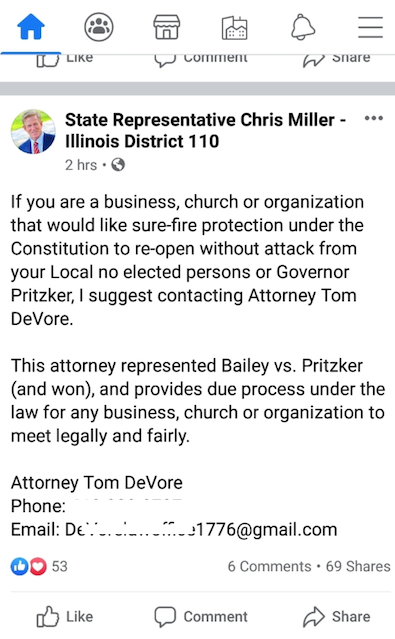
Devore is Rep. Bailey’s attorney. He’s getting a lot of free advertising off of this, including a blatant pitch from a state representative…
* Rafael Guerrero at the Elgin Courier-News…
The Northwest Bible Baptist Church in unincorporated Elgin intends to reopen for Sunday services beginning May 17, defying the state’s stay-at-home order and restrictions on large gatherings.
The church and its attorneys have sent Gov. J.B. Pritzker and county officials its intent to reopen under reduced capacity, using social distancing measures, requiring masks, and more.
“We are grateful for the guidance our government has provided through this pandemic and have respectfully refrained from gathering for weeks,” Pastor Keith Gomez said in a written statement. “However, we are persuaded that now is the time to safely resume meeting together in-person.”
Gomez has challenged stay-at-home orders in the past. When schools closed statewide in March, the church’s Northwest Baptist Academy school stayed open for a few days. Kane County sheriff deputies waited outside the campus on March 23 to greet parents and hand out copies of a compliance letter. That morning, Gomez told authorities they had reversed their decision and switched to remote learning.
More background on that pastor and his church…
Pastor Keith Gomez, leader of the “old-fashioned, independent” Northwest Bible Baptist Church in Elgin, Illinois, argued in a recent sermon that if it wasn’t for slavery, black people “would still be in Africa with a bone in their nose fighting lions.” […]
In the clip, Gomez argues that the book of Philemon supports slavery yet modern day Christians are being taught to hate it.
“When you get in the Pauline — are y’all listening to me? — when you get into the Pauline epistles, you’re getting in the doctrine. So why would you get in Philemon when he’s trying to teach you how to treat your slave? If they should be slaves,” Gomez said.
“See, what you wanna do is turn in to TBN [Trinity Broadcasting Network] and listen to them odd birds who don’t know doctrine whatsoever. And then you hate slavery because we were taught to hate that. Because we’re so nasty,” he continued before scolding white people for feeling guilty about slavery.
“And some of you little whities can’t get it either. If it wasn’t for slavery, those folks would still be in Africa with a bone in their nose fighting lions. And if you don’t like that, you can lump it any way you want. That ain’t a prejudice. That is factual and historical,” he said.
Whew.
* Another suit and another church…
Pritzker has also faced lawsuits, including one filed Friday in Clay County by salon owner Sonja Harrison. She alleged that Pritzker didn’t have constitutional authority to close her business, Visible Changes. A judge in the same southern Illinois county has already ruled in favor of one Republican lawmaker who claimed the order violated his civil rights. The state has appealed. […]
Also Sunday, a Chicago church that sued Pritzker over the stay-at-home order became the latest to defy restrictions limiting worship to 10 people. Roughly 70 people attended Elim Romanian Pentecostal Church, according to the Chicago Sun-Times. Masks, gloves and hand sanitizer were made available. Cristian Ionescu, the church’s senior pastor, directed worshipers to stand 6 feet apart inside the church that has capacity for roughly 1,400.
“We feel that we are discriminated against,” Ionescu told the Sun-Times. “We follow the same rules as other places that are also considered essential, and yet we cannot have more than 10 people in a service, which is ridiculous.”
Kinda wondering which Clay County attorney is representing Ms. Harrison.
* More…
The restaurant’s owner, Robert Newman, says he indeed opened the restaurant today, and has been in contact with the City of Herrin and the Franklin-Williamson Bi-County Health Department.
Newman says he had people wrapped around the building. Newman says he accepted a phone call from the health department a minute after opening, asking that he “voluntarily stop seating people”.
“He said, “Rob will you voluntarily stop seating people?” I said, “What does voluntarily mean? No, I will not.” He said, “Well, than I will have no choice but to pull your food license.” I said, “you can’t do that!” He said, “yes I can, and I will.”
Newman says, during the phone call, he claimed he would sue the health department. Newman says the man’s response was, “go right ahead.”
Newman says, at that point, he stopped seating people to avoid losing his license. “I don’t think the health department even knows their role in this. I never once got a letter from the health department or a visit from the health department when all of this started,” claimed Newman.
I don’t think Mr. Newman understands the role of public health departments.
* Meanwhile…
The Hamilton County Sheriff stated that his office will not be enforcing Governor JB Pritzker’s Executive Orders during the COVID-19 response.
In a Facebook post, Hamilton County Sheriff Tracy Lakin cited the office does not have the resources to enforce the orders.
Sheriff Lakin is asking county residents not to call his office to report any businesses that have opened or group gatherings.
He said he does not have the manpower to respond to these types of calls
Hamilton County is in Little Egypt.
* The demonstrations, however, are still pretty small…
Gov. JB Pritzker is no longer holding weekend COVID-19 briefings at Chicago’s Thompson Center, but protesters are still showing up to try to get his attention.
Dozens of people gathered outside the Thompson Center Saturday, calling for the governor to reopen Illinois.
“I think Pritzker is acting like a tyrant,” said Joliet resident Melissa Pointer. “I think he is taking away our constitutional rights, and I am calling him to stand down.”
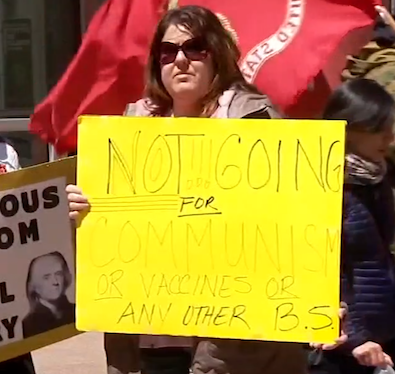
The anti-vaxxers are quite visible at these little rallies…
* Related…
* 72 Wisconsin residents got COVID-19 after being at large event
64 Comments
|
Our Democracy Is Too Important, The Fight Continues
Monday, May 11, 2020 - Posted by Advertising Department
[The following is a paid advertisement.]
The deadline to let voters decide if we should reshape our constitution and redistricting process has passed, but our fight continues. Fixing the foundation of our democracy is too important and we still can move forward toward a better redistricting process.
The Illinois Redistricting Collaborative, a diverse coalition of 34 organizations, is committed to standing with the 75% of Illinois voters who want an independent citizen-led commission.
Lawmakers can stand with Illinois voters and our diverse, statewide coalition by committing to passing meaningful legislative reforms before next year’s decennial redistricting.
Gerrymandering is voter suppression and we must end it. We can join the ranks of people in both red and blue states across the country who have made improvements to their redistricting process.

Learn more by visiting changeil.org/get-involved.
Comments Off
|
* Tribune…
As Illinois Gov. J.B. Pritzker tries to meet goals for daily COVID-19 testing and contract tracing, he’s not banking on any help from the federal government, he said Sunday CNN’s “State of the Union” with Jake Tapper.
“I have not been counting on the White House because there have been too many situations in which they’ve made promises not delivered,” Pritzker said. “Very recently they promised a lot of swabs, they’re supposed to arrive today, the first shipment of those, I’m looking forward to that. But what we’re doing is we’re going it alone, as the White House has left all the states to do.”
Illinois officials will continue to increase testing on their own, and are modeling contract tracing practices after Massachusetts’ approach, he said.
“We’ve had contact tracing across the state, we have county health departments that do that, we have our state health department which does that but what we’re now going to put in place and we’re in process is we’re imitating one of the great collaborative efforts that’s happened in the United States and that’s what’s happening in Massachusetts,” Pritzker said. “The Massachusetts contact tracing collaborative, we can do that in Illinois. We are, in fact. We’ve hired somebody who was at the CDC, who was an expert at their outbreak intelligence service and we think that we can have a massive contract tracing effort up in the next few weeks.”
I’ve already told subscribers what I think of the governor’s contact tracing claims. Bottom line: He greatly overstated the state’s progress.
Flashback to April 17th…
“We’ve gotten very little help from the federal government. It’s fine. I’ve given up on any promises that have been made,” Pritzker said on CNN’s “Erin Burnett Out Front.” “I hope something will get delivered from the federal government, but I don’t expect it anymore.”
* More from the show…
The Chicago Tribune Editorial Board wrote an editorial on Wednesday criticizing Pritzker’s Restore Illinois plan.
“He’s being more than just cautious. He has moved the goal posts… Pritzker’s state goal was to ‘get the outbreak under control’ — not eradicate COVID-19 completely… We don’t want his pursuit of the perfect outcome to unnecessarily delay the restarting of activities,” the board said.
Pritzker responded to the board’s editorial by saying they “did not read the plan.”
“The truth is, coronavirus is still out there. It hasn’t gone anywhere. We all are going to have to change the way we do things until we’re able to eradicate it,” he said.
“If the Chicago Tribune thinks everything is going to go back to normal without us having a very effective treatment, or a vaccine — they’re just dead wrong,” Pritzker added.
* Sun-Times…
Asked why Illinois hasn’t yet seen 14 consecutive days of downward movement, the governor said the state’s cases are going up because of increased testing. He said his team is watching the positivity rate, the number of people entering hospitals and the number of hospitals available in the event there’s a surge.
“We’ve done a lot to make sure that we’re keeping these numbers moving in the right direction,” Pritzker said. “And we will not reopen unless we meet all the standards that I’ve set for doing so.”
* CBS 2…
The governor said the guidelines of the reopening plan are subject to change, depending on how the outbreak evolves, and the recommendations of experts.
* The president’s apparent response…
34 Comments
|
Weekend IDPH reports
Monday, May 11, 2020 - Posted by Rich Miller
* Saturday…
The Illinois Department of Public Health (IDPH) today announced 2,325 new cases of coronavirus disease (COVID-19) in Illinois, including 111 additional deaths.
Clinton County: 1 male 80s, 1 female 90s
Cook County: 1 male 20s, 4 females 50s, 7 males 50s, 4 females 60s, 9 males 60s, 7 females 70s, 13 males 70s, 1 unknown 70s, 8 females 80s, 7 males 80s, 4 females 90s, 1 male 90s, 1 unknown 90s, 2 females 100s
DeKalb: 1 male 60s
DuPage: 1 female 60s, 2 females 70s, 1 male 70s, 1 male 80s, 7 females 90s, 1 male 90s
Iroquois: 1 female 90s
Kane: 1 female 70s, 2 females 80s, 1 male 80s
Kendall: 1 male 50s, 1 female 90s
Lake: 1 female 70s, 2 males 90s
LaSalle: 1 female 60s, 1 male 80s
Madison: 1 female 80s
McHenry: 1 male 70s, 1 female 80s, 2 males 80s
Rock Island: 1 male 80s
St. Clair: 1 male 40s, 1 female 80s, 1 male 90s
Will: 1 female 60s, 1 male 70s
Winnebago: 1 female 80s, 1 male 90s
Out of State: 1 female 90s
Currently, IDPH is reporting a total of 76,085 cases, including 3,349 deaths, in 98 counties in Illinois. The age of cases ranges from younger than one to older than 100 years. Within the past 24 hours, laboratories have processed 16,617 specimens for a total of 416,331.
That’s a 14 percent positivity rate.
* Sunday…
The Illinois Department of Public Health (IDPH) today announced 1,656 new cases of coronavirus disease (COVID-19) in Illinois, including 57 additional deaths.
Cook County: 2 males 20s, 2 males 40s, 3 females 50s, 4 males 50s, 5 females 60s, 9 males 60s, 1 unknown 60s, 5 females 70s, 7 males 70s, 4 females 80s, 4 males 80s, 4 females 90s, 1 unknown 90s, 1 male 100+
Kane County: 1 male 30s
Kankakee County: 1 male 60s
Peoria County: 1 female 80s
St. Clair County: 1 male 90s
Winnebago County: 1 female 50s
Currently, IDPH is reporting a total of 77,741 cases, including 3,406 deaths, in 98 counties in Illinois. The age of cases ranges from younger than one to older than 100 years. Within the past 24 hours, laboratories have processed 13,653 specimens for a total of 429,984.
12 percent positivity rate.
Since reporting started, the overall positivity rate is 18 percent.
* Charts…
7 Comments
|
As if we don’t have enough problems
Monday, May 11, 2020 - Posted by Rich Miller
* Oy…
More here.
* And this is from the BGA…
Government-funded needle exchange programs — such as the Community Outreach Intervention Projects’ storefront that serves Galorath — have cut services and closed exchange sites due to staff shortages and safety concerns as the virus sweeps the nation, so far killing more than 70,000 in the U.S.
In fact, the amount of needles exchanged by the Chicago program in March plummeted by more than 78% from the year before. It has left hundreds of high-risk users to fend for themselves — more likely to reuse or share needles and unable to get the help on which they have come to rely. […]
Staff reductions at COIP prompted it to close two storefront locations, in South Chicago and Humboldt Park, and reduce hours at three other storefronts, while also halting daily mobile efforts on the South and West sides. The Chicago Recovery Alliance, a mobile needle exchange and delivery operation, cut visits to two of its less-frequented sites and stopped providing supplies to another exchange in Edgewater, which also closed.
The programs — which together supply more than four million clean needles every year to the more than 10,000 injection drug users in the Chicago area — reported significant declines in the number of people the exchanges have served so far during the pandemic.
7 Comments
|
* Mark Maxwell…
In a Capitol Connection interview, Senator Dick Durbin (D-IL) poured cold water on an idea Illinois Senate President Don Harmon proposed in a letter to Congress last month.
“I would just characterize his letter to me and others as ambitious,” Durbin said in the segment that aired on Sunday morning.
Among other items, Harmon’s letter requested Congress send Illinois $10 billion in pension relief for state retirement systems.
“He was looking for federal assistance at a level at which is unrealistic, and I am sorry that he made reference to our pension challenge,” Durbin said. “Many states face a pension challenge. We should not be looking to the federal government at this moment or expecting in the future that it’s going to step in and fix these problems. What we need to do is ask for help for not only our state, but also local units of government, for their actual budget losses that are associated with this current national emergency. That, I think, is realistic.”
*** UPDATE *** Et tu, cheeseheads?…
For 43 Wisconsin Republican lawmakers, the urge to bash Illinois and go on record against bailouts for state governments during the coronavirus pandemic was just too good to pass up.
The lawmakers signed on to a letter sent Friday to the members of Wisconsin’s Congressional delegation asking them to reject a bailout package for the states. […]
“No one knows how long and how deep this economic crisis due to to COVID-19 will be, and Wisconsin is not immune to these fiscal challenges,” the letter said. “However, we do know our neighbors to the south have spent decades spending and borrowing recklessly.
“After years of failing to fund their overly generous pension system, Illinois is already asking for the federal government to bail them out of these series of poor financial decisions. The State Senate in Illinois has requested $44 billion – and that’s just for one state. Wisconsinites can’t afford to bailout reckless budgeting from other states.
“Wisconsin taxpayers should not be responsible for funding bailouts for irresponsible states across the country, like Illinois, New York and California. Please stand with Wisconsin taxpayers and reject the multi-trillion dollar bailouts being considered by Congress.”
34 Comments
|
* My weekly syndicated newspaper column…
Gov. J.B. Pritzker has repeatedly said he’s delegating enforcement of his stay-at-home order to local governments.
That stance has frustrated some folks who want him to get tougher with violators (although he’d undoubtedly risk making martyrs out of them if he did crack down hard). And the governor’s position seems to have emboldened some local officials to defy the governor’s executive order and open up their economies on their own.
But when local governments refuse to enforce the governor’s order, it appears that trial lawyers might step in and insurance companies might take a walk.
A growing number of Downstate sheriffs, state’s attorneys and other officials have declared they won’t be enforcing the governor’s stay-at-home order. The Woodford County state’s attorney has said he won’t prosecute violators, as has the White County state’s attorney. Johnson County’s sheriff is one of several who’ve said he also wouldn’t arrest anyone for violating the order.
East Peoria’s mayor has gone beyond even that, officially allowing the “opening” of several businesses in his city on May 1 that were ordered closed by the governor’s executive order, including hair salons, spas, gyms and indoor recreational facilities. On May 15, bars and restaurants will be allowed to reopen at 50 percent capacity, and churches and theaters also will be allowed to reopen on that date.
But the Illinois Trial Lawyers Association has a message for those renegade municipalities and businesses preparing to throw open their doors: Watch out for lawsuits.
“The risk of opening early outweighs the benefit of limiting liability not only for the municipality but also for any employer who follows the guidelines of the municipality,” said ITLA President Antonio Romanucci in a written statement. “The prudent course would be to stay closed for another 25 days and limit any further potential spread which could lead to litigation.”
I asked Pritzker at a recent press conference what he thought of the warning from trial lawyers.
“Well, I was a businessman before I became governor,” Pritzker replied, “and I have to tell you that I would not want to defy the executive order because I believe that I would be taking on liability if I did that.”
Those towns and businesses could find themselves without insurance coverage should something go wrong.
Kevin Martin, executive director of the Illinois Insurance Association, told me that insurance policies are “not going to cover intentional acts.” In other words, if a business intentionally reopens in violation of the executive order and somebody injures himself at the establishment or contracts the virus, insurance coverage won’t be a given. The same may go for municipalities that openly violate the executive order.
The Illinois Department of Insurance also chimed in, saying via press release: “If businesses reopen contrary to public health guidelines and the state’s executive orders, there is risk that an insurer could find reason within the policy language to deny COVID-19 related claims.”
I asked Pritzker at that same press about insurance issues.
“It would not surprise me if insurance companies are found to not be required to cover you when you are defying essentially state law or a state executive order,” he replied.
The Illinois Retail Merchants Association has taken the position from the beginning that the executive order is “the best course of action for both consumers and employees,” the group’s president, Rob Karr, said via written statement. “We have also advised retailers of both the liability, insurance and other legal issues that may arise from not following the state’s guidance.”
The Illinois Restaurant Association also released a statement saying the group has encouraged its members to follow the executive order. The Illinois Licensed Beverage Association, which represents tavern owners, said it “does not advise” its members to violate the executive order.
The governor has pointed out several times that many of the businesses that are defiantly reopening have state licenses. Your local barber or salon owner needs a state license to open and operate. Cosmetologists, electrologists, massage therapists and nail technicians are just some of the others who must have state licenses. Restaurants and taverns are under state oversight and can be closed down by local public health departments in situations just like this.
The bottom line is, if you don’t fear the virus, then you might want to start to fear being wiped out by lawsuits not covered by insurance or losing your license
35 Comments
|
Open thread
Monday, May 11, 2020 - Posted by Rich Miller
* Something to start you off…
Let’s keep it Illinois-centric and polite, please. Thanks.
12 Comments
|
|
Comments Off
|
|
 Support CapitolFax.com
Visit our advertisers...

 ...............
 ...............
 ...............


|
   
|
Hosted by MCS |
SUBSCRIBE to Capitol Fax |
Advertise Here |
Mobile Version |
Contact Rich Miller
|



