* 4:18 pm - The Justice Department had asked the US House Ethics Committee to hold off any investigation into Congressman Jesse jackson, Jr. while it probed the Rod Blagojevich case and related matters. That request has now been withdrawn, so the committee is moving forward.
Jackson will probably be hit with some bad press about this. For instance, this is from Debbie Halvorson…
“The House Ethics Committee’s decision to look into possible ethics violations by Representative Jesse Jackson, Jr. is proof that he continues to be plagued with distractions over his possible role in Rod Blagojevich’s pay-to-play scandal involving President Obama’s former Senate seat. We should have a Representative that is focusing on job creation and economic development for our district—not on ethics investigations. The 2nd Congressional District deserves strong leadership that will be focused on the needs of local residents. Our campaign remains focused on the many challenges facing the residents of the 2nd Congressional District.”
Headlines so far this afternoon…
* Ethics to look into Jesse Jackson, Jr., allegation on Obama Senate seat
* House Ethics Panel Resumes Inquiry Into Jesse Jackson, Jr.
* Ethics Committee Restarts Probe of Rep. Jesse Jackson Jr.
* But this development could also be seen as an implicit admission by the feds that they’ve wrapped up their investigation and aren’t going anywhere else with it.
…Adding… New York Times…
But a preliminary investigation by the Office of Congressional Ethics — which serves as a grand jury of sorts for the House Ethics Committee — concluded in 2009 that there was evidence that Mr. Jackson’s staff in Washington and Chicago “were used to mount a public campaign to secure the representative’s appointment to the U.S. Senate,” a possible violation of House rules that prohibit the use of public resources for personal or political causes.
The investigators also questioned if the “emissary” who was recorded offering Mr. Blagojevich help raising campaign funds was acting at the request of Mr. Jackson. If the congressman did have someone offer to raise money for the governor in return for an appointment to the Senate, then he might have “violated federal law and House rules,” the ethics office said in its 2009 report.
9 Comments  
|
Prosecution witness slams alleged victim
Tuesday, Oct 18, 2011 - Posted by Rich Miller
* There was an interesting turn of events today at Bill Cellini’s corruption trial. Star prosecution witness Stu Levine under cross-examination by defense attorney Dan Webb dumped all over the alleged victim in this case, Tom Rosenburg. From Natasha Korecki’s Twitter page…
Webb to Levine: “you don’t believe a word (Rosenberg) says?” Levine:”Correct.” Rosenberg may testify tomorrow. […]
Levine on tape about Tom Rosenberg: “He has clean hands all over the place.” Levine says he’s referring to ‘dishonest acts.”
So, according to the prosecution’s big witness the alleged victim is a lying crook?
Perhaps our experienced attorney commenters can tell us what this means, but I’m not sure it’s so great for the prosecution. If the victim was also allegedly hinky, then running a game on him might not be so bad. Then again, Rosenberg testified at Tony Rezko’s trial that Cellini never asked him for any money. Webb has referred to that testimony time and time again. Federal prosecutors allege that Levine attempted to extort Rosenberg on behalf of Rezko, Chris Kelly and the Blagojevich campaign. The feds also allege that Cellini participated.
* From yesterday’s cross examination…
Levine testified that he had, in fact, initially launched another extortion approach on Rosenberg — one that did not involve Cellini at all. He also told the jury that Cellini had early on actually helped Rosenberg.
Webb also spent considerable time exploring the relationship Levine had with Rosenberg.
Levine testified that Rosenberg had in 2001 allegedly agreed to another, unrelated bribe scheme with Levine but then failed to pay up. This angered Levine, he acknowledged.
* Meanwhile…
The defense at the trial of a clout-heavy Illinois businessman has sought to punch holes in prosecutors’ claim their client is heard on wiretaps admitting he delivered part of an extortion message to a Hollywood producer.
The issue took center stage Tuesday as William Cellini’s attorney tried to convince jurors that Cellini’s words were, at the very least, ambiguous. Defense attorney Dan Webb was cross-examining star prosecution witness Stuart Levine. […]
But Levine conceded Cellini never said he told the Hollywood executive that he must donate money to then-Gov. Rod Blagojevich’s campaign or risk losing state pension funds for his investment company.
* Done by Friday?…
Federal prosecutors [yesterday] afternoon said William Cellini’s trial could be headed for closing arguments Friday.
Defense lawyer Dan Webb is likely to conclude his questioning of star witness Stuart Levine on Tuesday. Assistant U.S. Attorney Chris Niewoehner said the government will put on the stand an out-of-state witness (presumably the victim of the alleged extortion, Tom Rosenberg) Wednesday and could be finished with its case by Thursday at the latest.
Webb said he gave a list of defense witnesses to Niewoehner. Still, Niewoehner said closings could happen by Friday.
17 Comments
|
Question of the day
Tuesday, Oct 18, 2011 - Posted by Rich Miller
* From the Tribune…
The Blagojevich family posted a message on Facebook on Monday, telling supporters that they can write letters on the former governor’s behalf before his sentencing. U.S. District Judge James Zagel can consider Blagojevich’s good works as mitigating factors when deciding his punishment.
Blagojevich, 54, could face a double-digit prison term after being convicted of corruption charges in June. Though no sentencing date has been set, Patti Blagojevich has indicated it could be sometime in the next month.
“We have been getting so many requests from people who would like to help us by writing a letter to the judge for sentencing that I would like to post the email of one of our attorneys Aaron Goldstein: agoldstein3@hotmail.com,” according to a post on Patti Blagojevich’s Facebook page. “He would be able to help you with how to get the letter to the right place. Thank you to all of you who have supported us during this hard time.”
* The Question: What would your letter to Judge James Zagel say?
Snark is heavily encouraged, of course.
45 Comments
|
[The following is a paid advertisement.]
A recent front page Chicago Tribune story (“Electric Bill Shocker,” June 11) warns that coal plant closures will trigger a substantial spike in our electric rates:
“Consumers could see their electricity bills jump an estimated 40 to 60 percent in the next few years.
“The reason: Pending environmental regulations will make coal-fired generating plants, which produce about half the nation’s electricity, more expensive to operate. Many are expected to be shuttered.”
Because of these closures, nearly double digit rate increases are already set to begin in 2014 - more will come unless we act.
Illinois legislators have a choice. They can protect consumers by voting for the Comprehensive Energy Efficiency and Investment Act (SB 1653). Highlights include:
• 16,000 direct and indirect jobs, according to the University of Illinois
• Energy efficiency programs the IPA says will offset residential rate increases
• Solar rooftop support for business and government
• Expanded rate protections for the $3.5 billion Taylorville Energy Center and other clean power projects
• Extensive MWDBE program for minority contractors
While opponents spread disinformation and use scare tactics, sponsors like Senate President John Cullerton and Representative John Bradley know that SB 1653 is a common sense approach to solving the serious problem of coal plant retirements.
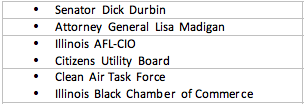
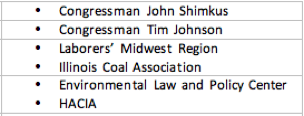
The diverse coalition of SB 1653 supporters includes:
Illinois has a choice. Act now.
Approve the Comprehensive Energy Efficiency and Investment Act
Comments Off
|
Simple math: 60 and 30
Tuesday, Oct 18, 2011 - Posted by Rich Miller
* Lou speaks the truth…
Gov. Pat Quinn on Monday laid out what kind of gambling expansion bill he could accept and it doesn’t include slot machines at Illinois race tracks, a position sponsors say could imperil their push to add five new casinos in the state, including one in Chicago.
“If this were in bill form it could not pass,” Democratic Rep. Lou Lang of Skokie said of Quinn’s suggestions.
And so does Sen. Terry Link…
Link said slots at race tracks bring more than 20 votes to the bill. Without it, he can’t pass any gambling expansion legislation, he said.
* The legislative math simply doesn’t work without slots at tracks. Barring a miracle or yet another Quinn flip-flop, the governor has all but killed gaming expansion…
“Unless these principles are followed, there’s no way I will approve a bill,” Quinn said at a Chicago news conference.
And…
“I’m the final word,” Quinn said. “We’re not going to have a willy-nilly gambling bill in Illinois that is not protecting integrity, that is way too big and excessive and doesn’t provide adequate revenue for education. … Casino gambling at 14 different locations in Illinois is way too much. We have no interest in becoming the Las Vegas of the Midwest. We need to retain our culture.”
It will be the mother of all Pat Quinn flip-flops if he decides during veto session that he can support slots at tracks after saying that. I mean, I don’t see a lot of negotiating room there, do you? McCaffrey does, but he gets paid to be an optimist…
Dave McCaffrey of the Illinois Harness Horsemen’s Association described Quinn’s announcement as “the first pitch of the seventh game, and the game will play out during the next month.”
* It’s a pyrrhic victory for Danville and Rockford…
Danville Mayor Scott Eisenhauer has been waiting six years to hear an Illinois governor say his city of more than 32,000 residents should get a casino.
On Monday, “to hear that Gov. (Pat) Quinn, too, supports a casino for Danville is a milestone,” Eisenhauer said. But Eisenhauer realizes that while Quinn supports a casino for Danville, Quinn also could not support legislation that actually would put one there. […]
Leaders in Winnebago County are thrilled to hear Quinn support a casino for their city of Rockford, said Mike Dunn, regional director of governmental affairs for the county.
“We could never figure out what he wanted, but this makes us feel better,” Dunn said.
* The Southland’s leaders thought this was a good thing…
Southland leaders are encouraged by Gov. Pat Quinn’s announcement Monday that he would support a casino in the south suburbs.
Hooray! We’re finally on the governor’s radar!
Kadner supplies the cold water…
“Everything in that bill was put there to attract enough votes to pass it out of the state Legislature,” said state Rep. Marlo Colvin (D-Chicago), a key backer of the casino legislation. “The horse racing industry is in difficult financial shape and needs help. I don’t know how the governor can ignore the economic realities of the south suburbs, Chicago and people across this state who need jobs and economic development.”
I pointed out to Colvin that Quinn did endorse a casino in the south suburbs.
“It isn’t going to matter if we can’t get the votes to pass the bill,” Colvin said. “We’ve been talking to the governor about this since the spring, trying to get a sense of what he wanted, and he comes out with this a week before the fall veto session, at the 11th hour, which is apparently his preferred manner of doing business.”
* The consequences of this particular Quinn decree have been overlooked…
Quinn also switched direction on the video poker law he signed in 2009 to pay for a statewide construction program. The law allows the machines to operate at restaurants and taverns unless a community decides to opt out. Instead, Quinn said the machines shouldn’t go up unless a community votes to allow them. That could greatly reduce video poker in Illinois.
He not only signed that into law, he came up with the idea in the first place. Video poker was designed to help fund capital projects - the very same projects Quinn always talks about when he wants to point to all the jobs he’s created. Opt-in would kill those revenues.
Also, he agreed at the time that there would be no changes to the capital bill unless it was agreed to by all the legislative leaders. This is definitely not an agreed change. And where are they gonna get the money to replace this revenue stream? Another cigarette tax hike? Senate President Cullerton could go along with that, few others will.
* The Sun-Times is concerned…
At a press conference Monday, Quinn didn’t leave much wiggle room. “Unless these principles are followed,” he said, “there’s no way I will approve a bill.”
Key lawmakers have signaled that they are more than willing to compromise.
We can only hope that Quinn will do the same.
But the Tribune is downright giddy…
Quinn’s challenge now is sticking to his ultimatums — in the past, not his strong suit — on what a revised casino bill can and cannot do if it is to win his signature.
Governor, on Monday you did right by the people of Illinois.
You’re holding the winning hand here.
Don’t fold.
It’s definitely a “winning hand” for someone who wants to kill gaming expansion. Quinn’s oversight changes and most of the rest of the stuff is nowhere close to being a deal killer. The slots at tracks thing is a killer, however, and money will have to be found to replace any revenues lost from a change to an opt-in for video poker.
They’ve been trying for a decade to pass this bill. They finally found the winning formula this spring and now it’s been tossed out the window.
* Related…
* ‘No way’: Quinn won’t support slot machines at Illinois racetracks
* Quinn: No slots at state fairgrounds
* Joliet leaders say Quinn casino plan still too broad
* Rockford casino opponents, proponents see Quinn announcement differently
* Rockford casino still a go in Pat Quinn’s proposed bill
60 Comments
|
C’mon, man!
Tuesday, Oct 18, 2011 - Posted by Rich Miller
* State Sen. Shane Cultra is just chock full of ideas…
“I think one thing, if we made Medicaid patients pay a co-pay, you know, just like any of us do… if they had to pay a lot more to go to the emergency room, and maybe take it out of their LINK card if they don’t have any cash, maybe they would think twice before they use medical services if it’s going to cost them something,” Cultra said.
So, let’s make the poor decide between eating and life-saving health care in the middle of the worst economic climate since the Great Depression. Wonderful idea. Why don’t we throw in a gigantic tax break for the rich while we’re at it? You know, just to rub it in.
* Meanwhile, in the real world…
When the owner of a southern Illinois child care center didn’t get the state funding he was promised on time and faced laying off employees and cutting service to low-income children, he borrowed money from family members to get by.
When a suburban Chicago center helping disabled people live independently didn’t get its state money quickly, employees waited three months for a paycheck so clients wouldn’t feel the pinch.
And when an Elgin domestic abuse program was left with stacks of unpaid bills and no sign of when the money would come from the state, workers took four weeks of unpaid furlough days, especially difficult for employees earning $25,000 a year.
They are among the thousands of community groups and charities making up Illinois’ system for providing human services: the state contracts out the work and agrees to make reimbursements. But as Illinois’ budget crisis worsens and the state lags further behind in paying bills, those that serve the state’s neediest are forced to make dire decisions and at-times heroic sacrifices to pick up the slack.
* And…
Andrew Buffenbarger was expecting a check from the state of Illinois. What he got instead was a letter saying the Champaign County Nursing Home wouldn’t be paid for its Medicaid services for 120 days.
That doesn’t seem like a big deal if you look at the records of unpaid bills at the Illinois comptroller’s office. They showed the nursing home, where Buffenbarger is the administrator, was owed only $47,000 early last month. In reality, however, the home was waiting on nearly $3.3 million.
* And…
Illinois owes the largest downstate ambulance company more than $750,000, and that business soon will cut services to stop the budget shortfalls.
So, how about we come up with some real ideas to solve these problems that doesn’t involve potentially starving out the poor? I’ve said before that it’s going to take years to get out from under these overdue bills even with the tax hike. Actually, I’m not the only one. Pretty much everyone admits it. A drastically scaled-back version of Gov. Quinn’s original borrowing plan would help get many of these bills paid off, particularly if it was accompanied by some negotiated budget cuts. But that’s going to take more courage than currently exists in the building, and legislators will have to ignore the howls about borrowing on the markets even though we’re already borrowing from domestic abuse programs in Elgin.
* Related…
* State’s Delinquent Payments Hurt Charity Organizations
* Universities cope with chronic late payments
* Unpaid bills a pain for SIU
66 Comments
|
* This story just gets weirder and weirder. Yesterday, the Sun-Times told us about how a late 1980s law designed to avoid white flight from Chicago is actually occasionally rewarding white flight with big payouts to sellers. Today, they look at the guy who’s running the obscure agency…
While overseeing the largest of three government-run home-equity assurance programs in Chicago, Kenneth Pannaralla got two interest-free home-improvement loans through his agency worth a total of $15,000, despite a ban on such benefits under state law.
The Southwest Home Equity Assurance Program used property taxes it collects to pay the interest on the loans Pannaralla got from Marquette Bank, under a home-improvement loan program the agency created 11 years ago, records show.
In addition, Pannaralla and his daughter, Jennifer Pannaralla, currently have another zero-interest home-improvement loan through the agency, this one for $10,000.
That, too, appears to be in violation of the Illinois Home Equity Assurance Act, which says: “No commissioner or family member of a commissioner, or employee or family member of an employee, may receive any financial benefit, either directly or indirectly” from the program.
The little-known agency Pannaralla oversees is one of the three created under a law Illinois legislators passed in 1988 to curb white flight in Chicago’s bungalow belt. The law guarantees that homeowners who signed up by paying for an appraisal wouldn’t lose money if they sold their homes even if property values declined, as long as they waited five years to sell and as long as property values went down for reasons other than a national housing slump, as has happened.
* This guy really knows how to make money off the public’s dime. And he’s a Madigan guy running a program that Madigan came up with…
Kenneth E. Pannaralla — once a top precinct captain for Illinois House Speaker Michael J. Madigan — has made a good living in government.
Pannaralla, 63, gets a pension from the city of Chicago in addition to the three paychecks from his three current government jobs, including one as the executive director of the Southwest Home Equity Assurance Program, a government agency created under a law Madigan co-sponsored.
Madigan, who is also chairman of the Illinois Democratic Party, also gave Pannaralla’s daughter, Jennifer Pannaralla, a one-year legislative scholarship in 2003 to the University of Illinois at Chicago. And Pannaralla’s son, Kenneth, is paid $24,000 a year as an aide to Madigan.
Pannaralla makes a total of $213,418 a year
Great work if you can get it.
* Ironically enough, black flight has become a big issue in Chicago these days…
Former magnets for black migrants, including Illinois, Michigan, New York and California, all have had black population declines. Atlanta has even overtaken Chicago as the city with the second-largest black population behind New York City. The black population in Atlanta has grown in the past decade by 473,493. In Dallas it grew by 233,890, and in Houston by 214,928 over the same period. Today, 57 percent of the country’s black population lives in the South, a 50-year high, according to the most recent census data.
Today’s migrants are chasing the same things their forebears sought decades earlier, according to those who have studied the return migration. Others are retiring or returning to familial homesteads, reclaiming land their relatives never let loose.
“There are places like Harlem that no longer have majority black populations because many of the black folks who have lived there for the last 50 or so years have decided to cash in, and they are going to live somewhere more affordable, places that don’t come with the urban baggage that maybe we didn’t ever want but put up with because this was our best chance at a solid economic future,” said Khalil Muhammad, director of the Schomburg Center for Research in Black Culture, part of the New York Public Library and renowned for its collections of historic artifacts. “Those people are going to places that look just the way they want them to look. They are not going to be shackled by a political nationalism or the segregation of the past.”
Meanwhile, Chicago has lost about 181,000 African Americans over the past decade, a drop of 17 percent. Many have fled to the Chicago suburbs. But to a greater extent, who is leaving and where they’re going is difficult to determine, according to demographers. But Brookings Institute reports that these new migrants tend to be financially stable and more educated. Many are students, professionals or retirees.
Obviously, it’s way past time to end that state-sponsored white flight prevention program. It appears to be gamed too much anyway.
26 Comments
|
[The following is a paid advertisement.]
“The Governor’s veto was a great disappointment to the business community and consumers alike. Opportunities for this kind of investment don’t come around every day. Our elected officials should seize it.”
-Jerry Roper, President and CEO, Chicagoland Chamber of Commerce
Businesses looking to relocate or expand can’t afford to rely on an electrical system designed more than 100 years ago. They need a stronger, smarter grid.
“We depend on a steady stream of electricity around the clock to meet the demands of our customers. Even the most minor outage can cost thousands of dollars. We need a modern grid that offers increased reliability to meet the demands of the 21st century economy.”
-George Gatto, president, Gatto Industrial Platers
A modern, reliable grid is essential for Illinois’ effort to rebound from the recession.
“A modern smart grid is necessary to avoid outages that cost local businesses money and hurt their ability to compete. A modern grid will position Illinois to attract new business and new jobs.”
-John Estey, President and CEO, S&C Electric Company, Chicago
For more information on the benefits of grid modernization through SB 1652, visit www.SmartEnergyIL.com .
Comments Off
|
|
Comments Off
|
|
Comments Off
|
Question of the day
Monday, Oct 17, 2011 - Posted by Rich Miller
* From the SJ-R…
Catholic Charities would be able to continue its foster care and adoption services without serving same-sex couples under legislation introduced this week by state Sen. Kyle McCarter.
The bill would amend the Illinois Religious Freedom Protection and Civil Union Act to allow religious-based child-welfare agencies and those operated or owned by a religious organization to refer such couples to the Illinois Department of Children and Family Services for other adoption and foster care options.
McCarter, R-Lebanon, introduced the legislation in response to an ongoing legal battle between Catholic Charities agencies and the state after the civil union law took effect June 1.
“I do believe that if it’s sent to the floor, there’s enough votes to pass it in the House and the Senate,” McCarter said Friday. “Catholic Charities is responsible for a majority of adoptions and placements of foster kids in southern Illinois, and they do it for a fraction of the cost, and they do it with an extreme amount of compassion.”
* More…
Peter Breen, an attorney for the Thomas More Society, the firm representing Catholic Charities in the ongoing legal battle with the state, applauded the introduction of the new bill. Last month, Circuit Judge John Schmidt reiterated his previous decision that DCFS can legally cut their ties with the agencies over their refusal to license same-sex adoptive and foster parents. The firm is expected to appeal that decision.
“The people of Illinois do not want to see Catholic Charities and other religious-based foster care agencies driven out of business, period,” Breen said in a statement. “Lawmakers intended when they passed the civil union law to protect religious groups from compromising their beliefs regarding civil unions.”
* Opposition…
“We have seen this bill before in the House of Representatives,” stated Anthony Martinez, Executive Director of The Civil Rights Agenda. “Obviously, the civil institutions behind this affront to LGBT civil rights are not backing down. We will not either. We had hoped to kill this bill quietly as has been done in the past. Unfortunately, that strategy is no longer an option and our opposition has now been galvanized. We will ensure that our followers and the community are informed as to the appropriate action once the General Assembly reconvenes.”
* From the bill’s synopsis…
[A] child welfare agency that is religiously based or owned by, operated by, or affiliated with a bona fide religious organization may decline an adoption or foster family home application, including any related licensure and placement, from a party to a civil union if acceptance of that application would constitute a violation of the organization’s sincerely held religious beliefs and, if an agency declines an application, it must provide the applicant with information on how to contact the Department of Children and Family Services to obtain information concerning other regional licensed child welfare agencies.
* The Question: Do you support or oppose Sen. McCarter’s bill to allow Catholic Charities and other groups to continue adoption and foster placement services even if they refuse to serve same sex couples in civil unions? Take the poll and then explain your answer in comments, please. Thanks much.
50 Comments
|
* DCFS Director Erwin McEwen left government last month and now we know why…
Inspectors concluded that Erwin McEwen, the former director of the Department of Children and Family Services, “created a situation that was ripe for a vendor … to enrich himself and inflate costs by billing for ‘ghost’ positions and billing various agencies for the same services.”
The report by the state’s executive inspector general found that George E. Smith and his various organizations collected $18 million in state grants from 2008 through 2011, but there’s little documentation of what services he performed for much of that money. […]
“Dr. Smith’s fraud continued for so long, in part, due to lack of DCFS oversight. At least one annual $450,000 DCFS grant awarded to him went completely unmonitored for years,” investigators reported.
The misconduct went beyond DCFS, they said. Chicago State University, the Department of Human Services and the State Board of Education all “paid Dr. Smith grant funds with little or no effort to determine whether services were actually provided.”
* But, wait, as they say, there’s more. Click the pic for a better view…
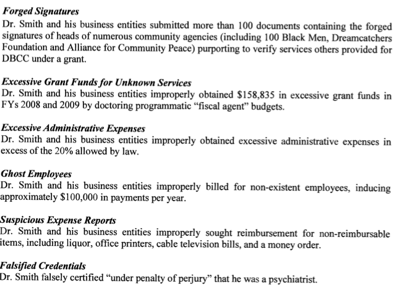
The inspectors general claim that both Director McEwen and Smith “failed to cooperate in this investigation” and claimed that “numerous other State agencies failed to adequately monitor grants awarded to Dr. Smith and his business interests.”
The full report can be read by clicking here.
* Background…
McEwen spent much of his 20-year career in the private sector, an administrator of child welfare programs that did contract work for the state.
In 1994, he left one agency after he tested positive for cocaine use. He says it was a false positive result and fought to have it expunged from his record but lost.
The episode did little to slow his career, however, and in 2003 he joined DCFS as a deputy director.
* From October of 2007…
A state employee whom Gov. Blagojevich once outed as a subject of a federal probe into his administration’s hiring practices is now being promoted to a top job within the Illinois Department of Children and Family Services.
Robin Staggers once was accused by a subordinate of creating “a culture of intimidation” within DCFS’ human resources department, according to an internal state report disclosed in January by the Associated Press.
But DCFS Acting Director Erwin McEwen said in a message Wednesday to the agency’s 3,000-plus employees that Staggers is being named chief of staff as part of a series of management changes.
From January of this year…
Amidst a blizzard of news on the impending snowzilla looking to stomp on Chicago, Governor Pat Quinn on Monday quietly announced six appointments to his cabinet, leaving the fate of other cabinet members uncertain.
Quinn re-appointed Director Rocco Claps to the Department of Human Rights, Director Brian Hamer to the Department of Revenue, Director Julie Hamos to the Department of Healthcare and Family Services, Secretary Gary Hannig to the Department of Transportation, Director Erwin McEwen to the Department of Children and Family Services and Secretary Michelle R.B. Saddler to the Department of Human Services.
From August of this year…
McEwen is moving to pursue new opportunities and was not forced out, an agency spokesman said.
From today…
Gov. Pat Quinn acknowledged Monday that he knew of the investigation when McEwen left office. “He was given the opportunity to resign and he took that opportunity,” the Democratic governor said at an unrelated news conference.
Also from today…
[Quinn] did not answer further questions or explain why he let McEwen resign and chose not to make the misconduct public.
*** UPDATE *** Former Sen. Hendon is mentioned in the report…
The report also makes mention of former state Sen. Rickey Hendon (D-Chicago), who abruptly resigned in February as federal investigators probed a series of questionable state grants bearing his fingerprints.
When questions arose internally at DCFS about how Smith was spending state grant money, a DCFS employee paid a visit to Smith’s offices to ask specifically about a $13,000 payment to a group known as Better Life for Youth, which was among organizations named in a 2010 federal subpoena to the State Board of Education.
The employee “asked Dr. Smith for information about the $13,000 payment. In response to his inquiries, Dr. Smith asked [the employee] if he knew that Better Life for Youth was [former] Illinois State Senator [Rickey] Hendon’s organization,” the report states.
33 Comments
|
* The prosecution’s star witness Stu Levine told jurors in the Bill Cellini corruption trial today that he paid bribes to a Chicago government official to obtain contracts.
Levine also said he paid bribes more than ten times to obtain Chicago Board of Education contracts for a bus company, and he admitted to bribing a postal union so its officials would help him win yet another contract. None of these things have anything directly to do with Cellini, of course, but they do show what sort of person Levine is.
Let’s go to the live blog. As always, BlackBerry users click here and everybody else just kick back and watch…
25 Comments
|
* Gov. Pat Quinn has outlined his own gaming plan and said he would veto the current bill, which hasn’t yet been sent to him…
The governor said he would support putting five new casinos in Chicago, Rockford, Danville, a Lake County site to be chosen by the Illinois Gaming Board — not the Park City location passed by the legislature — and a southern Cook County site, also to be chosen by the board.
Proximity to other casinos was a prime consideration, Quinn said.
Quinn’s alternative also would ban contributions to state elected officials by gaming licensees and casino managers, which other states have done, and undo a generous tax break for the highest-grossing casinos that was contained in the legislation that narrowly passed the House and Senate in May.
More…
The governor indicated he’s OK with the five new casinos in Chicago, southern Cook County, Rockford, Danville and Lake County. But Quinn said he would not allow gambling at racetracks, the state fairgrounds, or at Midway or O’Hare International Airports, as the current legislation proposes. […]
He also would require communities in Illinois to opt in to allowing video gambling throughout Illinois. Currently the law allows for communities to have video gambling unless they opt out. He also would require licenses for video gambling to be fully vetted rather than give initial licenses that are allowed to be vetted more thoroughly later.
When he said he would allow a boat in Lake County, Quinn specifically said “not Park City,” the location expressed in the current legislation.
More…
In the meantime, Sen. Terry Link said Monday morning that he plans to file a revised gambling plan today in an effort to satisfy some of the concerns of Gov. Pat Quinn.
The legislation could be heard at a hearing in Chicago as early as Tuesday, Link said.
“I think it will address a lot of his concerns,” Link said.
Discuss.
…Adding… The governor has issued a press release and what he’s calling a “framework“.
*** UPDATE 1 *** From Senate President John Cullerton’s spokesperson…
Now that the Governor has articulated his proposed changes, we will fold his recommendations into our ongoing discussion of how we can make the gaming bill better for the state. Additionally, we will be evaluating the Governor’s framework in light of what is passable by both chambers of the General Assembly. We look forward to developing the appropriate compromise with the Governor and members of the House.
*** UPDATE 2 *** Raw audio of the governor’s press conference…
*** UPDATE 3 *** Mayor Rahm Emanuel’s response…
Quinn told reporters the Chicago mayor’s reaction was “a pleasant one.”
Emanuel followed that up with an optimistic statement to boot, saying he was thankful Quinn at least outlined the requirements for a future proposal.
“We are encouraged that the Governor has come forward with a proposal,” Emanuel said. “We are anxious to work with him and the leadership in the Illinois General Assembly so that we can soon begin creating tens of thousands of jobs for Chicagoans and make the investment in the city’s aging infrastructure that will secure a successful future for Chicago.”
House Speaker Michael Madigan isn’t responding, since Madigan has recused himself from the gaming bill.
* But the initial Downstate react isn’t great…
Observers said the governor’s alternative plan would lose even more votes because the slot machines at the tracks were supposed to generate $25 million for a number of downstate programs, including soil and water conservation districts.
“I think it will cause the loss of more downstate support,” said state Rep. Dan Brady, R-Bloomington.
*** UPDATE 4 *** With a hat tip to a commenter, here’s Sen. Terry Link’s response…
Link said he will introduce a new casino bill as early as Tuesday that incorporates several of Quinn’s demands—but not all of them. Park City, he said, will remain in the bill as a host town, and so will slots at racetracks, two items Quinn outright rejected.
“At first, the governor said the bill was too top heavy, but he’s come a long way,” Link said.
38 Comments
|
A little good news for a change
Monday, Oct 17, 2011 - Posted by Rich Miller
* Crain’s Chicago Business takes a hard look at Illinois’ business climate and finds some things aren’t as bad as we may think…
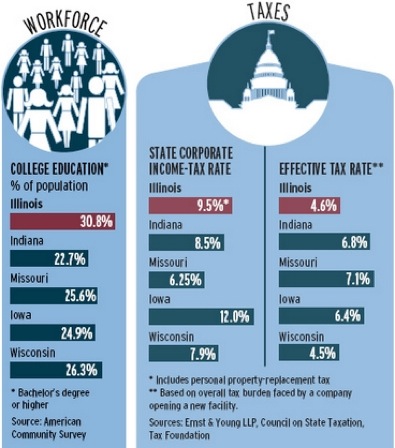
[A] business owner wondering where to open a new facility might be surprised to discover the overall tax burden actually could be lower in Illinois than in surrounding states. When all state and local taxes are considered, Illinois has the fifth-lowest effective tax rate in the country, at 4.6%, according to a 2011 study by Ernst & Young LLP. The study is based on data that don’t reflect the recent income tax hike, but Ernst & Young says the impact of the increase on Illinois’ effective tax rate would be relatively minor.
Among neighboring states, only Wisconsin is lower, at 4.5%. Missouri is highest, at 7.1%, followed by Indiana’s 6.8% and Iowa’s 6.4%.
How can that be? Corporate income taxes are just one piece of the overall tax burden — and not always the biggest. Franchise taxes, property taxes, sales taxes, gross-receipts taxes and levies on machinery and equipment add more to a company’s total tax bill.
“The two biggest are sales and property taxes,” says Donald Bruce, a University of Tennessee professor of business. “Income taxes are nowhere near the top of the list.”
And…
For many businesses — especially tech companies, professional services firms and ad agencies, which need highly skilled workers and pay them well — talent is the critical factor in deciding where to set up shop.
Accenture PLC, the global consulting firm, announced last week it would add 500 jobs in Chicago, its largest operation in North America, with 5,000 workers.
“It’s a real talent magnet for all the kids who go to college in the Midwest,” says Jorge Benitez, Miami-based CEO of Accenture’s U.S. business. “Getting the best people is paramount to what we do.” […]
About 31% of Illinois’ workforce has at least a bachelor’s degree, and 11.5% a graduate degree — both above the national average, according to federal data. Wisconsin and Missouri come closest at about 26% with a bachelor’s degree or more, followed by Iowa at 25% and Indiana, 23%.
A chart…
* In other news, it looks like the UAW may actually approve its contract with Ford…
Now, with two days of voting left at Ford plants, momentum has swung toward ratification, said Bernie Ricke, president of UAW Local 600, which represents workers at the Rouge.
“The longer people had the facts, and the more we cleared up the misinformation that was out there, the more support the agreement got,” Ricke said.
As of Friday morning, only 50.8% had voted in favor of the deal. By Sunday night, 62% of all votes counted were in favor of the deal. The national tally was boosted by Local 600’s 62% approval and 90% in Kansas City.
“If this were a political election, it would be viewed as a landslide,” said Harley Shaiken, a labor relations expert at the University of California Berkeley.
22 Comments
|
* There’s nothing like waiting until the last minute, eh? Sheesh…
Dozens of top state officials could be booted from their posts later this month under a new law originally designed to fumigate state government in the aftermath of former Gov. Rod Blagojevich’s ouster.
On Oct. 25, an estimated 90 agency heads, various university trustees and members of a number of state boards and commissions face an uncertain future when a deadline expires on their terms. […]
The law limits the ability of appointees to serve for more than 60 days past the effective date of the new act, which is Oct. 25. To avoid a break in service, the governor could rename all of the members before Oct. 25. He also could name them as acting appointments. Or, he could name new people to those positions. […]
Rikeesha Phelon, spokeswoman for Senate President John Cullerton, D-Chicago, said the governor has not communicated his intentions.
“We assume we’ll get a big stack of reappointments and appointments on Oct. 24,” Phelon said.
* Meanwhile, for this kind of money, we could send all these kids to the best private boarding schools in the world and have money left over to pay their tuition and expenses at Harvard…
Unlike the state’s overcrowded adult prisons, Illinois’ juvenile facilities are operating at just 68 percent capacity. The number of juveniles sent to them is dropping — from an average daily population of 1,603 a day in fiscal 2005 to 1,113 in fiscal 2011.
As the numbers have decreased, the per-bed costs have skyrocketed. In Murphysboro, which operated at about 40 percent capacity, the estimated cost to house just one youth in fiscal 2010 was $142,342 a year. Yikes.
The girls’ facility at Pere Marquette near Alton has an even more outrageous cost of $215,750 per youth. Quinn wanted to close that facility in 2009, then backed off because of public pressure.
* Oy…
Leigh Ann Stephens, executive director, DuPage Center for Independent Living, in an Aug. 17 letter asking for payment:
“The bank has declined a line of credit, despite a track record of strong fiscal management, not one single year ending in the red for the last 20 years. Their reason for this reduction was that the state is our major funding source.”
* Oh, man…
In one of the more egregious cases, the city stopped making payments into the Chicago Teachers Pension Fund for 10 years to free up money to pursue Daley’s school reform agenda. Now the teachers’ pension fund is reeling. In 2014, when a pension holiday negotiated by the Daley administration ends, the Chicago Public Schools’ contributions into the fund will triple to nearly $700 million, equaling the size of this year’s budget deficit.
* A little late, perhaps?…
The Democratic-led Legislature needs to reel in government pensions on its own during the upcoming fall veto session and not expect any financial lifeline from Washington, a group of leading congressional Republicans said in a letter Sunday to the four legislative leaders and Gov. Pat Quinn.
“We can say with clarity: There will be no legislative bailouts from the U.S. House of Representatives. The federal government is already borrowing over 40 cents of every dollar it spends — a sad reality House Republicans are working to correct. Given that incredible fiscal weight and the pressures facing many other states in our Union, the federal government cannot be expected to take on these additional obligations,” the joint statement from 19 House Republicans read. […]
The communiqué follows a statement from Quinn’s administration last February that it intended to seek “a federal guarantee of the debt” of the pension systems, though no such bailout of the pension systems that are $85 billion underwater has been initiated by the governor since then. […]
“The authors of this letter failed to note the following statement made in February by the governor: ‘Notwithstanding any media reports to the contrary, the state of Illinois has not and does not intend to request any federal guarantee of any of its bonds,’” said Kelly Kraft, spokeswoman for the Governors Office of Management and Budget.
* This is strange…
Like many homeowners these days, Victor and Yvonne Delia stood to lose a lot — about $90,000 — when they sold their townhouse near Midway Airport five months ago.
Instead, the two retired Chicago police officers managed to walk away with a 23 percent profit — thanks to property taxes collected from 61,145 of their fellow Southwest Side homeowners.
The Delias benefited from a law Illinois legislators passed in 1988 to curb white flight in Chicago’s bungalow belt. The law offered homeowners a guarantee: They wouldn’t lose money if they sold their home even if property values declined.
But there was a catch: No one was supposed to profit if their property values went down because of a national housing slump — as has happened in Chicago the past several years.
Still, some, like the Delias, have ended up profiting, while others aren’t getting paid at all.
The article’s headline is: “Taxpayer money set aside to curb white flight helped some flee city.” But, of course.
* And what the heck?…
Soon after Northwestern University professor Robert Fourer entered into a civil union, he did what many others in newly recognized relationships have done: He applied to add his partner to his health insurance.
But Northwestern denied his request because his partner is a woman.
The university’s top-tier PPO insurance plan is available to same-sex partners in a civil union, but not to heterosexual couples in the same type of legal relationship. Male-female partners are eligible only for the university’s HMO plan — unless they marry, in which case they can pick either plan.
* Other stuff…
* Deadbeat Illinois: Cash-strapped state deliberately waits to pay its bills as residents suffer
* $700,000 state debt to CWLP a big improvement
* State debt to pension funds ‘much better’
* Official takes another slap - County board cuts $9,000 regional school chief’s budget
* Dixon Mayor Speaks Out Concerning Plan to Close Local Mental Heath Center
* School districts feel pinch of transportation funding cuts
* Editorial: Quinn’s veto pen is not a budget panacea
16 Comments
|
Good reasons for Democratic worries
Monday, Oct 17, 2011 - Posted by Rich Miller
* My weekly syndicated newspaper column is kind of an extension of my Sun-Times column last Friday. Have a look…
Illinois Democrats can be excused for feeling more than a little spooked these days.
And there’s probably no greater example about why they are so worried than the stunning announcement earlier this month that longtime Democratic Congressman Jerry Costello won’t run for reelection.
Shock combined with fear was in almost every Democratic voice the day of Costello’s announcement. If Costello was bailing on them, then things must be even worse than they thought. It didn’t help that there appeared to be no “reason” for his decision. His son, state Rep. Jerry Costello, II, immediately defied all expectations by saying he wasn’t interested in the seat, so Costello wasn’t stepping aside for the kid. The congressman wasn’t ill. He didn’t have a job offer. He isn’t under investigation. The widespread conclusion was that it must be the worsening political environment.
And just to drive the point home even further, the national Republicans wildly cheered Costello’s exit and all but taunted him for cowardice for refusing to stand and fight. They confidently predicted victory, and convinced most of the D.C. media to go along with their theory.
Costello’s new district is fractionally less Democratic than his current one, so the Republican bluster carried some weight out East. The Republicans also pointed with pride to a TV attack ad against Costello they aired last summer as evidence that they pushed him out of the race, without mentioning they’d only spent $20,500 on the miniscule buy.
Costello laughed at all the theories and speculation during a long phone conversation the night of his announcement. No, he said, he hadn’t polled recently, as some had claimed. He wasn’t getting out of the race because he thought he’d lose. And he surely wasn’t dropping out because he thought he might be a drag on his son’s first election next year. In fact, he said, the last poll he took before the 2010 election showed he was the most popular Democrat at all levels in his district. He ended up winning that race with just shy of 60 percent during the worst Democratic year since 1946.
As to why he’s leaving, Costello said he was just tired of the whole thing, particularly the commute and the time spent away from home. He said he doesn’t want to cash in by lobbying or consulting in D.C. He wants to stay close to the Metro East area and teach and explore other opportunities.
Costello was constantly on the phone with legislative mapmakers during the General Assembly’s spring session, sometimes calling several times a day to check on his new district map. A couple of those mapmakers were frustrated that they’d drawn a district Costello himself could win. If they’d known he was leaving, they said, they would’ve made some different choices.
The Congressman scoffed at this notion, claiming he’d done his best with the new map to make sure a conservative Democrat could win the district. He said he’d been discussing retirement with his wife since February or March, so crafting a favorable map for his successor had been a high priority.
Costello also said he had talked to two people about running, but wouldn’t say who they were.
As I write this, however, no Democrat has stepped forward to run except a retired self-employed carpenter who has already campaigned against Costello four times. He’s not exactly an A-Lister.
Instead, the most prominent Democrats in St. Clair County have said they have no interest whatsoever in running. St. Clair is Costello’s home base and is one of the most formidable Democratic Party bastions outside Cook County.
The problem appears to be that the same discouragement Costello has about Washington, D.C., is also felt by the people Costello wants to replace him. Frankly, I don’t blame them. Congress is a completely screwed up mess. And the campaign to get there will be fraught with nasty attacks and uncertainty.
The same thing is happening with Democratic candidate recruiters for the state Legislature. They’re having a difficult time finding top notch candidates because Springfield is about as messed up as Washington, DC. The state’s economy is in the tank and despite a January income tax hike the ruling party cannot get a proper handle on the budget. To the average voter, they all look like nincompoops.
A lot can happen in a year, but at this moment in time the Democrats have good reason to be worried.
* Related…
* Retired carpenter plans run for Costello’s seat in Congress
* Field still unsettled: Former state Rep. Jay Hoffman, D-Collinsville, who announced last month that he would run in the 13h District, now is looking into running in the 12th District, currently represented by retiring Rep. Jerry Costello, D-Belleville. Hoffman actually lives in the 12th District and it is considered to be slightly more favorable to a Democratic candidate. Hoffman and his supporters continue to pass nominating petitions in the 13th District, said Scott Kennedy, Hoffman’s campaign manager. But he offered no promises that Hoffman would remain a candidate in the district. “There’s nothing new to report,” Kennedy said Thursday, “and I can’t tell you when there will be.”
* Kane Dems can’t find candidate for chairman
* Jerry Costello due for nice federal pension
10 Comments
|
* WBEZ has the best roundup by far of the latest congressional fundraising numbers. Go take a look. From the Tribune’s take…
One of the most-anticipated GOP matchups pits tea party favorite U.S. Rep. Joe Walsh, of McHenry, against Rep. Randy Hultgren, of Winfield, in the newly drawn 14th Congressional District.
Walsh raised $156,100 from July through September but spent $162,936. Still, Walsh reported $466,058 in cash left over to launch his re-election bid, while Hultgren had $275,810 available. Hultgren reported receipts of $186,945 in the three-month period while spending $155,916. […]
The Republican who defeated Halvorson last fall, freshman U.S. Rep. Adam Kinzinger, of Manteno, has opted to run in the newly drawn 16th Congressional District, against veteran GOP U.S. Rep. Donald Manzullo, of Egan. The new 16th extends from the Wisconsin border south and east to the Indiana state line.
Kinzinger reported receipts of $212,258 from July through September and had $567,012 left. Manzullo, who was elected in 1992, reported receipts of $320,392 in the last three months and reported $483,994 left for his re-election effort.
* Meanwhile…
A three-judge federal court panel in Chicago has opened the door for Republicans to try to learn the extent of the role played by the national Democratic Congressional Campaign Committee in the design of a new map of U.S. House districts in Illinois.
An order issued by U.S. District Judges Daniel Tinder, Robert Miller and Joan Lefkow allows lawyers representing a Republican-backed lawsuit trying to overturn the map to find out the identities of experts and consultants Illinois Democrats used to assist in drafting the state’s new congressional map. […]
The GOP has alleged in court documents that one unnamed Republican member of the congressional delegation was informed by an unnamed Democratic member that the DCCC or one of its agents created a draft map that was incorporated almost wholesale into the map adopted by the legislature.
Democratic state lawmakers in Springfield also privately have said that the DCCC had been assisting in the redrawing of congressional boundaries.
Two guesses who the unnamed Democrat and Republican were. If you said bosom buddies Jerry Costello and John Shimkus, you’re probably right.
Read the order by clicking here.
* Related…
* Hultgren picks up endorsement; group urges Walsh to run in 8th District instead: The Right to Life McHenry County Pro-Life Victory PAC announced its endorsement of Hultgren but made clear that it still supports Walsh. “Randy Hultgren should not have to face opposition in the primary from U.S. Rep. Joe Walsh,” the release read. “We continue in our efforts to encourage Joe to run as the pro-life candidate in the 8th Congressional District. When Joe Walsh announces this decision, we will support his victory in the 8th District, as well as Randy Hultgren’s victory in the 14th.”
* Q3 numbers, 14th District edition
* Johnson, Democratic colleague promote bipartisanship at town-hall meeting
* Perry appears at private Kane fundraiser: He said Perry “has workable solutions, not crazy stuff,” adding that he had interviewed other presidential candidates, including Herman Cain, the former Godfather’s Pizza CEO. “I found him highly arrogant and easily upset. I asked him about the (9-9-9 tax plan) … that is an embarrassment. He is unrealistic, and it made him mad” when he told Cain so, Roeser said.
8 Comments
|
|
Comments Off
|
|
Comments Off
|
[Updated and comments opened.]
* Jason Plummer will run in the 12th Congressional District Republican primary. The 12th is currently represented by retiring Democratic Congressman Jerry Costello…
“I’m going to run in the 12th,” he told The State Journal-Register. “I made the decision this morning.”
Plummer had also considered running in the new 13th, which includes part of Springfield. But also living in that district and running for another term is U.S. Rep. Tim Johnson, R-Urbana.
Plummer, 29, said there’s plenty of need for good representation in the new 12th, where longtime incumbent U.S. Rep. Jerry Costello, D-Belleville, recently announced he’s not seeking another term.
The Illinois General Assembly, which is controlled by Democrats, drew new congressional maps this year following the 2010 Census. Plummer said his current residence is in the new 13th, not far from the 12th. He plans to relocate into the 12th, which takes in a chunk of southern Illinois that includes Belleville, East St. Louis, Alton and Carbondale.
* He could face Rep. Mike Bost in the Republican primary…
State Rep. Mike Bost, a Republican from Murphysboro, said Tuesday he’s considering a campaign for the 12th Congressional District. […]
Bost says this could be Republicans’ best shot at taking the seat. He expects to make a decision on running in the next three or four weeks.
Three other Republicans have already announced their candidacies in the race. They are Roger Cook of Belleville, Theresa Kormos of O’Fallon, and Teri Newman of Highland.
*** UPDATE *** Monroe County Republican Chairman Myron Neff claims Plummer is the NRCC’s guy…
Plummer has been polling in the downstate 12th and 13th CDs, for the past few weeks, and he’s been encouraged with the results. Neff says Plummer, who invested in his own 2010 bid for Lieutenant Governor with GOP candidate Bill Brady, will be funded.
“He’ll be able to raise the money,” Neff said, “and the NRCC is 100% behind him. This seat will be one of the top five for them.”
13 Comments
|
|
 Support CapitolFax.com
Visit our advertisers...

 ...............
 ...............
 ...............
 ...............


|
   
|
Hosted by MCS |
SUBSCRIBE to Capitol Fax |
Advertise Here |
Mobile Version |
Contact Rich Miller
|




