Pritzker administration fires back at Shakman
Wednesday, Oct 14, 2020 - Posted by Rich Miller
* Coming a bit late to this Cook County Record story…
A group of Chicago lawyers, who for decades have helped lead the effort to combat patronage hiring in Springfield and Chicago, have asked a federal judge to hold off for at least six months on a request by Gov. JB Pritzker to end court oversight of state hiring practices, saying it will allow time to learn the truth of the governor’s claims that the state has fixed the decades-old patronage problems.
Late last month, attorney Michael Shakman and his associates in the firm of Miller Shakman Levine & Feldman LLP and Locke Lord LLP, all of Chicago, filed a brief in Chicago federal court, pushing back on Pritzker’s patronage claims. […]
Shakman said he and his co-plaintiffs wish to eventually end the oversight, just as the governor does.
But they said that can only come when the state institutes a new system, with strong rules and penalties for failure to follow them.
Shakman said he and his associates “want to finish the job, not prolong it.”
“But they (the Shakman plaintiffs), and the classes they represent, are entitled to assurance that whatever plans and practices the State adopts will provide a durable remedy warranting termination of the Decree, and not be just one more of the many official State acknowledgments that patronage practices need to stop, unsupported by effective enforcement mechanisms and sanctions for non-compliance,” he said.
Shakman said he would like the judge to reject Pritzker’s motion to end oversight under the decrees.
However, he said, for now, the Shakman plaintiffs would ask the court to also consider putting Pritzker’s request on hold for six months. That, he said, would allow Brennan to “gather the facts necessary” to help the judge decide whether or not Pritzker’s assertions concerning continued state government patronage hiring are correct.
* I asked the Pritzker administration for a response. I didn’t think I’d get one, but here’s Jordan Abudayyeh…
In their effort to keep this case going, the Plaintiffs are making arguments that ignore the facts and the law.
After six years of work, the Special Master and the State have finished all of the tasks ordered by the Court – creating a list of all exempt positions and an Exempt Hiring Plan.
Now, Plaintiffs want to oversee (and demand changes to) all employment policies – including provisions required in collective bargaining agreements. And they demand that the State implement an electronic hiring system, which they also want to monitor until they have decided it meets their standards.
But they can’t identify any reason under federal law to allow their requests. So, their last ditch argument is to ask the Court for just six more months – without ever explaining why six years is not enough, but six and a half is.
19 Comments  
|
Oppo dump!
Wednesday, Oct 14, 2020 - Posted by Rich Miller
* I told subscribers about this story yesterday and forgot to post it for the rest of y’all. Here’s David Giuliani at the Patch…
On May 5, 2016, [before she was a legislator, Rep. Deanne Mazzochi, R-Elmhurst] weighed in on President Barack Obama and then-Democratic presidential candidate Hillary Clinton in a “Snark of the day” post.
“We just had a president who was clearly in it to get historic revenge against ‘colonialist white men.’ Now we’re supposed to elect a revenge-hungry shrew who wants to punish all men in general? No thanks,” Mazzochi wrote. […]
Mazzochi wrote the post when she was the chairwoman of the College of Dupage Board of Trustees. […]
In 2016, she wrote a number of tweets in defense of then-Republican presidential candidate Donald Trump, although she won’t say these days whether she’ll vote for him. […]
“If you favor liberty then the President should be a white, male Republican. Because only then will the Deep State and the Media keep him in check,” she wrote.
There’s more.
* An Equality Illinois press release this afternoon is what reminded me…
Newly exposed discriminatory comments show it’s déjà vu in DuPage County following racist and homophobic remarks by State Rep. Amy Grant last month.
This week, thanks to diligent reporting by the Patch, voters learned State Rep. Deanne Mazzochi (House District 47) made transphobic comments on Facebook in 2016 while she was serving on the College of DuPage Board of Trustees. She called it snark, but we aren’t laughing at her transphobia.
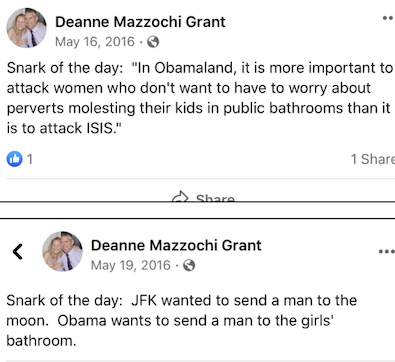
Mazzochi’s comments are beyond shameful. As a leader at an institution of higher education, she was entrusted with the well-being of all students and the cultivation of affirming learning environments. Instead, she sent the exact opposite message: trans students should be stereotyped and mocked. Even worse, she posted her comments just three days after the United States Departments of Justice and Education offered guidance to schools about the fair treatment of trans students.
Contrary to Mazzochi’s posts, trans people are disproportionately the victims of violence. At least 27 trans people were killed in the United States in 2016, the same year Mazzochi posted to Facebook. And 2020 has surpassed the previous five years, with at least 32 trans people killed in violent attacks in the United States.
Trans people also experience harassment and stigma in Illinois educational institutions. Eighty percent report mistreatment in K-12 schools, and 27% experience verbal, physical, or sexual harassment in colleges and vocational schools.
When Mazzochi had the opportunity last year as a state representative to support legislation that would make schools safer and more affirming for LGBTQ youth, she voted NO.
Mazzochi fails the basic test of acting in accordance with Illinois values of equality and inclusion. Since she is clearly unable to represent all of her constituents with equal care and respect, Rep. Mazzochi does not deserve re-election.
* Meanwhile…
Since late last year, Patch has been trying to get an answer about why state Rep. Deanne Mazzochi did not vote yes or no on a proposal to cap insulin prices. She voted present in November, even after she took a vocal stand against the measure.
If Mazzochi, R-Elmhurst, had voted no, she would have been in a small minority. The bill sailed through the House 100-13 and the Senate 43-1. She was the only one who voted present. Democratic Gov. J.B. Pritzker signed the bill in January. […]
In an interview last week, Mazzochi questioned what good a dissenting vote would have done. And she raised the prospect of negative campaign mailers. She is running against Democrat Jennifer Zordani of Clarendon Hills in the Nov. 3 election.
Mazzochi said she was against a price cap because it would remove pharmaceutical companies’ incentive to charge a price lower than the cap. With the politics involved, she said, one firm decided to stay out of the insulin market and that others would likely follow.
That vote has been called out by her Democratic opponent…
Jennifer Zordani, D-Clarendon Hills, is running against Mazzochi in the November election. She said Mazzochi’s firm is tied to pharmaceutical companies and that she is tilted toward them in the Legislature. Zordani cited Mazzochi’s present vote on the insulin issue.
Zordani said Mazzochi’s effort for an ethics bill that targets property tax lawyers such as Democratic House Speaker Michael Madigan is fair. But she said it should be broadened to include those with other conflicts, referring to Mazzochi’s ties to pharmaceutical firms, where she said the lawmaker has an “inherent bias.”
“The entire problem with Illinois politics is we don’t have strong enough standards,” Zordani said.
17 Comments
|
Question of the day
Wednesday, Oct 14, 2020 - Posted by Rich Miller
* Press release…
With a mission to expand local food options and continue efforts to remove Asian carp from Illinois waterways, the Illinois Department of Natural Resources (IDNR), together with Sorce Freshwater Company and the Midwest Fish Co-op, and with continued support from the Illinois Department of Commerce and Economic Opportunity, this Saturday will offer free Asian carp meals at nine locations across the state.
The events, which have been made possible with help from local partners including regional planning commissions, universities, food distribution companies and restaurants, will showcase the versatility and nutritional benefits of Asian carp.
“Removing Asian carp from our waterways has long been one of our best and most well-known tactics when it comes to keeping these invasive fish from the Great Lakes,” said Colleen Callahan, director, IDNR. “But what is lesser known when it comes to Asian carp is the overwhelming benefit as both a food source and potential menu item for restaurants. To showcase its nutritional benefits and adaptability as protein source, we’re partnering with businesses to provide free meals across the state.”
Locations include:
• Chicago, Logan Square: Unity Park, 2636 N. Kimball Ave. from 11:00 a.m. to 3:00 p.m. Asian carp tacos will be prepared by El Rancherito Restaurant
• Chicago, Lincoln Park: Dirk’s Fish & Gourmet Shop, 2070 N. Clybourn Ave. from 11:00 a.m. to 2:00 p.m. Asian carp burgers will be prepared and served by owner Dirk Fucik.
• Chicago, Pilsen: Open Books Chicago, 905 W 19th St. from 11:30 a.m. to 2:00 p.m. Asian carp tacos will be prepared by Mole Village Mexican Restaurant.
• Peoria: Kelleher’s Restaurant, 619 SW Water St. from 11:00 a.m. to 1:00 p.m. In partnership with the Tri-County Regional Planning Commission, Greater Peoria Economic Development Council and Distillery Labs, Kelleher’s will serve a chef’s choice of regular Asian carp daily specials.
• East Peoria: Levee District, 370 W Washington St. (tent near Target parking lot) from 11:00 a.m. to 1:00 p.m. In partnership with the City of East Peoria, Tri-County Regional Planning Commission, Greater Peoria Economic Develop Council and Distillery Labs, a chef provided by Sorce Enterprises will prepare and serve Asian carp.
• Springfield: Carter’s Fish Market, 1900 S. Grand Ave. East from 11:00 a.m. to 1:00 p.m. Owner Clint Carter will prepare and serve Louisiana style Asian carp hush puppies drizzled with a Remoulade sauce. Beginning Oct. 21, customers can enjoy a fish taco special at The Barn located at 1501 Wabash Ave.
• Quincy: Red Light Bar & Grill, 428 Maine St. from 12:00 p.m. to 2:00 p.m. Red Light Bar & Grill will prepare and serve Asian carp sliders; the sliders also will serve as a daily special for the week following the Asian carp cookout.
• Carbondale: Giant City State Park Visitors Center (tent in parking lot), 235 Giant City Rd., Makanda, from 12:00 p.m. to 2:00 p.m. Chefs from Cristaudo’s Café, Bakery and Catering will prepare and serve a Jamaican Escovitch fish taco filling for park visitors to pick up and consumer at their leisure. Cristaudo’s also will serve this dish at upcoming Southern Illinois Collaborative Kitchen events in the coming weeks.
• Carterville: Walker’s Bluff Vineyard, 326 Vermont Rd. from 2:00 p.m. to 9:00 p.m. Chefs from Walker’s Bluff Vineyard prepare and serve the Asian carp in the winery’s tasting room.
Additionally, students at the University of Illinois at Urbana-Champaign and Southern Illinois University-Carbondale also will have the opportunity to taste Asian carp creations at select dining hall locations.
“You know that old expression, ‘Take lemons and make lemonade?’ Well, that’s what we’re doing here,” Callahan said. “We’re just taking fish and making fish tacos, sliders, and a host of other food items Illinoisans love. It’s a win-win.”
* The Question: Would you try Asian carp? Take the poll and then explain your answer in comments, please…
bike trails
56 Comments
|
* If you click here, you can calculate what your state income tax would be if the governor’s graduated income tax plan is implemented.
The math does not favor the wealthy. For instance, if your state-based adjusted gross annual income is $100 million, your taxes will rise by $3,040,000 under the “Fair Tax.”
* Gov. Pritzker and others have long warned that if the graduated income tax fails at the ballot box, then the state’s flat income tax would likely have to be increased by at least a percentage point.
In that one-point flat-tax scenario, the aforementioned $100 million earner would see their current state income tax bill rise by $1 million, from $4,950,000 to $5,950,000. While still an increase, that’s a savings of $2 million a year over the proposed graduated income tax rate. Pretty darned sweet.
Even if the flat tax is increased by two points, that $100 million earner would still save a million bucks a year compared to the graduated income tax rate.
It’s just a no-brainer for the self-interest of the super-wealthy. I don’t blame them one bit for fighting it.
* So, color me skeptical of claims like this…
Democratic Gov. J.B. Pritzker’s cousin Jennifer Pritzker donated $500,000 on Tuesday to a group pushing for the defeat of the governor’s signature agenda item on the Nov. 3 ballot — a proposed state constitutional amendment to impose a graduated-rate income tax.
“There is evidence that the tax hike amendment could eventually raise taxes on the middle and working classes. With so many families and small businesses struggling to recover from the ravages of the pandemic, raising taxes is not a financial solution Illinoisans can afford to enact,” said Jennifer Pritzker, like her cousin a wealthy heir to the Hyatt Hotel fortune.
Please.
…Adding… For the “what about” people in comments, this same argument applies to $10 million AGR or $2 million AGR. Makes no difference. They’re gonna pay less when the flat tax is increased vs. a new graduated income tax.
57 Comments
|
* Highest number of hospitalizations since June 11. Press release…
The Illinois Department of Public Health (IDPH) today reported 2,862 new confirmed cases of coronavirus disease (COVID-19) in Illinois, including 49 additional confirmed deaths.
Adams County: 1 female 80s, 1 male 80s
Christian County: 1 male 60s
Coles County: 1 male 80s
Cook County: 1 male 60s, 1 female 70s, 1 male 70s, 3 males 90s
DeKalb County: 1 female 60s
DuPage County: 2 females 80s
Ford County: 1 female 80s
Franklin County: 1 female 100+
Jefferson County: 1 male 70s
Jersey County: 1 female 90s
Jo Daviess County: 1 female 90s
Kane County: 1 male 80s
Knox County: 2 females 80s, 1 male 80s
Logan County: 2 male 80s
Madison County: 1 male 70s, 1 female 90s
Marion County: 1 male 80s
Marshall County: 1 male 70s, 1 female 80s
Peoria County: 1 female 80s, 1 female 90s
Randolph County: 1 male 80s
Rock Island County: 2 males 60s
Sangamon County: 1 male 50s, 2 males 70s
St. Clair County: 1 male 80s, 1 female 90s
Vermilion County: 1 male 80s
Will County: 1 female 60s, 1 female 70s, 1 male 70s, 2 female 90s
Winnebago County: 1 female 40s, 1 female 80s, 1 female 90s
Woodford County: 1 female 60s
Currently, IDPH is reporting a total of 327,605 cases, including 9,074 deaths, in 102 counties in Illinois. The age of cases ranges from younger than one to older than 100 years. The preliminary seven-day statewide positivity for cases as a percent of total test from October 7 – October 13 is 4.6%. Within the past 24 hours, laboratories have reported 52,669 specimens for a total of 6,463,923. As of last night, 1,974 people in Illinois were reported to be in the hospital with COVID-19. Of those, 390 patients were in the ICU and 153 patients with COVID-19 were on ventilators.
Beginning today, IDPH is adjusting how data for Region 6, east central Illinois, is reported to most accurately capture spread across the region. Champaign County and its data will continue to be included in Region 6, but University of Illinois at Urbana-Champaign saliva testing will be broken out separately. This will allow us to better identify testing needs and trends in the region.
Starting tomorrow, IDPH will begin including both molecular and antigen tests in the number of statewide total test performed in Illinois. Previously, due to the limited number of antigen tests and limited information about antigen test accuracy, antigen tests were not included in the total number (which comprised less than 1% of total tests performed). Antigen tests, like BinaxNOW™, are now becoming more readily available, therefore, IDPH will include both molecular and antigen tests in its total number of tests starting October 15, 2020.
Following guidance from the Centers for Disease Control and Prevention, IDPH is now reporting separately both confirmed and probable cases and deaths on its website. Reporting probable cases will help show the potential burden of COVID-19 illness and efficacy of population-based non-pharmaceutical interventions. IDPH will update these data once a week.
*All data are provisional and will change. In order to rapidly report COVID-19 information to the public, data are being reported in real-time. Information is constantly being entered into an electronic system and the number of cases and deaths can change as additional information is gathered. Information for a death previously reported has changed, therefore, today’s numbers have been adjusted. For health questions about COVID-19, call the hotline at 1-800-889-3931 or email dph.sick@illinois.gov.
* Southern Illinois’ Region 5 hit the 8 percent positivity rate yesterday, but it dropped back down to 7.7 percent today. Gov. Pritzker warned today that three days above an average 8 percent positivity rate would trigger mitigations.
* Related…
* These Chicagoans Had Coronavirus And Never Got Better: ‘Long-Haulers’ Face Bizarre, Painful Symptoms After Recovery
* IDPH: Holiday Season Safety Tips
*** UPDATE *** Press release…
The Illinois Department of Public Health (IDPH) today reported 26 counties in Illinois are considered to be at a warning level for novel coronavirus disease (COVID-19). A county enters a warning level when two or more COVID-19 risk indicators that measure the amount of COVID-19 increase.
Twenty-six counties are currently reported at a warning level – Cass, Christian, Clay, Clinton, Coles, Crawford, Effingham, Fayette, Henderson, Jackson, Jefferson, Johnson, Knox, Lake, Lee, Mason, Massac, Pulaski, Richland, Saline, Shelby, Union, Vermilion, Whiteside, Winnebago, Warren.
Although the reasons for counties reaching a warning level varies, some of the common factors for an increase in cases and outbreaks are associated with large gatherings and events, bars and clubs, weddings and funerals, university and college parties as well as college sports teams, family gatherings, long-term care facilities, correctional centers, schools, and cases among the community at large, especially people in their 20s.
Public health officials are observing businesses blatantly disregarding mitigation measures, people not social distancing, gathering in large groups, and not using face coverings. Mayors, local law enforcement, state’s attorneys, and other community leaders can be influential in ensuring citizens and businesses follow best practices.
Several counties are taking swift action to help slow spread of the virus, including increasing testing opportunities, stressing the importance of testing to providers, hiring additional contact tracers, working with schools, and meeting with local leaders.
After learning of an individual who tested positive for COVID-19 and visited a bar, the Whiteside County Health Department (WCHD) worked with the business and quickly alerted the community of potential exposures, helping limit spread of the virus. Additionally, WCHD provides pre-event consultations for establishments planning events that may draw larger crowds. Pre-event consultations include, educating businesses about the importance of masking and social distancing, as well as reviewing emergency rules, and guidance, and other ways to keep attendees and the community safe.
IDPH uses numerous indicators when determining if a county is experiencing stable COVID-19 activity, or if there are warning signs of increased COVID-19 risk in the county. A county is considered at the warning level when at least two of the following metrics triggers a warning.
New cases per 100,000 people. If there are more than 50 new cases per 100,000 people in the county, this triggers a warning.
Number of deaths. This metric indicates a warning when the weekly number of deaths increases more than 20% for two consecutive weeks.
Weekly test positivity. This metric indicates a warning when the 7-day test positivity rate rises above 8%.
ICU availability. If there are fewer than 20% of intensive care units available in the region, this triggers a warning.
Weekly emergency department visits. This metric indicates a warning when the weekly percent of COVID-19-like-illness emergency department visits increase by more than 20% for two consecutive weeks.
Weekly hospital admissions. A warning is triggered when the weekly number of hospital admissions for COVID-19-like-illness increases by more than 20% for two consecutive weeks.
Tests performed. This metric is used to provide context and indicate if more testing is needed in the county.
Clusters. This metric looks at the percent of COVID-19 cases associated with clusters or outbreaks and is used to understand large increase in cases.
These metrics are intended to be used for local level awareness to help local leaders, businesses, local health departments, and the public make informed decisions about personal and family gatherings, as well as what activities they choose to do. The metrics are updated weekly, from the Sunday-Saturday of the prior week.
A map and information of each county’s status can be found on the IDPH website at https://www.dph.illinois.gov/countymetrics.
18 Comments
|
Chicago restarts school reopening debate
Wednesday, Oct 14, 2020 - Posted by Rich Miller
* Tribune…
Little more than three weeks remain of Chicago Public Schools’ fall quarter, but CEO Janice Jackson and Mayor Lori Lightfoot on Tuesday would not say when they will let everyone know if schools will reopen for the winter.
“We know that parents are anxious to hear from us on this, and we’ve committed to making an announcement very soon,” Jackson said during an unrelated news conference at City Hall. “We know that the second quarter is approaching quickly and we want to be sure that the plan that we put out will be as thoughtful as our parents anticipate.”
When a reporter pressed for specifics, asking, “This week?” Lightfoot simply said, “Soon.” Fall quarter ends Nov. 5.
The state has established some guidelines, but the final decision to reopen schools has been left up to individual districts.
* Chalkbeat Chicago interviewed Justin Lombardo, the Chicago Archdiocese’s “point person on reopening schools”…
CB: The Chicago Teachers Union has said it wants to see a strict protocol for contact tracing if schools should reopen to students. The archdiocese did institute a contact tracing protocol. How does it work?
JL: We have a team made up of people that have experience in doing interviewing and investigative work, as well as two nurses. We also trace within our parishes because we believe it’s part of our responsibility as a large organization. It begins with a report coming in to our central team, which reacts by immediately contacting the principal to get more details. Is it a positive case? Is it an exposure to a positive case? Or is it a presumptive positive (a case when a patient tests positive by a public health laboratory, but results have not been confirmed by the CDC)? Each of those we triage, and we take care of the positive cases first. We immediately gather data about the individual, and we quarantine the cohort. We have a standard procedure for notifying the families of students that are in a quarantined cohort, about what to do and where to go. We, of course, maintain privacy, and we never identify the individual.
I would say the overwhelming numbers of positive cases we get in our schools come from familial contacts of transmissions or transmissions in group settings outside of the school. We have many cases where the family or the parents or older siblings went to a party where social distancing was not observed, where masking was not done. We’ve had situations where there are sport leagues for students that are not run by the archdiocese or by our schools, where the precautions may not have been taken as completely as they should have been.
And so we’re really comprehensive. And that’s led to really very, very good outcomes for us. So in all cases in Chicago, where we’ve had a case reported in one of our cohorts, there’s only been one situation where a second case was reported within the 14 days of the infection time. Now, we have 40,000-some students and 5,000 staff in our schools, and in the city of Chicago alone, we have 91 schools with a population of 19,000 students, plus another 2,700 staff. That’s pretty good.
CB: Are you able to share how many cases you have had across your schools, and how many times your students have had to quarantine as a result?
JL: I don’t have the exact number, but I can tell you that our positivity rate, which is a key rate, is less than 1%. That is a very, very fine showing.
* There are competing claims about the dangers involved. From The Atlantic…
Texas reported 1,490 cases among students for the week ending on September 27, with 1,080,317 students estimated at school—a rate of about 0.14 percent. The staff rate was lower, about 0.10 percent.
These numbers are not zero, which for some people means the numbers are not good enough. But zero was never a realistic expectation. We know that children can get COVID-19, even if they do tend to have less serious cases. Even if there were no spread in schools, we’d see some cases, because students and teachers can contract the disease off campus. But the numbers are small—smaller than what many had forecasted.
Predictions about school openings hurting the broader community seem to have been overblown as well. In places such as Florida, preliminary data haven’t shown big community spikes as a result of school openings. Rates in Georgia have continued to decline over the past month. And although absence of evidence is not evidence of absence, I’ve read many stories about outbreaks at universities, and vanishingly few about outbreaks at the K–12 level.
One might argue, again, that any risk is too great, and that schools must be completely safe before local governments move to reopen them. But this approach ignores the enormous costs to children from closed schools. The spring interruption of schooling already resulted in learning losses; Alec MacGillis’s haunting piece in The New Yorker and ProPublica highlights the plight of one child unable to attend school in one location, but it’s a marker for more. The children affected by school closures are disproportionately low-income students of color. Schools are already unequal; the unequal closures make them more so. Virtual school is available, but attendance levels are not up to par. Pediatricians have linked remote schooling to toxic stress.
* But…
A study of more than a half-million people in India who were exposed to the novel coronavirus SARS-CoV-2 suggests that the virus’ continued spread is driven by only a small percentage of those who become infected.
Furthermore, children and young adults were found to be potentially much more important to transmitting the virus — especially within households — than previous studies have identified, according to a paper by researchers from the United States and India published Sept. 30 in the journal Science.
Researchers from the Princeton Environmental Institute (PEI), Johns Hopkins University and the University of California, Berkeley, worked with public health officials in the southeast Indian states of Tamil Nadu and Andhra Pradesh to track the infection pathways and mortality rate of 575,071 individuals who were exposed to 84,965 confirmed cases of COVID-19, the disease caused by SARS-CoV-2. It is the largest contact tracing study — which is the process of identifying people who came into contact with an infected person — conducted in the world for any disease. […]
The researchers found that the chances of a person with coronavirus, regardless of their age, passing it on to a close contact ranged from 2.6% in the community to 9% in the household. The researchers found that children and young adults — who made up one-third of COVID cases — were especially key to transmitting the virus in the studied populations.
“Kids are very efficient transmitters in this setting, which is something that hasn’t been firmly established in previous studies,” Laxminarayan said. “We found that reported cases and deaths have been more concentrated in younger cohorts than we expected based on observations in higher-income countries.”
Children and young adults were much more likely to contract coronavirus from people their own age, the study found. Across all age groups, people had a greater chance of catching the coronavirus from someone their own age. The overall probability of catching coronavirus ranged from 4.7% for low-risk contacts up to 10.7% for high-risk contacts.
* Related…
* Chicago teacher dies from coronavirus after trips to school, family claims
* CPS students petition to shorten the class day — and end homework — during remote learning, citing headaches, stress and too much screen time
14 Comments
|
Oppo dumps!
Wednesday, Oct 14, 2020 - Posted by Rich Miller
* From the state license application to be a principal officer of an adult use cannabis dispensing organization…
Have you ever been a principal officer, manager, board member or owner of a business or not-for-profit organization, other than a cannabis business, that had its license or registration fined, censured, suspended or revoked? This does not include non-disciplinary or non-public administrative orders. If yes, provide the name, address, type of business, and an explanation of the discipline below.
* While this person would not be disqualified under that language, the oppo doesn’t look so great…
For nearly three years, Jeffrey Rehberger has fought the state of Illinois’ attempts to take away his company’s lucrative video-gambling license.
Gambling regulators say Rehberger’s Lucky Lincoln Gaming violated state law, doing business in a way “that would discredit or tend to discredit the Illinois gaming industry or the state of Illinois,” records show.
And they also allege Rehberger engaged in “witness harassment” to try to get a former sales representative to change his testimony against him in an Illinois Gaming Board investigation.
But those big licensing problems with the gaming board did not prevent Rehberger from putting himself in prime position to cash in on the huge, new state-regulated bonanza — cannabis dispensary licenses.
Go read the rest, particularly the part about the armed robbery.
* Meanwhile…
After serving as one of Illinois’ top cannabis regulators, Cook County Commissioner Bridget Degnen confirmed Tuesday she has an ownership stake in a company vying for the right to open multiple pot shops across the state.
A spokeswoman for Degnen told the Sun-Times Tuesday the commissioner is part owner of Americanna Dream and was paid a stipend to write dispensary applications for the company.
The Highland Park-based firm submitted 17 perfect applications, beating out hundreds of other applicants to become a finalist in the state competition for the next round of dispensary licenses. The company has the maximum 10 spots in a lottery that will determine the winners of the 75 new licenses, each of which will likely be worth millions of dollars.
But Degnen’s ownership stake isn’t worth anything unless the company wins a license, according to her spokeswoman, who wouldn’t confirm how much Degnen’s been paid so far or what percentage of the company she owns.
The Chicago Democrat — who represents the county’s 12th District and campaigned on a promise to serve as a “full-time” commissioner — also issued a statement Tuesday defending her work for the “majority Black-owned social equity dispensary applicant.”
Breaking her promise to voters is not good, particularly since she whacked her opponent hard for his outside work. But it’s not legally disqualifying. And articles that use the term “dope shop” and claim that Degnan was “flooded” with a total of not even $20,000 in contributions (without mentioning she’s raised a total of $448K) tend to undermine their impact in my eyes.
People are making a whole lot of claims off the record about that operation. If they’re right about even half of it, I could definitely see serious trouble ahead. But, so far, nothing has emerged that proves anything particularly nefarious aside from a broken campaign promise.
* Related…
* Illinois Hits New Marijuana Milestone With $100 Million In Tax Revenue Collected Since Sales Began
11 Comments
|
* Washington Post…
The Supreme Court on Tuesday allowed the Trump administration to end the 2020 Census count now, concluding a contentious legal battle over the once-in-a-decade household count despite fears of an undercount that would fall hardest on minority groups.
The court put on hold a lower-court order that said the count should continue until the end of the month, because of delays brought on by the coronavirus pandemic. The court did not provide a reason, which is common in disposing of the kind of emergency application filed by the administration.
Justice Sonia Sotomayor was the only justice to note dissent.
“The harms caused by rushing this year’s census count are irreparable,” she wrote. “And respondents will suffer their lasting impact for at least the next 10 years.”
The order is here.
* SCOTUS Blog…
The administration said last week in an emergency request to the justices that it needs to wind down the census count right away in order to have enough time to process the census data and meet a key statutory deadline at the end of the year. A group of local governments and nonprofit groups, led by the National Urban League, said that ending the count early will result in an undercount of immigrants, low-income people and other groups that are difficult to count.
In a one-paragraph, unsigned order, the court granted the emergency request from the Department of Commerce, which conducts the census. The order is framed as a temporary pause of a district judge’s ruling that directed the department to proceed with the count through Oct. 31. But due to the compressed timeline for completing the census, the order is likely to be the definitive say on the matter. […]
In response to the National Urban League’s lawsuit, a district judge in California ordered the department to stick to its earlier plan and keep counting until Oct. 31. The U.S. Court of Appeals for the 9th Circuit upheld that directive.
In its emergency appeal to the Supreme Court last week, the department said that, if forced to keep field operations in place, it would be unable to meet a Dec. 31 statutory deadline by which it must send state-by-state population totals to the president. Those population totals are then used to reapportion congressional seats among the states.
* New York Times…
The administration asked the Supreme Court to intervene, saying that only by shutting down field work now could the bureau meet the Dec. 31 deadline, which is set by statute. “The district court’s order constitutes an unprecedented intrusion into the executive’s ability to conduct the census according to Congress’s direction,” Jeffrey B. Wall, the acting solicitor general, told the justices in a brief filed on Wednesday.
“As the law stands,” Mr. Wall wrote, “assessing any trade-off between speed and accuracy is a job for Congress, which set the Dec. 31 deadline and has not extended it, and the agencies, which acted reasonably in complying with that deadline.”
On Saturday, Mr. Wall wrote that as of Oct. 9 the bureau had counted over 99 percent of households in 49 states. But that was widely questioned by census and demographic experts, who cast the number as a public relations estimate that concealed broad gaps in the accuracy of the tally.
* ABC 7…
“Each of us is at risk of losing representation in Congress, so we’re pretty certain Illinois is going to lose at least one representative in the House of Representatives,” said Maria Fitzsimmons, 2020 census director for the Illinois Coalition for Immigrant and Refugee rights. “That just dilutes the amount of voices in Congress speaking for our needs.”
The representation and funding of neighborhoods across the country may well have been capped with the abrupt end of the census count.
“It will increase poverty among people as a result of this decisions. And it could potentially affect the redistricting process if a full census is undertaken. So it has all kinds of consequences,” said Rep. Chuy Garcia (D-IL 4). “This could have a devastating impact on marginalized, lower income communities across the country.”
The Supreme Court’s ruling Is not exactly the final word. An appeals process could play out in a lower court, but the case won’t be argued before the original October 31 deadline, so the last day to submit your census response is this coming Thursday, October 15.
* Gov. Pritzker…
The Supreme Court’s decision to allow President Donald J. Trump to cut the Census short is wrong. It means an undercount in communities that can least afford it, perpetuating generations of disinvestment that make our nation weaker.
Earlier [yesterday], my administration announced an additional $1 million in funding for Census outreach, on top of our historic & nation-leading $29 million investment.
Despite [yesterday’s] decision, know that every person counts in Illinois, and we will always provide quality services to all in need.
Discuss.
28 Comments
|
* Greg Bishop at the Center Square…
One of the attorneys challenging Gov. J.B. Pritzker’s COVID-19 mitigation efforts in court is also challenging the governor’s assertion that business prohibitions work to slow the spread of the virus.
Gov. J.B. Pritzker’s administration last week said the relaxation of mitigation efforts Friday in the Metro East St. Louis region was because of “proven and targeted mitigation efforts.”
“We are excited to see that after weeks of mitigation measures and sacrifice, Region 4 has reduced its positivity rate and can return to Phase 4,” Illinois Department of Public Health Director Dr. Ngozi Ezike said. “It takes communities working together to reduce the spread of the virus and lower the positivity rate. I want to thank Region 4 for its hard work to decrease the risk for all of Illinois.”
Attorney Thomas DeVore, who’s challenged the governor’s unilateral orders in court, told WMAY that’s not true.
“Down here in Region 4, I promise you, I was here, I go to all these counties, I worked in these counties, the overwhelming majority of the small business owners did not close down,” DeVore said. “The governor doesn’t want you to know that. He won’t tell you that. But that’s the truth because I am here. And I can tell you in Region 1, it’s the same thing.”
Region 1 still has mitigations in place prohibiting indoor service at bars and restaurants.
DeVore expects to be in a Springfield court Wednesday for a hearing about cases he brought challenging whether there are county-level health emergencies. He cautioned people who say a case has been decided when a judge denies a temporary restraining order, as has happened with cases across Illinois. He said a decision one way or another on a TRO isn’t based on the merits of the case.
“So when a court doesn’t grant one, or when a court grants one, lawyers know that at the end of the day that’s not a big deal and it’s not a test of whether that case has any merit or not,” he said.
* Jordan Abudayyeh at the governor’s office…
Tom DeVore has spent a baffling amount of time during this pandemic fighting commonsense solutions backed by science that keep people healthy and safe.
The most absurd part of his charade is that he’s lost every single case outside of Clay County, where the positivity rate is currently 13.4 percent thanks in part to his antics.
While it doesn’t fit the naysayers’ agenda, the positivity rates in regions 4 and 7 went down because of mitigations designed by public health experts, not magic.
Also, obtaining a TRO requires showing that you have a likelihood of success on the merits. So, I’m not sure where he gets that reasoning of his.
28 Comments
|
Open thread
Wednesday, Oct 14, 2020 - Posted by Rich Miller
* Please keep the convo Illinois-centric and be polite to each other. Thanks.
10 Comments
|
|
Comments Off
|
|
Comments Off
|
|
 Support CapitolFax.com
Visit our advertisers...

 ...............
 ...............
 ...............


|
   
|
Hosted by MCS |
SUBSCRIBE to Capitol Fax |
Advertise Here |
Mobile Version |
Contact Rich Miller
|



