* The Tribune reports that election day absenteeism by city workers was way down this year…
Four years ago, more than one of every three workers in those city departments targeted by prosecutors were absent from their jobs on Election Day, according to newly released city records analyzed by the Tribune.
But on Feb. 27, the absentee rate plummeted by almost half, to 18 percent from 34 percent. […]
In Streets and Sanitation, 677 workers, or 20 percent, took off on Election Day 2007. Unlike in 2003, employees were more likely to miss work on the day after Thanksgiving and the day after Christmas in 2006.
For the other four departments targeted in the federal investigation, this year’s Election Day did not even rank in the top five for days missed the prior year
* Paul Green had an analysis of Mayor Daley’s win in the Sun-Times today…
…Daley’s original 1989 electoral winning coalition of white ethnics, Latinos and lakefronters (the 42nd, 43rd, 44th, 46th, 48th and 49th wards) has held steady in their overwhelming support for the mayor. Second, Daley’s mayoral opponents have been, as they were in 2007, African-American, and once again these foes centered their energy mainly in the black community. Three, Daley’s support among African-American voters has grown and though in 2007 it was less than in 2003, it still was politically massive. […]
As in the past, Daley’s strength centered on his rock solid electoral base. Margin-wise (based on Brown’s and Walls’ combined vote) seven of his top 11 wards were on the city’s Northwest and Southwest sides (19th, 23rd, 13th, 41st, 45th, 11th, 36th), three others were along the north lakefront (42nd, 46th, 43rd) while the remaining ward was the Far North Side 50th. Each of these wards gave Daley 6,000-plus vote margins.
Daley’s best African-American margin wards were the West Side 29th Ward led by the mayor’s ally Ald. Ike Carothers and the South Side 16th Ward. Among Hispanic wards, another longtime Daley supporter Ald. Danny Solis (25th Ward — Pilsen) and 31st Ward Ald. Ray Suarez (Near Northwest Side) produced the biggest margins for the incumbent.
Percentage-wise, Daley had three wards provide him with 90-plus percent of their vote — 14th, 11th and 13th. All three of these Southwest Side wards are located in Daley’s former home base and are led by such Democratic notables as City Council Finance Chairman Ed Burke (14th), the mayor’s brother and Cook County Commissioner John Daley (11th) and Illinois House Speaker Michael Madigan (13th). Besides Burke’s ward, other top percentage Hispanic Daley wards were the 12th, 31st and 30th. In all the mayor captured 80-plus percent of the vote in 20 wards besides his 90-plus percent big three.
* I held up this entire post until I could do some follow-up work on a startling Beachwood Reporter story today. A nameless writer, who didn’t cite a single source, either on the record or off, claimed without qualification that Alderman-elect Brendan Reilly was already breaking a major campaign pledge…
[Reilly] hasn’t even been inaugurated yet and he’s already sanctioned a controversial new development in the very style of his outgoing predecessor, Burt Natarus. […]
Reilly is going to begin his term by tearing down a fortress of a building with no apparent discussion. […]
So the first act of our new alderman - I mean the new Prince of Downtown - is to advocate for a developer and campaign contributor from Kenilworth (which ironically wants to save its historic structures and ban demolitions) and an Evanston-based tax-exempt university, ignoring the sentiments of his tax-paying constituents and two non-profit preservation groups that seldom advocate for the preservation of the same structure.
Even though there were no actual sources cited by the anonymous writer, for a moment I seriously considered retracting my endorsement of Reilly that I wrote earlier this year. So I got ahold of the alderman-elect and let him have it but good.
Reilly, however, flatly denied everything in the report. Rather than take the time to write them all up, here are some of my notes from the conversation, which I also shared with the Beachwood Reporter’s publisher…
factually incorrect. could not be further from the truth. i’m not sold on the proposed development.
met with planning commission this morning and asked about the project. still gathering the information i need to make an informed decision.
needs to be thoroughly vetted by the community. when i said i wanted a transparent process i meant it.
i didn’t sign off on a demo permit
meeting with all parties. i have yet to speak on this issue. haven’t taken any position yet on a project. it will get a full debate in the community.
[the article was] way, way, way off base and insulting.
instructed developer to meet with entire neighborhood.
not told anyone that i’d sign off on it. i have not made a commitment one way or another.
In other words, Reilly says he didn’t “sanction” the project and he didn’t “advocate for a developer,” as claimed in the article above. Until I see some actual proof from the anonymous BR contributor, I gotta figure that there’s no there there. On the other hand, if Reilly lied to me for the first time in his life today (and we go back a long, long time), his life will be hell. That’s a promise.
Sure, millions of Americans refuse to register with either of the major parties, and they avoid the labels “liberal” or “conservative” to describe themselves ideologically. But what matters more than how they fill out registration forms at their county board of elections or define themselves when pollsters call is the policy opinions and attitudes they espouse and how those opinions translate into votes.
On that score, Mr. Abramowitz demonstrates that not only are liberals and conservatives voting more predictably for Democrats and Republicans, respectively, but their social and economic attitudes are becoming more internally consistent. He says it is easier today to predict, say, how a voter feels about stem cells based on her position on tax policy.
“To a much greater extent than in the past, voters’ opinions on economic, cultural and foreign policy issues are closely interconnected with Democrats overwhelmingly on the liberal side of almost every issue and Republicans overwhelmingly on the conservative side of almost every issue,” Mr. Abramowitz says.
America seems to be coming to the end of a period of partisan dealignment that began with the civil rights movement and the Vietnam War. The so-called vital center is collapsing.
Another quick note to update you on the new website hosting issue. We have to postpone the move until next Monday because my DNS server number will change when I make the final switch and it typically takes the Internet up to 48 hours to fully catch on to a new server number.
My old host, PowWeb, has picked up the pace this week (although still not enough) so our current situation isn’t nearly as dire as it was last week. Rather than create a confusing environment where many or even most of you are accessing the “old” web page for a couple of days and missing all of our updates, I’ve decided to just put it off. The change-over will happen Friday night so that by Monday morning everything should be hunky-dory.
This will also give my new host, MCS, a chance to put this site on their brand new server (which is being delivered tomorrow) and perform several tweaks on their end that will ensure they are providing the best possible hosting service. So far, they’ve been nothing but terrific.
So perhaps it shouldn’t be surprising that Kentucky is ahead of Illinois and Indiana - the other two states that lay claim to Lincoln - in funding and in planning for events surrounding Lincoln’s 200th birthday in 2009.
The Kentucky General Assembly already has approved $6 million for that state’s Lincoln bicentennial festivities, and planners will ask for another $4 million for 2008 and 2009.
The Indiana Lincoln Bicentennial Commission received word just this past week that the state legislature approved $1.4 million over two years for its Lincoln commemorations.
Meanwhile, Illinois has allocated merely $500,000 so far. Gov. Rod Blagojevich has proposed another $500,000 for fiscal 2008. […]
As so much attention is being focused on Lincoln, Lincoln sites in Illinois have less funding and fewer programs than they did five years ago, Brauer said.
Question: What Lincoln celebrations would you like to see here in Illinois? Snark heavily encouraged.
* Despite what you may read, not every business is upset at the GRT. It turns out, there’s a big loophole for many of the state’s most profitable companies…
Gov. Rod Blagojevich’s proposed gross-receipts tax — which he argues will create fairness by forcing corporate “fat cats” to pay their share — would cut taxes for at least a few of the most profitable corporations in Illinois.
The Chicago Mercantile Exchange, the Chicago Board of Trade and an unknown number of other highly profitable corporations would apparently pay less under the proposed plan. […]
One of the biggest winners in the new tax regime would be the Merc, which last year paid $30 million to $40 million in Illinois state taxes, according to its chairman, Terrence Duffy. Even if all $1.1 billion of the futures exchange’s revenue is subject to the proposed 1.95% gross-receipts tax — unlikely, since much of its business comes from out of state and would not be taxed — its tax bill would be just $21 million.
“If a gross-receipts tax supplants the state (income) tax, it could actually benefit us,” Mr. Duffy says.
* Meanwhile, the governor has done his level best to stamp out all talk of an income tax hike, but AP stories like this won’t help…
Groups are lining up to embrace Gov. Rod Blagojevich’s plan to spend billions of dollars on family-friendly programs. They want the new schools, higher teacher salaries, better health care and expanded child-care services.
They aren’t nearly so enthusiastic, however, about the tax increases that would be necessary to pay for it all. […]
Protesters converged on the state Capitol to demand more education money Wednesday, but most speakers carefully avoided endorsing Blagojevich’s tax plan.
Even groups that support the tax, such as the Illinois Hospital Association, rush to point out that they do so because it appears to be the only viable plan right now. If another gained momentum, they’d consider supporting that option instead.
* Here’s a Tribune story on the same basic subject, “Give us the money, but not the GRT”…
The Civic Federation of Chicago, a nonpartisan research group, called for rejection of Blagojevich’s controversial gross-receipts tax on businesses. The federation said it would “overburden Illinois businesses and consumers.” Instead, the group advocated an increase in the personal and corporate income taxes to stabilize the state’s precarious financial health.
* And the Illinois Education Association seems to be getting some push-back from a few of its locals over the union’s support of the gross receipts tax, including in the Metro East…
Metro-east educators are pressing state legislators to increase funding through a proposed increase in income taxes.
The [IEA] rally was a general push for legislative action, but educators in the Triad and Highland school districts said they favor the income-tax focused House Bill 750 over Gov. Rod Blagojevich’s tax proposal.
* Carol Marin concludes her latest column, which is about questions surrounding Senate President Emil Jones and his family’s questionable jobs and contracts, this way…
When coincidences look like conflicts, they usually are.
Human minds are specifically geared to look for coincidences and connections, even if none actually exist. That’s why we have to always be careful not to allow knee-jerk cynicsm to override hard facts. While Carol is right that coincidences are too often conflicts in this business, the quote reminds me of this exchange in the movie Syriana…
WHITING: In this town, you’re innocent until you’re investigated.
BOB: Innocent until investigated. That’s nice. It has a nice ring to it. I bet you’ve worn some miles on little sayings like that.
Very wise. Gives the listener the sense of law being written as it’s spoken.
As Sen. Donne Trotter said about the Jones controversy last week…
“They say nine-tenths of everything is perception, but that doesn’t make it a fact.”
The two personnel employees fired by Gov. Rod Blagojevich administration over allegations that they were rigging job tests should be suspended for only 14 days because the case against them was too weak to support their dismissal, a hearing officer said Friday.
The recommendation is a “huge victory” for Dawn DeFraties and Michael Casey, the two employees who were fired last year, said Carl Draper, their attorney.
Still, it’s difficult not to reach some negative conclusions when politicians do incredibly stupid things like this…
It’s a weekend in Las Vegas for some Illinois lawmakers.
With just a month left in the legislative session, an estimated 12 to 14 members of the Illinois House and Senate are spending the next couple of days at a trade show for the cable television industry.
The three-day, expense-paid junket comes as the cable industry is fighting an attempt by telephone giant AT&T to change state law in a high-stakes battle for the eyes and wallets of television viewers.
They are members of the Illinois House and Senate committees that deal with telecommunications legislation, such as a current bill that could ease the way for AT&T and other telephone companies to compete with cable television firms. The Cable Television and Communications Association of Illinois, whose members could lose their local franchises if the legislation is approved, is paying for the trip.
“It is 100 percent an educational experience from our point of view,” said Gary Mack, a spokesman for the cable television association. Committee members have been invited to national conventions in different cities for the past five years to look at new technology, he said.
I’ve been hearing reports from the Vegas site, and from what I’ve heard, it’s definitely not “100 percent an education experience.”
Every vote those legislators take on this issue from here on end will be in question, regardless of whether or not their hearts are pure.
Sometimes, coincidences will multiply to the point that they create enough smoke to make one suspect that there’s a fire underneath it somewhere, as is the case with Treasurer Alexi Giannoulias’ family bank, which popped up in the Tribune’s story about a federal mole who was apparently helping the feds set up developers, including Tony Rezko….
Thomas’ Carnegie Realty Partners helped Rezmar Corp. obtain financing from Broadway Bank for an ultimately failed deal to build a 24-story condo high-rise on a vacant lot at the southwest corner of Chicago and Hudson Avenues, according to interviews and a civil lawsuit against Thomas by a former Carnegie officer.
That doesn’t mean that Broadway is crooked, but the bank has certainly been involved in a whole lot of coinkydinks over the years. Even so, it would be nice to see some hard evidence.
By the way, I checked and couldn’t find any clear connection to the mole and Patti Blagojevich’s real estate firm. So not every connection necessarily leads down that path.
The “Innocent until investigated” mindset is also clearly evident in the lack of media coverage of the recent dismissals of a couple of important corruption cases, which my syndicated column addresses this week…
Federal prosecutors have recently been handed a couple of big setbacks in their ceaseless pursuit of governmental corruption. But you would hardly know it considering the lack of press coverage the cases have received here.
The point being: Yes, we certainly have a corruption problem here, but not every allegation or investigation is created equal, and all sides deserve a fair look.
A “carefully crafted performance-pay system has huge potential to transform the teaching profession in ways that can help all students learn more,” says the teachers’ report, which is available at Teacherleaders.org.
* National popular vote bill passes Illinois House
* Librarians won’t stay quiet about Internet filtering bill
“I would like to emphasize that we have for years taken the position that this is an issue of local concern,” he said. “The local officials, local trustees, librarians are most qualified to decide how Internet access should be provided to their patrons. The current bill overrides all local decisions.”
After being scapegoated and demonized, the “CMS Two” finally get a modicum of justice…
Two former state workers at the center of Gov. Rod Blagojevich’s effort to portray himself as a corruption-buster violated hiring rules but should not have been fired, a judge said Friday evening.
Administrative Law Judge Anthony Dos Santos recommended that Dawn DeFraties and Michael Casey be suspended for 14 days.
Blagojevich aides fired the two former managers of the Department of Central Management Services in April 2006 for allegedly rigging hiring procedures for favored jobseekers.
The administration said they cut corners to give some applicants a better chance at posts and pressured evaluators to give top “A” grades to sub-par applications from clout-connected candidates.
Dos Santos, in a 51-page ruling filed late Friday and obtained by The Associated Press, said the state proved violations against the pair, but not to the extent originally alleged.
“Neither Ms. DeFraties nor Mr. Casey directly or indirectly fixed the grading process,” Dos Santos wrote. “They did not order an ‘A’ to be given if one was not deserved.”
The judge also suggested throwing out charges of insubordination against the two for failing to answer questions from a lawyer hired by Blagojevich to investigate hiring irregularities. Dos Santos said the lawyer never informed the pair they could be fired for not cooperating.
The Chicago Sun-Times now has a printable “afternoon edition,” so I figure we can have a not-so-printable weekend edition. Here are some bits I missed earlier today and stuff that came in later as I was working on other things…
* This fight has also been playing out at the Statehouse, and I’ll have more on that next week…
FBI agents visited Joliet last week and asked questions about a land deal involving labor leader Joe Ward and the construction of his upscale Shorewood home overlooking the DuPage River.
Meanwhile, Gov. Rod Blagojevich recently appointed Ward to the Department of Labor Advisory Board.
Ward, 56, is the longtime treasurer of the International Union of Operating Engineers Local 150, a powerful, politically connected organization. It represents 20,000 workers who run cranes and other pieces of heavy construction machinery in Illinois, Indiana and Iowa. The union has a business office and hall in Joliet, 1050 NE Frontage Road.
Ward is in a bitter race with current union President Bill Dugan to become the next Local 150 president. In recent months, the candidates have filed dueling lawsuits including allegations of defamation, palm greasing and dirty dealing.
* Anita Mahajan, of leaning out the window and denying to a reporter that she knew the Blagojevich’s fame, was indicted today…
A woman with close ties to Gov. Rod Blagojevich and his wife, Patricia, has been indicted on charges that she bilked the state of more than $2 million for services her company never performed, Cook County prosecutors said today.
Anita K. Mahajan, 56, who was originally charged in March, appeared today before Cook County Circuit Court Judge Thomas Hennelly who announced the indictment and set May 24 for her arraignment.
* It was alleged in a couple of different Lee Newspaper articles that Sen. Gary Forby gave Senate President Emil Jones a “high five” after Jones killed off Forby’s amendment to include ComEd in the Ameren rate rollback and freeze bill. Those articles caused Forby a whole lot of headaches back in his district, but now the Marion Daily Republican has Senate Majority Leader Debbie Halvorson backing up Forby’s claim.
Senator Forby characterized the report of a friendly exchange of high fives as a “complete and utter lie.â€
Senator Debbie Halvorson (D-Crete, District 40) told the Marion Daily Republican Monday that she was sitting next to Senator Jones when Gary Forby walked up to the Senate President’s desk.
Senator Halvorson said, “After the vote, Forby came over to the senate president’s desk and his hand was clenched.
“He went to bang his fist on the Senate President’s desk and the Senate President reached across his desk to shake his hand. But Senator Forby’s hand was clenched. “Then Gary continued to bang his fist on the table. Anyone hearing what Forby said could not have thought it was a pleasant exchange. And in no way was there a high five,†said Senator Halvorson.
* MDR columnist Tom Kane takes the newspaper chain to task on the Forby story…
So here’s my point. If I could find a corroborating witness for Senator Forby’s claim in 20 minutes, why didn’t a newspaper with more resources than mine make the same effort?
Here is my opinion: the media are arrogant and assume their practitioners are in the right without doing an investigation. The public knows this and would be surprised if a newspaper behaved any differently than the one in question.
It’s one of many reasons that newspapers are losing their subscribers.
* I’m not even sure if I have a septic tank. I guess I should find out before I get hit with this fee…
The Illinois Senate has passed a bill that would exempt home owners with septic tanks from mandated testing that could cost 500-dollars a year in fees. However, Co-sponsor Senator John O. Jones of Mt. Vernon does have some concern about the future of the bill after a Chicago legislator grabbed the bill in the house at the request of the EPA. Jones says the EPA doesn’t like the bill and wants to charge everyone a fee. He reports the bill would grandfather everyone in that has a septic system that does not have the effluent leave their property.
* GOP Presidential candidate Mitt Romney took a swipe at US Attorney Patrick Fitzgerald during the debate this week. Cal Skinner has a nice catch at Illinoize…
Fitzgerald’s name was not mentioned, but Romney went into a virtual rant about what the Federal prosecutor did to Vice President Scooter Libby in a question of whether each thought Libby should be pardoned. Fitzgerald, of course, was that Federal prosecutor.
Nothing was mentioned about Fitzgerald’s fight against corruption in Illinois. […]
Bob Kjellander is Romney’s Illinois chairman.
* Dog Fight in the 50th blog had some good analysis of broken down warhorse Ald. Bernie Stone’s win…
* You may have noticed a few new additions to the blog as we await connection to our new web hosting service. (The people over there have been great so far, but they’re working out some bugs and it will likely be Monday or Tuesday before we’re connected to a new, much faster server.)
Paul has conducted a dead link safari and killed or updated a whole bunch of links in the pulldown menus.
I’ve added a couple of three new news feeds, one for Dick Durbin and another for High Tech stuff, plus one for Illinois and local-related blogs.
I’ve also added two new legislative searches in the center column. You can now search for legislation by bill number or keyword right here at the blog.
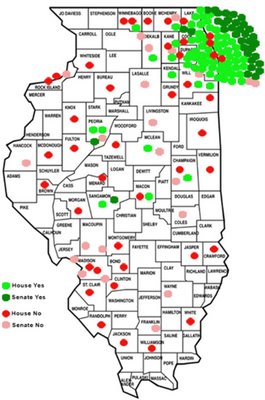
* IlliniPundit looked at the smoking ban vote and came up with some interesting numbers and a great graphic…
The total vote in both houses for SB500, Smoke Free Illinois was 107 Yes, 65 No.
North of I-80 the vote was 99 Yes, 23 No.
South of I-80 the vote was 8 Yes, 42 No.
Notice how almost all downstate legislators representing districts that border other states voted “No.”
But that doesn’t have much to do with our question today. This article does. Legislators want to run another bill to lift the smoking ban for casinos…
State Sen. Mike Jacobs, D-East Moline, voted against the smoking ban and said he worries it will force gamblers out of casinos in his district and into casinos just minutes away in Iowa.
“What we are trying to do is put a little common sense into a bad bill that was recently passed,” Jacobs said. “I think that it would affect our bottom line in a very serious and negative way. We don’t want to lose our patrons to Iowa.”
State Rep. Lou Lang, D-Skokie, voted in favor of the ban, but agrees that exceptions should be made for casinos and tracks.
“The unintended consequence of the smoking ban, which I voted for, is to cost the state of Illinois significant amounts of money,” Lang said. “We ought to at least consider the notion that if we don’t allow…an exemption then we are in effect inviting casino customers to go across the river to Iowa and Missouri and gamble.”
And so does this column by the Peoria Journal-Star’s Phil Luciano…
But the ban also invades private clubs. That’s nuts.
Indeed, private clubs - veterans groups, marinas and the like - are often open to the public. But at their core, they are private: They exist to promote fraternal interests.
Most private clubs historically allow smoking. If outsiders enter a private club, they know they might sniff smoke.
It’s like a house. If you visit a friend who smokes in his private residence, you have to assume the risk of smoke.
Question: Should casinos bordering other states and private clubs be exempted from the statewide smoking ban? Why or why not?
* Senate President Emil Jones addressed the ever-growing issue of his position and his family yesterday…
Senate President Emil Jones defended his family’s state jobs and business contracts, including one with the corporate parent of Commonwealth Edison, in a closed-door session Thursday with his Democratic members.
Jones “wasn’t remorseful” about published reports that tied his family to the lucrative jobs, but he wanted to clear the air during the closed-door meeting in the president’s office, according to one lawmaker who attended.
In Thursday’s editions, the Sun-Times and NBC5 disclosed Sterling’s business relationships with both Exelon and the City Colleges of Chicago — the latter of which awarded Sterling’s firm a $45 million no-bid technology deal on April 12.
Besides Sterling, Jones’ daughter, lobbyist Renee Rose, derives income linked to the City Colleges. She began lobbying members of the General Assembly on the college system’s behalf during the last year and a half, Jones spokeswoman Cindy Davidsmeyer said.
Davidsmeyer did not know the nature of the lobbying work, including whether any of it involved securing state computer grants that could have benefitted her stepbrother.
Rose’s work for the City Colleges was funneled to her through the law firm of Mayer, Brown, Rowe & Maw LLP, which she represents in Springfield. Mayer, Brown also lists Exelon as one of its clients, but both Davidsmeyer and an Exelon spokeswoman said Rose has done no lobbying work for the utility.
Jones should bow out from any more ComEd dealings this session and find jobs for his other children outside of the state government or companies that do work for government.
State Sen. Terry Link, a Waukegan Democrat and member of Jones’ leadership team, said he sees no problem with Sterling’s contract with the power company.
“I don’t think there’s any conflict whatsoever,†Link said. “He’s a grown man. It’s not like he’s a little kid at home.â€
* But at least one House Democrat expressed concerns…
“Obviously, it is something which concerns and troubles people throughout the state, and obviously it could have some impact on the negotiations,” [Rep. John Bradley (D-Marion)] said.
* Meanwhile, things aren’t going extremely well with the rate negotiations…
“I don’t think we’re close to a resolution at all,” said Rep. George Scully, D-Flossmoor. “I think that discussions are healthy, and I think that out of discussions a resolution can evolve.”
* The Illinois State Medical Society came out against the gross receipts tax yesterday.
llinois’ foremost doctors group gave a thumbs-down Thursday to Gov. Rod Blagojevich’s sweeping health care reform plan and the new statewide corporate tax that he would use to pay for it.
The Illinois State Medical Society, a politically powerful association of 13,000 physicians statewide, said it still supported the idea of universal health care, just not the governor’s plan.
“I’m operating under the assumption that the gross-receipts tax isn’t going to pass, at least in its present form,” said Charles Wheeler, director of the public-affairs reporting program at the University of Illinois at Springfield.
The medical society’s criticisms are significant, he said, because the group apparently weighed the new money that doctors could receive under Illinois Covered against other details of the plan.
“I don’t know if it’s the last nail in the coffin,” he said. “From my perspective, the coffin lid was nailed shut some time ago.”
* Judy Baar Topinka claimed the tax proposal was “hideous.”
“This is just the biggest tax plan that’s ever been proposed, the biggest spending plan. He knows that the state is in hock; it’s in debt; it has no money,” she said in Chicago Thursday…
* Declaring the governor’s gross receipts tax “dead on arrival,” the Sun-Times editorial board suggests looking at a tax swap instead…
There is an alternative, but it will require the governor to reverse his opposition to raising the sales and income taxes. The governor is trying to avoid hitting up “working families” but he won’t admit the obvious — taxes imposed on businesses are passed on to working families anyway. He also says businesses aren’t paying their “fair share” of the income tax, ignoring the fact that businesses pay a host of other taxes.
One approach we have long advocated is contained in Senate Bill 750, which would generate more than $9 billion by extending the sales tax to certain services and by raising the individual income tax rate to 5 percent from 3 percent and the corporate rate to 8 percent from 4.8 percent. A huge chunk of that money — $3.6 billion — would be returned to taxpayers in the form of property tax relief or tax credits, with the rest going to education.
Consider that in 2004, average individual tax filers paid $1,500 in taxes, while 12,500 of the largest corporations in Illinois with billions in annual revenue paid an average of $151 in corporate income tax. This simple statistic shows astounding inequity in our tax system that cannot continue.
Dozens of corporate loopholes for big businesses have increased the burden on individual taxpayers and small businesses. The governor’s proposed gross receipts tax is tailor-made to fix this inequity and exempts 85 percent of businesses in Illinois, in addition to exemptions for exports, retail food and prescription drugs.
What Filan isn’t telling you is that corporate tax receipts since 2004 have been way up.
* Meanwhile, the Center on Budget and Policy Priorities, a liberal think tank, says the GRT isn’t a bad idea, but believes changes must be made…
One potential problem with a GRT is its impact on high-volume, low-profit margin businesses, for which the tax can represent a high percentage of potential profits. Another potential problem is that a GRT favors businesses that conduct most operations in-house over businesses that purchase intermediate goods and services from other firms, since the tax is imposed each time a business purchases inputs from an outside firm. (This latter problem is called “pyramiding.â€)
Illinois can address both of these problems, however, by allowing businesses to subtract the cost of goods purchased from other companies from the gross receipts subject to the tax. Texas and Kentucky allow a similar, although broader deduction. If the cost of purchased inputs were deductible, a retail discount clothing store — an example of a high-volume, low-margin operation — would pay GRT not on its total receipts, but on its receipts minus the amount it paid the wholesaler for the clothes it sold. This would eliminate the disadvantage that such a store would have under a GRT compared to a boutique clothing store with much fewer sales but a high profit on each sale.
Similarly, the ability to subtract the cost of purchased inputs would eliminate most pyramiding, since the taxes paid during the intermediate stage of production would be included in the purchasing business’s cost of purchased inputs and thus would not be taxed again. Modifying the GRT in this way would help level the playing field between companies that purchase goods and services from other companies and “vertically integrated†companies that include multiple stages of production and have in-house staff to provide legal, accounting, and other services.
The CBPP claims the change would reduce GRT revenues by 30-40 percent, but includes some other ideas to make up that shortfall. Go read the whole thing.
“Illinois law says vehicles must pass other vehicles by a reasonable distance,” said Ed Barsotti, executive director of the League of Illinois Bicyclists. “People don’t connect that that applies to bikes.”
* Old State Capitol dome open to public for single night
I’ve been thinking of using this story about Springfield’s weird gnat problem in a clever little Statehouse analogy…
“Gnats suspected in chicken deaths ”
Buffalo gnats, which are members of the black fly family, have become special pests this spring in central Illinois. Nearly anyone who has spent much time outside over the last week or so has been harassed by the gnats, and some people suffer painful welts because of their bites.
According to the Illinois Department of Public Health, the gnats have a substance in their saliva that can trigger an allergic reaction in people, other mammals and birds. The gnats feed on blood and inject their saliva into host animals while feeding.
Agriculture officials do not know how the gnats are killing chickens, but they suspect the immediate problem could be an allergic reaction, blood loss or even suffocation because the gnats clog the chickens’ breathing passages.
Dr. Colleen O’Keefe, a veterinarian with the Illinois Department of Agriculture, said people with chickens or other birds should get the animals into some type of screened area.
“We did a little research, and it appears the gnats don’t do well in the dark. So, if possible, you should get them in a darkened barns and put some fans on them,” O’Keefe said.
“Buffalo gnats will land anywhere they can find skin on which to suck blood. Essentially that is all the females want; blood. They will seek this from any mammal they can find and people will often times be their prime target.â€
The Web site goes on to explain that swatting at the little pests is not all that effective. […]
But the true solution to the vampire gnat problem is - no, not garlic or teensy-weensy little wooden stakes - but warmer temperatures. As the water they grow in warms up, we are told the gnats will begin to vanish.
Help me write my next newspaper column. Best suggestion(s) wins lunch on me at a restaurant of my choice. (I promise it’ll be a decent place.)
The Tribune has a couple of stories today on Barack Obama’s time in the Illinois Senate. One of them, which required the combined efforts of four Trib reporters, breaks almost no new ground. Poker playing buddies, cautious nature, fights with Rickey Hendon and Donne Trotter, blah, blah, blah.
The other looks at pork projects that Obama doled out. Some of it is new info, some of it isn’t.
During his nearly eight years in Springfield, he tucked special earmarks into massive budget bills to shower small bequests on inner city schools, parks and youth service agencies.
But some of the larger grants Obama sponsored were tied to political allies and show how difficult it is even for politicians advocating reform to avoid the appearance of favoritism as they dole out taxpayer funds. Several non-profit directors, for instance, gave money to Obama’s campaigns soon after their allotments were awarded. […]
“It happens that there were major supporters in my district who had been supporters before they got member initiatives,” Obama said, noting that some of his contributors had been his allies for years.
One of those long-time supporters was Rev. Michael Pfleger, the politically active leader of St. Sabina Church. He gave Obama’s campaign $1,500 between 1995 and 2001, including $200 in April 2001, about three months after Obama announced $225,000 in grants to St. Sabina programs.
Also, the Tribune has set up a new web-page devoted to all things Obama. And they have another story today about the Obama campaign’s fight with a would-be disgruntled MySpace entrepreneur.
This is a Barack Obama open thread. How do you think his campaign is going so far?
Calling abstinence-only education a failed experiment, a spokesman for family planning and health groups urged the adoption of more comprehensive sex education programs in Illinois.
“Public spending for education is at a premium, and it is important that we spend every dollar wisely,” said Jonathan Stacks, campaign manager of the Illinois Campaign for Responsible Sex Education, which is backed by Planned Parenthood of Illinois and the Illinois Caucus for Adolescent Health. “Abstinence-only programs have no impact on student’s age at first intercourse, number of sexual partners and condom usage.”
Planned Parenthood is trying to strike from Gov. Rod Blagojevich’s proposed budget a $1.2 million grant that would go to an organization that produces sex education programs for Illinois schools — programs critics allege are ineffective because they teach abstinence-only.
A recent study found that students who participated in abstinence lessons were just as likely to have sex as those who did not. Mathematica Policy Research Inc. did the study. The same report said both groups started having intercourse around the same time and ended up having around the same number of sexual partners.
Each year, the federal government spends about $176 million on abstinence education. Illinois accepts some of this money and has no intention of discontinuing the state-sponsored abstinence programs, said Tom Green, spokesman for the Illinois Department of Human Services.
However…
Supporters of abstinence-only programs argue that alternatives fill students with falsehoods that won’t stand up against sexually transmitted diseases or unplanned parenthood.
“The whole idea behind safer sex is a lie. You’re teaching children that it’s OK to — wink, wink — engage in dangerous behavior,†said David Smith, director of the Illinois Family Institute. “It doesn’t make sense to remove funding for something that has shown to be promising, hopeful and works. Abstinence is 100 percent foolproof.â€
Finally, somebody else tackles the issue of the Illinois Press Association’s unusually strident opposition to the governor’s gross receipts tax and its impact on press coverage…
(T)he IPA’s position has been troubling for reporters, including myself, and potentially calls into question whether newspapers are covering the governor’s proposal fairly. […]
And then [the IPA press release] adds this: “Consequently, the IPA board is encouraging member newspapers to write news stories that focus on ‘the community or local impact of GRT.’”
That sure sounds to me, and many others, like the IPA was trying to direct news coverage.
The problem with that is that straightforward newspaper reporting that points out real problems with the governor’s proposal could be called into question if the governor or anyone else thinks a corporate agenda, not just the facts, are behind that coverage.
That’s exactly right. The IPA, in its zeal to oppose this tax increase, has seriously undermined the work of every reporter who works on the GRT story.
* Meanwhile, the State Journal-Register called for a compromise today…
Gov. Rod Blagojevich’s gross-receipts tax - he prefers calling it the tax fairness plan - has been sitting for a long time now on the legislative launching pad.
After House Speaker Michael Madigan’s announcement on Wednesday, we suspect this tax rocket is likely to fizzle. Madigan is calling for a special meeting of his chamber as a “committee of the whole†to discuss Blagojevich’s plan that seeks to tax business transactions for all firms doing $2 million or more in annual commerce. The plan would garner $7.6 billion, most of which would go to education and health care.
Blagojevich’s plan may not be dead, but its pulse is hard to find at this point. On Wednesday, 61 House members signed a resolution opposing the tax. That’s not a good legislative start to say the least. Blagojevich so far seems to have taken an “it’s my way or the highway†approach†to the GRT.
We suspect Madigan’s call for the full House meeting next week is sending a strong message that the governor needs to consider compromise. We hope he gets the message.
* The Daily Herald had some comments from Speaker Madigan in its story today…
I said that I think we’re going to need a tax increase, and that’s as far as I’m going to go,†Madigan told reporters Tuesday after speaking to a gathering of business owners.
“I don’t think that any tax increase is popular. If I walk my block in Chicago, people don’t say to me, ‘Oh, Mr. Speaker, please raise the tax.’ They don’t come out of their house and say, ‘Would you please raise the tax,’†Madigan said. “Just the idea that you are prepared to raise a tax or impose a tax is not an easy thing to do.â€
Emil Jones says he didn’t know about his stepson’s contract with ComEd’s parent company, but if his credibility on the utility rate freeze issue was already in serious question because of personal friendships with utility execs and bigtime campaign contributions, it’s now teetering on the verge of extinction…
At the same time Senate President Emil Jones went to unusual lengths to block a Commonwealth Edison rate freeze, his stepson’s computer-consulting firm was on the payroll of the utility’s corporate parent. […]
The disclosure set off questions about why Jones did not publicly disclose his familial ties to the utility, and prompted a call from Lt. Gov. Pat Quinn for Jones to “abstain” from any further negotiations or votes on rate-freeze legislation this spring.
Sen Gary Forby, whose amendment adding ComEd to his Ameren rate rollback and freeze bill was killed by Jones, voiced his suspicions to the Sun-Times…
“I think my people would probably not like this and maybe think that’s one of the reasons President Jones done this to me,” Forby said.
A companion article reports that Jones’ stepson also is doing very well with a college that has received a ton of pork money from the Senate President…
A firm headed by the stepson of Illinois Senate President Emil Jones stands to be paid up to $45 million from a no-bid tech deal it recently won from the City Colleges of Chicago.
The contract, awarded three weeks ago, comes on top of $55 million that John Sterling’s company, Synch-Solutions, already has been paid by the college system since 1999. […]
Jones in the past has controlled state grant money to City Colleges. In 2002, he steered at least $4.5 million to the colleges for computer upgrades at the same time his stepson’s information technology firm was winning no-bid contracts from City Colleges trustees. […]
“John Sterling is a successful businessman who worked for major companies doing technology before starting [Synch-Solutions],” Jones said in a statement Wednesday. “I have never interfered in his business, and he has never sought my counsel or advice in reference to securing business.”
And a sidebar reminds readers of other recent revelations about the Joneses…
Lorrie Jones: The Senate president’s wife, a psychologist, has seen her state salary increase from $116,460 to $186,000 under Gov. Blagojevich, who in 2005 promoted her to head the Department of Human Services’ mental health division. The Blagojevich administration rescinded its rule that the state’s mental health chief be a medical doctor just before Lorrie Jones got the job.
Emil Jones III: Jones’ son, hired April 3 as manager of real estate development for the Blagojevich administration’s Commerce Department. Earns $57,360 in his new post — a 7 percent increase over his previous state job, which he held from 1999 to November 2006.
* Opinion: State needs to direct funds toward mental health
Last year, a National Alliance for the Mentally Ill report graded Illinois’ health care system for serious mental illness an F. If the state is to improve its position, it needs to spend existing unspent money.
* Economist: State will lose money from smoking ban
Patrick Fleenor, chief economist at the Tax Foundation, a Washington-based educational group, said the state won’t save money and will most certainly lose it if fewer people buy cigarettes.
The best thing that happened to mass transit riders this year was an Illinois auditor general’s report that showed both sides are right: The CTA is underfunded and mismanaged. Maybe now they can stop arguing about whose fault it is and fix it.
* Lynn Sweet: Obama’s Illinois workers trained to help campaign elsewhere
* Over 400 city employees top $10,000 in overtime pay in 3 months
“It was a pretty normal winter. No huge snowstorm. No disaster natural or man-made. . . . It looks like purely political motivation to help out the mayor and his allies on the City Council,” said Ald. Joe Moore (49th), who eked out a victory over Daley’s opposition.
Just a quick note to tell you that my new web hosting service will hopefully begin operation tomorrow, but we may need to work out some bugs over the weekend. Either way, things will start to change for the better around here very soon.