Sam Adam Jr., the boisterous onetime attorney to former Gov. Rod Blagojevich and R&B singer R. Kelly, told the Chicago Sun-Times Tuesday he is considering a run for U.S. Rep. Jesse Jackson Jr.’s seat.
“My wife and I are thinking about it,” Adam told the Sun-Times. “I am a fighter. They may have said I wasn’t qualified, but they can’t say I don’t fight.” […]
Adam said he would have to give up his law practice. He recently set up a new firm with Victor Henderson. The two represent Cook County Commissioner William Beavers, who is to go to trial on Dec. 3. They also represented indicted – but reelected – state Rep. Derrick Smith, a West Side Democrat. Along with Ed Genson and Adam’s father, Adam represented Kelly in an underaged sex case. Kelly was acquitted. Adam gave openings and closings in the first trial against Blagojevich, which ended in a deadlocked jury on 23 of 24 counts.
“Best” Sam Adam, Jr. campaign slogan wins a night of adult beverages on me.
Over the last few months, Blagojevich has fought off boredom with books about former presidents, Adam said.
“He and my father [defense attorney Sam Adam Sr.] now are studying Ulysses S. Grant. He sends presidential books every month, and now they’re up to Grant,” Adam Jr. told WBBM Newsradio.
“Blago is the son my father never had. He’s the intellectual,” he added.
* Some House members want to again remove Representative-elect Derrick Smith (D-Chicago) from the chamber…
On Thursday, Republican Rep. Jim Sacia, a former FBI agent from Pecatonica, said Smith must be removed because his alleged activities make Illinois a “national laughingstock.”
Kicking out Smith again could prove difficult because the Illinois Constitution prohibits a lawmaker from being expelled more than once over the same set of circumstances. It’s a provision akin to a double jeopardy clause, lawmakers from both parties said Thursday. If Smith is convicted in federal court, however, he would have to leave the House once more.
Sacia insisted “there has to be a way” and said he would gather the best legal minds of both parties soon to hunt for options to remove Smith again.
“There are those out there that have the attitude that, ‘If you’re not convicted … there is no need to throw someone out of the General Assembly,’” Sacia said. “Nothing could be further from the truth. He brought great discredit to the Illinois House and the General Assembly as a whole.”
Republican Rep. Jim Durkin, a former prosecutor from Western Springs who presented the first expulsion case against Smith, said the only way he sees to remove Smith a second time would be if federal prosecutors file more charges against him that allege misdeeds while he served as a lawmaker. Rep. Elaine Nekritz, the Northbrook Democrat who oversaw hearings on Smith’s legislative case, agreed with Durkin’s assessment.
* The Question: Do you think the General Assembly should try to find a way to remove Derrick Smith from office yet again? Take the poll and then explain your answer in comments, please.
llinois has elected it’s fourth openly gay member of the Illinois House of Representatives. Democrat Sam Yingling won the 62nd district over Republican incumbent Sandy Cole.
“This is a very important and historic win because Mr. Yingling is the first openly gay State Representative to be elected outside of Chicago,” said Anthony Martinez, Executive Director for The Civil Rights Agenda. “This shows that constituents in Illinois are no longer concerned with the sexual orientation of their representative, but the capability of the individual.”
The 32-year-old Yingling is from Grayslake. As Avon Township supervisor, Yingling was a leading proponent for property tax reform.
* Democratic Senate candidate Andy Manar handily won his conservative Downstate district race even after being whacked by Republicans for supporting civil unions…
In a pleasantly pandering mailer sent recently on behalf of state Senate candidate MIKE McELROY, the state GOP displayed a nice color picture of a husband, wife, son and daughter sitting at the dinner table, hands clasped, praying over the chicken and vegetables. Everything is perfect, except that the son doesn’t join the rest in having his eyes closed.
“Who will stand up for our Illinois values?” the flier asks.
The answer, on the opposite side, says in part, “Conservative Mike McElroy believes that marriage is a sacred union between a man and a woman” and that McElroy is “opposed to efforts to water-down the definition of marriage and supports a constitutional Amendment to protect marriage.”
Despite the over the top mailer, Manar’s Republican opponent actually supported civil unions as well, despite the district being heavily Catholic.
Bernard Cherkasov, chief executive of the gay-rights group Equality Illinois, says the election results showed same-sex marriage winning in four states: Making same-sex marriage the law in Maine, Maryland and Washington, and preventing a constitutional ban in Minnesota. These are the first statewide victories at the ballot box for supporters of same-sex marriage.
“Here in Illinois itself, we had many candidates throughout the state who supported marriage equality, who ran in tight, competitive races and who won election, including candidates who were endorsed by our own PAC, so that was fantastic,” he said.
Democrats also will have huge majorities in the new General Assembly, but Cherkasov says when there have been advances on gay rights in Illinois and elsewhere, Republicans have joined, and he expects that to be the case on the marriage issue.
Gov. Pat Quinn signed a bill authorizing civil unions for same-sex couples, and he has come out for marriage rights, as has this page. It’s not likely to pass in the near future, but time is on the side of the proponents.
Their cause has the advantage of resting on respect for liberty and fairness. Wherever it can also count on public support, it will be unstoppable.
* But some groups, including the Catholic Church, refuse to concede…
- The Vatican, reacting to strong gains for gay marriage in the United States and Europe, on Saturday pledged never to stop fighting attempts to “erase” the privileged role of heterosexual marriage, which it called it “an achievement of civilization”.
For the second consecutive day, Vatican media weighed in with forceful editorials restating the Roman Catholic Church’s unequivocal opposition.
“It is clear that in Western countries there is a widespread tendency to modify the classic vision of marriage between a man and woman, or rather to try to give it up, erasing its specific and privileged legal recognition compared to other forms of union,” Father Federico Lombardi, said in a tough editorial on Vatican Radio.
State Sen. Kyle McCarter (R-Lebanon) confirmed his interest in ousting Radogno from her leadership post after she failed to stave off a whopping five-seat loss for Republicans in the state Senate.
“If we were a competitive college sports team with a record like this, somebody would have been fired already,” McCarter told the Chicago Sun-Times.
McCarter’s criticism came the same day that a conservative political action committee, Family PAC, circulated a letter to each Republican state senator, urging Radogno’s ouster. […]
Radogno, whose caucus will drop in size from 24 to 19 members in January, defended her backing of all Republican Senate campaigns and dismissed Caprio as an “outlier” in a party that she said must be recalibrated after Tuesday’s outcome. She also took direct aim at McCarter.
“I’m not sure what we need now is an in-your-face, confrontational, white, downstate male. I love our downstate guys. I have a great relationship with them, and I’m not playing a gender card,” she told the Chicago Sun-Times.
“What I’m saying, as a practical matter, is that we need to change our image. Fairly or not, we’re perceived — and these aren’t my words, I’ve read it reported this way — as being the party of angry white men, and that’s not true by the way. The fact of the matter is perception is reality, and we need to deal with it,” she said. […]
[McCarter] also took issue with Radogno’s implication that the GOP would be best suited with a suburban woman, since Republicans across the board didn’t badly with women voters, particularly in the suburbs.
“If it’s all about doing better with women, having a woman in charge didn’t fix things Tuesday,” he said.
Ouch.
* Radogno’s team has attempted to put the losses into context by using data from past remap election results…
‘82 - Dem map — SGOP lost 3
‘92 - GOP map — SDems lost 4
‘02 - Dem map — SGOP lost 6
‘12 - Dem map - SGOP lost 5
That’s very true. Unfortunately for the Republicans, the last Democratic map was pretty darned good, so the SDems started this campaign cycle with 35 seats. They now have 40, which is unprecedented in modern times.
The financial titans of Chicago’s Loop; right-wing think tanks and advocacy groups; the state’s largest newspaper and Republicans, whose campaign message was “Fire (House Speaker Michael) Madigan,” took aim. They ripped the Democrats for passing an income tax increase in 2011 aimed at stabilizing the state’s finances and for failing to restructure the state’s pension systems to deal with $83 billion of debt.
The state’s voters brushed aside those arguments, giving Madigan and Senate President John Cullerton, D-Chicago, larger majorities than they already had.
Voters didn’t just snub the Republicans, they also turned their noses up at the Tribune. From a pal…
By my count, in the seven most competitive races for the Illinois Senate, only one Chicago Tribune-endorsed candidate won (Kotowski.) Most of these races occurred in areas where the Tribune used to be pretty influential.
Mother Trib did a little better in the Illinois House, but not much better. In what looks to me like the 17 most competitive races, Tribune-endorsed candidates won only six of the 17 contests. Also interesting that the day before the election they did special reminder endorsements of Tyson, Sweeney, Fee, Saviano, Sente, and Friedman — only Sente won.
I guess we shouldn’t pick on the Trib, newspaper endorsements have lost their influence everywhere. It’s just that the Trib editorial board always seems so sure of itself…never allowing for the possibility they might be a little bit wrong about something. That makes it kinda fun when they are wrong. I also felt like they lost a lot of credibility when they didn’t endorse Elaine Nekritz.
After what the Tribune did to Nekritz, I don’t know why anyone would ever again try to cultivate that editorial board. She was the lone Democratic vote against Madigan’s rules, is negotiating pension reforms and has always been independent-minded. She’s pretty much the poster child of the suburban Tribune Democrat, yet the Trib endorsed her Republican opponent.
Tuesday, Nov 13, 2012 - Posted by Advertising Department
[The following is a paid advertisement.]
Credit unions are not-for-profit financial cooperatives. They were first exempted from federal income taxes in 1917 to fulfill a special mission as valuable and affordable cooperative alternatives to for-profit banks. Even though credit unions are exempt from income tax, they still are subject to, and pay, property, payroll, and sales taxes, and a host of governmental regulatory supervision fees. Since their inception, credit unions have more than fulfilled their mission, as evidenced by Congressional codification of the credit union tax exemption in 1951 and 1998.
Though the range of services has evolved to effectively serve their members in an increasingly competitive financial marketplace, the cooperative structure, which is the reason for their tax exempt status, has remained constant. Nationally, consumers benefit to the tune of $10 billion annually because credit unions are tax-exempt.
In Illinois, by most recent estimates credit unions annually provide more than $198 million in direct financial benefits to almost three million members.
In an era that continuously poses economic and financial challenges, credit unions remain true to one principle - people before profits - and represent a highly valued resource by consumers during these uncertain economic times.
CHICAGO, Nov 10 (Reuters) - Illinois Democratic lawmakers, facing the state’s own version of the fiscal cliff, are expected to use their newly won veto-proof majority in the legislature to solve the state’s impending financial crisis with permanently higher tax rates on personal income and corporations. […]
“The Democrats can install any agenda they want. They don’t need any Republican votes. My recommendation to Republicans is let them go forward and see if it works,” said John Tillman, chief executive of the Illinois Policy Institute, a nonpartisan public policy research group. […]
Predictions are that Madigan, who has been Speaker for 28 of the last 30 years, will pounce on the opportunity to make permanent temporary income tax rate increases approved in January 2011.
The Policy Institute and Senate GOP Leader Christine Radogno were warning about a potential lame duck vote on the income tax hike for weeks before the election. I took a look at their warnings a while ago and found it to be without merit, partly because Senate President John Cullerton was completely opposed to the idea. The Sun-Times followed up…
Last week, Senate Minority Leader Christine Radogno (R-Lemont) sounded the alarm in an online interview with the Illinois Policy Institute, a conservative think-tank.
Cullerton, however, told the Chicago Sun-Times that it’s an issue best left for candidates in the 2014 governor’s race to sort out rather than ramming it through later this month, early next month or in January. On Thursday, House Speaker Michael Madigan (D-Chicago) sent a memo encouraging lawmakers to be prepared for a six-day session in January, when passing legislation becomes easier.
“My thought would be timing,” Cullerton said. “We’d have an election for governor, and that would be the best time to have a debate about what the proposal ought to be.
“I’d think the Republican running for governor and Gov. Quinn, if he’s running, would have a proposal for what they want to do: Keep it at 3.75 percent, do other changes or make it higher than that.
“I just think it would be the best time,” he said. “We’d have an election.”
* Finke: Veto proof? Maybe, maybe not: So the threat of an override is real and could affect the relationship between the legislature and Quinn. But an override isn’t necessarily a sure thing, especially in the House where all the Democrats would have to be in agreement if it came down to a party-line vote. And despite House Speaker Michael Madigan’s reputation, the Democrats there aren’t a monolithic bunch.
In 1992, Latinos made up about 8 percent of Illinois’ population, but only 1 percent of that year’s total voter pool was Latino. The trend continued for years. Latinos just didn’t vote.
Twenty years later, things have changed in a big way. According to exit polling, 12 percent of Illinois voters last week were Latinos, which is pretty close to their percentage (16 percent) of Illinois’ overall population.
That high participation contributed to many of last week’s electoral surprises.
Twenty years ago, 85 percent of Illinois voters were white and 12 percent were black, while the other 3 percent consisted of Latinos, Asian-Americans and others. Last week, whites made up 70 percent of the state’s voters, blacks were 14 percent and Asian-Americans 2 percent.
In 2004, 2006 and 2010, exit polls showed that 8 percent of voters were Latino, and they accounted for 6 percent in 2008. A persistent, years-long push by immigration rights groups to register Latinos to vote and get them to the polls definitely had an impact here this year, along with a decidedly hostile national Republican position on immigrant rights.
The state Democratic Party focused hard on getting Latinos to the polls. Only about 40 percent of Latinos live in Chicago, with the vast majority in the suburbs and downstate. So concentrating on those voters was a way of pumping up the total Democratic vote, and it appeared to work quite effectively.
Exit polling showed that 81 percent of Illinois Latinos voted for President Obama on Tuesday. That trend presumably resonated all the way down the ticket.
DuPage County is now almost 14 percent Latino, which could be why the Democratic Party did so well there this year. Lake County is 20 percent Latino, Will County 16 percent and Kane County 31 percent.
Rep. Skip Saviano (R-Elmwood Park) went into Election Day hoping to win his new district’s DuPage County precincts by 1,500 votes to overcome an expected 1,200-vote deficit on the Cook County side. He ended up doing slightly better than that in Cook, losing by 1,100 votes, but he lost DuPage by 26 votes. Despite an endorsement by U.S. Rep. Luis Gutierrez (D-4th), the Latino vote appears to have done in Saviano.
Democrat Mike Smiddy’s surprise win over freshman Rep. Rich Morthland (R-Cordova) is partially due to the Latino vote, Democrats say. The district’s Latino voting-age population is about 7 percent, and a heavy Latino turnout in the Sterling/Rock Falls area reportedly helped Smiddy over the top.
Smiddy also worked very hard for a year, raised a lot of money from labor unions, particularly AFSCME, and Morthland was injured and unable to walk precincts. Smiddy won with 52 percent of the vote, without any real help from the House Democrats.
The 36th Senate District has a voting-age population that’s about 9 percent Latino, and that undoubtedly helped gin up the numbers for Sen. Mike Jacobs (D-East Moline). The Senate Democrats went into Election Day hoping to squeak out a win for Jacobs. Instead, he breezed to victory with 55 percent of the vote.
One explanation for Jacobs’ surprisingly large margin is that pollsters didn’t accurately measure the potential Latino impact because Latinos voted in far higher numbers this year than ever before. That will change, as will the perception of Latinos as non-voters. This year marks a definite turning point in Latino political power in Illinois.
The 62nd House District, where Democrat Sam Yingling upset Rep. Sandy Cole (R-Grayslake) has a Latino voting-age population of 22 percent. Yingling defeated Cole by 10 percentage points in a district drawn to elect a Republican. Yingling worked very hard for months,and Cole simply didn’t, but the Latino vote was obviously crucial.
The Kankakee-area’s 79th House District is 7 percent Latino. Democrat Kate Cloonen won the district despite being drastically outspent by the GOP and it being widely perceived as a Republican district. Hard work, message discipline and a favorable black and Latino vote enabled Cloonen to win.
If the Republican Party wants to again be relevant in Illinois, it had better stop dismissing Latino concerns. The GOP simply cannot win many elections, especially for statewide office, in this state if Latinos turn out in large numbers and vote 81 percent Democratic.
* An example of how surprised even the Democrats were last week…
John Cullerton said internal Senate Democratic polling showed Tom Cullerton trailing [GOP Sen. Carole Pankau] even up to Election Day, though within the margin of error, meaning there was a chance for victory.
“I’m the one who told Tom he won,” John Cullerton said. “He was just stunned. He didn’t know he was gonna win. Our polls had him behind, but close.”
That Senate district has a Latino voting age population of 13.6 percent.
* So if Latinos continue voting in large numbers, and if they continue voting for Democrats, this may not pan out…
The narrative about the election in Illinois so far has been about the Democrats’ dominance of hotly contested races for both Congress and Statehouse.
But in the suburbs, Republicans can look to 2014 with hope. Because the suburbs are Illinois’ version of swing territory, and seats have tended to change hands often between Republicans and Democrats.
It seems every cycle, Democrats are either gaining seats in the suburbs or ceding ground.
Also, no targeted suburban Senate Democratic members will be up for reelection in 2014. None.
The Justice Department probe into Democratic Rep. Jesse Jackson Jr. (Ill.) over alleged misuse of campaign funds has broadened to include his wife, Chicago Alderwoman Sandi Jackson, The Wall Street Journal reports.
In a report Tuesday, the Journal said prosecutors are investigating whether Sandi Jackson was complicit in the alleged use of campaign money to redecorate the family’s Washington, D.C., home.
Prosecutors have not decided whether they will press criminal charges against Sandi Jackson, and sources in the report suggested that federal lawyers are using the threat of charges to pressure Jesse Jackson to accept a plea deal.
Unlike the mob, the feds will target your family. They’ll go after your friends. They’ll do whatever it takes to convince you to play ball.
Just days after winning a handy reelection to his Chicago-area district, 17-year Rep. Jesse Jackson, Jr., D-Ill., has entered negotiations for a plea deal that would include his resignation from Congress and likely jail time.
Jackson, Jr., the son of civil rights activist Rev. Jesse Jackson, Sr., and husband to Chicago Alderman Sandi Jackson, has not yet pleaded guilty to alleged misuse of campaign funds to decorate his house and purchase a $40,000 Rolex watch for a female friend. But CBS Chicago reports the congressman’s lawyer, white-collar criminal defense attorney Dan Webb, is negotiating with the federal government a plea bargain that will likely be reached by year’s end.
The tentative deal includes Jackson, Jr.’s resignation from Congress for health reasons, a “guilty” plea involving misuse of campaign funds, and repayment of any contributions that were converted to personal use. At least some jail time is expected. Jackson, Jr.’s pension, which would pay out between $65,000 and $80,000 a year when he turns 62, is also part of the talks.
* Related…
* Cellini gives up bid to remain free, will go to prison Jan. 4: Defense attorney Thomas Kirsch II told The Associated Press that Cellini also is considering forgoing any appeal, even though Cellini believes he would prevail, Kirsch said. The appeals process would take longer than Cellini’s sentence, he said, and Cellini and his family want to put the legal saga behind them as quickly as possible.
* Kadner: Jesse Jackson Jr.’s saga of failure and betrayal
David Gill Ends Congressional Campaign in 13th District
Thanks Supporters & Calls on Rodney Davis to Seek Compromise To Help Middle Class
Dr. David Gill, Democratic candidate in Illinois’ 13th District, issued the following message to his supporters as he ended his campaign for Congress this afternoon:
“My exhausted campaign team has completed a county by county analysis of outstanding provisional and absentee ballots in the 13th Congressional District, as well as some precinct-based anomalies in ballot returns and turnout.
The closeness of this race (less than 1/2 percentage point) demanded that we diligently check the numbers. I am very grateful for the dedicated work of my campaign staff to go through this data in the last few days, and for the cooperation of election officials in each of the 14 counties.
It has become clear to me, based on the numbers I’ve seen, that there are simply not enough uncounted ballots remaining to wipe out the current 1,287 vote deficit I face in this election. […]
While Rodney Davis and I have very different priorities and political philosophies, I hope we share a few things in common: a deep desire to see a better future for the communities we love in this part of Illinois and a commitment to leave things better than we found them for our children. I hope Mr. Davis will seek ways to compromise and support the President so we can see real progress for middle class families.
The time has now come to bring this exciting campaign to a close. I know the friendships and partnerships we have forged in this long fight together will go on for many years to come. I will never forget all that you have done.”
* Davis’ statement…
Congressman-Elect Rodney Davis issued the following statement Friday evening following David Gill’s concession in the 13th Congressional District race:
“I would like to thank David Gill for the passion with which he campaigned. I appreciate that he has forgone dragging this out further with his concession this evening. Shannon, our family, and I are thankful for the wonderful support we’ve received. I am humbled to have the honor to serve as Congressman for the 13th District and am ready to get to work.”
* Someone once said that the end of a political campaign has all the subtlety of a freight train crashing into the side of a mountain. So, let’s have Jamey Johnson and Alison Krauss make the world go away…
* You may have noticed that I haven’t picked on Illinois GOP Chairman Pat Brady this week, despite his party’s big losses. One reason for that is, unlike the Democrats’ top guy, the Republican chairman is rather powerless. The losses cannot really be blamed on him.
Yes, his “Fire Madigan” mantra failed miserably. But lots of commenters have already dinged the guy for that. It didn’t work. At all. Speaker Madigan and President Cullerton picked up almost every seat they targeted, and then some. And while the new map put Democrats in play, it didn’t explain some outcomes, like Sam Yingling’s huge upset win against GOP Rep. Sandy Cole up in Lake County.
I’ve talked with Pat Brady many times over the years. He’s not a bad guy at all. And I was told that he offered to resign on election night because somebody, somewhere ought to man up and fall on his sword. I respect that.
Part of Republicans’ brutal losses can be chalked up to the once-a-decade redistricting process, during which Democrats redrew political boundaries to their favor, Brady said.
But he also said Tuesday’s losses demonstrate that Illinois Republicans have a larger image problem.
“You can’t whine about the map. The map’s the map,” Brady said. “We need to take a cold, hard look at what happened, face the realities and do better, which we will.” [Emphasis added.]
* One of those realities the party needs to face is that making robocalls and even in-person calls hasn’t worked all that well. In 2010, the party claimed to have made 4 million calls to voters, urging them to cast their ballots for Republican candidates. This year, the party made the same claim about the same 4 million calls.
Our beloved Oswego Willy loves to talk about how the Republicans in this state can’t seem to get any sort of ground game going. For instance, here’s a comment from today about the 2010 campaign…
ILGOP needs to do the following:
Find more GOP voters in Cook, as simple as 4 more KNOWN votes per precinct in Chicago and Cook, given that “known” GOP voters and NOT voting, literally VOTING at a 100% turnout. (2034 Pcts in the City, 1673 Suburban Cook), that gets you 14,800 … Brady lost by just over 19,400, you now need to find 4,600 votes … in the entire state.
4 votes …4 voters … 2 houses of a couple that has a recorded GOP history and they didn’t vote … at all. Remember, not AGAINST Brady’s conservative views, they didn’t vote.
4 votes, and then the collars and the rest of the state should be ably to find the 5,000 to easily get over.
If you have a strong GOTV and Field Operation.
* As a group, Republicans just don’t walk many precincts. Some do, but not most. Still, focusing very hard on a smaller number of people could definitely help. And that can be done over the phone, and in mail, and in an efficient and aggressive vote-by-mail campaign.
It won’t solve all the party’s many, many problems. And it won’t insulate the GOP from the national freak show. But it would be a good start.
* Also, I mentioned this yesterday, but the party chairman cannot be timid about calling out the flakes. Chairman Brady could have helped insulate people like Bob Dold by publicly taking that goofball Joe Walsh to the woodshed after Walsh’s infamous “no exceptions” press conference. The far Right might’ve blown up, but it’s not like they’re in danger of voting Democratic.
Brady says he’s putting together an “after action” report. A realistic and effective GOTV program needs to be a big part of that. But he also needs to be willing to be a referee within his own party.
Friday, Nov 9, 2012 - Posted by Advertising Department
[The following is a paid advertisement.]
The State of Illinois is in a budget crisis. Yet, satellite TV operators – who represent a third of the video provider market – pay no franchise or video service fees to support our communities and state. By exploiting this corporate tax loophole, satellite operators are taking their profits out of Illinois instead of paying the industry standard in franchise or video service fees.
When customers watch television through a satellite or cable provider, what they get is largely the same experience. There is no reason why satellite providers should be permitted to exploit this corporate loophole.
Twelve other states have successfully closed similar tax loopholes on satellite companies and in turn have worked towards more balanced government budgets. Here in Illinois, closing this loophole would bring much needed funding to Illinois education, including support for early childhood education, local K-12 school districts, and financial assistance for Illinois college students.
Let’s ensure that everyone pays a fair share. There should be a level playing field for everybody to compete fairly – particularly when closing such loopholes will directly help Illinois students.
Now is the Time to Support our Students and Communities. Vote Yes on HB 5440!
*** UPDATE *** As noted by a commenter, House Speaker Michael Madigan revived a bill of his today that directly impacts this topic…
Declares that the State shall appropriate for no more than an X% increase for wage increases associated with any and all collectively bargained contracts throughout State government.
States the policy of the State of Illinois that the size of, or a reduction in, the State employee workforce shall not be a topic of collective bargaining.
The bill has been languishing for a year, but was moved into the House Revenue Committee today. The proposal has bipartisan co-sponsorship.
[ *** End Of Update *** ]
* A friend of mine came home from work last night and found this Henry Bayer robocall on his answering machine…
This is Henry Bayer, director of your union, AFSCME Council 31.
Negotiations for a new state contract have gone on for more than ten months, and the Quinn administration is still demanding big takeaways that will reduce your pay and drastically increase your health insurance cost.
That’s why state employees are coming together to take action at their worksite next week, between November 13th and the 15th.
We have to make clear to management that we are not going to accept these very steep cuts.
If you’re not willing to settle for a contract that drives down your standard of living, then join in the Unity Days of Action at your worksite next week.
These action days are being coordinated at the local and worksite levels. I asked AFSCME for some examples of what its members will be doing. The e-mailed response….
- “Green Days” in which all members wear AFSCME green shirts, wristbands, jackets or hats;
- Displaying signs with “Stand Together” and “Fair Contract” messages in cars and throughout worksites;
- Solidarity actions such as all members marching into a worksite together in the morning, standing up as one and silently displaying signs in their worksite at an appointed time, or picketing worksites over the lunch hour.
Illinois Gov. Pat Quinn says he’s looking forward to accomplishing pension reform by Jan. 9 with bipartisan cooperation and before a new Legislature is sworn in. […]
Quinn says an overhaul of the state’s employee retirement system is needed so there will be adequate resources for schools, public safety and veterans’ programs.
He says Tuesday’s election results show that voters across the country want to see Democrats and Republicans work together.
* Over 100 people responded to yesterday’s question about state Sen. Kirk Dillard’s upcoming gubernatorial campaign. Large numbers described him as a “moderate” who would save the Republican Party.
I’ve known Sen. Dillard for a very long time. He’s a good guy and a good legislator. He’s well-known for working across the aisle, and his moderate bonafides were boosted when he cut that TV ad for Barack Obama’s 2008 primary campaign.
* But on abortion, guns and gay rights he’s no moderate. And those three issues play heavily in the suburbs.
Dillard was rated as “Fully Pro-Life” this year by Illinois Citizens for Life and was endorsed by the Illinois Federation for Right to Life PAC. Judy Baar Topinka was a moderate on abortion issues, supporting most abortion rights but also supporting things like parental notification. That moderate stance got her labeled as a pro-life fanatic by groups like Personal PAC, which raises and spends big bucks in this state.
And while gay rights has become a far more acceptable issue in Illinois, Dillard attempted to intervene in a lawsuit this year on the anti-gay rights side. He also voted against civil unions.
* All campaigns are cartoons. We are subjected to black and white arguments. Nuance and moderation don’t always come through very well. Topinka was slammed in a cartoonish way for her moderation on abortion. But Dillard’s position is the same as Bill Brady’s on that issue, so he’ll be subjected to a similar assault if he wins the primary. The same goes for guns and gays.
I am not saying here that Dillard cannot win a general election. I’m also not saying that Dillard doesn’t have a moderate persona. What I am saying, however, is that he will be portrayed in TV ads as a hardline right-winger if he makes it to the general election.
When it comes to the idea of raising income taxes, about half felt that families making over $250,000 a year could afford to pay a little more. About four in 10 wanted to see tax rates frozen for everyone, while few backed the idea of an across-the-board tax hike.
Efforts to dismantle a 16-year ban on same-sex marriage in Illinois may be gaining support. Two years after the state legalized civil unions, more than half of voters said the state should legally recognize same-sex marriages. No issues involving same-sex marriage or civil unions were on the ballot.
Illegal immigrants wanting a chance to apply for permanent residency appear to have Illinois in their corner. More than 70% of voters say illegal immigrants working in the U.S. should be given a chance to apply for legal status.
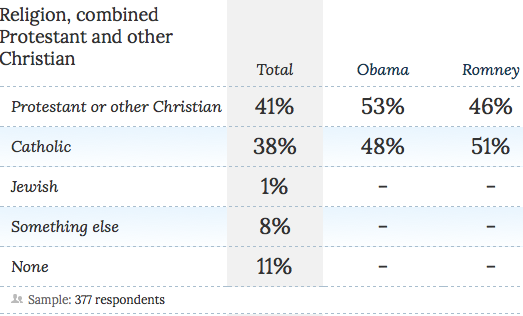
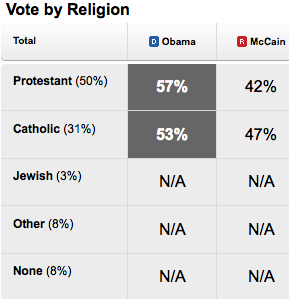
Definite slippage among Catholics, so the bishops should be somewhat happy. But Obama also slipped among white voters overall this year, so that may explain at least part of the Catholic result.
* Sometimes, a graph is easier than reading. My Sun-Times column today is based on a graph I made yesterday afternoon to help myself understand Tuesday’s election. I was so blown away by the chart that I had to write about it. Using exit polling data, here is the partisan makeup of self-identified election day voters since 1992. Click for a better view…
For the first time in at least 20 years, more independents voted in Illinois last Tuesday than Republicans.
I spent part of Thursday afternoon going through some exit polling data to see if I could find anything to cheer up my Republican friends. I really couldn’t.
Way back in 1992, when Republican Jim Edgar was governor and George H.W. Bush was running for re-election against Bill Clinton, 39 percent of Illinois voters told the exit pollsters they were Democrats; 34 percent said they were Republicans, and 27 percent said they were independents.
Two years later, when the country turned against Clinton and the Republicans swept just about everything here and nationally, the two parties were tied at 36 percent each in Illinois, with 28 percent saying they were independents.
The Republicans dropped down to 32 percent two years later, while the Democrats surged to 42 percent. Things stayed more or less the same until 2006, George W. Bush’s second midterm election, when Democrats vaulted to 46 percent, Republicans dropped to 31 percent and independents plummeted to a 20-year low of 23 percent.
Obviously, the Democrats won over independents, and the Republicans lost them. Republicans continued losing more independent-minded folks in 2008, when Barack Obama was elected president. Democrats made up 47 percent of the Illinois electoral pool, but Republicans dropped to 28 percent and independents moved up to 28 percent.
And despite a national Republican landslide in 2010, people who said they were Democrats dropped just 3 percentage points, to 44 percent. Republicans moved up only three points to 31 percent, and independents dropped a couple of points to 24 percent.
Believe it or not, the percentage of voters who said they were Democrats was the same in this year’s election as it was in 2008: 44 percent. But Republicans tumbled to 27 percent and independents rose to 28 percent.
The number of people who say they’re independent really hasn’t moved a whole lot over the past two decades. It has been within a five-point range for more than 20 years.
The Republican Party’s problem is that it has been on the decline overall since its 1994 high. Part of the reason is that a triple whammy hit the GOP: George Ryan, George W. Bush and Barack Obama. Ryan’s corruption turned voters away from their favored state governing party; Bush turned Illinoisans off altogether, and Obama is the home-state guy.
So, it’s possible that with both Georges long gone and Obama having won his final election, Republicans might start returning to a more reasonable level of support. But they probably can’t turn around numbers like this on a dime.
For starters, women have left the party in droves. In 1994, 61 percent of Illinois women voted for the pro-choice Edgar’s re-election bid. By 2010, just 44 percent of women voted for the pro-life Republican gubernatorial candidate Bill Brady. And this year, a mere 35 percent of women here voted for Mitt Romney, according to the exit polls.
If the Republicans don’t do something differently, and soon, they’ll hurt their brand so much that most women will eventually refuse to vote for any GOP candidate.
Latinos, the fastest-growing ethnic group in Illinois, also have trended more Democratic. In 2004, 53 percent of Latinos voted for John Kerry. Two years ago, 63 percent of Latinos voted for Democratic Gov. Pat Quinn. This year, 81 percent went with Obama.
The bottom line here is that the GOP has to stop alienating women and Latinos. Now. Today. There is simply no other path back to relevance in Illinois.
Friday, Nov 9, 2012 - Posted by Advertising Department
[The following is a paid advertisement.]
Cooperatives can be formed to support producers such as farmers, purchasers such as independent business owners, and consumers such as electric coops and credit unions. Their primary purpose is to meet members’ needs through affordable goods and services of high quality.
Cooperatives such as credit unions may look like other businesses in their operations and, like other businesses, can range in size. However, the cooperative structure is distinctively different regardless of size. As not-for-profit financial cooperatives, credit unions serve individuals with a common goal or interest.
They are owned and democratically controlled by the people who use their services. Their board of directors consists of unpaid volunteers, elected by and from the membership. Members are owners who pool funds to help other members. After expenses and reserve requirements are met, net revenue is returned to members via lower loan and higher savings rates, lower costs and fees for services.
It is the structure of credit unions, not their size or range of services that is the reason for their tax exempt status - and the reason why almost three million Illinois residents are among 95 million Americans who count on their local credit union everyday to reach their financial goals.