* My dad is in the hospital again, so I’m not sure when I’ll be back to work. The interns will be covering tomorrow’s lite guv extravaganza and will be posting videos here. We may or may not post on Monday. Besides, it’s spring break and I need some time off.
* The governor just announced his choice of Sheila Simon for lt. governor…
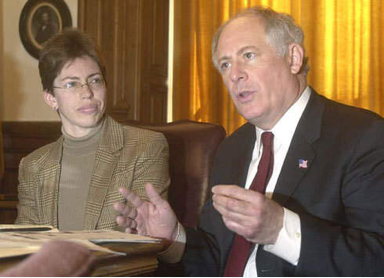
“This is a very important day,” Quinn said speaking at the Allegro Hotel in downtown Chicago. “I do want to commend the party for the open process. Having been Lieutenant Governor, I know it’s an important position…My choice is Sheila Simon.” […]
“I think its important to have downstate balance,” Quinn said today. “It’s important to have a downstater.”
67th District Representative Chuck Jefferson is angry that Quinn didn’t select Turner. As a result, the Rockford democrat says he’s pulling all his support of Quinn and urging other black lawmakers to do the same.
Just about everybody else in the Black Caucus has said that they’ll support the ticket, but tensions are apparently starting to bubble up.
…Adding… The esteemed Charlie Wheeler posted these numbers in comments and they’re well worth a front page reference…
General Election, November 4, 2008
Total Ballots Cast
5,577,509
Cook County
2,933,502 52.6 percent
Collar Counties
1,345,166 24.1 percent
96 other counties
1,298,841 23.3 percent
Source: Illinois State Board of Elections.
“Official Vote–General Election–November 4, 2008.”
…Adding More… Louis Howe gives us the more pertinent 2006 numbers…
Ballots Cast 2006
Cook County 1,350,915 38%
Collar Five 764,409 21%
Downstate 1,472,352 41%
Total 3,587,676 100%
*** UPDATE 4 *** From Rep. Turner’s campaign…
Statement on Sheila Simon
“Sheila Simon was Rep. Turner’s son’s law school professor, and he speaks the world of her. But it is up to the Democratic State Central Committee to make this important decision on who should be the Party’s nominee for Lt. Governor. We still think Rep. Art Turner is the best qualified, most experienced person for the job. And we believe that the committee members are more interested in quality ideas, significant experience and proven leadership than in a home address or other demographics.”
* Our not-so-prestigious award goes to ALEC, the conservative legislative group. The e-mail subject line was “IL and OK Legislatures Oppose Obamacare.” Here’s the text of the headline and the lede…
Illinois Is 40th State to Defend Health Care Choice; Oklahoma Health Freedom Bill Poised for Ballot
Washington, D.C.—Yesterday, Illinois became the 40th state where legislators have introduced, or will introduce, legislation modeled after the American Legislative Exchange Council’s (ALEC) Freedom of Choice in Health Care Act. Illinois House Bill 6842 prohibits a requirement to purchase health insurance and would provide the state with protection in a constitutional challenge of the federal health reform bill.
That a major national organization which deals exclusively with state legislative issues would make such a goofy claim is just beyond me. Here’s how ALEC describes itself…
The American Legislative Exchange Council (ALEC) is the nation’s largest nonpartisan, individual membership organization of state legislators.
Everybody knows they have a conservative bent, but that press release shows they also have clear hackish tendencies. They certainly ought to know all the terms of legislative art.
…Adding… As we discussed the other day, NCSL did a study of the bills introduced nationwide on this issue and found ALEC’s claims lacking.
…Adding more… How’s about a question: What’s the goofiest press release you’ve seen lately?
* Rep. Bill Black (R-Danville) gave a rousing speech on the House floor this afternoon and received a standing ovation at the end. Black praised Rep. Art Turner as a great legislator and a fine man. My intern Dan Weber caught the end of this speech and it’s a must-watch, even though the video quality is no good. That’s not Dan’s fault. It’s the cameras we’re using. I gotta upgrade over break. Anyway, watch it…
* Also today, the Alexi Giannoulias campaign released a new Internet video blasting Mark Kirk over the Republican US Senate candidate’s vow to “lead the effort” to repeal the new healthcare reform law. Have a look…
The Giannoulias campaign has also published a mock Facebook page making fun of Kirk’s repeal vow. Kirk really ought to come home and explain his statement.
…Adding… Zorn thinks Quinn blew it with the Simon pick, calling it emblematic of the governor’s “huge weakness for symbolism over substance.” Go read the whole thing…
When the candidacy of Democratic nominee Scott Lee Cohen imploded, Quinn and party leaders had a chance to choose a No. 2 that contrasted with Plummer and with Quinn in ways that would appeal to independent and undecided voters — someone whose resume actually suggests a readiness to become governor if the necessity arose.
Instead Quinn has chosen an inexperienced downstater who’s his ideological clone. She contrasts with him only in her gender and brings little more to the ticket than a famous last name: Shallow symbolism where substance was called for.
Whatever her faults, Sen. Susan Garrett was loaded with substance. So is Rep. Turner, for that matter.
* Rep. Art Turner talked to reporters today about his ongoing campaign for lt. governor, the governor’s choice of Sheila Simon, why he thinks he ought to be picked even though the governor wants somebody else and what the whip count looks like at the moment. Watch it…
Rep. Karen Yarbrough has been a strong Turner supporter and is on the central committee. She emphatically expressed her support for Turner today…
Rep. Will Davis is the chairman of the Legislative Black Caucus. He talked about the Turner/Simon situation as well…
Both Yarbrough and Davis said they’d support the ticket no matter what happens tomorrow.
* Those who said they’re surprised that this LG selection process isn’t completely fair are either naive or skewing reality for their own purposes. They should also look at what just happened over at the Tollway. They also had an open applications process for a new director and a top aide to Gov. Quinn was one of those who applied. She won. It was a no-brainer of a prediction, although she’ll most likely do a good job over there and has bipartisan support…
Sen. Kirk Dillard, a Hinsdale Republican, said Lafleur’s “background in economic development and transportation is well-suited for the tollway.” And, “as a suburbanite I want the executive director of the tollway to have the governor’s ear.”
State Sen. Susan Garrett, a Lake Forest Democrat, said “she’s on top of the issues and also is aware of past problems and seems determined to address those.”
* On March 3rd, state Sen. Michael Bond introduced a resolution…
WHEREAS, The members of the Illinois Senate are saddened to learn of the death of Mycol Jermaine French of Zion, who passed away on February 1, 2010; and…
WHEREAS, He loved to joke around; his pride was his business “The Booth,” a photography and music studio; he loved technology, dogs, and spending time with his family…
Sen. Bond has introduced 43 “memorial” resolutions since February of 2009. They’re pretty common. Families are sent a copy of the resolution, which can be comforting.
But this resolution was a bit different. It turns out that French was shot to death by the police while he was allegedly trying to run them over…
Three north suburban drug task force officers were injured and a suspect was killed following a traffic stop late Monday afternoon.
The suspect had prior run-ins with police, the Lake County News-Sun reports.
Illinois State Police Master Sgt. Isaiah Vega said the Lake County Metropolitan Enforcement Group officers made a traffic stop at approximately 1 p.m. near Green Bay Road and 24th Street.
As the officers approached, the driver put the car in motion and struck two of the officers. One officer fired his weapon into the vehicle, striking the driver, identified as Mycol French, 29.
Oops.
Bond claimed that a staffer copied the info from an obituary, which didn’t list the cause of death. And now he’s doing some serious backtracking in the wake of a local uproar…
Mundelein Police Chief Raymond Rose, a member of the task force’s advisory board, said Thursday night he found the resolution “outrageous.” […]
Told that Bond said it was a mistake made by staff, Rose said “there should be some editing of this practice.”
Rose said French had three outstanding warrants at the time officers tried to arrest him at a location where a drug deal was taking place.
“For the Senate of the state of Illinois to be recognizing a violent drug dealer is just outrageous,” he said. “This guy is a serious player.”
Bond said he plans to issue an official statement apologizing for the resolution and continue his calls to law enforcement to explain the mistake. He said he has worked with the task force in the past to pass legislation to help their work.
Bond is a Tier One target and those Republican mailers are gonna write themselves.
* And, now, a legislative roundup…
* Illinois school consolidation billed as cost-cutter, but data say otherwise
* Amateur mixed martial arts in Illinois sees less oversight
* There’s been a lot of umbrage, particularly on the Chicago Tribune’s editorial page, about how the pension reform legislation doesn’t touch the benefits of current employees. But Progress Illinois makes a very important point…
It’s important to remember that these cuts do not effect current employees; opening those contracts (the benefits are outlined here) would likely violate the state’s constitution.
The state can’t just open up a union contract and change it. But that doesn’t stop people from demanding that magic ponies be found.
Mr. Madigan also apparently decided not to mess with Mr. Daley, who likely could have scuttled the deal. So he added a clause that allows Chicago Public Schools to reduce its required pension contribution by $400 million a year for each of the next three years.
As a fiscal matter, that’s stunningly irresponsible. As of June 2006, on a market-value basis, the Chicago teachers retirement fund only had 54% of the assets needed to pay its eventual liabilities, according to the fund. To get back to where it should be, around 90%, it needs more money, not less.
But given that schools chief Ron Huberman had been threatening to lay off hundreds of teachers to close a budget gap of nearly $1 billion next year, he now has an extra $400 million. Which means that, though the Chicago Teachers Union isn’t happy, the need for huge layoffs has dropped. Which means that it’s much less likely that teachers will go on strike just before Mr. Daley gets ready for his presumed re-election bid next winter.
“If this bill becomes law, Illinois will have the highest teacher retirement age in the country,” Illinois Federation of Teachers President Ed Geppert said. “New teachers will think twice before teaching in a state that makes them teach kindergarten or PE until age 67 to get a full pension.”
If they get into teaching at 22 for a pension, then maybe they shouldn’t be teaching anyway. But, this is a valid argument…
One main problem the teachers union has with the bill is the change in retirement age, Stanley said. If teachers have to work until age 67 to earn their full pension, local school districts will spend more money paying their salaries than if they retired earlier and younger so less experienced teachers could be hired to replace them.
“While you attempt to save more money the state pays in pensions … you once again add an additional, significant cost of salaries for local school districts,” Stanley said.
It’s a burden-passing solution, which is never good.
* I was surprised that nobody followed up on my subscriber-only story this week, so I decided to use it in my Sun-Times column. Let’s all try to be very, very careful in comments, please. I don’t want to see any rumors posted and he’s innocent until proven guilty. With that in mind, read on…
The biggest story under the Illinois Statehouse dome this week wasn’t the landmark change to public employee pension plans.
It wasn’t the Senate’s passage of a school voucher measure.
It wasn’t that state Sen. Susan Garrett might very well be Gov. Quinn’s choice as a running mate.
The story that had everybody talking was something I wrote for my newsletter subscribers about how a well-known Statehouse lobbyist admitted he had been cooperating with a federal corruption investigation for the past two years.
Bob Swaim has been around forever. He lobbies for the gaming industry and several other clients. Last week, a very brief story appeared in the Springfield newspaper that Swaim had been indicted by the Central Illinois U.S. Attorney’s office on tax charges. He allegedly owes the IRS almost $400,000 going all the way back to 1990.
On Monday, Swaim sent an e-mail to a group of friends that shocked them to no end.
“More than two years ago,” Swaim wrote, “I was pressured into cooperating with the Federal Government regarding their investigations of public corruption in Springfield and Illinois.”
Swaim claimed he did “everything” the feds asked him to do during those two years. But last December, the government allegedly revealed to him that some of his friends were “the targets of their investigation.” He stopped cooperating, he said, and the feds played “hardball” with him, leading to the indictment.
Everybody on that e-mail list probably choked on their coffee when they read those lines. If the feds really are playing hardball with him, they could grab that e-mail and see who belongs to his inner circle of friends. Not a smart move.
The first thing I did when I obtained the e-mail was call the U.S. Attorney’s office in Springfield. I wanted to get the standard “We can’t comment on an ongoing investigation” response and to make sure I wasn’t going to blow a case or something. I don’t need any trouble with the federales. No way.
After a very pleasant U.S. Attorney representative thanked me for the heads up, I called Swaim, but he understandably refused to talk.
I wanted to know how far he went. For instance, did he wear a wire? Was the probe related to Rod Blagojevich or were they looking at something completely different? I didn’t get a chance to ask much else.
Those same questions, and more, were asked by many folks under the dome this week.
Some tried to replay in their heads any conversations they had with Swaim during the past two years that could be taken out of context (or worse).
Others pondered whether there were any warning signs. Just about everybody debated who those allegedly targeted “friends” were and what the feds were up to.
The vast majority of people in politics are honest, even scrupulous. But it’s not hard to see how much pressure the feds can use to make their cases.
Heck, even I’m scared of them, and I have no reason to be. There’s no telling what somebody might say under those circumstances.
Also, the stain on state politics that the Blagojevich indictment has wrought is making this business intolerable for some.
Another investigation will just make matters worse for the honest ones, at least in the short term.
“Just what we need,” one guy said with a sigh this week as he tried to pass a bill. “More heat.”
“Now I find myself in a strange and unfair place,” Swaim wrote to his friends.
Yeah, so does everybody else while we all wait around to find out what’s really going on.
Again, make sure to keep the comments free of rumors and other over the top stuff. You don’t want to be banned for life, do you? Thanks.
Simon said teaching duties at Southern Illinois University’s law school will keep her in Carbondale Friday. The governor is expected to make his announcement in Chicago.
[Sheila] Simon, 49, said Thursday night that she had not talked to the governor about his decision but said she was “excited” to hear that sources had confirmed she was his preferred candidate.
“If it is offered, I will accept,” Simon said.
* So, why the move away from Sen. Garrett? As I told subscribers today, Quinn’s tax hike was a big factor…
State Sen. Susan Garrett of Lake Forest had been considered Quinn’s top candidate, but she recently declined to embrace Quinn’s call for an income-tax increase for education.
When Quinn and Simon talked before he made his decision, they “focused a lot on whether we would be compatible, and I said, ‘Yes, I support his proposal for a tax increase,’” she said.
And this trait says more than maybe Quinn meant to say…
“I know Sheila,” Quinn said. “I’ve worked with Sheila. She has a servant’s heart, and that’s exactly what Illinois needs in a lieutenant governor.
“I am someone who fits the bill geographically, broadens the ticket a little bit. I think women’s votes are a primary concern in the campaign, and I think I can help there. … I have some name recognition that will help get me in the door a few places.”
All true.
* Rep. Art Turner isn’t giving up. From an e-mail to supporters…
With all the phone calls and excitement surrounding Saturday’s selection by the Democratic State Central Committee of the party’s nominee for Lt. Governor, supporters have organized buses to leave on Saturday morning to hold our leaders accountable and witness this historic event.
Could things get raucous? We’ll have to wait and see. Turner’s supporters, including members of the state central committee, held a press conference yesterday…
Rep. Charles Jefferson, D-Rockford, who like Turner is black, warned at a news conference Thursday that, if Turner is overlooked for the nomination, “there might be consequences.”
“We’re not here to threaten him today,” Jefferson said of Quinn. “We’re asking him to do the right thing.”
State Rep. Charles Jefferson, a Rockford Democrat, said the party’s selection of anyone other than Turner might be viewed as an affront to black voters, who overwhelmingly supported Quinn in the close primary.
“A lot of people are going to say maybe this is a slap in the face to the African-American community,” Jefferson said.
Rep. Karen Yarbrough (D-Maywood), a state central committee member, said Simon contacted her Thursday.
“She asked me for my support for being for lieutenant governor. I simply said I was going to be supporting somebody that actually ran in this process,” Yarbrough said.
*** UPDATE *** From the Turner campaign…
Statement on Sheila Simon
“Sheila Simon was Rep. Turner’s son’s law school professor, and he speaks the world of her. But it is up to the Democratic State Central Committee to make this important decision on who should be the Party’s nominee for Lt. Governor. We still think Rep. Art Turner is the best qualified, most experienced person for the job. And we believe that the committee members are more interested in quality ideas, significant experience and proven leadership than in a home address or other demographics.”
* Citing anonymous sources familiar with the decision, the Chicago Tribune is reporting Gov. Pat Quinn plans to announce he would prefer to run with Sheila Simon.
The sources, who asked not to be identified so as to not preempt Quinn’s public announcement of a running mate on Friday, said the governor ultimately rejected another top contender for the post, state Sen. Susan Garrett of Lake Forest, who has been reluctant to fully embrace his call for an income tax increase without preconditions. Simon said she would back the governor’s plan.
* Simon is daughter of the late former U.S. Sen. Paul Simon, a southern Illinois Democrat. An associate law professor at Southern Illinois University School of Law in Carbondale, Simon is a former member of the Carbondale city council and challenged incumbent Republican Mayor Brad Cole in the spring of 2007.
Rich says he had been hearing talks of Quinn’s decision, which he expects to formally announce Friday, throughout today.
Gov. Pat Quinn said he intends to be conservative when using expected savings from the massive pension overhaul to help balance next year’s state budget.
At a Statehouse news conference today, Quinn said the administration will stick with an estimated $300 million in savings that he built into his budget proposal earlier this month. The legislature’s Commission on Government Forecasting and Accountability thinks the changes could save the state anywhere from $500 million to $1 billion next year.
Quinn has not yet signed the pension bill, but said he will shortly.
“This is the mother of all cutting spending proposals,” Quinn said. “Anyone who wants cuts in government, you’ve got it. This was a political earthquake.”
* The governor also took a funny little shot at the Tribune’s reactionary editorial board today when asked a question by a Trib reporter about his lite guv choice. Watch…
* Quinn also took questions about the cuts to the State Police. He essentially admitted that his proposed tax hike for education could take the pressure off other areas of the bureaucracy. Have a look-see…
The lawmaker who drew criticism for initially refusing to relinquish a $25,000 statue that belonged to Chicago State University is now in trouble over remarks she made about minorities Wednesday.
Rep. Monique Davis (D-Chicago) apologized to Hispanic lawmakers after she generalized about Latinos and tacos while protesting a bill to license hair braiders.
“You do not license a Chinese person to sell Chinese food. You do not license a Latino to sell tacos,” Davis said. “You do not license an African-American woman to hair-braid.”
Representatives Edward Acevedo (D-Chicago) and Susana Mendoza (D-Chicago) quickly rose to protest Davis’ stereotype.
“For anyone to come to this floor and make fun of my ethnicity, I’m so appalled at the statement that was made on the House floor,” Acevedo said.
The quotes above don’t do her initial comment or the rebukes justice. You can listen to it all by clicking here. Davis’ logic was weird and twisted, and she deserved the blow-back.
She did eventually apologize…
“I apologize to them and I want them to know and the body to know that I have the utmost respect from the bottom of my heart for the multicultural diversity of our body,” Davis said.
* We didn’t post this story from earlier this month, but it was something I broke and then eventually followed up on by Kristen McQueary of the Southtown Star. I found it today while looking for something else.
The basic gist is that a Democratic township committeeman with close ties to the Pat Quinn campaign is alleged to have pressured a potential appointee to the Illinois House to vote for the governor’s tax hike.
Worth Township Democratic Committeeman John O’Sullivan supported Kelly Burke for the House and she supported his campaign against an incumbent as well. Burke defeated a candidate backed by House Speaker Michael Madigan, but she made up with MJM and wanted the appointment after incumbent Rep. Jim Brosnahan (D-Evergreen Park) resigned. Everybody figured it was a “go” since Burke and O’Sullivan were allies. But it all fell apart.
While Burke told O’Sullivan she wanted the appointment, things started to unravel last weekend. In a series of phone calls, O’Sullivan began pressuring Burke to commit to supporting an income tax increase if she was sent to Springfield.
Burke wouldn’t comment publicly on that part of the story, but four sources confirmed it happened - including someone from O’Sullivan’s camp.
O’Sullivan denied he pressured her.
“The fact of the matter is (Burke) couldn’t give me a commitment as far as protecting these teaching jobs. My wife is a teacher. She’s one of them,” O’Sullivan said. “We felt with (Carberry’s) union background - he’s very affiliated with the teachers in our community and the unions - he would be a great candidate. Saving teaching jobs is our main objective. I don’t know if (Burke) thinks she was owed this appointment, but we have plenty of teachers in our community who are very nervous about this.” […]
Burke, however, wasn’t comfortable with strings attached to the appointment.
There are many claims from insiders that the Quinn campaign was directly involved with this pressure on Kelly, but the governor’s campaign won’t comment.
* Speaking of MJM, he had a bit of fun with my intern Barton Lorimor yesterday. Watch…
And while we’re looking at silly videos, here’s a weird one of Rep. Bill Black…
* 11:14 am - The Senate just SB2494, which would create a pilot school vouchers program for Chicago elementary schools. It would impact about 22,000 students.
Whew, I wouldn’t want to be a teachers union lobbyist this week, man. “If they would just vote down a tax increase this week we’d have the trifecta,” cracked one union official a few minutes ago.
* 11:15 am - The Senate is now taking up the red light camera bill, SB935.
* 11:51 am - The bill, which was a compromise worked out by Senate President John Cullerton, passed 45-10.
Over Republican objections, the Illinois Senate endorsed legislation Thursday that will assure the state’s prison guards get paid in June.
Democrats argued the stopgap spending measure is needed because the budget approved last summer was based on Gov. Pat Quinn laying off hundreds of prison guards.
But the union representing the workers was able to block the move, meaning the state will still have to pay the employees. The shortfall — expected to affect the state’s June payroll — is about $31 million.
Republicans complained the Illinois Department of Corrections should cut its spending on things like cookies and cable television for inmates in order to make up the shortfall.
“The mismanagement from this administration does not warrant more money,” said state Sen. Matt Murphy, R-Palatine.
A $50 million job creation program is headed to Gov. Pat Quinn’s desk.
In action Thursday, the Illinois Senate unanimously approved a plan to give small business owners a $2,500 tax credit for each full-time position created in the next year.
It would affect people hired at a rate of $13.75 or above at companies that have fewer 50 employees. The program would be capped at 20,000 workers.
* House Republican Leader Tom Cross teamed up yesterday with former GOP gubernatorial candidate Adam Andrzejewski to call for a “forensic audit” of the state budget…
[Andrzejewski] said during the Blagojevich and Quinn administrations, even other elected officials and government agencies couldn’t get a handle on how large state government has become and how much state government is spending.
“The comptroller said we have 252 state programs. Auditor [Bill] Holland said we have 1,750, and he said we had more but he couldn’t quantify the number. Auditor Holland said we have 100 state agencies. The comptroller said we have 69. We don’t even know the basics of Illinois financial data,” said Andrzejewski.
Andrzejewski said if an audit could straighten-out those inconsistencies, Illinois could find $1.25 billion in savings.
House Leader Cross wouldn’t go that far. But said there could be some money found which could be better spent.
Some of those differences are about semantics, but he has a good point.
Andrzejewski told the SJ-R in January that the cost of the audit would be at least $60 million. The auditor general would be in charge of this project, but the current fiscal year’s appropriation for the auditor general’s office is $24.3 million all funds, including $6.8 million GRF. So, a $60 million project would be unprecedented for that office.
The price tag is one reason House Democrats are dismissing the idea.
“I question what the motivation is and why you’d want to spend tens of millions of dollars when the state is broke,” said Steve Brown, spokesman for Democratic House Speaker Michael Madigan. “It’s a huge waste of money.”
Brown also said the study would essentially duplicate the auditor general’s responsibilities.
Cross’ resolution was introduced yesterday and is now in Rules Committee. You can safely bet that the HGOPs will make a stir on the floor to get that thing released.
The Daley administration will strongly oppose Gov. Quinn’s plan to impose State Police cutbacks so draconian, they would require Chicago Police to assume primary responsibility for patrolling 53 miles of Chicago area expressways, City Hall sources said today.
State Police have had exclusive control over Chicago area expressways since 1985. That’s when 12 months of negotiations between then-Mayor Harold Washington and then-Gov. Jim Thompson culminated in a deal that transferred responsibility to the state in exchange for the right to sell lottery tickets at O’Hare Airport.
Sources said Mayor Daley will attempt to hold the state to that agreement on grounds that Chicago cannot afford what amounts to an unfunded mandate from the state.
If they didn’t put it into statute, I’m not sure he can hold Quinn to it. We’ll see.
Chicago Mayor Richard Daley says a four day school week isn’t the answer to school funding issues.
That’s after the Illinois House of Representatives passed a measure giving local school districts the option of closing schools one day a week, while offering longer school days. The move would save schools money on transportation and utilities.
But Daley says it would place an unfair burden on parents.
DALEY: Again, when you think four day school week, what do parents then do on a Friday or a Monday or a Wednesday? Many parents are working. A single parent has to work. And so how do they afford then… what do they do with their child? There’s so many problems with this issue.
We always encourage schools and lawmakers to work together to save money and improve learning. For a rural district with long bus routes, the reduced transportation costs - along with salary savings on other nonunion personnel such as food service workers - might save enough to make this worth considering.
However, we doubt this kind of change would be a good fit for suburban districts, which generally have a smaller percentage of students taking buses and travel a shorter distance. Lifestyle issues such as child care and activities also would make a four-day school week more of a hardship.
“We would save $100,000 or more a school year … (if we) run the buses one less day a week. I turn the heat off an extra day a week. Your cafeteria is open one day less a week,” said Mark Janesky, superintendent of Jamaica School District in Vermilion County.
His district, with less than 500 students, covers 110 square miles. The cost savings in busing alone would be substantial, he said.
“We’re out in the middle of a cornfield,” he said. “Under the circumstances, busing is a huge issue for us.”
* There was a microscopic bit of good news on the budget front…
Illinois’ prison population declined by 313 inmates in 2009, says the Pew Center on the States, adding to an annual decrease in the number of inmates in state prisons nationwide for the first time in nearly four decades.
In a report titled, “Prison Count 2010,” Pew says the number of inmates in state prisons nationwide dropped .4 percent in 2009 – the first decline since 1972. That equates to about 5,700 fewer prisoners, out of about 1.4 million in state prisons across the United States.
“After nearly four decades of uninterrupted growth, an annual drop in the state prison population is worthy of note, no matter the scale of decline,” Pew says. “However, it is too soon to say whether the 2009 decline will be a temporary blip or the beginning of a sustained downward trend.”
The decrease in Illinois comes after nearly 2,000 Illinois inmates were released early from state prisons in 2009, and many were subsequently re-incarcerated when public outcry forced a halt to the early release program. Illinois currently holds about 45,000 inmates in facilities designed for about 31,000.
* Some people are just never happy unless they get everything they want. For instance, here is a press release by R. Eden Martin, the president of the Civic Committee of The Commercial Club of Chicago regarding the pension reform bill approved yesterday…
“This bill is a small step in the right direction but it doesn’t begin to solve the State’s urgent fiscal problems. The only way to achieve significant cost reductions now is to reform retirement benefits for current state employees prospectively and new hires moving forward. The people of Illinois are not going to be satisfied with tiny steps in the right direction when we have a State fiscal crisis of this magnitude on our hands.”
Senate President John Cullerton said yesterday that his research shows cutting benefits not yet earned by current employees cannot legally be done. And the General Assembly was nervous enough about cutting benefits for future employees that a cut to current employees would’ve been hugely tough, if not downright impossible.
That said, we understand the realpolitik here: Democrats and Republicans who voted for this bill Wednesday can tell voters they’ve done something worthwhile, even if it doesn’t much diminish the state’s current budget crisis or pay down our already staggering unfunded pension obligations.
What the politicians can’t pretend, though, is that this bill repairs how Illinois spends money today. Until they’ve made the major spending reforms that this page and other voices keep advocating, Gov. Pat Quinn is free to keep scaring people with his threat to slash education funding by $1.3 billion.
As we’ve already discussed, the Tribune’s budget cut ideas are grossly inflated and some are even downright bogus. And if editorial board members had bothered to read their own paper, they’d know there are some significant immediate and longterm budget savings in this package…
But the growth in the state’s pension debt should be reduced dramatically, said Dan Long, executive director of the Commission on Government Forecasting and Accountability. Long also said the state will save $119 billion over the next 35 years under the legislation.
Though major pension savings won’t accumulate for years, Quinn and lawmakers plan to use the pension changes to save money as they craft a budget in the face of a $13 billion shortfall. Because the bill allows officials to recalculate the state’s overall pension burden, they estimate saving $300 million to $1 billion in pension payments that would have been required in the next budget.
COGFA has a rough estimate of $500 million to $1 billion for next fiscal year. It won’t cure the deficit, but it ain’t chump change, either.
* Doug Whitley of the Illinois Chamber was far more optimistic than the naysayers…
“This bill is not window dressing. It’s substantial reform,” said Senate Minority Leader Christine Radogno.
The Sun-Times editorial board, which is way more reality-based than the Tribune’s grumpy old men, praised the proposal as a “giant first step.” But they did have some quibbles…
We don’t think all employees should wait until 67 to retire. Is that really the right age for a kindergarten teacher?
We’re concerned that the cost-of-living reduction is too severe. The bill exempts the financially weak pension systems for police officers and firefighters, which we think is a mistake.
* Require an employee to be 67 years old with 10 years of service in order to qualify for unreduced benefits. A person could retire at age 62 with 10 years of service, but with a reduction in benefits of 6 percent per year.
* Cap the salary used to determine benefits at $106,800.
* Base benefits on the highest average salary earned during eight consecutive years of the last 10 years of service. Now the benefit is based on four years of service.
* Would stop compounding annual cost-of-living benefit increases; those increases would be based on 3 percent or one-half of the consumer price index, whichever is less.
* Limit participation in the “alternative formula,” which provides enhanced benefits for high-risk state jobs, to correctional officers, state police and state firefighters.
* Do not allow a person to draw a pension from one system while working a full-time job covered by another pension system. Pension payments would be suspended during such a period.
The measure that passed Wednesday takes aim at 13 pension systems, including those representing state workers, teachers, Chicago city and park district employees, Cook County workers, legislators and judges. Police and firefighters are exempt from the changes.
The plan also gives Chicago’s public schools a windfall to address what could be a $1 billion deficit next school year by reducing the amount that must be contributed toward teacher pensions by $1.23 billion over three years. The measure also extends by 14 years the period when the Chicago Teachers Pension Fund must be 90 percent funded. It is now 74 percent funded.
We support this, reluctantly, because the only real alternative is unconscionable cuts in the classroom. In general, we oppose underfunding pensions. That is, after all, how Illinois got into this fiscal mess in the first place.
“This bill is nothing more than lawmakers shifting the burden of the state’s past mistakes onto future teachers and public employees,” said Ed Geppert, president of the Illinois Federation of Teachers. “If this bill becomes law, Illinois will have the highest teacher retirement age in the country.”
The Illinois Federation of Teachers’ political director Steve Preckwinkle talked to me last night about the bill and the union’s political plans. Watch it…
David Vaught, Gov. Pat Quinn’s budget director, said he was concerned that Illinois’ bond rating, which determines the interest rate the state will have to pay on borrowed money, could be downgraded again when the state seeks to borrow about $1 billion in April to fund the capital construction plan.
Vaught said pension reform could help Illinois avoid a slip in its rating because it would show investors that the state is taking steps to address its structural deficit and “the straitjacket of skyrocketing pension costs.” The state’s total pension liability is $126.5, billion, $77.8 billion of which is unfunded.