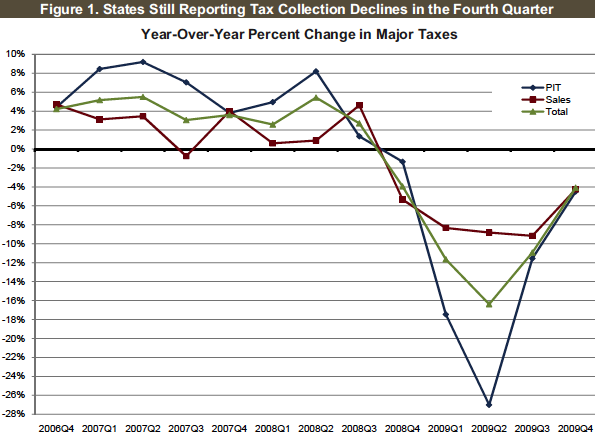
* Click the pic for a better look at this graph of year-over-year revenue receipts for major taxes. The blue line represents personal income taxes, the green line is total tax collection. This is for all states…
Yikes.
The graph is from the Nelson A. Rockefeller Institute of Government, which claims that Illinois’ tax receipts in the fourth quarter of last calendar year plunged 6.9 percent compared to the same quarter a year earlier.
From the dot points…
This is a record fifth consecutive quarter that total tax revenues and collections from two major sources — personal income tax and sales tax — declined on a year-over-year basis.
Oof.
* A map showing how individual states fared. Again, click the pic for a better look…
The gloomy national state budget outlook…
Despite indications that the national recession may be over, the revenue situation remained gloomy in most states in the fourth quarter of 2009. Many states have been reporting shortfalls in revenue compared to projections used for this year’s enacted budgets. While stock indices are well above their lows and some other indicators point to strengthening in the economy, overall conditions remain weak. Nonetheless, retail sales and consumption have stabilized and we expect more states to begin seeing year-over-year growth in some revenue sources over the next few months, particularly the sales tax.
However, even with growth, tax revenue is likely to remain below its prerecession peak for quite some time. State tax revenue will continue to be insufficient to support current spending commitments, and more spending cuts and tax increases are most likely on the way for many states — particularly those that did not take significant actions to balance revenues and expenditures in their FY 2010 budgets.
* The College Democrats at Northwestern University are bringing in Rod Blagojevich for a publicity stunt… er… um… speaking engagement…
As stated on the event’s Facebook page, a Northwestern faculty panel including law Professor Tonja Jacobi, Political Science Professor Donald Gordon and Medill Professor Donna Leff, will interview the former governor, and students will be allowed to ask questions afterward.
Why a group of Democrats thinks this is a good idea is simply beyond me, but whatever. Free country and all that.
Blagojevich (WCAS ’79) will have 15 minutes to plead his case before an NU faculty panel can begin asking questions, Rockoff said. The panel will include Law Professor Tonja Jacobi, Political Science Professor Donald Gordon and Medill Professor Donna Leff, the Communication senior said.
“The majority of the event will be an interplay between the faculty panel and the former governor,” he said.
After the faculty panel has finished, students will have the opportunity to ask questions, Rockoff said.
“Our belief is that students at Northwestern are interested in debating this issue,” he said. “They will be interested to see this kind of dialogue.”
* The Question: What questions would you ask RRB if you attended this function? Try to avoid snark, please.
* Everybody always wants to spend more money. That’s nothing new. They even want to spend more state tax money during the greatest fiscal crisis this state has ever had. Not surprising, considering the way people are.
The Southern Illinoisan today editorialized on behalf of a bill that would divert about $500,000 a year from the sales tax on wine to benefit the state’s fledgling wine-making industry. Normally, that might be a great idea, especially considering the much-needed tourism dollars the wine industry draws to southern Illinois.
And, frankly, $500,000 ain’t a whole lot of money, so I can see why Rep. Mike Bost (R-Murphysboro) could sponsor the proposal with a mostly clean conscience. Although his reaction to his bill’s defeat in the House Revenue Committee was more than a little over the top…
Bost was disappointed when his bill didn’t get out of committee Thursday, and accused state Democrats of wanting to control the state’s revenue stream.
“It’s an abuse of powers. It does not allow me to represent my district,” Bost said.
But perhaps there is some area for compromise, some tweaking of the legislation that would create the wine fund without shorting the general fund.
Yep. The answer is magic money! Unless they mean raising the sales tax, which they didn’t specify.
Money has to come from somewhere. Perhaps the Southern could offer to give up its state sales tax exemptions on newsprint, ink, equipment, etc. Until then, proposing a magic money solution is not a responsible alternative.
* Meanwhile, Mayor Daley talked to reporters yesterday about the state budget. Hizzoner made it clear that cuts must come before tax hikes…
“You just can’t increase taxes and say, ‘That’s the answer,’ ” Daley told reporters. “That’s not the total answer. If you think that is, you’re kidding yourself.” […]
“You have to streamline government,” said the mayor, who has cut some spending and raised taxes and fees to balance the city’s precarious budget in recent years. “You have to look at priorities and figure out if there’s waste, inefficiency and corruption, anything, because you have to look at that.”
” In the long run, you need a governor and a lt governor working together like that because there’s a responsibility when he or she is out of state, incapacitated. They can take over. It’s just like the presidency. I think they should run together.”
* Some more federal money? At least for a while, and for new recipients…
A White House compromise proposal on health care reform would boost funding for Illinois and other states facing newly eligible participants in their cash-strapped Medicaid programs. […]
Under the White House proposal, states would get 100% federal funding for any newly eligible Medicaid participants for four years, from 2014 to 2017, with 95% reimbursement in the following two years and 90% after that. Normally, the federal government reimburses half of Medicaid expenditures in Illinois, although that was boosted temporarily by last year’s stimulus program.
“It gives states plenty of time to adjust to these new responsibilities and gives them additional financing pretty much forever,” Nancy-Ann DeParle, director of the White House Office of Health Reform, said in a conference call for reporters.
However, the summary of the proposal didn’t address other details that concern some Illinois hospitals, such as the schedule for phasing out additional Medicaid payments they get for treating an above-average number of Medicaid patients.
* Chicago Tonight hosted a long discussion about the state budget last night. Have a look…
* Naperville considers joining push for statewide pensions: The state Constitution outlaws diminishing employee benefits, but [Assistant City Manager Dan] DiSanto said one option would be for the state to create a second tier of benefits for new hires.
* Tryon Legislation to Bring Transparency to State Budget
* Fox Chicago took a look at legislative staffers who also go off payroll to work on political campaigns. They focus solely on the House Democratic staff, whom they refer to as “Madigoons“…
“What they really are, are political workers with side jobs in the off season,” Means said. “They keep them employed so they’ll be around for the next political season. And that really does seem to me to be the tail wagging the dog.”
FOX Chicago News examined three years of legislative payroll records, and then compared them with political campaign expenditures. We found 34 Democratic House employees under the control of Speaker Madigan taking off from their jobs for weeks, sometimes months at a time.
From what I was told a couple of weeks ago by Fox, they could only find four or so House Republican staffers who dropped off state payroll. I thought that number seemed quite small, since they’re staffing most of the same campaigns as the Democrats. The HGOP number isn’t in the story, however. Maybe a follow-up is planned. I dunno.
…Adding… Dane Placko just called. He said they’re planning a story on the Republicans tonight. He eventually found a total of 13 HGOP staffers who also worked on campaigns. More than originally, but still not a lot by comparison. I’m looking forward to the piece.
But Decremer took off seven months in 2007, four months in 2008 and another four months in 2009. He has made more than $40,000 from political campaigns.
His specialty? Challenging the petitions of candidates Madigan wants off the ballot.
And with Illinois facing a $13 billion deficit, with all these people bouncing on and off the payroll, it begs the question–
“Is that a job we need in state government?”
Former Federal Prosecutor Patrick Collins chaired the Illinois Reform Commission, which lost its battle to curb the clout of the legislative leaders.
“Is that a job we need in state government? Because if it can go unfilled for four or five or six months at a crack, I can guarantee you there’s a cheaper way to provide that service to the people of the State of Illinois,” Collins said.
That’s certainly one way of looking at it, and I won’t dispute its validity. But when the GA isn’t in session, all of its staff just isn’t needed. Then again…
But that’s not what our investigation found. When the legislature was battling Gov. Rod Blagojevich over a budget stalemate in 2008, with plenty of work to do, nearly half of Madigan’s staff was off the state payroll doing political work.
Analysts, program specialists, legal assistants and even the house photographer bounced on and off the state payroll. His specialty is campaign mailings.
While on leave, those state workers collect paychecks from political campaigns. We counted a total of $728,000 in political pay the past three years.
“We’ve had so much in Illinois where politics drives our government. I think it would be a good time for government to essentially take the priority role,” said former prosecutor Collins.
Actually, nobody was doing much during that stalemate, but I see the point.
Bankruptcies in the region jumped more than 18 percent in 2009, despite federal changes that took effect in 2008 and made it harder to wipe out debt. More than 10,700 central Illinoisans filed for bankruptcy last year.
* CTA snow removal violates union deal, arbitrator says
The CTA continued to use its outside snow-removal contractor, Christy Webber & Co. Inc., to clear and salt station walkways and platforms, instead of calling on the CTA’s unionized janitors, during the snowfall that occurred Sunday and Monday.
* A year later, no answers in parking ticket probe
Chicago police say their investigation into the matter continues, but many questions remain in what ranks as one of What’s Your Problem’s most bizarre cases.
Attorneys for Calvin Boender have subpoenaed 10 aldermen for testimony about their knowledge of how Boender’s development, Galewood Yards, won approval from the city.
Huberman conceded that reforms he announced a few months ago didn’t go far enough and said he will hold public hearings to gather input on needed changes.
While we’re not willing to go so far as to support an Illinois bill that would let school districts ignore mandates that aren’t funded, we wholeheartedly agree that mandates need to be examined through a new lens - one that acknowledges the difficult economic situation our schools face.
The Oswego School Board voted 6 to 1 to approve a $5.5 million reduction plan that would include 80 employee reductions, furlough days and program cuts, the first phase of reductions to help balance a budget for the upcoming school year.
According to Assistant Superintendent for Business Dave Holm, the district estimates it will receive between $3.5 million and $4 million in federal funds that Springfield will use to make three general state aid payments to District 204. The state owes the district more than $7.8 million for the 2010 budget.
…
Bur earlier this month District 204 — like many others in the area — informed its residents that state funding for next year is, what Holm called, “the big unknown.”
His proposal to eliminate 56 teaching positions applies to non-classroom teachers, he said, such as reading coaches, post-secondary coaches and teacher leaders.
“Classroom teachers are OK,” Milton said.
Of the district’s 1,201 certified teachers, 427 work outside the classroom in various academic support roles, according to Alexander Ikejiaku, the district’s personnel director.
The city found out Monday that a $10 million line of credit with Associated Bank, which has been funding the Rockford Local Development Corp.’s purchase of the homes, has been extended for 60 days. City leaders also learned they may be able to further extend the line of credit with another bank after the city closes with Associated, said Ald. Carl Wasco, chairman of the Finance and Personnel Committee.
Also, according to a document from the Illinois Finance Authority, the project’s estimated cost is $90.2 million, down from the original $102 million.
City Manager Scott Moore said on Monday that city officials received a debt payment schedule on revisions to the project but are waiting for changes to the overall plans from developer Gary Matthews of East Peoria-based EM Properties.
* NIU’s proton-therapy cancer center back to square one
* 7:46 am - Rep. Art Turner is on WVON Radio right now talking about his campaign for lt. governor, race, the Democratic Party and Gov. Pat Quinn. Listen by clicking here. Help live-blog in comments if you can.
* 8:00 am - End. Since nobody apparently saw the link in time to comment, this is now an open thread on Rep. Turner’s argument in favor of his appointment to the ballot.
…Adding… I was working during the interview, but I did catch this quote by Rep. Turner about Sen. Rickey Hendon’s candidacy for lt. governor…
“Sen. Hendon was only in this race to stop me from winning.”
* Last year, the Senate Democrats talked about passing a bill to force the GOP gubernatorial nominee to come up with his/her own budget proposal not long after the governor’s budget address. They withdrew the idea, but now President Cullerton has decided to resort to public pressure instead…
Illinois Senate President John Cullerton is challenging Republican candidate for governor Bill Brady to present his own budget plan as the state struggles with a whopping deficit.
Cullerton on Monday said he doubted Brady’s suggestion that he could fix the state’s finances without an income tax increase.
Cullerton says the state senator from Bloomington should detail his plans to cut the budget and fix the deficit ahead of the November election.
Brady has said the state doesn’t need an income tax increase.
I highly doubt that Brady would take the bait, but I would like to see how he plans to cut taxes by a billion dollars and still balance the budget with a ten percent across the board cut. I mean, we’re talking about a $26 billion operating budget this year and a $13 billion or so FY11 deficit.
* Meanwhile, if you’ve heard any rumors that Sen. Kirk Dillard is conceding soon, forget them. From a press release…
Dillard for Governor Campaign Update
(Lisle, Ill.) – Republican candidate for governor Kirk Dillard today provided a campaign update regarding the vote count in the GOP Primary:
“As I have said, the race for governor is a statewide election, and it is our sincere desire that every legal vote is counted and counted accurately. That process continues, and we will await the results from the Illinois State Board of Elections before determining our next course of action.”
State Sen. Bill Brady’s campaign says its lead in the GOP race for governor is 247 votes, a spokeswoman said Monday.
Illinois counties have to have their final vote totals reported to the state by tomorrow. Brady’s camp has been counting votes by county, and spokeswoman Jaime Elich said she expects the 247-vote lead to hold up. […]
Dillard spokesman Wes Bleed said Monday he was unsure if his camp agreed with Brady’s numbers. But Bleed said Dillard could make a public announcement about the race Tuesday or Wednesday.
As California stumbles through its continuing budget crisis, 60% of likely voters in the state now believe it would be better if most incumbents in the state legislature were defeated in this November’s elections.
The president of the Illinois Senate says he’s interested in two big changes to shore up the state’s dramatically underfunded employee pension plans — but only two changes.
In an interview before a Chicago speaking engagement, Senate President John Cullerton said he is “interested in exploring” an older retirement age and a cap on the maximum retirement benefit.
But those are potentially “the only changes” he’s prepared to support, Mr. Cullerton added, because, “compared to other states, benefits in Illinois are not overly generous.”
After successfully quashing discussion of a federal tax on soft drinks last year, Coca-Cola Co., PepsiCo Inc. and the fast-food industry are facing a new battle on the state level, where legislators are beginning to consider their own taxes on sweetened beverages.
The next showdown could be in California, where legislators last week pledged to pass such a tax in light of new studies linking soft drink consumption to obesity in children and adults. One study suggests that obesity and related problems cost California alone $41 billion a year in medical expenses and reduced productivity.
Just sayin…
* Dear Illinois Review,
Publishing assassination fantasies disguised as jokes probably won’t help with the advertising.
Just sayin…
* Your turn…
…Adding… Dear University of Illinois,
Gigantic cash reserve piles are, by design, for use during fiscal emergencies. We’re in one. Letting the GA know you have this much cash - and more - squirreled away probably won’t help your case this spring…
The University of Illinois is spending a pool of easily accessible cash to pay its overdue bills while it waits for the state to come through with $475 million in overdue appropriations.
Doug Beckmann is the university’s senior associate vice president for business and finance. He says the university is using the $800 million to whittle away at $3.8 billion in bills.
Beckmann says the money is going quickly. If the state doesn’t come through soon, he says the university will have to tap other reserves by May. [emphasis added]
Sorry, but entities with that sort of rainy day stash need to drain those reserves entirely while everybody else is facing real cuts.
The differences on social issues are quite stark. Brady wants an all-out ban on abortion, even in cases of rape and if the mother’s health is at risk. Mark Kirk is largely pro-choice, and had received a 100 percent rating from NARAL Pro-Choice America before his vote for the Stupak Amendment. The National Right to Life Committee gives Kirk a 9 percent rating, another pro-choice indicator.
Bill Brady also wants to change the state Constitution to ban gay marriages and civil unions. Mark Kirk voted against several such amendments to the U.S. Constitution during his tenure in the House, and his 75 percent rating from the Human Rights Campaign indicates a favorable stance toward gay rights.
Lastly, and maybe most bizarrely, Brady wants to allow Illinois schools to teach creationism. Kirk has come out strongly against creationism, saying that the theory of Intelligent Design “appears to be neither.”
There’s been a bunch of talk elsewhere about how Sen. Brady is a creationist and wants creationism taught in public schools. Not quite. First, he appears to believe that evolution is real, albeit after God created earth…
“I accept the theory of creation, as I was taught, and believe the world has continued to evolve since.”
And his position on teaching creationism in schools is a bit more nuanced than what some may have you believe…
When this reporter asked Brady about teaching evolution and/or creationism in the public schools, Senator Brady said, “Curriculum ought to be left to local school boards.” When this reporter followed up and asked if Brady would be okay with a local school board deciding to teach creationism, not evolution, Brady said he believed most school boards probably would choose not to do that, but he supported leaving local control in the hands of the local school boards.
* Meawhile, a few days ago the Chicago Tribune editorial board parroted national GOP talking points and demanded that Alexi Giannoulias fess up about his family bank…
Now that Alexi Giannoulias is the Democrats’ nominee for U.S. Senate, he’s got an answer for everything: Jobs, jobs, jobs. That’s not what people are asking about, though, and Giannoulias knows it.
Voters want to know about his role in his family’s struggling Broadway Bank, and Giannoulias promised he’d provide those details after the Feb. 2 primary election. “If I’m fortunate enough to make it out of the primary, we can have that conversation,” he said. His plan now seems to be to stonewall until November. Or forever. Jobs, jobs, jobs, jobs, jobs… […]
Giannoulias says the payouts were triggered by his father’s death in 2006. The senior Giannoulias’ will called for estate taxes to be paid through dividends. But $70 million? Really? Can someone show us the math? That’s one of the questions Giannoulias refused to answer before the primary.
He did say he got about $2.5 million, half of which went to pay taxes. He holds only a 3.6 percent share in the bank and has no voting rights, so he’ll play no role in deciding how the family deals with the situation. So as far as he’s concerned, it’s all been asked and answered. Time to change the subject, and what topic could be safer than jobs? Someone needs to remind him that worked for Scott Lee Cohen, until it didn’t.
The GOP has sent out at least 10 e-mails in recent weeks demanding that Giannoulias answer questions about the bank. Trouble is, he has been answering questions, at least to the Sun-Times…
Most recently in December, Giannoulias spent 12 minutes before Sun-Times editorial board members answering questions about the loans. […]
One question the e-mails from the Republicans and the Tribune editorial say Giannoulias should answer is whether he plans to give back any of the dividends paid out after his father’s death. That was $70 million to $86 million the Giannoulias family took out of the bank as it was struggling. Giannoulias said that money went to cover taxes on his father’s estate and the administration costs of handling that estate. Only $2.5 million of that went to Alexi Giannoulias and about $1.5 million of that went to taxes Giannoulias campaign has said. Will Giannoulias give back any of that $1 million?
“If my family asks me, sure,” he told the Sun-Times. […]
Giannoulias said he had no role in approving loans to convicted influence peddler Tony Rezko, a close confidant of Giannoulias’ “mentor,” Barack Obama. Broadway loaned $10.9 million to Chicago Hudson LLC, which was Rezko and his partner Daniel Mahru. Broadway Bank got back $9 million of the loan.
Asked if he may have been involved in servicing those loans, Giannoulias said yes, but added, “I’m one of the few elected officials who never received any contributions from Tony Rezko.”
Referring to his opponent, Rep. Mark Kirk, Giannoulias said, “Some Republicans did. My opponent took contributions from Tony Rezko.”
She is as polarizing as she is popular. Last year, the winning Republican gubernatorial candidates in Virginia and New Jersey never had her stump for them. Illinois Democrats last week continued to pound U.S. Rep. Mark Kirk, the Republican Senate nominee, for soliciting Palin’s backing last year. As Pete Giangreco, an adviser for Democratic Senate nominee Alexi Giannoulias, put it, Kirk was the author of “a covert memo trying to beg for her endorsement.”
But several Illinois Republican leaders said if Palin is agreeable — and used in targeted areas — she could be a help, especially in the governor’s race, where either state Sen. Bill Brady or Sen. Kirk Dillard will face Gov. Quinn.
Pat Brady, chairman of the Illinois Republican Party, says Palin “energizes people.” State Sen. Dan Rutherford (R-Pontiac), the Republican nominee for state treasurer — Washington is in his district — says, “I think she does invigorate a certain constituency.”
Palin probably wouldn’t play well in Cook and DuPage counties, but, in central and southern Illinois, her stardom could get out the vote.
* City’s parking ticketers are crossing the line: Viverito not only confirmed this is a long-standing issue in Central Stickney but also that he’d received reports that very morning about Revenue Department employees ticketing more local residents in their driveways.
* Area gets ‘call to action’ as federal prison nears: Even if the prison plan doesn’t become a reality, northwest Illinois communities need to be prepared for other economic development opportunities by analyzing their readiness in areas such as housing, education, infrastructure and broadband availability, Prasse said.
QUINN: As the nominee of the Democratic Party, I should have a strong voice in who my running mate is, and I’m sure that’ll happen.
TURNER: Well, I’m not certain where the governor’s coming from. He sounds a little confused on a number of issues.
State Representative Art Turner got the second most votes in the primary, behind Scott Lee Cohen, who dropped out. Turner says he thinks the governor’s heart is in the right place, but notes that the nominee will be voted in by members of the Democratic state central committee, not Quinn.
TURNER: You know, I respect his opinion, but I think that voice is up to the 38 people, and they’re the ones that should make this decision.
That’s probably not the best tack to take, to say the least.
The argument against [naming state Rep. Art Turner as the Democratic lt. governor candidate] is that not only is he is Black, but that the Democratic General Ticket is not balanced. Quinn is at the top of the ticket, and everyone else is Black. Therefore, the Lt. Governor choice should be a white person and preferably a downstate white person, which would balance the ticket. This is a great thought in the name of diversity and racial consideration. But what about the voters? Should we vote; should we appoint; or should we call a special election? What happens to the runner up, no matter what?
Have there ever been too many Irishmen on the ticket? Kennedy; Daley; O’Brien; O’Keefe; Burke; Madigan; O’Connor; is that too Irish?
The late columnist, Mike Royko, used to write an annual column on the Irishmen who ran the city.
So, Turner finds himself in a strange position on racial politics. The concern or the fear is that if Turner is on the ticket, he will darken it too much and it might throw the election. Voters might not vote for the straight party ticket. Turner has been a good party man, who happened to be Black. But then, if one is appointed to the position, the voters are slapped in the face and it makes you wonder if your vote matters.
Either position smacks of racial politics and if things were truly fair and balanced, which this shows we are not, it wouldn’t matter. I wonder if anyone told Cohen to withdraw from the race because he is Jewish?
* Meanwhile, comments like these are why I was secretly hoping that Sen. Rickey Hendon would win the lt. governor’s primary…
A powerful Democratic lawmaker is throwing some big stones at the likely Republican nominee for Illinois governor. Rickey Hendon says his fellow state senator, Bill Brady is “as crazy as you could possibly get.”
HENDON: People will look at Bill Brady and his hoffific, horrific voting record. I serve in the Senate with him. He is as far to the right as you can possibly get. You don’t get any crazier - and that’s the word I used - than Bill Brady when it comes to right-wing politics.
Brady says he has no comment on the tone of Hendon’s remarks. But he insists he’s a “center right” candidate in a state full of “center right” voters.
Not that I agree with Hendon, understand. But, man, would he have been fun to cover on the trail.
* Related…
* Editorial: We should drop the lieutenant governor
* Marin: You be the judge. No, wait. That’s Madigan.
* The Question: Whom should Gov. Quinn and the Democratic Central Committee choose to run for lt. governor? Explain.
Also, since Gov. Quinn is adamant about filling the seat with somebody and not leaving it open, choose an actual candidate. And, as always, stick to the question at hand.
One day last May, the 37 Democrats in the Illinois Senate went behind doors only to emerge and, on the strength of their votes alone, pass an income and sales tax increase to help balance the state budget.
At the same time, the Senate Republicans were meeting privately to plot their opposition to the tax plan. In the end, the increase never passed in the state House.
Yet there was nary a complaint from the media or good government groups that monitor the Capitol over the Democrats’ meeting.
One summer when Rod Blagojevich was still governor, he met collectively with the vast majority of the Illinois House behind closed doors at the executive mansion to discuss the budget. Not a peep was heard from the reform groups or the editorial pages.
But when the Senate decided to hold a “joint caucus” last week to hear from an NCSL representative, all heck broke loose…
Why such diverse reactions? Why is it OK for the Democrats, who have enough votes to control the Senate agenda, to privately discuss strategy on actual issues, but then seemingly a sin against the constitution to include the political minority Republicans who, on most days, are powerless to do anything but object in the Senate?
“That’s actually a really good question,” said Cindi Canary, director of the Illinois Campaign for Political Reform, a group all too familiar with the ways of the Capitol.
“They always have closed partisan caucuses. The difference was this was the Senate as a whole. This was the entire body. There is no such thing as a joint Senate caucus. There is simply a Democratic caucus or a Republican caucus or the Senate.”
OK, I agree, but party caucus meetings, particularly in the Senate, often involve actual roll calls. The “real” questions are asked in caucus meetings and that’s almost always where the “real” debates take place - in both chambers.
I developed a niche for myself back in the 1990s by writing about the goings-on in the House Democratic caucus. When the HGOPs took over, I wrote about their meetings as well. My reporting on the Senate GOP caucus meetings were so detailed and inflamed tempers so much that members were told they’d be expelled if they leaked any more information to me - which, of course, was my headline the next day.
I still write about caucus and leaders meetings. It’s the only way to shine any real light on this process, which is almost entirely conducted in secret.
The only big difference between now and then is that Speaker Madigan rarely ever divulges information in caucus now. Back in the day, I had a couple of his members taking detailed notes in every meeting. So, he eventually stopped sharing information.
…Adding… After months of angrily and loudly and insistently pushing for a state reform bill that capped campaign contributions (sometimes noting parenthetically that it actually opposes contribution caps), the Tribune editorial board’s latest “reform” screed more than suggests that banning federal campaign contributions from foreign corporations would be unfair…
Justice Anthony Kennedy said explicitly in the court’s opinion that the government “may regulate corporate political speech through disclaimer and disclosure requirements.”
Where the [federal] bill faces more uncertain prospects is in banning certain corporations from engaging in political speech at all. Foreign companies, government contractors and banks getting federal bailout money would all be barred.
The court justified its invalidation of the corporate ban on the ground that it deprived voters of information and interfered with the “marketplace of ideas.” The same problems exist when only some corporations are restricted. If the information is potentially helpful to voters in assessing candidates, should it matter whether it comes from a domestic or foreign source?
* In just about every speech, Gov. Pat Quinn holds up his Super 8 VIP discount card to show how frugal he is…
The problem is, however, that the Daily Herald has found Super 8 VIP cards like Quinn’s were discontinued more than five years ago.
So the card Quinn has been touting at news conferences was effectively useless even as it helped him build a reputation as a politician so thrifty he not only sleeps in budget motels, but uses a discount card to do so.
Quinn’s office said in a statement to the Daily Herald that the card was intended as a “demonstration.” His office said the governor has stayed at Super 8 hotels in Moline, Mokena and Joliet within the last year.
“Especially in these difficult economic times, we need a governor (who) is fiscally responsible,” read the statement from Quinn’s office. “Governor Quinn has stayed at Super 8 Hotels across the state for many years and will continue to do so.”
If Quinn has stayed at the Super 8 at least three times this past year, then he knows the VIP card is no good. So, all along, this has just been patronizing populist schtick.
An Associated Press review of state records shows that, as lieutenant governor, Quinn stayed at Super 8 motels when travelling and routinely paid for his own food.
Quinn say he is proud to be frugal, and considers Super 8 a move up from his previous choice, Motel 6.
When Gov. Pat Quinn stepped inside a famous West side Chicago soul food restaurant on Friday to celebrate Black History Month alongside lawmakers, it marked the end of a more than two-week hibernation from public events.
Quinn’s postelection downtime was in stark contrast to the whirlwind of government appearances he held before the Feb. 2 primary, announcing millions of dollars of taxpayer-funded construction projects.
Quinn’s official government schedule shows the governor’s Friday event was the first time he’s held an appearance on taxpayer time since before he narrowly defeated Comptroller Dan Hynes in the Democratic primary. Today, Quinn’s scheduled to be in Washington, D.C., for several events, including a meeting with President Obama along with other members of the National Governors’ Association. […]
“I’ve been at work every day,” Quinn said as he entered the Capitol in Springfield one day last week, adding that he’s gone back and forth between Chicago and Springfield.
I poked a bit of fun at the governor’s disappearance in my most recent Sun-Times column. But I do understand if he wanted to take a break from the public eye after a grueling campaign.
Quinn has long portrayed himself as the consummate political outsider. His credentials as a reformer include leading a successful push to reduce the number of lawmakers in the General Assembly and creating the Citizens Utility Board consumer advocacy group.
But voters shouldn’t view him any differently now, despite his turning for help to the Democratic establishment, his campaign spokeswoman says. “Absolutely not,” Mica Matsoff says.
“The governor’s credentials as a reformer rest on 35 years of fighting for change,” she says. “That’s not, in any way, undermined by the fact that he accepted contributions from members of his own Democratic Party.” […]
Quinn sees “Ed Burke as a family friend,” Matsoff says [even though Burke backed his opponent in the 1998 lt. governor primary] […]
“[Berrios and Quinn have] worked together since 1982 and have been friends ever since,” Matsoff says [even though Quinn backed a Berrios opponent in 1988].
Underscoring Illinois’ bleak financial outlook, one of the state’s most prominent tax watchdog groups says it’s time to bite the bullet and raise the personal income tax rate by 66 percent.
“The Civic Federation does not enjoy advocating a significant tax increase in the middle of a difficult recession,” said President Laurence Msall. “However, continuing to do nothing would be, by far, a worse option.”
It also recommends the state tax retirees’ pension and Social Security checks be taxed for the first time at the same rate as workers’ paychecks.
Obviously, there’s real political danger in raising taxes in an election year - particularly this year. But to include retirement income in the new, higher tax base for the first time would be a guaranteed suicide mission.
* The Civic Federation wants to increase current employee pension contributions by $179.4 million, and reduce other state spending by $2.114 billion by rolling back spending to “actual expenditure” levels in Fiscal Year 2007. From the report, with emphasis added…
This spending rollback in FY2011 will amount to a 7.2% cut from the total General Fund expenditures in FY2010.
Although the difference between General Funds expenditures in FY2010 and FY2007 is only $682 million, the calculation of the cuts adjusts both the FY2010 and FY2007 expenditure numbers to account for State pension contributions that should have been—but were not—made from General Funds in both years.
Also adjusted were the FY2007 numbers to keep Medicaid state-source General Funds expenditures and General State Aid to elementary and secondary education at FY2010 levels. That brings the adjusted difference between FY2010 and FY2007 expenditures to $2.1 billion including making the full pension payment from the General Funds and protecting critical services.
The cuts can be achieved, the federation contends, by rolling back the state’s General Fund spending to fiscal year 2007 levels, excluding spending for Medicaid and schools.
This, unfortunately, puts the burden for spending cuts squarely on important social services, such as care for seniors, abused and neglected children and the mentally and physically disabled.
If the federation really thinks that’s the way to go, it should spell out and stand behind each and every painful cut they’d like to see.
I agree. It’s easy to just say “roll back spending.” It’s far more difficult to say “cut this specific program.”
“Since this proposal to slash $2 billion exempts education and health care, it would mean reducing human services and public safety,” AFSCME spokesman Anders Lindall said. “We think that’s reckless, especially in a recession that’s driving demand for public services up, not down.”
Its proposal for a spending rollback and 7.2% spending cut approaches Mr. Brady’s call for a 10% across-the-board cut. But his also would apply to spending on schools, as well as tens of billions of dollars a year in capital expenditures, federally funded programs and other line items.
The Civic Federation’s recommendations would enable the state to pay down the $12.8 billion deficit by more than $10 billion by June 2011, but $2.1 billion in red ink would carry over for at least another year under the group’s plan.
None of this works, of course, without the personal and corporate income tax hikes, the new income tax on seniors, corporate loophole closings and a buck a pack increase on cigarettes. And most of that is just highly unlikely to ever be approved by the end of May.
Illinois’ 3 percent rate is among the lowest in the country. In Iowa, it’s 8.98 percent. In Wisconsin, it’s 6.75 percent. As a percentage of personal income, the overall tax burden in Illinois — all state and local taxes and fees — is among the lowest in the country, 41st out of all the states.
* Lawmakers see program at risk of state cuts: On Friday, state Reps. Linda Chapa La Via, D-Aurora, and Tom Cross, R-Oswego, toured the center. Early education centers like Brokaw are among many institutions that could be at risk if the state continues to delay its payments to districts.
Decisions made by a governor in a far away but strikingly similar state might actually influence our election right here in Illinois.
Just a week or so after Gov. Pat Quinn lays out his state budget blueprint next month, recently elected New Jersey governor Chris Christie will do the same.
Illinois and New Jersey have more in common than you might think. They’re not exactly alike by any means, but they’re both Democratic-leaning states that have elected Republican governors in the past. They both have unemployment troubles, although New Jersey is better off than us right now, and they both have horrible state budget problems.
Illinois’ budget crisis is somewhat worse than New Jersey’s, but they’re similar enough that the two governors’ budget plans will undoubtedly be compared. Illinois’ budget deficit for next fiscal year, which starts in July, is projected at somewhere around $13 billion. New Jersey’s upcoming red ink total will be about $11 billion. The two states’ operating budget sizes are about the same.
Christie, a conservative Republican, already has ruled out any tax hikes to solve the problem and has vowed to allow a corporate income tax surcharge to expire. The liberal Democratic Quinn, on the other hand, still is talking about raising the income tax so he can avoid as many cuts as possible.
A few days ago Christie issued an executive order declaring a “state of fiscal emergency.” He froze school aid to districts that were running at least a 2 percent surplus, ordered a state spending freeze and reserved for himself emergency powers needed to balance the current fiscal year’s budget, among other things. The result, according to Christie, was $2.2 billion in savings - which matches his current deficit.
Illinois’ current fiscal year deficit of $5 billion is much higher than New Jersey’s, but Gov. Quinn has not yet taken any dramatic public action - although the state has quietly shut off the money spigot to just about anything outside of employee payroll, general school aid and most Medicaid reimbursements. Almost nobody else is getting a check. That’s why universities are owed hundreds of millions of dollars, for instance, state workers are being forced to pay up front for doctor visits and legislators are discovering that their district office landlords are being stiffed.
So far, the reaction to Christie’s actions in New Jersey has been mixed. The local media has mostly gushed over Christie’s “bold” executive order, but the Democratic-controlled Legislature was upset that the governor made the move without consulting them, and various interest groups are beginning to speak out in anger.
What we are almost certain to get next month is a stark contrast in approaches. While Quinn likely will propose big cuts in his budget plan, including slashes to agency operating expenditures and the “suspension” for a year or two of a large number of state programs, new revenue sources will dampen the blow. New Jersey’s Christie, on the other hand, will probably rely solely on steep cuts, “reforms,” payment deferrals and borrowing.
So far, at least, Christie’s promises and rhetoric match up pretty well with Sen. Bill Brady, who appears to be the presumptive Republican nominee for governor here.
Brady has said if elected he would cut taxes by at least a billion dollars, “reform” Medicaid to save as much as $1.8 billion, cut pension benefits and make big state agency cuts across the board.
If Christie is successful in putting together a budget that isn’t horrifically Draconian, Brady can point to that example as something he could follow.
However, I’m not sure that Christie can actually pull it off without coming across as too severe. The projected New Jersey budget deficit is more than a third of the state’s entire operating budget.
But, hey, New Jersey isn’t Illinois, so I won’t even pretend to know how that state runs. Its population is about a third less than ours, yet its operating budget is just as big and it has more state employees, so there seems to be a lot more room to cut over there.
If Christie does somehow succeed, Quinn’s cut, defer, borrow and tax plan probably will come under fire. If, on the other hand, Christie’s budget is repulsively retrograde and doesn’t stand the test of time, Quinn can claim some justification for his own approach, and Brady’s promises could be undermined.
“It has been a long time since the last big snow, and temperatures are mild, so anyone who has put anything out in the public way needs to get rid of it or we will do it for them.”
Hastert staffers say the office is crucial to cataloging the records and coordinating the schedule for the man who served as speaker longer than any other Republican.
Hastert spokesman Brad Hahn is quick to point out that the former speaker is technically entitled to spend this money, and more. Yes, he’s entitled because Congress likes to take care of its own. Congress talks about being frugal, but it’s much better at preserving its sense of entitlement.
And what’s $1 million to Congress? Like the pennies and dimes you drop in a change jar.
* Weighing an education: College students worry if degree worth the debt
The average Illinois public university costs about $10,000 a year in tuition and fees alone, Illinois Student Assistance Commission spokesman Paul Palian said. Tuition at the University of Illinois at Urbana-Champaign is about 30 percent to 50 percent higher, depending on major.
And that doesn’t include books, food and shelter.
* Enrollment at [Shawnee Community College] continues upward trend
* UI’s bond rating off watch list, but outlook is ‘negative’
Moody’s this month confirmed the University of Illinois’ higher Aa3 rating (high quality and very low credit risk) and removed the school from its watch list, though it changed the UI’s outlook to “negative.”
* UI is paying flood of bills by using its rainy day account