Anne Dias Griffin, a rare woman at the helm of a hedge fund as well as wife of billionaire hedge fund manager Kenneth Griffin, is starting a for-profit digital media company called Reboot Illinois.
The website will promote “political, educational and fiscal reform in Illinois and the Midwest,” according to an online job posting.
Political reform? Really? This is the same person who, partnering with her husband, sidestepped campaign contribution caps by contributing big bucks to small Downstate county party committees, which then turned around and contributed the majority of that cash to the state Republican Party. I wrote this back in January…
Back when the reformers demanded that state campaign contributions be capped, they said it would limit the dollars flowing into Illinois political funds.
But contributions have only barely decreased from four years ago, according to a search of the Illinois Board of Elections’ database. That may have as much to do with the economy these days compared with what it was in 2007, when Illinois’ unemployment rate was half what it is now. […]
Individuals now are capped at $5,000 when donating directly to a candidate, but they can give up to $10,000 to PACs and political parties and PACs can contribute $50,000 to candidates. You probably can see where this is going.
The Griffins made $305,000 in contributions between Dec. 29 and Jan. 6, with the vast majority confined to the last three days of 2011. A bunch of that cash went to small, downstate Republican Party county committees.
For instance, the Griffins each contributed the maximum $10,000 to the Stark County Republican Central Committee on Dec. 29. The tiny county party reported raising just $5,700 in cash over the past three years until the Griffins came along.
Republican parties in Christian, Jefferson, Douglas, Logan and Richland counties all were showered with similar Griffin beneficence. Such political party committees can contribute unlimited amounts to candidates in a primary election.
And then when the next campaign finance reports were filed, we found out that much of that money went right back to the state GOP. From Bernie…
While the Griffins combined to donate more than $200,000 to more than 10 GOP organizations, including GOP committees in Logan, Douglas, Fayette, Madison and Richland counties, those groups then — coincidentally? — combined to donate more than $120,000 to the Illinois Republican Party in the first three months of this year.
Griffin and her husband, founder and chief executive of Citadel LLC, are among the largest donors to the Illinois Republican Party and have been active in organizations trying to reduce the influence of teachers unions.
The Griffins also have given approximately $1.5 million over time to David and Charles Koch’s conservative causes, which operate under the umbrella Americans for Prosperity.
A family spokeswoman who declined to be named said Ken Griffin was not involved in the media venture and that it would be nonpartisan. A launch date has not been set.
The spokeswoman declined to be named? Huh? What’s with the secrecy? Even the new site’s Tweets are “protected”…
Only confirmed followers have access to @rebootillinois’s Tweets and complete profile. Click the “Follow” button to send a follow request.
And this will be a “nonpartisan” operation? OK. We’ll see. The Griffins were the top contributors to the Illinois House Republicans during the last cycle. I just can’t wait to watch this little venture sprout forth.
Reboot Illinois is a non-partisan, reform-based digital and social media company serving as the voice of reform in Illinois. We aim to educate and engage citizens and to encourage measurable actions on the critical issues facing our state. We aim to inform citizens with our educated political analysis, data, and local perspective to inspire action through digital/social media channels, at live events, and to facilitate citizens to participate fully in the the democratic process.
That’s awfully wordy.
* The Question: Can you please streamline Reboot Illinois’ mission statement? Snark is heavily encouraged, of course.
There was no action during the regular legislative session on pension reform and we consider this negative from a credit standpoint. Given that the pension reform legislation did not pass during this session, it will now be a much more significant challenge to implement, in Standard & Poor’s opinion, requiring a three-fifths majority if addressed in a special session in 2012.
We have kept our outlook on the state of Illinois (’A+’ general obligation debt) negative since January of 2011. Despite significant revenue enhancement and ongoing revenue recovery, structural budget balance has been elusive and liquidity remains strained due to the state’s growing accumulated deficit (accounts payable and general fund liabilities). We expect to resolve the outlook on Illinois this year based on our review of the fiscal 2013 enacted budget and the state’s progress, if any, on addressing its significant pension
liabilities and associated cost pressures.
“It is clear from this (S&P writeup) as well as past ratings agencies’ comments that pension reform must happen immediately,” Mr. Quinn’s office said in a statement. “(The governor) cannot act alone and continues to work with legislators to make certain we address this challenge.”
* Quinn met with the other leaders today and is now back to insisting that some pension cost-shifting to local school districts be enacted. Quinn dropped the idea last week when the Republicans wouldn’t agree to it, but then the resulting pension reform bill died because Speaker Madigan was opposed.
Quinn also dismissed Senate President John Cullerton’s proposal to just do the state and General Assembly retirement systems right now and put everything else off for a while. “I think it’s very important to understand that this issue can’t be delayed, it can’t be a partial solution,” Quinn said.
Quinn said today that the leaders will meet again sometime around the “19th, 20th or 21st of this month” to look at data for the various ideas which were offered up at the meeting. He didn’t specify what those ideas were.
*** UPDATE *** Via the AP, it appears the leaders are divided into two camps…
Senate President John Cullerton, Senate Minority Leader Christine Radogno and House Minority Leader Tom Cross want to pass measures where there’s already broad agreement and keep negotiating the others.
But Gov. Pat Quinn says he wants a complete overhaul, and House Speaker Mike Madigan says any pension reform should address the schools issue.
* The House’s Special Investigating Committee has voted unanimously to recommend that indicted Rep. Derrick Smith be referred to another House committee for punishment. The committee’s report is here. Live broadcast of the press conference is here.
*** UPDATE *** If you missed the live feed, here’s the raw audio…
The committee’s task was only to determine whether Smith should be punished. Another committee will choose whether to reprimand, censure or expel Smith — or to take no action.
The seven-page report said the alleged misconduct legislators should examine is that Smith “abused the power of his office by participating in a scheme to obtain a personal benefit in exchange for his official acts.”
Smith, 48, allegedly took the bribe for backing a $50,000 state grant application on behalf of a day care center that turned out to be fictitious. Authorities say it was an FBI sting with an undercover informant wearing a recorder. […]
In making its finding, the special committee had a much lower standard of fault-finding than Smith would face in federal court.
“Accepting a cash bribe in exchange for an official act, or even plotting or attempting to do so, constitutes a breach of Rep. Smith’s obligation as a public official to faithfully discharge his duties in the best interests of the people of the state of Illinois and warrants disciplinary action by the House of Representatives,” the report states. […]
Smith faces the potential of censure, reprimand or expulsion under the House procedures, which started with the investigative panel that convened Thursday and could eventually bring his case before the full House.
* Reps. Lou Lang and Jim Durkin have been appointed House managers. Twelve “jurors” from the House - six from both parties - will listen to the case presented by the managers. The committee must convene no later than 30 days from today.
* The Chicago Tribune published yet another series of stories about House Speaker Michael Madigan’s power. But like past investigation, some of this series is a bit of a stretch.
Chicago’s largest operator of assisted living homes for the poor was looking to grow its business when it decided to add a new member to its legal team: the law firm of House Speaker Michael Madigan.
Within months of that decision, the most powerful lawmaker in Illinois and the chamber he controls voted in 2005 to create a state program that would send tens of millions of dollars to his new client. […]
There are other tax lawyers to see in Chicago. But nothing gets done in Springfield without Madigan, who wields unilateral control over the movement of every bill in the House.
That was true in 2005, when a coalition came to the state Legislature seeking to turn a pilot project on assisted living homes for the poor into what is now the permanent Supportive Living Program.
A founding member of that coalition was Pathway Senior Living LLC, Chicago’s largest developer of such homes.
The idea was to save money by moving the most able-bodied nursing home patients into these less expensive facilities where they could get the help they need at 60 percent of the Medicaid cost to taxpayers. It was supported by advocates for the poor and politicians from both parties.
Pathway and other companies wanted to expand, but investment money and state incentives were hard to come by because of the tenuous nature of the pilot program.
At about the same time, Pathway, which has long used another law firm for all its property tax business, hired Madigan’s firm for a single Chicago property. Public records show Madigan’s firm filed its first paperwork on behalf of the company on April 12, 2005.
On May 20, Madigan and the House voted 113-0 to create the permanent program.
* OK, to the bill in question. The legislation was introduced in the Senate on February 24, 2005 by Sen. Kwame Raoul (D-Chicago). Raoul is not exactly known as a tool of the Madigan machine. The bill passed the Senate on April 8th, four days before that paperwork was filed. Then the House voted unanimously in favor of it.
Too often in journalism, particularly at the Tribune, correlation is causation. But that bill was a measure supported by Gov. Rod Blagojevich’s administration, and RRB was never an MJM fan.
Pharmacies face cuts in drug reimbursements under the legislation, but lawmakers largely went with the industry’s own suggestions for trimming rather than harsher proposals.
Supportive living homes and nursing homes face rate cuts, but they are lower than first proposed. The supportive living industry got some protection against potentially damaging changes in eligibility rules. And nursing homes won concessions on new rules to increase staffing.
As subscribers already know, pharmacies negotiated their own cuts months ago, but then got whacked again by the new bill. They are hardly winners here.
And pretty much every provider ended up with cuts that were lower than first proposed by Gov. Pat Quinn. Physicians have no cuts at all, and that’s mainly because the House Republicans (who get tons of campaign cash from the docs) stood up for them. Hospitals avoided huge cuts. And the AP claimed nursing homes were a big session loser.
* Now, on to the banks. Madigan’s property tax law firm represents Bank of America, which would’ve taken a very big hit if this bill had passed…
In addition to stopping that legislation, the other priority for the banking industry this legislative session was to pass a measure that would allow them to much more quickly foreclose on and dump abandoned properties from their books. In an effort to win over critics, the banks offered to pay more to help cities around the state maintain abandoned homes.
The bank-backed bill passed the Senate after weeks of closed-door meetings but stalled in the House Rules Committee. Lawmakers and advocates who opposed it credited Madigan, saying he didn’t think it raised enough money from big banks for the foreclosure funds.
Then, on the final day of the session, Yarbrough countered with her own version of the fast-track bill. It would raise twice the money — an estimated $50 million — to help municipalities and fund foreclosure counseling services. But it would only impose higher fees on the very largest banks, which have at least $10 billion in assets.
Smaller community banks and credit unions would be spared, and their lobbying association joined housing advocates in supporting it. The Illinois Bankers Association, which was representing the interests of bigger banks, opposed it.
Yarbrough said Madigan, who voted for the bill, provided counsel and was involved in the process nearly the entire time. “He held my hand all the way,” she said.
She said she wasn’t aware it helped some Madigan banking clients and said Madigan didn’t come up with the idea to exclude community banks from the bill. She said those ideas came from housing advocates who were assisting her with the bill and added that Madigan was an advocate for her concerns this session.
But Madigan also represents small, community banks, so he’s made to wear the jacket, even though the bill passed the House and stalled in the Senate. I was at that House committee hearing (I needed to talk to a committee member about another issue, so I was staking him out and watched the hearing), and a BoA lobbyist testified against it. That’s a very big MJM client, so I’m not sure what the problem is here.
Banks, like hospitals, are in every legislative district and are usually run by some of the most important people in those districts. Beating them ain’t easy, to say the least.
* The overall point of the series is that Madigan is a walking conflict of interest. He’s all-powerful and has grown personally wealthy by using that power to his own advantage. No argument there.
No state benefit is ever offered to gain a client and any potential client who seeks a state benefit is not accepted.
If a client of the law office requests my intercession with a state agency, I refuse; and
If a client of the law office expresses an interest in legislation such as to create a conflict of interest, I recuse myself from consideration of the bill.
In real-world politics, you never specifically ask for a quid pro quo. Ever. That’s what got Blagojevich in trouble. You just assume that you’re buying good will and let it go at that. Madigan would toss an idiot out his window if he offered to sign up with the law firm in exchange for a Springfield benefit.
Bank of America is, according to the Tribune, a Madigan client. BoA lobbyist Pat Holden testified against the foreclosure bill, so shouldn’t that have created a conflict of interest?
“Power and secrecy are a potentially lethal, or at least an unhealthy, combination. Too much secrecy is absolutely wrong whether or not it’s combined with as much power as one individual has.
“I think there could be a much clearer definition of what constitutes a conflict of interest. That could be more precisely defined.
“Everything ought to be out on the table. Does that stop it from happening? No. But I think at least it provides the basic information that it seems to me citizens have a right to have in evaluating their elected representatives.”
More openness would obviously be better.
* Now, on to campaigns. I told subscribers months before the primary that Madigan’s organization would be backing Aurora Ald. Stephanie Kifowit over two other primary opponents. The Tribune finally reported on it this week like it was some great revelation…
And because Madigan controls both a state staff and a campaign war chest, he has a ready reserve of public employees he shifts off the payroll at will to add muscle to the most powerful election force in the state.
Decremer and other Democratic staffers are deployed to answer phone calls, schedule campaign events and scour petitions of competing Democrats to get them kicked off the ballot.
Republicans also have pulled dozens of staffers off the state payroll in election years, but after nearly 30 years as speaker, Madigan is the master at using the levers of government to his political advantage.
So, everybody does it and Madigan is the best and that makes it particularly bad. OK. But the Tribune does point out the consequences of using state staffers for campaigns…
During the March primary season, records show, nearly two dozen state staffers went off the state payroll, being paid instead by Madigan’s political funds to work for more than 30 candidates. In many of the less competitive races, the staffers worked for less than a day, simply checking to see if a Madigan-backed candidate had any opponents. In nearly half of the races, which were more competitive, the staffers worked for weeks at a time. […]
Soon after the primary campaign was done, Decremer and other Madigan staffers were back at work in Springfield.
Decremer is a fixture at major committee meetings and can often be seen in the House chamber conferring with top Madigan lieutenants. He also moves easily through the aisles and to the desks of rank-and-file lawmakers, chatting some up and checking over the shoulders of others.
In Illinois, it’s all one thing. And it’s not just Madigan or Madigan’s staff, either. It’s everybody. He just does it better, and has done it better for longer than anyone else.
* The Daily Herald looks at what the compounding of annual pension cost of living increases has done to the system…
Retired Illinois teachers received a collective $900 million bump above their original pension benefits last year.
These “cost-of-living adjustments” amounted to 21.3 percent of the $4.2 billion total retirement benefits paid to 101,288 former educators from around the state, officials from the Illinois Teachers’ Retirement System reported. That’s up from 18 percent of the total teacher pension payout just five years ago. […]
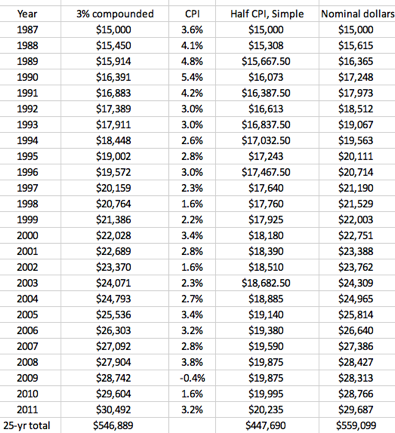
Simply compounding a 3 percent increase to the current average teacher pension of $46,452 over a 25-year period produces an additional $114,238 over that span, compared to the same 3 percent increase if it had not been compounded. In year 25, the teacher’s compounded pension would be $94,427. Not compounded, the pension would amount to $79,897.
* But not everybody is convinced that getting rid of compounding COLAs is the right answer…
West Chicago Republican state Rep. Mike Fortner said he’d prefer to see an increase to employee contributions rather than risk a protracted legal battle over changing employee retirement benefits. He said increasing teacher retirement contributions by 1 percent would essentially pay for the compounded pension bump perk.
“They can keep the compounded plan as long as they’re paying for it,” Fortner said.
If Fortner is right, why wasn’t that route taken instead? The teachers’ unions reportedly offered to kick in two more percentage points into the system. We need more data. Fast.
*** UPDATE 1 *** Rep. Lisa Dugan just called to say that she asked that very question and was told in no uncertain terms that the additional kick-in by employees wouldn’t produce nearly enough cash to solve the compounding problem.
*** UPDATE 2 *** From AFSCME…
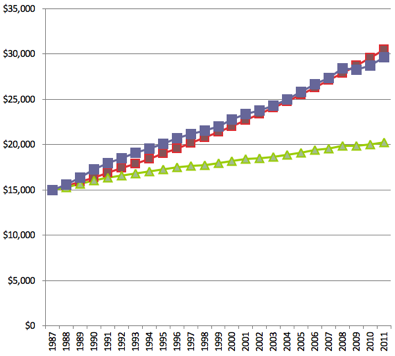
This chart shows how the 3% compounded COLA is critical to protecting retirees from inflation. Imagining someone who retired with a $15,000 pension in 1987, the chart shows the amount of their pension in each of the 25 subsequent years under two scenarios: Red is what the retiree has earned under current law, with a 3% annual compounded COLA; green is what they would have earned if the Tier 2 COLA provision had been in place (half of CPI capped at 3%, simple). The purple line shows the amount the retiree would have needed in each year for the pension to keep pace with the actual rate of inflation.
Under current law, the 1987 retiree is today an aggregate $12,000 behind, or 2% less than, the amount required to keep pace with CPI for the period. The benefit has exceeded the real value of the base plus inflation in just 3 of the 25 years. Had the Tier 2 COLA been in effect, the retiree would have lost $111,000 or 20% of the value of the base plus inflation.
* Maybe the CTU thought that scheduling a strike authorization vote the day after the Wisconsin recall election would give the union a big morale boost…
Chicago Teachers Union President Karen Lewis Wednesday joined thousands of teachers across the city — and even some from hospital beds — in voting on whether to authorize a strike of the nation’s third-largest school district.
Although she cautioned a gaggle of watching media at King College Prep that “do you all know the meaning of a secret ballot?” observers could clearly see her determined vote of “yes” on the question of whether to “authorize a strike on such a date as may be determined by the House of Delegates.’’
Lewis later predicted the union would make a new 75 percent approval threshold needed from all members — not just those who vote.
She said a strong voice was needed now from members “to make some movement at the table,’’ where the union has been sitting since November.
* But Gov. Scott Walker survived yesterday’s recall effort. This Forbes piece is a representative sample of the conservative react…
Public sector unions have reached their high water mark. Let the cleanup begin as the red ink recedes.
Despite a last-minute smear campaign accusing Scott Walker of fathering an illegitimate love child, the governor’s recall election victory sends a clear message that should resonate around the nation: The fiscal cancer devouring state budgets has a cure, and he has found it. The costly defeat for the entrenched union interests that tried to oust Walker in retribution for challenging their power was marked by President Obama’s refusal to lend his weight to the campaign for fear of being stained by defeat. We’ll see how well this strategy of opportunistic detachment serves in the fall as Obama reaches out to unions for support.
As Wisconsin Gov. Scott Walker emerges victorious from a union-backed recall campaign, it is time to step back and look at the larger picture. It is one in which unions, especially those that supposedly represent government employees, are coming under increased scrutiny and their powers are being pared back throughout the five Great Lakes states.
Gov. Walker attracted the anger of those unions when he sharply limited their bargaining authority and gave individual employees the right to decide for themselves whether or not to join or support a union.
“Turnout was extremely high during this election, and this only shows one thing: voters are fed up with big spending Democrats running their state governments. Walker’s reforms are exactly what Illinois needs right now. Illinois could use more fiscally courageous leaders like Scott Walker and less like Pat Quinn, Mike Madigan and John Cullerton who think the solution to every problem is a tax increase.”
* Indeed, the exit polling showed that 52 percent favored the state’s new limits on collective bargaining and that Walker had a job approval rating of 54 percent.
Some 60 percent of Wisconsin voters said a recall was only appropriate when a public official was accused of some kind of official misconduct. Walker’s recall was triggered when he led the drive to grind down the collective bargaining rights of state government employees — a major policy difference, not a personal failing.
That resistance to the use of the recall tool suggests why some voters in Wisconsin were comfortable in casting a ballot for a Republican with roots in the Tea Party movement and turning around and saying in November they could vote for Democrat Obama.
Illinois Senate President John Cullerton will push for quick action on changing pension rules for state employees and lawmakers even if top state officials continue to disagree on similar changes for teachers and university workers.
In an interview Tuesday with The State Journal-Register, Cullerton argued that taking steps to reduce costs of the State Employee and General Assembly retirement systems will signal bond rating agencies that Illinois is willing to tackle its pension funding problems.
“If we pass a bill in a bipartisan fashion that deals with 25 percent of (the pension shortfall) as soon as possible, it would go a long way towards showing the rating agencies that we are getting serious about this,” Cullerton said.
That process would be made easier because, in the closing hours of the spring session Thursday, the Senate passed House Bill 1447, which would cut the state’s expense for state employee and legislator pensions. The House did not take up the bill, but could if a special session is called.
* Cullerton got almost no publicity (and even less credit) for passing a pension reform bill last week. So, the media interviews serve to highlight his chamber’s achievement. The reaction from other leaders was not overwhelmingly positive ahead of today’s planned meeting in Chicago…
Steve Brown, spokesman for Democratic House Speaker Michael Madigan, said the value of Cullerton’s proposal will depend on reaction from the governor and from the rating agencies that are threatening to downgrade the state’s credit yet again if Illinois doesn’t fix its pension problems.
A better way to deal with the situation, Brown said, would be making it clear that state government can no longer pay the retirement costs of local employees.
House Minority Leader Tom Cross, R-Oswego, will not comment on the proposal before discussing it with Cullerton, a spokeswoman said.
A wave of retirements at the Illinois Department of Natural Resources could result in no full-time employees at some parks.
DNR confirmed Tuesday that 80 of the department’s 1,100 employees have filed notices of their intention to retire.
“There are some sites that if they were down to one or two people, if they decide to file for retirement, … then there would be nobody there,” DNR spokesman Chris McCloud said.
However, McCloud said the department is still deciding what it will do in the event of those retirements.
* The Pantagraph had one of the best analyses of the Rep. Mike Bost tirade this week.
Unlike most news outlets, the editorial page reported that Bost voted for the very House rules that he complained had been “forced down our throats.” The paper also admitted the obvious that House Speaker Michael Madigan has too much control over the chamber and criticized Republicans for their stance against the cost-shifting plan that would gradually put more responsibility for pension costs in the hands of local school boards. Here’s the end…
The ultimate solution is for Republicans to win more elections and become more of a force in the General Assembly. Until that happens, outbursts may garner some attention, but won’t have any real effect.
The ultimate cure for the woes of being in the minority is more members. Also, if the Republicans had nominated a more electable candidate in 2010 (and they didn’t need much in a year like that), then they would’ve had a legit shot at drawing the new district map.
* Also missed in the coverage is that Rep. Bost is a Republican floor leader. It’s his job to create trouble during debate. If you watch the video closely, you won’t see Republicans around him jumping up and down with anger like Bost was. They sit quietly during the show. And that’s what it was. A show. But what a show it was. When pressed, Bost refused to back down…
A day after the episode, state Rep. Edward Acevedo, D-Chicago, called for decorum to be restored to the House.
“Folks. Enough is enough,” Acevedo said.
Bost would not apologize. “My job is to represent my people. The people I represent in the 115th District have been slapped enough. I do not apologize for saying or raising my voice.”
Slapped? Really?
Meh.
* Like the late Rep. Zeke Giorgi always used to say when things got out of hand in the House: “It’s the greatest show in Illinois.” Sneed…
A GOP source tells Sneed the Bost rant was rehearsed and based on the antics of another retired Southern Illinoisan: former Senate GOP Leader Frank Watson (R-Greenville), who tossed a red faced diatribe a few years ago. Both men are pals and once threw hundreds of unstapled pages of bills up in the air while screaming at the opposing party. Rumor has it Bost even weighed the bill in his office and practiced punching it!”
* And it still is a show. David Letterman showcased the outburst this week…
* Bost has appeared on several national news programs since his tirade. And there have been more than a few tribute videos made. Here’s my favorite. “Mike Bost is Furious for SPARTA!!!…
* At least ten people are interested in replacing Democrat Brad Harriman on the 12th Congressional District ballot. Whomever is chosen will face Republican Jason Plummer in the fall.
With the Democratic Party in the process of selecting a candidate to replace Brad Harriman in the 12th Congressional District race, State Rep. John Bradley, D-Marion, said he is considering a run at the seat.
Bradley said he has been approached by several people about the possibility of running, but declined to comment on who approached him.
“I am considering it, and I ultimately want to do what’s in the best interest of my children and the people of Southern Illinois and the Metro East,” Bradley said.
St. Clair and Madison counties have the weighted vote here, but Bradley could be a strong candidate. He has his downsides, including that income tax hike vote.
Locally the names heard the most are Bradley and Illinois State Senator Gary Forby (D-Benton). Others include former U.S. Congressman David Phelps, of Eldorado and Lt. Governor Sheila Simon. None of these potential candidates have yet indicated an interest
Forby? The House and Senate Democrats have spent millions keeping him in office over the years. I doubt the DCCC will want that burden. Phelps definitely expressed a strong interest when I talked to him. Simon did not when I talked to her last week. Bernie has more on Simon…
Could there be a rematch between Lt. Gov. SHEILA SIMON and businessman JASON PLUMMER?
Plummer, of Fairview Heights, the 2010 GOP nominee for lieutenant governor, is now the Republican candidate for the U.S. House in the new 12th Congressional District.
The winner of the Democratic primary in that district, BRAD HARRIMAN of O’Fallon is dropping out of the race because of a worsening neurological condition that he says requires surgery.
Names being bandied about as a possible replacement for Harriman on the ballot include Simon, whose late father, PAUL SIMON, was lieutenant governor, a member of the U.S. House and, later, the U.S. Senate.
Simon told me she knows people have been talking about the idea. But she also said the talk seems to her “way more inflated than it deserves.”
“Just looking at it from the really personal point of view, it’s challenging to be working on a statewide basis,” she added. “It means a lot of time away from my husband. … Thinking about being even farther away doesn’t appeal too much.”
She went even further when she talked to me, saying she was approached about running for the seat last year and turned it down and hadn’t really changed her mind yet.
Belleville attorney William Enyart, adjutant general of the Illinois National Guard, confirmed Friday he was approached by 12th District Democrats to run for Congress in November in place of Brad Harriman.
Enyart said he is considering whether to run for the office, but, as of now, is undecided.
“I have had some people approach me and I think that is a great compliment,” Enyart said. “I plan to sit down with my wife and family to discuss it.”
Enyart is married to retired St. Clair County Circuit Judge Annette Eckert. He said he was called about 5 p.m. Wednesday about the position, a day after Harriman announced he would drop out of the race for health reasons. He wouldn’t reveal who spoke with him.
So far, a number of other names have surfaced as potential Democratic candidates. However, three prominent Democrats, St. Clair County Board Chairman Mark Kern, state Rep. Jerry Costello II and former state Rep. Jay Hoffman, all have said they are not interested in the job.
* Charlie Cook has this district as a toss-up. Cook has also moved the 17th District from “Lean Democrat” to “Toss up.” From a press release…
Following a recent Public Opinion Strategies poll that showed U.S. Rep. Bobby Schilling (R-Colona) with a 16 point lead over his opponent, Alderwoman Cheri Bustos (D-East Moline), the Cook Political Report, a prominent political analysis website, has changed its rating for the Illinois 17th District from “Lean Democratic” to “Toss Up.”
Jon Schweppe, communications director for Bobby Schilling for Congress, said that financial support from extreme special interest groups like EMILY’s List won’t be enough to deliver the race to Bustos.
* Apparently, they’ll pay anybody to write any goofy thing over at the Wall Street Journal. Here’s an opinion piece by William McGurn published today…
Unlike Illinois, Ohio has a Republican governor, John Kasich, and a reformist Republican legislature. Unlike Illinois, Ohio’s governor ruled out tax hikes as a way to address his state’s budget hole ($8 billion). And unlike Illinois, whose Medicaid cuts mostly do nothing to slow the growth of spending, Ohio’s Medicaid program expects to see its annual rate of increase cut in half.
How did Buckeye Republicans do it? It turns out that when you can’t rely on dubious revenue projections, you get more serious about spending. When Mr. Kasich’s people looked at Medicaid, they found that 4% of Ohio’s Medicaid cases accounted for 51% of the spending. That allowed them to address costs while improving care—e.g., coordinating care for the most expensive, chronic cases instead of just having them show up in emergency rooms.
In sharp contrast, the cigarette tax in Illinois raises many more questions than it answers. Take the projected $350 million in revenue, which is designed to help close a $2.7 billion Medicaid gap.
OK, so Illinois slashed programs, whacked reimbursement rates to providers, cut the state’s Medicaid “credit card” to prevent it from using next year’s revenues to pay for this year’s spending and moved people into less expensive care and yet the WSJ says the cuts “mostly do nothing to slow the growth of spending”? Ridiculous. Here are a couple of “losers” identified by the AP…
LOSERS
• Patients: The vast majority of the spending reductions will mean leaner services for the state’s 2.7 million Medicaid patients.
The cuts end prescription drug coverage for nearly 200,000 senior citizens and halt health coverage entirely for 35,000 adults. Illinois would join other states that already cut back on Medicaid extras like regular dental care for adults. The state would no longer cover most visits to chiropractors and only people with diabetes could see podiatrists.
Eyeglasses would be limited to one pair every two years. Prior state approval would be required for wheelchair repairs, heart bypass surgery and obesity surgery. Patients would be limited to four prescription drugs per month without prior approval. […]
• Nursing homes: Illinois is trying to discourage expensive nursing home care for people who could stay in their own homes with help. That’s reflected in the Medicaid rate cuts. Nursing homes with healthier residents will take a 10 percent cut in payments. Those with sicker residents will face cuts of 1 percent. Institutions for Mental Disease, a type of nursing home with mostly mentally ill residents, will see cuts of 2.7 percent.
The lesson in all this is that reforming government takes courage and deliberation. By leaving pension reform to the last week of the legislative session, lawmakers betrayed that it wasn’t a priority. They tried to cobble together a bill at the last minute, but things done in haste are rarely successful.
The pension study group, staff and leaders worked on this issue for months. And everything big in Illinois is put off until the last week.
* We’re coming to this a bit late in the game, but, whatever, let’s get to it now…
Illinois Attorney General Lisa Madigan has filed a motion to intervene in support of 25 same-sex couples who have sued for the right to marry in Illinois.
The attorney general will intervene in two separate lawsuits filed by Lambda Legal and the American Civil Liberties Union of Illinois, aimed at winning marriage equality in the state.
The suits were filed May 30 against Cook County Clerk David Orr in his official capacity ( Orr personally supports marriage equality and the lawsuits ) . Plaintiff couples have alleged that civil unions, which began a year ago, have failed to provide same-sex couples with the same rights gained through marriage.
In the motion, filed in the Circuit Court of Cook County Chancery Division, the attorney general asks “to present the Court with arguments that explain why the challenged statutory provisions do not satisfy the guarantee of equality under the Illinois Constitution.”
The lawsuits, filed Wednesday by the gay rights group Lambda Legal and the American Civil Liberties Union of Illinois, are against the clerk of Cook County and claim that his refusal to issue marriage licenses to same-sex couples violates those couples’ rights to due process and equal protection under the state’s constitution.
Cook County Clerk David Orr has stated he applauds the lawsuits and is in favor of same-sex marriage. Officials from the Cook County state’s attorney’s office, which will represent Orr, did not respond to calls seeking comment.
Peter Breen, executive director and legal counsel of the Chicago-based Thomas More Society, which opposes gay marriage, said after the lawsuits were filed that he expects the state’s attorney’s office to defend the state law that bars same-sex couples from marriage.
So because the Illinois Attorney General is not defending the state’s marriage law definition, private non-profit groups are stepping forward to fill the void of legal representation. Illinois law defines marriage to be between one woman and one man, and civil unions were allowed in 2011.
“Regarding the Illinois Marriage Law that the ACLU/Lambda Legal is attempting to get declared unconstitutional, you may be pleased to know that I signed a Contract of Legal Representation with ADF this afternoon so that IFI can intervene to defend the law,” Smith announced Monday afternoon.
* There wasn’t a whole lot of news today and I have a handyman at the house doing a few much-needed tasks, so I need to be away from my office for a while this morning. Sorry about that, but it is what it is. I can’t get this stuff done during session.
Legislative leaders are planning to meet with Gov. Pat Quinn in Chicago this week after a failed attempt to rein in the cost of the state’s public pension systems.
Quinn said earlier this year pension reform must happen this spring, and said he would call lawmakers back to Springfield if they failed to pass substantive changes.
Late Thursday, Quinn issued a news release saying he would call a meeting with the four legislative leaders to salvage a plan scuttled in the last days of the spring session.
Rikeesha Phelon, spokeswoman for Senate President John Cullerton, said the following leaders will probably meet Wednesday in Chicago: Illinois House Speaker Michael Madigan, D-Chicago; House Republican Leader Tom Cross, R-Oswego; Cullerton, D-Chicago; and Senate Republican Leader Christine Radogno, R-Lemont.
Quinn’s office, which is coordinating the meeting, didn’t respond to questions to confirm its date.
Patty Schuh, spokeswoman for Radogno, said it’s extremely unlikely the Legislature would return to Springfield before the leaders and Quinn had a chance to sit down and hash something out.
“I think he’d want a leaders’ meeting first, unless he wants to continue to be like Rod,” Schuh said, referring to former Gov. Rod Blagojevich, who had a protracted battle with the Legislature that involved many summer session days.
I’m told that members of the pension reform task force and staff will also be at tomorrow’s meeting in Chicago.
* The Question: Your prediction for tomorrow’s pension reform pow-wow? Snark is definitely encouraged. Enjoy.
“Thousands of dollars” in state grants awarded to bolster health care in minority communities instead went to pay campaign workers for former state Sen. Rickey Hendon and Democratic candidates Hendon supported, a Chicago nurse has told investigators.
The nurse, Tonja Cook, 44, detailed her allegations in four interviews with state and federal authorities between October 2010 and May 2011, records show. […]
Those previously undisclosed reports portray Hendon, along with his political organization, as the beneficiary of state grant funds that Hendon helped obtain for the Chicago Chapter of the National Black Nurses Association, which Davis and Cook helped run. […]
Cook, who was the association’s treasurer, told authorities Davis would use money from those grants to “give as much as $500 in cash to as many as 10 individuals attending the weekly Monday meetings at the campaign offices of Hendon to go out and conduct campaign work for Hendon and other local politicians,” according to the investigators’ reports.
Those reports were supposed to have been filed under seal but were included, apparently inadvertently, in the online court records for the criminal case against Davis and Cook. They are now under seal.
“Cook said she and Davis would meet with Rickey Hendon and discuss state grants” and “attend political fund-raisers for mainly Hendon,” the reports say.
“Davis told Cook to ‘donate to Hendon because he is helping us,’ ” the investigators quote Cook as telling them.
They say Cook told them that, on four or five occasions in the summer of 2006, “Davis instructed Cook to cash checks to generate thousands of dollars in cash from the grants.
“Grant funds were used to pay for political work to help certain candidates like Hendon,” outgoing Metropolitan Water Reclamation District Commissioner Patricia Horton, “an alderman from the West Side of Chicago possibly named Ed Smith or Ed Williams, a judge whose name she could not recall at this moment and possibly others,” the reports say. “Davis herself usually paid the political workers in cash but did not obtain receipts.”
If that was cash she’d be keeping anyway via her own salary, that’s one thing. But if it was cash which was supposed to be going to programs, there could be trouble.
* Sen. Michael Noland was bashed by one of his local columnists over the weekend, but the thrashing paled in comparison to what happened to Noland on the Senate floor last week…
But Sen. Noland has never bowed to anything, much less logic. Sensing an opportunity to be the center of attention and to pretend to wield the power and influence he’ll never have, not only did he refuse to bring the amended bill up for a vote, but he wouldn’t relinquish sponsorship of it either.
And that folks, effectively killed it.
But get this. Noland isn’t arguing that the eavesdropping statute should stand. He’s saying his bill doesn’t go far enough in providing police the unfettered right to record citizens.
“If you’re approaching someone on the street with a video camera, there’s notice that the whole world is watching,” Noland said, “When the whole world is watching, people tend to behave better.”
I suppose he’s referring to how well it’s worked with the Syrian regime and reality TV shows. If cameras really did make people behave better, my first suggestion would be to point one directly at the senator.
Noland added that broader surveillance powers would keep both officers and the public safer and save money by reducing criminal litigation cases. Call me crazy, but if an officer pointed a camera at me for no reason, that might actually make me want to file a lawsuit.
I can see it now. A posse of Elgin police officers roaming the riverfront, camcorders firmly in hand, while the real criminals wreak havoc upon the rest of the city. Just to be on the safe side, perhaps we should start practicing our best Bob Fosse moves now to keep ’em from getting bored.
I smell another reality show.
Noland insisted he wasn’t hijacking his own bill; he was only trying to make it better. He said he wants to “reconcile” it with current court decisions because “audiovisual evidence is compelling” and that law enforcement groups were behind him.
C’mon, any time you threaten to expand police surveillance powers, that’s bound to make ’em downright giddy.
Noland was literally ridiculed on the Senate floor Thursday night by his fellow Senate Democrats for bringing his bill to the floor. I’ve never seen anything like it. Usually, the Senate observes fairly strict decorum rules. I’ve asked our friends at BlueRoomStream.com for the video, but they’re doing server work today, so maybe I’ll get it tomorrow.
* Meanwhile, I’m sorry, but it’s my own humble opinion that filing charges against somebody who threatens to deck you during a media scrum is just unnecessary…
Local TV reporter Jay Levine was found not guilty of misdemeanor assault Friday for a brief verbal tussle with conservative commentator William Kelly during an interview of Rahm Emanuel.
During a short hearing in the Cook County court at Belmont and Western, Judge Geary Kull noted that Levine didn’t raise a fist in the incident, which was recorded and is available on YouTube.
Though Levine said he was going to “deck” Kelly, Kelly’s behavior was “not indicative of an individual who reasonably feared Mr. Levine would strike him,” the judge said.
“Clearly Mr. Kelly wasn’t aware it was threat because he had to ask Mr. Levine if it was a threat,” Kull said.
On the Web video, Kelly badgers Emanuel with questions and opinions while Levine and another local reporter tried to interview him.
Kelly testified in court Friday that he thought Levine’s threat was legitimate.
Like the judge said, if Kelly really thought Levine’s threat was legit, he wouldn’t have needed to ask.
I’ve seen worse threats at Statehouse gangbangs. George Ryan had to break up a fight between two TV cameramen back in the day. Elbows get thrown, things get said, and we deal with it and move on. It’s just part of the life.
* Who was the spring session’s biggest winner? Who was the spring session’s biggest loser? Please answer both questions and please explain both answers. Thanks.
* I don’t disagree with Civic Federation President Lawrence Msall’s viewpoint that the pension reform negotiations probably should’ve been far more data-driven. But I do have some significant quibbles. First, let’s hear him out…
The publicly debated and data-backed effort to repair Medicaid resulted in a package of bills that will likely prevent the collapse of vital services to the state’s most vulnerable residents. The closed path to pension reform lacked any meaningful data and led nowhere.
The road to repairing Medicaid included three key components that were absent in this week’s disjointed legislative maneuvering surrounding pension reform.
• First, lawmakers identified a shared goal of what the state needed to achieve: cut $2.7 billion from the Medicaid program. Lawmakers must be able to identify an equally specific goal for pension reform. The state currently projects it will spend 22.1% of its operating revenues on pension costs in fiscal year 2013 (including both contributions and payments on pension bonds). This percentage has grown from only 3.6% in fiscal 1996 and is expected to reach nearly 30% by the 2033 budget year. These costs are obviously unsustainable and will continue to crowd out the state’s ability to pay for basic government services. What percentage of operating resources can the state afford to spend on pensions? This answer to this question is essential to defining the goal of pension reform.
• During the Medicaid deliberations, lawmakers and the general public also had access to detailed information on the implications of all proposed options for achieving the shared goal. The Illinois Department of Healthcare and Family Services made information widely available on each of the proposed changes and their projected savings. The various pension reform proposals did not come with this kind of detailed analysis. Lawmakers and the public could only speculate on what the vague notions of cost savings would imply for the state, local governments, employees and retirees.
• Finally, meaningful reform requires a rigorous debate on the proposed options, involving all stakeholders. Such debate on pension reform was impossible without access to the kind of detailed information provided on the Medicaid program.
In the absence of a shared goal, detailed information and rigorous debate, pension costs will continue to crowd out other state spending priorities. There is no time to waste to get pension reform right: Every day of delay makes the solution more painful.
* I agree, generally, with the argument that Gov. Pat Quinn set a $2.7 billion goal for Medicaid and probably should’ve set some sort of hard long-term savings goal for pensions as well. Quinn had a plan, but he was malleable on all points.
I also agree that the various pension reform proposals should have come with lots more data and been publicly disseminated. I think there was probably a worry that sharing too much would harm some pretty delicate and intense negotiations. But a bit more openness and a lot more data should’ve been the rule here.
Also, it’s tough to foster any public debate - available data or not - when the unions refuse to discuss the finer points and insist on sticking to their public talking points about how the government’s historic underfunding is to blame and that workers shouldn’t be made to shoulder the entire burden.
Make sure to keep in mind that Msall’s Civic Federation and Ty Fahner’s Civic Committee of The Commercial Club of Chicago are two separate entities. Msall is the guy who sounded the legitimate alarm on the Medicaid crisis. The Civic Committee is the group that paid for that goofy billboard truck which was spotted near the Statehouse last week.
* I have some late breaking news for the Alton Telegraph editorial board: Most Metro East residents already drive across the river for their big cigarette purchases. The tax hike won’t make all that much of a difference…
But the tax increase surely will reduce revenues for thousands of businesses in Illinois counties that border neighboring states with lower taxes on cigarettes. That particularly applies to those counties that border Missouri, which has the lowest tax on cigarettes of any state at just 17 cents.
It’s a nightmare scenario for convenience stores and gas stations in cities such as Alton, where shoppers can take a short drive across the Mississippi River to find cheaper smokes in Missouri. Up until now, the difference between the states’ cigarette taxes amounted to 81 cents per pack, which might not be enough to drive a smoker to make that trip. But if the smoker buys cigarettes by the carton, 10 packs at a time, the difference already is roughly $8 per carton. And when the new Illinois tax kicks in, retailers here will have to charge some $18 more per carton than their counterparts in Missouri.
When you add that to the fact that gasoline consistently sells for 20 to 25 cents less per gallon in Missouri, because Illinois also imposes a sales tax on the fuel, retailers in border areas of our state are facing disaster. Thousands of customers will go across the state line to buy their cigarettes and gas up their cars, and while they’re visiting the convenience stores in the Show-Me State, they’re likely to buy a few snacks and beverages, as well, further cutting Illinois’ sales tax revenues.
If they’re not already crossing the bridge with an $8 a carton difference, then they’re just plain silly. There’s no way to compete with a 17 cents per pack cigarette tax without really hurting our own revenues and encouraging more smoking. And statewide policy should not be made to benefit one, smallish region.
Yes, this cigarette tax hike will have an impact. But it will be relatively small - not the “nightmare scenario” envisioned by the Telegraph. That cig business has already been lost.
I’ve been spending a lot of time in the Metro East lately (partly because there are some big upcoming races there and I’m attempting to further boost my knowledge of the region in advance). I’m happy to report that there appear to be thriving convenience stores everywhere, so they seem to be weathering the border competition pretty well so far.
* And what would the Telegraph have done with Medicaid restructuring without that $700 million in revenue from the cigarette tax? Would they have cut funding even more for their local hospitals, which pay far higher salaries and create much better jobs than convenience stores? Or would they have kicked even more people off health care, which would’ve most certainly hurt their purchasing power and caused an even greater ripple effect on local businesses?
It’s really easy to complain and predict the end of the world every time the General Assembly passes a bill. It’s a whole lot tougher to actually solve the very real problems of the day.
* The speculation that Bill Brady is probably running for reelection is no surprise at all. He’s almost definitely in for a third straight try. The fact that he’s paying closer attention to his voting record this time around is what might be the bigger surprise…
When the gambling expansion bill was approved by the Illinois Senate last week, state Sen. Bill Brady, R-Bloomington, was a “present” vote.
When he ran for governor in 2010, Brady said he was beat up for approving an easement in Champaign close to a subdivision owned by his family’s development company, Brady Homes.
“In this case, I have an equity interest in a hotel in Danville, Illinois. And, when Danville was thrown into the bill, my ethics officer advised me that I should declare a conflict by voting present,” Brady said.
The gambling expansion bill includes five new casino licenses, including ones in Danville and Chicago, as well as slot machines at racetracks.
Brady’s answer made it seem as though he’s considering another run for governor.
“At frustrating times like the end of the session sure lead me to realize there’s a lack of leadership in Springfield, and there’s certainly a lot I think I can do. But, I think I’m going to reserve that answer until probably after the election in November,” Brady said.
Senate President John Cullerton, D-Chicago, flatly predicted Quinn will veto the bill. He said senators would then pass another version of the measure.
Quinn refused to say whether he would sign, veto or use his powers to rewrite the gambling bill. The governor also would not directly answer whether he continues to oppose slot machines at horse racing tracks — the reason he gave for opposing last year’s casino legislation.
The governor said he is focused on whether the latest bill has tough ethics standards.
“We must have integrity, strong no-nonsense ethics standards, and if we apply that over and over again, we’ll be a better state,” Quinn said.
Gambling expansion sponsor Sen. Terry Link, D-Waukegan, has said he’ll push a bill this fall with more oversight of the Chicago casino and a ban on political contributions from gambling licensees. Such changes could allow Quinn to more easily pivot and go along with the gambling measure if he’s inclined to do so.
Additionally, Sen. Terry Link, a Waukegan Democrat and sponsor of the bill, filed additional legislation Thursday that would add more ethics provisions, including a ban on campaign donations from some gambling interests.
“We answered every request that (Quinn) could have,” Link said. “I don’t know what more I can do for him.”
Link’s additional legislation could be key to luring Quinn’s support.
“I have a great deal of hope we can do it. We probably just don’t have the language yet,” Duchossois said. “I think that will come through. I think that’s what we’re trying to put together.”
Lame duck lawmakers could also play a role if an override vote is needed this fall. Already there are 12 suburban lawmakers among other lame ducks across the state. And that number will grow after the Nov. 6 election. Lawmakers relieved from the political pressures of facing re-election could be more willing to vote for a controversial plan.
* Gov. Pat Quinn, the Tribune editorial board, myself and several others have repeatedly warned that failure to pass both Medicaid and pension reform this spring would lead to a significant bond rating downgrade. Medicaid reform did pass with (mostly) bipartisan support (except for the Senate Republicans, who took themselves out of the game again), but pension reform stalled. So, how did the raters react? Here’s a quick roundup.
Karen Krop, an analyst at Fitch Ratings, said while she has not seen details as yet, the fact the budget was passed on time with Medicaid reforms “that seemed significant for cost controls” was a positive move for Illinois.
She said that Fitch’s ‘A’ rating with a stable outlook was more reflective of Illinois’ fiscal balance and operations, and any pension reform would be considered positive.
* A Moody’s analyst conceded that the ratings agency understands the political problems involved, but wanted some action relatively soon…
But Moody’s Investors Service analyst Ted Hampton said on Friday the credit ratings agency was looking for “significant” action on Illinois’ pensions.
“Any sign the state is at an impasse and is unable to move forward on this issue would be a negative credit factor,” Hampton said, adding that Moody’s recognizes the political and legal challenges involved.
“The state’s pension challenges remain staggering regardless what happens in Springfield in the next few weeks,” he said, adding there was no “silver bullet” that will make the enormous unfunded pension liability immediately disappear.
* And S&P, which warned of a multiple downgrade if action wasn’t taken on both Medicaid and pensions this spring, was cautious…
However, an agreement on a budget for next year with reduced deficits and big Medicaid cutbacks was a positive sign for the New York credit rating agencies, assuming the details stand up to scrutiny. The question is whether long-term pension costs also can be curtailed.
“Pension reform is the other piece that’s pretty critical to where the state’s rating moves,” said Robin Prunty, lead Illinois credit rating analyst for New York-based Standard & Poor’s Ratings Services. “A lot will depend on whether there’s action on pension reform.” […]
“If there is no action on pension reform, that is not a positive from a credit standpoint,” said Ms. Prunty.
* A Democratic higher-up worried late last week that the momentum would be lost on pension reform if members were sent home while the leaders tried to cut a deal. So far, though, the media has been brutal. Check out this over the top CBS2 story that was picked up by the Illinois-hating Matt Drudge…
Illinois lawmakers may have gotten stymied on the issue of pension reform, a multi-billion-dollar mess affecting every taxpayer in the state.
But at least they managed to pass a bill involving miniature horses.
You heard that right. Under a measure the House sent to Gov. Quinn Thursday night – the evening members were supposed to consider a cost-saving pension bill – people with disabilities could use miniature horses as service animals in public places, much like guide dogs are used.
The vote was near-unanimous.
Whatever.
* First of all, the Americans with Disabilities Act already classifies miniature horses as guide animals. Illinois is just getting itself into compliance…
The Guide Horse Foundation says that guide horses have several characteristics that make them a great alternative when service dogs are not suitable, as guide horses can be useful for people with severe allergies or phobias to dogs, or people who want an animal likely to live longer than a dog. Miniature horses usually have a docile nature but can be strong enough to provide support while their handler gets up from a chair. As well, the foundation says the mini-steeds have shown excellent judgment and are not easily distracted by crowds.
* Secondly, the General Assembly passed several bills this session, including some pretty good ones, like this…
The House voted 68-50 Thursday to reinstate sentence credits for prisoners who stay out of trouble behind bars or participate in self-improvement programs.
Non-violent inmates could qualify for as much as six months’ time off their sentences.
Quinn shut down a similar program in 2009 after The Associated Press reported his Corrections Department released violent inmates weeks or even days after arriving at prison.
Now, the prison population is 14,000 over capacity. Officials fear a lawsuit over the congestion.
Then, of course, there was the Medicaid fix.
But talking about serious, bipartisan legislation to address very big problems would’ve completely ruined a masterful cheap shot. It’s so much easier to write about miniature horses.
At least for now, it doesn’t appear that rank-and-file legislators will have to spend much time in Springfield this summer — even though they failed to finish their work on pension reform last week.
Aides to Gov. Pat Quinn claim that they’ve learned from the mistakes of his predecessor, Rod Blagojevich, and won’t drag legislators back to the Statehouse for a grueling overtime session to try to resolve the pension funding crisis, which has already overwhelmed the state budget.
Blagojevich convened numerous overtime sessions, and they were all divisive political circuses. Plus, forcing legislators back to Springfield to sit around and wait for the leaders to come to an agreement means they’ll have plenty of time on their hands to bad-mouth the governor to reporters, who won’t have much to do, either.
Quinn signaled his understanding of this dynamic in an official statement issued after it was apparent that pension reform was dead in the water in the spring session.
“I will convene a meeting with (Senate) President Cullerton, (Senate Minority) Leader Radogno, (House) Speaker Madigan and (House Minority) Leader Cross in the coming week so we can forge a pension reform agreement as soon as possible and return to Springfield to enact it into law,” Quinn said.
There’s really no need to convene the full General Assembly because the real problem here is a fundamental disagreement among the legislative leaders.
Speaker Michael Madigan (D-Chicago) is insisting on shifting teacher pension costs away from the state and onto downstate and suburban school districts. House and Senate Republican leaders are adamantly opposed to such cost shifting, saying it would substantially boost property tax bills and punish wealthier school districts that tend to have higher pay for educators.
Madigan handed off control of the pension reform package to Tom Cross (R-Oswego) earlier in the week and allowed the bill to be amended to strip out the cost-shifting language at the behest of the governor.
But the next day, the last day of the legislative session, Madigan let it be known that he would be voting against the bill. That was all it took for his members to jump off it as well.
House members from Chicago were among those against the bill. Some were told by Quinn aides that Mayor Rahm Emanuel supported the revised legislation, but the mayor’s Springfield crew never got the word to work for the proposal.
Emanuel has pushed hard for the cost-shifting plan, believing that it’s unfair for Chicago Public Schools to pay its full share of employee pension costs while school districts outside the city have the state cover most of those costs.
With Madigan opposed and Emanuel not working for the bill, it quickly became clear to the governor’s office that there was simply no way to pass it. Cross told the House that this would be a “summer issue” and that emotions needed a chance to cool down.
The Republicans (and downstate and suburban Democrats) are so completely against any talk of shifting pension costs to school districts — even if they’re phased in over several years — that the issue appears almost impossible to resolve.
But Madigan and Emanuel know that there’s probably no better vehicle to attach the idea to than the politically important issue of pension reform, so they’re not giving up, either. The solution might be getting more school more money for Chicago, perhaps in a way that gives additional cash to education in general.
Then again, there’s been little willingness on Madigan’s part to move forward with a highly controversial pension bill that riles up teachers before the Nov. 6 election, when all 177 seats in the Legislature are up for election, many in new districts.
State and university workers and retirees are mostly concentrated in pockets around the state, so their political impact on legislators is limited. But public schoolteachers and retirees are everywhere. And there are a lot of them. And they are very politically active.
The Senate showed last week that it can pass a pension reform bill when it approved changes to the State Employees Retirement System on what appeared to be a carefully structured roll call.
That reinforced the idea that bringing the entire General Assembly back to town for an extended stay this summer is both unnecessary and a bad idea. If the leaders can be put on the same page, then the members will undoubtedly follow.
* Related…
* Pension reform faces uncertain path forward: So the focus may turn to how lawmakers can tweak their plans to force local school districts, community colleges and universities to pick up some of the state’s pension costs. “What we have to do is find common ground between both proposals,” Quinn said. Coming up with a new idea is possible, but it could be tricky as lawmakers have already used creative policy ideas to get this far. “If I’d thought of it (another plan), I would have put it on the table,” state Rep. Elaine Nekritz, a Northbrook Democrat.
* A near miss in Springfield on Illinois pension reform: But not everyone wants a quick solution to pensions. Collin Hitt, senior director of government affairs at the Illinois Policy Institute, a right-leaning think tank, said although he was surprised a pension deal didn’t pass, he wasn’t disappointed given the legislative gymnastics happening at the eleventh hour.
* Legislators headed to overtime: Rep. Don Moffitt, R-Gilson, said he would have been surprised if an agreement was reached before the session’s Thursday deadline. Sen John Sullivan, D-Rushville, said the complexity of reforming both Medicaid and pensions and the body’s time constraint worked against them. He said Medicaid was the more pressing issue because it had implications for the current budget.
* Quinn implores legislators on pension reform: Senate Republican leader Christine Radogno, of Lemont, said passage of even the slimmed-down pension reform represented a huge step forward, but said it’s “excruciatingly frustrating” that lawmakers failed to pass a comprehensive pension overhaul this spring.
* How pension-reform push spun out of control - Legislative squabbles, fear of alienating unions both played roles
* Ill. pension fix derailed; officials to try again: Did Madigan always intend for pension negotiations to collapse, perhaps as a way to please deep-pocketed unions who have long supported Democrats? Did he intentionally blow things up after realizing his own proposal couldn’t pass? Did he maneuver Republicans into presenting their plan and failing, hoping that it would embarrass Republicans and make his own proposal more palatable? House Minority Leader Tom Cross, R-Oswego, said he wasn’t sure… But Cross’ political organization claimed to know Madigan’s goal, sending out a fundraising appeal Friday that said Madigan abused his power and “got his wish of halting real reform.”