Springfield staffer (and interim bureau chief) Dan Carden spotted a member of the House Democrat’s leadership team returning to his Springfield apartment with what appeared to be enough freshly dry-cleaned shirts to last the month.
Oof.
More…
Special session starts tomorrow at 2 p.m.
How long will it last?
The Senate President has a news conference scheduled for 2:30 p.m.
Not unexpected. The tax hike vote will take place Wednesday, and without GOP votes it’s a goner.
* On a completely unrelated topic, I didn’t know David Hernandez, of Sports Webio infamy, looked so much like Gov. Quinn…
The whereabouts of [South Carolina] Gov. Mark Sanford have been unknown to state officials since Thursday, and some state leaders are questioning who is in charge of the executive office.
Neither the governor’s office nor the State Law Enforcement Division, which provides security for governors, has been able to reach Sanford after he left the mansion in a black SLED Suburban SUV, said Sen. Jake Knotts and three others familiar with the situation but who declined to be identified. […]
First lady Jenny Sanford told The Associated Press today her husband has been gone for several days and she doesn’t know where he is. […]
The governor’s office issued a statement Monday afternoon: “Gov. Sanford is taking some time away from the office this week to recharge after the stimulus battle and the legislative session, and to work on a couple of projects that have fallen by the wayside.
Sanford’s office told the lieutenant governor’s office Monday afternoon that Sanford has been reached and he is fine, said Frank Adams, head of Lt. Gov. Andre Bauer’s office on aging.
* Sen. Dick Durbin has suggested that some suspected terrorist detainees at Guantanamo Bay be transferred to the federal prison in Marion to await trial or further disposition. Gov. Quinn responds…
QUINN: We’ll we’d have to look very carefully at that. I haven’t talked to either senator. You know, that’s a serious matter. I think we, uh, understand that the President is focused on that issue, as far as those prisoners there. I’d certainly want to have a lot more study of exactly what they’re talking about and where they’re talking about it.
Senator Durbin says guards at the federal prision in Marion think they can handle Guantanamo detainees. And the mayor of Marion says he can’t think of a better place to send the prisoners.
* The Question: Should Quinn give his consent? Explain.
Also, let’s not get into a debate over the wars here. Just stick to the question and only the question. Thanks.
Christopher Kelly, a former adviser and chief fundraiser for former Gov. Rod Blagojevich, was sentenced to 37 months in prison today on federal tax fraud charges for concealing his use of corporate funds to cover gambling debts.
Kelly had faced up to 4 years in prison. He pleaded guilty to the charges in January, admitting he underreported his roofing company’s profits by nearly $500,000 from 2001 through 2005.
There was no mention in court of any negotiating Kelly may have been doing to cooperate in the Blagojevich investigation. Kelly’s second case,is expected to go to trial in September. Kelly is charged with taking part in a kickback scheme to rip off United and American Airlines at O’Hare International Airport through a roofing company he owned.
Bucklo allowed Kelly to surrender for his sentence on Nov. 2.
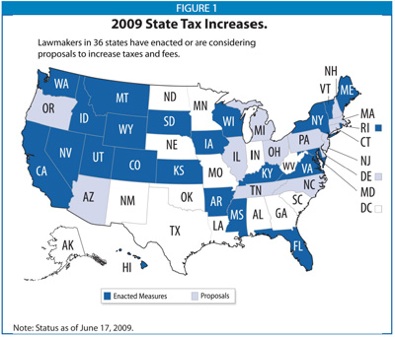
These steps are in addition to revenue actions taken by 10 states in late 2007 and 2008 as the recession’s effects began to be felt. Although some of these measures are relatively small in terms of the amount of revenue raised, others — such as packages enacted in California and New York and under consideration in Oregon — are very significant. […]
Historically, raising taxes in a recession is a common response by states. During the recession of the early 1990s, 44 states raised taxes by a significant margin (at least 1 percent). In the recession of 2001, 30 states did so. These actions increased annual revenue collections by tens of billions of dollars. (States often go in the opposite direction during periods of strong economic growth: 36 states cut taxes from 1994 to 2001.)
More…
Six states have enacted measures that will increase revenues from the personal income tax in fiscal year 2010. These changes include rate increases, the addition of new upper-income tax brackets, and reductions in various credits, exemptions, and deductions. […]
In 2009, 10 states have increased sales tax revenues by such means as raising rates, expanding the tax base to cover previously untaxed goods and services, and administrative changes. […]
At least seven states have enacted business tax increases […]
At least 10 states have increased excise taxes on tobacco and alcoholic beverages. […]
Nine states have increased various fees and taxes related to motor vehicles and fuels
* Patrick Collins, the chairman of the now-defunct reform commission, responds to an op-ed written by Senate President John Cullerton…
[Cullerton] has every right to defend his record on ethics reform. But in defending that record, he also denigrated the work of the Illinois Reform Commission. He claimed that portions of our proposals may have been motivated by “partisan” interests and that we did not advance actual legislation.
As to the “legislative leader term limits” recommendation, the commission’s report fails to explain how it targets “the core of the culture of corruption” or even relates to the rampant and bipartisan corruption in the executive branch over the last decade. If anything, the “reform” idea smacks of a personal or partisan animus toward House Speaker Michael Madigan, rather than a proposal supported by evidence.
Sen. Cullerton is right that neither Collins nor the commission have yet to make a specific case for why those specific reforms are needed and why Madigan is the true bad guy in government.
Also on that topic of leadership influence, Cullerton made an interesting and valid point…
…the commission’s proposal to allow only legislative leaders to maintain additional political committees to support multiple candidates would further consolidate, not diminish, the power of legislative leaders.
Yep.
* On to the second point in Collins’ op-ed, that Cullerton wrongly claimed the commission “did not advance actual legislation.” This is what Cullerton actually wrote…
Patrick Collins is incorrect that we “outright ignored” the commission’s legislative rule-changes idea. Early in my presidency, the Senate adopted rules changes that provide members with greater ability to advance and control their own bills. In addition, I reversed the policy of my predecessors by assigning virtually every bill and amendment to a substantive committee. At no time did the commission ever propose actual language for these rule changes. As I’ve said before, the General Assembly enacts legislation, not press releases.
There’s certainly room for good-faith disagreement between Cullerton and reform advocates about whether Illinois “won big” this year. But the bar for what constitutes meaningful ethics reform will not be set in Springfield. It won’t be set by the commission members. It will be set by Illinois citizens.
Let’s hear if they think they won.
* Related…
* Cash goes to districts of Congress members directing corps funds: The states getting the most money — California, Mississippi, Illinois, Texas and Florida — all have lawmakers serving on the appropriations committees. The seven states getting no corps stimulus funding include Michigan, which has the nation’s highest unemployment rate but no members on the energy and water spending panels in either chamber.
* The Republicans appear to be calculating that Gov. Quinn won’t pull the trigger on massive budget cuts…
House Republican leader Tom Cross said he doesn’t know if Quinn can “pull the trigger” on deep human services budget cuts.
“I think he’s too good a human being, too compassionate a human being to harm the social service agencies,” Cross said.
The Republicans, as you already know, want either a “month to month” budget that would drag this thing through the summer and into the fall, or a “six month budget” using available funds. The governor has rejected the second idea, but I don’t believe he’s been asked about a one-month continuing appropriation. And Mother Tribune hates the idea of putting off a budget resolution for six months…
Some of those lawmakers think they’ve found a way to finesse their dilemma: They might vote for a big tax increase — but only after they learn whether they’ll have serious primary election opponents next year. Think of this as calculated cowardice.
* As I told subscribers last week, this pension note idea is under serious consideration…
Watch for a new pension proposal that could help buy some time for the state to recover from the economic slump and free up about $2 billion during the next cash-strapped year.
Gov. Pat Quinn’s administration could propose issuing pension obligation notes, which differ from pension obligation bonds. A note is a form of short-term borrowing that would have to be repaid within five years. The state does short-term borrowing all the time. The notes could carry a lower interest rate than pension obligation bonds, which are repaid over much longer periods of time. […]
One of the largest pressure points on the state budget for the next fiscal year is the contribution to the public employee pension system. Illinois is supposed to pay about $4 billion. Quinn proposed skipping next year’s payment to free up about $2 billion to help fill what his office estimates will be an $11.6 billion deficit. The legislature rejected the idea of skipping the payment; however, the Democratic-approved budget only authorized $1.5 billion for the state’s contribution into the pension system. If enacted, money would have to be skimmed from other state programs to cover the full $4 billion payment, which is required by law. […]
With the $1.5 billion already approved, one idea would be to issue about $2.2 billion in pension notes. That would get the state to about $3.7 billion, leaving only about $300 million that the state needed to find to get all the way up to $4 billion.
Call President Obama and ask him to give the state carte blanche to use the federal stimulus money as operating cash. Lauzen said he would not support a tax increase.
He’d have to call Congress. They’re the ones who passed the law.
Usually when polls are taken about tax hikes, the respondents are “informed” about the benefits of raising more government money, whether it’s for education, public services or what have you. So not surprisingly, those polls regularly show lots of support for tax increases.
But a recent poll of 800 Illinois voters taken this month on behalf of the Illinois Coalition for Jobs, Growth & Prosperity, a business group, only asked whether Illinoisans favored raising taxes to balance the state’s budget.
Because the state is in such a deep hole, that’s pretty much all any tax hike will go for anyway - and it won’t even fully accomplish that. And because most people don’t pay a great deal of attention to state government, that’s all they probably know about the tax hike plan anyway.
So, the results probably won’t surprise you.
A whopping 73 percent opposed hiking taxes to balance the budget, while only 23 percent supported the concept.
According to the poll, 82 percent of Illinoisans believe the governor and lawmakers have not done enough to control state spending.
That’s also not a surprising number. Very few governments ever do “enough” to control spending.
The poll asked lots of questions about forcing someone else to bear the brunt of the multibillion-dollar budget deficit nightmare this state faces.
Cut pension benefits for newly hired state workers? Seventy-two percent agreed. Force the state employees union to reopen its contract and renegotiate pay raises? Seventy-four percent said, “Heck yes.” Require unpaid furloughs for state employees? Sixty-five percent were on board. Make state workers pay more for health care? Sixty-five percent wanted it. Roll back Medicaid eligibility a bit? Seventy-two percent were for it.
The survey asked just one specific question about “shared sacrifice.” Human beings tend to want somebody else to carry the load, so the answer to this question wasn’t all that amazing, either.
“Would you support closing state facilities like aged prisons, state parks, historic sites until the state’s finances improve?” the pollster asked.
“No” was the overwhelming response. Almost three-quarters, 74 percent, said they don’t want those facilities to close during the budget meltdown.
Well, too bad.
You can’t come close to balancing the budget - currently estimated at $9.2 billion in the hole - even if the General Assembly enacted all the spending reforms so widely supported in that poll. It would barely make a dent.
The only real way to close that gaping hole is to do the things that three-quarters of Illinoisans don’t want, and a whole lot more.
I assume that if voters were asked the same question about closing down rape treatment centers, drug abuse rehab facilities, scholarship funds for college students and programs for autistic and handicapped children the “no” responses might be even higher.
What about day care for financially strapped single mothers struggling to get on their feet? Home care for the elderly? The “no” responses probably would be off the charts.
We assume that because we live in the richest nation in the world that devastating governmental shutdowns like those listed above shouldn’t happen and couldn’t happen.
Unfortunately, times have changed. Gross mismanagement by Rod Blagojevich (a governor who was elected twice, by the way) and the worst economic climate since the Great Depression mean that one of two things has to happen:
1) Those programs and facilities listed above and many, many more are going to have to be shut down; or
2) Taxes will have to be raised and many of those programs might still have to be shuttered because the budget hole is so big.
I keep seeing newspaper editorials, columnists and letters to the editor practically begging for some sort of magic solution to this problem. Can’t something be done without raising taxes and still preserve vital programs and public facilities?
No.
You have to cut where the spending is.
There is no magic bullet. President Barack Obama has said the states aren’t getting any more bailouts. Our state Constitution, which Illinois voters overwhelmingly refused to change last year, requires a balanced budget.
We’re stuck.
As I write this, legislators are scheduled to return to Springfield to attempt to deal with the budget disaster. If they can’t find a solution, the doomsday will be upon us. Maybe then Illinoisans will realize what “balancing a budget” is really about.
The budget, in the end, is about all of us. It’s our responsibility. I just hope you don’t have to find that out the hard way.
After I wrote Friday about the failed tax cut leading to devastating reductions in social programs, many readers reacted by claiming the solution is to cut waste and fraud. Then there’ll be plenty of money. “It is not too much,” one wrote, “for the taxpayers to expect the corruption to stop now.”
Yes, it is. To say, “Cut waste and you’ll have enough to fund everything” is a theory, a hunch, based on distrust of government — justified distrust, to be sure. But given the tenacity of corruption in Illinois, to demand that it end before social services are funded is a straw man argument.
Corruption and funding social services are not unrelated, but one is a perennial problem and the other is a house on fire.
Which brings us back to the GOP demand for pension reforms as a condition for voting to raise taxes. The largest state employee union, the American Federation of State, County and Municipal Employees, and the Illinois Federation of Teachers and the Illinois Education Association are all opposed to tampering with pension benefits. These are pretty powerful groups that throw around a lot of campaign cash. Most lawmakers are careful about crossing them.
Wouldn’t it be fun, though, to see a bill that changes pension benefits for these groups get a vote in the General Assembly? Just to see how many Republicans are still demanding pension reforms when the vote counts.
The Taxpayer Action Board report says, “Other states have had significant success in implementing a broad-based capitated managed-care program, including North Carolina, Pennsylvania and Wisconsin.”
But taxpayer board member Dory Rand, president of the Chicago-based Woodstock Institute and an advocate for low-income people, wrote in a dissent that Illinois’ fee-for-service Medicaid program spends less per patient than those three states and 38 others.
She wrote that this data, from the nonpartisan Kaiser Commission on Medicaid and the Uninsured, supports the Quinn administration’s contention that “its management of the fee-for-service program results in lower costs to the state than if the program relied more heavily on a capitated managed-care model.” [Emphasis added]
* I built a subscriber story around this very same 1989 speech several days ago. It’s probably just a coincidence that GateHouse uses it now, I’m sure…
History has shown, though, that even the skeptical can change their minds [about tax hikes]. In 1989, House Speaker Michael Madigan, D-Chicago, delivered a speech to the House in which he picked apart Thompson’s earlier dire warnings.
“We were told that if we did not pass the $1 billion tax increase that thousands of state employees would be laid off,” Madigan said. “Well, what really happened was that nobody was laid off and in that year the administration hired 3,000 new workers.
“We were told that if we did not pass the tax increase, that one of our largest prisons, the Menard Penitentiary would be closed,” Madigan continued. “Well, as you know, Menard is still operating.”
After talking about how frugal the state had been, Madigan said, “This is a state which does not automatically see the solution of every problem expressed in a call for higher taxes.”
Towards the end of that session, Madigan announced and jammed an income tax hike through his chamber in less than a day. Then again, all the new tax money went to schools and local governments. Not a dime went into the state budget.
* It’s been known for several weeks that GOP state Sen. Matt Murphy was leaning heavily towards a gubernatorial bid. He’s now made it all but official…
“I’m very serious. I look at it as I really feel that among those in this, I give it the best chance for us to win,” Murphy, a Palatine Republican in his second term, told the Tribune. “It felt like everything kind of came together right in a strange sort of way. The feedback has been good enough. I’m ready to go forward. I’m in.” […]
“The issues that I have spent the most time focusing on are jobs and ethics. Those are the two most important things we’re going to be talking about for the next year and a half and doing things about thereafter,” said Murphy, whose Senate seat is not up for election next year.
“If you’re a Republican and afraid of anything in 2010, you shouldn’t be running,” said Murphy, who considered a bid for Cook County Board chairman. “The time to be afraid is over. What do we have to lose? If you’re not afraid to lose, you’re a whole lot better candidate. I think a compelling message is that there’s an electorate that is ready to fire these [Democrats], but we need to step up and see that we earn that piece of respect.”
* Laura Washington on Lisa Madigan, President Obama and Alexi Giannoulias…
Impeccable sources tell me that in that White House meeting, Obama made it clear he wants her to run for the Senate. […]
All that sputtering shows that Giannoulias has been knocked off his game. It makes you wonder just how well he really knows his old pal. When it comes to winning, pragmatism is Job 1 for Obama. The Obama-ites want to hold onto that seat at all costs, basketball buddies be damned. […]
All the same, she’ll take her time and may run her decision right up until August, when her nominating petitions must hit the streets. At best she could look indecisive, at worst, politically calculating. As the daughter of House Speaker Mike Madigan, that’s a perilous place to be.
The big question: Can Lisa Madigan really say no to the president of the United States? You bet.
I had a very similar analysis to this one last week and came to a somewhat opposite conclusion: Leaning towards.
* Related…
Will a name like Raja play in Peoria? - 35-year-old Indian American Krishnamoorthi eyes state comptroller post, chance to make history
[Updated, comments open and bumped up for visibility.]
* The CBS2 story about Sen. Roland Burris preparing to announce his campaign yesterday has disappeared from the station’s website and has been replaced by a different story. Sen. Burris’ PR flak says Burris is still deciding….
Delmarie Cobb, Burris’ political director, said Burris was still deciding whether to run in the 2010 Senate Democratic primary.
“We always said he was going to take it one step at a time . . . and one of the things he had to weigh were the perjury charges hanging over his head. Now that the perjury charges have gone away, that does not make the decision for him, that was certainly one of the steps in the process.”
But about a dozen people forwarded me a Burris fundraising e-mail yesterday which was originally sent by Cobb’s company and included this header logo…
*** UPDATE *** Burris spoke at an honors luncheon for African-American students and pretty much showed what his campaign will be based on should he run…
…Burris also spoke to the students, telling the audience it was “outrageous” that the Senate has only two Hispanic senators and one black.
“And that’s me,” he said. “And friends, we might not have any black in the Senate if I’m not there. But that’s another story.”
[Sangamon County State’s Attorney John Schmidt] appears to have been thorough and fair, just as Burris says, but the Chicago Democrat overclaims when he says Schmidt’s decision confirms he got his Senate seat “in an honest and legal way.” Legal, maybe. Honest, no way.
It’s still plain as day Burris intentionally misled everyone about his dalliances with disgraced former Gov. Rod Blagojevich in pursuit of the Senate seat until the job was safely his. It’s just not nearly so clear that he committed the very specific act of knowingly making a false statement while being questioned under oath.
Schmidt, a Republican, said Burris’ incomplete answers to the broad questions asked of him by legislators didn’t amount to perjury, explaining that the burden was on them to pin him down. They’ll know better next time.
It’s better this way anyhow.
The last thing the people of this state needed right now was a sensational but marginal prosecution of a public official who has already shown his willingness to turn his tribulations into a racial cause.
The United Neighborhood Organization, the city’s largest Latino community group, is poised to become the biggest charter school manager in Illinois after scoring a $98 million state grant to build eight more schools.
The group’s Mexican-American chief executive, Juan Rangel, said the organization makes a conscious effort to copy the century-old, up-by-the-bootstraps approach of white ethnic immigrants like the Irish and Italians. He renounces the more recent fight-the-power style of some African-American and Latino leaders who have sought to expand their political influence.
“Is this community going to see itself as another victimized minority or are they going to be the next successful immigrant group?” Rangel said. “There is an assumption that this community mimics the African-American community — where it’s been and where it’s going. That’s not the case at all. It has very little in common with the African-American experience.”
Rangel also is not shy about touting the group’s friends in high places, including Mayor Richard Daley and Illinois House Speaker Michael Madigan (D-Chicago).
But a new study by the Center for Neighborhood Technology found that while cities produce more greenhouse gases per acre than suburban and rural areas, people who live in cities produce less.
So when a young charismatic reverend, with ties to the local aldermen and to U.S. Rep. Danny K. Davis, touted a jobs program, people came running.
“We met him through word of mouth,'’ said Tracy Wilburn, one of four brothers who got involved in the program. “He kept using Danny Davis’ name. People were saying that this reverend was going around helping ex-cons get jobs.'’
The men were asked to pay $35 for a uniform and were told to come back later for an orientation and a job assignment.
But the jobs did not materialize, and the men did not get anything for their $35.
A long-stalled bid by Wal-Mart to build a huge store on the South Side could come before the City Council’s Rules Committee soon. If the Rules Committee approves, the measure could go to the full council for a vote by the end of July.
The Cook County Clerk of the Circuit Court is holding approximately $18 million in mortgage foreclosure surplus funds — profits generated when the bank sells a property for more than what the original owner owed the lending institution.
The county has identified about 1,900 onetime owners who are owed money as a result of foreclosure sales in the last decade, and Circuit Court Clerk Dorothy Brown has launched a campaign to get the word out.
In one case, a property owner could collect $460,000, she said.
So many people turn the keys over to the bank and don’t look back — and that’s why the money has accumulated, Brown said.
The advertising company that provides bus shelters in Chicago is now putting up the first of a series of food concession kiosks planned for city parks.
Spartan Light Metals will be hiring back about 30 employees of the more than 100 who were laid off in the winter in the next month, company representatives have announced.
FLORES: To just simply say, ‘Well, we’re going to write a blank check and we’re gonna put the City of Chicago, hold the City of Chicago responsible for that blank check,’ I can’t sign on to that.
Flores plans to introduce an ordinance that would cap the city’s financial responsibility at $500-million. The City Council already committed to guarantee that amount. Mayor Daley and Chicago 2016 officials say it’s unlikely they would need to tap into the money.
The city of Chicago spends more than $22 million a year leasing property, usually from clout-heavy landlords and often at higher rents than other tenants pay, a Chicago Sun-Times investigation has found.
In all, the city’s Department of General Services says it has 75 leases for properties the city uses for such things as libraries, offices, warehouses and clinics.
But the list — provided by the mayor’s staff in response to a Sun-Times records request — appears to be incomplete. It doesn’t include, for instance, the warehouse at 3348 S. Pulaski that the city has occupied on a month-to-month lease since it was acquired by Vanecko and his partners in 2007. City Hall has paid them more than $480,000 in rent over the past 15 months.
Niles Trustee George Alpogianis is a convicted felon and the Cook County state’s attorney’s office will seek to remove him from the village board if he doesn’t resign, spokesman Andy Conklin said.
But in an interview Thursday, Alpogianis said he’s not planning to resign.
“Right now, I’m not stepping down,” Alpogianis said.
Alpogianis was elected in April despite news reports that he had pleaded guilty to six felonies as a teenager.
When Cook County sheriff’s officials opened the evidence vault at the tiny Ford Heights Police Department — a department it took over about a year ago — they found hundreds of weapons, along with drugs, molded sexual assault kits and other items stacked on shelves and sealed in boxes, said Cmdr. Brian White.
Problem is, no one knows why the items were confiscated by Ford Heights police. None of the evidence was properly tagged or marked, meaning authorities don’t know if they are connected to crimes — and if so what crimes — or even how long they’ve been in police possession.
That means there are possibly crimes in Ford Heights that will never be solved, said Cook County Sheriff Tom Dart.
“This is serious. This is horrible. This is devastating,” he said. “There is no way to put a cheery spin on this. … We’ll never know where some of these guns are connected to or where they come from.”
Sgt. Carl Lewis of the Illinois Department of Natural Resources says they’re trying to determine if the run off from a train derailment in the Rockford area got into the Kishaukee River, which flows into the Rock River. That train was carrying ethanol, and Friday’s derailment caused an explosion that killed one person.
Staff Sgt. Joshua Melton, 26, of Germantown and Sgt. Paul Smith, 43, of East Peoria died when their vehicle was hit by an improvised explosive device in Kandahar, the military said.
Including Melton and Smith, the Illinois National Guard has lost 14 soldiers in Afghanistan since September — as many as died in Iraq and Afghanistan in the preceding seven years combined. In September, it called up 2,700 guardsmen in its largest deployment since World War II.
This Father’s Day arrives in the midst of what has been dubbed a “he-cession.” Job losses have hit men with particular fury. The unemployment rate for men is 2.5 percentage points higher than that of women — the biggest gap since World War II — in large part due to plummeting employment in male-dominated fields like manufacturing and construction.
Perhaps reflecting the paper’s readership, the story focuses on upper-income men who’ve found themselves out of work and are enjoying their unemployment. The lede item is about a Lake Forest dad picking up his kids from day camp. Turns out, he was the president of a company whose severance payment “will last till the fall.”
Somehow, I don’t think that’s one of this state’s typical unemployed fathers.
* I’m actually writing from some experience here. As I think I’ve told you before, my father used to work at least two and often three jobs, mostly in factories, to support his five sons. When my mom took a civilian job with the Department of Defense and was sent to Savanna, IL for training, my dad quit his jobs and moved us there. The only available jobs in the region paid so poorly that Dad discovered he could make almost as much from unemployment insurance.
So, Dad stayed home and was “Mr. Mom” for a while. He grew a beard, bought a 1963 Cadillac convertible for a thousand dollars, read a lot of books, rented films and a projector from the local library for “family movie nights,” developed a love for “outlaw” country music, cooked our dinners, cleaned the house and generally ran things with military precision. We were able to rent a huge, gorgeous brick home on a hill in Hanover for practically nothing, and Dad turned out to be a genius at stretching every last dollar.
He was quite the talk of that little town back in the mid-1970s - an unemployed, bearded man who lived in a nice house, spent his days at the library and picked up his government check in a Cadillac.
Most importantly, though, Dad was able to get some real rest and do some extended philosophical reflection for the first time in his adult life. Also, my brothers and I got to know our father for the first time. I was 13 years old when we moved to Hanover.
It wasn’t all fun and games. We had lived for years near my maternal grandparents, whom we all loved dearly and missed terribly when we left. Also, like any unemployed person, Dad occasionally had too much time to think about things. In the long run, though, it was a positive experience for the family.
* My experience and the happy talk Tribune profile of upper-class dads are obviously not your usual unemployment stories. This economic crash has caused severe pain out there, even in leafy suburban villages. We shouldn’t ever forget that.
Still, that Tribune piece did bring back a lot of memories, and for that I’m thankful. I’ll close with a photo of my dad and my mom’s dad taken not long before we left on our excellent adventure, which eventually took us to the Great American West and then to Europe…
* Here we go, kids. Our last weekend before all that is nasty hits the Statehouse fan. Rest up well because next week is gonna be a rough one. And have a happy and wonderful Father’s Day!
* For Sen. Burris…
You had one eye in the mirror as you watched yourself gavotte
Burris is expected tonight to announce in Chicago that he will campaign to hold onto Barack Obama’s former seat in 2010.
Storms in Chicago delayed Burris’ arrival on a flight from Washington. He is now expected to hold a news conference at O’Hare Airport shortly after 3:30 p.m. He is expected to revel in the decision by Springfield’s prosecutor John Schmidt not to lodge perjury charges against Burris.
* 4:03 pm - The comedy writes itself. I didn’t notice this at the bottom of the story…
Tonight’s election announcement by Burris is set for a nightclub called “Vain” at 2354 Clybourn in the city.
I’m speechless.
This is gonna be one fun campaign to cover. Delmarie Cobb strikes again.
*** 4:18 pm *** OK, I shoulda known it was all too good to be true. I’m getting that the CBS2 story linked above is not accurate and there’s no announcement coming.
* The news has been so relentlessly bad lately that I think we need a respite. Statehouse reporter Scott Reeder sent me this earlier today…
Small Newspaper Group statehouse intern Kevin Lee saved the lives of two people over the weekend. While canoeing down rain-swollen Sugar Creek in Indiana’s Turkey Run State Park, he came across a brother and sister whose canoe had capsized and were clinging to a log in The middle of the stream. He jumped into the swift current and pulled the pair to safety. Apparently the girl didn’t know how to swim and her brother was too frightened to act.
* From the the editors of the Minneapolis Star-Tribune comes news that Jeff Meitrodt, a top-notch Statehouse reporter recruited from New Orleans and then abruptly laid off by the Chicago Tribune, has found new employment…
We are pleased to announce that Jeffrey Meitrodt, a hard-charging journalist with a long track record of exemplary investigative work, will become our next Investigations Editor. […]
Jeff is deeply committed to the kind of investigative work that we consider a top priority in the newsroom. He will lead our I-Team projects, supervise our expanding Whistleblower initiative, and help reporters around the newsroom develop investigative stories. He’ll also play a big role bringing our investigative work to life in an ambitious new way online that will be unveiled soon. Projects work by our Health and Business reporters will continue to be led by Kate and Eric Wieffering, respectively.
Jeff will be moving soon to the Twin Cities with his wife and two young daughters from Springfield, Illinois. He will start work in late July.
State Rep. Lou Lang (D-Skokie) says Gov. Pat Quinn must start convincing those who disagree with an income tax increase that a tax hike is the only way to solve the state’s budget woes.
Lang referenced several whirlwind trips Quinn has made, stopping around the state to rally support for additional state revenue to save state-funded social programs.
“He’s still not doing it in the places where legislators voted no,” Lang said. “He’s not doing it in Du Page County which has a dozen or 15 or 20 legislators. Not a single one of them, not one, voted for the income tax increase. Did he go Downstate to rural Illinois where, obviously they are very conservative but don’t understand that if their daycare center closes they wont be able to go to work? The person who is against taxes but their husband, who is a substance abuser, won’t get his services? Did they talk to those legislators? No. What the governor has been doing lately is preaching to the choir.”
* The Question: Should the governor take Rep. Lang’s advice, or do you think Quinn is on the right track? Explain.
* After checking around a lot yesterday, I don’t think Lisa Madigan demanded these pledges from the president…
I reported on Wednesday that Madigan had two conditions she wanted if she ran for the Senate: an immediate Obama endorsement and for the Democratic primary field to be cleared. Madigan political director Mary Morrissey told me Thursday Madigan and no one in her camp set down any conditions.
* Also after checking around, I think Sheriff Dart is leaning very hard towards a run for Cook County Board President, how that Forrest Claypool has dropped out. The rest, I dunno yet…
Names potentially in contention now include Cook County Sheriff Tom Dart, who, according to a source close to the sheriff, is “very, very interested and seriously considering it.”
County Assessor James Houlihan said Thursday that he was currently “re-evaluating his options.” And county Commissioner Larry Suffredin is forming an exploratory committee for the job. Already declared is the candidacy of Ald. Toni Preckwinkle (4th), and Circuit Court Clerk Dorothy Brown has already commissioned polls.
Another source says there was an “understanding” that if Claypool didn’t run against Stroger, Dart would.
* Notes from the circular firing squad. Doug Ibendahl tries to turn up the heat on SB600, which requires the Illinois Republican Party to elect its committeepersons…
An in-party fight among Illinois Republicans that has been percolating quietly out of sight of most voters is starting to bubble to the surface, helped along by a GOP activist who [yesterday] compared his state party’s chairman — unfavorably — to Iranian President Mahmoud Ahmadinejad. […]
One of the leaders of the GOP rebellion is Chicago attorney and former state GOP general counsel Doug Ibendahl, co-founder of “Republican Young Professionals,” which is among the most rebellious elements of the party. Ibendahl today emailed reporters with a link to an essay he wrote comparing GOP state party Chairman Andy McKenna to the Iranian president — who, of course, is currently being accused by demonstrators in Iran of stealing that country’s recent election.
“What do Mahmoud Ahmadinejad and Andy McKenna have in common?” asks Ibendahl’s essay. “Answer: Both have constituents who want their vote back.” Ibendahl goes on to suggest that McKenna is “dividing and destroying our party on the idea that Republicans should have lesser voting rights than even the Iranians enjoy.”
“Good grief, at least they had an election their voters can demonstrate about,” writes Ibendahl.
* While much of this Tribune “Clout Goes to College” series has been overblown nonsense, today’s story shows how the U of I’s admissions system may have been gamed for political ends…
A relative of Chicago Ald. Frank Olivo’s didn’t have the required grades for a specialized accounting program at the University of Illinois but got accepted anyway after Illinois House Speaker Michael Madigan’s office intervened.
Another applicant — the relative of a prominent attorney who, along with his firm, contributed more than $120,000 to ousted Gov. Rod Blagojevich’s campaign — got into the law school despite objections from the admissions dean.
A relative of convicted Blagojevich influence peddler Antoin “Tony” Rezko’s was going to be rejected until a series of powerful patrons got involved, in a case previously reported by the Tribune.
While these scenarios suggest that admissions at the state’s flagship university may have been used as a political plum, the connections may not be apparent to a special commission looking into how influence affects admissions at the U. of I. The commission has decided not to press for the names of more than 800 politically connected applicants given special consideration at the Urbana-Champaign campus during the last five years.
Retired federal judge Abner Mikva chairs the governor’s commission. I can’t help but wonder if he ever made any calls to law schools on behalf of students while he was a judge.
* Meanwhile, Senate President John Cullerton has promised to get more aggressive in defending the GA’s reform record. Today’s op-ed in the Tribune is an opening shot…
When the commission completed its work in April, it offered reform ideas — not actual legislation, just ideas — in six areas: campaign finance, procurement, enforcement, government structure, transparency and what the commission called “inspiring better government,” a catch-all for miscellaneous reform ideas. As commission chairman Patrick Collins, acknowledges, the General Assembly implemented the commission’s procurement, transparency and “inspiring better government” ideas.
As for the other three ideas, Collins claimed that the General Assembly viewed them as a “grave threat” and our decision to not accept them whole cloth revealed an “unwillingness to get to the core of the culture of corruption.”
That’s simply not true. The General Assembly was already striking at that culture of corruption before the Reform Commission was created. Let’s be honest. We rejected some parts of the commission’s campaign-finance proposal for good reason. First, the proposed contribution limits — which mirror federal contributions caps — are too low. That’s not just our view. It’s also the opinion of the most vocal reform advocates, the Chicago Tribune and other editorial boards. The commission’s proposal also would favor wealthy, self-funding candidates, not the average citizen running for office.
More…
Patrick Collins is incorrect that we “outright ignored” the commission’s legislative rule-changes idea. Early in my presidency, the Senate adopted rules changes that provide members with greater ability to advance and control their own bills. In addition, I reversed the policy of my predecessors by assigning virtually every bill and amendment to a substantive committee. At no time did the commission ever propose actual language for these rule changes. As I’ve said before, the General Assembly enacts legislation, not press releases.
As to the “legislative leader term limits” recommendation, the commission’s report fails to explain how it targets “the core of the culture of corruption” or even relates to the rampant and bipartisan corruption in the executive branch over the last decade. If anything, the “reform” idea smacks of a personal or partisan animus toward House Speaker Michael Madigan, rather than a proposal supported by evidence. Of the scores of legislative leaders elected in the last 100 years, only two have served for more than 10 years — Madigan and former Senate President Phil Rock. There is no need for term limits as a fair reading of history proves.
Not quite. Cullerton didn’t include minority leaders in that calculation. Senate President Emil Jones, for one, served 16 years as a leader when his minority leadership is taken into consideration. House GOP Leader Lee Daniels served for well over a decade as minority leader.
* This won’t go over well, but it seems reasonable, and it’s from a Republican state’s attorney, so it’s tough to scream politics….
A four-month investigation by the Sangamon County state’s attorney’s office has found insufficient evidence to charge U.S. Sen. Roland Burris with perjury. […]
Sangamon County state’s attorney John Schmidt said some of Burris’ statements were vague, “but vague statements cannot support a perjury charge.”
“Moreover, an individual does not commit perjury if he corrects the known falsity before the adjournment of the tribunal,” Schmidt said in a letter delivered today to House Speaker Michael Madigan explaining the reasons behind his decision. […]
“These were not substantive discussions concerning how to get the appointment, but rather Sen. Burris imploring the listener to tell Gov. Blagojevich he was interested,” Schmidt wrote to Madigan.
When Representative Durkin asked Senator Burris if he spoke to members of the Governor’s staff or family members regarding his interest in the senate seat, Burris responded, “I talked to some friends about my desire to be appointed, yes.” Transcript House Impeachment Committee January 8, 2009 page 941 lines 9-20. This is a truthful answer. While Senator Burris failed to mention the phone conversations with Rob Blagojevich or John Harris, he did say he spoke to friends about his interest. The Illinois Supreme Court has consistently held the burden is on the questioner to pin the witness down as to the specific object of the questioner’s inquiry. People v. Robert Willis, 71 Ill 2nd 138 (1978). Next, Senator Burris was asked:
REPRESENTATIVE DURKIN: I guess the point is I was trying to ask,
did you speak to anybody who was on the Governor’s staff
prior to the Governor’s arrest or anybody, any of those individuals
or anybody who is closely related to the Governor.
MR. BURRIS: I recall having a conversation meeting with Lon Monk about my
Partner and I trying to get continued business . . . Transcript January 8, 2009
Page 941-942
Senator Burris answered the question by recalling a conversation with Lon Monk. The fact he did not mention others does not make the statement perjerous. It makes it incomplete. Again, the burden is on the questioner to ask specific questions. Senator Burris truthfully stated he had a conversation with Lon Monk.
The same analysis applies to Senator Burris’s responses to Representative Tracy. Senator Burris is asked to whom he expressed senate seat interest and the time frame September of 2008 or as early as July of 2008. Transcript 998 Lines 13-17. Burris responded that one person he spoke with was his law partner. Chairwoman Currie stated, “Is that when you talked to Lon Monk?” Then Representative Tracy asked, “Was it Lon Monk was that the extent of it Lon Monk.” Transcript pages 998-999. Senator Burris reiterated his conversation where Lon Monk told him he was qualified to be in the U.S. Senate. Transcript page 999. Senator Burris was asked, “So you don’t recall that there was anybody else besides Lon Monk that you expressed an interest to at that point?” He responded, “No, I can’t recall because people were coming to me saying Roland you should pursue the appointment . . .” Id. Moreover, Senator Burris volunteered to give names of individuals the committee could contact regarding his interest in the senate seat. See Transcript page 1000, Line 17-21.
Burris’ responses cannot support a perjury charge. He said he could not recall anyone specific because there were many individuals urging him to run. The answer was incomplete, but that is not perjury given the form of the questions.
This is not a criticism of the questioners. The committee was finding facts concerning the possible impeachment of Governor Blagojevich. Asking broad questions allowed a great deal of information to be discussed without the need to constantly ask follow-up questions. However, such questioning makes difficult the prosecution the crime of perjury which is a knowingly untruthful answer to a precise question. Case law clearly mandates very direct specific questions be asked and knowing false answers be given to support perjury. Answers subject to different interpretations or incomplete are insufficient to support perjury.
The two affidavits signed by Senator Burris dated January 5, 2009 and February 4, 2009 are not inconsistent, thus do not support a perjury charge. The January 5, 2009 affidavit only describes the actual appointment process of Governor Blagojevich appointing Roland Burris to the vacant senate seat. It is insufficient to support perjury charges based upon Burris’ testimony before the House Impeachment Committee.
*** UPDATE - 12:01 pm *** Statement from Sen. Burris…
“I am obviously very pleased with today’s decision by State’s Attorney John Schmidt. His investigation was both thorough and fair, and I am glad that the truth has prevailed,” Burris said in a statement emailed to my colleague Manu Raju.
“This matter has now been fully investigated; I cooperated at every phase of the process, and as I have said from the beginning, I have never engaged in any pay-to-play, never perjured myself, and came to this seat in an honest and legal way. Today’s announcement confirms all that,” he said.
* One of the things that the Republican legislative leaders have argued for is treating the “50 percent budget” as if it is only a six-month budget. But former Gov. Jim Edgar told reporters yesterday that’s not a good idea…
[Edgar] cautioned them against passing a temporary budget fix.
EDGAR: I don’t see any way Governor Quinn could approve a budget that he knows isn’t going to last for the full year. You just can’t manage. And we’ve had enough mismanagement in Springfield over the past few years. We need to do things right.
* And Republican Cook County Commissioner Tony Peraica warns the two Republican leaders not to cut a deal on tax hikes in exchange for redistricting reform…
Afraid of being the party of “no” -– some Republicans are anxious to cut a deal with Pat Quinn and the Democrats that supports some “reform” concessions in exchange for a tax increase.
This is wrong. It will enable the Democrats’ continued mismanagement of state government. It will hurt each and every Illinois taxpayer.
“I thought we had gotten rid of the (former Gov. Rod) Blagojevich threats and bluff and bluster, but evidently we haven’t,” Black said. “How silly can it be to close Lincoln’s Challenge when there’s $38 million to literally build a new campus in the capital budget?
“I don’t think Lincoln’s Challenge is going to close. It’s just more threats for if he doesn’t get his income tax increase. I would have thought he learned a lesson in all his years as lieutenant governor, watching Blagojevich threaten and bluff and bluster. But evidently he didn’t learn a thing.”
Black voted for the tax and fee hikes (and gaming expansion) to pay for that Lincoln’s Challenge capital project, but he voted against the tax hike to fund its operations.
“The thing that really I see as more likely is that they won’t get it done, there will be these draconian cuts, real live human people will suffer dramatically, and then they’ll come back and do what they should have done.”
How long will that take?
“I have no idea,” he said. “One would hope not very long.”
* The Daily Herald editorial board shows its cluelessness once again…
An excellent analysis by Daily Herald Staff Writer Dan Carden showed that Illinois has far fewer state workers per capita than many other states, including those similar in size. We understand that laying off thousands of state workers would cause horrible problems that would quickly compound in the private sector. But we also noted with interest that most other states are much farther along toward cutting state worker pay and requiring furloughs.
Gus van den Brink, executive director of Sertoma Centre Inc. in Alsip, said he would be forced to shut down employment and recreational services to 250 of its clients if $2.2 billion in current cuts from the Illinois Department of Human Services cannot be restored with Quinn’s proposed 50 percent income tax hike. […]
He said the state is already ranked 47th in the nation in terms of the tax dollars allocated for the developmentally disabled and that the proposed cuts would virtually decimate the programs that exist.
[Clete Winkelmann, president of Children’s Home] estimates $6.7 million in cuts to his total $20 million budget that translates to 119 jobs. Catholic Charities Diocese of Peoria is facing $3.15 million in cuts out of a $12 million budget and as many as 100 positions eliminated. Lutheran Social Services of Illinois estimates $1 million in local cuts in the total $5.3 million budget that could affect up to 12 staff members. The $3.5 million budget for Counseling and Family Services will be slashed nearly in half, resulting in the loss of roughly 35 jobs, officials said Thursday.
An estimated 10,000 children between the four agencies would be affected in the Tri-County Area.
Mike Brown, vice president of operations for Charleston Transitional Facility, said the proposed budget cuts would result in the elimination of CTF’s autism and children’s services programs.
Cuvo addressed the crowd about the importance of the autism center and the role it plays in Southern Illinois. Through state funding, the center has assessed more than 460 children from the region, provided therapy to more than 120 of them, helped many autistic children transition into regular classrooms and affected the lives of families from about 115 communities across more than 30 counties, he said.
“They will have to go out of the region, including out of the state, to get diagnosed,” Cuvo said of the effect the closure of the center, which would happen under the state’s worst-case scenario budget. “It will be a very sad day for children with autism and their families throughout Illinois.”
The state spending plan approved by lawmakers calls for state spending to be cut in half in some areas. That includes a hit to the fund used to pay for Monetary Award Program grants, which are need-based assistance for about 130,000 Illinois college students.
“I’ve saved the state over $300,000 by keeping my children at home where they belong,” Cathy said. “I don’t think our kids are pork. Why are they cutting that out of the budget? Cut the other pork. My kid isn’t pork.”
So do you think cash should go to livestock awards, the Illinois wine and grape industry or high-end Port-A-Potties? It’s in the budget. But if you cut it, it doesn’t come close to saving other programs.
* Related…
* Quinn calls special session to deal with state budget
* ComEd to ax 500 jobs, freeze exec pay to cut costs
ComEd parent Exelon Corp. said it is slashing 500 jobs, most at its Chicago headquarters, reorganizing its executive team and freezing executive pay to reduce costs amid economic challenges in the industry.
Roughly 400 corporate support jobs at Exelon and 100 management positions at ComEd will be eliminated, the company said. Most cuts are expected to be completed by August 31.
The company said in addition to freezing executive salaries, it will reduce annual and long-term incentive compensation.
A Florida-based credit repair company that placed unauthorized charges on the phone bills of thousands of Illinois consumers has been shut down, and victims may now apply for refunds, Illinois Attorney General Lisa Madigan announced Thursday. US Credit Find and its owner, Aaron Stanz, agreed to cease participating in the alleged deceptive practice, called “phone cramming.” Consumers who were victims have until Aug. 20 to file complaints with the attorney general’s Consumer Fraud Bureau to be considered for refunds.
Thirty-year mortgage rates fell this week, reversing course after three straight weeks of rising and hitting the highest level in seven months last week. The average 30-year, fixed-rate mortgage fell to 5.38 percent, down from 5.59 percent last week.
* LaHood Asks for 18-Month Extension of Four-Year-Old Transpo Law
* Lack of nearby grocery store takes years off life: study
Living in a food desert — primarily the city’s African-American neighborhoods with no full-service grocery stores — can shorten your life.
That’s a new conclusion drawn by food-desert researcher Mari Gallagher, who released a report Thursday showing that a full-service supermarket in the South Side Roseland community would allow that neighborhood, collectively, to gain about 15 years of life back from diabetes, 112 years of life from cardiovascual diseases, 13 years from liver disease and 58 years of life back from diet-related cancers.
A proposal for the Congress Plaza Hotel to expand at 520 S. Michigan survived a raucous crowd and a perturbed alderman Thursday to win clearance at the Chicago Plan Commission.
The mayoral-appointed commission overwhelmingly approved the same proposal it rejected on a narrow vote 18 months ago. But that earlier vote produced a lawsuit in which a Circuit Court judge held the commission’s action was illegal.
Reconsidering the expansion under Judge Sophia Hall’s order, several commission members said their hands were forced on approving the project. The proceedings occurred under watchful eyes of the Unite Here Local 1 hotel workers union, which has been striking at the Congress Plaza for six years.
Union members and sympathetic aldermen opposed the proposal on the grounds that it rewards hotel ownership that allegedly pays substandard wages. They also have complained about conditions at the hotel, which charges budget rates for downtown.
Madison County Sheriff Robert Hertz said Thursday that budget cuts imposed a day earlier by the County Board would mean longer response times to emergency calls by the sheriff’s office and could endanger public safety in the county.
“We were already understaffed before this happened as far as I’m concerned,” Hertz said.
“People want leaner government, but I don’t think they want it at the expense of first responders to emergencies,” the sheriff added.
He said the County Board had mandated a cut of $325,000 for the sheriff’s operations, effective immediately. That means Hertz cannot replace four deputies who have left recently or who are expected to leave soon by retirement or taking other jobs, he said.
Arlington Heights is applying for an energy efficiency grant from the U.S. Department of Energy, even though the bulk of the money may yield only small savings.
Village trustees directed staff this week to apply for the $714,000 Energy Efficiency and Conservation Block Grant. The village proposes to spend $460,000 of that on replacing sodium vapor lights in about 240 downtown streetlights with more efficient light-emitting diodes (LEDs).
We’re talking about a T-shirt sold around Wrigley Field during the Crosstown Classic with a likeness of Guillen behind a lawn mower, saying “Ozzie Mows Wrigley Field.”
* Museum of Science and Industry free today, its 76th anniversary