* The Daily Herald has a piece today entitled “Five myths told by Illinois politicians.” Actually, most of the myths aren’t told by politicians, just things erroneously believed by voters. Anyhoo….
* The Question: Can you identify some Illinois political myths?
* Yep, bloggers are bad because everyone in the mainstream media says we just aren’t trustworthy sources. Well, here’s an MSM story that ran yesterday…
$3 billion is heading to Illinois to fund education. Governor Pat Quinn and Education Secretary Arne Duncan announced the money from the American Recovery and Reinvestment Act will be used to pay school districts for funds owed for this year and will provide $174 million more for the 2010 fiscal year.
Um, wrong. About $1.8 billion of the federal money is being used to balance the state budget, not to increase funding for schools. The rest (about a billion) will go to schools via existing federal programs for poor districts and the disabled.
Look, I was pleasantly surprised that states like Illinois were allowed to skim stimulus money ostenibly earmarked for education and use it instead to balance their budgets. We desperately need every federal dollar we can get to avoid an even bigger tax hike or deeper budget cuts.
But $3 billion is definitely not “heading to Illinois to fund education,” even if the party line is that we’re actually using the money to avoid cuts in our education budget. That would not have happened. Don’t be silly.
Simply restating whatever the governor says got us all into a lot of trouble during the last two administrations. Time to stop.
Asked about Gov. Pat Quinn’s plans to use a large portion of the federal stimulus money meant for education to plug holes in the state budget, Duncan declined to discuss specifics.
“If folks are playing shell games, if folks are operating in bad faith, it puts their second chance at billions of dollars in jeopardy,” he said. “We have significant carrots and sticks.
The former Chicago Public Schools chief said the state has a real chance to compete for a share of $5 billion the Obama administration plans to make available for states that want to try new approaches to improving education. But Duncan also acknowledged skepticism about the odds Illinois will change its stripes, given his years of frustration in unsuccessfully lobbying for reform in Springfield.
“Business as usual, to be clear, would basically eliminate Illinois from competition,” Duncan said. “But we’re not looking just at past track record. We’re looking at folks who are really willing to challenge the status quo.”
* Speaking of the budget, this angle is not getting nearly the coverage it deserves…
While the stimulus funds are “reducing the harm” in Illinois, budget cuts to social programs remain on the table. For instance, the Department of Human Services has planned a questionable consolidation of offices across the state and the governor has proposed reductions in both home care and child care spending.
* Related…
* Sales-Tax Revenue Falls at Fastest Pace in Years
* Thanks To Stimulus, IL Triggers 13 Extra Weeks Of Jobless Benefits
Merging the redundant investment arms of the five pension systems into a single Illinois Public Employees Retirement System, or ILPERS, would lower the likelihood of corruption—and save state pension funds tens of millions in overhead costs every year.
Then again, a merger would make it a whole lot easier for a future corrupt governor to get control of all the pension investments at once. Imagine, for a moment, if Rod Blagojevich had that power.
While I’ve said many times that we couldn’t have stopped the criminal, it’s important to first put all reforms through a “WWRD” (What Would Rod Do?) filter. This could’ve been a real boon to the Blagojevich mob.
Tacking local elections onto state or federal cycles might save money, but county officials see that as a nightmare for them and voters, who would face very long and complicated ballots. It also would require changes in voter registration laws.
Consolidated local elections are the most complicated to manage, election officials said. So many ballot variations are needed in small and large numbers—from community college trustee races that every voter in a county can weigh in on to a contested trustee race where only residents of that community are eligible to vote.
Ballots for those races must be coordinated with those for local school districts, which may not have the same boundaries, and park districts, which may have different boundaries than municipalities and school districts. Toss in referendums and the task of assuring that every voter gets the appropriate ballot can be head-spinning.
To increase voter numbers, Quinn has pointed to Oregon — the only state to offer 100 percent mail-in elections — as a model Illinois could follow. […]
Virginia Ross, a Portland, Ore., attorney serving on the board of the Oregon Voter Rights Coalition, says voting by mail makes voting easier since you can fill out a ballot on your own schedule.
“Wait till you get a chance to vote by mail just once,” she said. “You’ll never look back.”
However, Ross also said voting by mail works in her state because Oregon has a “tradition of integrity” and an anti-machine political culture. With former Gov. George Ryan in jail and former Gov. Rod Blagojevich facing charges that could earn him upwards of 300 years in prison, Ross admitted that Illinois may have trouble adopting a similar system.
Thoughts about this one?
* Is it really “fumigation” if you give your target two weeks notice and he quits instead?
Rajinder Bedi, the $111,708-a-year managing director of the state’s Office of Trade & Investment, decided Tuesday to resign his post after Gov. Quinn’s administration told Bedi the governor would fire him at the end of the month.
Former Gov. Rod Blagojevich hired Bedi in June 2003 after he helped the ex-governor raise significant campaign dollars in Chicago’s Indian-American community.
Well, at least he’s gone. One down, countless more to go. Get on with it, already.
“Most importantly, we have to take the integrity crisis caused by my predecessor and confront that once and for all and disinfect Illinois state government and make sure it has the honesty and integrity and openness and cleanliness the people are entitled to,” [Gov. Quinn] said.
And Quinn, who has declined to say much on whether he’ll seek election as governor next year, indicated that winning a full term isn’t his top priority at this point.
“And so, whatever happens to me, whether I’m governor two, three, four years from now, matters not in my opinion because right now my mission is to get Illinois cleaned up.”
OK, get on with it. First, “confront” the past by confessing your own not insignificant role in the Blagojevich disaster. Then, fumigate your own administration.
…Adding…This column is why I always advise my interns to become lawyers.
“I have not let the people of Illinois down,” the 52-year-old Rod Blagojevich told about 75 reporters and cameramen outside the Dirksen Federal Building.
“The incentive to do the show would be the money. It would be his only source of income. He didn’t make a lot of money on the advance on his book, which he went back to writing as soon as the arraignment ended.”
I thought he got a six figure guarantee? Huh. Guess not.
Whatever the facts are proved to be—Rob and Rod pleaded innocence on Tuesday—the Blagojevich story is a family tragedy. If the brothers are guilty, part of their punishment will be knowing they let their parents down. I’m guessing their parents would have felt heartsick and loved them anyway.
Stroger wants to cut the county’s sales tax rate from 1.75 percent to 1.50 percent, according to a statement issued by his office.
In the statement, Stroger said the county can afford the cut because it is getting more money from President Barack Obama’s stimulus package and additional state health care funding.
Mayor Daley’s plan to entice homeowners along Chicago’s Bungalow Belt to make the switch to water meters — instead of paying a flat fee for unlimited use — is off to a slow start: Only a trickle of homeowners have volunteered.
Water Management spokesman Tom LaPorte refused to reveal the precise numbers. But, he acknowledged that homeowners are not exactly jumping at a seven-year guarantee that water bills during that period will be no higher than they would otherwise have been when the water spigot was flowing freely for a flat fee.
Other sources described the number of volunteers as embarrassingly low.
* A post on arguments for and against gay marriage over at Illinois Review contained this comment…
We are being asked - no told - to change and accept something many are repulsed by.
* The Question: Do you think the “Ick Factor” plays a dominant role in the opposition to gay marriage and/or gay rights (the same basic argument was used against the public accomodations legislation here)? Explain, and tell us if repulsion for the act of homosexuality itself is a valid objection in your view.
Also, keep it clean, please. Thanks.
Here are some related stories, but try very hard to stick to the question at hand…
Former Gov. Rod Blagojevich left his Northwest Side home at about 10:20 a.m., getting in a black SUV that stopped in a rear alley while another vehicle–apparently a decoy for waiting reporters–pulled up to the front of the house.
As if he can avoid the press. Sheesh…
Blagojevich is scheduled to be arraigned at the Dirksen U.S. Courthouse this morning on corruption charges.
Some reporters and photographers who thought the former governor might try for an early arrival were camped out in the lobby, and rows of TV trucks were lining nearby Plymouth Court. About half a dozen video cameras already were set up to capture Blagojevich going through security before his scheduled 11 a.m. arraignment.
Several still photographers had set up short step ladders in a media bullpen area in the hopes of getting a better shot.
* It’ll only be Blagojevich and his brother Rob today. Natasha Korecki explains…
The ex-governor’s former fund-raiser, Chris Kelly, moved his arraignment date today to later in the week. There’s a conflict because Kelly’s lawyer is in Florida.
Three others charged in the case—Springfield power broker William Cellini, former Blagojevich chief of staff John Harris and top Blagojevich fundraiser Christopher Kelly—are set to be arraigned Thursday. Harris is cooperating with federal authorities, as is another former chief of staff, Lon Monk, who is expected to be arraigned April 24.
* You can follow the circus on Korecki’s Blagojevich blog or on Twitter. The Trib and the CS-T are also Tweeting. I’ll update if anything interesting happens.
*** 11:28 am *** This would be almost hilarious if it was another state’s former governor…
“Mr. Rod Blagojevich would waive reading of the indictment and enter a plea of not guilty,” the lawyer said. U.S. District Judge James Zagel asked the former governor a series of questions, including one about his schooling.
“Um, I have a degree from law school,” Blagojevich replied
Moments after leaving the courtroom and asked how he was feeling, the ex-governor compared himself to Winston Churchill, saying “this is the end of the beginning.”
He added that “the truth will prevail. I look forward to clearing my name and being vindicated.”
*** 3:39 pm *** Blagojevich speaks. I wonder when he’ll vow to fnd the real killers…
Former Illinois Gov. Rod Blagojevich released the following statement, via The Publicity Agency (www.thepublicityagency.com), the PR firm that represents him, following his arraignment in U.S. District Court today:
“Now we can begin the process of getting the truth out and I can clear my name and vindicate myself.
“I have not let down my family or the people of Illinois. I am innocent of every single allegation.”
Gov. Pat Quinn says Illinois must confront the “integrity crisis” caused by his predecessors, indicted former Gov. Rod Blagojevich and imprisoned former Gov. George Ryan.
Quinn says it’s time to disinfect Illinois government of corruption.
The buck stops with you, governor. Get on with it. Clean up your own house first. I’m tired of waiting.
Gov. Quinn is not only continuing to pass out old business cards with the word “lieutenant” crossed off — but Sneed hears he’s also passing out generic pens minus his name at bill-signing ceremonies.
But I’d rather Quinn just spent the money on fancy pens so he didn’t have to worry about spending his time leaking silly stories like that to Sneed and then focus more energy on fumigating the darned government…
Gov. Quinn said Monday he’ll quickly decide the future of a $111,708-a-year top state employee who also was a key fund-raiser for former Gov. Rod Blagojevich in Chicago’s Indian-American community.
Quinn’s comments about Rajinder Bedi, managing director of the state’s Office of Trade & Investment, came the same day the Chicago Sun-Times disclosed Bedi might have played a role in Blagojevich’s alleged scheme to sell President Obama’s U.S. Senate seat.
I mean, this looks like a no-brainer…
Under Blagojevich, Bedi fended off multiple sexual harassment allegations from female employees — including one he allegedly called “tigress” and another he allegedly kissed and told “men have needs.” He denied the allegations but agreed to undergo sensitivity training.
Says Quinn…
“There will be a decision shortly,” Quinn said of Bedi. “I believe everybody’s record should be reviewed on an individual basis, and, in his case, he’s in a policy-making position. I’m looking at it, and I’ll take a position rather quickly.”
Look, I know that he’s got a big budget problem and all, but the governor is traveling the state demanding that legislators fall into 100 percent lockstep on his reform agenda while he drags his feet on weeding out Blagojevich holdovers from his own administration. That seems awfully hypocritical to me.
I’ve deliberately laid off of him, but time is up. No more. If he wants to claim the mantle of reform then he ought to prove it by ridding his office of the holdovers.
Actions, governor, speak much louder than words. Get on with it, for crying out loud.
* Meanwhile, the Kankakee Daily Journal blasts a reform bill which Quinn recently signed into law which effectively empties out the state pension boards of all Blagojevich appointees…
It would have been far fairer, though less popular, to dismiss those who had performed poorly or who had abused the public trust in some fashion.
Except for two things that the paper ignored:
1) Pension board members are appointed for specific terms and those terms don’t just expire at the snap of somebody’s fingers and the guv can’t just fire them.
2) Gov. Quinn has dragged his feet so much on his “fumigation” pledge that it might be years before he got around to replacing the bad apples.
* We’ll start this budget post with a silly demand by the Civic Federation of Chicago…
[The Civic Federation] says Illinois must cap and reduce spending, and the income tax should not be raised at all unless it would go only to reduce pension and retirement health-care liabilities and not to new programs.
What? How about the programs that are underfunded now? The Civic Federation is OK with continuing to delay paying Medicaid bills, which are now finally being addressed?
Quinn is speeding up payment of overdue bills so the state can qualify for more federal money.
Illinois has fallen far behind in paying its bills, particularly to the hospitals, nursing homes and pharmacies that care for the poor. They sometimes have to wait 150 days to be paid.
Localgovernments and schooldistricts are having to cut way back. The State Police are being forced to abandon a headquarters building because of lack of funds.
Perhaps the Civic Federation would like to look struggling providers for the developmentally disabled in the eye and say: Tough luck. Or, decide which underemployed mothers will receive child care assistance. Or tell seniors they’re outta luck.
Instead, we’ll raise taxes on individuals and corporations only for pensions and public employee health care costs and forget about everyone else. Yeah, that’ll go over well out in Voter Land. Also, how do they propose to find any legislative votes for that proposal?
Please.
That’s almost as comical and politically suicidal as playing gotcha games by implying that the governor is not serious about getting the budget in order unless he’s willing to zero out the Illinois Arts Council.
* And that brings us to House GOP Leader Tom Cross, who penned this op-ed with the chief executive officer of the Illinois Policy Institute…
“We’re moving to Texas,” to paraphrase what a few friends have said. “Dallas has the best growth opportunity for what I do. Plus, there’s no income tax and property taxes are much lower. We can live like kings there.”
One of my brothers lives near Dallas. I love my brother and he loves his town, but I wouldn’t live there if you paid me. It’s far more sensitive to boom and bust cycles, the downtown area is dead for a city its size and the rest of the region is one, giant suburb without anything approaching an adequate public transit system. Its wages aren’t exactly progressive.
Maybe Cross ought to visit before proclaiming it to be the land of milk and honey with streets paved with gold. Or, maybe he ought to just move there if that’s the sort of place he desires. I’ll take Chicago, with all its problems, any day.
Dallas also has advantages that we don’t have, like sitting on top of a recently discovered and truly gigantic natural gas reserve. Short of stealing their natural resources, I’m not sure how we ever even the score on that point. It’s also warm in the fall, winter and spring, which attracts some folks. Perhaps global climate change will help us on that point.
* My syndicated newspaper column, which appears in papers large and small throughout the state, is about Mike and Lisa Madigan this week…
Back in 2005, I asked House Speaker Michael Madigan why he didn’t just run somebody against Gov. Rod Blagojevich in the 2006 Democratic primary if he was so upset at the way Blagojevich was running things.
“I did that once, and it led to 26 years of uninterrupted Republican rule,” Madigan cracked.
In the early 1970s, a very young Madigan was Chicago Mayor Richard J. Daley’s point man in the House against Daley’s archnemesis, Democratic Gov. Dan Walker. That legislative opposition led directly to Daley’s forces beating Walker in the 1976 primary. Their candidate went on to lose to Republican Jim Thompson, and the GOP held onto the governor’s job until Blagojevich won the 2002 campaign.
I told you that story to give you an idea how Madigan may be sizing up next year.
Keep in mind that no matter what else you may read, the speaker won’t make the final decision about whether his daughter, Attorney General Lisa Madigan, will run for governor. Ms. Madigan has a mind all her own. The elder Madigan will have significant input, but he won’t have any sort of veto power. Still, it’s worthwhile to look at how both Madigans are thinking right now and what options they confront.
Speaker Madigan is a man of unusually strict habits. When he finds something that works, he sticks with it forever, like having an apple every day at exactly the stroke of noon. And he almost always shuns things that don’t work. The hard lesson Madigan learned about that 1976 primary has stuck with him ever since: Avoid primaries against sitting Democratic governors.
Had Blagojevich survived, a primary against him next year would’ve been a different matter. The race would’ve gotten messy and divisive, but Blagojevich’s horrific unpopularity made him an easy mark. If the Madigans try to beat Gov. Pat Quinn in the 2010 primary, however, all heck could break loose.
Quinn can be slammed for running with Blagojevich twice and even defending Blagojevich after his ethics were questioned. Quinn’s new tax hike proposals are also extremely easy targets.
Quinn has never raised much money, and when he did it was at least partly because of his ties to Blagojevich. He had just $83,000 in the bank at the start of this year, compared to about $3.5 million for Lisa Madigan.
Quinn is not exactly the most astute campaigner and doesn’t seem prepared at all for the February primary, as evidenced by his repeated failed calls to move the primary date to June or September. His campaign committee filed for a name change from “Taxpayers for Quinn” to “Quinn for Illinois,” and then back to “Taxpayers for Quinn” within one 24-hour period last month. “Professional” is not a word anyone would use to describe his campaign style or apparatus.
So, he’s definitely beatable in the primary, but a Quinn loss to Ms. Madigan could divide the party and cause enough controversy that the Democrats will suffer badly in the fall. If Lisa Madigan does beat Quinn, her father’s powerful hold over the Democratic Party will likely become one of the most important November issues. The House speaker and state party chairman doesn’t want to give up either job, yet he may have little choice but to step down from one or both if he becomes the biggest obstacle to her victory.
And then there’s the question of whether Lisa Madigan really wants to be governor. She wanted nothing more than to prevent a third Blagojevich term, but now that primary motivation has been removed from office. Madigan has a young family and she’s young herself. She clearly loves being attorney general. There’s plenty of time to wait.
The other side of the equation is whether Quinn can fend off the Republicans next November. Tax hikes everywhere, Blagojevich’s humiliation, the ill legacy of total Democratic control and Quinn’s shortcomings as a candidate all add up to a very big “if” indeed. If Quinn is judged incapable of holding on to his post, the Democrats may have to go with someone else, despite the inherent dangers.
There are a kabillion factors to consider here, and the Madigan clan is best known for looking at all of their options before making any move, big or small.
On the one hand, we have Dan Walker and the noontime apple. On the other is everything else.
Canadian National Railway Co. has filed its first monthly operating report on its controversial acquisition of the Elgin, Joliet & Eastern Railway Co., showing minimal blocking of street crossings since it started rerouting some trains through the western suburbs instead of Chicago.
Trains blocked street crossings along EJ&E tracks 50 times for 10 minutes or more since Feb. 1, but CN noted that almost all of those delays were tied to trains that normally ran on EJ&E tracks before.
The report, which was required by the Surface Transportation Board as a condition for approving the takeover, said there were two blocked crossings averaging 29 minutes since March 11, when CN trains started running on EJ&E tracks.
The University of Chicago’s policy is not “dumping” poor patients, Whitaker said in response to a question from former State Treasurer Judy Baar Topinka at City Club of Chicago luncheon Monday.
“You should not use the emergency department as the place to get primary care,” Whitaker said. “For some reason, this is controversial. Emergency rooms should be used for emergencies. I’m shocked we should be getting into debates about this. An emergency room visit is $1,000. A doctor’s visit is $100.”
If these patients are uninsured, other patients are paying the unnecessary extra $900 through higher insurance premiums, Whitaker said.
Food banks in Illinois will start receiving truckloads of supplies next month under funding provided by the American Reinvestment and Recovery Act, Sen. Dick Durbin said Monday during a visit to a Catholic Charities food bank in Des Plaines.
The act includes an additional $935 million in food stamp benefits for Illinois families. An average household of four people receiving food stamps will see an increase of $80 per month in benefits starting this month.
The act also provides more than $3 million for schools in Illinois to buy equipment to prepare meals for school lunch and breakfast programs; $6.3 million for soup kitchens and food pantries to purchase and distribute food through the Emergency Food Assistance Program; $3.7 million for senior meal programs; and $4.1 million for nonprofit and faith-based organizations to provide emergency food and shelter to meet the immediate needs of struggling individuals.
At a Chicago “journalism town hall” in January, otherwise intelligent observers of the human condition sniffed at those uncouth practitioners of “amateur” news as not adhering to any sort of editorial standards, as if bigger papers and TV stations give credit to every community weekly from which they rip-and-read daily.
Roughly 400 workers at ArcelorMittal’s East Chicago plant will be out of work, as the steel company has no plans to restart work at that facility.
The weak economy has forced the world’s largest steel company to idle operations indefinitely at its Indiana Harbor Long Carbon plant, part of a larger complex that employs thousands of workers.
Under the bill offered by Rep. Aaron Schock, R-Ill., and Rep. Walt Minnick, D-Idaho, employers and employees of businesses with 50 or fewer workers would pay no Social Security and Medicare taxes for six months. Currently, both employers and employees are required to pay the 6.2 percent Social Security tax and the 1.45 percent Medicare tax throughout the year.
Chicago police will beef up curfew enforcement and add more officers to its Mobile Strike Force in an effort to curb youth violence, top police and Chicago Public Schools officials said Monday.
With all of the precincts counted, after 34 years in office, it looks as though James P. Petkus is three votes shy of getting re-elected to the Oak Forest Park District board.
* Sports biz round-up: Where are the Sox on MLB Network? Hawks ratings, Golf Makeover
A press release says the MLB Netowrk will showcase 24 or 30 teams in the first seven weeks. A Thursday night Cubs-Cardinals game is slated for May 21.
However, the White Sox are among the teams missing from the early MLB Network broadcasts. Sox fans are very sensitive, so yes, we feel slighted.
The Blackhawks set a ratings record for a Chicago regional sports network this year. They averaged 1.26 rating (more than 44,000 households per game) on Comcast SportsNet. The previous high for the Hawks was a 1.06 rating for the 1996-97 on SportsChannel.
This year’s rating on CSN was a 100% increase over last year’s 0.63 average. CSN is counting on even bigger numbers during its coverage of the Hawks in the playoffs
The sale of the Chicago Cubs baseball team could drag on past May as the Ricketts family arranges financing for its $900 million bid and works for Major League Baseball’s approval.
Officials with Tribune Co, which is selling the team, its storied home park of Wrigley Field and a 25 percent stake in a local sports TV network, had originally hoped to have the deal done in May.
“They are being optimistic, frankly, despite good intentions all the way around,” said a person with knowledge of the sale who was not authorized to speak on the matter.
* My four brothers and I received this e-mail from my mom last night…
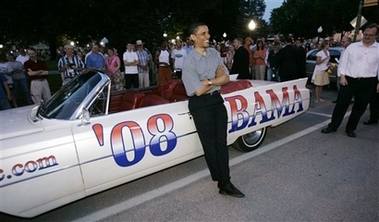
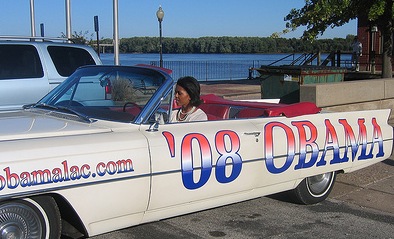
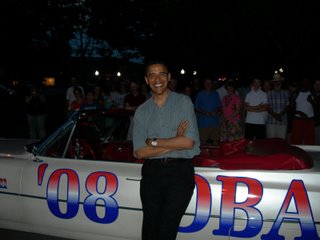
Everything must come to an end and Thursday is the end of the Obamalac. Your Dad has an appointment to have the stickers removed.
* Ah, the Obamalac. I saw it for the first time when my dad, Rich Miller, Sr., showed up for Obama’s 2007 campaign kickoff in Springfield. You can read my first post about the car by clicking here. Some early photos…
* Dad drove his Caddy all over Iowa. Obama himself loved the car…
A video of dad taking one of those Obama photos is here.
Even Michelle got into the act…
She said it reminded her of her dad’s old car.
* Dad’s ride got a lot of press. He was in just about every major newspaper and magazine in the country. The Politico had this item at the end of a story on Obama’s speech to some transcendental meditation types…
Behind him, a man driving a red, white and blue 1963 Cadillac convertible with the word “Obamalac” and “The Time Is Now” carefully stenciled across it was being gently chided by a wiry, smiling meditator.
“The time is now,” the driver said, as he headed out of town.
“But the time is always now,” the local man said.
* Dad eventually became somewhat famous, but he probably realized his place in Illinois politics on election night last year. He was driving the Obamalac up and down Michigan Ave. and several people approached him to say, “Hey, you’re Rich Miller’s dad!”
There’s only room for one Rich Miller in this state, I suppose. And, only one Obamalac.
* We’ll close with a music video featuring the “pre-Obama” version of Dad’s 1963 Cadillac, produced and directed by my brother Devin…
* This has, indeed, been the chatter of late. JBT is mulling a bid for treasurer or comptroller…
Confirming chatter among GOP insiders, former state Treasurer Judy Baar Topinka says she has been asked and is considering running in the 2010 elections, most likely either for her old job or for Illinois comptroller.
“I’m out here scandal free in a state that is fraught with corruption,” Ms. Topinka, 65, said in a phone interview Monday morning. “I have people who are asking me to do this. People in the party, people in my old office. They’re asking me to think about it.” “I really don’t know yet,” Ms. Topinka added. “You could say I am ruminating.” […]
In addition, the Topinka camp recently received results of a poll taken on her behalf. It reportedly shows her with near-universal 87% name recognition — a huge plus — and indictates that her positives have recovered from the pounding they took in the Blaojevich media blitz.
Ms. Topinka Monday said the GOP needs “a little bit of pizzazz” because the party, frankly, “has not had a good run.
* Bob Schillerstrom is also looking at a statewide bid, likely governor. He’s apparently gonna hold his own “tea party” on tax day without calling it such…
DuPage County Board Chairman Bob Schillerstrom is giving suburban residents a chance to address how a state tax increase would impact their families and businesses.
A “Tax Day Speakout” will be held at 6 p.m. April 15 at Ashyana Banquets, 1620 75th Street, Downers Grove. […]
Set to coincide with the IRS filing deadline, “Tax Day Speak Out” encourages residents to share their financial realities and offer their insights into the impact of a tax hike.
…Adding… As several commenters have noted, Schillerstrom strongly supported the General Assembly’s move to increase the sales tax in order to bail out mass transit. One wonders whether this will be a topic of discussion on 4/15.
* State GOP Chairman Andy McKenna says the obvious: the 2006 gubernatorial primary was a waste of money and counterproductive…
Though McKenna stopped short of proposing a slating process for endorsing candidates for statewide office as Democrats have done in the past, he said, “Where possible, both the Republican organizations and donors are going to try to coalesce around candidates they feel can get the job done.”
“Primaries of themselves aren’t bad,” he said. “They’re bad if they become negative and people use it to try to destroy other candidates.”
…Adding… Charlie Cook has published his new “partisan voting index.” Click here to see it. Progress Illinois has put the Illinois data into a spreadsheet and compared pre 2008 election data to post 2008 election data…
Democratic gains in the suburbs and GOP gains downstate.
…Adding More… Halvorson gets her first opponent…
Illinois Republican Henry W. Meers Jr., has filed paperwork to organize a campaign against first-term Democratic Rep. Debbie Halvorson in the 11th District south and west of Chicago.
Meers, a self-described conservative, is a real estate investor and a frequent donor to the Republican Party.
According to CQ MoneyLine, Meers has donated in recent years to the Republican National Committee and to former Rep. Jerry Weller, among other GOP organizations and candidates. He also gave to the 2004 Pennsylvania Senate campaign of then-Rep. Pat Toomey, a conservative who narrowly lost to Sen. Arlen Specter in a Republican primary, and to the 2008 New Mexico Senate campaign of then-Rep. Steve Pearce, who defeated the more moderate Rep. Heather A. Wilson in a primary but then lost decisively to Democratic Rep. Tom Udall in the general election.
Two-thirds of “prominent members of the national news media” believe the Internet is hurting journalism more than it is helping, according to a poll conducted by The Atlantic and National Journal, which surveyed 43 media insiders.
The survey asked whether, “on balance, journalism has been helped more or hurt more by the rise of news consumption online.” Sixty-five percent said journalism has been hurt more, while 34% said it has been helped more.
* The Question: On balance, has journalism been helped or hurt more by the rise of news consumption online? Explain.
* This probably won’t happen. Minority parties have the advantage of just shooting down proposals by the majority. When they put forth their own detailed ideas, then they open themselves up to criticism. And I highly doubt they’ll find many votes in the SGOP caucus for $1.4 billion in cuts to schools…
Republican Sen. Matt Murphy of Palatine argues the GOP’s Senate minority should consider coming up with its own alternative to Democratic Gov. Pat Quinn’s spending plan if it wants to be able to legitimately argue that state government doesn’t need a tax increase.
“I will be honest. I have suggested that (an alternative budget) be done. I don’t know if we’re going to get there or not,” said Murphy, who defended the role of a Senate GOP panel that he co-chaired in proposing $3.4 billion in budget cuts largely involving Medicaid restructuring. […]
[Murphy] also said state aid to schools could be cut another $1.4 billion to its budget level of two years ago. […]
“Personally, I would put (a Senate GOP budget) side by side (with Quinn’s) and say, ‘You know what? This is our vision. This is our way out and we’re willing to say this and we’re willing to put our neck out,’” Murphy said. “Personally, I don’t know what we have to lose that we haven’t already lost, in all candor.”
Voters hate tax increases No doubt. They also love government funding for things like schools. What the Republicans would “lose” is votes in the suburbs.
* Meanwhile, the governor’s plan to give schools just $200 million more next fiscal year and then demand that they provide property tax relief with that relatively small pile of cash ain’t gonna go over well out there…
Gov. Pat Quinn said Friday he was open to proposals for property tax relief to take the sting out of his plan for an income tax hike.
Quinn said on WBBM-AM 780’s At Issue radio program, which airs Sunday at 9:30 a.m. and 9:30 p.m., that he would consider forcing school districts that receive more state funding to in turn provide a break on local property taxes. […]
Quinn was vague about the details of any property tax relief, instead saying that could be worked out with legislative leaders.
Under questioning from reporters, Lisa Madigan said she hasn’t discussed Quinn’s budget with her father. But she did offer some criticism over Quinn’s proposal to increase the state’s income-tax rate from 3 percent to 4.5 percent and triple the current $2,000 personal exemption — a move Quinn says will cut taxes for 5 million middle- to lower-income Illinoisans. […]
“It is very, very difficult to ask people to give the state more money when families themselves are struggling and they’ve seen a reduction in their family incomes,” Madigan said. “It’s just that simple.”
* Sen. Bill Brady, who had real trouble raising money in his last gubernatorial campaign and has some personal wealth, is now in favor of campaign contribution caps…
Republican gubernatorial hopeful Bill Brady is backing campaign contribution limits like those proposed by a government reform commission set up by Gov. Pat Quinn.
Illinois is among only five states that currently have no limits on campaign contributions. One of those states, New Mexico, recently enacted legislation that will impose limits after the 2010 elections.
The problem with contribution limits is that people who want to buy influence find ways around the limits.
Political action committees, which solicit donations and then give to favored candidates, proliferated because of the limits imposed on individuals in the 1974 post-Watergate federal reforms. Wealthy individuals who once might have given large sums to politicians who share their views could no longer do so—leading some of them to use their wealth to run themselves. […]
Donation caps won’t stop corrupt donors and politicians from finding mutually agreeable arrangements. A candidate who can be bought with a generous campaign contribution can also be bought with a generous independent expenditure on his behalf.
Such limits also have a destructive effect: making it harder for candidates to raise money and forcing them to spend more time doing it. Perpetual fundraising is now an inescapable fact of life for members of Congress. It deters some very good people from even trying to run.
The Trib, like myself, says if there has to be a contribution cap then it ought to be the $10,000 cap proposed by Senate Republican Leader Christine Radogno. Tribune: “That would make it easier for candidates to come up with the cash they need to compete (particularly against incumbents) without appreciably increasing the risk of corruption. Even the cheapest politician isn’t likely to be for sale at that low price.” I mostly agree with that, except I’m not sure you can ever find a “magic” level at which graft disappears. Some people can be bought for lunch.
But [campaign contribution] limits will make it harder to buy influence and easier to mount challenges against well-financed incumbents.
Let me make this clear one more time: Congressional incumbents don’t lose in this state unless they’ve been involved in some sort of scandal. Caps have not helped congressional challengers defeat incumbents in this state. Period.
A campaign reform bill that has passed the Illinois House takes aim at contributions that are “all in the family.” The bill applies to donors who one of the state’s constitutional officers appoints to a board or commission. The $2,400 limit for those donors would expand to the donor’s entire household.
Targeted caps might be the way to go. I’m not sure. You?
The goal of the Ohio Redistricting Competition is to demonstrate that an open process based on objective criteria can produce fair legislative districts in Ohio. During the competition, it is our belief that a robust public conversation about the process can occur, leading to the development of the best possible redistricting recommendations for consideration by the Ohio General Assembly.
Ethical, fair redistricting would go a long way towards truly leveling the playing field here.
* Mike Lawrence looks at the allegations against Rod Blagojevich that he schemed to pad his own personal bank account and concludes…
The Blagojevich scandal has prompted calls for such reforms as protecting whistleblowers, diminishing the influence of money in politics and purifying the state purchasing process.
But structural change cannot fully address the creeping corruption that can exploit character fault lines. No individual is perfect, nor is any administration. Honorable politicians are particularly vulnerable to the arrogance of incorruptibility.
The right kind of elected official will recognize the potential for corrosion. He or she will recruit, respect and heed aides and other associates who speak truth and integrity to power. We have had — and still have — such public officials, aides and associates. But we need more.
We also need citizens who value honest government more than a plowed street — citizens who resist the cynicism that permits them to tag all politicians as corrupt and avoid the homework that helps distinguish between the fakers and the true public servants.
I wrote about that willfully blind voter phenomenon in the Sun-Times many weeks ago and named it TII…
Illinois has almost always valued “getting things done” over partisanship, or ideology, or regionalism or whatever. Corruption was part of that “whatever.”
* The Sun-Times has another scoop, and this could be a big one…
Former Gov. Rod Blagojevich’s camp was told last year that U.S. Rep. Jesse Jackson Jr. (D-Ill.) would raise up to $5 million in campaign cash for the ex-governor if he was appointed to President Obama’s U.S. Senate seat, the Chicago Sun-Times has learned. The overture came from at least two members of the local Indian community who approached the Blagojevich fund-raising team last fall, sources say.
Details…
The first came from Rajinder Bedi, a state employee who acted as a conduit to the Indian community for Blagojevich, sources say. Bedi met with the governor’s brother, Robert, to tell him that a longtime fund-raiser and wealthy health care businessman, Raghuveer Nayak, would help organize fund-raising within the Indian community and that Jackson would raise money as well.
Then, at an Oct. 31 planning luncheon at the India House restaurant in Schaumburg, Nayak delivered a similar message to Robert Blagojevich, the Sun-Times has learned. Nayak allegedly identified himself to the Blagojevich camp as a representative of Jackson, sources say.
At some point, signals were crossed in communicating the dollar amounts, though, leaving Rod Blagojevich to believe, according to the criminal complaint against him, that he would be paid $1.5 million should he appoint Jackson to fill Obama’s seat.
But the offer was really supposed to be $5 million raised by Jackson, as well as up to $1 million from the Indian community, sources said.
Jackson has said he met with Nayak about the Senate seat, but has told the Sun-Times in the past: “I pray for him and I am confident I didn’t ask him to do anything that is suggested in the complaint that would violate the law.”
He’d better hope he didn’t.
* The Sun-Times also looks at a $40,000 realtor fee that Tony Rezko allegedly steered to Patti Blagojevich, even though Rezko wasn’t directly involved with the property. Here’s the timeline…
• • On Dec. 30, 2003, a company called 1101 W. Lake LLC — owned by developer Sean Conlon and two partners — sold two floors of the building for $1.36 million to a company called Lake & Aberdeen LLC.
• • Lake & Aberdeen was headed by Brian F. Hynes, a Chicago lawyer and lobbyist who had done legal work for Rezko.
• • Another Lake & Aberdeen owner was Kevin F. Flynn. At the time, Flynn was chief executive of Emerald Casino Inc., the company that had been seeking final state approval to build a casino in Rosemont.
• • Around the time of the alleged payment to Patti Blagojevich in January 2004, Rezko held an option to lease a hotel site in Rosemont that could have become a gold mine if a Rosemont casino was built.
• • Also around the time, Flynn’s company was at odds with state gambling regulators, who accused Emerald of having ties to organized crime that ultimately would help scotch Emerald’s casino plans.
So Flynn potentially stood to gain if the Illinois Gaming Board changed course and dropped its objections to Flynn’s company. And Rezko potentially stood to gain had a casino gone to Rosemont.
Congressman Danny Davis lobbied for a Senate appointment last fall - before then-governor Rod Blagojevich was arrested for, among other things, allegedly trying to profit from that appointment.
Now Davis is mulling a run in next year’s election for Senate, and he compares the decision to a battle with nature.
DAVIS: You know, you may want the honey. But are you willing to walk into a bee hive to try and get it? [laughs]
I cannot believe that Davis would actually make this run. He’s also talking about possibly running for county board president, so maybe he is looking at moving on, or maybe he’s just musing. Thoughts?
Gov. Pat Quinn is set to attend a brief public question-and-answer session at Harper College in Palatine Monday before heading to a fundraiser in his honor in Hoffman Estates.
At Harper, Quinn’s expected to address the state budget, his proposed income-tax increase, the ethics-reform package aimed at rooting out political corruption and the proposal to allow community colleges to offer four-year degrees, said Harper spokesman Phil Burdick.
The 15-minute question-and-answer session is scheduled to start around 4:30 p.m. at the student center - Building A at the campus at Euclid Avenue and Roselle Road - and is open to the public.
Last month, Quinn appointed former Army Capt. Jon Monken as director of the State Police. There has been some criticism of the choice, with some lawmakers saying that Monken lacks civilian police training.
Quinn on this week again backed his decision of appointing Monken while calling for reforms with in the State Police. He says Monken is looking into a backlog of forensic tests and the agency’s alleged failure to comply with Freedom of Information Act requests. The backlog was found after a scathing audit.
As for a timetable to get through the backlog of forensic tests, Quinn said, “as quickly as we can,” adding that the state “has a lot of problems.”
Poor Pat Quinn. As if our new governor weren’t busy enough sorting through the rubble left behind by his predecessor, now the federal government is forcing him to mediate the eternal Chicago vs. Downstate feud.
I’m referring to the new state quarters. Having just run a popular, decade-long series of 50 commemorative quarters celebrating the 50 states, the U.S. Mint — in one of those spectacular failures of imagination that define our government — is going to redo the whole thing again, beginning in 2010, this time picking a “national site” in each state after inviting that state’s governor to recommend a location deserving of honor.
By that measure, Quinn should nominate Wrigley Field — historic, beautiful, it would look good on the back of a coin. But elsewhere in the mint criteria “sports” are specifically excluded, and, anyway, Downstaters would howl that Wrigley isn’t exactly natural, and lobby for some spot like Starved Rock — that would sure look impressive next to the Grand Canyon.
The old quarters allowed for compromise — Wisconsin’s design of an ear of corn, a wheel of cheese, and a cow basically covered every working adult in the state. With locations, it’s harder. I suppose Quinn could suggest a split design, with some noteworthy Downstate feature — they must have a mound, or a cave, or something they’re proud of — on one side, and the Chicago River on the other. Sure, it’s a compromise, like last time, but if the mint can repeat itself, so can we.
Governor Pat Quinn says customers in Illinois who buy natural gas from alternative suppliers will now get a “fair shake”. The governor signed a bill into law Friday that protects consumers who enter into those contracts. Still, Attorney General Lisa Madigan says there have been thousands of complaints from people about these companies.
MADIGAN: I would warn people, as I would with any type of service, be careful before you sign any contract. Read it, learn more information, if somebody shows up at your door and says, ‘You need to do this,’ no, you don’t.
Madigan says alternative natural gas suppliers often say they can offer consumers better rates. The new legislation prohibits these companies from giving false information to customers. It also gives people multiple chances to cancel their contracts if they’re unsatisfied with the service.
But the U of I has lost about 13 percent of its annual state funding since the high-water mark in 2002, making planning four years in advance difficult, Kangas said.
“To protect themselves the universities have started moving toward fees,” Bost said. “It’s sad, and I can’t agree with it. But it’s awful difficult to criticize them for doing that when they’re trying to survive but the legislature’s undermining them.”
State Rep. Shane Cultra, R-Onarga, cast one of six dissenting votes when the “truth-in-tuition” law passed out of the House in 2003. He said the law would force schools to err on the high side when looking at tuition increases.
“The university doesn’t know what their reimbursement from the state is going to be, what their expenses are going to be.” Cultra said. “From a student standpoint, maybe it makes sense. But looking at it from the university’s standpoint, they don’t want to get stuck with huge increased costs and not be able to raise tuition.”
Any young person under age 26 whose parents have a health insurance policy that allows for dependent coverage. There’s an important caveat: The young adult can’t be married.
Any young person under the age of 30 whose mom or dad served in the military. The young person must live in Illinois and be unmarried.
For two years, state Rep. Renee Kosel has been trying to pass a law setting minimum age and driving requirements for cab drivers. The city of Chicago has fought her efforts.
Improvement of the Greater Kankakee Airport for $2 million; expansion of a new Kankakee Community College training program in energy technology for $876,000; another $1.5 million for a wind energy facilities for the Kankakee metropolitan sewage treatment system; $600,000 to upgrade the public water system for the south side of Momence.
They’re all among more than $420 million in appropriations requests made by U.S. Rep. Debbie Halvorson, D-Crete, for her 11th Congressional District.
Requests specific to The Daily Journal circulation area include:
* Fiat-Chrysler alliance good for Belvidere, experts say
Analysts say a Fiat-Chrysler alliance would be good news to workers in Sterling Heights, Mich., and Belvidere. Those two plants, and one in Toluca, Mexico, are the only ones out of Chrysler’s 12 assembly plants set up to build medium-sized cars.
Among the Chicago area’s largest publicly traded companies, Motorola Co-CEO Sanjay Jha stands to reap by far the highest public-company CEO payout in the United States — $104.4 million — if he can turn around the Schaumburg-based company’s iconic cell-phone business and take it public as a separate company by Oct. 31, 2010.
The next highest-paid CEO in the Chicago area is Robert Lane of Deere & Co., at $21.8 million, or about one-fifth that of Jha.
Meanwhile, Motorola has announced layoffs of 7,000 people since late last year, including 3,000 in the cell-phone division, while Deere has announced it is laying off several hundred workers amid a slowdown in its construction and forestry sales.
While workers are often the first to feel the impact of the economy, executive compensation generally shrinks when company shares take a hit, since the bulk of most CEOs’ pay is based on the company’s performance.
The subpoena was revealed in a court document filed Thursday with the U.S. Bankruptcy Court in Delaware. Tribune Co. filed for Chapter 11 bankruptcy protection in Delaware on Dec. 8.
Thursday’s document asked a judge to permit Jenner & Block, Tribune Co.’s legal firm, to expand its scope to help cover the Department of Labor’s request. Jenner & Block has retained by Tribune Co. to represent the owner of the Chicago Tribune on certain litigation matters.
On March 2, the Department of Labor issued a subpoena asking Tribune to produce documents related to its employee stock ownership program (ESOP). The Department of Labor made the request as part of an on-going investigation under the Employee Retirement Investment Income Securities Act (ERISA), according to Thursday’s court filing.
The requested documents were turned over to the Department of Labor on March 31.
Tribune’s ESOP had a central role in buyout engineered by Mr. Zell. The commercial real estate billionaire crafted a complex transaction that would create an ESOP that would become the sole owner of Tribune Co. The deal saddled Tribune Co. with $8.4 million in new debt while avoiding corporate taxes.
Growing fruit in one state and selling it in another could put the Gundersens in the path of new federal regulations proposed by several food safety bills under consideration in the House. One of those bills, called the Food Modernization Act, would create a new Food Safety Administration with power to inspect and regulate food establishments.
Aides to the bill’s sponsor, Rep. Rosa DeLauro, D-CT, say small growers wouldn’t be affected by the bill because its focus is to ensure the safety of food sold across state lines. But even though the Gundersens’ business is small, they don’t fall into that category.
Harold Gundersen fears the bill could pile more regulations onto a list he says is already lengthy.
“We’re highly regulated by state government and federal government,” he said. “I can’t buy chemicals without a license. There are also days to harvest. Everything is regulated that we do.”
City Hall, Cook County Board, and Local Politics Round-UP
Mayor Richard Daley and his wife did not make nearly as much money in 2008 as in past years because Maggie Daley did not work, according to the tax return released Friday by the mayor’s office.
The Daleys’ net income was $183,992, down from $238,190 in 2007 and $363,647 in 2006. The majority of their income for 2008 was from the mayor’s city salary, with about $15,000 earned on investments, according to the tax return.
Maggie Daley stopped working in 2007, Daley spokeswoman Jacquelyn Heard said. She had been paid $50,000 in 2007 and $100,000 in 2006 as a consultant for the Academy of Achievement, a Washington-based non-profit, scouting locations for the academy’s annual conferences of outstanding graduate students.
Last month, the mayor’s office acknowledged the Daleys had traveled on a private jet belonging to EduCap Inc., another non-profit that provides funding for the Academy of Achievement. The Internal Revenue Service and Congress are investigating EduCap, which loans money to students.
The Daley administration cited tough economic times when it canceled $55 million in contracts with 11 public relations firms last month — on the same day the Sun-Times reported that City Hall had signed a new, $5 million PR contract to supplement the city’s in-house army of media handlers.
Days after those contracts were canceled, the Chicago Housing Authority — a separate government body — hired one of those firms, MK Communications Inc., owned by longtime Democratic strategist Marilyn Katz.
Four years ago, City Hall revoked the permit and issued a stop-work order. That was amid opposition from businesses in the Kinzie Industrial Corridor and allegations that Cedicci had attempted to curry favor with city officials involved in the permitting process.
The foundation and 1.5-story building have sat unfinished ever since.
Two high-ranking city officials resigned after acknowledging they accompanied Cedicci and his brother on a 2005 trip to Rio. Two other bureaucrats with apparent knowledge of the trip also resigned.
The project would have been the first residential intrusion in Chicago history in a planned manufacturing district.
The City of Pekin has adopted a back-door approach to enforcing the state’s smoking ban from neighboring municipalities that have used it with mixed results.
* Parking meter samaritan caught in middle of … crime?
“Well officer, I’m putting quarters in these parking meters and it’s making her mad,” I said in even tones, pointing to the PEA.
“He’s following me down the street and feeding other people’s meters and harassing me,” the PEA shrieked at the three officers who showed up.
After five to 10 minutes of questions, being patted down, emptying my pockets, explanations, and being scolded, the three police officers told me to essentially . . . take a walk.
The cops actually seemed more pissed off at the PEA, who from what I could tell, had radioed in a call of a city employee in distress or being attacked or something like that. Obviously, the police officers had better things to do than referee a sidewalk legal debate between an angry PEA and some self-styled doofus Robin Hood trying to keep a few cars from being ticketed.
Cricket Communications Inc. has signed a 10-year agreement to lease the CTA’s wireless communications infrastructure in the Red Line and Blue Line subways, CTA officials will announce Monday. The transit agency will be paid $22,250 per month by Cricket, officials said.