Thursday, Oct 20, 2011 - Posted by Advertising Department
[The following is a paid advertisement.]
ComEd/Ameren: “SB1652 has consumer protections like a 2.5% rate cap.”
SB1652: The cap applies to a customer’s entire bill (generally comprised of 70% energy costs and 30% delivery costs). With energy costs expected to decline over the next two years, ComEd and Ameren will have more room to increase the delivery charge and still remain under the cap. (Pages 101-103)
ComEd/Ameren: “SB1652 does not guarantee utility profits.”
SB1652: The utilities’ profits are tied to an automatic formula that is based on 30-year Treasury bonds which are at historic lows. As Treasury bonds increase, so do ComEd and Ameren’s allowed profits. (Page 82)
ComEd/Ameren: “SB1652 will create jobs.”
SB1652: ComEd and Ameren may charge ratepayers millions in severance costs for laying off workers. (Page 83)
ComEd/Ameren: “SB1652 will hold the utilities accountable for their performance during extreme weather events.”
SB1652: ComEd and Ameren may each exclude 90 of the worst storms over the ten year program when calculating performance. (Page 97)
ComEd/Ameren: “SB1652 is about smart grid.”
SB1652: The utilities may recover money from ratepayers that has nothing to do with smart grid including executive bonuses, pension packages, workforce reduction costs, and storm expenses. (Pages 82-87).
The five new ones would operate in Chicago, South Cook County, North Suburban Lake County, Rockford and Danville. The governor said the ultimate locations should be determined by the Illinois Gaming Board, not by the General Assembly.
As a commenter pointed out last night, how can the governor insist that the Gaming Board should be the one to pick all the new locations and in the same breath say he wants to specifically name Danville and Rockford in the expansion legislation? And, of course, he’s OK with naming Chicago in the bill, too. There was no specification of the location of the south suburban casino, other than it had to be in the south suburbs, so there’d be no change if a Quinn-approved bill actually became law.
That just leaves the proposed Park City casino in Lake County, which is specified in the bill. Is the governor being hypocritical here? Or, maybe he’s just taking a not so subtle shot at Sen. Terry Link, who has been tied to a potential Park City casino owner. I’m betting he’s taking the shot while hoping nobody notices the hypocrisy.
* The Illinois Radio Network has a story about Gov. Quinn’s top priorities for the veto session. Number one is killing the legislative scholarship program, two is addressing the Smart Grid issue and here’s number three…
Quinn said lawmakers must come up with a gambling expansion plan. While there is legislation to expand gambling that passed in the House and the Senate, Quinn says if it makes it to his desk in its current form, he’ll veto it.
It literally took the General Assembly decade to devise the current plan, which Quinn has vowed to veto. Crafting and then finding the votes to pass a new plan without slots at tracks, that requires local “opt-in” for video gaming, bans campaign contributions from the gaming industry, etc. all within the next three weeks is gonna require a legislative miracle.
What Link and Lang may end up doing in the alternative is to write a “trailer bill” that would address some of Quinn’s concerns of about industry oversight, while keeping intact the slots-at-the-tracks provisions, and pass that along to Quinn. (Or, as Lang put it just now, “ram it down his throat.” Yes, things are getting a little tense here.)
[State Sen. Dave Koehler, D-Peoria] said he also is concerned that Quinn had not fully engaged with lawmakers to find an acceptable compromise bill that could be passed.
That alone could mean that things are “back to square one,” said state Rep. David Leitch, R-Peoria.
[Tim Bollman, general manager of Wild Rose Casino and Resort] had some good news to report. Illinois Governor Pat Quinn announced he would not support a bill that would expand gambling in Illinois without significant changes. Quinn said that certain bill provisions, such as allowing slot machines at race venues, would have to be removed under threat of veto.
Bollman said that adding slot machines to race tracks in border cities could potentially lure a percentage of the Wild Rose’s client base away.
* But the Illinois attorney general is supportive…
Attorney General Lisa Madigan said she was concerned from the beginning about the “enormous expansion” of gambling in Illinois.
“In order to expand gaming at any point you have to make sure you have the resources and the structure in place to ensure that you’re not ending up with a greater criminal element involved and that’s always been a priority of mine and I’m glad the governor took the time to look at this,” Madigan said.
Indiana’s reliance on casino gambling might not be so apparent in northeast Indiana, but it goes far beyond the service-sector jobs in communities where Indiana’s 13 casinos are found. Casinos generated more than $860 million in tax revenue last year, about 5 percent of all state tax revenue.
Five percent of all state revenues? That’s huge. By contrast, Illinois casinos comprise a little over 1 percent of state revenues. And a very big percentage of that Indiana money is coming across state lines from Illinois.
* Illinois wouldn’t keep all that money home, however, even if it somehow does manage to build Chicago and south suburban casinos. Gamblers like to smoke. Look at what happened in Illinois after the smoking ban took effect compared to surrounding states…
“In the Chicago region, Illinois’ four riverboats (aggregate gross revenue) totals have fallen a combined $472.5 million,” or a minus 35.5 percent since the state passed a ban on cigarette smoking, “while Indiana’s four Chicago-area riverboats have actually increased by $6.6 million or 0.6 percent during this same time frame,” according to the report.
* Mark Parent as the new White Sox bench coach with Jim Thome as a possible hitting coach and an extension of Mark Buehrle’s contract? AJ’s rally beers? Will the Cubs unveil Theo Epstein as their new president of baseball operations tomorrow? And how about that World Series team just across the river?
That’s certainly more than one question, so just consider this a baseball open thread.
* 12:18 pm - From an Illinois Department of Employment Security press release…
The September seasonally adjusted unemployment rate in Illinois ticked up to 10 percent despite the addition of +1,600 new jobs, according to preliminary data released today by the U.S. Bureau of Labor Statistics and the Illinois Department of Employment Security (IDES). […]
In September 2011, unemployed individuals increased +10,500 (1.6 percent) to 663,300 compared to August. Total unemployed has declined -76,800 (-10.4 percent) since January 2010 when the state unemployment rate peaked at 11.2 percent.
* Unlike the rest of this year, government layoffs weren’t much of a factor. According to IDES, the same number of people were employed by state and local governments in September as in August. The year-over-year numbers are pretty astounding, however. Government employment is down 13,200 when compared to September of last year, far more than the 2nd place category, “Information,” which is off by 4,300.
The biggest month-to-month drops were in construction (3,000), financial activities (1,800) and information (1,200).
A Hollywood producer testified in federal court Thursday morning that a Springfield power broker told him his business with the state had been put on hold because he hadn’t contributed to then-Gov. Rod Blagojevich’s campaign fund.
Producer and businessman Tom Rosenberg said his firm, Capri Capital, did not initially get the $220 million in state teachers’ pension fund business it was slotted to get.
When he asked Springfield millionaire William Cellini about it, Cellini told him he had angered Blagojevich fund-raisers Tony Rezko and Chris Kelly by not kicking in to the then-governor’s campaign fund, he said.
“Bill told me that Rezko and Kelly said it would not go forward until Capri made the appropriate (contribution),” Rosenberg testified. “He was telling me why it was stopped and it would be stopped until money was contributed to (Rod) Blagojevich.” […]
The testimony combats Cellini’s contention that he was an unwitting participant, or “the ham in the ham sandwich” in the alleged extortion scheme. Cellini is on trial, accused of conspiring with board member Stuart Levine, Rezko and Kelly to extort Rosenberg.
Assistant U.S. Attorney Christopher Niewoehner then asked Rosenberg how Cellini reacted to his ire.
“He was nervous,” Rosenberg quickly responded over the objection of Cellini’s attorney but then was allowed to continue. “I interpreted his voice as nervous.”
Stu Levine has testified that he asked Cellini to deliver a message to Rosenberg about the planned shakedown, and then Rosenberg essentially testified today that he got that message. The defense is cross-examining Rosenberg as I write this, but they’d better poke some big holes in Rosenberg’s story or Cellini could very well be doomed. I’ll let you know what happens.
Prior to the start of the direct examination of Rosenberg, Terry Gillespie (of Gillespie and Genson) questioned Rosenberg out of the presence of the jury, a practice Judge Zagel employs frequently to decide whether and how to limit testimony of witnesses, in accord with the Federal Rules of Evidence.
Tom Rosenberg was questioned by Gillespie with regard to six telephone conversations Rosenberg had with Bill Cellini, which were the only communications the two had during the relevant time period [2004]. Rosenberg testified that at the time of each call he never felt that Cellini was trying to cause him economic harm. Gillespie will not be able to ask that type of question, which calls for a legal conclusion, in front of the jury this morning. However, he may be able to come close. If Gillespie succeeds in asking similar questions and getting similar answers, the result may be “game, set and match,” for Mr. Cellini.
* But Judge Zagel has limited the defense’s questions to the extent that Cellini’s lawyers asked for a mistrial yesterday…
Cellini’s lead lawyer, Dan Webb, asked for a mistrial after U.S. Judge James Zagel refused to allow Webb to question Levine about statements Levine made in the Rezko trial.
Federal prosecutors contend Cellini relayed to Rosenberg that he would be expected to make a campaign contribution in order to get TRS funds to invest.
Webb said he believed Levine had contradicted himself in Cellini’s trial compared with testimony Levine gave in Rezko’s trial. Webb said Levine told the jury in Rezko’s trial that no one, including Cellini, directly asked Rosenberg for a $1.5 million political contribution to then-Gov. Rod Blagojevich in May 2004, when the conspiracy was being hatched. […]
“Their (the prosecution’s) theory is that Cellini’s purpose was to deliver … a message … that I would characterize as a ‘that day will come’ message,” Zagel said. “You can argue about whether he delivered the ‘that day will come’ message.”
Whether Cellini thought he delivered the message or not, today’s testimony indicates that Rosenberg received it.
Stay tuned.
…Adding… Let’s do the ScribbleLive thing to keep us updated as it goes along. As always, BlackBerry users click here. Everybody else can kick back and watch…
The proposal, which leaders want to push during the veto session that starts Tuesday, would rewrite state law to tax the exchanges only on trades or sales that occur in Illinois, said Senate President John Cullerton. Today, they must pay taxes on all trades, regardless of where the seller or buyer is located. The proposal thus would exclude the many electronic trades that pass through the exchanges from out-of-state parties.
“We’re close,” Mr. Cullerton, a Democrat from Chicago, said in an interview. “They make a strong argument for a correction. Now, it’s just a matter of it’s highly technical and we’re just trying to figure out a way to attribute the sales.”
Nonetheless, Mr. Cullerton said that there’s no agreement with CME yet because it’s not clear yet what the amount of the tax reduction might be.
CME Executive Chairman Terrence Duffy has contended his company pays more in Illinois corporate taxes than any other, including larger ones such as McDonald’s Corp. and Boeing Co., shouldering a disproportionate 6% share of total receipts. The issue came to a head when the state increased the corporate tax rate earlier this year to 7% from 4.8%, boosting CME’s annual expense by $50 million, he said.
The other question would be how this impacts the state budget, which is in better shape than last year, but still far from great. Then again, if CME and CBOE did follow through on their threats, the budgetary impact would be traumatic. Still, are the companies going to make any new Illinois investments in exchange for a break? That’s usually part of any deal.
* Of course, it would also help if the governor and the mayor were on better terms. For instance…
They’re at it again.
After United Auto Workers announced Tuesday that employees nationwide had outvoted local workers and approved a new Ford Motor Co. contract, Mayor Rahm Emanuel and Gov. Pat Quinn staked their claim to the resulting 1,200 jobs in Chicago — in separate statements. […]
When the Ford jobs initially were on the table before workers ratified the deal, Quinn appeared cool to Emanuel’s celebration. Quinn publically said it wasn’t a big deal who gets credit, but his staff clearly wasn’t thrilled that Emanuel jumped out in front of the news.
A carpenters’ union has a tentative accord with the city of Chicago over labor reforms at McCormick Place, but no deal has yet been struck with Gov. Pat Quinn.
“We have an agreement with the city of Chicago and Mayor Emanuel, and we continue our discussions with Gov. Quinn,” a spokesman for the Chicago Regional Council of Carpenters confirmed Wednesday.
Mr. Quinn’s office was not immediately available to comment..
* In a related story, despite Sears’ well-known financial problems, the company claims that at least 15 states besides Illinois have offered incentives to move its headquarters and its 6,000 jobs from Hoffman Estates. And the company is pushing back against the naysayers…
Sears insisted that its balance sheet is strong and it generates significant cash. As with most retailers, an overwhelming bulk of its business happens in the fourth quarter, Brathwaite said. […]
Despite its financial problems, Sears Holdings still ranks No. 52 on the Fortune 500 with more than $43 billion in revenues reported in fiscal year 2010. Sears employs about 6,100 people at its Hoffman Estates headquarters and 20,000 statewide. Its 1992 relocation invested about $200 million into local infrastructure and aided in the development of the Prairie Stone region, Brathwaite said.
Sears also is a major taxpayer in Illinois, to the tune of about $213 million last year and billions over the last 20 years, Brathwaite said.
“We’re an economic development engine for local businesses, with 9,000 in-state vendors, 30,000 hotel nights and meals, and 18,000 plane tickets in and out of O’Hare (International Airport) for visiting associates alone, with 100,000 people visiting our campus every year,” Brathwaite said.
Illinois hasn’t exactly encouraged its employers to stay home. An income tax hike and an appalling failure to deal with the state’s massive debt — starting with its pension obligations — make moving a more attractive option. Sears is going to weigh its costs. One factor in Illinois’ favor is that Sears, like any business, will calculate the cost of business interruption and attrition of its talented workforce against the benefits of incentives being dangled by other states. There is a home field advantage.
Sears says it must know soon where Illinois stands. We understand that. This competition will move forward, with or without Illinois. The local governments should be negotiating with the state and each other on the terms of a new EDA. This matter can’t drag.
Don’t ram this down the throat of the local schools, though. That’s hardly the neighborly thing to do.
The Illinois Supreme Court let stand a decision by the Quinn administration to take away the property tax exemption of the Downstate retirement community affiliated with a Lutheran social services agency.
In a little-noticed case, the court has declined to hear the appeal of Meridian Village Assn., a 100-unit development that opened in 1999 in Glen Carbon, about 20 miles east of St. Louis.
Meridian, which was seeking to avoid paying about $161,000 in property taxes in 2000, provided just $30,000 in financial assistance to residents, according to an order issued earlier this year by Illinois Appellate Court in Mount Vernon. The appellate court ruled that the development was not entitled to tax-exempt status either as a charitable or a religious institution, upholding the position of the Illinois Department of Revenue.
The case is another example of how the department — and local officials — are taking a hard-nosed approach to property tax exemptions for non-profits. Operations providing minimal charity are especially vulnerable to losing their tax-exempt status. The state supreme court’s decision is particularly a warning to non-profit hospitals and other health care providers, which are battling in the courts and in the Illinois General Assembly to maintain the long-held benefit, which is possibly worth millions of dollars a year.
* Related…
* North Chicago mayor hopes Abbott breakup isn’t another Hospira: North Chicago Mayor Leon Rockingham Jr. said he hopes a split doesn’t mean that one company will leave, recalling that Hospira Inc. took its operation, along with hundreds of jobs, to Lake Forest after it spun off from Abbott in 2004.
* Ford deal OK’d that brings 2,000 jobs to Chicago
* The AP’s series on the state’s overdue bills continues today…
The Illinois Department of Corrections insists its failure to pay its bills on time isn’t creating any safety concerns inside state prisons. But documents show a department executive warned of “a big problem looming” if a food supplier halted deliveries.
“I am fearful at some locations we won’t be able to meet the food needs of the population. To an inmate, food is the most important part of the day, so this obviously would create huge security concerns,” Bryan Gleckler, the department’s chief financial officer, wrote in a June letter that was obtained through the Freedom of Information Act.
The state soon coughed up part of the $2.5 million it owed the supplier, MJ Kellner Co. of Springfield, and Gleckler now plays down the safety concerns. He said the department tries to keep enough food on hand to keep providing meals even if deliveries are cut off.
As of Sept. 8th, the Illinois comptroller’s office had $39.3 million in Corrections-related bills that it hadn’t yet paid. That’s bad enough, but check out this item on the list…
Interest on overdue bills: $2.3 million (5.8 percent [of total])
We’re even late on paying the interest on overdue bills?
Sheesh.
* Quad Cities Online has a handy tool for taking a look at Illinois’ list of overdue bills. The state has 166,002 overdue bills for about $4.9 billion, according to the site. I broke that down by amount owed out of curiosity.
There are, for instance, about 169,000 overdue bills on the books for less than a million dollars. Total all of them up, and you get $1.8 billion.
REGIONAL TRANS AUTHORITY… $306,335,651.20
UNIVERSITY OF ILLINOIS… $298,713,296.07
CHICAGO DIST 299… $245,231,291.81
TEACHERS RETIREMENT SYSTEM SPRINGFIELD… $180,810,081.30
STATE UNIVERSITIES RETIREMENT… $109,707,083.00
STATE EMPLOYEE RETIREMENT SYST… $74,970,220.00
SIU CARBONDALE - PAYROLL CLEAR… $55,605,902.76
CHICAGO CITY TREASURER … $50,027,005.73
HELP AT HOME INC… $48,101,966.81
Help at Home, Inc. isn’t the only business on the bigtime past due bills list. Addus Healthcare is owed $34 million, for instance, and Harmony Health Plan of IL is owed more than $27 million.
* My point here is that perhaps the state could fashion a borrowing plan to pay off either the smaller bills, which are owed to a lot of not-for-profit service agencies and for-profit companies, or it could design a plan to provide immediate relief to all non-governmental entities. Yes, this would be unfair to the RTA, the U of I, etc., but these overdue bills are a significant drag on the Illinois economy.
Borrowing is not popular, to say the least, but a relatively small borrowing plan to pay off some of the state’s overdue bills coupled with some negotiated budget cuts could do wonders for thousands of Illinois businesses and help boost the economy.
Rep. Bobby Schilling is being asked to “lay low’’ after an online threat that offered a $75,000 reward for his assassination exploded across the Internet, a Quad Cities TV station reported late Wednesday.
The Colona Republican learned about the threat via a Google alert Tuesday night. It’s being investigated by Capitol police and the FBI, WQAD-TV reported.
“I’m supposed to kind of lay low, not really go out in public,” Schilling told the station.
The email states: ‘’I will pay $75,000 for ASSASSINATING Illinois Congresswoman (sic) Bobby Schilling and any US Congressman, US Senator and FBI, CIA and NSA DIRECTORS and their FAMILY MEMBERS regardless of their age.’’
Schilling said he’s been told that the California man making the threat has a history of this type of behavior.
‘’I’m pretty concerned. My wife is very concerned. It’s a general threat to all members of Congress, but they specifically called my name out in the threat,” he told the station.
By using that quote in the article, I was able to find similar online threats made by this nutball. The Schilling threat appears to have been deleted [UPDATE: Here it is], but there are others, including one against Congressman Joe Walsh, which has also been taken down.
* Most of the state’s Republican delegation has been threatened by this guy, using the same, exact message…
I will pay $75,000 for ASSASSINATING Illinois Congresswoman Donald Manzullo
and any US Congressman, any US Senator and FBI, CIA and NSA
DIRECTORS and their FAMILY MEMBERS regardless of their age.
BOMB AMERICAN FEDERAL BUILDINGS, INFRASTRUCTURE and KILL FBI, CIA, DNI and
NSA DIRECTORS
I CHALLENGE all readers to email my THREAT to FBI, CIA, NSA and
Secret Service and get me arrested…….FBI TRANSVESTITES will NOT
arrest me because of this reason.
This is my profile at FBI, CIA and NSA
http://groups.google.com/group/alt.privacy/msg/6212b297461a5bc0?hl=en
You MORONS………just listen to me…….Everything mentioned in the
following document is REAL and FBI, CIA and NSA had this technology for more
than 20 years……..
TORTURE BIBLE of FBI, CIA and NSA
Covert Operations of NSA- Mind Control and Directed Energy Weapons
http://www.scribd.com/doc/25664429/Conspiracy-Mind-Control-Covert-Ope…
I doubt that any of the congressmen have much to worry about, but it’s unnerving that somebody like this is walking around free. Let’s be careful out there.
…Adding… More searches have turned up additional threats against the rest of the state’s GOP delegation. He’s also threatened lots of others.
Thursday, Oct 20, 2011 - Posted by Advertising Department
[The following is a paid advertisement.]
Much of the focus of electric grid modernization has been on jobs and consumer benefits. But did you know that Senate Bill 1652 is also a roadmap for a greener future for Illinois?
Here’s how.
SB 1652…
1. Increases energy efficiency resources available to consumers.
Today, energy efficiency programs save residential customers $95 million annually. SB 1652 will increase those programs by at least another 10 percent.
2. Creates incentives for small-scale generation.
Today, owners of small-scale solar generating systems are unable to bid their power back into the electric grid. SB 1652 changes this by carving out 1% of the existing 6% state solar requirement for small scale generation. This improves the economics for rooftop or other types of consumer-driven solar generation.
3. Provides the platform necessary for the coming electric vehicle revolution.
Widespread use of electric vehicles simply can’t happen without a modern electric infrastructure.
4. Creates a Science and Energy Innovation Trust.
SB 1652 requires the utilities to contribute $20 million for the creation of Science and Energy Innovation Trust, which supports green energy efficiency-based technology startup companies.
For more information on all the benefits of grid modernization through SB 1652, visit www.SmartEnergyIL.com.
* The Paul Simon Public Policy Institute at SIU has some new statewide poll results. They poll every year. Let’s start with right track, wrong track…
Fewer than one in five voters in the Simon Poll (19.2%) said they thought things in the country were going in the right direction, down significantly from the three in ten (30.2%) who said so in 2010.
Perception of the direction of the state may have bottomed out. Only 14.9% said Illinois was heading in the right direction, statistically equivalent with last year’s 12.2% “right direction” response.
Interesting that national right track has cratered here while state right track has risen ever so slightly. Back in 2008, for instance, the Institute’s poll showed state right track at 12.4 percent.
You might think the national right track decline could be the result of President Barack Obama’s decline. Obama’s Illinois job approval rating is 51.8 percent, essentially identical to his Illinois approval rating in the Institute’s poll a year ago. That’s pretty much the same as a We Ask America poll taken a few weeks ago.
* Gov. Pat Quinn’s approval rating is 35.5 percent. That’s more than 5 points higher than the recent We Ask America poll, which had him slightly below 30 percent, but still close enough to essentially validate both results. The Institute didn’t poll Quinn’s job approval last fall, so there’s no way to measure his change over time in this particular category. But 35.5 percent is about where everybody has had Quinn for well over a year. Quinn’s approval rating in the Institute’s October, 2009 poll was 66.5 percent.
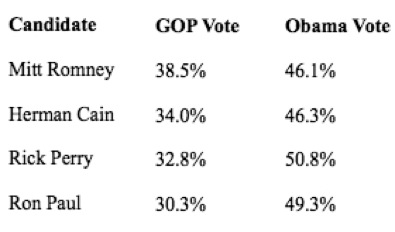
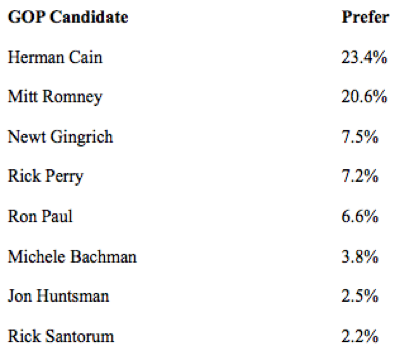
* Now, as you know, I don’t usually do national stuff, but I thought you’d like to see the rest of these numbers. As always, do your very best to avoid bumper sticker slogans and, please, eschew regurgitated DC talking points in comments. Presidential head-to-heads…
“You could look at this as being uncomfortably close for the president in his home state,” said Simon Institute Director David Yepsen. “On the other hand you could say Obama is holding up fairly well in Illinois, given the difficult year he has had politically and the continued poor performance of the economy.”
* Compare those results to a recent We Ask America poll and there are some differences…
[Obama had] 50 percent vs. former Massachusetts Gov. Mitt Romney’s 35 percent. Other match-ups look similar: Obama 52 percent vs. Texas Gov. Rick Perry’s 30 percent; Obama 53 percent vs. businessman Herman Cain at 30 percent; and Obama 53 percent vs. New Jersey Gov. Chris Christie at 34 percent.
The We Ask America poll was conducted September 28 and Oct. 2. The Simon Institute poll was conducted Oct. 11-16. The Institute’s poll has apparently captured the national Cain surge. However, the Institute’s poll has Obama doing worse against the Republicans than he WAA’s poll. He’s under 50 in all but one Institute poll, and over 50 against everybody in the WAA poll. Then again, the numbers are not hugely different, so we could be looking at noise and methodology differences here. WAA does robopolling, for instance, while the Institute uses humans.
Keep in mind that self-identified Republicans are a fairly small percentage in this state, so the margin of error is going to be quite high for that subset on a total polling universe of 1,000 registered voters.
* Also, in case anybody wants to know, the Simon Institute didn’t use taxpayer dollars to conduct this poll.
* How about a caption contest? This is Joe Walsh. No, not the freshman congressman. This is the Joe Walsh we all knew before last year’s election pushed that other Joe Walsh into our brains…
Do your very best to keep your answers Illinois-centric, please. Thanks.
Wednesday, Oct 19, 2011 - Posted by Advertising Department
[The following is a paid advertisement.]
ComEd/Ameren: “SB1652 has consumer protections like a 2.5% rate cap.”
SB1652: The cap applies to a customer’s entire bill (generally comprised of 70% energy costs and 30% delivery costs). With energy costs expected to decline over the next two years, ComEd and Ameren will have more room to increase the delivery charge and still remain under the cap. (Pages 101-103)
ComEd/Ameren: “SB1652 does not guarantee utility profits.”
SB1652: The utilities’ profits are tied to an automatic formula that is based on 30-year Treasury bonds which are at historic lows. As Treasury bonds increase, so do ComEd and Ameren’s allowed profits. (Page 82)
ComEd/Ameren: “SB1652 will create jobs.”
SB1652: ComEd and Ameren may charge ratepayers millions in severance costs for laying off workers. (Page 83)
ComEd/Ameren: “SB1652 will hold the utilities accountable for their performance during extreme weather events.”
SB1652: ComEd and Ameren may each exclude 90 of the worst storms over the ten year program when calculating performance. (Page 97)
ComEd/Ameren: “SB1652 is about smart grid.”
SB1652: The utilities may recover money from ratepayers that has nothing to do with smart grid including executive bonuses, pension packages, workforce reduction costs, and storm expenses. (Pages 82-87).
A new survey shows that Americans overwhelmingly support the self-styled Occupy Wall Street protests that not only have disrupted life in Lower Manhattan but also in Washington and cities and towns across the U.S. and in other nations. Some 59 percent of adults either completely agree or mostly agree with the protesters, while 31 percent mostly disagree or completely disagree; 10 percent of those surveyed didn’t know or refused to answer.
What’s more, many people are paying attention to the rallies. Almost two-thirds of respondents–65 percent–said they’ve heard “a lot” or “some” about the rallies, while 35 percent have said they’ve heard or seen “not too much” or “nothing at all” about the demonstrations.
The results appear in the latest edition of the United Technologies/National Journal Congressional Connection Poll.
Remarkably, nearly one-third of Republicans—31 percent—completely or mostly agree with their aims. The sour economy has sparked some class resentments in unexpected places, it seems.
The United Technologies/National Journal Congressional Connection Poll is conducted by Princeton Survey Research Associates International, which surveyed 1,007 adults by landline and cell phone on Oct. 13-16. It has a margin of error of plus or minus 3.7 percentage points.
[ *** End Of Update *** ]
* This is from a newspaper op-ed in opposition to extending Sears’ tax breaks to keep it from moving its headquarters and 6,000 jobs to another state…
When government officials hand money to large employers while raising taxes on others, we do not have representative government. We have corporate statist government. And when government officials promise a future river of tax revenues to benefit everyone, and then keep tax revenues flowing to one politically connected corporation, we have corporate statist government that has lied to us.
So, who do you think wrote that piece? No fair peeking. Was it one of those Occupy Wall Street lefties? Nope. It was Steve Stanek from the Heartland Institute, which is about as far right as one can get and still receive grant funding.
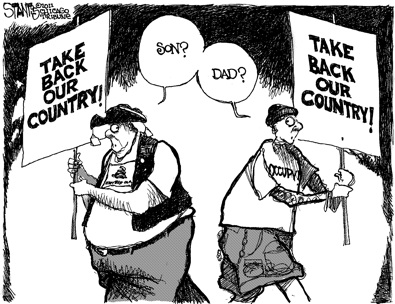
* Both sides forcefully deny it, but two angry populist streams are definitely overlapping on a major issue. But, as is often the case in America, they’re all talking past each other and accentuating their ideological and partisan differences. Fox Chicago actually tried to force a convergence last night…
FOX Chicago News asked South Sider Catherina Wojtowicz, a founder of the Chicago Tea Patriots, to visit tonight’s Occupy demonstration and let us listen to her talk to the other side.
Among them were unemployed college graduate 20-somethings and an older, self-described “unemployed, Marxian-trained economist.”
The most fascinating exchange, by far, though, involved Larry Roberts, a middle-aged union electrician. He just walked up to us, not directly part of the protest, but very sympathetic to it.
“God bless ‘em. They’re sticking up for the working man and the people less fortunate. God bless ‘em,” said Roberts.
Wojtowicz said she thinks the “Occupy” protesters want to crush Wall Street, and can’t understand what their plan is after that. She does agree with some of their rhetoric, though.
Mr. Emanuel — asked what his top priority is for the Illinois Legislature’s fall veto session — answered that it’s helping CME Group and CBOE Holdings Inc. cut their state income-tax load. The session begins next week.
The firms now are treated “not exactly in a fair way, at least in their view,” he said, and as a result are threatening to move some operations out of town. The big trading firms have made Chicago “a worldwide leader” in the derivatives and options business, he said. “It’s important to us as a city and a state to maintain that leadership.”
Mr. Emanuel served on the board of a predecessor firm to CME several years ago.
Discuss.
* Related…
* New era close at McCormick Place as tentative union pact reached
* Survey: Many Occupy Wall Street protesters are unhappy Democrats who want more influence
* Gallup: Most Americans Uncertain About “Occupy Wall Street” Goals: Given Americans’ apparent lack of knowledge about the Occupy Wall Street movement, it is not surprising to find a minority of Americans describing themselves as supporters (26%) or opponents (19%) of the movement. A majority, 52%, say they are neither supporters nor opponents, with another 4% not having an opinion. Those closely following the news about the movement are more likely to describe themselves as supporters (38%) than opponents (24%). The percentage of supporters increases to 52% among those following the news “very closely.”
* ILGOP Chair: ‘Occupy Chicago’ Protesters should be in front of Mike Madigan’s Office
* Kirk: Occupy Chicago feels like ‘undisciplined, unfocused, unintellectual anger’
* Emanuel says he consulted on Occupy Chicago arrests
* A close associate of Mayor Rahm Emanuel’s told me once that hizzoner is at his most calm when things are going wrong. Emanuel’s most quiet, serene days during the recent campaign, my friend said, were when Emanuel was temporarily kicked off the ballot over residency issues. There was no screaming, no swearing no threats. His demeanor was “let’s find a way to work through this.”
Emanuel reacted the same way, I’m told, when Gov. Pat Quinn announced Monday that he was making huge new demands on gaming expansion which appear to kill the legislation in its tracks. So, nice words do not mean that the feud is over…
After months of political feuding with Gov. Pat Quinn over casino gambling, Mayor Rahm Emanuel on Tuesday changed his tune, saying he hoped to find “common ground” that would pave the way for a Chicago casino and a bonanza of local revenues.
One day after Quinn drew the line at five new casinos and ruled out slot machines at racetracks, O’Hare and Midway Airports and the Illinois State Fairgrounds, Emanuel said he had a “good conversation” with the governor and came away encouraged. He said a revised gambling bill could be introduced by Friday.
* Mayor Emanuel made those comments before Gov. Quinn had another press conference yesterday. Raw audio…
* If you listen to that audio, you’ll know that Quinn is solidly opposed to the most important (as far as finding the votes is concerned) aspects of the gaming expansion bill. Asked if there was any chance he could relent on slots at tracks, Quinn said…
“Casino gambling locations at racetracks. The racetracks want to become casino operations. That’s what they’re looking for. The proposal that the legislature came up with, it’s way too broad and expansive, it’s excessive, and it would convert the racetracks at Illinois into gambling casinos. They can call it whatever name want, I don’t think that’s a good idea… Statutes exist today that provide adequate support for horseracing and agricultural interests. Now, they just want more. They want the opportunity to have their racetrack become a casino. I don’t think that’s the way to go.”
* Asked if there was any circumstance in which he could sign a bill to allow slot machine at a racetrack venue, Quinn said…
“Well, no. I think I spoke about this issue yesterday. I think that’s not necessary… To allow oversaturation of gambling, namely converting the racetracks into casino gambling locations, I don’t think it’s healthy for Illinois and that’s why I didn’t support that.”
* Certainly, Quinn was told, he’s been around long enough to know that the lack of any kind of progress on gaming expansion was because the tracks and the casinos were not working together. And now that the tracks are getting what they needed and enough votes were found despite casino opposition, “Did you know that this was the poison pen in signaling your opposition to it?” a reporter asked. Quinn dodged the question…
“It cannot be some kind of bill that passes to appease every single lobbyist in Springfield.”
* Asked by another reporter if his demands were a poison pill, Quinn said…
“Everything I’ve done is designed to protect the public interest, to protect integrity. It’s not designed to just get a bill passed for its own sake. I don’t think that’s healthy for Illinois.
“You know, before I arrived there was too much done the old way, the political way. Do things whatever works for the politicians for the interest groups, the lobbyists. I don’t want to do it that way, I want to do it the right way, the people’s way.”
* The governor also took some Blagojevichian shots at the General Assembly…
“There are those in the Legislature who may have friends in this or that business. Well, they’re entitled to that friendship, but that isn’t going to be the policy of Illinois.” […]
“The Legislature I think was very sloppy when they passed a bill after two days of debate, on May 31st in a hasty way. And a lot of people who said, ‘Oh, sign that bill,’ never read it. We did. 499 pages, 409 pages. And a lot of the things in that bills had loopholes you could drive a truck through.
“And so we have to stop that. And that’s the job of a governor, to say ‘No, this is a bum bill, it won’t get approved by me and go back to the drawing board and come up with something better.’ And I gave an outline, a framework of how to do it. And I think it was a pretty good one and a lot of people have said that to me in the past 24 hours.
“I think we’re on the right track and I think some of our legislative leaders and political leaders need to pay attention to that.”
* If Mayor Emanuel and the sponsors can find a way to pass this bill without slots at tracks, or get a revised bill into law over the governor’s veto, then it’ll easily be one of the biggest legislative achievements of the past ten years. That’s how tough this task is. But the governor has repeatedly dismissed the idea of a trailer bill this week, so don’t count on this tactic working…
State Sen. Terry Link (D-Waukegan) said he and other legislative leaders may offer Gov. Quinn a new plan to expand gambling by the end of the week. Link said it likely would include “everything” Quinn requested in terms of anti-corruption safeguards, but it would still call for controversial slot machines at six horse racing tracks in the suburbs and Downstate. […]
Sen. Link said one possibility is that legislators could pass a second, “trailer bill,” effectively amending the already-approved Senate Bill 744. The goal would be accommodate some of Quinn’s demands. If the bargaining were successful, Quinn could then sign both bills into law.
Gambling interests gave $388,000 to candidates and officials in 2011, including $304,300 from racetracks, $68,516 from existing casinos, and $15,100 from other gambling interests. Top recipients include Chicago for Rahm Emanuel ($74,550), the Senate Democratic Victory Fund ($23,700), and Citizens to Elect Tom Cross ($23,050).
Keep in mind that the gaming industry is split into opposing camps. The existing casinos don’t want this expansion.
* Aside from the obvious personal issues, just about everything you need to know about the broad themes in the upcoming battle royale between freshmen Republican Congressmen Joe Walsh and Randy Hultgren are right here in this New York Times clip…
Then, there are Mr. Walsh’s political problems. Democrats in charge of the Illinois redistricting process have redrawn his district with boundaries overlapping that of Representative Randy Hultgren, a fellow Tea Party Republican. While the new map is being challenged in court, Mr. Walsh said that he was prepared to force Mr. Hultgren into a primary — and that he would be the clear favorite because Mr. Hultgren voted too often with party leaders.
“As a freshman you pick your poison,” Mr. Walsh said, “and maybe leadership is going to help him raise money or open some doors for him and in exchange for that he’s going to give them his vote.”
Mr. Hultgren, who has more than 15 years’ experience in state and local government, brushes off the accusations. “Using a leadership style that emulates Rod Blagojevich or Barack Obama, Joe likes to govern ineffectively though press releases, sound bites, political grandstanding, and name calling,” said his campaign spokesman, Andrew Flach. “He certainly does not lead by example.”
If the boundary challenge fails and the two freshmen lawmakers do face off, it will be in a district where much of the territory comes from Mr. Hultgren’s current district.
Mr. Walsh appeared to be a popular figure at a recent Tea Party convention in Schaumburg, part of his current district. When he stepped to the dais to deliver his luncheon address, the first thing he did was remove his suit jacket. “What’s unique with Joe Walsh is this,” he said, nearing the end of his speech. “You did nothing fancier, you did nothing more complicated, you did nothing more sophisticated than elect one of your own.”
Illinois’s 10th District, Rep. Robert Dold (R) vs. Democratic winner
Dold has always known his first reelection campaign would be a tough one: He’s a freshman running in a Chicago-area district during a presidential year, when local voters are expected to turn out in droves to support Obama, the city’s favorite son.
So Dold’s been stockpiling cash, which he’ll badly need in the country’s third-most-expensive media market. He enters the fall with almost $1 million in the bank, after raising $367,000 in the third quarter and more than $1.2 million for the cycle.
Brad Schneider, the Democratic front-runner in a multi-candidate primary, had a sub-par quarter with only $79,000 raised. But he’s been frugal in his campaign spending so far and entered the fall with a solid $417,000 in the bank.
Even Republicans acknowledge Dold will be vulnerable, blanketed by Democratic groups hoping to pick him off in a presidential year. But he has turned heads with his early fundraising.
“The fact remains that it’s an expensive media market, and Dold is the best fundraiser of the freshman class,” a top GOP operative said. “And if you’re going to beat Sen. [Mark] Kirk’s protégé in a district that Kirk would have won last year, you’re going to need a dump truck full of cash.”
It’s a bit amazing that Schneider is considered a frontrunner. But Democratic woes being what they are this year, a more well known candidate hasn’t emerged.
…Adding… As a commenter pointed out, the Politico writer was apparently unaware that the 10th is not a Chicago district.
* Related…
* Sweet: Congressional hopefuls stockpiling cash for March
* Republican players look to tap tea party activism
An electric rate hike proposal that triggered a shoving match between two state senators last spring could bring more legislative fisticuffs to the Capitol next week.
State Sen. Mike Jacobs, D-East Moline, said he thinks he’s convinced enough of his colleagues to vote in favor of overriding Gov. Pat Quinn’s veto of a proposal allowing Ameren and ComEd to boost electric rates in exchange for them paying for upgrades to an aging electric grid.
In all, Jacobs needs five lawmakers to change their votes from “no” to “yes.” […]
In the House, four members would have to change their votes to “yes” in order for Quinn’s veto to be nullified. Some lawmakers want to see follow-up legislation that would add additional layers of protections for consumers before they decide how they are going to vote.
* Methinks this development, if true, had more to do with lobbyists than the Senate sponsor. Campaign contributions probably didn’t hurt, either…
Illinois’ two largest utility providers have given $116,400 to the campaign warchests of lawmakers just weeks before the Legislature is expected to address a contentious rate-hike veto.
Gov. Pat Quinn vetoed legislation last month that would have allowed Commonwealth Edison Co. and Ameren to charge customers more to pay for statewide infrastructure upgrades. Under this proposal, Commonwealth Edison Co. customers would have seen their bill jump by $36 a year and Ameren customers by $40 more annually. […]
Commonwealth Edison Co. and its parent company, Exelon, and Ameren have donated to 38 legislators since Quinn’s veto Sept. 12, according to Illinois State Board of Election records.
* The Illinois Campaign for Political Reform has tallied over $900K from Smart Grid proponents this year…
The Smart Grid proposal would change the way that electricity rates are set, allowing companies like Commonwealth Edison and Ameren to charge more to upgrade the transmission system. Electric companies have given $939,680 to officials, candidates, and political parties in 2011. Top donors are Ameren, affiliated companies and employees ($399,188); Commonwealth Edison, its parent company Exelon, related companies and employees ($262,422); and Midwest Generation ($93,450). Top recipients are the Senate Democratic Victory Committee ($89,750), Citizens to Elect Tom Cross ($62,500), and the House Democratic Majority ($45,100).
*** UPDATE *** From a Teachers Retirement System press release…
The video’s script does not accurately describe the finances of Teachers’ Retirement System. TRS is not going broke and will have enough money to pay pensions for decades.
· The video’s script says: “This is how much money we have in the fund,” and a graphic showing “$31 billion” pops up.
o That number reflects the assets held by TRS last year. The current assets, thanks to a 24 percent return on investment for fiscal year 2011, total $37.5 billion.
· The script says: “This is how much we need to pay our current retirees.” A graphic of “$49 billion” pops up.
o This is an incomplete statement. What’s not said is that the $49 billion is the estimate of what’s needed to pay “current retirees” every year for the next 30 years. The actual cost of teacher pensions this year is $4.5 billion.
· The script then says: “This is how much we need to pay people like you.” A graphic of “$27 billion” pops up.
o Again, what’s not said is that this number reflects a 30-year estimate for teachers who are not even eligible for a benefit.
· The script barely mentions current revenues collected by TRS. Over the last two years, TRS revenue totaled $17.3 billion, from teachers, school districts, state government and investments. TRS benefit checks in the last two years totaled $8 billion.
· TRS currently carries an unfunded liability of $44 billion, but this is a number that never comes due at one point in time because only current retirees are eligible to be paid. TRS has carried an unfunded liability since at least 1953 and has never missed a pension check.
[ *** End Of Update *** ]
* IllinoisIsBroke.com has a new TV ad. It started last night on Chicago network and is also running on cable. It’ll play through the start of veto session. Rate it…
* The Tribune editorial board is all in with this theme, of course.
* By the way, the FiveThirtyEight blog had a pretty good two-part series on understanding how campaign ads work. The above spot is not a campaign ad, but let’s have a look at the piece anyway. This is from Part 1…
2. Campaign ads matter more when a candidate can outspend the opponent.
This simple fact sometimes gets lost because people fixate on the content of ads. But the volume of ads may matter more. Consider the 2000 presidential election. In the final two weeks of the campaign, residents in battleground state were twice as likely to see a Bush ad as a Gore ad. This cost Gore 4 points among uncommitted voters.
The same thing happened in 2008, when Mr. Obama vastly outspent his Republican opponent, Senator John McCain. According to some research, in counties where Mr. Obama broadcast 2,000 more ads than Mr. McCain, he received about 1 percentage point more of the vote than John Kerry did in those same counties in 2004. (That a difference of 2,000 ads only appeared to earn Mr. Obama a single point is a testament to the limits of campaign advertising when most voters already have opinions about the candidates.)
Of course, disparities like those between Mr. Gore and Mr. Bush, or Mr. Obama and Mr. McCain, do not come along in every presidential race. If Mr. Obama and the Republican nominee decline public financing in 2012, expect fewer disparities. But the ultimate point is this: if the 2012 race is close, do not pay attention to every subtle or even subliminal message in the ads. Just look to see who is spending more. Spending more does not guarantee a victory, but it is more revealing than endless speculation about whose message is more effective.
* 4:18 pm - The Justice Department had asked the US House Ethics Committee to hold off any investigation into Congressman Jesse jackson, Jr. while it probed the Rod Blagojevich case and related matters. That request has now been withdrawn, so the committee is moving forward.
Jackson will probably be hit with some bad press about this. For instance, this is from Debbie Halvorson…
“The House Ethics Committee’s decision to look into possible ethics violations by Representative Jesse Jackson, Jr. is proof that he continues to be plagued with distractions over his possible role in Rod Blagojevich’s pay-to-play scandal involving President Obama’s former Senate seat. We should have a Representative that is focusing on job creation and economic development for our district—not on ethics investigations. The 2nd Congressional District deserves strong leadership that will be focused on the needs of local residents. Our campaign remains focused on the many challenges facing the residents of the 2nd Congressional District.”
Headlines so far this afternoon…
* Ethics to look into Jesse Jackson, Jr., allegation on Obama Senate seat
* House Ethics Panel Resumes Inquiry Into Jesse Jackson, Jr.
* Ethics Committee Restarts Probe of Rep. Jesse Jackson Jr.
* But this development could also be seen as an implicit admission by the feds that they’ve wrapped up their investigation and aren’t going anywhere else with it.
But a preliminary investigation by the Office of Congressional Ethics — which serves as a grand jury of sorts for the House Ethics Committee — concluded in 2009 that there was evidence that Mr. Jackson’s staff in Washington and Chicago “were used to mount a public campaign to secure the representative’s appointment to the U.S. Senate,” a possible violation of House rules that prohibit the use of public resources for personal or political causes.
The investigators also questioned if the “emissary” who was recorded offering Mr. Blagojevich help raising campaign funds was acting at the request of Mr. Jackson. If the congressman did have someone offer to raise money for the governor in return for an appointment to the Senate, then he might have “violated federal law and House rules,” the ethics office said in its 2009 report.
* There was an interesting turn of events today at Bill Cellini’s corruption trial. Star prosecution witness Stu Levine under cross-examination by defense attorney Dan Webb dumped all over the alleged victim in this case, Tom Rosenburg. From Natasha Korecki’s Twitter page…
Webb to Levine: “you don’t believe a word (Rosenberg) says?” Levine:”Correct.” Rosenberg may testify tomorrow. […]
Levine on tape about Tom Rosenberg: “He has clean hands all over the place.” Levine says he’s referring to ‘dishonest acts.”
So, according to the prosecution’s big witness the alleged victim is a lying crook?
Perhaps our experienced attorney commenters can tell us what this means, but I’m not sure it’s so great for the prosecution. If the victim was also allegedly hinky, then running a game on him might not be so bad. Then again, Rosenberg testified at Tony Rezko’s trial that Cellini never asked him for any money. Webb has referred to that testimony time and time again. Federal prosecutors allege that Levine attempted to extort Rosenberg on behalf of Rezko, Chris Kelly and the Blagojevich campaign. The feds also allege that Cellini participated.
Levine testified that he had, in fact, initially launched another extortion approach on Rosenberg — one that did not involve Cellini at all. He also told the jury that Cellini had early on actually helped Rosenberg.
Webb also spent considerable time exploring the relationship Levine had with Rosenberg.
Levine testified that Rosenberg had in 2001 allegedly agreed to another, unrelated bribe scheme with Levine but then failed to pay up. This angered Levine, he acknowledged.
The defense at the trial of a clout-heavy Illinois businessman has sought to punch holes in prosecutors’ claim their client is heard on wiretaps admitting he delivered part of an extortion message to a Hollywood producer.
The issue took center stage Tuesday as William Cellini’s attorney tried to convince jurors that Cellini’s words were, at the very least, ambiguous. Defense attorney Dan Webb was cross-examining star prosecution witness Stuart Levine. […]
But Levine conceded Cellini never said he told the Hollywood executive that he must donate money to then-Gov. Rod Blagojevich’s campaign or risk losing state pension funds for his investment company.
Federal prosecutors [yesterday] afternoon said William Cellini’s trial could be headed for closing arguments Friday.
Defense lawyer Dan Webb is likely to conclude his questioning of star witness Stuart Levine on Tuesday. Assistant U.S. Attorney Chris Niewoehner said the government will put on the stand an out-of-state witness (presumably the victim of the alleged extortion, Tom Rosenberg) Wednesday and could be finished with its case by Thursday at the latest.
Webb said he gave a list of defense witnesses to Niewoehner. Still, Niewoehner said closings could happen by Friday.
The Blagojevich family posted a message on Facebook on Monday, telling supporters that they can write letters on the former governor’s behalf before his sentencing. U.S. District Judge James Zagel can consider Blagojevich’s good works as mitigating factors when deciding his punishment.
Blagojevich, 54, could face a double-digit prison term after being convicted of corruption charges in June. Though no sentencing date has been set, Patti Blagojevich has indicated it could be sometime in the next month.
“We have been getting so many requests from people who would like to help us by writing a letter to the judge for sentencing that I would like to post the email of one of our attorneys Aaron Goldstein: agoldstein3@hotmail.com,” according to a post on Patti Blagojevich’s Facebook page. “He would be able to help you with how to get the letter to the right place. Thank you to all of you who have supported us during this hard time.”
* The Question: What would your letter to Judge James Zagel say?
Tuesday, Oct 18, 2011 - Posted by Advertising Department
[The following is a paid advertisement.]
A recent front page Chicago Tribune story (“Electric Bill Shocker,” June 11) warns that coal plant closures will trigger a substantial spike in our electric rates:
“Consumers could see their electricity bills jump an estimated 40 to 60 percent in the next few years.
“The reason: Pending environmental regulations will make coal-fired generating plants, which produce about half the nation’s electricity, more expensive to operate. Many are expected to be shuttered.”
Because of these closures, nearly double digit rate increases are already set to begin in 2014 - more will come unless we act.
Illinois legislators have a choice. They can protect consumers by voting for the Comprehensive Energy Efficiency and Investment Act (SB 1653). Highlights include:
• 16,000 direct and indirect jobs, according to the University of Illinois
• Energy efficiency programs the IPA says will offset residential rate increases
• Solar rooftop support for business and government
• Expanded rate protections for the $3.5 billion Taylorville Energy Center and other clean power projects
• Extensive MWDBE program for minority contractors
While opponents spread disinformation and use scare tactics, sponsors like Senate President John Cullerton and Representative John Bradley know that SB 1653 is a common sense approach to solving the serious problem of coal plant retirements.
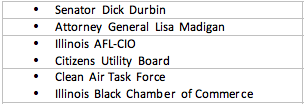
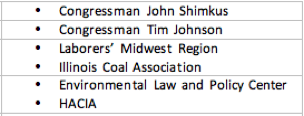
The diverse coalition of SB 1653 supporters includes:
Illinois has a choice. Act now.
Approve the Comprehensive Energy Efficiency and Investment Act
Gov. Pat Quinn on Monday laid out what kind of gambling expansion bill he could accept and it doesn’t include slot machines at Illinois race tracks, a position sponsors say could imperil their push to add five new casinos in the state, including one in Chicago.
“If this were in bill form it could not pass,” Democratic Rep. Lou Lang of Skokie said of Quinn’s suggestions.
Link said slots at race tracks bring more than 20 votes to the bill. Without it, he can’t pass any gambling expansion legislation, he said.
* The legislative math simply doesn’t work without slots at tracks. Barring a miracle or yet another Quinn flip-flop, the governor has all but killed gaming expansion…
“Unless these principles are followed, there’s no way I will approve a bill,” Quinn said at a Chicago news conference.
“I’m the final word,” Quinn said. “We’re not going to have a willy-nilly gambling bill in Illinois that is not protecting integrity, that is way too big and excessive and doesn’t provide adequate revenue for education. … Casino gambling at 14 different locations in Illinois is way too much. We have no interest in becoming the Las Vegas of the Midwest. We need to retain our culture.”
It will be the mother of all Pat Quinn flip-flops if he decides during veto session that he can support slots at tracks after saying that. I mean, I don’t see a lot of negotiating room there, do you? McCaffrey does, but he gets paid to be an optimist…
Dave McCaffrey of the Illinois Harness Horsemen’s Association described Quinn’s announcement as “the first pitch of the seventh game, and the game will play out during the next month.”
Danville Mayor Scott Eisenhauer has been waiting six years to hear an Illinois governor say his city of more than 32,000 residents should get a casino.
On Monday, “to hear that Gov. (Pat) Quinn, too, supports a casino for Danville is a milestone,” Eisenhauer said. But Eisenhauer realizes that while Quinn supports a casino for Danville, Quinn also could not support legislation that actually would put one there. […]
Leaders in Winnebago County are thrilled to hear Quinn support a casino for their city of Rockford, said Mike Dunn, regional director of governmental affairs for the county.
“We could never figure out what he wanted, but this makes us feel better,” Dunn said.
“Everything in that bill was put there to attract enough votes to pass it out of the state Legislature,” said state Rep. Marlo Colvin (D-Chicago), a key backer of the casino legislation. “The horse racing industry is in difficult financial shape and needs help. I don’t know how the governor can ignore the economic realities of the south suburbs, Chicago and people across this state who need jobs and economic development.”
I pointed out to Colvin that Quinn did endorse a casino in the south suburbs.
“It isn’t going to matter if we can’t get the votes to pass the bill,” Colvin said. “We’ve been talking to the governor about this since the spring, trying to get a sense of what he wanted, and he comes out with this a week before the fall veto session, at the 11th hour, which is apparently his preferred manner of doing business.”
* The consequences of this particular Quinn decree have been overlooked…
Quinn also switched direction on the video poker law he signed in 2009 to pay for a statewide construction program. The law allows the machines to operate at restaurants and taverns unless a community decides to opt out. Instead, Quinn said the machines shouldn’t go up unless a community votes to allow them. That could greatly reduce video poker in Illinois.
He not only signed that into law, he came up with the idea in the first place. Video poker was designed to help fund capital projects - the very same projects Quinn always talks about when he wants to point to all the jobs he’s created. Opt-in would kill those revenues.
Also, he agreed at the time that there would be no changes to the capital bill unless it was agreed to by all the legislative leaders. This is definitely not an agreed change. And where are they gonna get the money to replace this revenue stream? Another cigarette tax hike? Senate President Cullerton could go along with that, few others will.
At a press conference Monday, Quinn didn’t leave much wiggle room. “Unless these principles are followed,” he said, “there’s no way I will approve a bill.”
Key lawmakers have signaled that they are more than willing to compromise.
Quinn’s challenge now is sticking to his ultimatums — in the past, not his strong suit — on what a revised casino bill can and cannot do if it is to win his signature.
Governor, on Monday you did right by the people of Illinois.
You’re holding the winning hand here.
Don’t fold.
It’s definitely a “winning hand” for someone who wants to kill gaming expansion. Quinn’s oversight changes and most of the rest of the stuff is nowhere close to being a deal killer. The slots at tracks thing is a killer, however, and money will have to be found to replace any revenues lost from a change to an opt-in for video poker.
They’ve been trying for a decade to pass this bill. They finally found the winning formula this spring and now it’s been tossed out the window.
* Related…
* ‘No way’: Quinn won’t support slot machines at Illinois racetracks
“I think one thing, if we made Medicaid patients pay a co-pay, you know, just like any of us do… if they had to pay a lot more to go to the emergency room, and maybe take it out of their LINK card if they don’t have any cash, maybe they would think twice before they use medical services if it’s going to cost them something,” Cultra said.
So, let’s make the poor decide between eating and life-saving health care in the middle of the worst economic climate since the Great Depression. Wonderful idea. Why don’t we throw in a gigantic tax break for the rich while we’re at it? You know, just to rub it in.
When the owner of a southern Illinois child care center didn’t get the state funding he was promised on time and faced laying off employees and cutting service to low-income children, he borrowed money from family members to get by.
When a suburban Chicago center helping disabled people live independently didn’t get its state money quickly, employees waited three months for a paycheck so clients wouldn’t feel the pinch.
And when an Elgin domestic abuse program was left with stacks of unpaid bills and no sign of when the money would come from the state, workers took four weeks of unpaid furlough days, especially difficult for employees earning $25,000 a year.
They are among the thousands of community groups and charities making up Illinois’ system for providing human services: the state contracts out the work and agrees to make reimbursements. But as Illinois’ budget crisis worsens and the state lags further behind in paying bills, those that serve the state’s neediest are forced to make dire decisions and at-times heroic sacrifices to pick up the slack.
Andrew Buffenbarger was expecting a check from the state of Illinois. What he got instead was a letter saying the Champaign County Nursing Home wouldn’t be paid for its Medicaid services for 120 days.
That doesn’t seem like a big deal if you look at the records of unpaid bills at the Illinois comptroller’s office. They showed the nursing home, where Buffenbarger is the administrator, was owed only $47,000 early last month. In reality, however, the home was waiting on nearly $3.3 million.
Illinois owes the largest downstate ambulance company more than $750,000, and that business soon will cut services to stop the budget shortfalls.
So, how about we come up with some real ideas to solve these problems that doesn’t involve potentially starving out the poor? I’ve said before that it’s going to take years to get out from under these overdue bills even with the tax hike. Actually, I’m not the only one. Pretty much everyone admits it. A drastically scaled-back version of Gov. Quinn’s original borrowing plan would help get many of these bills paid off, particularly if it was accompanied by some negotiated budget cuts. But that’s going to take more courage than currently exists in the building, and legislators will have to ignore the howls about borrowing on the markets even though we’re already borrowing from domestic abuse programs in Elgin.
* This story just gets weirder and weirder. Yesterday, the Sun-Times told us about how a late 1980s law designed to avoid white flight from Chicago is actually occasionally rewarding white flight with big payouts to sellers. Today, they look at the guy who’s running the obscure agency…
While overseeing the largest of three government-run home-equity assurance programs in Chicago, Kenneth Pannaralla got two interest-free home-improvement loans through his agency worth a total of $15,000, despite a ban on such benefits under state law.
The Southwest Home Equity Assurance Program used property taxes it collects to pay the interest on the loans Pannaralla got from Marquette Bank, under a home-improvement loan program the agency created 11 years ago, records show.
In addition, Pannaralla and his daughter, Jennifer Pannaralla, currently have another zero-interest home-improvement loan through the agency, this one for $10,000.
That, too, appears to be in violation of the Illinois Home Equity Assurance Act, which says: “No commissioner or family member of a commissioner, or employee or family member of an employee, may receive any financial benefit, either directly or indirectly” from the program.
The little-known agency Pannaralla oversees is one of the three created under a law Illinois legislators passed in 1988 to curb white flight in Chicago’s bungalow belt. The law guarantees that homeowners who signed up by paying for an appraisal wouldn’t lose money if they sold their homes even if property values declined, as long as they waited five years to sell and as long as property values went down for reasons other than a national housing slump, as has happened.
* This guy really knows how to make money off the public’s dime. And he’s a Madigan guy running a program that Madigan came up with…
Kenneth E. Pannaralla — once a top precinct captain for Illinois House Speaker Michael J. Madigan — has made a good living in government.
Pannaralla, 63, gets a pension from the city of Chicago in addition to the three paychecks from his three current government jobs, including one as the executive director of the Southwest Home Equity Assurance Program, a government agency created under a law Madigan co-sponsored.
Madigan, who is also chairman of the Illinois Democratic Party, also gave Pannaralla’s daughter, Jennifer Pannaralla, a one-year legislative scholarship in 2003 to the University of Illinois at Chicago. And Pannaralla’s son, Kenneth, is paid $24,000 a year as an aide to Madigan.
Pannaralla makes a total of $213,418 a year
Great work if you can get it.
* Ironically enough, black flight has become a big issue in Chicago these days…
Former magnets for black migrants, including Illinois, Michigan, New York and California, all have had black population declines. Atlanta has even overtaken Chicago as the city with the second-largest black population behind New York City. The black population in Atlanta has grown in the past decade by 473,493. In Dallas it grew by 233,890, and in Houston by 214,928 over the same period. Today, 57 percent of the country’s black population lives in the South, a 50-year high, according to the most recent census data.
Today’s migrants are chasing the same things their forebears sought decades earlier, according to those who have studied the return migration. Others are retiring or returning to familial homesteads, reclaiming land their relatives never let loose.
“There are places like Harlem that no longer have majority black populations because many of the black folks who have lived there for the last 50 or so years have decided to cash in, and they are going to live somewhere more affordable, places that don’t come with the urban baggage that maybe we didn’t ever want but put up with because this was our best chance at a solid economic future,” said Khalil Muhammad, director of the Schomburg Center for Research in Black Culture, part of the New York Public Library and renowned for its collections of historic artifacts. “Those people are going to places that look just the way they want them to look. They are not going to be shackled by a political nationalism or the segregation of the past.”
Meanwhile, Chicago has lost about 181,000 African Americans over the past decade, a drop of 17 percent. Many have fled to the Chicago suburbs. But to a greater extent, who is leaving and where they’re going is difficult to determine, according to demographers. But Brookings Institute reports that these new migrants tend to be financially stable and more educated. Many are students, professionals or retirees.
Obviously, it’s way past time to end that state-sponsored white flight prevention program. It appears to be gamed too much anyway.
Tuesday, Oct 18, 2011 - Posted by Advertising Department
[The following is a paid advertisement.]
“The Governor’s veto was a great disappointment to the business community and consumers alike. Opportunities for this kind of investment don’t come around every day. Our elected officials should seize it.”
-Jerry Roper, President and CEO, Chicagoland Chamber of Commerce
Businesses looking to relocate or expand can’t afford to rely on an electrical system designed more than 100 years ago. They need a stronger, smarter grid.
“We depend on a steady stream of electricity around the clock to meet the demands of our customers. Even the most minor outage can cost thousands of dollars. We need a modern grid that offers increased reliability to meet the demands of the 21st century economy.”
A modern, reliable grid is essential for Illinois’ effort to rebound from the recession.
“A modern smart grid is necessary to avoid outages that cost local businesses money and hurt their ability to compete. A modern grid will position Illinois to attract new business and new jobs.”
-John Estey, President and CEO, S&C Electric Company, Chicago
For more information on the benefits of grid modernization through SB 1652, visit www.SmartEnergyIL.com.