Jim Oberweis said he would not seek the Republican nomination for Kane County Board chairman in 2012, but he is eyeing a run for the 25th State Senatorial District. […]
“I have a number of people encouraging me for the senate in the 25th District,” Oberweis said, referring to the seat currently held by State Sen. Chris Lauzen R-Aurora since 1992. “I am taking that very seriously. I suspect he [Lauzen] is not going to run for re-election.”
Oberweis said he would decide in a couple of weeks.
Lauzen himself is pondering whether to run for re-election, county board chairman or congress against former Congressman Bill Foster in the newly drawn 11th Congressional District.
Think of the nose-diving career expectations here. He ran for US Senate in 2002 and 2004 and lost the primary both times. He lost the GOP primary for governor in 2006. Then he lost two congressional bids in 2008 (a special and a general). Now he’s thinking about state Senate?
Man, that would be weird having him down here. Interesting, for sure, but weird.
“After I won last year, my ex-wife filed a lawsuit against me,” he said. “For the past eight months I have been trying to work it out privately and legally and haven’t been able to. Let me say this – virtually everything in that [Chicago] Sun-Times piece was wildly and off-the-charts inaccurate. When I go to my grave a year or 10 or 100 from now, there’s only one thing I want on my tombstone, ‘He tried to be a hell of a dad.’ My kids have been my life. … This is different because this is personal.” [Emphasis added.]
You’ll recall that the Sun-Times recently reported that Walsh’s wife has sued him for allegedly owing over $100,000 in back child support. His lawyer appeared to admit in the piece that Walsh does owe something…
“Joe Walsh hasn’t been a big-time wage-earner politician until recently — he’s had no more problems with child support than any other average guy.”
Yet, he somehow had enough cash to loan his campaign $35,000 last year. People who are not “big-time wage-earners” don’t usually have that much mad money laying around. You get the feeling from reading the story that it might possibly be about a guy who’s trying to hide assets from his ex. That’s not exactly a rarity in the divorce world.
* Turning this controversy around on the media appears to be Walsh’s concept here…
“It’s an ongoing legal proceeding that involves my kids,” Walsh told the crowd. “This is something I’m going to fight, but I’m going to do it privately and legally. There is no way the media will get me to talk about my three kids. I won’t do it!” [Emphasis added.]
It seemed to work because nobody brought up the subject at the meeting.
Members of a newly formed group, the Northern Illinois chapter of Progressive Democrats of America, together with Catholics United held a protest at Congressman’s Joe Walsh’s office Saturday, July 30 in Fox Lake.
About 25 people attended the protest.
“The purpose was to express our distaste with a deadbeat dad representing the 8th Congressional district,” said group member Steve Williams of Lake Villa.
Whatever you think of Walsh, that action sorta left a bad taste in my mouth.
* How would you rate Gov. Pat Quinn’s job performance on a scale of one to ten? One being the worst, ten being the best. Take the poll and then explain your answer in comments. Thanks.
…Adding… I almost never step in on these questions, but the people who are giving the governor a “1″ really need to get a clue or stop being so knee-jerk partisan. Did you completely forget Rod Blagojevich already?
This isn’t the first time a governor envisioned the pollution board as a cushy sinecure: That’s also where Rod Blagojevich infamously tried to find a lucrative state job for his wife, Patti.
Yes, Rod Blagojevich did think about appointing his wife to the Pollution Control Board. However, he was told by his chief of staff that she wasn’t qualified…
Blagojevich proposed that he appoint his wife to the pollution control board, a post that paid $100,000 a year, but Harris said he was able to dissuade the governor after telling him that board members needed specific qualifications that Patti Blagojevich did not have.
So, that’s a truly disingenuous remark by the Trib.
* Republican Congresswoman Judy Biggert on the GOP’s federal lawsuit against the Democrats’ new redistricting map…
Biggert said there’s a legal precedent for success, that Republicans went to court in 1991 and had the Democratic maps overturned and created the first Latino district.
Um, no. The Republicans drew the maps in 1991.
…Adding… Corrected by a reader. Republicans drew the legislative map, but no congressional map passed, so the courts chose the GOP map. The Dem map, however, was not overturned, so the point is still the same.
On December 8, 2010, the City Council voted 46 to nothing to give CME—a multibillion-dollar company run by multimillionaires—$15 million in property tax dollars from the LaSalle/Central TIF district.
Curiously, almost nine months have passed and the city and CME still have not finalized the TIF deal. While CME did not respond to a request for comment, the city’s official explanation is they’re studying the fine print, making sure that all the Is are dotted and Ts crossed. “It’s not unusual for final details to be addressed as an RDA [redevelopment agreement] is completed,” says Susan Massel, a spokeswoman for the city’s department of Housing and Economic Development. “That’s what is happening.”
The scuttlebutt at City Hall is that the Merc is balking at the deal. Why? Because they’d like to get even a better deal—they’re wrangling with the state to get a tax break. The corporate income tax rate in Illinois increased this year from 7.3 percent to 9.5 percent.
If CME were to take the $15 million the city is desperately trying to give them, they’d have a harder time leveraging the state for a tax break.
Let’s take a moment to review this. In short, we, the happy idiots of Chicago, gave the CME $15 million to keep jobs in town. And now CME is threatening to move if they don’t get a better break.
* Cleaning up the mess created by Gov. Pat Quinn’s veto of funding for regional superintendent salaries is not going to be easy. The governor wants to pay them using funds from the corporate personal property replacement tax. He says that’s the way to do it because many of the tax proceeds already go to local schools. But the cash also goes to local governments, and some of them are not happy in the least about this idea…
Rock Island County chairman Jim Bohnsack said the county simply doesn’t have the funds that could be required under draft legislation to pay the salaries of the Rock Island County regional superintendent and the assistant superintendent. […]
Ms. Kraft said other locally elected officials are paid through PPRT and the governor believes regional superintendents also should be paid through these funds. She said if the draft legislation would be approved, possibly during the fall veto session, it likely would fall to Rock Island County to pay for the regional superintendent and assistant salaries.
Mr. Bohnsack said the county has “no extra money” for these costs. He said the county had a $3.2 million deficit last year and made enough cuts — including eliminating 19 positions — to balance the budget with $2,300 in reserves. He said the county received $2.25 million this year in PPRT and those funds are added to the general fund. He said the majority of PPRT goes toward the justice system, including the salaries of correctional officers.
The governor says regional superintendents are local elected officials and should be paid with local funds.
[Sangamon County Regional Superintendent Jeff Vose] said Sangamon County already provides about $230,000 for employees’ salaries and provides office space.
“The county board is already doing its share,” he said.
* Some regional superintendents are now saying that instead of trying to work out a deal with Quinn, the General Assembly ought to just override his veto this October…
[Debbie Niederhauser, regional superintendent of schools for Adams and Pike counties] said the notion of using PPRT to pay regional superintendents “is not what we’re proposing.”
She said: “He (Quinn) thinks we should be paid regionally even though we do the state’s work and we’re state employees.”
Niederhauser said she would like to see the Legislature restore the salaries by simply overriding the governor’s veto. But there is no assurance that may happen.
But state Rep. Chapin Rose, R-Mahomet, said he would oppose such a move [to pay the superintendents out of the personal property tax replacement fund] because some local school districts, including those in Tuscola and Mahomet, get money from the tax.
“It’s the principle that if you start moving $10 or $12 million today, next year it will be $43 million and in three years it would be $100 million,” Rose said.
Calling it “the stupidest veto ever,” Rose said he would vote to override the veto and restore state funding for the offices.
“He made a mistake; let’s put it back in,” Rose said. “To their credit,, the regional superintendents said that despite the governor’s ridiculous veto that jeopardizes kids coming back to school, they would work until the fall veto session. That’s very statesman-like. They get credit in my book.”
An override looks to be the easiest way around this craziness.
Women will have to wait at least another six months before they can possibly join the Springfield Motor Boat Club.
Gene Hayes, commodore of the private club on Lake Springfield, said late Thursday a vote that would have allowed women to become full members of the club failed because of a procedural problem.
The “no” vote did not have anything to do with the merits of the proposal, Hayes said, and another vote could be taken in six months. […]
The Springfield Motor Boat Club, 17 Club Area, has restricted membership to men since the club was formed in 1933. An effort in 2005 to allow women to be full members failed. The Motor Boat Club did not allow reporters to attend Thursday’s meeting. Hayes commented by telephone after the meeting.
Not only is it supremely offensive and truly goofy that a dinky little boat club would deny membership to females in 2011, but the City of Springfield owns the land that the club sits on. The club leases the land from the town. Yet, Springfield has no ordinances against discrimination by these lake clubs on its very own property.
I don’t belong to any lake clubs, by the way. I just don’t feel the need to shell out bucks every month for the right to buy a hamburger.
Ward 5 Ald. Sam Cahnman wants the Springfield Motor Boat Club, and any other club that leases land from the city, to be required to allow female and male members. […]
The city code already prohibits discrimination against women in employment, financial credit and public accommodations.
“Yet we lease our most treasured public land on Lake Springfield to a club which openly discriminates against women by prohibiting them from being full members,” Cahnman said. “Ninety-one years after women gained the right to vote, this is a form of discrimination we cannot and must not tolerate any longer in Abraham Lincoln’s hometown.”
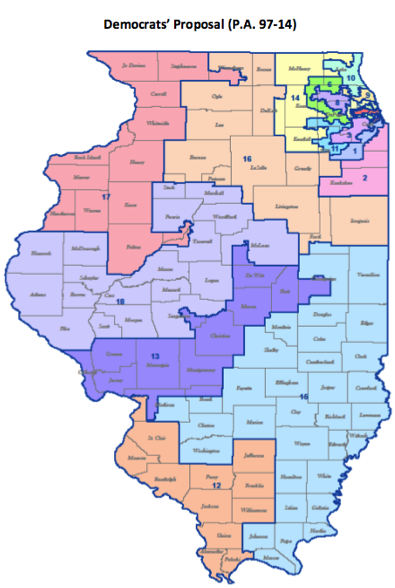
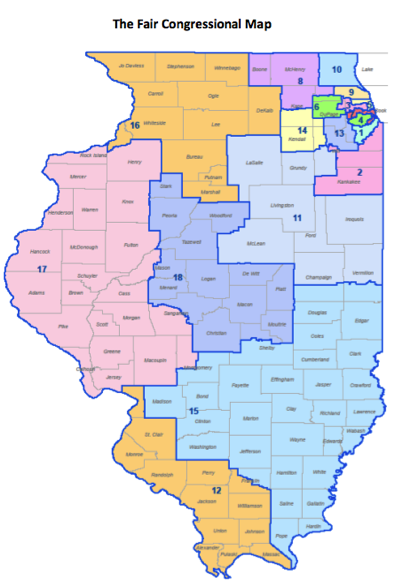
* The state’s Republican Congressional delegation has released its own “fair map” proposal. From a press release…
“The Fair Map filed in federal court today proves that it is possible to create congressional districts that respect both constitutional and democratic principles. More importantly, this map stands in stark contrast to the contorted map passed by the Democrats, which is so gerrymandered that it can have no goal but to maximize partisan advantage by disregarding the will of Illinois voters.
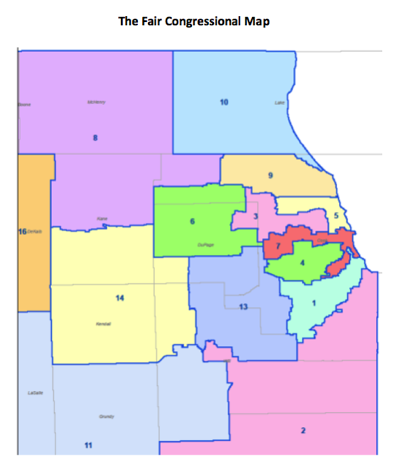
“The Fair Map specifically addresses the problems with the Democrats’ map by providing a second district for the state’s growing Latino population, creating district lines that satisfy the tests for compactness, and protecting communities of interest by keeping them wholly within individual districts.
“We look forward to an impartial hearing in court that exposes the fatal flaws in the Democrats’ Illinois congressional redistricting scheme and recognizes the fact that creating fair, compact, and representative congressional districts is not only possible, but necessary.”
I haven’t checked the Google Earth version as of yet, but the Republicans say they didn’t put any Democrats into the same districts with each other.
• The Republicans first proposed the “earmuff” (District 4) in 1991. At the time, it was the only way to draw a majority-Latino congressional district.
• At the time, the Democrats proposed a map that did not include a majority Latino district. The Republican map prevailed with a three-judge federal panel endorsing the creation of the first majority Latino district in state history.
• In 1991, the earmuff was 65.0% Latino by total population, 59.2% Latino by voting-age population. For the last 20 years, the earmuff has effectively afforded Latino voters the opportunity to elect the candidate of their choice.
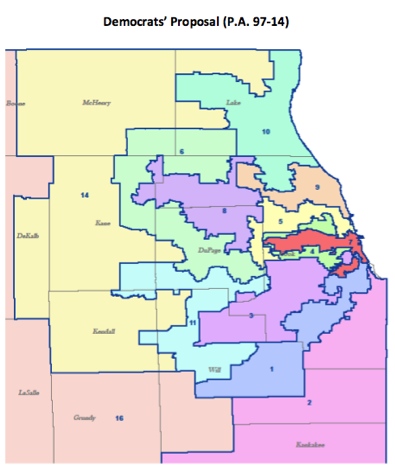
The Democrats’ Proposal
• Latinos have grown to become the largest minority community in both Cook County and statewide. In Cook County, Latinos have grown from 13.6% of population in 1990, to 24.0% in 2010.
• Despite that growth, the Democrats’ Proposal packs Latino voters into a single district. The packed earmuff would be a staggering 71.1% Latino by total population, 65.9% Latino by voting-age population.
• The Democrats’ Proposal dilutes Latino voters in the two neighboring white districts (Districts 3 (Lipinski) and 5 (Quigley)), depriving Latino voters of any chance to elect a second candidate of their choice for at least the next decade.
• The Democrats’ Proposal intentionally discriminates against Latino voters, by drawing district boundaries in Cook County for which race is the predominant factor in a way that is not narrowly tailored to meet any compelling state interest. This violates the “strict scrutiny” constitutional test that federal courts have long used to evaluate governmental actions based on race.
While Congressman Johnson believes the redistricting process leading to this map was unfair and a distortion of the people’s wishes, these challenges have not ever succeeded, so he has decided to devote his energy and resources to his reelection campaign. He hopes that an impartial court will modify the map in a way that will better serve the voters of the state.
…Adding More… Dan Lipinski appears to be the guy who loses his congressional district.
Thursday, Aug 4, 2011 - Posted by Advertising Department
[The following is a paid advertisement.]
System Investments Mean Better Reliability for Customers; Performance Standards Provide Accountability
If enacted into law, the Illinois Electric Energy Infrastructure Modernization Act (SB 1652), which passed the Illinois House and Senate in May, would put in place more stringent performance standards for Illinois electric utilities.
Utilities would be held accountable for their performance on a range of issues that matter most to customers. And if the utilities don’t meet these standards, it gets taken out of their bottom line.
Among the performance standards in SB 1652, utilities must…
• Improve outage duration by 15 percent over a 10-year period
• Improve outage frequency by 20 percent
• Improve estimated bills by 90 percent
Utilities could stand to lose tens of millions of dollars each year if they fail to deliver benefits from investment in grid modernization. There is no symmetrical upside – utilities are penalized for failure to perform but they don’t receive bonuses for achieving goals.
For more information on the other benefits of grid modernization, visit www.smartenergyil.com.
* Without a doubt, this has to be one of the worst Chicago baseball seasons in a very long time. Yesterday’s pummeling of the White Sox made me physically ill. Cub fans have probably been ill all year.
* The Daily Herald takes a look at what happens after an inspector general’s investigation turns up alleged wrongdoing…
An investigation by the Illinois executive inspector general’s office determined that [John Grana], a 16-year Illinois Department of Transportation veteran from Roselle, solicited gifts from underlings at the agency’s Schaumburg service yard in exchange for better work assignments. It also found he misused his state email account by sending personal missives laced with sexually inappropriate and racially insensitive material. In the report, Grana denies many of the accusations.
Based on the report’s conclusions, Executive Inspector General Ricardo Meza suggested Grana could be fired from his $75,264-a-year highway maintenance supervisor job. And IDOT managers did suspend Grana without pay for 192 work days — nearly three-quarters of a work year — and ordered him to undergo ethics retraining. But a collective bargaining agreement protected him from losing his job.
State Sen. Ron Sandack told the paper that Gov. Pat Quinn ought to order his agencies to fire somebody when the Inspector General recommends it. But, as noted in the story, Grana was protected by his union contract, so his punishment had to be negotiated. And the IG himself isn’t insisting that his recommendations be followed to the letter…
Union officials defend the collective bargaining rules. They argue the process protects more good employees than it does bad ones. Meza isn’t holding a grudge against transportation department hierarchy who allowed Grana back despite the contents of his office’s scathing report.
“Frankly, as far as I’m concerned, once we’ve made a recommendation, that’s all it is, and I’m fine with that,” Meza, an Arlington Heights resident, said. “If we make a recommendation of termination and you don’t terminate, I’m not going to be upset. But if (that employee’s) name comes up again, we’re going to be sure to mention that we recommended that the employee be discharged.”
* I can understand why motorcyclists would want this law, but I can also see how this could easily cause a whole lot of confusion…
If a bill sitting on Gov. Pat Quinn’s desk gets signed soon, motorcyclists sitting at red lights that won’t turn green will be able to proceed as if at a stop sign — if no other cars are nearby or going through the intersection, of course.
Many of us have been at a red light that won’t turn green, but it’s far more likely for those on a motorcycle because the stoplight sensors can’t always tell a vehicle of that size is present. […]
[Traffic manager Tom Szabo of the Kane County Transportation Department] said the size and weight of some motorcycles makes it difficult to trigger the “loop detector” at intersections that change the signal.
“The detectors are embedded in the pavement and use magnetic fields to determine the presence of a vehicle,” Szabo said. “Some other intersections use video detection.” […]
Not particularly enamored with the thought of something that could cause accidents or allow people to ignore red lights, Geneva Police Cmdr. Julie Nash said she would be “stunned” if the bill is signed into law.
Some red lights are so long that you might think their weight sensors aren’t working. Here’s the actual language…
the driver of a motorcycle or bicycle, facing a steady red signal which fails to change to a green signal within a reasonable period of time because of a signal malfunction or because the signal has failed to detect the arrival of the motorcycle or bicycle due to the vehicle’s size or weight, shall have the right to proceed, after yielding the right of way to oncoming traffic facing a green signal, subject to the rules applicable after making a stop at a stop sign
So, it’s up to the motorcyclist and, I assume, the cop to decide what is a “reasonable period of time”? Not confusing at all.
* It’s not really clear whether there are more of these couples or whether they’re more open about reporting themselves to the Census Bureau, but the numbers are the numbers…
The number of Illinois households run by same-sex couples has jumped nearly 42 percent in the last decade, according to U.S. Census Bureau statistics released late Wednesday.
The trend in Illinois mirrors those nationwide, with experts and advocates saying a change in social attitudes toward gay couples and homosexuality in general is among the top reasons for the increase.
In 2010, there were 32,469 same-sex households in Illinois, up from 22,887 in 2000. The biggest jump was in female couples, a 53 percent increase compared with a 32 percent one for male couples. In 2000 there were more male couples -12,155 compared with 10,732 female. Last year there were 16,416 female couples compared with 16,053 male couples.
The sweltering, deadly heat and non-stop heat warnings of last month led to the month making the record books as the sixth warmest July on record in Illinois.
The statewide average temperature for July was 80.1, according to Jim Angel, Illinois State Climatologist. That averages to 4.3 degrees above what’s normal for this time of year and ties with July 1955 as the sixth warmest July since records were kept since 1895.
The warmest July was recorded in 1936 when the average temperature for the month was 83.1. July 1901 came in second at 81.7 average and coming in as the third warmest July was in 1934 when the average temperate was 81.3.
It was the extended nighttime temperatures that pushed the state into the top 10 warmest list. Because of high humidity levels, the state was unable to cool off at night and broke 168 nighttime high-low records throughout the state, according to Angel. At the same time, only 28 daytime high temperature records were broken statewide.
Just imagine living here in the 1930s when those records were set. Ugh.
* Gov. Pat Quinn created a mess - or an opportunity, depending upon your perspective - when he vetoed the salaries for regional superintendents of schools out of the budget. None of them have been paid since. According to Illinois Statehouse News, the officials were told by the governor’s office yesterday to expect an update in a week about how they might be paid this month. But the plan so far doesn’t look like paychecks will go out before October…
Kelly Kraft, Quinn’s budget spokeswoman, said lawmakers and regional superintendents have been discussing adding the $11 million to the budget.
“We are working on draft legislation to restore the payroll appropriation for the regional superintendents, and shift the obligation to Personal Property Replacement Tax,” said Kraft. “PPRT funds local elected official stipends, and we feel regional superintendents, which are locally elected, should be funded in the same manner.”
But to change how the regional superintendents are paid would take a vote from the General Assembly. Lawmakers are not scheduled to be back at the Capitol until late October.
Somebody really should’ve thought ahead before that certain somebody vetoed $11 million out of the state budget.
* The Tribune editorial board says the state should just let them all resign and deal with it later…
Robert Daiber, president of the Illinois Association of Regional Superintendents of Schools, warns that some schools may not open on time unless his fellow officeholders stay on the job. He told us that three assistant superintendents have resigned, “and we’ve got a lot of superintendents contemplating how long they’ll be able to work without compensation. If we have an exodus of people leaving, we’re going to have issues.”
But state schools Superintendent Christopher Koch doesn’t sound worried. “We’ve had regional offices empty before, and we’ve managed to deal with it,” he told us.
In other words: Schools will open. Red tape can be sliced in other ways. The state can deal with it.
Daiber and his fellow superintendents may hope they can spook the Legislature into restoring money for their offices in the fall. Or that the state Board of Education will mount a herculean effort to shuffle money their way.
Instead, let’s prepare for other offices to take the work.
Regardless of what the state board or the Tribune says, there are clear statutory obligations here. And these are, after all, duly elected officials.
Gun-rights advocates claim that Illinois is violating the Second Amendment by prohibiting Illinois residents from being able to, in some fashion, carry a firearm in public. A hearing on one such case, in which Michael Moore, of Champaign, and the Second Amendment Foundation Inc., a gun-rights advocacy group, are suing Illinois Attorney General Lisa Madigan’s office and the state of Illinois, is scheduled Thursday in the U.S. District Court in Springfield. […]
Madigan’s office argues in court filings that the state is following constitutional law, because a person isn’t outlawed from owning a firearm, just limited in the manner he can wield it.
A nearly identical lawsuit with nearly identical arguments is unfolding in a U.S. District Court in southern Illinois. The Illinois State Rifle Association, or ISRA, a group dedicated to furthering firearm rights and affiliated with the National Rifle Association, or NRA, is backing both cases but is only a plaintiff in the southern Illinois instance. […]
“We have a very strong case,” Todd Vandermyde, a NRA lobbyist, said. “When you look at some of the briefs that have been filed by the state and attorney general and some of the arguments they are trying to make, I think it is clear they are very, very nervous.”
Vandermyde specifically pointed to an argument made Madigan’s office that since the state doesn’t outlaw openly carrying a loaded gun outside of cities, towns and other incorporated parts of counties, there is not full scale prohibition.
“The laws being challenged here are reasonable measures to ensure public safety and do not violate the constitution,” said Maura Possley, a spokeswoman for Madigan.
Illinois’s 720 ILCS 5/24-1 (the “Unlawful Use of Weapons” law) and 720 ILCS 5/24-1.6 (the “Aggravated Unlawful Use of a Weapon” law) constitute a complete ban on the public carrying of firearms by law abiding citizens otherwise qualified to possess them in Illinois.
The effect of the Unlawful and Aggravated Unlawful Use of a Weapon law (the “Weapons Laws”) is, at a bare minimum, a plain violation of Plaintiffs’ Second Amendment rights.
The harmful effects of this ban are severe, and its immediate forestallment imperative. As a result of the Weapons Laws, 69-year-old Mary Shepard was unarmed when working at the First Baptist Church in Anna, Illinois on September 28, 2009. At 3:00 p.m., an attacker broke in to the church, beat Mrs. Shepard and another elderly woman nearly to death, and left them bleeding. Mrs. Shepard sustained four skull fractures, fractures of both cheeks, shattered teeth, a concussion, crushed vertebrae, two torn rotator cuffs, and a mangled arm. She has lost the hearing in her left ear, and now suffers blinding recurrent headaches.
Mrs. Shepard has a valid Illinois Firearms Owner Identification Card and has no criminal record. She has completed five safety and self-defense training courses. Although Mrs. Shepard is licensed in two other states to do so, she was not carrying a handgun on her person on the afternoon of the attack. Forty-nine states recognize some form of self-defense carriage; Illinois alone recognizes no form of self-defense carriage.
The other suit is nearly identical, except for certain facts involving the plaintiff.
As always, try your very best to avoid bumper-sticker slogans and drive-by comments on this topic. We’ve all heard your one-liners before. There’s no need to repeat yourselves. Violators will be deleted and possibly banned.
* In other gun-related news, Gov. Pat Quinn signed a bill into law earlier this week…
Under the law, signed Tuesday, felons convicted of unlawful use or possession of a weapon face two to 10 years behind bars.
Additional violations by felons caught with guns while on parole or supervised release will carry a sentence of three to 14 years in prison.
Quinn was asked yesterday whether the new law would lead to even more overcrowded prisons. The governor side-stepped the question, saying laws have to be enforced. Listen…
* There won’t be another back to school sales tax holiday in Illinois this year. Iowa is about to hold its 11th annual holiday on sales taxes for clothing and footwear. Missouri is also having a tax holiday soon. Time Magazine has more info…
At least 16 states are hosting tax-free shopping events in the near future, including 11 states waiving sales tax on many purchases this weekend: Alabama, Arkansas, Iowa, Louisiana, Missouri, New Mexico, North Carolina, Oklahoma, South Carolina, Tennessee, and Virginia. Other states—Connecticut, Florida, Maryland, Massachusetts, Texas—hold their tax-free weekends later in August.
The governor has said nary a peep about it, because the Illinois General Assembly didn’t reauthorize the tax holiday. Frankly, we don’t recall the governor pushing very hard for a reauthorization, either.
What’s different in 2011?
The economy still isn’t very robust.
Families still are struggling to make ends meet, and back-to-school shopping remains “expensive and difficult,” to use Quinn’s words from last year.
Besides, the state has had a hefty chunk of new money coming in since January, after the Legislature approved and Quinn signed big increases in income tax rates for individuals and businesses.
So, you’d think it would have been even easier this year than last for the state to give back-to-school shoppers a temporary sales tax break.
The cynic might point out that last year was an election year, and this year isn’t.
But surely that wouldn’t be the reason the governor and Legislature forgot all about extending the sales tax holiday in 2011.
Would it?
* And Sen. Toi Hutchinson didn’t completely dispute that angle during a talk with Phil Kadner…
State Sen. Toi Hutchinson (D-Olympia Fields), who was a sponsor of the original tax holiday bill, told me Wednesday that Illinois simply can’t afford such generosity this year.
“We have $8.7 billion in unpaid bills,” Hutchinson said. “We’ve made unprecedented cuts in the state budget that are very painful.
“As much as I would like to help families and schoolchildren in Illinois, this is simply something the state cannot afford to do this year.”
I noted that last year the state was not only drowning in red ink, but had yet to pass a 67 percent income tax hike. Still, the Legislature thought the sales tax holiday was a good idea.
“Sometimes you do things for political reasons that are not good public policy reasons,” Hutchinson said.
I give Hutchinson high marks for honesty. Most politicians wouldn’t have answered that question in such a direct manner.
“When they (legislative leaders) came to me last year and asked me to carry this bill, I thought it would be a good thing to do to help people who were struggling in this economy and had children in school,” Hutchinson said.
“I have since learned a lot more about the budget process, and as much as I would like to help people with children in school again this year, it just doesn’t make sense.”
* I’m probably excerpting too much from Kadner’s column, but he has more that’s of interest…
Susan Hofer, spokeswoman for the Illinois Department of Revenue, said the state estimates that consumers spent $323 million on school supplies during last year’s 10-day tax holiday, for a sales tax savings of $16 million.
That’s far short of the $60 million in savings some politicians were predicting when the bill waiving the 5 percent state share for sales tax for school supplies passed.
As for the business stimulus the legislation was supposed to create, Hutchinson said, “After studying some of the figures on tax holidays, I’m not sure people spend more. I just think it impacts when people spend instead of how much they spend.”
Gov. Pat Quinn originally predicted $40-60 million in savings.
Thoughts?
* Meanwhile, the state is losing out on big federal bucks this fiscal year…
The end of the federal stimulus program and changes in Medicaid payments will cost Illinois more than $1 billion this fiscal year compared to last, says an analysis from a state economic-forecasting commission.
‘We knew this was coming,” said Jim Muschinske, revenue manager for the Illinois Commission on Government Forecasting and Accountability.
The commission’s July revenue update estimated the state would receive $4.530 billion in federal transfers for the fiscal year that ends June 20, 2012. The estimate compares to $5.386 billion received in the previous fiscal year.
Muschinske said a 60 percent federal reimbursement rate for state Medicaid costs returned to 50 percent after the economic-stimulus program expired. The state’s decision to stretch out payments to Medicaid providers in the current fiscal year also will reduce the amount eligible for federal reimbursement, he said.
* Related…
* Governor’s office announces homebuyer down-payment assistance program
* Illinois notifies seniors eligible for free rides
* Yearly tab for Ald. Burke’s bodyguards nearly $600,000