* When we talk about the circular firing squad in Illinois, it’s usually about the Republican Party. But the Left has its share of problems as well…
In a move that will likely send shock waves through the local LGBT community, pro-LGBTQ organization Equality Illinois is no longer employing Rick Garcia as its director of public policy. […]
Garcia’s contribution to the advancement of gay rights in Illinois is undeniable. He was a key figure in the passages of both the amendment of the state’s human-rights act that includes sexual orientation and gender identity as well as the civil-unions bill that recently passed through the Illinois General Assembly.
Garcia, though, who co-founded Equality in 1992 and has been the group’s top lobbyist since then, said a few hours after being let go that he didn’t intend to go quietly and the next morning, Dec. 17, showed up to work at Equality’s offices on North Halsted Street.
When he refused to leave, Cherkasov called Chicago police and had them escort Garcia out of the offices.
An interview with Garcia is here. Some of it is not safe for work.
The U.S. Attorney’s office in Chicago collected about $99 million from criminal and civil debts in 2010.
The collection of more than $72.5 million in debts, coupled with an additional $26.4 million collected through asset forfeiture, means that the office’s total collections this past fiscal year amounted to more than three times its annual budget of approximately $32 million, a U.S. Attorney’s office release said.
In all the best movies about Prohibition, federal agents at some point raid a warehouse of illegal booze, smash the barrels of beer with axes and pose triumphantly for the press cameras.
They pretend not to know — or, worse, really are unaware — that they are on the losing side of history.
We like to watch such movies with a beer in hand.
Precisely the same story played out again Thursday in Chicago, but with marijuana instead of beer. Federal agents held a news conference to announce they had confiscated 11 tons of pot in a raid on a warehouse in Chicago Heights.
The agents showed pictures of the pot and posed for the cameras and called it a “great day for the good guys.”
As if they did not know they are on the losing side of history.
A provision banning the Obama administration from transferring detainees from Guantanamo Bay to the United States, even for trial, made its way into the National Defense Authorization Act that passed the House Friday. According to reports, it was part of a deal worked out with Illinois Republicans to repeal Don’t Ask, Don’t Tell.
Congress hammered out a compromise last week that stripped controversial measures like DADT repeal (passed instead in a standalone bill) from the defense spending bill. But Illinois Republicans, lead by Sen. Mark Kirk, warned the negotiators not to take out the Gitmo transfer ban if they wanted the bill to pass both houses.
* Charlie Cook takes a look at what could happen to the currently crazy 17th Congressional District after reapportionment…
But what might be better for Democrats than eliminating Schilling’s 17th CD altogether? They could actually make it even more Democratic than it already is. How? First, the 17th CD could give away its only heavily Republican area, Quincy (Adams County), to the safely Republican 19th CD. Then, it could combine Rock Island (Schilling’s home) and Springfield from the current 17th CD with Democratic-leaning Peoria in the 18th CD (sophomore GOP Rep. Aaron Schock’s home) to create a Democratic “supermajority” district. This might force Schilling and Schock into a primary for a seat that would be an uphill battle in a general election. And even if either Schock or Schilling were to prevail in the general, Democrats will have succeeded in “carving out” a Republican. A downstate Democratic dream scenario is depicted here:
The map…
More…
Of course, the rest of the state might not be as easy for Democrats to navigate. If Illinois loses a seat and Democrats eliminate one district downstate, all Chicago area districts would still have to expand. One palatable option for Democrats would be to move the 11th CD represented by Kinzinger (whose home is downstate in Bloomington anyway) downstate and out of suburban Will County entirely. Then, the inner Chicago districts of Reps. Jesse Jackson (IL-02) and Dan Lipinski (IL-03) could expand into fast-growing Will County, which lacks an incumbent, without too much political consequence. If Illinois somehow manages to hold onto its 19th seat, Democrats could still merge Schock and Schilling, but Kinzinger would still probably hold onto most of Will County.
In either case, Democrats would love to strengthen their numbers in the northern Chicago suburban districts of Walsh and Dold, whom they regard as flukes. Democrats could draw more of Walsh’s GOP-leaning McHenry County precincts into GOP Rep. Don Manzullo’s 16th CD, and force Walsh to take over more Democratic precincts in Lake County. In turn, Dold’s district would gain even more heavily Democratic precincts to the south in Cook County around Evanston. Democrats could also seek to improve their numbers in GOP Rep. Judy Biggert’s 13th CD by adding heavily Democratic Aurora (Kane County) from new GOP Rep. Randy Hultgren’s 14th CD. Their hope would be to assume strong position to capture the district when Biggert, who will turn 75 in 2012, decides to retire.
* Other stuff…
* Your Apps Are Watching You - A WSJ Investigation finds that iPhone and Android apps are breaching the privacy of smartphone users
This morning in Classic Chicago we’re featuring a Chicago Christmas tradition, the Walnut Room.
This iconic holiday destination has been delighting locals and tourists for generations.
If you’re looking’ for Christmas cheer look no further. There is no room any more festive, any more tradition-rich and more beloved at the holidays than the Walnut Room.
“We are in the unique position of selling holiday memories. We have customers that have been coming in 30 to40 years. Second-, third- and fourth-generations. We just feed off of that. It’s a wonderful experience and we’re very proud to be part of a Chicago tradition,” said Art Lorenz of Macy’s.
* The Question: Not to be a Grinch or anything, but what is your least favorite holiday tradition? Explain.
The hearing officer in Rahm Emanuel’s residency case has tossed out a friend-of-the-court brief filed by 47 well-known attorneys who argued that Emanuel should be allowed to run for mayor.
The attorneys raised no new arguments that Emanuel’s attorneys had not already made, and four of the attorneys work at the Mayer Brown law firm, which is representing Emanuel in the case, hearing officer Joe Morris wrote.
Morris’ ruling on the friend-of-the-court brief does not necessarily signal his decision on Emanuel’s right to run for mayor, when he presents his findings to the Chicago Board of Elections on Wednesday. […]
“The hearing officer has examined the proposed brief and finds in it no argument that has not already been made,” Morris wrote.
“There are some who are asking the question, ‘Where is Danny Davis?’ And still others have suggested that I may just not run. The truth is, I’m just getting in this race,” Davis said to a crowd gathered at the West Side’s Johnny L. Miller Abundant Life Center.
Rahm Emanuel has been running for mayor for months, as has Rev. Sen. James Meeks, and Gery Chico, and Carol Moseley Braun, etc. It’s pretty darned late to be just getting set up. And it’s perfectly legit to ask where he’s been all this time.
* And crowing about a poll that has you in single digits is a bit odd…
Davis also cited a recent Tribune poll in which he and former Chicago Public Schools chief Gery Chico were tied for second with 9 percent. The poll showed that Davis is backed by 21 percent of black voters, more than any of the other candidates in the race.
Q. There are pictures that appear to show you placing a crown on the head of Rev. Sun Myung Moon, head of the Unification Church at a banquet. How’d that whole thing happen?
A.That’s a big lie. I was at the banquet. A fella named Michael Jenkins, whom I know, came up to me and said, “We are going to crown Rev. and Mrs. Moon ‘true parents.’ Would you do us a favor and carry one of them up to the place where they are sitting?” And I said, “Well, yeah, Michael, I think I can do that.” And so I carried the crown for Mrs. Moon. When I got to where she was, I gave it to somebody else and they then crowned her. So I didn’t put a crown on anybody, I was not even, I guess, a part of the ceremony. Why can’t the truth just be the truth?
Q. His church is very controversial. It has been called a “cult.” He’s made anti-Semitic and anti-homosexual statements. He’s a big promoter of conservative causes. How did you get to be friends with him?
A.I don’t have any friendship or relationship with Rev. Moon. I’ve seen Rev. Moon a few times in my life. He is very conservative in terms of his political philosophy. I have some difficulty with this guilt-by-association idea. The fact that Rev. Moon said some things at an event that I attended has no bearing whatsoever on my feelings. There is not a public official in the city of Chicago who has been more supportive of lesbians and gays than Danny Davis. You cannot find a single person that has been more supportive of the Jewish community of Chicago than Danny Davis.
As he made clear toward the end of his speech to the gathering, Moon believes himself to be “God’s ambassador, sent to Earth with his full authority.”
He said, “I am sent to accomplish his command to save the world’s 6 billion people, restoring them to heaven with the original goodness in which they were created.”
Moon went on to tell the gathering in simultaneously translated Korean that he’s been in communication with the spirits of Hitler, Stalin, Marx, Lenin and “the founders of five great religions,” and that these men and other notables have unanimously “declared to all heaven and Earth that Rev. Sun Myung Moon is none other than humanity’s savior, messiah, returning lord and true parent.”
Rep. Davis said: “I think he was simply saying that he’s a promoter of a message and that he thinks his message of peace and world peace make sense, not that he’s a messiah in the traditional sense.”
* But he hasn’t been reelected all those times for nothing…
“For too long I’ve seen two cities in Chicago. One city is prospering and vibrant; the other, poor and struggling,” he said.
Davis also said he supports an elected school board and wants a professional educator to lead the public schools.
This is a race to the runoff. Davis needs to ramp up super-fast. With two other African-Americans in the race, it won’t be easy. But Toni Preckwinkle took half the vote in the February primary even though she had black opposition and was up against a guy with unified white support.
Also, keep in mind that Chicago is very tough to poll.
Former Sen. Roland Burris took himself out of the race for mayor Friday as obscurely as he entered it — with a brief press release.
From the day a few weeks ago that supporters filed nominating papers, until Friday, Burris made no public appearances and attended none of the public forums that most of the major candidates for mayor attended.
* Rahm Emanuel confident he’ll survive residency fight: On another subject, Emanuel condemned as a “false choice” Chicago Police Superintendent Jody Weis’ upcoming plan to reallocate police resources from lower-crime districts to those that need more officers. Instead of robbing from Peter to pay Paul, Emanuel favors his own plan to use funds generated by Chicago’s 159 tax-increment-financing (TIF) districts to hire 250 more police officers to beef up Targeted Response Units that flood high-crime areas.
* Emanuel case before GOP hearing officer: From behind his reading glasses, Morris kept an even demeanor during the hearings and went out of his way to help objectors without lawyers craft questions in legalese, often to the obvious annoyance of the lawyers in the room. But Morris also was quick to try to shut things down when objectors veered off topic, such as when one man insisted on asking Emanuel about his FBI file.
* Mayoral candidate Davis releases tax returns: Davis, 69, who has represented a West Side and suburban district since 1996, earns a salary of $174,000. The couple also reported $51,000 in pension and annuity income and $22,000 in Social Security income in 2009.
* The Chicago Tribune ran a big story over the weekend about how suburban towns are seeing revenues fall from red light cameras…
In Bellwood, which in late 2006 became the first suburb to install the cameras, photographed violations brought in $1.1 million at their peak in 2008, instead of the projected $1.5 million to $2 million. Revenues dropped almost by half last year, and officials say net revenues this year are near $250,000. […]
The number of tickets exceeded 14,000 in 2008, fell to 11,000 last year and was slightly more than 7,000 through October. But [Melrose Park] village spokesman Nathan Brown said that’s what officials were hoping.
But they buried something…
Chicago has more red-light cameras than any other U.S. city, with 189 intersections covered. The city took in $59 million in fines during 2009, officials said, and is on pace for more in 2010, after adding cameras late last year.
Violations are down at individual sites, so the city simply added more cams. Clever.
The number of accidents fell significantly last year at the first suburban intersections to be patrolled with cameras, but state officials caution that a change in reporting requirements makes a year-to-year comparison suspect.
Overall, the number of collisions at the 14 suburban intersections in 2009 dropped 36 percent from the number in 2008. Collisions decreased at 11 of the 14, according to the Illinois Department of Transportation.
Accidents increased at two intersections and showed no change at another. But the state raised the minimum level to report a property damage accident from $500 to $1,500, reducing the number of reported crashes statewide by 28 percent and potentially skewing the results, officials said.
At the same time, the number of accidents in which someone was injured, a figure unaffected by the reporting change, fell to 30 from 39 at the same sites last year, according to IDOT statistics.
* The paper also took a look at some notorious speed trap towns, including Carol Stream…
Using another tactic that has drawn fire from critics, the department this year joined an area police trend to charge an extra $500 impound fee — separate of any criminal fines — to motorists caught for specific crimes, ranging from DUI to suspended licenses. So far this year, it’s collected about $350,000 from just over 700 tows.
Civil libertarians complain that such impounds have few safeguards to ensure the innocent aren’t forced to pay up or lose their cars.
The department also helped pioneer another trend in policing that has prompted criticism — going incognito to nab violators. Officers have hidden in bushes, behind disabled vehicles and beside lampposts to conduct stings for speeding as well as seat belt and child seat violations.
Among their disguises: homeless wanderer, garbage collector, postal carrier, public works employee, landscaper and utility worker.
The flip-side of Chicago’s 1.25 million city stickers would carry advertising to generate $15 million-a-year — enough to hire 100 new police officers and give motorists a modest break — under a plan proposed by the frontrunner for city clerk.
State Rep. Susana Mendoza (D-Chicago) wants to turn city stickers into money makers, much the way Mayor Daley has talked about letting private companies put holiday decorations and their corporate logos on bridge houses along the Chicago River.
The front-side of Chicago city stickers bears the winning entry of a design competition among student artists. The flip-side that motorists stare at on the inside of the windshield includes a grey scale of the city seal and signatures of the mayor and city clerk.
“It really advertises me, if I’m elected. It’s a complete waste of real estate. We have an opportunity to open it up to corporate advertisers to raise $15 million,” said Mendoza, who’s running for city clerk with the backing of powerful City Council Finance Committee Chairman Ald. Edward M. Burke (14th).
The states have been getting by on billions of dollars in federal stimulus funds, but the day of reckoning is at hand. The debt crisis is already making Wall Street nervous, and some believe that it could derail the recovery, cost a million public employees their jobs and require another big bailout package that no one in Washington wants to talk about.
“The most alarming thing about the state issue is the level of complacency,” Meredith Whitney, one of the most respected financial analysts on Wall Street and one of the most influential women in American business, told correspondent Steve Kroft
Whitney made her reputation by warning that the big banks were in big trouble long before the 2008 collapse. Now, she’s warning about a financial meltdown in state and local governments.
“It has tentacles as wide as anything I’ve seen. I think next to housing this is the single most important issue in the United States, and certainly the largest threat to the U.S. economy,” she told Kroft.
Asked why people aren’t paying attention, Whitney said, “‘Cause they don’t pay attention until they have to.” […]
And nowhere has the reckoning been as bad as it is in Illinois, a state that spends twice much as it collects in taxes and is unable to pay its bills.
Comptroller Dan Hynes is then interviewed. His stories are familiar to readers by now.
Ms. Whitney also said she believed that while states will find a way to pay off their debts, they will likely pass the fiscal burden onto local municipalities. She predicted “50 to 100 sizable defaults” or more in the near future. Here’s the complete video…
* Meanwhile, the Freeport newspaper editorialized in favor of allowing states to declare bankruptcy…
Under the federal bankruptcy code, states are not allowed to file for relief under Chapter 9, like municipalities, counties and other subsidiary governmental entities can already do. States also enjoy the right of sovereign immunity, a judicial doctrine that prevents the government or its political subdivisions, departments, and agencies from being sued without its consent. That immunity prevents a vendor, or other private sector interests, from compelling payment of a debt, which might force a state to collapse its assets to meet its financial obligations.
But in the face of $80 billion in unfunded pension benefits, a state budget deficit somewhere more than $13 billion, and a six-month, $6 billion, backlog of overdue payables to state vendors, Illinois certainly fits the criteria for bankruptcy.
A study by The Center on Budget and Policy Priorities revealed that 41 states were facing severe budget shortfalls in 2009. Some states were worse off than others, with California ($31.7 billion) and Illinois leading the deficit pack. In all, the 41 states were facing a $71.9 billion budget shortfall in 2009 and the projection for 2010 put that deficit at more than $200 billion.
Amending the Federal Bankruptcy Code to allow states to file for relief might present a viable solution to the financial crisis that confronts Illinois, and 40 other states in the Union.
* State pension systems still selling assets to pay benefits: With Illinois government’s fiscal year nearly half over, the five state-funded pension systems have received little to no money from the state and have sold billions of dollars worth of assets to pay out benefits.
* Sale shows how bad situation is: In the wake of an executive order by Gov. Pat Quinn calling on state agencies to purge all surplus items in hopes of making a quick buck, officials with the cash-strapped state are now poised to review whether unused property around the state’s fleet of prisons might somehow bring in added revenue.
* Taxpayer group says government employees should fund their own retirements: “In Illinois, if each current state pension fund employee were required to contribute an additional 10 percent to his or her pension, taxpayers would save over $150 billion over the next 35 years,” Tobin said.
Springfield mayors hold a unique position in Illinois. As the mayor of the state’s capital city, they have access to more state leaders more often and more intimately than just about any other local leader except for maybe Chicago’s mayor.
Tim Davlin took advantage of that position better than most mayors his city has ever had.
Davlin was a regular at state events and built surprisingly strong relationships in the General Assembly and among statewide officials far beyond what an outsider might have thought possible when Davlin was first elected without any previous governmental experience.
He was also quite popular among his fellow Illinois mayors. Active for years in the Illinois Municipal League, Davlin was eventually elected its president. By chance, I happened to be staying at the same Chicago hotel as the Illinois Municipal League meeting the day Davlin was elected the group’s president. He was fully in his element, and his new position made it even more plausible that he might succeed one day at fulfilling his dream of higher office.
Davlin’s greatest challenge leading the Municipal League was pushing an initially reluctant General Assembly to reform the pension systems for police and firefighters during the recent fall veto session. The Legislature refused to touch pensions for first responders during the spring session partly because police and firefighters are so well-respected and because everyone knew that they couldn’t impose the same retirement ages and other restrictions on them. Nobody wants a 67 year-old firefighter showing up at their door when their house is ablaze.
It was a very difficult and controversial issue, but Davlin insisted that it be tackled. The unions representing the first-responders weren’t happy with being forced to give back hard-won gains, and they initially fought hard. Davlin kept his cool, never let the discussions turn personal, and firmly insisted on a fair outcome for everyone.
What resulted was something of a surprising rarity for Statehouse politics. Unlike the state employee and teacher pension bill, which was quickly jammed through the General Assembly last spring while enraged state worker and teachers’ unions were cut out of the process entirely, the first responders bill wasn’t really hated by anyone. Davlin even attended a function for a police union a few weeks after the bill passed. He was warmly received.
That’s just the way he was. The man actually persuaded the Sierra Club to sign off on a so-called “clean coal” electricity generation plant for his city. That was no simple feat. The Sierra Club hates coal, clean or not. The group has even locked arms this year with Exelon, which produces tons of pollution at its decades old coal-fired plants, to stop construction of a new clean coal plant near downstate Taylorville.
Davlin certainly wasn’t a saint. He made his share of governmental mistakes and he had his share of enemies in the city of Springfield, like any mayor would. But I do not know of a single enemy that Tim Davlin ever made at the Statehouse. In an environment where you are defined as much by your enemies as by your friends, Davlin literally had no enemies.
Some serious personal financial problems helped derail Mayor Davlin’s political career this fall. Davlin abruptly announced that he wasn’t running for reelection after the news stories broke. We’re still not sure how extensive his problems were, but he assured all who would listen that he would get everything back on track. He had such an easygoing manner and such a long record of success that it was difficult not to believe him. Davlin stopped by an annual holiday celebration of Statehouse lobbyists in Chicago a couple of weeks ago. Friends said he was as upbeat as always and genuinely relieved that he would no longer have to struggle with his city’s tough budget problems.
Sadly, that all ended when Mayor Davlin apparently took his own life last week. Some have speculated that maybe his troubles were worse than everyone thought. But, in reality, nobody really knows why he did it. Actually, it’s impossible to ever know why almost anyone would commit suicide, even if they leave a note. Suicide is an irrational act. Rational minds can never even begin to comprehend what a suicide victim is thinking.
I, for one, will choose to remember Tim Davlin for how he lived. His successor truly has gigantic shoes to fill, not only in Springfield, but throughout Illinois.
* Meanwhile, new details have emerged about former Chicago School Board President Michael Scott’s financial situation before he committed suicide…
† About two weeks before Scott’s suicide, a development company that had been paying him $10,000 a month “for consultation in regards to future projects involving the possible Olympic Games in Chicago” canceled his contract, according to new details from the Chicago Police Department that officials previously had refused to release. Scott lost that lucrative part-time job because the city failed to land the 2016 Games, according to an unredacted police report on his suicide obtained by the Better Government Association.
† Two downtown fast-food restaurants Scott co-owned — part of a franchise called Salad Creations — had gone out of business shortly before his death, and a third closed shortly thereafter, according to Phil Gershman, Scott’s partner in those eateries. Scott had been negotiating to build a fourth Salad Creations, this one at Midway Airport, but that deal didn’t materialize, Gershman says.
† Lenders are now seeking a total of about $1.2 million from Scott’s estate, probate records show. Nearly $1 million of that stems from a pair of loans that Scott and Gershman obtained for their restaurants in 2007 from First Chicago Bank & Trust. First Chicago also wants $182,025 from the estate to pay off a loan it gave Scott in 2005. American Express also has gone to probate court seeking $46,633 — the apparent unpaid balance on a Scott credit card.
Is that the “reason” he killed himself? We’ll never really know. As I wrote above, suicide is not a rational act. Rational minds simply cannot understand it.
* Related…
* A final farewell for Springfield Mayor Tim Davlin
* State medical society a roadblock to legislation barring dangerous doctors, critics say - Lobbying group has spent more than $6 million in campaign donations over the last 10 years
* Q&A on the census and redistricting: Which states may gain or lose?: The states with the biggest anticipated changes are Texas, which could gain as many as five seats, and Ohio, which could lose two. Nine states — Illinois, Iowa, Louisiana, Massachusetts, Michigan, Minnesota, New Jersey, New York and Pennsylvania — could each lose one.
* Parks orders probe into spiked pensions with lawsuits possible: Park District of Highland Park commissioners authorized an official investigation and possible lawsuits against two of its former executives Thursday night in an attempt to recapture previously approved salaries and bonuses.
* Tara Davlin, the daughter of the late mayor, posted this on her Facebook page today…
For all of those that asked what they can do for us: Hug your loved ones tighter tonight for me. When we were down, my father always spoke the words, “This too shall pass.” Please remember that it will. Life is too short.
Words to live by.
* Timmy was a great Irishman, and many of us will never forget our good times with him at some tavern or another. So the Pogues will play us out. Raise your glasses and turn it up…
I am going, I am going
Any which way the wind may be blowing
I am going, I am going
Where streams of whiskey are flowing
UBS, the Swiss banking giant, has issued a new dress code for its workers — and it features some patented Swiss precision.
The 43-page edict is being tested at five Swiss branches. It notes that: “Our body odor cannot be changed. However, we can ensure that it produces only pleasant scents. Strong breath (garlic, onions, cigarettes) can have a significant impact on communication.”
It also includes, according to NBC:
For women:
♦ “Light makeup consisting of a foundation, mascara and discreet lipstick will enhance your personality.”
♦ “Women should not wear shoes that are too tight-fitting as there is nothing worse than a strained smile.”
♦ “A flawless appearance can bring inner peace and a sense of security.”
♦ “The ideal time to apply perfume is directly after you take a hot shower, when your pores are still open.”
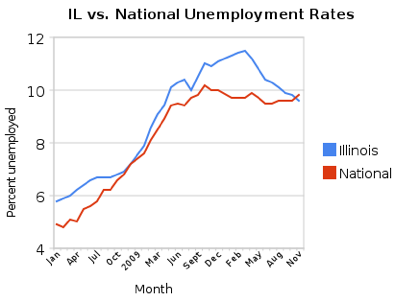
The unemployment rate in Illinois fell to 9.6 percent in November from 9.8 percent in October, the eighth straight decline, the Illinois Department of Employment Security said today. But the state lost 2,600 jobs.
The jobless rate is down from 10.9 percent in November 2009 and fell below the national rate for the first time since January 2007. The national rate is 9.8 percent. […]
The biggest job gains over the year were in professional and business services, up 15,400; educational and health services, up 13,900; and trade , transportation and utilities, up 10,100.
The biggest job declines over the year were in construction, down 7,800; financial activities, down 5,300; and leisure and hospitality, down 3,800.
* Progress Illinois’ chart shows that the state’s rate is now below the national average, which is kinda good news, of sorts…
The number of foreclosures in Illinois fell by 24 percent from October to November. A report from Realty-Trac shows 12,941 people filed for foreclosures in November. The number includes default notices, auction sale notices, and bank repossessions.
The rate is 21 percent lower than November of 2009. But it’s still an ominously high number; Illinois ranks 9th in the nation in foreclosures.
* Meanwhile, the Illinois Policy Institute takes a different look at tax burden rankings, which traditionally rate Illinois as a low-tax state. The per capita ranking is far higher…
Illinois’s state and local tax burden per capita ranked 14th-highest in 2008, at $4,346. The “tax burden” measure focuses on the total amount residents pay in state and local taxes, as opposed to how much money state and local governments collect. As citizens will pay taxes to bodies both within and outside of their state of residency, this measurement provides a better understanding of which states’ residents are most burdened by state and local taxes by tallying tax payments in taxpayers’ home states.
All neighboring states, including Wisconsin, Iowa, Missouri, Kentucky, and Indiana, had lower per-capita tax burdens than Illinois in 2008.
The usual way of measuring is tax revenues as a percentage of personal income. This is why IPI claims that measurement skews the results…
…it’s important to note that income levels can skew rankings. High-income states will show lower collections as a percentage of income than low-income states even if the actual tax bill is exactly the same.
Consider Illinois and Indiana. Looking at state revenue collections per capita, Illinois and Indiana are ranked 27th and 26th, respectively. Illinois collected $2,267 per person in 2009, while next-door Indiana collected $2,320 per person—just $53 more. Yet in the measurement of state tax revenues as a percentage of personal income, Indiana ranked twenty slots higher (17th highest) than Illinois (37th highest). This is largely attributable to income levels: Illinois ranks 13th highest for per capita income, at $46,693, while Indiana ranks 40th highest, at $37,279. Illinois is a higher-income state than Indiana. Chicago’s status as a world financial center drives up income figures, and this in turn affects the rankings.
Two laws aimed at limiting the use of cell phones while driving have resulted in nearly 7,800 motorists being pulled over by the Illinois State Police this year.
In January, Illinois banned the use of cell phones in construction and school zones, as well as took aim at texting while driving. […]
Through Dec. 16, the construction and school zone ban netted 4,236 citations and 2,629 warnings from the state police.
The texting ban has resulted in a total of 929 citations and warnings over the same time period.
Those figures don’t count citations or warnings issued by county or municipal police agencies.
That’s about 132 a week for cell phones and about 18 a week for texting. Not a whole lot, particularly the texting ban, which is pretty tough to enforce.
To those who know her, it’s no surprise that Hannah Perryman would keep working for stalking victims, though her own ordeal is over.
But the rapid pace of happenings since she came forward to tell her story several weeks ago is daunting even to the teen who specializes in slinging fastballs for Elgin High’s softball team.
After being contacted by 17-year-old Hannah, who, after years of being stalked by a neighborhood teen pushed for a change in state law, Gov. Pat Quinn has issued a proclamation declaring January Stalking Awareness Month in Illinois.
Hannah said she recently e-mailed Quinn at his state of Illinois e-mail address, with links to the Daily Herald’s three-day series of articles telling her story. […]
In less than a week, Hannah said, Quinn wrote back with the news, sending her an official proclamation.
A Tinley Park couple was out of jail and cleaning up their home Thursday evening after being arrested and charged with running a $1 million marijuana lab from their suburban home.
John Gecan, 52, and his wife Darlene, 52, didn’t deny growing the plant, but said they weren’t distributing and seemed most upset about the raid on their 7,000 square foot home, located in the 5300 block of West 175th Street.
“You can’t come into somebody’s home and do that,” said John Gecan as he stood among the belongings strewn about the room. “It doesn’t matter what they found.”
Apparently, these people never anticipated that the coppers might ransack their alleged grow-house, which was pretty sophisticated…
Police showed off the mechanics of the basement operation, illustrating how the family hid a ventilation system in the walls and up four floors into a vent through the attic to get rid of the smell. There was another intake vent to let fresh air in, they said.
And the reason they grew the pot?…
“The real estate taxes went up four grand. My sons are unemployed, they can’t find jobs,” she explained.
Hookay.
* The infestation of Asian carp isn’t actually a crime, but we’ve declared war on the little buggers. And that little war might actually help a lonely little Metro East airport…
With invasive Asian carp teeming in Illinois rivers and growing exports of the fish back to Asia, St. Clair County leaders hope that booming trade may help their underused airport.
The county Public Building Commission approved the framework Thursday of a plan to turn MidAmerica St. Louis Airport into a center for the export of the carp to China.
The 12-year-old airport in Mascoutah has never turned a profit.
The Belleville News-Democrat reports that under the plan, carp caught by commercial fishermen in Iowa and Illinois will be trucked to MidAmerica and shipped fresh aboard air cargo planes.
* On a far more serious note, the Tribune editorializes today about a bizarre loophole in Illinois law which may be closed soon…
In California, a doctor convicted of a sex crime automatically loses his license to practice medicine. It is automatic and permanent.
That’s not what happens in Illinois. A doctor convicted of a sex crime here sometimes escapes discipline — even when his victims are patients, as the Tribune’s Megan Twohey has reported. When a doctor is punished, the discipline can be as tepid as a short suspension of his medical license.
A Chicago-area doctor convicted in 2001 of sexually abusing a Villa Park woman who had sought a bikini-line laser treatment at his Oak Brook office can still practice medicine in Illinois.
So can a Downers Grove doctor convicted of misdemeanor sexual abuse and battery of a Lisle woman who came to his clinic seeking treatment for a severe headache.
* The Tribune is still trickling out its poll results…
The survey found 47 percent of Chicago voters now back a city-owned casino while 41 percent oppose it. Those numbers are almost the exact opposite of voters’ views in a similar Tribune survey taken in 2003.
The new poll of 721 registered and likely voters in the Feb. 22 mayoral contest found support for a city-owned casino greatest among voters younger than 50. Fully 56 percent of voters ages 18 to 35 favored a city gambling emporium, the same view held by 51 percent of voters 36 to 49. […]
The survey also found a sharp gender gap on the issue. Among men, 56 percent backed a city casino while only 34 percent opposed it. But 46 percent of female voters opposed a casino while 39 percent supported it.
Not exactly resounding support, but not a terribly large opposition, either.
More than half of Chicago voters don’t like the idea of spending future gains in city and county ticket taxes on renovating Wrigley Field, a new Tribune/WGN poll shows. […]
Fully 51 percent said they opposed such a plan, while only 36 percent supported it. Another 13 percent said they had no opinion of the proposal. The opposition was steady across gender, racial, age and income lines.
* This week’s WVON mayoral debate appearance by Sen. James Meeks is something of a racially charged goldmine.
For instance, Meeks claimed during the debate that mayoral opponent Rahm Emanuel kept African-American leaders “out of the White House,” and said of Emanuel, “He’s never done anything for African-Americans.”
I asked the Meeks campaign twice yesterday to explain the White House allegation, but did not hear back.
* Also, early in the debate, WVON went to a commercial break and left the video microphones on. It’s a bit tough to hear at first, but Meeks privately explains to Carol Moseley Braun about how “When white people were in the [school] system, resources, you name them. Art, music, all of that stuff was going on. When black and brown people are just in the system, they took out everything.” Watch…
It’s not that he’s necessarily wrong. It’s just that the clip may show how much he sees things as a racial issue.
* And a day after saying that women, Asians and Hispanics are “not people who have been discriminated against,” and aren’t “people of color” and therefore should not receive affirmative action benefits, Rev. Sen. James Meeks tried to calm things down a bit yesterday. It didn’t really work.
His first attempt at backtracking was to say that only white women should be excluded from affirmative action programs. But his comment just fanned the flames…
Hedy Ratner, co-president of the Women’s Business Development Center, was already “furious” at Meeks. She argued Thursday that, if anything, the 5 percent set-aside for women “should be higher.”
“Is he saying that this should be an African-American city with policies only for African Americans? I’m surprised that a candidate for mayor who wants to represent the entire city would exclude a majority of its citizens,” she said.
Paul Cerpa, executive director of the Hispanic American Construction Industry Association (HACIA), said the federal government has made it clear that the “presumptive group” of those historically discriminated against includes blacks, Hispanics, Asians, Native Americans and “women, regardless of ethnicity.”
“To draw the line in the sand and say, ‘This is only mine — not yours’ doesn’t allow everyone to play in the sandbox,” Cerpa said.
In a somewhat ambiguous statement issued Thursday afternoon, he said “all minority- and women-owned businesses deserve their fair share of city contract opportunities.”
However, it immediately adds, “Chicago has a history of systemic corruption in its minority- and women-owned business program and (a history that) that African-American-owned businesses are the most underrepresented among city contractors.”
* Meeks then attempted an apology of sorts on ABC7…
“People are making much ado about nothing,” said Senator Meeks.
Meeks apologized for–as he put it–”a bad choice of words”. The point he says is that African Americans receive only 70 percent of city contracts and have been criminally shortchanged by minority front companies.
“The federal government has deemed that this program is a corrupt one and we need to fix this program,” said Sen. Meeks.
Whatever you think about affirmative action programs and the very real problems with fraud, you can’t argue with the fact that Sen. Meeks has done a terrible job of communicating.
A couple of years ago, Meeks and I sat down to talk after he’d said something or another about some racial thing. I scolded him pretty good, saying he’d been a black preacher for so long and a black legislator for so long that he apparently never bothered to learn how to talk to white people (and, I should’ve added, “everyone else”). I told him that he needed to learn some basic communication skills. Obviously, he never did.
And that’ll about do it, folks, for the mayoral aspirations of Mr. Meeks, which were already a bit of a long-shot due to his social conservatism and the presence on the ballot of three other prominent African American candidates (two if you don’t count Roland Burris, which, come to think of it, you probably shouldn’t).
The question now is whether he’ll drop his increasingly unlikely bid before the election on Feb. 22 and try to gain some political leverage by offering his support to another candidate, or whether he’ll carry on to the bitter end.
My prediction is he’ll drop out.
On the other hand, Meeks could be hoping for a black backlash. We’ll see.
* Whenever a legislature tries to do some sort of budgetary or policy reform, somebody’s ox is gonna get gored. And sometimes, that certain somebody is a powerful interest group. For instance, the Illinois Hospital Association testified this week against lowering the rates paid for doctor visits for workers compensation patients…
Barb Malloy, consultant and former workers’ compensation administrator for the city of Chicago, said that medical fees employers pay for injured worker’s treatment in Illinois outpace what the state and federal government pay under medical programs for the low-income and elderly residents. Malloy said a standard visit to a doctor costs $24.25 under Medicaid, $42.99 under Medicare and $77.81 under workers’ compensation requirements in Illinois. […]
Mark Deaton, general counsel for the Illinois Hospital Association, said that as some of the largest employers in the state, hospitals are sensitive to costs of workers’ compensation. However, he warned that budget cuts and substantial federal health care reforms make it a dangerous time to do any major tweaking to Illinois’ health care sector. […]
Eugene Munin, budget director for the city of Chicago, said the city has seen workers’ compensation costs rise while the number of city employees decreased. Munin said the city has eliminated around 6,000 positions in the last 10 years because of budget cuts. He said the city had 2,000 workers’ compensation claims in 2005 and had 1,350 in 2009. But workers’ compensation cost Chicago $61 million in 2009 versus $38 million in 2005.
Clearly, the 2005 workers compensation reform bill didn’t save the system any money, and, in fact, raised costs. But changing the law will not be easy at all.
* More often than not, however, those “somebodies” are political nobodies with little power. From a press release…
Community Leaders to Governor Quinn: DON’T BE A GRINCH!
STREET THEATRE ACTION CALLS ON GOVERNOR AND IDOC TO KEEP THEIR PROMISES TO CHILDREN OF INCARCERATED PARENTS
WHO/WHAT: Community and religious leaders will join Community Renewal Society’s Civic Action Network in a Christmas-themed action calling on Gov. Pat Quinn and Illinois Department of Corrections Director Gladyse Taylor to respond to the needs of children with incarcerated parents. Protesters will perform their adaptation of “How the Grinch Stole Christmas,” portraying Quinn as “the Grinch.” Protesters will also perform a series of mock Christmas carols and attempt to deliver letters to the offices of Quinn and Taylor. […]
WHY: At an Oct. 9 public meeting, Quinn and Taylor committed to working on behalf of children of incarcerated parents. But at a follow-up meeting, Taylor stated that she no longer felt that these issues fit into IDOC’s mission. Quinn has yet to schedule a meeting with the Children of the Incarcerated team, despite his commitment to meet by Thanksgiving.
Community Renewal Society’s Children of the Incarcerated campaign is advocating for vital resources for the more than 90,000 Illinois children who have a parent in prison or on parole.
* And these sorts of fight are likely to proliferate as the state attempts to solve its budget problems. Illinois isn’t alone…
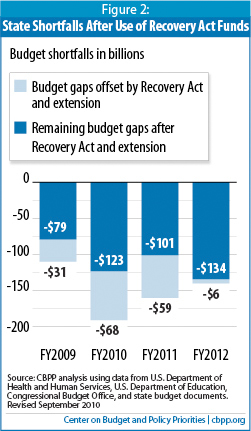
The worst recession since the 1930s has caused the steepest decline in state tax receipts on record. State tax collections, adjusted for inflation, are now 12 percent below pre-recession levels[1], while the need for state-funded services has not declined. As a result, even after making very deep spending cuts over the last two years, states continue to face large budget gaps. At least 46 states struggled to close shortfalls when adopting budgets for the current fiscal year (FY 2011, which began July 1 in most states). These came on top of the large shortfalls that 48 states faced in fiscal years 2009 and 2010. States will continue to struggle to find the revenue needed to support critical public services for a number of years, threatening hundreds of thousands of jobs. States face:
A few charts…
Related…
* State eager to help keep local auto plant going: State officials aren’t saying exactly what they would do to help keep a Japanese carmaker in Central Illinois, but Gov. Pat Quinn hasn’t been shy about doling out big-ticket incentives for other struggling automobile manufacturers.
The real estate manager who helped Rahm Emanuel buy his North Side home testified in a residency hearing today that Emanuel’s renters wanted $100,000 to end their lease early when he returned to Chicago this fall to run for mayor. […]
Levy said he passed the $100,000 figure to Emanuel, who called it “ridiculous.” The counter offer was $5,000 a month for every month early the Halpins left, Levy said. The lease is set to expire in mid-2011.
* And could this $100K gambit by the Halpins been part of the challenge to Emanuel’s candidacy? Maybe…
A lawyer for Halpin called him, [realtor Paul Levy] said, and told him he was concerned that another lawyer Halpin was talking to, Burt Odelson, was speaking to the press about the situation in possible breach of the confidentiality agreement that is a rider on the Halpins’ lease.
Odelson went on to be the lawyer for the lead objectors to Emanuel’s candidacy.
Hmm. Curiouser and curiouser.
* Hearing officer Joe Morris is expected to decide today whether to call Rahm Emanuel’s wife, Amy Rule, to the stand. So far, Emanuel’s lawyers have been able to keep her out of it. But after yesterday’s weirdness, Morris may have no choice…
Rahm Emanuel’s tenant, Lori Halpin, testified Wednesday that contrary to Emanuel’s testimony, she has never seen any of the 100 boxes of personal items he says he left in the basement.
Halpin said she has not found any hidden room where such boxes might be stored. There is a piece of plywood behind some shelves against an outside wall that would lead to an area under a porch. But she would not think people would store valuables there, she said. […]
As part of his argument that he is eligible to run for mayor, Emanuel testified Tuesday that he kept 100 boxes of valuable and sentimental personal items – his wife’s wedding dress, a jacket owned by his grandfather – in the Ravenswood home he rented out to the Halpins a year and a half ago.
A friend of Chicago mayoral hopeful Rahm Emanuel’s wife testified Wednesday that she helped pack away their family heirlooms and other mementos for storage before Emanuel moved to Washington to become President Obama’s chief of staff.
Mee Kim-Chavez spoke at a Chicago Board of Election Commissioners hearing on residency challenges to Emanuel’s bid for the city’s top job. She said she helped Emanuel’s wife, Amy Rule, store 20 to 30 boxes in a crawl space under a home addition they’d built.
“She was going to come back,” Kim-Chavez said of the possessions. “There was no need for her to take them with her to D.C.”
On Tuesday, Rahm Emanuel testified that he didn’t know whether his wife checked the box for a “permanent” address change on the US Postal Service’s form to forward their mail to DC. That could also be a reason for her testimony.
If Morris decides not to call Ms. Rule, then he could wrap everything up today.
* Meanwhile, some of the objectors who got all goofy on Tuesday and didn’t seem to understand how to ask a question and that the questions they asked needed to be pertinent to a residency case complained to Morris yesterday about their treatment in the media…
The proceedings sometimes became chaotic as objectors shouted in protest and held Emanuel’s vehicle sticker up to overhead lights to try to see if it was real.
Some of those citizens pointed out Wednesday they did ask some proper questions, complaining to Morris that the news media portrayed them as a ragtag group of conspiracy theorists and “rejects from ‘The Price is Right.’”
Objector Georzetta “Queen Sister” Deloney challenged the media to stop making fun of her behind her back, saying that from there, “you’re in a real good position to kiss my butt.”
Quite a large number of Tuesday’s objectors appeared to have far higher self-esteem than self-awareness. It was positively painful, which may have been the object of the whole charade. It’s not the media they should be upset with, it’s the people who may have put them up to this scam in the apparent hope that their antics could ruffle Emanuel’s feathers.
Burt Odelson, the lead attorney in the case against Emanuel, appeared to be losing his patience with some of the non-attorney activists who have piggy-backed onto his case. Odelson complains that some of the out-of-left-field questions some of them ask cloud the central legal question of the case.
As one challenger, Dr. Lora Chamberlain, asked Levy whether the disputed “storage area” in the house’ basement where the Emanuels say their valuables are stored is heated, Odelson told her that was a “great” question.
Rahm Emanuel’s wife won’t be subpoenaed to testify as the hearing over residency challenges to his mayoral bid grinds on.
Some of the objectors to Emanuel’s Feb. 22 mayoral bid withdrew their requests to subpoena Amy Rule.
A Chicago Board of Election Commissioners hearing officer also denied a request for a subpoena from another objector who didn’t give a good reason why Rule should be called to testify.
No surprise about the objector’s nonsensical reasoning. Sheesh.
The mayoral-race mystery of where candidate Rahm Emanuel stored boxes of personal items has been solved.
Attorneys for Emanuel visited the house he owns in Ravenswood at 1:30 p.m. Thursday, located the much-discussed “crawl space,” looked inside and found the valuable items Emanuel had maintained he had stored there. They have argued the fact they left the items there while Emanuel went to Washington D.C. to work as President Obama’s chief of staff shows he always planned to return to Chicago — and therefore should be eligible to run for mayor.
Attorney Dana S. Douglas brought photos of the boxes — which include his wife’s wedding dress and other sentimental items — to Emanuel’s ongoing residency hearing just 80 minutes after taking the pictures Wednesday, and he passed copies of the photos around to all the objectors claiming Emanuel is not a bona fide resident of Chicago.
But, of course, one of the objectors refused to be convinced…
“I believe that these photographs are phony and faked. Those could have been taken in my house,” said objector Zakiyyah Muhammad.
* A new school reform proposal working its way through the Illinois House has a section which would severely limit teachers’ right to strike. If there’s an impasse, the state’s Education Labor Relations Board could appoint a fact finding panel which would then come up with a solution. If that’s rejected by both parties, the panel’s proposals are published in local newspapers and the sides then have 10 days to settle. If there is no settlement, the two sides exchange their proposals and then the school boards, by a two-thirds vote, can impose a solution on the unions. If the school boards cannot muster a two-thirds vote, then and only then the union has the right to strike.
However, according to an internal analysis I’ve obtained created by the Illinois State Board of Education, it appears that Chicago’s education board could simply impose their own terms on the teachers union and prevent it from striking. And lots of people believe that this bill is designed to prevent a teachers strike when the current contract expires in 2012.
The legislation would also prevent teachers from including school-year length in their union contracts. Again, this appears aimed at the city, where the school year is one of the shortest in the nation.
* The Question: Should the Chicago Board of Education be allowed to impose its own terms on the teachers union to prevent a strike? Explain.
* Related…
* Illinois lawmakers considering plan to limit tenure, strike rights
Navy Pier officials blame Groupon for a drop in revenue for its biggest annual festival, though they credit the daily-deal site for generating more traffic.
With Winter Wonderfest ticket sales up 12% in volume, but event revenue down about 8% so far, Navy Pier officials are reconsidering whether future partnerships with Chicago-based Groupon are worthwhile.
Groupon offered Winter Wonderland tickets for $9, half the price, one day in early November. Mark Thompson, senior director of marketing for the Pier, estimated some 7,500 Groupons were sold that day — a 283% increase from the same Groupon deal offered for last year’s Wonderfest.
Overall ticket sales are running 12% ahead of last year to date.
But revenue is down considerably: Wonderfest has netted $420,000, compared with $455,000 during the same period in 2009.
While pier officials expect to garner more revenue than last year for the indoor holiday fun fair, which runs through Jan. 2, they plan to evaluate whether to use Groupon again, at least at those deep discount levels.
Well, duh. Groupon claims it is always willing to make a deal with its clients, and that’s what should have been done here to begin with. It’s not really Groupon’s fault that Navy Pier officials didn’t consider that so many tickets could be sold at such a low price.
Groupon has been criticized for this before, but every time I’ve seen a story, it’s about a businessperson who was overwhelmed with the response to its offer and ended up losing money. They either figured that coupon holders would buy other items when they were in their shops (which didn’t happen because the shoppers just wanted the steeply discounted stuff) and/or they simply sold too many items at less than the cost of providing them. From Chicagoist…
We’ve taken advantage of one Groupon that we can remember and have talked with chefs and other entrepreneurs who have felt similarly burned after doing a Groupon. We were also at a recent brunch at a local restaurant where we were also the only person in the restaurant who wasn’t there because of a Groupon deal.
But that’s the Catch-22 with Groupon. It should introduce businesses to valuable new customers, but once the half-off deal is cashed in, does it?
Groupon users are apparently cheapskates. So, buyer beware.
* Speaking of Groupon, they’re helping spark a tech boom in Chicago, according to WBEZ…
In this building, Watermelon Express is like a tiny barnacle stuck to the side of the Groupon battleship.
It’s an example of how Groupon is transforming the culture of Chicago, creating the right atmosphere for small companies like this one to get a start.
RANGNEKAR: I would say the last nine months have been phenomenal. I would not want to be in any other city but Chicago right now.
And here’s the lineage to Groupon.
Eric Lefkofsky and Brad Keywell are serial entrepreneurs who bankrolled Groupon.
They discovered Rangnekar at the University of Chicago business school and funded his company in July.
It’s one of eight startups they’ve invested in this year out of a new $100 million dollar fund.
Keywell says Chicago’s tech scene is starting to get the ego it needs to rival Silicon Valley.
* Rev. Sen. James Meeks has a well-known mouth problem. The problem is he continually inserts his foot into his mouth, particularly on the subject of race. From Fox Chicago…
On Wednesday, Chicago mayoral candidate James Meeks said that only African-Americans should be able to participate in affirmative action programs– and that Hispanics, Asians, and women should be excluded. Later, he tried to clarify his remarks.
Speaking to a candidates’ forum Wednesday on black-oriented WVON radio, the South Side state senator said it’s unacceptable that the share of city contracts going to African-American-owned businesses has shrunk in recent years.
“I think that the word ‘minority,’ from our standpoint, should mean African-American,” Meeks said. “I don’t think women, Asians and Hispanics should be able to use that title. That’s why our numbers cannot improve, because we use women, Asians and Hispanics, who are not people of color, who are not people who have been discriminated against. We fought for these laws based on discrimination. Now, groups that have not been discriminated against are the chief beneficiaries.” […]
Later on Wednesday night, Meeks attempted to clarify his earlier statement, and said that he would remove from City Hall affirmative action set-aside only businesses owned by “white women.”
Video…
React…
“People need those protections that are afforded in that term and the programs that go along with them. I think we need a broader set of protections, not a narrower set of protections,” Gery Chico said.
“I think what is needed is a greater outreach effort to make sure that we have qualified businesses who can contract,” Miguel del Valle said.
“I think the whole point of the set-asides is to integrate and bring people into our economy who had previously been excluded and that includes women and African Americans and Hispanics. There’s a whole list of people,” Carol Moseley Braun said.
* 3 black Chicago mayoral candidates agree on little
* Mayoral hopefuls enlisting help from corporate, civic worlds: “I just accepted this responsibility a week and a half ago,” said Willie Wilson, an entrepreneur and former McDonald’s franchisee, who is volunteering as U.S. Rep. Danny Davis’ finance chairman. “By the end of next week, I should have my arms around this thing.”