* Last week, the Illinois State Rifle Association urged its members to attend a town hall meeting sponsored by “Anti-gun state Represenative” Karen May. A couple of days later, ISRA sent out another message to its membership headlined: “REP. MAY SEEKS TO SILENCE YOUR VOICE ON THE ISSUE OF CONCEALED CARRY”…
In our earlier alert, we urged supporters of concealed carry to attend Rep. May’s town hall meeting and challenge her on her position against self defense. In response to our alert, Rep. May issued a statement saying that her staff would be checking IDs at the door to the meeting and would deny entry to anyone who did not live in Rep. May’s House District.
Recall that the meeting is being held in the Highland Park Public Safety building – a building most certainly built using state and federal tax dollars – your tax dollars. Therefore, we believe it improper - and possibly illegal - for May to deny any well-behaved person from entering a public meeting in a public building.
Do not let May’s threats deter you! It is now especially important for you to attend Saturday’s public meeting.
* Outsiders were apparently allowed into the meeting, according to a LakeForester reporter who covered the event…
Nearly a dozen attendees, most from outside May’s North Shore district, wore yellow shirts or hats that displayed IGOLD (Illinois Gun Owner Lobby Day) decals and messages. Several more gun-rights activists joined members of the Illinois State Rifle Association to help create the standing-room crowd. […]
Evanston resident Blair Garber and Oak Brook’s Jim Nazarowski changed the subject, asking the first two questions about the state’s conceal-carry policy.
Nazarowski told May her opposition is hypocritical based on her thoughtful positions on the other public safety laws she supported. […]
Garber asked May why Illinois wouldn’t be able to manage effectively a conceal-carry law if 49 other states currently have the regulatory framework on the books. The Evanston resident said May’s opposition is actually an extreme position given the national support of conceal and carry. […]
“We are a very different state,” May responded, prompting one of two crowd uproars.
Public anger at Commonwealth Edison arising from the severe storms on June 21 and 30 thwarted efforts by backers of conceal-carry gun legislation to dominate state Rep. Karen May’s (D-Highland Park) town hall meeting Saturday. […]
Though the gun legislation dominated the early part of the question-and-answer period, as soon as Jane Mordini of Highland Park told the group about her longstanding issues with electric service, interest in a firearms debate subsided.
“I’ve lived in this home in Highland Park for 14 years and it’s an ongoing problem,” Mordini said. “This year I’ve been without power on 17 different occasions. It’s the whole block; it goes out all the time.”
May then talked about the day in 1988 when Laurie Dann walked into schools in Highland Park, Glencoe and Winnetka murdering a fifth grader before taking her own life.
“I believe in gun safety. It goes back to when Laurie Dann, who was a mentally ill young woman, took a gun and went on a shooting spree in park districts, camps and local schools,” May said.
Mazerowski interrupted May to opine if one of the teacher’s at Hubbard Woods Elementary School had a gun on May 20, 1988, Nicholas Corwin would be alive today.
Phyllis McMillan of Northbrook responded before May had a chance: “I was there when Laurie Dann came in to that school and a teacher in that building having a gun could have done nothing.”
Severe thunderstorms swept through the Chicago area Monday morning, pelting commuters rushing to get to work and leaving more than 576,000 Commonwealth Edison without power.
The heavy rain, hail and winds have downed wires throughout the city and sent trees into streets.
As of 11 a.m., more than 576,000 ComEd customers were without power after the storms, a spokesman said. The hardest hit region was in the northern suburbs where 253,000 are without power.
At its height, more than 660,000 customers were affected by the outage.
* The Tribune ran a story today about a consequence of the state’s new civil unions law…
The state of Illinois has declined to renew its foster care and adoption contracts with Catholic Charities across Illinois, threatening to end a historic public and private partnership initiated by the Roman Catholic Church a half century ago and displace about 2,500 foster children.
Lawyers for three of the agencies will seek an injunction from a Sangamon County judge on Tuesday.
In a letter sent last week to Catholic Charities in the dioceses of Peoria, Joliet, Springfield and Belleville, the Department of Children and Family Services told all four agencies that the state could not accept its signed contracts for the 2012 fiscal year because “your agency has made it clear that it does not intend to comply with the Illinois Religious Freedom Protection and Civil Union Act.” […]
During a meeting last month, lawyers for the attorney general’s office and DCFS reportedly told Catholic Charities that couples in civil unions must be treated the same as married couples when it comes to providing foster care services, said Peter Breen, an attorney with the Thomas More Society representing Catholic Charities. Spokespeople for the attorney general and DCFS could not comment immediately on Monday.
* The governor was asked about the development at a press conference this morning.
“They made a choice,” Quinn said, about the decision by the various Catholic archdiocese leaders to refuse to place foster children in the homes of couples joined by civil unions. “We’re not going back.”
“If an organization… decides they don’t want to voluntarily participate with the state,” Quinn said, “they have that choice and we honor that choice.”
* Quinn also claimed that the problem would be solved soon.
“We have other entities that are involved in foster care that are willing to assume that duty,” the governor said, without identifying any particular group. However, one group has already stepped up…
David McClure, executive director of Youth Service Bureau of Illinois Valley, believes Catholic Charities left his agency no choice but to take care of the 330 children affected by Doran’s decision.[…]
Because agencies in the area were already approaching capacity, none could add Catholic Charities’ more than 300 families to its caseload all at once. While distributing the workload among different agencies was a possibility, families would be assigned new caseworkers and staff at Catholic Charities would simply lose their jobs. […]
McClure said he believed it could be done as long as all the resources accompanied the operation. DCFS assured him that would be the case.
“I just couldn’t find a good reason not to do it,” McClure said. “If we have the money to do it and they need it to be done, why would we not?”
Peter Breen, executive director of the Thomas More Society, represents Catholic Charities in the dioceses of Joliet, Peoria and Springfield. “The idea that a religious entity needs to check its religion at the door when it takes state money is a false idea,” Breen says.
For decades, he says, Catholic Charities has referred unmarried couples — regardless of their sexual orientation — to other agencies or back to DCFS, the Illinois Department of Children and Family Services.
“If the theory behind civil unions is live and let live, then those folks who are for civil unions can also be for Catholic Charities, and other religiously based adoption agencies, to provide services to the state which are valuable. And [the agencies] can continue to do it without shutting down — without compromising their deeply held religious beliefs,” says Breen.
Kendall Marlowe, a spokesman for DCFS, says separate but equal just isn’t good enough and the state’s anti-discrimination position is clear.
Since we last talked, the Joliet, Peoria and Springfield dioceses sued the state to force the issue as to whether they’re exempt from placing children with same-sex civil union partners. Those Catholics want to continue referring “unmarried” folks to other agencies, as they’ve done all along.
As much seeing my tax dollars go to a group that unfairly singles out gays makes me cringe, I hope they win their lawsuit. You see, these church adoption services are so superior to any state-run (and most private) programs that by applying their own greater good principle, I can accept something somewhat distasteful in consideration of the more pressing need for these children to find stable homes.
* It’s summertime, and since the GA isn’t coming back to town to deal with the capital bill, we can all relax. So, in keeping with our more laid back mode, let’s lighten it up a bit today.
* A very good friend of mine recently pleaded with me to give some props to his favorite restaurant, Popeye’s Bar-B-Que. Tedd eats there four days a week and he wants to help them spread the word about an important milestone. The restaurant sent this over…
Clay’s Popeye’s Bar-B-Que is celebrating 50 years in business and has made a major decision to raise the bar higher and higher! Clay’s Popeye’s Bar-B-Que Sauce is going on sale in house this week, now that you’ve tried all the rest, welcome home to the best.
We welcome you to stop in and try the sauce with a recipe that’s over a 100 years old. Try the tantalizing pork and beef and the lip smacking ribs - it will leave you wanting more! While you’re here, don’t forget to ask for a shot of Dee Blazin’ Heifer Sauce.
Clay’s Popeye’s Bar-B-Que is located at 11th and South Grand Ave. East, Springfield, IL. Hours of operation are Tuesday thru Saturday 11:00 a.m. 6:00 p.m. Don’t forget to visit our website www.popeyesbbq.com.
* The Question: What’s your favorite lunchtime eatery? Explain.
And, just as an FYI, I’m not getting anything (other than getting Tedd off my back) out of that little plug for Popeye’s.
* As you already know, the Illinois Supreme Court will issue a ruling today at 9 o’clock about the constitutionality of the capital construction bill. The Tribune has a good primer you can read while you wait…
The Illinois Supreme Court is expected to decide today the constitutionality of Gov. Pat Quinn’s showcase $31 billion public works program, with an adverse ruling likely to throw a state in financial turmoil into even deeper disarray.
Sinking in billions of dollars in red ink despite adopting a massive income-tax increase, Illinois government could face a tumultuous time resurrecting a funding scheme to pay for the “Illinois Jobs Now” program, begun in 2009 to help build the state out of the recession. […]
The state has borrowed roughly $4 billion to get the construction projects started, said Kelly Kraft, a spokeswoman for Quinn’s budget office. Kraft said $1.3 billion of that is left to spend.
Since the construction program began, the state has raked in more than $640 million from the increases in driver fees and additional taxes, according to documents on the state treasurer’s website.
Check the Supreme Court’s website both here and here. Their Twitter feed is here.
This post will be updated with the ruling.
*** UPDATE 1 *** The decision is here. They reversed the appellate court and upheld the law.
From the opinion…
The appellate court held that the single subject of Public Act 96–34 was revenue, based on its official title, “An Act concerning revenue.” However, defendants assert before this court that the single subject of Public Act 96–34 is capital projects. Defendants are not limited solely to the contents of the title of an act in offering a single subject rationale. Boclair, 202 Ill. 2d at 109-10; see also Olender, 222 Ill. 2d at 140. Moreover, capital projects is a legitimate single subject, one which is not “so broad that the rule is evaded as ‘a meaningful constitutional check on the legislature’s actions.’ ”
Having determined that the subject of capital projects is legitimate, we must examine the provisions in Public Act 96–34 to discern whether they have a “natural and logical connection” to that subject. Sypien, 198 Ill. 2d at 338-39. In doing so, we find that the substantive provisions in Public Act 96–34 clearly are connected to capital projects in that they establish increased revenue sources to be deposited into the Capital Projects Fund. The few provisions that do not directly raise revenue are still related to the overall subject of the Act in that they help to implement the other provisions.
More…
According to plaintiffs, even assuming that the single subject of Public Act 96–34 is capital projects, several provisions in the Act bear no relation to that subject because they have the effect of allocating money to the General Revenue Fund rather than to the Capital Projects Fund. We do not find plaintiffs’ argument persuasive.
* The Court gave some examples of “real” violations of the Single Subject clause, including…
Finally, in Johnson v. Edgar, 176 Ill. 2d 499, 517 (1997), the enactment was held to be an “egregious example of the legislature
ignoring the single subject rule.” What started as an 8-page bill became a 200-page bill, encompassing such diverse topics as child sex offenders, employer eavesdropping, and environmental impact fees imposed on the sale of fuel. Rejecting the State’s suggestion that the subject of the bill was “public safety,” we held, “[w]ere we to conclude that the many obviously discordant provisions *** are nonetheless related because of a tortured connection to a vague notion of public safety, we would be essentially eliminating the single subject rule as a meaningful constitutional check on the legislature’s actions.”
And then concluded…
In contrast to the cases described above, there are no “smoking gun” provisions in Public Act 96–34 which clearly violate the intent and purpose of the single subject rule. On the Act’s face, all of the provisions have a natural and logical connection to the single subject
of capital projects.
Furthermore, a review of the extensive legislative debate preceding the enactment of Public Act 96–34 supports our conclusion that the Act does not violate the single subject clause. […]
In the debate on Public Act 96–34, although a few legislators remarked that they disliked some of the revenue sources, particularly video gaming, they also commented that the bill was reached through compromise and with the goals of putting people back to work and improving the state’s infrastructure. We interpret these remarks as legitimate compromise on a bill which comprised a single subject. Indeed, there is a difference between impermissible logrolling and the normal compromise which is inherent in the legislative process.
* The opponents also contended that the capital budget implementation bill was unconstitutional. Not so, say the Supremes…
Plaintiffs contend that Public Act 96–37 “creates entirely new acts, launches wholly new programs, and initiates laws that have nothing to do with implementation of the State budget.” However, there is no authority to support the proposition that a budget implementation bill may only makes changes to existing programs and may not create new programs. After much consideration, we find that all of the provisions in Public Act 96–37 bear a natural and logical connection to the single subject of implementation of the state’s capital budget.
* From Senate President John Cullerton’s office…
“The Supreme Court’s endorsement of the construction program affirms the bipartisan work done by the General Assembly. This ruling serves as a reminder of just how important the 2009 jobs program was and what the General Assembly can accomplish when politics is set aside and people participate.”
* The opinion knocked down every single objection brought by the plaintiffs, including this one…
In addition to previously existing taxes, the provision adds a new tax of 4.6 cents per gallon on distributors of beer, 66 cents per gallon on distributors of wine, and $4.05 per gallon on distributors of spirits. In count III of their complaint, plaintiffs contend that there is “no expressed or sustainable rationale whatsoever for the huge difference in the gallonage taxes as between the categories of beer, wine and spirits” and, therefore, the tax increases in article 900, section 945, violate the uniformity clause. We disagree.
Plaintiffs acknowledge that the percentage of alcohol is higher by volume in wine than in beer, and higher in spirits than in both beer and wine. It is well established that higher taxes may be constitutionally imposed on alcoholic beverages that have a higher alcohol content, based on the rationale that beverages with a higher alcohol content contribute to various societal ills and higher taxes on those beverages promotes temperance.
So much for Rocky Wirtz’s real reason for challenging the capital bill.
* News coverage so far…
* Sun-Times: Supreme Court upholds state construction bill funded by video poker
* Daily Herald: Illinois Supreme Court upholds video gaming
* Tribune: Illinois Supreme Court upholds construction plan, video poker law
*** UPDATE 2 *** The governor’s press conference this morning will be broadcast live on the Internet. It was supposed to start at 10, but it’s been delayed. Click here to watch or listen.
* Chicago Mayor Rahm Emanuel has won deserved praise for shaking things up in Chicago. His latest move is sure to be popular…
Mayor Rahm Emanuel is cutting from 500 to just 30 the number of credit cards used by local government agencies — and banning the use of petty cash altogether —after alleged abuses that ousted the chiefs of the CHA and Chicago Park District.
Government employees will also be expressly forbidden from spending taxpayers’ money on everything from alcohol, flowers, office decor and restaurant meals within a 50-mile radius of Chicago to sponsorships, charitable donations and parties celebrating holidays, birthdays and employee appreciation.
To guard against future abuses, only five credit cards will be issued to each of six agencies: the CTA, CHA, Park District, Chicago Public Schools, City Colleges and Public Building Commission. Their use will be confined to top executives, whose expenditures will be posted monthly to shine the light on credit-card spending.
Security details for several city public officials will be reduced or eliminated, the Chicago Police Department said tonight.
The Police Department offered few details on the moves, but said they will put more cops on the street and save taxpayers more than $650,000.
Mayor Rahm Emanuel’s security detail already has been reduced and the number of sworn officers guarding Police Superintendent Garry McCarthy will decrease.
The security details for Ald. Edward Burke, 14th, chairman of the Chicago City Council’s finance committee, and City Treasurer Stephanie Neely will be reduced. Burke has had city-paid bodyguards since the “Council Wars” era of the 1980s, and questions have arisen about his continuing need for security at taxpayer expense.
Dr. Anita Blanchard is widely known as the obstetrician who delivered Barack and Michelle Obama’s two daughters, Malia and Sasha. Her husband, Chicago businessman Martin Nesbitt, is a basketball-playing buddy of the president and has been described as one of his closest friends. […]
Mayor Rahm Emanuel has nominated Blanchard to serve on the Commission on Chicago Landmarks, the panel entrusted with safeguarding the city’s architectural treasures. Could the fact that Nesbitt donated $5,000 to Emanuel’s mayoral campaign have anything to do with the nomination? This is Chicago, after all.
Blanchard, it turns out, is not the only bewildering nominee put up by Emanuel.
At Thursday’s commission meeting, it became clear that the mayor is not going to reappoint four highly respected members of the panel, including two architects (Ben Weese and Edward Torrez), a National Park Service official with a master’s in historic preservation (Phyllis Ellin) and a preservation-minded financial services consultant (Yvette Le Grand).
Instead, he’s backing Blanchard and a well-known local chef, Chinatown’s Tony Hu, along with two career politicians, former Ald. Mary Ann Smith and former Cook County Assessor Jim Houlihan, who bring at least a modicum of experience to the table.
Mayor Rahm Emanuel… named an attorney who kept him on the Election Day ballot to a board overseeing port authority issues, one of more than two dozen appointments made ahead of the holiday weekend.
Michael K. Forde, a partner at Mayer Brown, will serve on the Illinois International Port District Board, along with four others. Board members are paid $20,000 a year and the chairman gets $25,000.
Forde served as one of Emanuel’s top attorneys after more than 20 legal challenges were filed claiming Emanuel wasn’t eligible to run for mayor because he abandoned his Chicago residency when he went to work for President Barack Obama. The Illinois Supreme Court eventually sided with Emanuel, who went on to win overwhelmingly.
“His private sector experience navigating complex multi-billion dollar transactions will be greatly needed on the Port Authority Board as it moves forward,” said Chris Mather, an Emanuel spokeswoman.
* Related…
* Nonprofit at the head of the class with ‘political establishment’ - Group touted by Emanuel trains teachers for the toughest turnaround schools, but critics ask, ‘What about the rest?’
* Phil Rosenthal: The mission is the message: “I don’t buy into this ‘government as a job-engine creator’ and I also don’t buy the ‘government is a problem,’” Emanuel said. “I think both of those are wrong. Anybody who’s looked at either economic history or you talk to business leaders, government has a role to play, and what I’m trying to do is focus on that role.”
* Chicago parking rates among highest in nation: Chicago drivers pay the fourth-highest daily parking rate, and seventh highest monthly parking rate in the United States, according to a new survey.
* Last week, Attorney General Lisa Madigan trumpeted a national settlement with JP Morgan Chase and 23 other states over bid-rigging. The national settlement totaled $92 million. Illinois received $2.2 million. Bank of America and UBS previously settled with the states for $67 million and $90.8 million, respectively, so this was obviously a very widespread practice. From Madigan’s press release…
[The] agreement centered on allegations that from 2001 to 2005, JPMC conspired with financial institutions and brokers to rig bid prices for municipal derivatives, circumventing the competitive bidding process. In some instances, JPMC and other financial institutions communicated directly with each other, and not through brokers, to fix prices or to fix rates or key terms of these transactions. Brokers also frequently offered JPMC and other financial entities the unfair advantage of reviewing other bids, thus rigging who would win the deal.
Municipalities, schools and other organizations typically issue municipal bonds to fund capital projects. Once bonds are issued, the money is typically placed into accounts to spend as the local entity incurs expenses for the project. Because the money from the bonds does not need to be spent immediately, the entity that issued the bonds typically seeks to invest the money and may also use strategies to manage or transfer the bond’s interest rate risk. These investment accounts and risk management products – which are collectively called “municipal bond derivatives” – are offered by large financial institutions.
* Some are unimpressed, to say the least. The attorneys general settled with JP Morgan Chase at about the same time as the Securities and Exchange Commission hit the company with a $228 million fine. That fine was passed off as a mere slap on the wrist by Matt Taibbi, a vicious critic of the financial services industry…
This is one of the best examples we’ve had yet of the profound difference in the style of criminal justice enforcement for the very rich and connected, versus the style of justice for everyone else. This scam that Chase, Bank of America and UBS were involved with was no different in any way, really, from old-school mafia-style bid-rigging scams.
What these banks did is they got together and carved up territory between them, arranging things so that they wouldn’t be bidding against each other in municipal debt auctions. That means the 18 different states involved in these 93-odd deals all got screwed out of the best prices, leaving the taxpayers in those places severely overcharged for their public borrowing.
This is absolutely no different from what mafia groups in New York used to (and probably still do) do for public contracts – the proverbial five families would get together, divide up the boroughs and neighborhoods between them, and each family would individually buy or intimidate their way into the bidding process, corrupting the game so that the public had to overpay for their garbage collection or their construction labor or whatever. The only difference here is that we’re talking about debt, not garbage. But the concept is exactly the same; it’s the same crime.
If Khuzami’s defendants had been a bunch of Italians from Howard Beach, they would be facing RICO charges and would be looking at years in prison, plus seizure of all their ill-gotten gains, in addition to civil suits and penalties.
As it is, as my friend Eric points out, the endgame for banks like Chase is, “Admit nothing, pay two hours of revenue and all good!”
* And Bill Singer at Forbes wants to see far more serious penalties against these corporations, instead of relatively minor fines…
[The] DOJ and SEC continue to slam the individual employees, frequently with industry bars, but the member firms/banks always seem to be able to obtain an exemption from the Bad Boy provisions. The UBS and BOA cases are perfect examples. At what point does the gestalt result in the simple syllogism that if an organization’s employees are being indicted and administratively pursued, that it’s no longer solely an issue about “our former employees” and becomes an issue about the company itself? If the SEC won’t shut down a UBS or BOA for, say five days, after hundreds of millions in muni fraud, then how about refusing to give the No-Action Letter relief for 3 months, or 6 months, or even a year?
Andrew Davis, executive director of the state agency running the beleaguered College Illinois prepaid tuition program, is out.
Gov. Pat Quinn’s newly installed Illinois Student Assistance Commission on Friday removed him from day-to-day responsibilities and put him on paid administrative leave.
Appointed in his place is an interim executive director, John Sinsheimer, chief financial officer of ISAC from 2007 to 2009. More recently, Mr. Sinsheimer has been director of capital markets for the state of Illinois, responsible for managing state debt issuance.
Mr. Davis will continue collecting his $198,000 annual salary for an indeterminate period. The previous commission gave Mr. Davis a 10% raise in February and extended his employment contract until the end of 2012. He’s due a significant severance if he’s let go unless he’s fired for cause. The exact amount couldn’t be learned immediately.
* Overtime, scheduled pay raises and less use of part-time employees all contributed to this phenomenon…
The state of Illinois paid fewer employees more money in 2010 than in 2009, a Dispatch/Rock Island Argus analysis of state payroll reports indicates. It was the second consecutive year that more money was paid to fewer workers. […]
– During calendar year 2010, 78,567 people got paychecks from the state, a decrease of 369 from the 78,936 paid in 2009. In 2008, the state employed 82,681 people at some point in the year.
– Even as the number of people paid dropped in 2010, the payroll went up by $94.8 million, from $4.35 billion in 2009 to $4.45 billion in 2010. In 2008, the state paid $4.30 billion in payroll
The analysis of the year-end reports also shows that in 2010, as in 2009, the number of people receiving less than $50,000 dropped, while the number making more than $50,000 grew, most dramatically in the $100,000-$150,000 range. The number of people in that range increased by 613, to 3,147 in 2010, after having increased by 314 from 2008 to 2009.
There are lots of different angles to Gov. Pat Quinn’s highly controversial decision to unilaterally refuse to pay scheduled, contractual pay raises to unionized state employees, so let’s take them one at a time.
This is not “new” news:
Chicago reporters are the only ones with access to the governor these days (Quinn has held just one Springfield press conference in months). The city’s reporters probably don’t know that the House Republicans — and even some House Democrats — have been agitating since at least April to somehow stop AFSCME’s scheduled pay raises.
The issue burst into the open during a late April hearing of the House Human Services Appropriations Committee when the state’s director of Rehabilitation Services threatened to shut down the Illinois School for the Deaf and the Illinois School for the Visually Impaired if the committee followed through on its proposed overall spending limits. Republicans thundered that AFSCME’s pay raises should be cut before the administration even considered such a drastic closure ideas. Even Democrats got into the act during the hearing, saying the union should, at the very least, be brought to the table to talk about the upcoming raises.
House members openly admitted that they’d eliminated AFSCME’s pay raises from the budget when they overwhelmingly passed an appropriations bill on May 12th. That approp bill shorted numerous agency personnel lines by millions of dollars. Rep. Bill Mitchell (R-Forsyth) even cited the elimination of the pay raises as a reason he voted against the bill.
So, the governor is absolutely right that this shouldn’t be a surprise to anyone.
Both sides have good points
The governor rightly says that the Illinois Constitution gives the General Assembly sole power to make appropriations, then correctly quotes the state’s Labor Relations Act: “Subject to the appropriations power of the employer, employers and [public employee unions] may negotiate multi year collective bargaining agreements pursuant to the provisions of this Act.”
So, Quinn says, the lack of legislative appropriations for raises means there is no legal authority for the raises. And considering that the issue of union pay raises is part of the legislative record on that appropriations bill, it certainly sounds like a valid argument.
Then again, the General Assembly went farther than just cutting pay raises out of the budget. In some agencies, personnel costs were slashed well beyond the price of the scheduled raises. So, it may not be as cut and dried as Quinn says.
Plus, AFSCME Council 31 Executive Director Henry Bayer claimed last week that the statute Quinn is using as vindication was actually pushed by AFSCME back in the day. Bayer explained that the law was drafted to allow local governments to negotiate multi-year union contracts.
Union officials also point to a provision in their state contract which mandates that the administration “shall not unilaterally change any bona fide past practices and policies with respect to salaries, hours, conditions of employment, and fringe benefits enjoyed by members of the bargaining units without prior consultation and negotiations with the Union.” That sure looks like Quinn can’t do anything without first negotiating a change.
The union has taken its case to an arbitrator, which could force the administration back to the bargaining table, where the union is under no real obligation to concede anything. They’ve also filed a federal lawsuit.
Hollow blame game
The governor blamed the General Assembly and Rod Blagojevich for his predicament last. The Legislature got the blame for failing to appropriate enough money to fund the pay raises, and Blagojevich was hit for negotiating the contract’s pay raises to begin with. Fair enough.
But Quinn is the one who really hemmed himself in by negotiating an election-year agreement with AFSCME to not lay off workers or close state facilities until next June. Without that agreement, Quinn wouldn’t be in such a bind today. Then again, without that agreement, Quinn might’ve lost the election.
Contradictory explanations
The order to rescind the raises was issued by the Illinois Department of Central Management Services, which oversees the AFSCME contract. The original explanation I got from CMS was that they believed alternate strategies, like eliminating empty job positions, would invite an AFSCME lawsuit. However, eliminating positions has always been held forth as a way to manage the appropriations shortage, and it is clearly within the administration’s right. The governor then said that he wanted to keep the government functioning properly, so he decided to avoid eliminating positions. Quinn also said he’d be “happy” to meet the union in court when it files a lawsuit over the pay raise issue.
In a further step to uphold its collective bargaining agreement with the state of Illinois, the largest union representing state employees today filed suit in federal court in Springfield.
The American Federation of State, County and Municipal Employees (AFSCME) Council 31 asked the United States District Court for the Central District of Illinois to rescind the pay freeze announced one week ago by Governor Pat Quinn, and to restore the negotiated pay schedule for the nearly 30,000 affected employees in 14 state agencies, boards and commissions.
The union’s lawsuit names as defendants Gov. Quinn, Acting Director of the Illinois Department of Central Management Services (CMS) Malcolm Weems, and the State of Illinois.
The AFSCME suit argues that Governor Quinn’s action to cancel scheduled pay increases is a violation of provisions against the impairment of contracts found in the United States and Illinois Constitutions, that the pay freeze constitutes a denial of the equal protection of laws under the federal and state constitutions, and that by violating the union’s collective bargaining agreement it amounts to breach of contract under the Illinois Public Labor Relations Act.
Riverboat casinos battling the racetrack industry lost an appeal Friday when the 7th Circuit Court of Appeals upheld a law signed by convicted former Gov. Rod Blagojevich, which siphoned money from casinos to support racetracks.
The law, dubbed the Racetrack Bill and referenced repeatedly in Blagojevich’s trials, was passed by a majority of the state legislature in 2006 and 2008 and signed by Blagojevich both times. It aimed to correct a blow dealt by riverboat casinos perceived to be luring away gambling dollars, giving racetracks proceeds from a 3 percent tax on riverboats to reverse the damage.
Casinos with annual earnings less than $200 million were exempt from the tax, leaving four Illinois riverboat casinos suing five racetracks and Blagojevich, who they accused of setting up the tax in cahoots with racetrack executive John Johnston, who owns two tracks.
Quinn said Friday he hopes the court upholds the law. If they don’t, he says lawmakers would have to come back to Springfield to deal with the situation, something he called “a job emergency.”
Quinn said they should be prepared to take action again if the Supreme Court strikes the law down. The governor said he would be “open minded” to raising taxes on cigarettes to pay for construction projects. But some lawmakers said they should stick to the original funding sources while finding a way to redraw the legislation so it passes legal muster.
A spokesman for House Speaker Michael Madigan said an alternative funding plan for the construction program has not been discussed because “we are confident that the bills passed by the legislature will be upheld.”
* Listen to today’s gubernatorial press conference…
* If they have a special session, perhaps the GA can override some of the governor’s budget vetoes. Then, maybe, the regional superintendents will be paid. But this press release by the Illinois Association of Regional Superintendents of Schools suggests a deal is imminent…
“A meeting took place with the Illinois Association of Regional Superintendents of Schools (IARSS) and the Governor’s staff. We have agreed that the Regional Offices of Education will remain open and the Regional Superintendents will fulfill their duties. The Governor’s staff indicated that there is a desire to fund the salaries of the Regional Superintendents and their Assistants. There will be future meetings to work out the details.”
In fact, I’m told, a deal is imminent.
But, get this, the governor will reportedly use his 2 percent “reserve” authority to move money around within the state budget. The governor line-item vetoed the superintendent salaries. Those salaries were appropriated from the Common School Fund to the Illinois State Board of Education. Keep in mind, however, that his reserve authority applies only to intra-fund or intra-agency cash moves. He can’t move money from the Department of Corrections to the Board of Education, for example.
So, in other words, the governor will apparently be moving money to the regional school superintendents from the very same state funding source that he vetoed.
If true, then that was possibly the stupidest veto ever. Somebody was simply not thinking ahead.
* So, what happens if a previously vetted casino town elects a corrupt mayor? Perhaps they should explain this idea a bit more…
Des Plaines Mayor Marty Moylan and the mayors of seven other riverboat casino towns recently met with Gov. Pat Quinn to discuss the merits of the state’s massive gambling expansion plan. […]
Des Plaines, which was awarded the 10th and what was then the final casino license in late 2008, is gearing up for the July 18 opening of the Rivers Casino. […]
Moylan said the mayors asked Quinn to keep the oversight of any new gambling licenses under the Illinois Gaming Board’s authority.
“They should have to go through the same vetting process that we did,” he said.
Caterpillar Inc. avoided approximately $2 billion in U.S. taxes in recent years by fraudulently using Switzerland and Bermuda subsidiaries, according to a report on an executive’s lawsuit.
The executive, Daniel Schlicksup, alleges Peoria-based Caterpillar sold and shipped parts from a warehouse in Illinois and improperly accounted for $5.6 billion in profits on those deals to an arm in Geneva, Switzerland, according to Bloomberg News.
Now we know why they’re so sensitive to Illinois taxes. Apparently, they hate paying them so much they allegedly use foreign subsidiaries to hide taxable income. From Reuters…
The Geneva subsidiary, Caterpillar SARL, or CSARL, had no spare-parts employees and did no work to sell or ship the parts, Schlicksup claims in the lawsuit. The parts are shipped to dealers around the globe from a warehouse in Morton, Illinois, about 10 miles southeast of Caterpillar’s Peoria headquarters, according to the lawsuit, which also describes the spare-parts business as the company’s most profitable line.
“In order to shift profit to Switzerland, Caterpillar pretended to shift the management and control of a large portion of its most profitable business segment to Switzerland, but in reality the management and control of this business remains in the United States,” Schlicksup said in an 88-page declaration he filed as part of the suit.
“Everything is done the same way it was done before except that on paper, now CSARL is doing it, not Cat, while in practice Cat is doing everything,” O’Day said in an interview. While the Swiss unit nominally buys the parts from suppliers, it maintains its inventory in the U.S. unit’s Morton warehouse, where Caterpillar Inc. (CAT) employees ship it and send invoices, he said. […]
While the Swiss structure moved income to Geneva, Caterpillar had New York-based accounting firm Ernst & Young LLP devise a complementary “Bermuda strategy” aimed at returning some cash to the U.S. without paying tax on it, according to a Nov. 13, 2006 memo from Pricewaterhouse and internal corporate tax summaries from 2006 and 2007 written by Schlicksup’s then- boss, Robin Beran, Caterpillar’s chief of global taxation. The documents are filed as exhibits to the lawsuit.
Starting this fall, the Indiana Department of Education will no longer require Indiana’s public schools to teach cursive writing.
State officials sent school leaders a memo April 25 telling them that instead of cursive writing, students will be expected to become proficient in keyboard use.
The memo says schools may continue to teach cursive as a local standard, or they may decide to stop teaching cursive altogether.
The debate over the need for cursive isn’t a new one. The worries range from more emotional concerns, like a growing detachment from the written word, to more practical ones, such as fears that a sloppy, simplistic and inconsistent signature is much easier forged.
Those who support the move, meanwhile, say that classroom time is limited and teachers should use the time they have to build computer skills and typing prowess at a time when more and more communication takes place online.
* The Question: Should Illinois make cursive instruction optional? Take the poll and then explain your answer in comments, please. Thanks.
*** UPDATE *** Well, this is kinda funny. According to the Board of Education, Illinois never has mandated cursive writing instruction. It’s still an interesting question, though, so carry on.
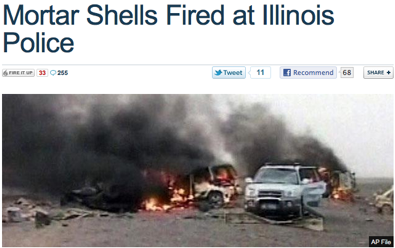
It’s a story about Peoria firefighters and police officers who were attacked by professional bottle rockets while responding to a dumpster fire at Taft Homes the other night. Notice the photo? It portrayed a vehicle destroyed by explosives amid a street that is littered with debris. It has nothing to do with what happened in Peoria. Nothing. It’s odd, because the photograph that ran in the Journal Star was pretty dramatic in its own right.
The headline screams “mortar shells” were lobbed at firefighters, but the article says that “mortar-style fireworks” was used.
Whatever. It’s Fox News. The entire organization has only a casual relationship with the truth.
A large-scale illegal fireworks display in a housing complex adjacent to the state’s largest Fourth of July celebration turned into what police termed a near-riot Monday as tens of thousands of revelers tried to filter out of Downtown.
As the grand finale of the Red, White and Boom! event exploded over the Illinois River, emergency responders were called at 9:46 p.m. to a trash bin fire in nearby Taft Homes, where commercial-grade fireworks had been shooting into the sky since before the riverfront show began.
A fire engine and two Peoria police officers responded, but encountered what police described as a crowd of hundreds of people and an impassable Hancock Street choked with trash and fireworks — both live and spent. The debris blocked access to the burning trash bin.
Police at that point began ordering the crowds to disperse, and firefighters hosed down the live fireworks and smoldering remnants of spent shells. That’s when mortar-type fireworks began firing toward and exploding near the officers and firefighters. Some people also hurled bottles and rocks, according to police.
At least three shells exploded on the engine, causing burn marks, and one hit a firefighter in the shoulder, charring his heat-resistant gear and temporarily initiating hearing loss. Division Chief Gary Van Voorhis said Tuesday the firefighter declined medical attention at the scene and remained on duty.
A few weeks ago, hundreds of people, most of them white, gathered in Lincoln Park to celebrate Peace Fest, which featured DJ sets, jam bands, and enough open marijuana smoking that passersby on surrounding streets could get a contact high. Not that anyone was complaining.
That week at the Cook County courthouse at 51st and Wentworth, dozens of people, almost all of them black men, went before a judge to face marijuana possession charges. Some of them ended up with fines and jail time.
Yes, marijuana is illegal. Yet studies show—and come on, everybody knows—that it’s widely used by all racial groups. By and large, however, black people are disproportionately getting busted for it.
The ratio of black to white arrests for marijuana possession in Chicago is 15 to 1, according to a Reader analysis of police and court data. And by the time the cases make their way through the court system, the gap widens even further: the ratio among those who plead or are found guilty is 40 to 1.
Chicago police made tens of thousands of arrests in 2009 and 2010 for marijuana possession, including 47,400 in which that misdemeanor was the most serious charge. So how egregious are the racial discrepancies?
• Of those arrested, 78 percent were black, 17 percent were Hispanic, and 5 percent were white.
• In those years 4,255 people pleaded or were found guilty of low-level marijuana possession after being arrested in Chicago: 89 percent were black, 9 percent were Hispanic, and 2 percent were white.
Maybe now would be a good time for Gov. Pat Quinn to pay off his bet with Wisconsin Gov. Scott Walker. After all, according to AFSCME, they’re practically soul brothers these days.
Quinn bet Walker way back in January that the Bears would beat the Packers for the NFC Championship title. The Bears lost, and Quinn was supposed to volunteer at a Wisconsin food bank wearing a Packers jersey.
But Quinn canceled his scheduled Milwaukee appearance after Walker attempted to strip his state’s public employee unions of their collective-bargaining rights and the state exploded with political rage.
Tens of thousands of protesters descended on the Cheesehead Statehouse and the entire Wisconsin Senate Democratic caucus fled to Illinois in an attempt to halt Walker’s agenda. Quinn firmly declared his solidarity with the teeming northern masses, welcomed the fleeing Democrats with open arms and declared Walker an anti-union heathen.
Quinn made some good points during Wisconsin’s troubles. For instance, Quinn was proud of being the first governor in Illinois history to persuade AFSCME to reopen its contract and defer its members’ pay raises. That was no mean feat, even if Quinn did have to agree to no layoffs and no facility closures.
AFSCME, which represents state workers, is about the most obstinate group of hardheads you’ll ever meet. They take their contracts seriously, and they’ve never budged before. Even so, Quinn cut them a decent deal last summer and the union endorsed his re-election soon after.
Quinn has since insisted that his way of doing things was far superior to those heartless right-wingers to our north. They should talk to the unions and work things out, he said. Unions are reasonable if you treat them with respect and dignity.
The problem with kicking the budgetary can down the road is that the bills eventually come due.
AFSCME’s pay raises were deferred to July 1 of this year, and the General Assembly didn’t appropriate enough money to cover all of them.
Rather than slash much-needed programs, the Legislature cut personnel costs. In the end, the budget shorted payrolls for 14 state agencies.
But Quinn had boxed himself in. He couldn’t lay off anybody or close a state facility because he had given AFSCME his word. His staff says he couldn’t move money around within agencies to pay for the raises without harming crucial programs. He couldn’t veto the budget, because then the Republican minority would have a seat at the table, and they would demand even more cuts and wreak loads of havoc.
Ignoring the Legislature’s mandated payroll cuts and handing out the promised raises anyway could result in a minor fiscal crisis next year if he couldn’t persuade the General Assembly to increase the appropriations.
So, the governor decided to reinterpret an old state law that was originally written to protect union contracts in a way that allowed him to break AFSCME’s current state contract.
Without first sitting down and attempting to cut a deal with the union, Quinn unilaterally declared there would be no pay raises for those 14 agencies.
AFSCME was furious with Quinn’s move and the way he handled it. The union’s executive director blustered that Quinn was actually worse than Walker ever was.
Gov. Walker can be excused for experiencing a hugely satisfying rush of schadenfreude right about now.
If you can’t honor your union contracts, Gov. Quinn, you can at least honor your bet.
Go get yourself a Packers jersey, swallow hard, and take off for the Great White North.
A legislative committee could vote next week to block Gov. Pat Quinn’s plan to rescind pay raises for 30,000 state government workers. […]
However, Rep. Angelo “Skip” Saviano, R-Elmwood Park, a co-chairman of the committee, said there is little time for the committee members to review the 376-page emergency rule.
“I don’t know if we are going to be ready or willing to take it up,” Saviano said Thursday. “I would think something as complicated as this would need more time.”
The committee’s next scheduled meeting is in August. An emergency rule can stay in effect for up to 150 days.
* Also, Don Moss has penned an open letter to JCAR…
Dear Members of the Joint Committee on Administrative Rules -
We advocates for people with disabilities do not begrudge pay raises for the thousands of hardworking state employees. However, we do wish to point out the inequities between what they receive and what their private non profit community services “partners” have received over the past several years. Please see the two charts below and keep them in mind when 1) You consider the Governor’s freeze on state raises, and 2) the next time you vote on the funding of community service providers.
And here are the charts. Click the pic for a larger view…
* 4:30 pm - I’ve been distracted by other things, but the Illinois Supreme Court’s press office called a while ago to say that the Court will issue an opinion in the capital bill case on Monday morning. The Trib has a short piece on it as well…
The Illinois Supreme Court will release a decision Monday on the legality of a 2009 law that raised liquor taxes and legalized video poker around the state, the high court said today.
Supreme Court spokesman Joseph Tybor said the decision is expected to be filed by 9 a.m. The decision could strike down or uphold the wide-ranging legislation meant to raise billions of dollars for construction projects.
A state appellate court ruled in January that lawmakers didn’t properly assemble the pieces of a deal that legalized video poker for bars, restaurants and truck stops and raised taxes on candy, beauty products, liquor and license plate stickers.
This is the first time I can recall that the Supremes have announced a decision release this far in advance.
In response to Gov. Quinn’s Friday afternoon announcement canceling scheduled pay increases for some 30,000 employees of 14 state agencies, the largest union representing employees in those agencies is seeking a ruling from an independent arbitrator to enforce the terms of its collective bargaining agreement with the state of Illinois.
The American Federation of State, County and Municipal Employees (AFSCME) Council 31 contends that by rescinding a negotiated pay increase, the Governor has violated the union’s contract.
In January 2010, Edwin Benn served as a mediator to resolve the union’s grievances and litigation over layoffs threatened by Quinn. The resulting grievance resolution—which provided for tens of millions of dollars in cost-savings, wage deferrals and a voluntary furlough program, as well as a bar against state employee layoffs—gave Benn the authority to resolve disputes regarding its implementation. He retained that jurisdiction under the terms of a subsequent agreement which again modified the wage provisions of the union contract.
Following the AFSCME request, Benn convened a preliminary conference. Today he issued a scheduling order directing both the state and union to submit briefs on the matter by July 16. Benn could then rule on the question or schedule a further evidentiary hearing. The arbitrator’s ruling may be appealed in state court.
“By refusing to pay state employees in accordance with the contract, Governor Quinn has violated an agreement that was fairly bargained and legally binding,” AFSCME executive director Henry Bayer said. “This is about integrity. What is the value of the governor’s word if he can break it? What is the value of a contract if it can be ignored? Bringing this matter before the arbitrator is our union’s first step in seeing that the contract is upheld and integrity is restored.”
Union attorneys continue to review other legal options. Seeking an arbitrator’s ruling does not preclude AFSCME from filing suit in state or federal court.
“Frontline employees do the real work of state government,” Bayer said. “They care for the disabled, protect children from abuse and neglect, risk their lives in state prisons and provide countless other vital public services in every Illinois community every day. They deserve to be paid fairly, to be treated with respect, and to know that their employer, the governor, will keep his commitments. AFSCME will do everything possible to hold Pat Quinn to his word.”
In addition, AFSCME announced that state employees at worksites throughout Illinois will hold informational pickets on Tuesday, July 12, to raise awareness of the vital work they do on the frontlines of state government.
Equality Illinois, the state’s oldest and largest LGBT advocacy organization, announced today that during June, the first month that civil unions were available to couples in Illinois, 1,618 total civil union licenses were issued throughout the state. Of the state’s 102 counties, 83 counties reported issuing at least one or more licenses.
* Approximate number of indigent burials in Illinois every year: 10,000.
* Number of annuitants from the State Employees Retirement System who are on the National Taxpayers United’s “Top 100″ annual pension recipients in Illinois: Zero.
* Amount of campaign contributions that Illinois Supreme Court Justice Mary Jane Theis claims to have raised for her reelection campaign in just over a month: $300,000.
* Illinois’ ranking in the annual Trust for America’s Health and the Robert Woods Johnson Foundation study of adult obesity: 23rd. Last year’s ranking: 28th. More…
Ten years ago, no state had an obesity rate above 24 percent, and now 43 states have higher obesity rates than the state that was the highest in 2000.
* Number of states that ban all drivers from using hand-held cell phones: 8, plus Washington, DC.
* Under current state law, probability that a horse owned by the Queen of England could compete at an Illinois track without Her Majesty’s fingerprints on file: Zero.
* Percentage drop in attendance at this year’s Taste of Chicago compared to last year’s: 11. Number of major nationally known bands and spectacular fireworks displays at Grant Park during this year’s festivities: 0.
David O. Rudd, 56, of Springfield died at 4:55 a.m. on Wednesday, July 6, 2011 at Memorial Medical Center. He was born March 4, 1955 in Elmhurst, IL to John Owen and Pauline Lumina Pelletier Rudd and they preceded him in death.
He married Gayla S. Smith on July 14, 1984 and she survives. Also surviving are two sisters-in-law, Kendra (Allen) Millard of Shelton, WA and Nancy (Mark) Heard of Sesser, IL; a brother-in-law, Ron Smith of West Frankfort, IL; mother-in-law, Eileen Smith of West Frankfort, IL; several nieces and nephews and his Bouvier, Kozmo.
David lived in Springfield for the past 27 years. He received a BA in Political Science in May of 1977 from SIU Carbondale and a JD from SIUC School of Law in May of 1980.
He was employed by Gallatin-River Communications as a Lobbyist and Attorney and formerly worked at the Illinois Commerce Commission.
He was a member of the Island Bay Yacht Club, Illinois Telecommunications Association, Illinois Bar Association and was a Registered Lobbyist. He enjoyed sailing and boating, traveling and was a great cook.
A Private Memorial Service will be held at a later date.
Memorial contributions may be made to the Animal Protective League.
* Well, here’s some good news for a change. The legislature’s Commission on Government Forecasting and Accountability is reporting that state sales tax receipts grew 8.3 percent during the past fiscal year.
…Adding… Take out all the tax amnesty proceeds, and the result is 6 percent growth. However, it’s not a sure bet that none of those proceeds would’ve been realized, and June over June receipts grew 8.2 percent and May over May growth was 7.6 percent.
Unlike the income tax, the General Assembly didn’t increase sales tax rates, so that’s a pretty darned good showing. Overall, state revenues grew $3.4 billion in the last fiscal year. Most of that was from the tax hikes, but some was from economic growth…
“Obviously the tax changes enacted halfway through the fiscal year played the key role in the increase, as did the tax amnesty program which occurred in the fall,” said a COGFA analysis. “The magnitude of the effect of those items often served to mask the underlying improvement in the economic sources that was happening simultaneously with the tax changes.
“While impossible to dissect and assign values to each, it was clear from receipting performance that revenues were recovering from last year’s dismal showing which saw receipts plunge over $2 billion.”
* By comparison, as of May, Indiana’s sales tax receipts were growing at just a 4.9 percent annual rate - meaning our revenue growth was almost 70 percent higher [22 percent sans all tax amnesty proceeds]. Illinois’ personal income tax receipts grew by 30.4 percent last fiscal year. But factor out the tax hike and Illinois income tax receipts also appear to be growing at a higher rate than Indiana’s 17.3 percent.
While not the be-all, end-all analysis, it doesn’t appear that Illinois is falling behind its Hoosier neighbor just yet, despite the tax hike.
COGFA is now working on fiscal year 2012 revenue projections, which may be down from the estimates made four months ago, [Jim Muschinske, revenue manager for COGFA] said.
“The General Assembly cut and then the governor cut again,” he said. “So we’re trying to get a handle on what that means in terms of federal sources. But it’s going to be hundreds of millions less than what was anticipated in the March period. You’re looking at probably between $400 million and $500 million less federal money.”
COGFA’s original estimate was $1 billion higher than the House’s revenue estimate. If Muschinske is correct, that estimate will be cut in half, meaning less money to pay off old bills and patch any other budget holes.
* As subscribers read this morning, Gov. Pat Quinn is asking the Joint Committee on Administrative Rules to approve an emergency rule that implements his plan to scrap union worker pay raises…
Vicki Thomas, executive director of the Joint Committee on Administrative Rules, said the panel has a number of options, including one that could block the governor’s move. “Yes. They could stop it,” Thomas said Wednesday. […]
State Sen. John Jones, R-Mount Vernon, who also is a member of the panel, said he doesn’t support the governor’s decision. “I would be inclined to go against the governor,” Jones said. “I don’t know how you can go against the contract like that.” […]
Righter said the governor needs to explain why he thinks he is legally allowed to cancel the raises, given the state’s collective bargaining agreement with AFSCME. “Clearly, there are a lot of unanswered questions out there,” Righter said.
* These are all union pay raises, by the way. We’re not just talking about the 2 percent raise that was supposed to take effect July 1 under the contract…
* Meanwhile, the SJ-R reminded readers of how the governor blasted Wisconsin Gov. Scott Walker earlier this year over his own dealings with public employee unions…
“In Illinois, we always believed in working together as a team and not kicking somebody in the shins,” Quinn said in February as he welcomed Wisconsin Democratic senators who had fled to Illinois to stop Walker’s move.
To be clear, we can’t exactly say our hearts go out to the 30,000 union employees who won’t receive raises that total 5.25 percent over the next seven months.
At a time when their non-union colleagues have gone years without raises, this was an exceedingly sweet deal. It also ignores the financial reality in which most private sector employees now live.
But Quinn signed off on it back in September, then accepted AFSCME’s endorsement in the November election.
He needs to live up to the agreement or bring the unions back into discussions to change it.
* And remember this classic from February? Quinn was on MSNBC and said those who don’t believe in giving unions a “voice at the table” ought to “soak their heads”…
Thursday, Jul 7, 2011 - Posted by Advertising Department
[The following is a paid advertisement.]
On June 21 powerful storms, including two tornadoes, struck ComEd’s service territory knocking out power to 440,000 customers.
ComEd’s call center responded to nearly 600,000 calls and Web site traffic was at an all-time high as customers reported their outages and checked to find out when power would be restored.
With more than 800 crews, working around the clock ComEd restored service to 90 percent of customers within the first 48 hours. Within three days, the company had restored power to virtually all customers, with some individual, isolated outages lingering into Saturday.
Power outages are more than just an inconvenience; they lower productivity of the region’s economy and cost money.
But what if smart grid technology had been in place?
o ComEd would have known customers were out of power without them having to call us.
o Technology would have pinpointed outages allowing us to dispatch crews more quickly to restore service.
o Digital automation would have rerouted power meaning fewer customers would have been seen outages, and
o Thousands of customers may have never experienced an outage.
Why wait to modernize our electric grid? The time to act is now.
Twenty-nine state workers have felt the wrath of the Illinois Executive Ethics Commission since the little-known board’s inception seven years ago.
For violating the ethics code, those workers were fined a combined $28,350 by the commission.
Meanwhile, the efforts of the nine-member board cost taxpayers $338,139 a year in salaries for the appointees — or more than $2 million so far. The members also receive reimbursements for expenses they incur.
The 29 fines, ranging between $100 for forwarding politically tinged emails and $5,000 for soliciting political donations on the job, are a fraction of the more than 1,000 complaints a year brought to the attention of the executive inspector general.
The Executive Inspector’s office has had its troubles. Having investigators tail a state employee into Springfield taverns after working hours was perhaps one of the more egregious abuses of the system I’ve ever seen. Investigating a gubernatorial chief of staff for almost a year over three very minor campaign-related e-mails was freaking ridiculous.
So, after 7 years and at least $2 million spent, all they have to show for their work is 29 fines at an average of $977? That’s an average of about 4 fines a year, at a cost to the state - for just the IG’s board - of about $85K per violation.
Considering all the time and effort they put into some of their more publicized investigations, there’s little doubt that the IG has thoroughly investigated the violation reports. But, if more than a thousand complaints are filed every year and an average of just four people a year are fined, that leads me to believe that the ethics reporting system is being abused, or at least misused by those who are claiming violations.
But even more than that, it’s tough to conclude otherwise that state workers are, overall, pretty darned ethical.
The son of Illinois’ former state parks director is resigning after investigators determined he slept on the job and abused his state cellphone, but Gov. Pat Quinn’s administration let him stay on the payroll long enough for his pension to vest, records released Tuesday showed.
The case involves Scott Flood of Belleville, who held a supervisory role at the Department of Natural Resources. He’s the 49-year-old son of Sam Flood, the agency’s former director and a longtime Democratic leader on the Illinois side of the Mississippi River near St. Louis.
The younger Flood’s attorney said Tuesday that his client negotiated the terms of his departure from state government in the wake of details in an investigative report that he maintains are inaccurate or out of context.
Executive Inspector General Ricardo Meza said investigators determined Scott Flood violated numerous policies. Among other things, he came into work late and left early and used his state cellphone for more than 370 personal calls, investigators found.
* Meanwhile, I’m not quite sure I get the logic on this criticism of Mayor Emanuel’s decision to cap lobbyist gifts to city employees at $50…
The $50 limit means a lobbyist can’t treat a city worker to the courtside Bulls tickets said worker would never be able to afford on a government salary. Instead, they’ll have to sit in the upper deck. Emanuel, you may have noticed, always sits courtside.
The limit also means a lobbyist can’t dine with a city worker at MK Chicago restaurant, where Emanuel recently attended a fundraiser for President Obama. The Spring Tasting Menu is $54. Perhaps MK can solve that problem by offering 10 percent off with a City of Chicago pay stub. Otherwise, there’ll be a lot more lobbying done at Phil’s Kastle Hamburgers on the East Side.
Really, these new “ethics” rules are no different than Emanuel’s offering higher salaries to top Chicago Public Schools administrators while stiffing teachers on their annual pay raise.
With a campus of around 20,000 people at any given time, Great Lakes Naval Station is a huge collection of young people in northern Lake County.
And now, anti-gambling activists are arguing that a proposed casino in Lake County would be a bad influence on the young sailors nearby, pointing to research that says young people are more prone to gambling addiction.
But…
Supporters of the plan, though, say the argument is a red herring. Many of the recruits at Great Lakes aren’t old enough to legally get into an Illinois casino and aren’t even allowed off the Naval property while in boot camp. […]
The rest, he said, are adults who can be trusted to make responsible decisions about gambling.